

Crude oil jumps nearly 3% as Israel vows ‘painful’ response to Iran missile attack


U.S. crude oil rose nearly 3% on Wednesday as traders fear Israel could target Iran’s oil infrastructure in retaliation for a ballistic missile attack.
Israel’s ambassador to the United Nations, Danny Danon, vowed late Tuesday that Israel will exact a “painful” response against Iran. Danon’s threat came hours after the Islamic Republic launched around 180 ballistic missiles at Israel in retaliation for the assassination of top Hamas and Hezbollah leaders.
Here are Wednesday’s energy prices:
- West Texas Intermediate November contract: $71.86 per barrel, up $2.03, or 2.91%. Year to date, U.S. crude has gained less than 1%.
- Brent December contract: $75.50 per barrel, up $1.94, or 2.64%. Year to date, the global benchmark is down about 2%.
- RBOB Gasoline November contract: $2.0113 per gallon, up 2.27%. Year to date, gasoline is down nearly 5%.
- Natural Gas November contract: $2.984 per thousand cubic feet, up 3.04%. Year to date, gas is up nearly 19%.
“The next turn in this retaliation spiral may very well involve oil – via the degrading of Iran’s oil capacity or Iran’s proxies attacking oil and gas shipping from the Persian Gulf,” Piper Sandler analysts told clients in a Wednesday note. Israel might take aim at Iran’s oil industry to hit Tehran’s income and degrade its ability wage war, they said.
The geopolitical risk premium, however, should remain moderate given high spare oil capacity globally and the fact that there have been limited actual production disruptions, Goldman Sachs analyst Yulia Zhestkova Grigsby told clients Wednesday.
OPEC+ is planning to increase oil production in December, and U.S. output has been set records. Demand in China, the world’s largest crude importer, has also been soft this year.

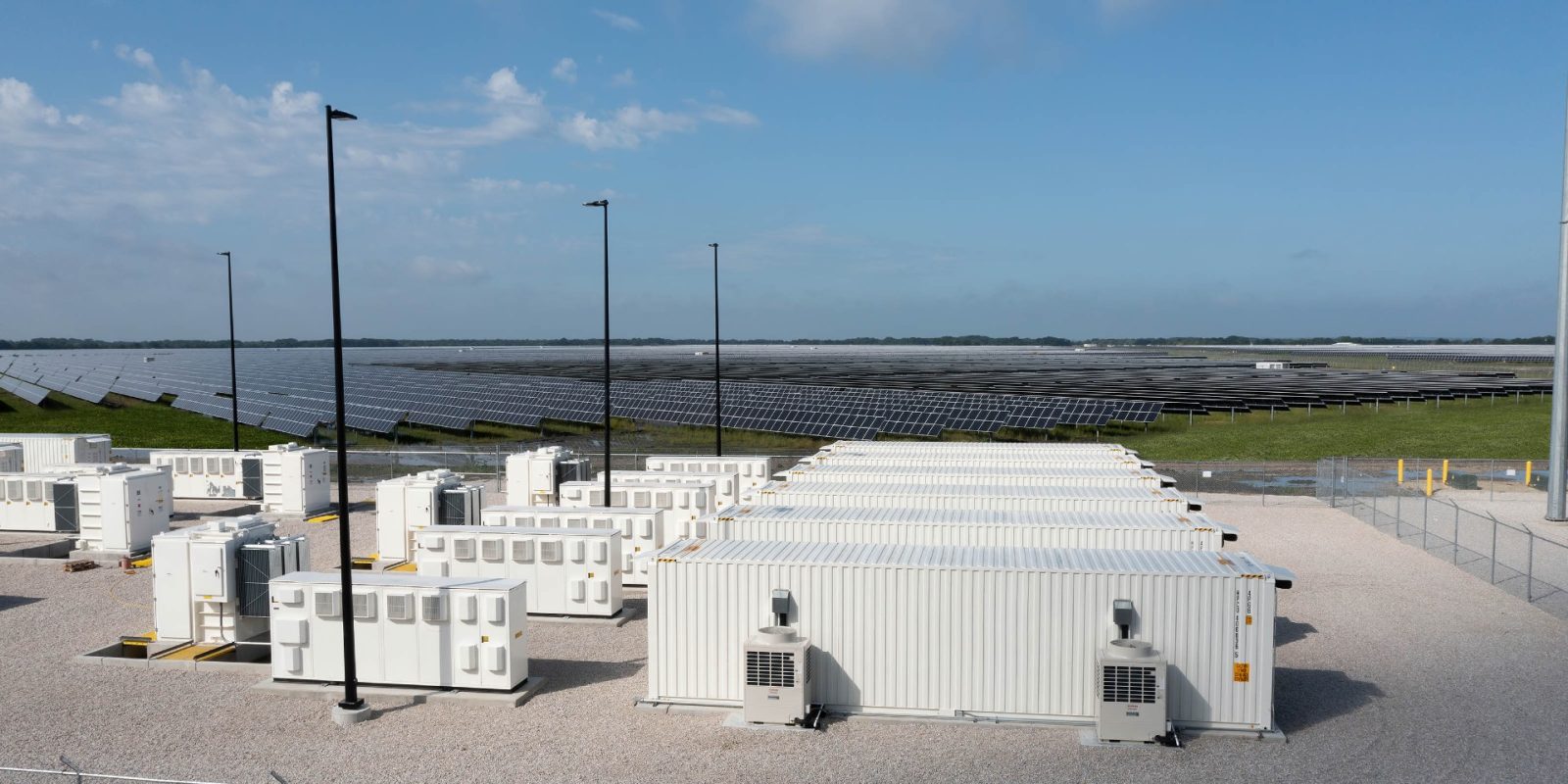
Turning cheap daytime solar into electricity you can actually use at night just got a lot cheaper. A new analysis from energy think tank Ember shows that utility-scale battery storage costs have fallen to $65 per megawatt-hour (MWh) as of October 2025 in markets outside China and the US. At that level, pairing solar with batteries to deliver power when it’s needed is now economically viable.
Battery storage costs have fallen dramatically over the past two years, and the decline continues. Following a steep decline in 2024, Ember’s analysis indicates that prices continued to fall sharply again in 2025.
The findings are based on real-world data from recent battery and solar-plus-storage auctions in Italy, Saudi Arabia, and India, as well as interviews with active developers across global markets.
According to Ember, the cost of a whole, grid-connected utility-scale battery storage system for long-duration projects (four hours or more) is now about $125 per kilowatt-hour (kWh) as of October 2025. That figure applies to projects outside China and the US. Core battery equipment delivered from China costs around $75/kWh, while installation and grid connection typically add another $50/kWh.
Those lower upfront costs have pushed down the levelized cost of storage (LCOS) to just $65/MWh. Ember’s calculation reflects real-world assumptions around financing costs, system lifetime, efficiency, and battery degradation.
Cheaper hardware isn’t the only reason storage costs are falling. Longer battery lifetimes, higher efficiencies, and lower financing costs, helped by clearer revenue models such as auctions, have all contributed to the sharp drop in LCOS. Ember has published a live calculator alongside the report, allowing users to estimate LCOS using their own assumptions.
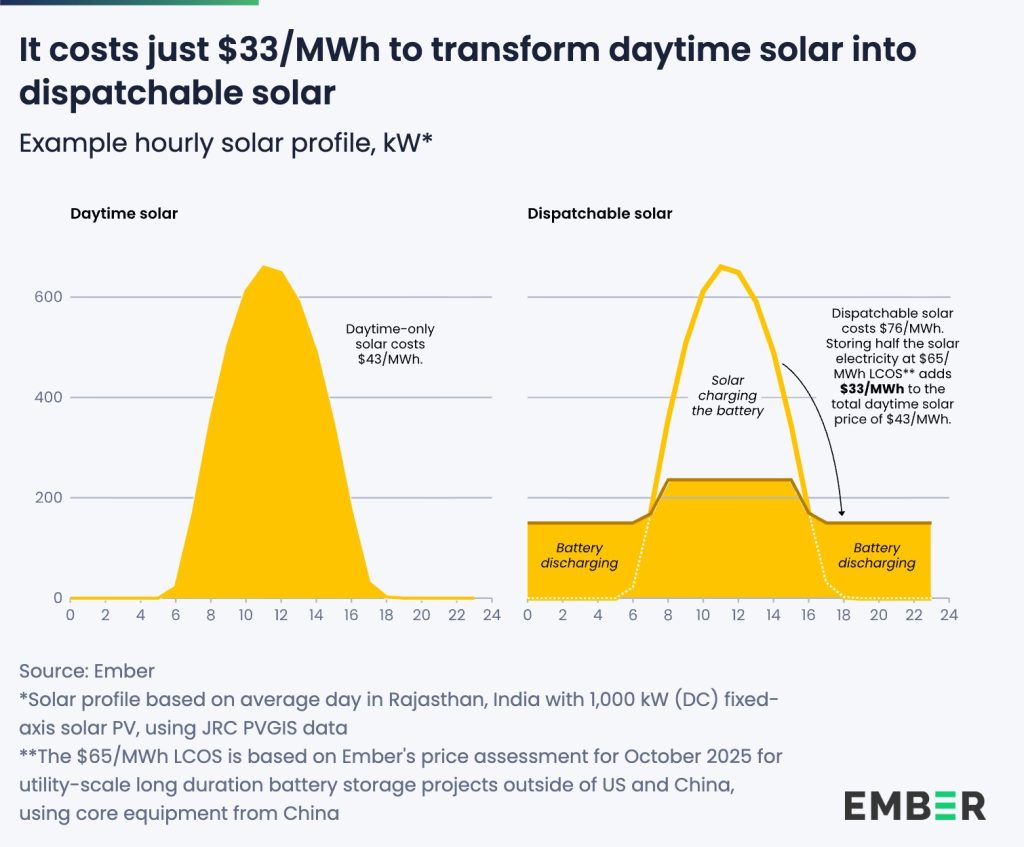
Why this matters comes down to how solar is actually used. Most solar power is generated during the day, so only a portion needs to be stored to make it dispatchable. Ember estimates that if half of daytime solar generation is shifted to nighttime, the $65/MWh storage cost adds about $33/MWh to the cost of solar electricity.
With the global average price of solar at $43/MWh in 2024, adding storage would bring the total cost to about $76/MWh, delivering power in a way that better matches real demand.
As Ember global electricity analyst Kostantsa Rangelova put it, after a 40% drop in battery equipment costs in 2024, the industry is now on track for another major fall in 2025. The economics of battery storage, she said, are “unrecognizable,” and the industry is still adjusting to this new reality.
“Solar is no longer just cheap daytime electricity; now it’s anytime dispatchable electricity. This is a game-changer for countries with fast-growing demand and strong solar resources,” Rangelova added.
Together, solar and battery storage are increasingly emerging as a scalable, secure, and affordable foundation for future power systems.
Read more: EIA: Solar + storage soar as fossil fuels stall through September 2025

If you’re looking to replace your old HVAC equipment, it’s always a good idea to get quotes from a few installers. To make sure you’re finding a trusted, reliable HVAC installer near you that offers competitive pricing on heat pumps, check out EnergySage. EnergySage is a free service that makes it easy for you to get a heat pump. They have pre-vetted heat pump installers competing for your business, ensuring you get high quality solutions. Plus, it’s free to use!
Your personalized heat pump quotes are easy to compare online and you’ll get access to unbiased Energy Advisors to help you every step of the way. Get started here. – *ad


FTC: We use income earning auto affiliate links. More.

In the Electrek Podcast, we discuss the most popular news in the world of sustainable transport and energy. In this week’s episode, we discuss a very telling Tesla Optimus fail, Rivian’s AI/Autonomy day, Mercedes GLB EV, and more.
The show is live every Friday at 4 p.m. ET on Electrek’s YouTube channel.
As a reminder, we’ll have an accompanying post, like this one, on the site with an embedded link to the live stream. Head to the YouTube channel to get your questions and comments in.
After the show ends at around 5 p.m. ET, the video will be archived on YouTube and the audio on all your favorite podcast apps:
We now have a Patreon if you want to help us avoid more ads and invest more in our content. We have some awesome gifts for our Patreons and more coming.
Here are a few of the articles that we will discuss during the podcast:
Here’s the live stream for today’s episode starting at 4:00 p.m. ET (or the video after 5 p.m. ET:
FTC: We use income earning auto affiliate links. More.

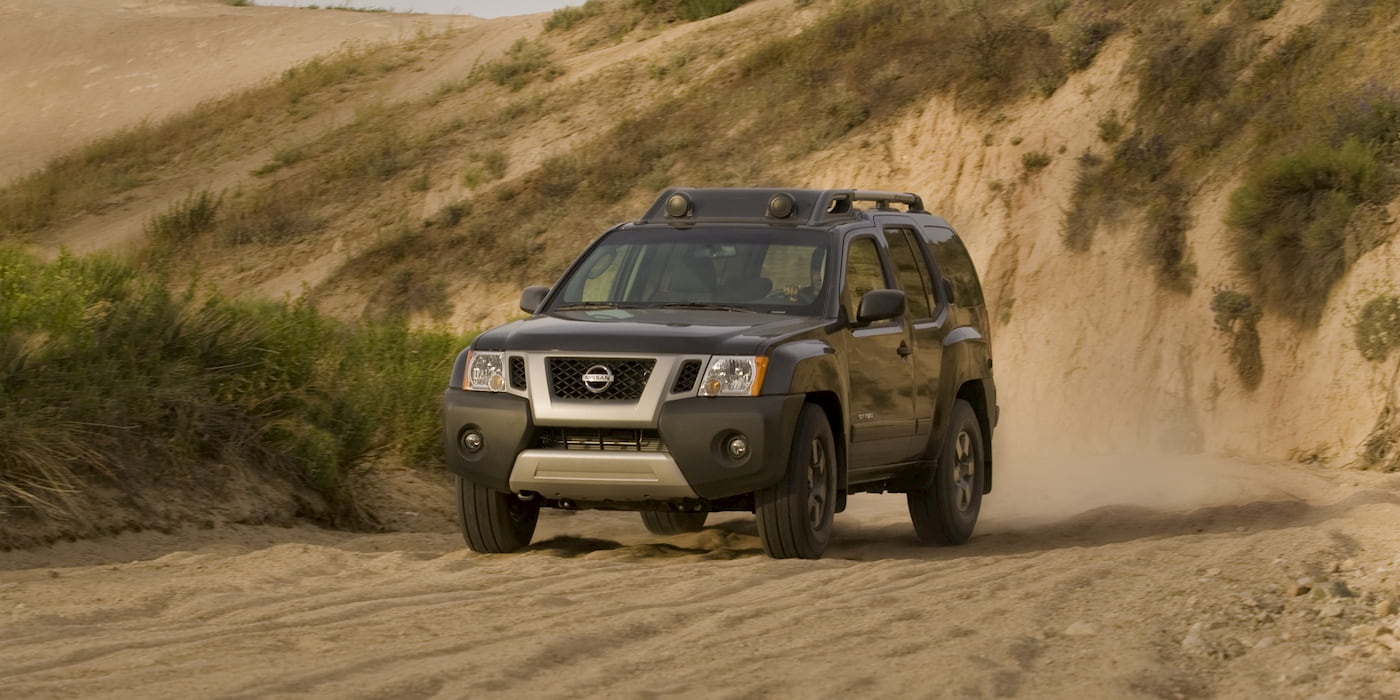
Nissan is reviving the Xterra, the rugged SUV that once attracted a cult-like following, but this time it will be “electrified.”
The Nissan Xterra will be electrified, but by how much?
Earlier this year, Nissan offered a sneak peek of its upcoming lineup in a shadowy image previewing several new vehicles.
Alongside the new 2026 LEAF, a plug-in hybrid Rogue, updated Pathfinder, and Sentra, Nissan teased a new electric “adventure-focused SUV,” which we later learned will be badged the Xterra.
The rugged electric SUV appeared to have a more upright, boxy stance than the original model. The previous Xterra attracted a cult-like following as a cheaper off-road alternative to the Toyota 4Runner, Ford Bronco, and Jeep Wrangler.
However, Nissan discontinued it after the 2015 model year as buyers opted for more efficient options like the Honda CR-V and Toyota RAV4.
The new Xterra, but this time “it will have to have electrification,” according to Nissan Americas chief planning officer, Ponz Pandikuthira.

Pandikuthira told MotorTrend that the next-gen Xterra “cannot be ICE only,” but just how electrified it will be remains up in the air. “Is that an EREV? Is that a parallel hybrid system? Is that a plug-in system? That’s not defined yet. That’s all being actively studied right now,” he explained.
Nissan plans to launch a series of new extended-range hybrid (EREV) vehicles based on its e-Power system. The e-Power system uses a gas-powered engine connected to a generator.
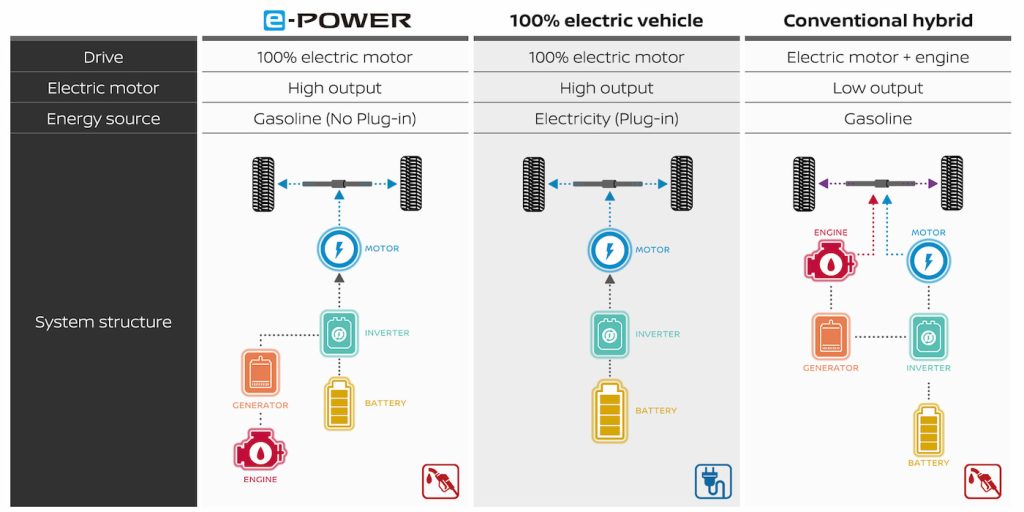
The generator feeds energy to the inverter, which charges the battery and electric motor. Since the ICE only charges the battery and does not drive the wheels, it benefits from the instant torque and smooth drive of an EV.
However, it’s still powered by a gas engine at the end of the day. The 2027 Nissan Rogue will be the first e-Power vehicle in the US.
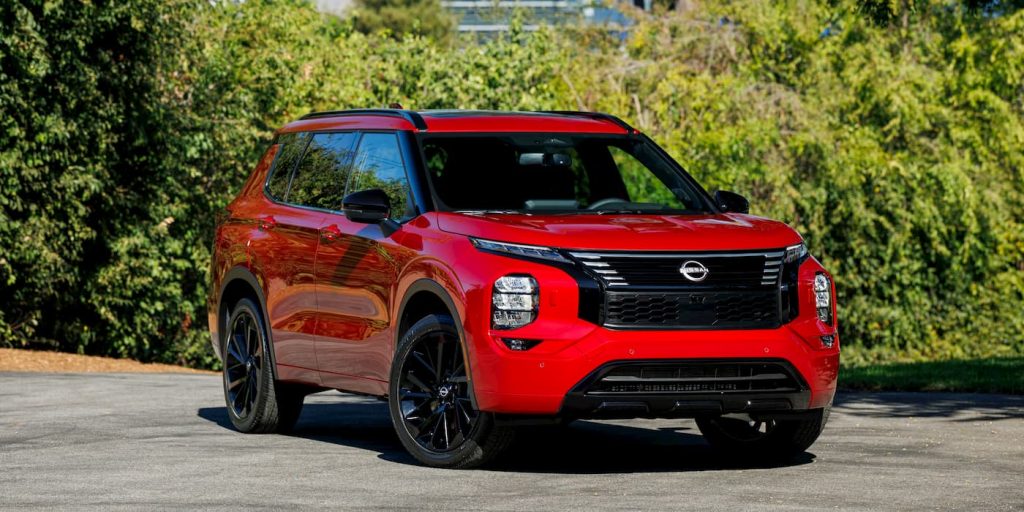
The Xterra could also arrive as a plug-in hybrid (PHEV) similar to the 2026 Nissan Rogue. The 2026 Rogue will be Nissan’s first PHEV for the US and is expected to be a key part of its comeback plans.
It will go on sale in early 2026 with an EPA-estimated 36 miles of electric driving range. Combined with the gas engine, the hybrid powertrain provides up to 420 miles of EPA-estimated driving range.
The electrified Xterra will share a body-on-frame platform with the Pathfinder and Frontier, with a V-6 engine, all-wheel drive (AWD), and space for bigger batteries.

According to Pandikuthira, the V-6 will give it an edge over the competition, while the hybrid powertrain will improve efficiency.
The “electrified” Xterra will be built at Nissan’s Canton, Mississippi, plant, starting in 2028. The following year, a luxury Infiniti electric SUV, based on the Vision QXe concept, will join it.
Electrek’s Take
While Nissan is launching new PHEVs, hybrids, and EREVs, it has already pulled one electric SUV, the Ariya, from its US lineup.
For now, the only fully electric vehicle Nissan offers in the US is the 2026 LEAF. Although it was once viewed as a leader in the shift to EVs with the initial LEAF launching in 2010, Nissan has quickly fallen behind and is now scrambling to catch up.
Nissan hopes to plug the gap with a series of gas-power hybrids over the next few years until new all-electric vehicles begin rolling out in 2028.
Even with less efficient hybrid tech, Nissan is still late to the game and will need to keep pace with Toyota, Honda, Ford, Stellantis, and others betting on hybrids in the US.
FTC: We use income earning auto affiliate links. More.
-
 Sports2 years ago
Story injured on diving stop, exits Red Sox game
-
 Sports3 years ago
‘Storybook stuff’: Inside the night Bryce Harper sent the Phillies to the World Series
-
 Sports2 years ago
Game 1 of WS least-watched in recorded history
-
 Sports3 years ago
Button battles heat exhaustion in NASCAR debut
-
 Sports3 years ago
MLB Rank 2023: Ranking baseball’s top 100 players
-
Sports4 years ago
Team Europe easily wins 4th straight Laver Cup
-
 Environment3 years ago
Japan and South Korea have a lot at stake in a free and open South China Sea
-
 Environment1 year ago
Here are the best electric bikes you can buy at every price level in October 2024