
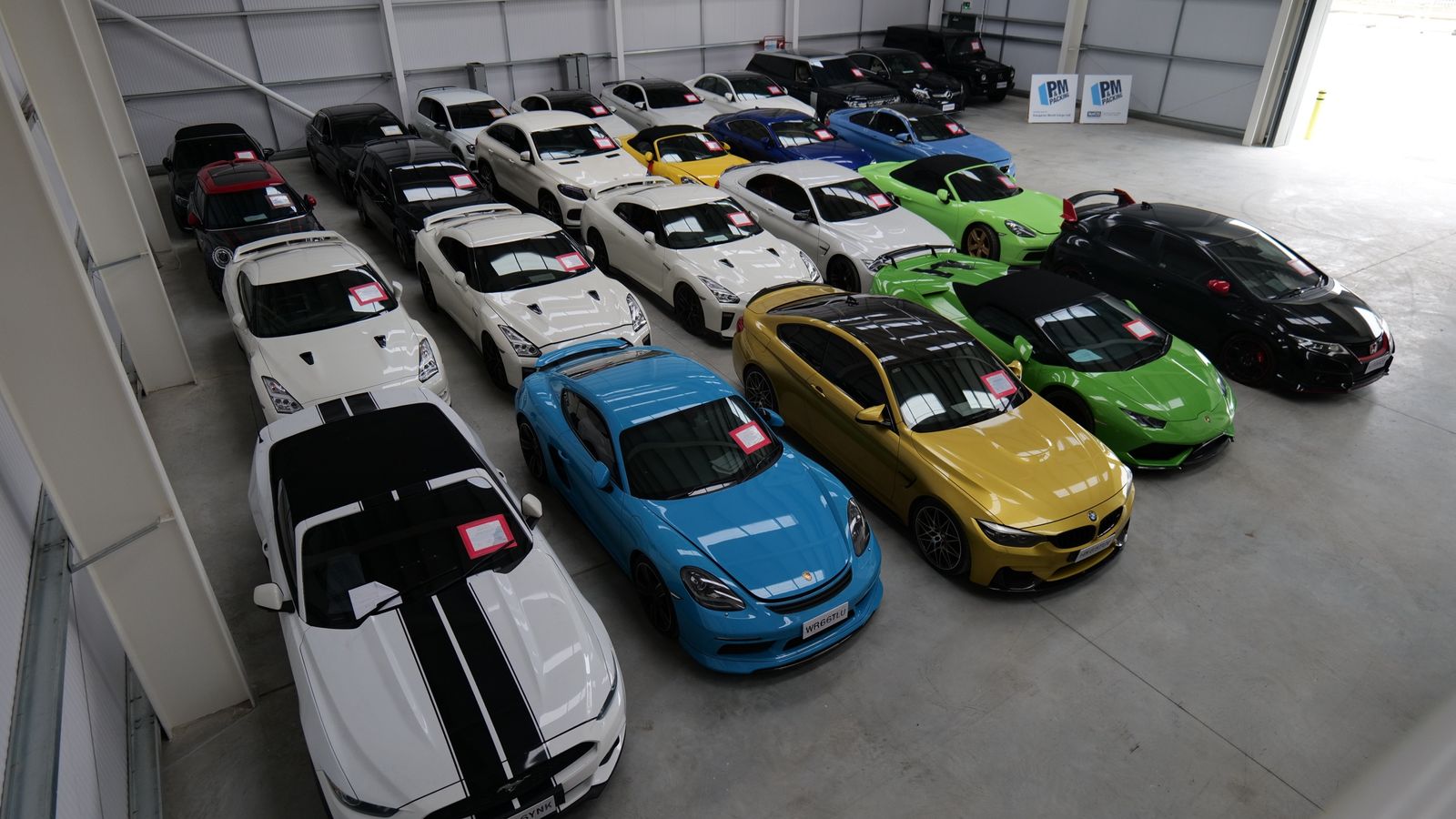
Dozens of stolen supercars smuggled abroad are returned to UK

Thirty supercars stolen and illegally exported to Thailand have been returned to the UK after an eight-year investigation.
A total of 35 high-end vehicles – including Range Rovers, Porsches, Mercedes, BMWs, and Lamborghinis – were taken, with a combined value of £6.5m, according to the National Vehicle Crime Intelligence Service (NaCVIS).
They were obtained fraudulently on finance contracts from car dealerships across England in 2016 and 2017 before being shipped to Thailand, the agency said.
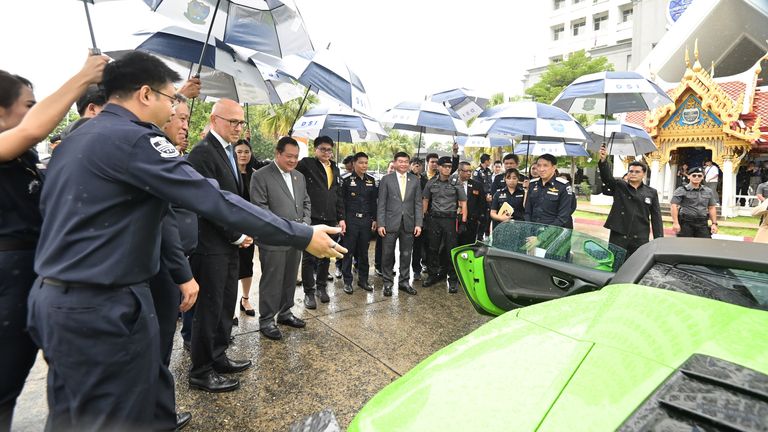
After an eight-year investigation led by NaCVIS, with the help of the Met Police, National Crime Agency, and the British and Thai embassies, multiple arrest warrants were executed and 30 of the cars were tracked down and seized in Bangkok.
Thai authorities in Bangkok with one of the stolen cars. Pic: National Vehicle Crime Intelligence Service
Read more from Sky News
British man among dead in Spanish floods
Looting after LA Dodgers win
Passengers removed over MAGA hat
The vehicles have now arrived back in the UK through the Port of Southampton and are being stored in a warehouse nearby before being returned to their original dealerships.
Sharon Naughton, head of NaCVIS, said the organisation “will not rest until every avenue of investigation has been exhausted”.
“There is no time limit on our efforts to disrupt criminality and return proceeds obtained through illegal means,” she added.
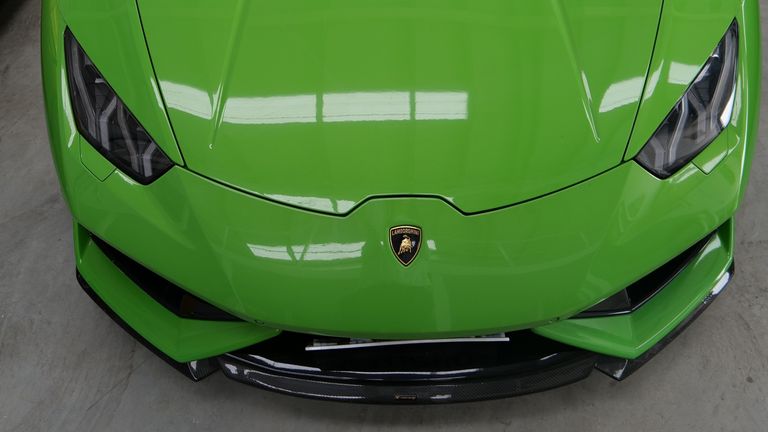
A green Lamborghini recovered from Thailand. Pic: National Vehicle Crime Intelligence Service
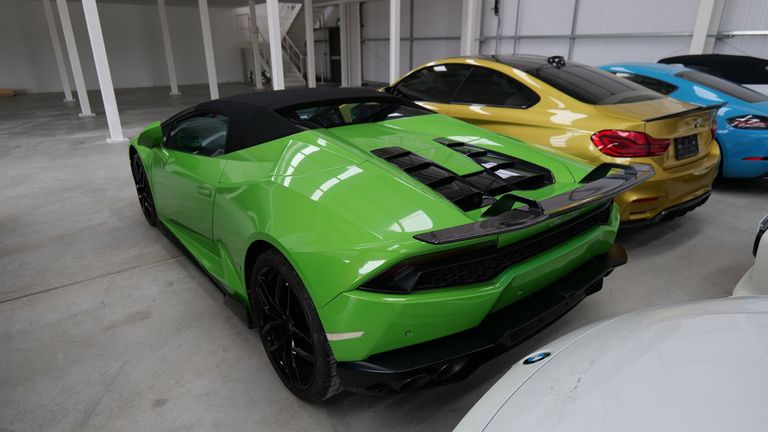
Pic: National Vehicle Crime Intelligence Service
Jenny Simms, the National Police Chiefs’ Council lead for vehicle crime, said the offences have a “huge impact” on victims.
“The tireless work involved in this investigation reflects how seriously we take our role in tackling it,” she added.
Thirteen people have now been charged as a result of the investigation, the National Crime Agency said.
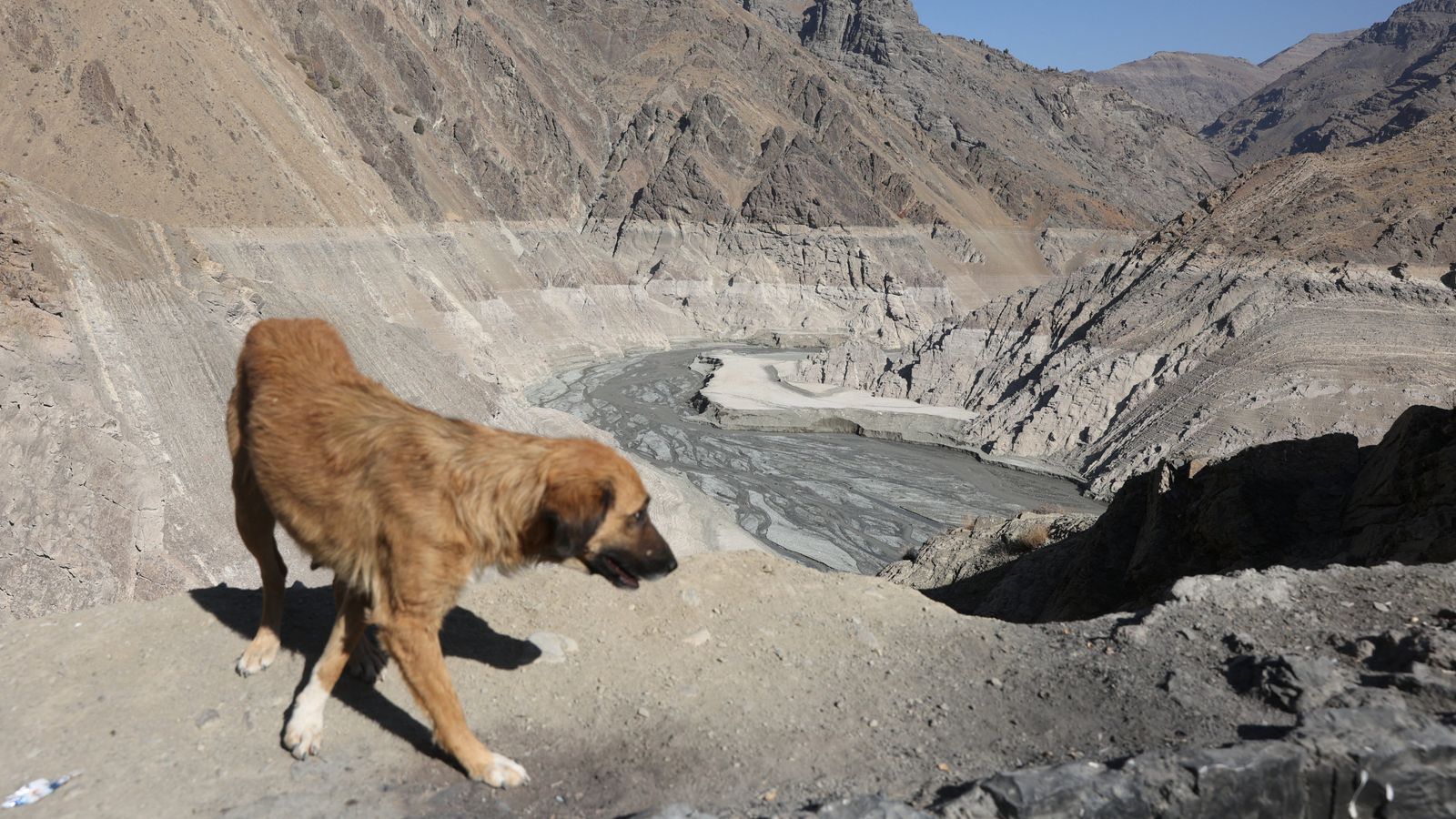
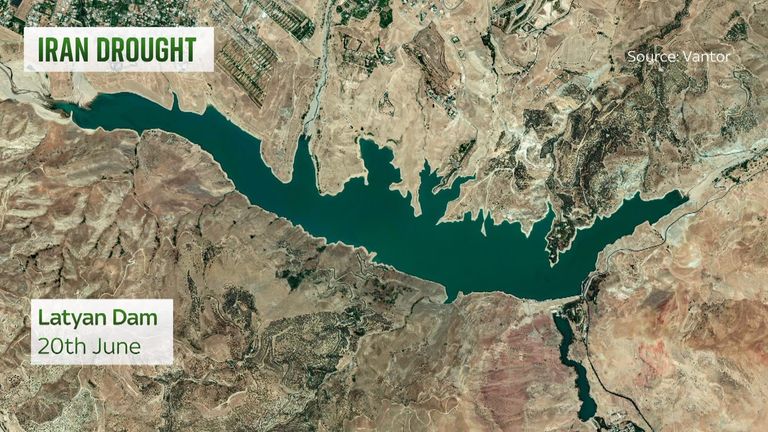
Iran’s capital is counting down to “day zero” – the day the water runs out and the taps run dry.
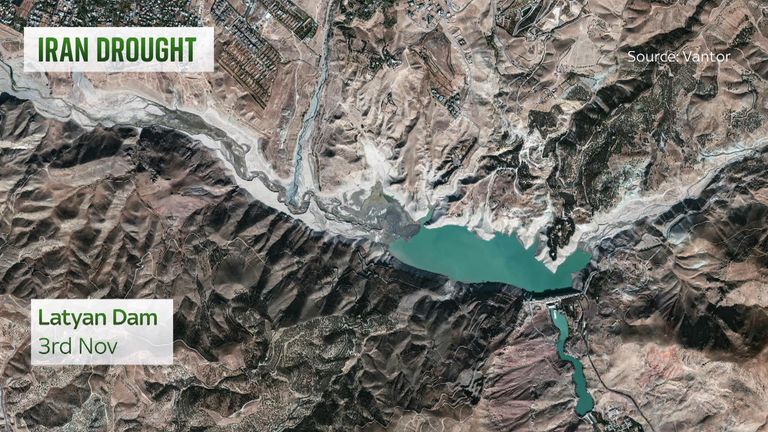
Reservoirs that supply Tehran’s 15 million residents are almost empty.
The Karaj dam, which supplies a quarter of the city’s drinking water, is just 8% full.
Water rationing has begun in some areas, with the flow from taps reduced or even stopped altogether overnight.
President Masoud Pezeshkian has urged people to use water sparingly – or the city, or at least parts of it, may even have to evacuate.
So what’s going on?
Rain should start falling in the autumn after Iran’s hot dry summer.
But according to the country’s National Weather Forecasting Centre, this has been the driest September to November period in half a century, with rainfall 89% below the long-term average.
The combination of low rainfall and high heat has lasted for more than five years, leaving the country parched.
But the weather – and the shadow of climate change – aren’t the only factors in Tehran’s water crisis.
According to the Centre for Strategic and International Studies, the population of the city has almost doubled from 4.9 million in 1979 to 9.7 million today.
But water consumption has risen even faster, quadrupling from 346 million cubic metres in 1976 to 1.2 billion cubic metres now. Increasing wealth has allowed more people to buy washing machines and dishwashers.
To supplement supplies from reservoirs, Tehran has had to turn to natural aquifers underground, which provide between 30% and 60% of its tap water in recent years.
But that puts the city in direct competition with farmers who draw on the water to irrigate crops.
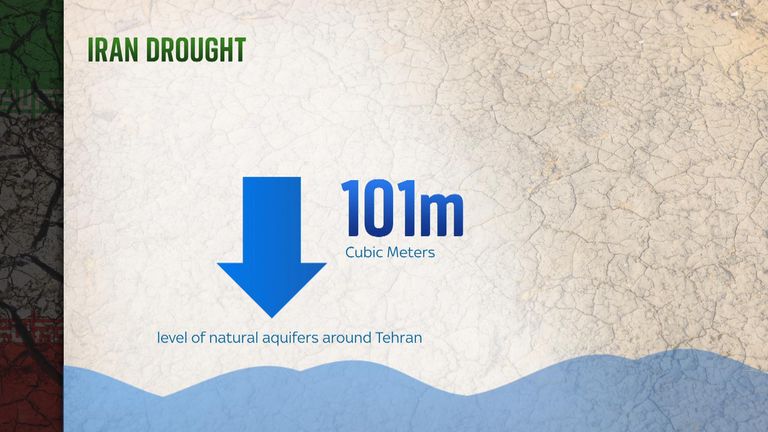
Levels are falling by 101 million cubic metres a year around Tehran, according to analysis in the journal Science Advances. That’s water that has accumulated from many decades of rain – and will take at least as long to replenish.
Read more from Sky News:
Could a volcanic eruption have spread the Black Death?
The words you have mispronounced all year – and how to say them
Professor Kaveh Madani, the former deputy head of Iran’s environment department and now director of the United Nations University Institute for Water, Environment and Health, said chronic mismanagement of natural resources has led to what he calls water bankruptcy.
He told Sky News: “These things were not created overnight.
“They’re the product of decades of bad management, lack of foresight, overreliance and false confidence in how much infrastructure and engineering projects can do in a country that is relatively water short.”
Government ministers blame the water shortage on climate change, water leaks from pipes and the 12-day war with Israel.
Whatever the reason, it underlines the threat of water scarcity to global cities. Tehran is not alone.
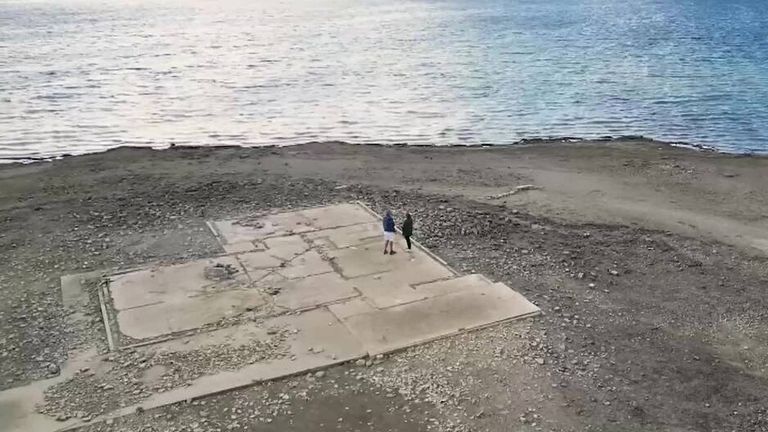
Water crisis: Will Britain’s taps run dry?
Cape Town in South Africa narrowly avoided taps running dry eight years ago after a city-wide effort to save water.
Even London, known for its rain, is at risk. Supplies haven’t kept up with population growth and booming demand.
As Tehran has found, droughts that are being made more likely and more severe with climate change can expose the fragility of water supply.
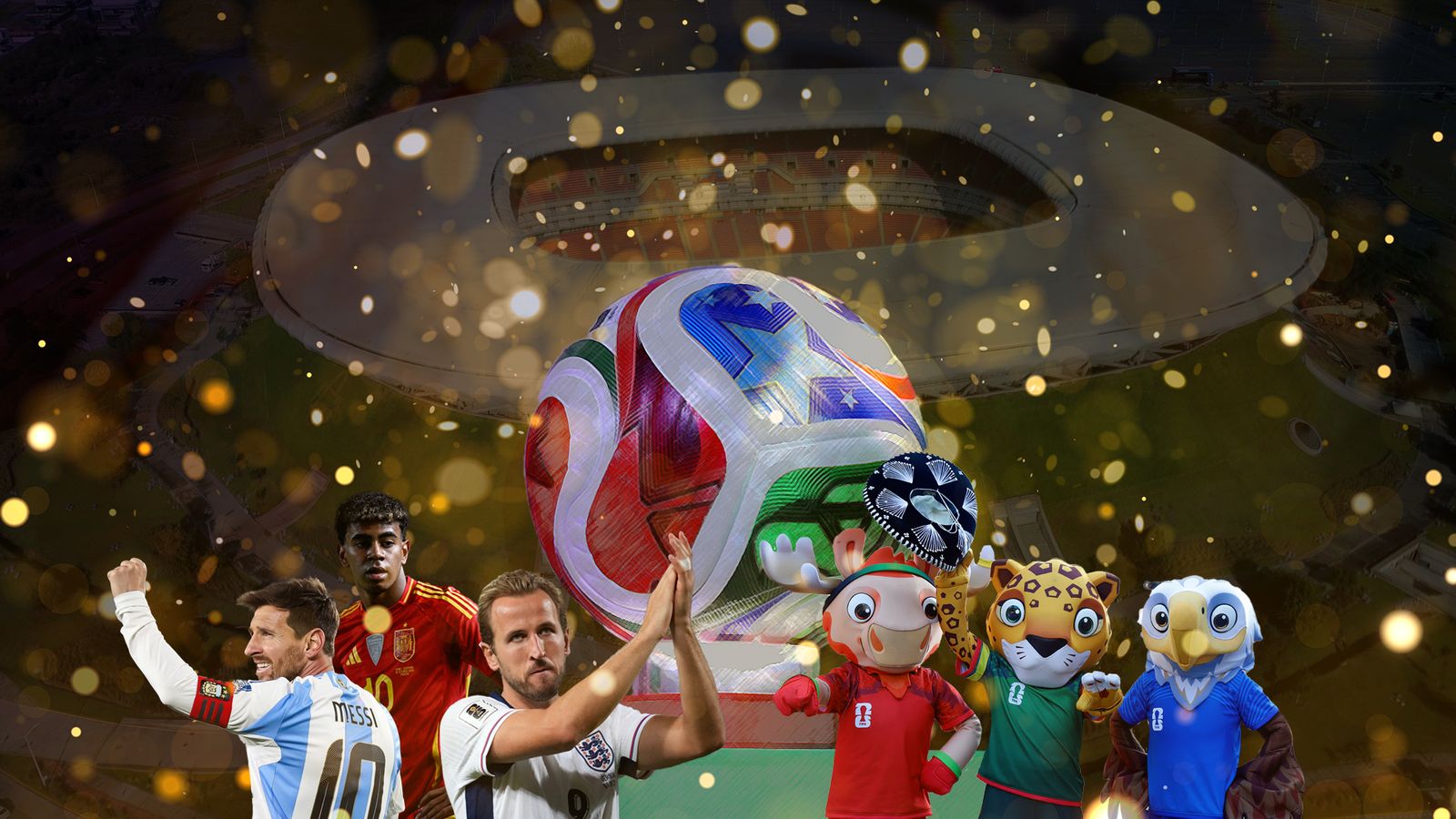
England and other qualified teams are finally set to find out who they’ll be facing in the group stages of the 2026 FIFA men’s World Cup today.
It’s guaranteed to be the biggest World Cup ever, with 48 teams competing instead of the usual 32.
Here’s everything you need to know.
When is the World Cup draw?
The draw, which determines which teams face which in the group stages, will take place on in Washington DC from 12pm local time, or 5pm UK time tonight.
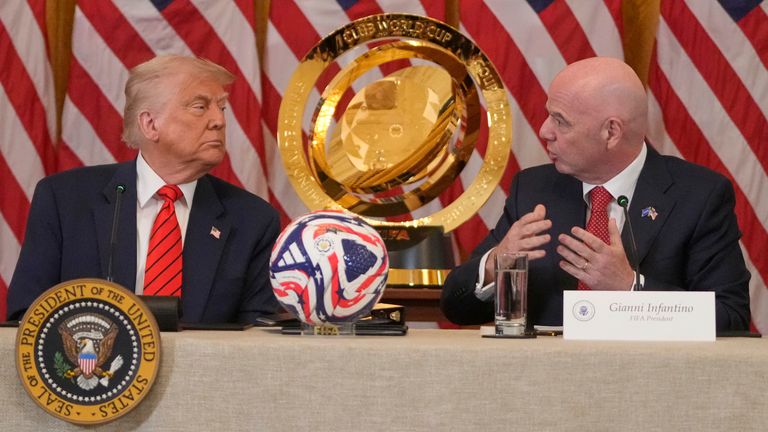
US President Donald Trump will join FIFA’s Gianni Infantino at the John F Kennedy Center – a performing arts venue where Mr Trump is chairman – to decide the fixtures.
Donald Trump and FIFA president Gianni Infantino. Pic: AP
Due to the increased number of countries taking part in the tournament, the format of the group stages has changed slightly. Instead of 32 teams being divided into eight groups, this year will see 12 groups of four.
The top two teams in each group, plus the eight best third-placed teams, will advance to a round of 32.
For the draw, Spain, Argentina, France and England – the four highest ranked teams – will be placed in the same pot for the draw, and are guaranteed not to meet each other until the semi-finals.
The three host nations are also guaranteed not to meet early, having been put in Pot 1 with the top teams.
The draw seedings are as follows:
Pot 1: Spain, Argentina, France, England, Brazil, Portugal, Netherlands, Belgium, Germany, United States, Mexico, Canada.
Pot 2: Croatia, Morocco, Colombia, Uruguay, Switzerland, Japan, Senegal, Iran, South Korea, Ecuador, Austria, Australia.
Pot 3: Norway, Panama, Egypt, Algeria, Scotland, Paraguay, Tunisia, Ivory Coast, Uzbekistan, Qatar, Saudi Arabia, South Africa.
Pot 4: Jordan, Cape Verde, Ghana, Curacao, Haiti, New Zealand, European playoff winner 1, European playoff winner 2, European playoff winner 3, European playoff winner 4, Intercontinental playoff winner 1, Intercontinental playoff winner 2.
You’ll be able to watch the ceremony via FIFA’s website or YouTube channel, while the BBC and BBC iPlayer will also be showing the draw.
Sky Sports will be offering live coverage of the draw, including analysis and reaction as the groups and fixtures are revealed.
FIFA says the draw is scheduled to take about 45 minutes during a show lasting about an hour and a half.
On 6 December at 5pm UK time, FIFA will put out another broadcast in which it will reveal all match venues and kick-off times.
Could Trump be getting a prize?
In November, FIFA revealed it had created a new worldwide peace prize, and that it would hand it out for the first time during the draw ceremony.
It said it would be given to “individuals who have taken exceptional and extraordinary actions for peace” – with no indication that potential recipients were limited to the world of sports.
It has prompted speculation the award will go to Donald Trump, who has long campaigned for a Nobel Peace Prize.
Mr Infantino, who has built up a strong relationship with the US president, backed him for the Nobel prize, writing on Instagram in October that Mr Trump “definitely deserves” the award for his efforts toward a peace deal in Gaza.
The award ultimately went to Venezuela’s opposition leader Maria Corina Machado.
When asked later if Mr Trump would get FIFA’s award, Mr Infantino laughed and said: “On the 5th of December, you will see.”
When and where is the World Cup?
The tournament runs from 11 June to 19 July 2026 and will be played at 11 sites in America, three in Mexico and two in Canada.
A total of 48 countries will be involved – up from 32 in 2022 – and 104 games will be played overall – up from 64.
The host nations automatically qualify and will play all three of their group stage matches on home soil.
The final will take place at the New York New Jersey (MetLife) Stadium – home of the New York Giants and New York Jets.
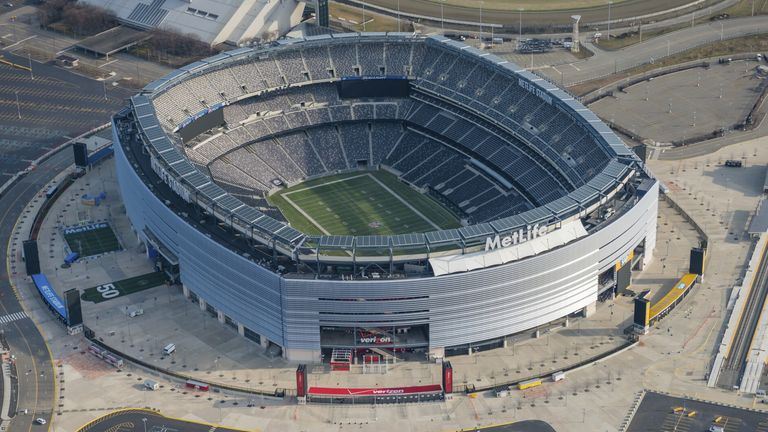
Aerial view of Metlife Stadium, where the final will be played. Pic: AP
All stadiums where games will be played include:
America:
• Atlanta Stadium
• Boston Stadium
• Dallas Stadium
• Houston Stadium
• Kansas City Stadium
• Los Angeles Stadium
• Miami Stadium
• New York New Jersey Stadium
• Philadelphia Stadium
• San Francisco Bay Area Stadium
• Seattle Stadium
Mexico:
• Estadio Azteca Mexico City
• Estadio Guadalajara
• Estadio Monterrey
Canada:
• Toronto Stadium
• BC Place Vancouver Stadium
Trump threatening to change host cities
Despite the stadiums already being selected, Donald Trump has threatened to remove Democrat-run city of Los Angeles from hosting, along with the Boston area.
Boston itself is not a host area, but the home of the NFL’s New England Patriots is being used by FIFA for seven matches, 30 miles away in Foxborough, Massachusetts.
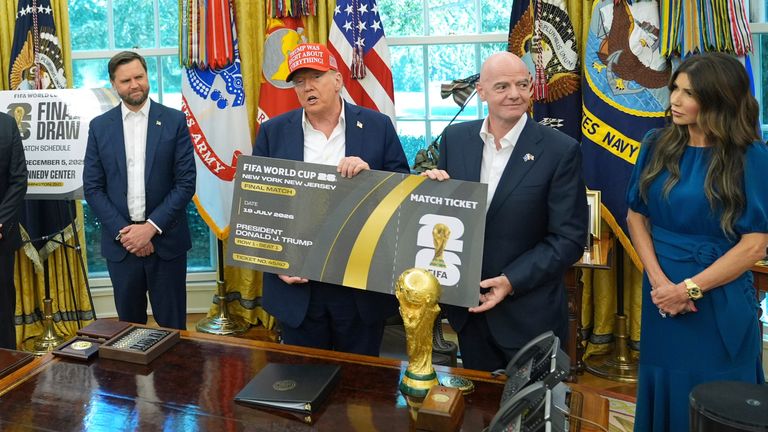
Could Trump move World Cup matches?
“If we think there’s going to be a sign of any trouble, I would ask Gianni [Infantino] to move that to a different city,” Mr Trump said in November, as protests against his government have taken place in both cities.
FIFA has told Sky News the US government does have the right to determine if cities are safe for the World Cup.
In a statement, FIFA said: “Safety and security are the top priorities at all FIFA events worldwide.
“Safety and security are obviously the governments’ responsibility, and they decide what is in the best interest for public safety.
“We hope every one of our 16 host cities will be ready to successfully host and fulfil all necessary requirements.”
Scott LeTellier, who was managing director of the 1994 World Cup in America, suggested the cities in question shouldn’t worry about Mr Trump’s threats, as changing the stadiums would require “some kind of national emergency that would give the government the authority to cancel an event”.
“I don’t see even a remote chance of that happening,” he said.
What teams could still qualify?
Out of an available 48 spots, 42 teams have already qualified.
The line-up automatically includes the three host nations, America, Mexico and Canada. While 16 of the spots are reserved for European teams – made up of the 12 UEFA qualifying group winners and the other four coming via play-offs.
Remaining qualifying spots are divided between the other confederations:
• CONMEBOL (South America) gets a minimum of six
• CONCACAF (North/Central America and Caribbean) gets a minimum of six
• AFC (Asia) gets eight
• CAF (Africa) gets nine
• OFC (Oceania) is guaranteed one spot.
For the first time since 1998, Scotland have bagged themselves a place through qualifying while Jordan, Curacao, Cape Verde and Uzbekistan will all make their World Cup debuts.
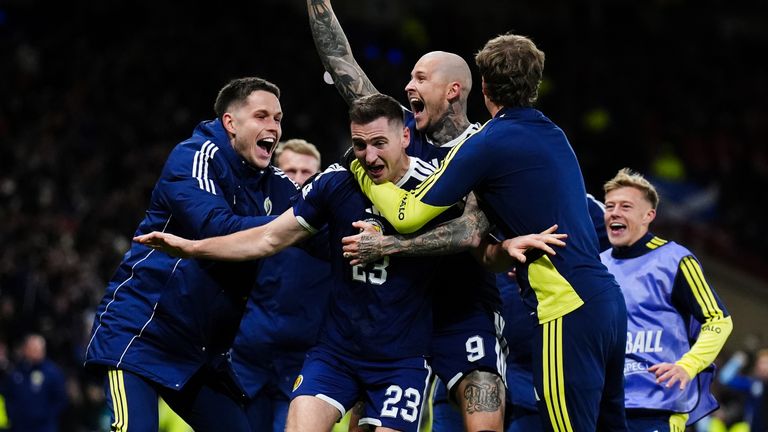
Scotland qualify for World Cup
The final slots at the tournament will be decided through play-offs.
On one side, a new inter-confederation tournament will see two teams from CONCACAF and one team each from CONMEBOL, AFC, CAF and OFC to battle it out for two spots in the World Cup.
The six teams that have qualified for these play-offs are: Bolivia, Congo DR, Iraq, Jamaica, New Caledonia and Suriname.
European, or UEFA, play-offs work slightly differently, with 16 teams battling it out for four available spaces.
This tournament is made up of the 12 runners-up from the European Qualifiers groups and the four best-ranked group winners of the 2024/25 UEFA Nations League that did not finish their group stage in first or second place.
On 20 November, a draw to determine who is set to play who in the eight semi-final matches on 26 March 2026 was made by FIFA. The winners will advance to the four final-stage matches on 31 March.
Should Wales and Northern Ireland both win their first-round games, they will then face each other, putting two home nations up against one another.
Will there be a half-time show?
Following in the footsteps of the NFL’s Superbowl, FIFA has confirmed that a half-time show will be performed during the World Cup final on 19 July.
Despite other finals having had musical acts before, this will be the first half-time show.
Earlier this year, FIFA’s Mr Infantino said British band Coldplay is behind the decision-making on multiple artists who will perform – none have been confirmed so far.
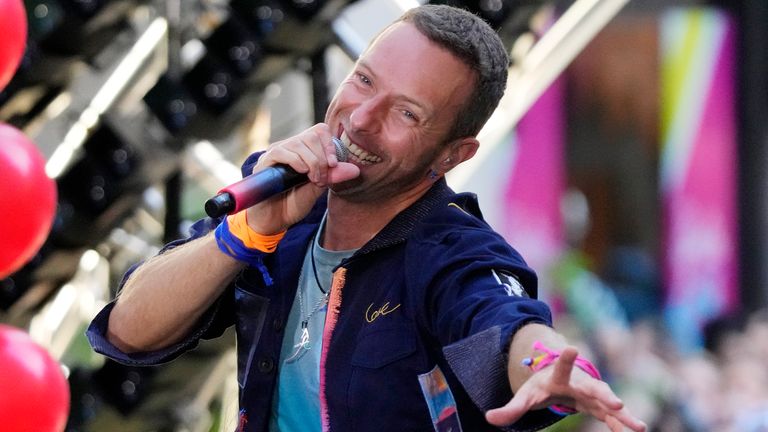
Coldplay’s Chris Martin will help decide who will perform at the World Cup half-time show. Pic: Charles Sykes/Invision/AP
Meet the mascots – and the ball
As there are three host nations, this year’s World Cup also comes with three mascots.
Maple the moose, Zayu the jaguar and Clutch the bald eagle will represent host countries Canada, Mexico and America respectively.
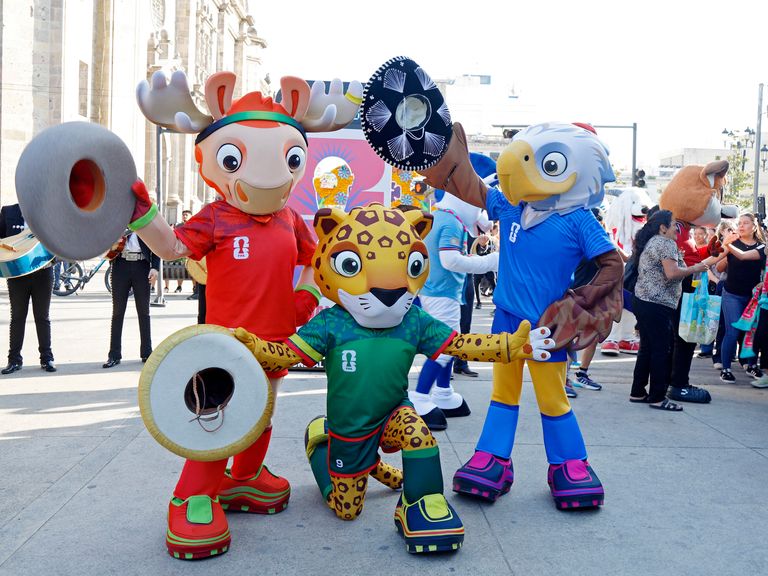
Pic: Reuters
Also reflecting the three co-hosts is the official World Cup match ball – Trionda – which means three waves in Spanish.
The ball features a swirled pattern incorporating red, green and blue, with each section representing a host nation.
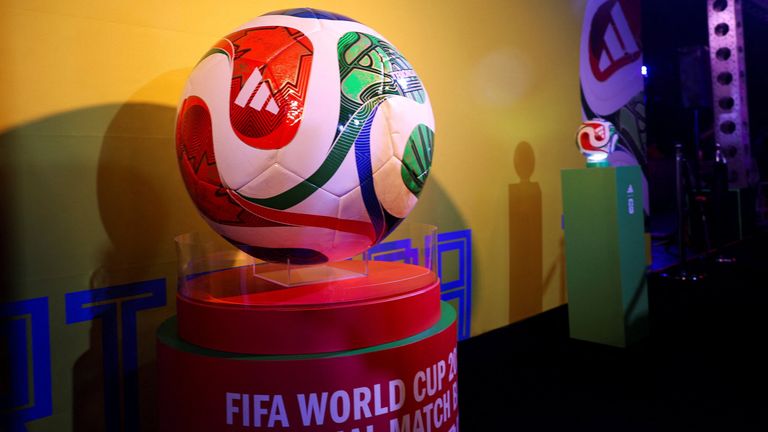
The official ball of the 2026 FIFA World Cup named Trionda. Pic: Reuters
How much are tickets?
FIFA says the cheapest tickets are from $60 (£45) in the group stage. But the most expensive tickets for the final are $6,730 (£5,094).
Initially, FIFA suggested tickets would be sold using dynamic pricing, meaning fans would pay different prices according to demand.
Variable pricing – fluctuating based on demand – had never been used at a World Cup before, raising concerns about affordability.
FIFA has now backed away from it, saying allocations would be set at a fixed price for the duration of the next ticket sales phase.
How you can get tickets
Tickets for the World Cup have been released in three phases, each with slightly different rules on who can buy the tickets and how.
Phase one was a Visa Presale Draw for people with a valid, unexpired Visa debit card, credit card, or reloadable prepaid card enabled with 3D Secure. This phase has now closed.
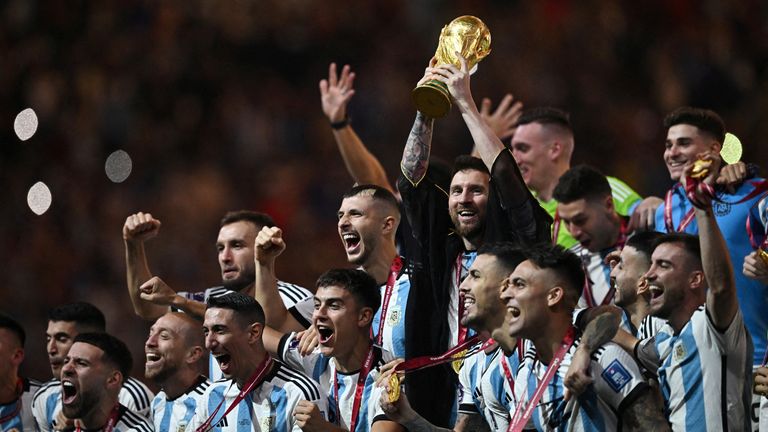
Argentina are reigning World Cup champions. Pic: Reuters
Phase two ran from 27 to 31 October, and saw registered individuals allocated time slots to purchase tickets from 12 November to early December.
Read more: Everything you need to know about buying tickets
The third phase, called a random selection draw, will start after the final draw determines the World Cup schedule.
It starts on 11 December, with the entry period for fans open until 13 January.
Those wanting tickets will need to have a FIFA ID in advance, which can be made via FIFA.com/tickets.
It’s from this same site that entries to the random selection draw will begin on 11 December, at 4pm UK time.
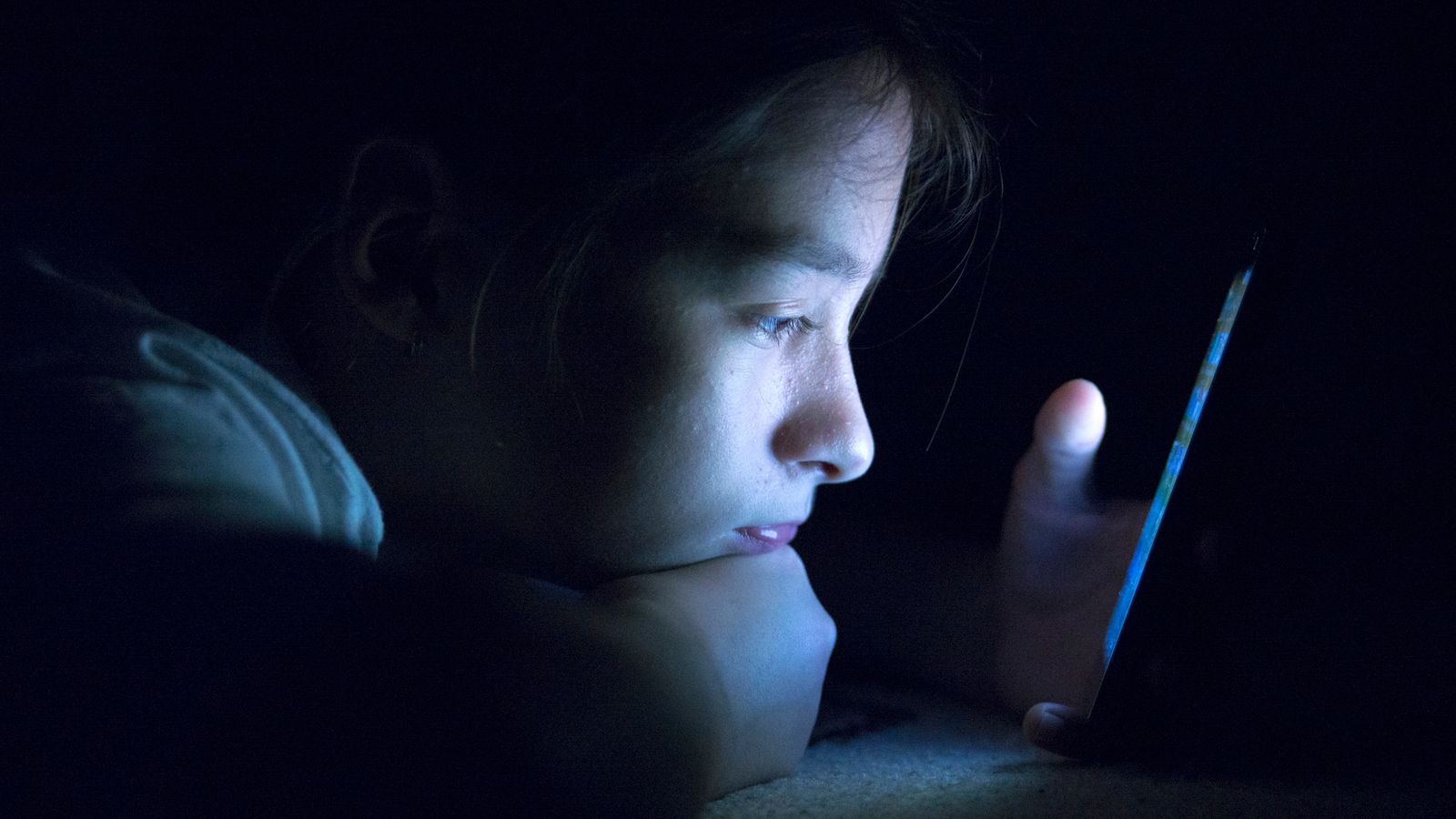
Australia will introduce one of the world’s toughest social media policies for children next week, with a ban that comes into effect on Wednesday.
Technology giant Meta has already started locking children under the age of 16 out of Instagram and Facebook, as it runs age checks on its users.
Other platforms have started contacting underage users – advising them to download their photos and contacts, and offering the choice of deleting their accounts or freezing them until they turn 16.
The age-restricted ban also includes TikTok, Snapchat, YouTube, Reddit, Twitch, Kick, Threads and X.
Skateboarders post photos and videos of their latest tricks
Impact on influencers
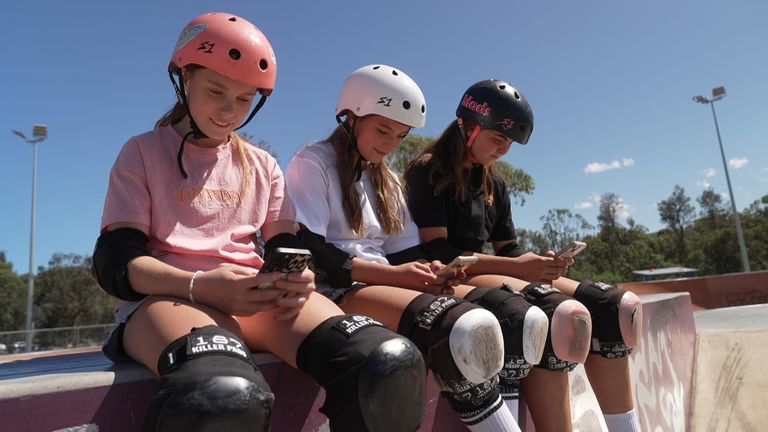
In the town of Umina on the New South Wales central coast, 14-year-old skateboarders Vespa Eding and Indy Conwell post photos and videos of their latest tricks in the skate bowl. Their accounts are managed by their mums.
The girls also coach young skaters and have corporate sponsors.
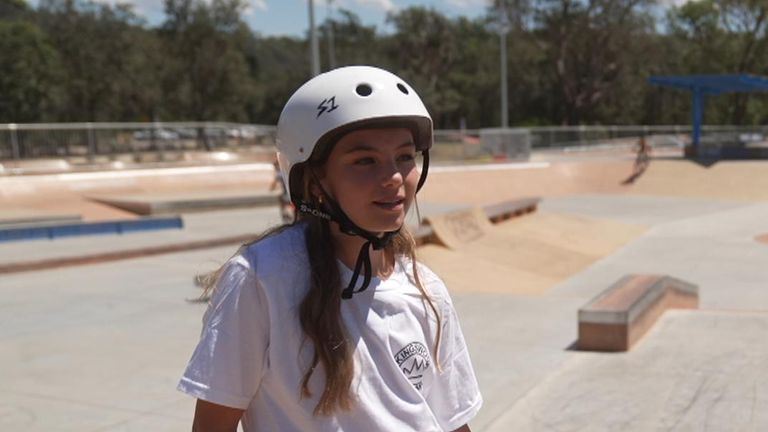
Indy Conwell
“I see both sides to it,” Indy explains. “It’s sad because I’m probably going to lose my account that I use to contact my sponsors and do my business.”
“But I think it’s a good idea [to ban it] for people getting bullied or if they’re getting addicted to it.”
Read more:
Teens launch legal challenge over ban on social media for children
How will ban work and could the UK bring in a similar law?
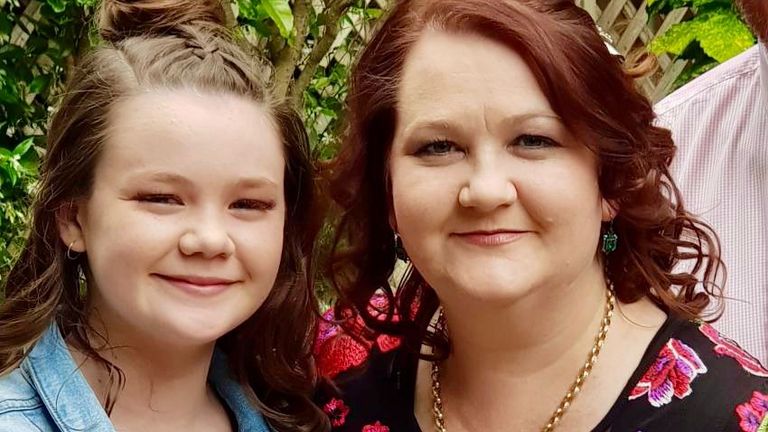
Emma Mason and her daughter Tilly
Mental health crises
Lawyer and mother Emma Mason knows how damaging social media can be.
Her daughter Matilda Rosewarne, who was called “Tilly”, suffered from years of online abuse as a teenager in the regional city of Bathurst.
Tilly took her own life on 16 February 2022. She was 15 years old.
“When Tilly was about 14, a fake nude was sent around by a friend of hers at school in Bathurst,” Ms Mason said.
“It spread to about 300 children, then it went to about 1,000 kids and by 6pm she had attempted suicide.”
Ms Mason has campaigned for Australia’s social media ban since she lost her daughter, and spoke at an event on the sidelines of the UN General Assembly in New York this year.
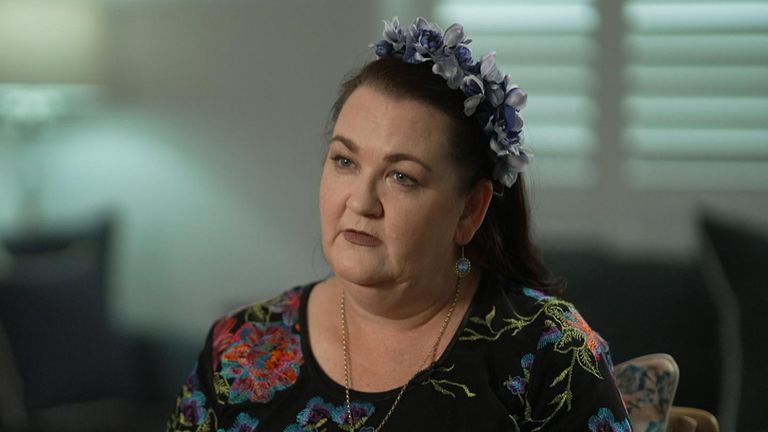
Emma Mason
Psychologist Danielle Einstein, co-author of the book Raising Anxiety, says there is clearly a link between anxiety, uncertainty and social media.
“Now is the time to get contact numbers and to see who your good friends are,” Dr Einstein said. “Who are the people you have fun with and who are the people you talk to when things aren’t going well.”
Under the ban, children will still be able to use messaging services.
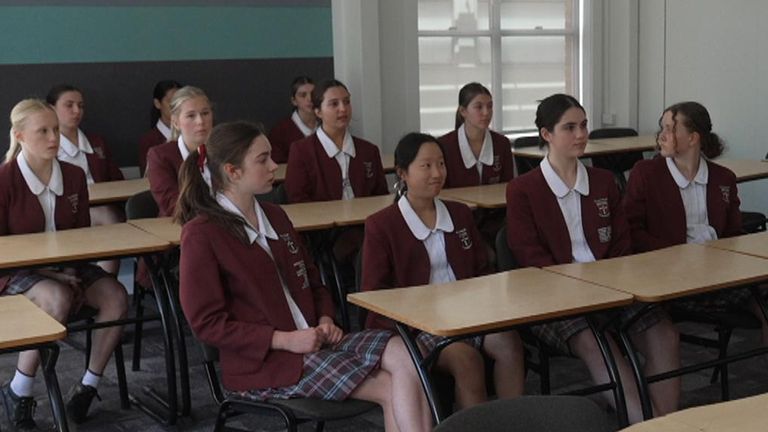
Students at Brigidine College in Sydney
Life off the apps
At Brigidine College in Sydney, students are preparing to get off the apps.
Teenager Sophia Benson says: “I’m on the fence about it. I think it’s good for kids’ mental health. But I also think it encourages the younger generation to find ways around it because obviously if you’re told you can’t do something, you want to do it more.”
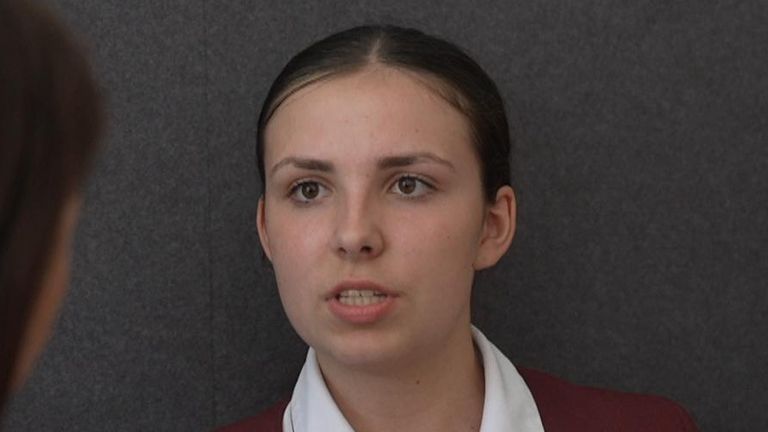
Sophia Benson
Elsie Ord is 15 years old and will spend the next seven months without social media access.
“I signed up at such a young age I was already using fake ages,” Elsie says. “I’m on social media around eight hours a day. I don’t know how I’m going to cope. I’m one of the people thinking how am I going to escape this, but it’s inevitable.”
Some 96% of Australia’s teenagers under 16 have social media accounts, according to Australia’s internet regulator.
The Australian government says the new social media laws are necessary to protect children from addiction and cyberbullying.
However, there is opposition as well.
Social media ‘whack a mole’
John Riddick is a member of the NSW Parliament and the Libertarian Party.
He’s also president of the Digital Freedom Project, which is backing a High Court challenge against the ban.
Mr Riddick says it should be up to parents to decide what is good for their children, not the government.
“Kids are tech savvy. You say ‘you can’t do this, and you can’t do that’ and you’re going to play whack-a-mole, the kids are going to get around it,” he argues.
The government has warned it may expand its list of banned apps.
Anyone feeling emotionally distressed or suicidal can call Samaritans for help on 116 123 or email jo@samaritans.org in the UK.
Alternatively, you can call Mind’s support line on 0300 102 1234, or NHS on 111.
-
 Sports2 years ago
Story injured on diving stop, exits Red Sox game
-
 Sports3 years ago
‘Storybook stuff’: Inside the night Bryce Harper sent the Phillies to the World Series
-
 Sports2 years ago
Game 1 of WS least-watched in recorded history
-
 Sports3 years ago
Button battles heat exhaustion in NASCAR debut
-
 Sports3 years ago
MLB Rank 2023: Ranking baseball’s top 100 players
-
Sports4 years ago
Team Europe easily wins 4th straight Laver Cup
-
 Environment3 years ago
Japan and South Korea have a lot at stake in a free and open South China Sea
-
 Environment1 year ago
Here are the best electric bikes you can buy at every price level in October 2024