
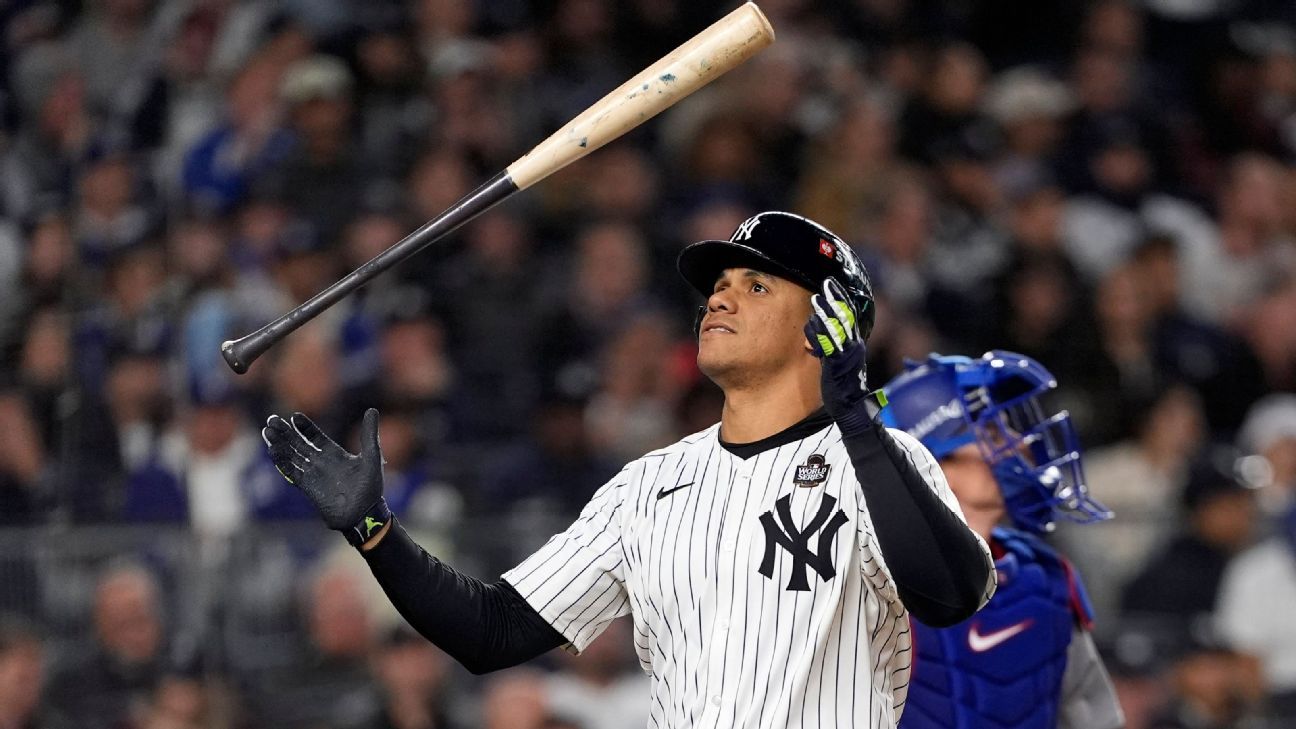
Yanks’ Soto on free agency: Open to every team


-
Jesse Rogers, ESPN Staff Writer
NEW YORK — Just days after losing in the World Series, New York Yankees slugger Juan Soto will hit the open market as one of the most sought-after players in recent history.
Soto’s talent and age — he turned 26 last week — make him attractive to just about any team.
“It’s going to be exciting,” Soto said not long after the Yankees’ Game 5 loss to the Dodgers on Wednesday. “It’s going to be a good experience. I think every player in the big league wants to experience this. So it’s exciting to see how it’s going to be.”
Soto is coming off a monster regular season. He posted a .288 batting average, 41 home runs and 129 walks and a .989 OPS. He ranked fourth in fWAR and is a Gold Glove finalist in right field. He also hit .327 with four home runs this postseason, helping the Yankees earn a spot in the Fall Classic.
“I’m proud of the year that Juan had,” teammate Aaron Judge said. “It was fun to come to work with him every single day. Even when the guy was hitting .320, I’d see him hitting late after games. If he had a oh-fer, he was showing up early doing work. Whatever he decides, whatever him and his family decide … he’s going to make the right decision for him. We were definitely lucky to have him here, and it would be great to keep playing with him because he’s definitely a special player.”
Judge and Soto formed a dynamic duo in the Yankees lineup, combining for 99 home runs, but Soto was noncommittal about giving the Yankees a leg up on re-signing him. He’s not closing any doors on them — or any team in baseball.
“I’m really happy with the city, with the team, but at the end of the day we will see,” Soto said. “We’re going to look at every situation, every offer that we get. I don’t know what teams want to come after me, but definitely I’ll be open to listen to every single team. I don’t have any doors closed or anything like that, so we’re going to be available for all 30 teams.”
Though every team could use his talent, only a handful are likely to afford his massive payday. Both New York teams are natural fits, as are almost all of the other big-market franchises. Soto was asked about the possibility of receiving a deal that could be worth over $600 million.
“It’s a lot of money that people are talking about here and there, but definitely we are going to shake it out,” he said. “What’s my value?”
That’s a question that will begin to get answered by his agent, Scott Boras, starting next week at the general manager meetings in Texas. If the past is any indication for Boras’ top clients, a decision won’t come quickly. In the meantime, the Yankees can make their pitch — both from the manager’s office and clubhouse.
“I hope he’s here forever, but I also know I’m excited for him and what the next few months are for him,” Yankees manager Aaron Boone said. “But from my standpoint, I couldn’t have asked for better.”
Judge added: “I think everybody in this room wants him back. … He just does a lot of the little things that people don’t notice that truly make him one of the best players, if not the best player in the game.”
Soto was asked what his priority will be in free agency.
“I feel like everybody wants to be on a winning team,” he said. “That’s one of the biggest things that you look up to. You want to be part of this. Even if you don’t make it to the last team standing, you want to be involved in all these [games], so I think that’s one of the biggest things I’m looking for.”
The Yankees also have a handful of other decisions to make regarding potential free agents, beginning with a $17 million option on first baseman Anthony Rizzo for next season. On Thursday, he’ll have X-rays on two broken fingers he was playing through during the postseason. No matter the team’s decision, Rizzo, 35, said he wanted to keep playing.
“I don’t know what the future will [hold],” Rizzo said. “Talk with Cash [Brian Cashman], see what they’re thinking. We have a lot left to give in this game in a lot of different ways.”
Pitchers Clay Holmes and Tommy Kahnle are also free agents, as are infielder Gleyber Torres and outfielder Alex Verdugo.
“I just really started thinking about it right now,” Verdugo said about free agency. “It’s been the closest group of guys I’ve been with and these guys get me emotional just because how much they mean to me and how much they accepted me and let me in. So we got some things to think about, but I definitely want to be back in pinstripes to help us win one.”
Soto expressed a desire to win it all as well after coming up just short with the Yankees. But will it be for the other New York team or someone else? The intrigue probably will be similar to Shohei Ohtani‘s free agency last offseason, when he signed for over $700 million with the Los Angeles Dodgers, who beat the Yankees to win the World Series. Soto’s deal isn’t likely to reach Ohtani levels, but it will certainly be rich.
“Leaving any place that is a winning team? It’s always hard, and definitely this place was really special,” Soto said. “It’s been a blast for me. I’ve been really happy. If I’m here or not, I’m really happy for the teammates that I have and the people that I got to know in here. This was a really special group.”

-
Bradford Doolittle
Welcome to the middle of the 2025 MLB season. We’ve already passed the natural halfway point (1,215 games) and are nearing the symbolic version of midseason (the All-Star break). Either way, we’ve seen more regular-season baseball in 2025 than we’ll get the rest of the way.
With that in mind, let’s wade into this month’s Stock Watch by taking a retrospective spin around the majors. As usual, we’ll slot teams according to the current competitive hierarchy and see how the picture has changed since we last convened. In addition, we’ll note the dominant storyline that has emerged for each club and hand out first-half MVP awards for all 30 teams.
Should we name those awards? The Stockies? No? OK, fine. Let’s just get to it.


Win average: 101.4 (Last month: 97.9, 3rd)
In the playoffs: 99.7% (Last: 97.2%)
Champions: 24.0% (Last: 16.2%)
First-half storyline: The Dodgers spent the first few months of the season proving the adage that you can’t have too much pitching. A team with an overstuffed pitching depth chart entering the spring has not just endured an avalanche of injuries to the staff, but many of those who have pitched have underachieved. And yet, because the offense has beaten its projection by nearly 100 park-neutral runs per 162 games, the Dodgers are doing just fine, thank you. And the worst of the injury spate has to be behind them at this point. Right?
First-half MVP: Shohei Ohtani (145 AXE, 1st on Dodgers, 3rd in MLB). Ohtani’s OPS is over 1.000 for the third season in a row. He’s on pace to top his career-high 54 homers from last season and score more than 150 runs. He has recently returned to the mound but looks fantastic. Just wait until we see this two-way act on an October stage.

Win average: 97.9 (Last: 99.6, 1st)
In the playoffs: 99.8% (Last: 99.3%)
Champions: 14.4% (Last: 15.6%)
First-half storyline: It’s the year of the Tiger. Detroit has broken out in a stunning way, and it’s thrilling to watch. If the season ended today, the Tigers’ Pythagorean winning percentage would be one of the five best in franchise history, behind only historic teams from 1909 (Ty Cobb), 1934-35 (Hank Greenberg) and 1968 (Denny McLain). It would be ahead of 1984 (Kirk Gibson). Yes, it’s that kind of season for the Tigers.
First-half MVP: Tarik Skubal (138 AXE, 1st on Tigers, 6th in MLB). Skubal has gone to a place that few pitchers reach. He’s in the top four of the AL in wins (1st), ERA (4th) and strikeouts (2nd). Given his trajectory, it’s possible Skubal will win his second straight pitching Triple Crown. The only pitchers to do that in back-to-back seasons: Grover Alexander (1915-16), Lefty Grove (1930-31) and Sandy Koufax (1965-66).

Win average: 96.1 (Last: 97.3, 4th)
In the playoffs: 97.2% (Last: 96.7%)
Champions: 12.6% (Last: 12.3%)
First-half storyline: An offensive explosion. The Cubs’ offense figured to be better after the offseason acquisition of Kyle Tucker. Tucker has been as advertised, but Chicago has gotten production up and down the lineup and is on pace to beat its park-neutral run forecast by 102 runs. The Cubs’ 121 team OPS+ so far is their best since — hold on to your hat — 1884.
First-half MVP: (tie) Kyle Tucker, Pete Crow-Armstrong (139 AXE, 1st and 2nd on Cubs, 4th and 5th in MLB). Tucker has a minuscule AXE edge when you go into decimals, but it’s fitting that these dynamic outfielders are co-MVPs when we round off. Again, it has been more than these two. The Cubs’ total of seven players with a 110 AXE or better is tied for second in the majors. Six of them are hitters.

Win average: 94.7 (Last: 89.5, 6th)
In the playoffs: 98.5% (Last: 83.4%)
Champions: 8.9% (Last: 4.2%)
First-half storyline: The window is open. Those (yes, me) who were heralding the imminent demise of the Astros’ dynasty now look like Cassandras. Despite the loss of Kyle Tucker, an injury-riddled half for Yordan Alvarez, a so-so start for Jose Altuve, lackluster production from key signee Christian Walker and the loss of the orange juice theme of its ballpark, Houston once again sits in the catbird seat of the AL West. The pitching — Hunter Brown and the game’s best bullpen — is the main reason, but the Tucker trade (getting Isaac Paredes and Cam Smith from the Cubs) has worked out swimmingly.
First-half MVP: Jeremy Pena (137 AXE, 1st on Astros, 8th in MLB). Pena recently hit the injured list because of a fractured rib. Given the way Houston has responded to adversity to date, the Astros probably won’t lose a game while he’s out. That’s nothing against Pena, who, in his age-27 season, has been baseball’s best shortstop this season.

Win average: 93.5 (Last: 88.6, 8th)
In the playoffs: 93.8% (Last: 65.0%)
Champions: 7.6% (Last: 3.0%)
First-half storyline: They are up in arms in Philadelphia. According to AXE, three of the top six NL starters and four of the top 11 are members of Philadelphia’s rotation … and no one in that quartet is named Aaron Nola. Zack Wheeler, co-front-runner for NL Cy Young with Paul Skenes, leads the way, but Cristopher Sanchez, Ranger Suarez and Jesus Luzardo have been excellent. Mick Abel and Taijuan Walker have chipped in. If Nola can get healthy and productive, and if Andrew Painter is anything close to advertised, the Phillies will feature baseball’s best and deepest rotation.
First-half MVP: Zack Wheeler (138 AXE, 1st on Phillies, 7th in MLB). At 35, Wheeler has flashed career-best levels in ERA+, FIP, WHIP and SO/9. If Wheeler doesn’t land his first Cy Young Award, it will be because someone like Skenes takes it from him, not because he doesn’t earn it.

Win average: 92.4 (Last: 97.3, 5th)
In the playoffs: 95.8% (Last: 98.0%)
Champions: 12.8% (Last: 18.6%)
First-half storyline: Improv time in the Bronx. The Yankees’ run profile is almost exactly on target with the preseason projection, yet this season has not followed the script. The pitching has mostly held up despite Gerrit Cole‘s season-ending injury and Devin Williams‘ mysterious inconsistencies. The hitting has found its level around Aaron Judge despite Juan Soto‘s departure and that Giancarlo Stanton‘s first homer didn’t happen until July 2. Yet, as things began to ebb in June, the outcome of this Yankees story is very hard to foresee now.
First-half MVP: Aaron Judge (159 AXE, 1st on Yankees, 1st in MLB). Despite a temporary recent downtick that now seems to be over, Judge is hitting .363/.470/.735 and is on pace for 12 WAR while playing every Yankees game so far. Don’t take this guy for granted, baseball fans — even those of you who don’t like the Yankees — because this is incredibly special.

Win average: 89.4 (Last: 98.2, 2nd)
In the playoffs: 75.7% (Last: 97.7%)
Champions: 3.2% (Last: 13.5%)
First-half storyline: Peaked too soon? The Mets got off to a roaring start but slumped miserably over the second half of June. Through June 12, New York was 45-24 and owned baseball’s best ERA, mostly thanks to an MLB-low 2.79 mark from the rotation. New York dropped 14 of 18 after that while posting the worst rotation ERA (5.93), bullpen ERA (6.53) and, of course, overall ERA (6.24) during that span. Injuries have played a big part in the plunge, but a team built on depth — which the Mets are — should hold up better than this. July is a really big month for this team.
First-half MVP: Pete Alonso (129 AXE, 1st on Mets, 18th in MLB). It’s a good thing the Mets paid Alonso during the winter. They’ve gotten the hottest version of the Polar Bear yet, one who suddenly discovered the joys of the line drive. Still, that Alonso lands in this slot rather than Juan Soto or Francisco Lindor (both 126 AXE) is a bit of an upset and, perhaps, an omen of happy regression from here.

Win average: 88.2 (Last: 85.6, 12th)
In the playoffs: 82.4% (Last: 56.9%)
Champions: 4.5% (Last: 2.0%)
First-half storyline: Major offense in a minor venue. The Rays dropped to a season-low five games under .500 on May 20 and proceeded to win 27 of 40 behind a surging offense. The Rays scored 20 more runs than any other team during the spree, as they joined division rival Toronto in bearing down on the Yankees for the AL East lead. As usual, the Rays are doing it with a roster of players casual fans might be pressed to identify. Tampa Bay might be playing in a minor league venue, but the Rays’ way continues to flourish in the majors.
First-half MVP: Jonathan Aranda (123 AXE, 1st on Rays, 42nd in MLB). Well, something clicked for Aranda, a 27-year-old first baseman who entered 2025 as a career .222 hitter. He has tacked on nearly 100 points to that mark this season with excellent secondary skills. His 123 AXE is tops among AL primary first basemen, including All-Star starter Vladimir Guerrero Jr.

Win average: 87.5 (Last: 84.8, 13th)
In the playoffs: 61.7% (Last: 34.5%)
Champions: 2.1% (Last: 0.9%)
First-half storyline: More than enough good. No, that’s not bad syntax, it’s how the 2025 Brewers are built. Yet, Milwaukee is in the thick of postseason contention and it’s not because of any star-level breakouts, not even from super-talented Jackson Chourio. Instead, the Brewers have 18 players in the 100-to-119 AXE range, second most in baseball behind St. Louis. No greatness, just lots of goodness.
First-half MVP: Brice Turang (119 AXE, 1st on Brewers, 65th in MLB). Turang is again flashing Gold Glove defense at second base and stealing bags when he gets on base, which he has been doing more than ever. His OBP is fueled by a .288 batting average, which, in turn, is fueled by a .363 BABIP. Fluke? There might be some regression in store, but the improvements are real. Turang’s line drive rate is 3% better than the league average, and his hard-hit rate has jumped by 16.3% over last season. Turang has tacked on 4.6 mph to his 2024 average exit velocity.

Win average: 86.9 (Last: 84.3, 15th)
In the playoffs: 72.7% (Last: 46.2%)
Champions: 1.8% (Last: 1.0%)
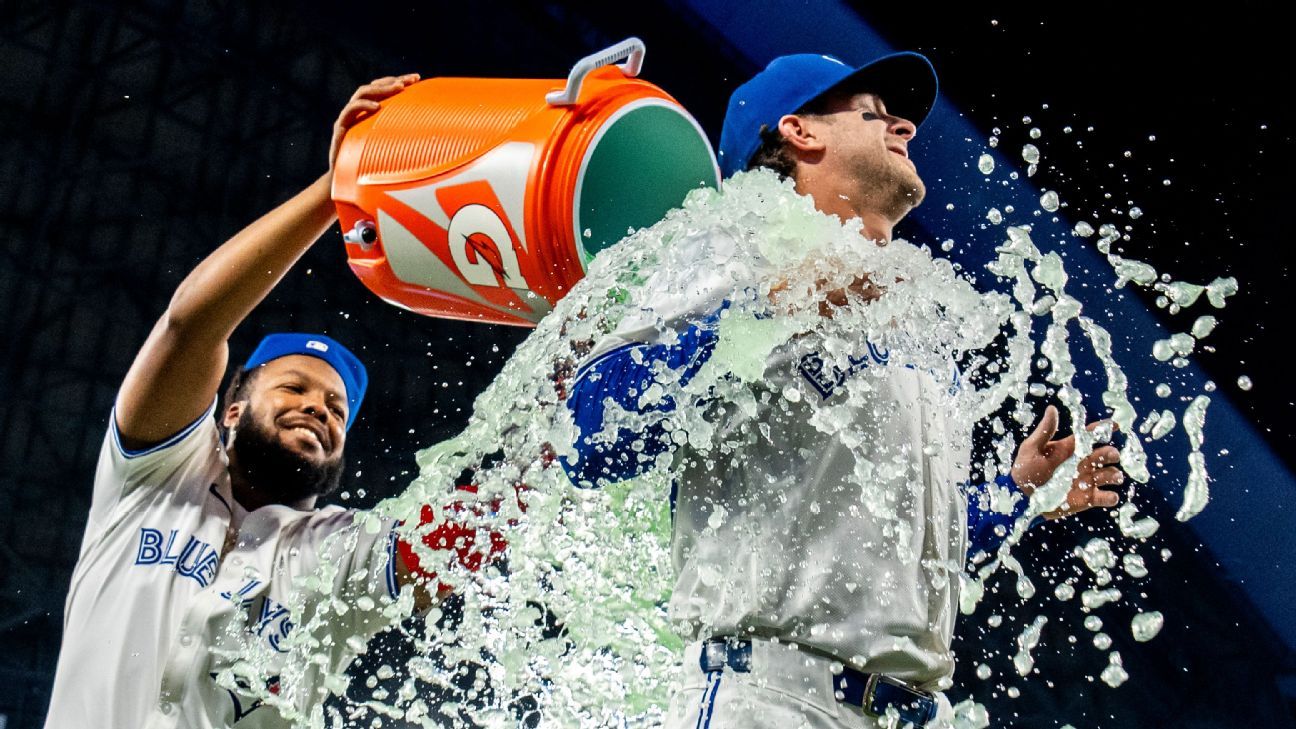
First-half storyline: Staying afloat. The Blue Jays are even in the AL East standings with the Yankees shortly after July began despite the run differential of a middle-of-the-pack team. The Jays have gotten little from key signee Anthony Santander. Vladimir Guerrero Jr. has been very good but not great. Same for Bo Bichette. The key high-leverage relievers (Jeff Hoffman and Chad Green) have been coughing up too many homers. And yet, here the Jays are … and some of these problems might regress in the right direction. Or maybe the run differential is more of who the Jays are than the record. This is why we play 162-game seasons, to sort out stuff like this.
First-half MVP: Ernie Clement (119 AXE, 2nd on Blue Jays, 63rd in MLB). Guerrero leads the Jays in AXE (121), but we’re going to shine a light on the surprising Clement. Not that this is a race we track, but he has to be the front-runner for the AL Gold Glove at the utility player position. At the plate, he has made the most of his high-contact style. The defense, in particular, underscores a big factor in Toronto’s success: MLB-best defensive metrics.

Win average: 85.6 (Last: 84.5, 14th)
In the playoffs: 66.5% (Last: 51.1%)
Champions: 2.4% (Last: 1.9%)
First-half storyline: Rotation injuries. The Mariners have mostly spread out their injuries, but their core-five starting rotation has not been whole this season. Given that knowledge at the beginning of the season, you would not expect Seattle to be where it is, which is in position to land a wild-card slot if the season ended now. And that rotation has a good chance of getting whole as the season progresses.
First-half MVP: Cal Raleigh (149 AXE, 1st on Mariners, 2nd in MLB). Entering the season, Raleigh had a good case to be considered baseball’s best catcher. And, sure, he has hit a lot of homers the past couple of years. But could anyone have envisioned this? This is more than a breakout. This is a player on pace to shatter Mickey Mantle’s record for single-season homers by a switch-hitter (54 in 1961). And he’s a Gold Glove catcher.

Win average: 85.6 (Last: 88.4, 9th)
In the playoffs: 41.3% (Last: 62.0%)
Champions: 1.1% (Last: 1.9%)
First-half storyline: Covering the holes. Entering the season, the Padres figured to have some glaring lineup holes, and that has been the case. But San Diego has stayed in contention behind the star power of Fernando Tatis Jr. and Manny Machado, and the work of a deep and dominant bullpen. As for those holes? We’ve got a month until the trade deadline.
First-half MVP: Fernando Tatis Jr. (131 AXE, 1st on Padres, 15th in MLB). Post-suspension Tatis still operates at a lower level than pre-suspension Tatis. Before missing the 2022 season, Tatis had a 160 OPS+ and averaged 8 bWAR per 162 games. Since coming back, he’s at 118 OPS and 5.7 bWAR per 162 games. But Tatis is still really good, and always has that ability to be great stashed in his hip pocket.

Win average: 85.5 (Last: 85.7, 11th)
In the playoffs: 43.2% (Last: 42.1%)
Champions: 1.0% (Last: 1.1%)
First-half storyline: One fast transition. In retrospect, we might have overreacted to the Cardinals’ offseason rhetoric about 2025 being about positioning for the front office transfer of power to Chaim Bloom. The Cardinals took a passive approach to player acquisition and caught plenty of heat for it. They also removed obstacles in front of a number of their in-house talents, and that has paid off in a big way so far this season.
First-half MVP: Sonny Gray (118 AXE, 1st on Cardinals, 76th in MLB). Like Milwaukee, the Cardinals have succeeded thanks to a depth of solid performances rather than any breakouts. Some of those solid performers are key to St. Louis’ future: Matthew Liberatore, Victor Scott II, Masyn Winn. But the veteran Gray, who might have been dealt if not for his contract’s no-trade clause, has led the way.

Win average: 84.4 (Last: 89.1, 7th)
In the playoffs: 35.5% (Last: 67.0%)
Champions: 1.2% (Last: 2.4%)
First-half storyline: Buster’s breakout followed by a bust-out? Under first-time exec Buster Posey, the Giants exploded out of the gate. Then, they bolstered a lineup light on power with the season’s biggest trade to date, bringing in the suddenly positionally flexible Rafael Devers. Yet, the Giants have since slumped, winning just five of Devers’ first 10 appearances with the team. Where that leaves Posey and the Giants is unclear, but it’s nothing a Devers power spree and a few wins wouldn’t fix.
First-half MVP: Logan Webb (126 AXE, 1st on Giants, 26th in MLB). Webb was already established as the closest thing to a durable, top-of-the-rotation starter as we can hope to get in today’s game. This season, he has amped up the run prevention as well, posting a career-high and NL-best 2.32 FIP while again leading the circuit in innings. Alas, on the heels of two straight top-10 Cy Young finishes, as of now, it looks like Webb will have to get even stingier if he is to overtake Paul Skenes and Zack Wheeler in the awards race.

Win average: 82.5 (Last: 79.0, 22nd)
In the playoffs: 19.4% (Last: 8.4%)
Champions: 0.4% (Last: 0.2%)
First-half storyline: Rambling rotation. The Reds’ game score winning percentage (.612) is the best in the National League and second overall behind the Yankees. This has happened despite Hunter Greene‘s injury and tepid debuts by exciting prospects Chase Petty and Chase Burns. Andrew Abbott has been as hot as any pitcher in baseball, and the trio of Nick Lodolo, Brady Singer and Nick Martinez has been consistently productive. This has a chance to be a very exciting group down the stretch.
First-half MVP: Elly De La Cruz (127 AXE, 1st on Reds, 25th in MLB). De La Cruz is on pace for 34 homers and 41 steals while soaring past 100 runs and 100 RBIs. His OPS+ has risen to 125 on the strength of improving strikeout rates. It kind of feels like he can do more, too. But that might always be the case for De La Cruz, no matter what his numbers look like, simply because he’s such a marvel to watch on the field.

Win average: 82.4 (Last: 81.2, 18th)
In the playoffs: 20.9% (Last: 16.1%)
Champions: 0.5% (Last: 0.4%)
First-half storyline: Not what we signed up for. The D-backs appeared positioned to possibly challenge the Dodgers in the NL West, thanks largely to a stacked starting rotation bolstered by the high-dollar signing of Corbin Burnes. Burnes’ season ended after 11 starts, while Zac Gallen, Brandon Pfaadt and Eduardo Rodriguez are on the wrong side of 5.00 ERAs. The bullpen, weakened by injuries to A.J. Puk and Justin Martinez, has been even worse. Too often, Arizona has had to outscore the opposition.
First-half MVP: Eugenio Suarez (124 AXE, 3rd on Diamondbacks, 37th in MLB). Suarez is a hair behind Corbin Carroll (126) and Ketel Marte (125) on the AXE leaderboard, but his potent power bat has perhaps been more crucial to Arizona’s ability to hang around .500. Carroll and Marte have given the Snakes about what they expected — which is considerable — but Suarez has outstripped his projection and helped to shore up shortfalls elsewhere on the roster. From 2021 to 2024, Suarez averaged 2.4 bWAR per season; this year, he’s already at 2.5.

Win average: 81.1 (Last: 79.6, 21st)
In the playoffs: 27.3% (Last: 18.4%)
Champions: 0.5% (Last: 0.3%)
First-half storyline: Complete lack of an attack. Two years after riding a dynamic offense to a championship, the Rangers have morphed into an all-pitch, no-hit team despite a lineup with many of the same players. And the positions that have turned over have tended to go to promising prospects such as Josh Jung (recently demoted), Wyatt Langford and Evan Carter. In 2023, the Rangers’ 4.77 home-scoring average ranked sixth in the majors. This season, their 3.76 mark ranks 27th.
First-half MVP: Jacob deGrom (128 AXE, 1st on Rangers, 20th in MLB). On the bright side, deGrom is back and he’s still very much Jacob deGrom … and seemingly getting better with each outing. In general, the rotation has been a bright spot for Texas, whose top three performers by AXE are deGrom, Nathan Eovaldi and Tyler Mahle.

Win average: 80.0 (Last: 79.8, 20th)
In the playoffs: 11.2% (Last: 12.6%)
Champions: 0.4% (Last: 0.4%)
First-half storyline: What happened? Last season, the Braves figured prominently into our preseason coverage when we wondered whether it was they or the Dodgers who would emerge as baseball’s power team. Once again, the forecasts were high on Atlanta’s chance to have a bounce-back season and return to the top of a competitive NL East. A couple of days ago, the Braves slipped behind the Marlins in the standings. When you look at an IL that includes Chris Sale and Spencer Schwellenbach, it’s a dispiriting season in Cobb County.
First-half MVP: Matt Olson (125 AXE, 1st on Braves, 34th in MLB). Olson hasn’t produced at the level he flashed in 2023, when he mashed 54 homers and put up 7.5 bWAR. But he has produced and he has also been there, which is more than you can say about most of Atlanta’s other key players. Olson still hasn’t missed a game since joining the Braves as Freddie Freeman‘s replacement in 2022.

Win average: 79.8 (Last: 80.0, 19th)
In the playoffs: 17.8% (Last: 20.3%)
Champions: 0.3% (Last: 0.5%)
First-half storyline: It’s not about who’s here, but who is not. When you look at the roster of the 2018 champion Red Sox and how many of the key players are still star-level players for other teams, this is going to cast a pall over Fenway Park until a new group emerges to win at a high level. Any hopes of that cloud lifting because of the passage of time were dashed when Boston traded Rafael Devers.
First-half MVP: Garrett Crochet (134 AXE, 1st on Red Sox, 11th in MLB). Crochet pitched this well last season for the White Sox, his first full season as a big league starting pitcher. But it wasn’t quite a full season because Chicago tamped down his usage in advance of dealing him for maximum return. Trading for Crochet for a valuable combination of prospects was a bit of a leap of faith by Craig Breslow. Well, you can quibble with a lot of things that have happened in Boston, but so far, the Crochet trade is not one of them.

Win average: 79.7 (Last: 87.2, 10th)
In the playoffs: 18.0% (Last: 68.8%)
Champions: 0.3% (Last: 2.9%)
First-half storyline: Close, but no cigar. The Twins are another team whose park-neutral runs and runs allowed paces are on track to meet forecasts. Their record, however, is not. Why? Look no further than the Twins’ 8-15 record in one-run games. An optimist would suggest that this should even out. The problem is that it’s probably already too late for the Twins in the division race, and they are but one of a legion of teams in the AL’s middle wondering if they are really playoff contenders.
First-half MVP: Byron Buxton (130 AXE, 1st on Twins, 16th in MLB). Buxton is on pace to play in 130 games. That might not sound too impressive, but if he were to get there, it would be the most games he has played in since 2017. A healthy (or mostly healthy) Buxton is something to behold. He has already topped his 2024 totals in homers and steals and is close in bWAR, even though he has appeared in only 69 games. (He played in 102 last season.) Let us all take a moment to knock on wood.

Win average: 77.3 (Last: 81.9, 16th)
In the playoffs: 8.5% (Last: 28.5%)
Champions: 0.1% (Last: 0.4%)
First-half storyline: Could really use Josh Naylor. The Guardians’ position player roster this season is dominated by below-replacement performances. You can understand the desire to open things up for power prospect Kyle Manzardo, who has been up and down. But Naylor was a foundational producer for a team that was a couple of wins shy of the World Series in 2024. The lineup needed him a lot more than the rotation needed Slade Cecconi, who has been fine over eight starts. You can’t help but wonder if Cleveland, owner of baseball’s oldest title drought, will ever stop pushing things down the line.
First-half MVP: Jose Ramirez (128 AXE, 1st on Guardians, 24th in MLB). Who else? Ramirez is on target to do what he does every year, across the board. His isolated power is down a touch, but Ramirez remains more than capable of going on a binge to clear that up. This is another season to boost Ramirez’s future Hall of Fame case.

Win average: 76.3 (Last: 73.2, 23rd)
In the playoffs: 6.2% (Last: 2.7%)
Champions: 0.0% (Last: 0.0%)
First-half storyline: Bittersweet surprise. The Angels are a mild surprise because they appeared, at various junctures, like a team about to slide back into the basement. But the 2025 Angels have been fairly resilient despite another Mike Trout injury and lack of superstar production, Ron Washington’s season-ending health issue and widespread bullpen woes, aside from closer Kenley Jansen. It’s to their credit that they’ve stayed close to .500, and there have been some positive developments on the roster. That doesn’t make them contenders.
First-half MVP: Yusei Kikuchi (117 AXE, 1st on Angels, 80th in MLB). The Angels’ rotation has been solid and a big reason the team has stayed competitive. The addition of Kikuchi has been the biggest upgrade. The 34-year-old lefty has mostly retained the gains he made after being traded from Toronto to Houston last season, save for an uptick in walks. He’s not an ace, but he has given the Halos a consistent presence in a rotation that, over the years, has lacked stability.

Win average: 76.2 (Last: 81.3, 17th)
In the playoffs: 5.9% (Last: 25.7%)
Champions: 0.1% (Last: 0.5%)
First-half storyline: Oh no, there’s no O. The Royals have been an above-average team in most areas of what helps a team win: defense, baserunning, starting rotation and bullpen. It has all been undermined by wretched hitting. Kansas City has averaged 3.77 runs per game on the road, ranking 25th. That’s bad! But it looks explosive compared with what the Royals have done at the K: 2.84 runs per game. That’s not only last in the majors, but it’s not even close to the second-worst mark (3.58 by Cleveland). If you watch the Royals regularly, hopefully you’ve been wearing a hat because otherwise watching this team hit has likely caused you to pull out all your hair.
First-half MVP: Bobby Witt Jr. (134 AXE, 1st on Royals, 12th in MLB). Witt has been terrific. He hasn’t been as terrific as he was in 2024, and somehow, he finished behind Jacob Wilson of the A’s in the All-Star voting. Witt is perhaps a victim of the standards he set in 2024. Witt is still on pace for 56 doubles, 43 steals and more than 7 bWAR. It’s a “down” season most players can only dream of, and it’s certainly not Witt’s fault the Royals’ offense has been so bad.

Win average: 71.8 (Last: 67.2, 26th)
In the playoffs: 0.3% (Last: 0.1%)
Champions: 0.0% (Last: 0.0%)
First-half storyline: Evil rumors. Low-level buzz that maybe the Pirates should look to trade Paul Skenes didn’t come from the team, so you don’t want to bash Pittsburgh for that. But you kind of do because such suggestions should not be possible. They are only because it feels so unlikely that the Pirates will invest in building a contender around Skenes. But again: If you trade this guy during his second season, what are you building for? Anyway, it hasn’t happened. Skenes has been great; the team has not.
First-half MVP: Paul Skenes (137 AXE, 1st on Pirates, 9th in MLB). Skenes is 41 starts into his career, and his ERA remains under two: 1.99, over 244 innings. His ERA+ is 213. It’s the best ever given a minimum career total of 41 starts. Sure, Skenes might hit rough patches and the number would go up. But he’s got a lot of room for error: second best is Kodai Senga (160 over 43 starts) and third is Jacob deGrom (157 over 235 starts).

Win average: 71.1 (Last: 69.4, 25th)
In the playoffs: 0.7% (Last: 0.6%)
Champions: 0.0% (Last: 0.0%)
First-half storyline: Thud. Our last preseason Stock Watch pegged the Orioles at 88 wins with a 65% shot at returning to the postseason. That outlook has changed.
First-half MVP: Gunnar Henderson (119 AXE, 1st on Orioles, 70th in MLB). That Henderson would top the Orioles’ AXE leaderboard is no surprise. That he would do so with a 119 mark certainly is — last season, he finished at an MVP-like 150. Henderson has trended upward after a bad April, and there’s nothing really to worry about. Still, his step back is emblematic of Baltimore’s mystifyingly lost season.

Win average: 69.7 (Last: 62.4, 28th)
In the playoffs: 0.1% (Last: 0.0%)
Champions: 0.0% (Last: 0.0%)
First-half storyline: Bobbing back to the surface. There certainly was no particular reason to think the Marlins would be interesting this season, beyond what might possibly happen around the trade deadline with getting-better-fast starter Sandy Alcantara. Give the Fish and first-year manager Clayton McCullough credit, though, because the Marlins enter our July Stock Watch as one of baseball’s hottest teams. In fact, if you go to windows of “past 50 games,” Miami has split those games, better than division mates Atlanta and Washington, a game worse than the Mets and just four behind the Phillies. At the very least, you can say that despite a bad start and zero expectations, Miami has not thrown in the towel.
First-half MVP: Kyle Stowers (114 AXE, 2nd on Marlins, 108th in MLB). Stowers is behind Otto Lopez (116 AXE) for the Marlins, but we’ll give him a nod for his huge strides at the plate. The former Orioles prospect entered the season with a career slash line of .208/.268/.332 over 117 games. This season, he’s at .286/.360/.520 in 80 games, upping his homer total from six to 21 and more than doubling his RBI count. He’s not a star, but he has been a key part of a team that has been kind of fun to watch lately.

Win average: 68.3 (Last: 72.4, 24th)
In the playoffs: 0.0% (Last: 0.7%)
Champions: 0.0% (Last: 0.0%)
First-half storyline: How long is this going to take? If you zero in on the player level, there is plenty on the Nationals’ roster you can point to as a positive sign: James Wood‘s ascension, the play of CJ Abrams and MacKenzie Gore, the presence of touted prospects Dylan Crews and Brady House. The bottom line is that a team that hasn’t sniffed .500 since winning the 2019 championship has a winning percentage worse than what it posted in each of the past two seasons. The Nationals need to make a leap, sooner rather than later.
First-half MVP: James Wood (135 AXE, 1st on Nationals, 10th in MLB). Wood is the real deal, a hyped prospect who manifested his ability as soon as he hit the majors. He’s 165 games in at this point and owns a 144 OPS+, 30 homers, 104 RBIs and 26 steals. His power is somehow both explosive and effortless, and his plate discipline is outstanding for such a young slugger. It should only get better from here.

Win average: 65.9 (Last: 64.3, 27th)
In the playoffs: 0.0% (Last: 0.1%)
Champions: 0.0% (Last: 0.0%)
First-half storyline: Is it the park or the pitcher? The Athletics teased us with becoming an exciting sleeper wild-card contender. Then they lapsed into a horrifying slump, a 3-24 disaster during which the staff ERA was 7.79. That would be bad in slow-pitch softball. So much for contention. The Athletics have bounced back to an extent, but their season ERA is 5.67, ahead of only the Rockies. And while Sacramento has not been a hospitable place for the pitchers, the A’s can take solace in the fact that their road ERA is also well over five. It’s just not a good pitching staff.
First-half MVP: Jacob Wilson (123 AXE, 1st on Athletics, 44th in MLB). Wilson has fallen off after an exhilarating start that had his batting average at .372 through June 8. But he’s still a gas to watch, and apparently a lot of people have because Wilson will start at shortstop for the AL in the All-Star Game. As good as Wilson has been at the plate so far in the majors, his defensive metrics have been well in the red. Which kind of makes him the bizarro version of his father, Jack.

Win average: 56.2 (Last: 58.2, 29th)
In the playoffs: 0.0% (Last: 0.0%)
Champions: 0.0% (Last: 0.0%)
First-half storyline: Roster turnover. GM Chris Getz has been a transaction lover as a lead exec, and after the pain of the initial tear-down period, things are starting to feel downright coherent. Some of the prospects have played well in the majors, such as Chase Meidroth and Kyle Teel. The starting rotation has become above average, and that position group has a gaggle of high-upside prospects on the way. The White Sox still lose a lot of games, and the bullpen saves leader is a three-way tie with two. But things have grown considerably less dim than they were at this time last year. Granted, that’s a low bar, but it could be worse.
First-half MVP: Adrian Houser (112 AXE, 1st on White Sox, 132nd in MLB). Houser is our one first-half MVP who didn’t start the season with his team. But he has put up a 1.90 ERA over seven starts after being released by Texas in May. In doing so, he has become someone who might generate interest at the trade deadline. In that way, he’s an avatar for what the White Sox’s modus operandi is at this point: talent accumulation, in every way you can do it.

Win average: 41.8 (Last: 40.8, 30th)
In the playoffs: 0.0% (Last: 0.0%)
Champions: 0.0% (Last: 0.0%)
First-half storyline: Historic ineptitude. We wish we could put it nicer than that, but the Rockies are on pace to win 36 games and post a run differential of minus-422. And this isn’t a team following any kind of obvious rebuilding scheme, beyond the reality that when you’re this bad, you are by definition rebuilding. Somehow, the fact that the Rockies are still drawing well at the gate makes this even worse. It’s like a Monty Python sketch.
First-half MVP: Hunter Goodman (116 AXE, 1st on Rockies, 94th in MLB). No snark needed here — Goodman has been pretty solid and, at 25, he is young enough that maybe the gains are legit. The best part of Goodman’s first half is that his numbers are actually a lot better away from Coors: .925 road OPS; .790 at home. He’s been good.
Sports
From a Cy Young winner to an All-Star closer: One player every MLB team should trade for (or away) this July

-
David Schoenfield
This year’s MLB trade deadline is going to be complicated. So many teams are currently in the playoff race — only eight are more than five games out of a wild card — that it might make for a slow deadline if all those clubs remain in contention by the end of July.
One thing is clear, however: The Arizona Diamondbacks are the fulcrum of this deadline, with the ability to make it a lot more interesting if they decide to trade away their players heading into free agency — a group that includes slugging third baseman Eugenio Suarez, starters Merrill Kelly and Zac Gallen, .300-hitting first baseman Josh Naylor and rejuvenated closer Shelby Miller.
While there’s always a desire for ownership and the front office to go for it and not sell out a clubhouse that has worked hard to get into the playoff chase — let alone sell out the fans who have supported the team — that’s not always possible.
This past weekend’s sweep at the hands of the Miami Marlins was a crushing three games and decreased their playoff odds by about 11 percentage points, to under 20%. Factoring into Arizona’s ultimate thought process: Corbin Burnes is done for the season following Tommy John surgery, and with Gallen continuing to struggle with a 5.45 ERA, the rotation just hasn’t been competitive. A run to the postseason feels unlikely, and a run through October even less so.
As July kicks off, we present our annual list of one player every team should trade for (or away) before the July 31 deadline. And yes, we have the Diamondbacks saying goodbye to a number of their impending free agents. Let’s start with them.
Jump to team:
American League
ATH | BAL | BOS | CHW | CLE
DET | HOU | KC | LAA | MIN
NYY | SEA | TB | TEX | TOR
National League
ARI | ATL | CHC | CIN | COL
LAD | MIA | MIL | NYM | PHI
PIT | SD | SF | STL | WSH
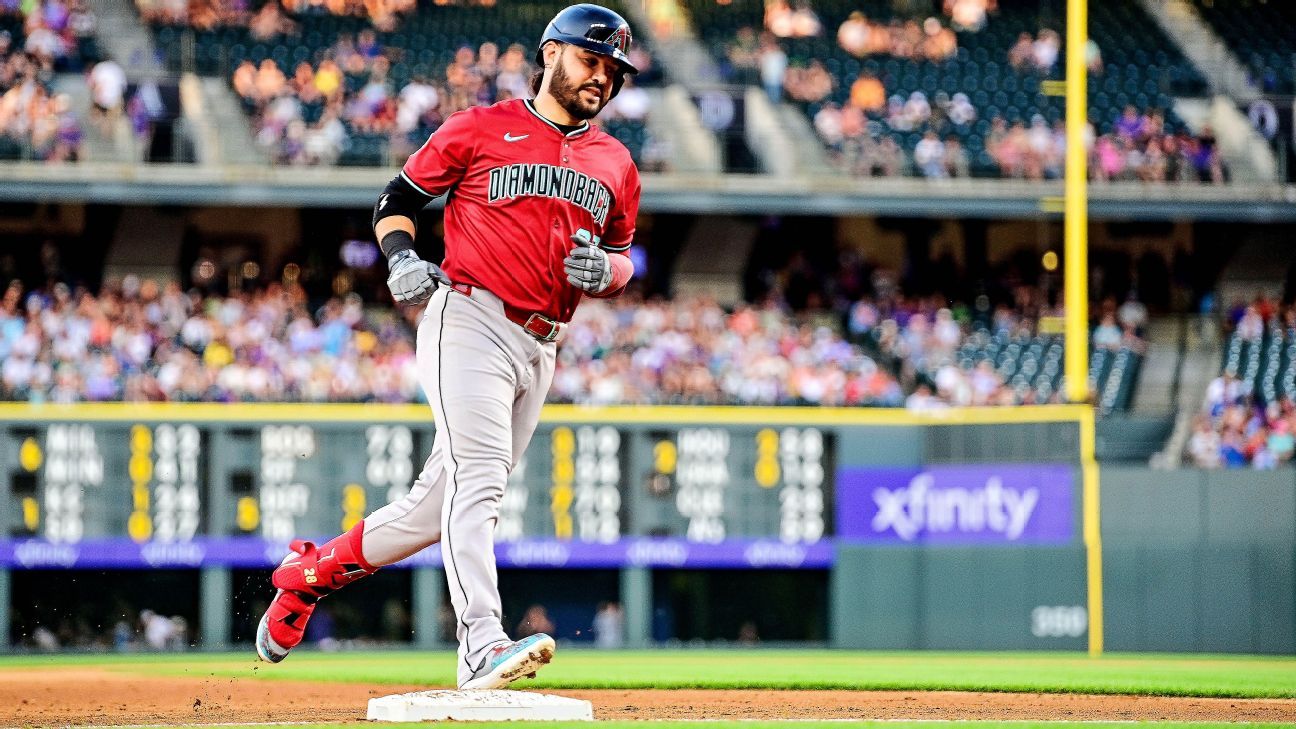
Arizona Diamondbacks: Trade away Eugenio Suarez
In a deadline that lacks a marquee superstar — remember that the biggest names of the past two deadlines, Shohei Ohtani in 2023 and Garrett Crochet in 2024, weren’t traded anyway — Suarez might be the best player who gets traded. He’s having a huge power season, hitting .254/.324/.564 with 26 home runs, recently belting his 300th home run to cement his underrated career. His strikeout rate is the lowest it’s been since 2018 as he has made a concerted effort to swing a little more often early in the count. It’s paid off. The Diamondbacks also have top prospect Jordan Lawlar ready in the minors to take over at third. He’s a natural shortstop, but Geraldo Perdomo has locked down that position and Lawlar’s bat should still play at third.
There are several contenders in need of an upgrade at third base, including the Cubs and Reds, but the Tigers and Mariners might have the edge in prospect depth to make the deal. The Tigers will likely make multiple moves — no doubt, adding a bullpen arm at a minimum — and while the lineup has shown surprising depth, adding Suarez to hit between lefties Kerry Carpenter and Riley Greene feels like the perfect fit while allowing Zach McKinstry to return to his utility role. Suarez would also hedge against some of the possible regression from the likes of McKinstry, Javier Baez, Gleyber Torres and Spencer Torkelson, who have performed much better than last season.
The Mariners have been playing Miles Mastrobuoni and rookie Ben Williamson at third base. They chip in an occasional single but have combined for just two home runs in over 300 at-bats. With Cal Raleigh accounting for a third of the Mariners’ home runs — granted, he has hit a lot of them — Suarez would add a much-needed cleanup hitter to bat behind Raleigh. Oh, and it would rectify the big mistake president of baseball operations Jerry Dipoto made when he traded Suarez to Arizona after the 2023 season in a cost-cutting move.
Kelly is the type of pitcher who used to be called a bulldog. He battles, he’s tough, and he gets the most out of an arsenal that features a pedestrian 92 mph fastball. Every team would love to have him in its rotation and, for what it’s worth, he was excellent in the 2023 postseason for Arizona when he posted a 2.25 ERA across four starts. He had a nine-run blowup in his second outing of 2025 but is pitching better than ever since then with a 2.83 ERA and more strikeouts than innings pitched.
The Cardinals continue to exceed expectations, and Kelly’s $7 million contract would be especially attractive to them — or any team looking for a starter at an affordable rate, for that matter. As for the need: The Cardinals rank in the middle of the pack in the majors in rotation ERA, but Erick Fedde, Andre Pallante and Miles Mikolas are averaging fewer than 6.5 strikeouts per nine. (St. Louis is 26th in rotation strikeout rate.) Kelly would give them a better strikeout pitcher to go alongside Sonny Gray to head a potential playoff rotation.
The Rangers have struggled to score runs — 3.77 per game, nearly two fewer runs per game than 2023 — and while they’re looking up at the wild-card leaders, they don’t want to give up on a season where they have Jacob deGrom, Nathan Eovaldi and Tyler Mahle dominating on the mound (although Mahle is out with shoulder fatigue). The Rangers rank 22nd in the majors in OPS at first base and last at DH, so even factoring in this season’s odd low-run environment at Globe Life Field, Naylor is a solution for either position, especially considering their DHs this past week included light-hitting journeyman Sam Haggerty and whichever catcher wasn’t starting.
Alcantara is signed for $17.3 million in 2026 with a $21 million team option for 2027, so even though his season stats look scary — 4-8, 6.98 ERA — the 2022 Cy Young winner still fits as a long-term option for a trade partner. More importantly, the results were at least better in June with a 4.34 ERA and .689 OPS allowed, although there are still concerns about his low swing-and-miss rate despite a fastball averaging 97.3 mph.
The Marlins don’t have to trade him, of course, and given how bad their rotation has been — only the Rockies have a worse ERA — you can argue that trading him will only open a hole they’ll have to fill for next season anyway. They just went 6-0 on their road trip, and if they play well over the next month, it becomes less likely they trade Alcantara, with the view that he’ll be a necessary part of a potentially better team in 2026. It all comes down to the prospect haul, however, and Alcantara’s recent performance might be enough to swing a deal.
The Cubs feel like the perfect match for multiple reasons. Their rotations ranks 22nd in ERA and 17th in innings, so they’re getting neither great production nor enough lengthy outings from their starters. The bullpen has held up to the stress so far with the second-best ERA in the majors, but acquiring Alcantara would add depth behind Matthew Boyd and Shota Imanaga, the team’s only reliable starters.
A question the Cubs will have to evaluate: Alcantara has a higher-than-average ground ball rate, so will having Dansby Swanson and Nico Hoerner behind him help? That seems logical, but the Marlins have allowed a slightly lower average on ground balls this season than the Cubs, so it’s probably a negligible difference. The Cubs do have the better overall defense thanks to their outfield, but Alcantara has not been pitching into bad luck (indeed, his actual batting average allowed of .266 is lower than his expected average of .280).
Astros general manager Dana Brown just talked about looking for a left-handed bat to help his right-heavy lineup, but the Astros have a track record for making big pitching moves like this at the deadline: Justin Verlander in 2017, Zack Greinke in 2019 and Verlander again in 2023. The one-two punch of Hunter Brown and Framber Valdez is as good as it gets, but the rotation is currently counting on unheralded rookies Colton Gordon and Brandon Walter, who have been pleasant surprises and pounding the strike zone (a combined 68 strikeouts and seven walks in 71⅓ innings) but might be over their heads right now. With Valdez heading to free agency, Alcantara would also provide insurance if they lose Valdez in the offseason.
It’s starting to look a little desperate in Kansas City. The Royals are only 4½ games out of the third wild card, but they have six teams to climb over, Jac Caglianone has failed to ignite the offense, and they went 8-17 in June. They’ll need a major Bobby Witt Jr. heater just to get close by the trade deadline. The emergence of Kris Bubic as a likely All-Star pitcher plus rookie Noah Cameron give the Royals some rotation depth to deal from, and Lugo remains an extremely attractive trade option, as he’s signed through at least next year (he owns a player option for 2027) and has a 2.74 ERA in 2025. Aside from Caglianone, the Royals’ system lacks impact hitters in the upper minors. Trading Lugo gives them the chance to help their offense for the future.
It’s hard to believe the Dodgers might need another starting pitcher after all the money they’ve invested in their rotation, but we still don’t know the seasonlong prognosis for Tyler Glasnow, Blake Snell and Roki Sasaki, although Glasnow has at least started a rehab assignment in Triple-A. The one thing we do know is the Dodgers have a system loaded with hitting prospects that might make them the team most capable of making this trade — if they want to do it.
The Blue Jays are currently in the second wild-card spot, despite a scuffling rotation that ranks 26th in ERA. They did just get Max Scherzer back, but there’s no way of knowing what he’ll bring, plus Chris Bassitt and Scherzer will be free agents — so they’ll be looking for pitching help in the offseason anyway. Lugo’s contract is a more attractive option than gambling on a high-level free agent, even if it costs a team some good prospects.
The Guardians were 31-26 at the end of May even though they had been outscored by 18 runs, but June was a rough go, with a 9-16 record and minus-29 run differential, dropping them under .500. Clase is signed through 2028, with his salary topping out at $10 million the final two years, making him a bargain for an elite closer.
Is he still elite, though? He’s allowing a .289 average after batters hit just .154 against him in 2024, and while his location was certainly off a bit in April, he also had a lot of BABIP bad luck. His ground ball rate is significantly down from where it once was (as high as 68% in 2021, down to 45% this season), but he has still surrendered just one home run. The Cleveland bullpen hasn’t been as dominant as last season but it’s still deep, and Cade Smith has been their best reliever, so he’s ready to take over as the closer. Given the potential return for Clase — and hedging against the possibility that he could be on the decline — this might be the best chance for the Guardians to get a big haul for him.
When I flipped on the Phillies-Braves game Saturday, the score was 1-1 in the seventh inning with the bases loaded as Philly’s Jordan Romano pitched to Atlanta’s Sean Murphy. The broadcast flashed a graphic showing the Braves were the only team without a grand slam this season. First pitch: Boom. The Phillies need bullpen help and they need to win now. This has all the markings of a Dave Dombrowski deal.
The Orioles went 16-11 in June and are playing a little better, so there might be some hope … OK, sorry, Orioles fans. You’re still seven games out of the final wild-card spot with playoff odds hovering below 4%. A playoff run is unlikely given their rotation, and with up to 11 impending free agents after this season, if you count the three players on club options, general manager Mike Elias could make a slew of deals to add prospect depth to the organization. It’s not the way the Orioles expected the season to go, but this is the rare case where punting on the year makes sense.
O’Hearn is probably the best of the group. They got O’Hearn from the Royals and milked three excellent seasons out of him as a platoon DH/1B/RF, and with so many teams starving for offense, his ability to hit right-handers (.312/.398/.518) makes him one of the best bats available.
You could find a half-dozen teams where O’Hearn fits, but let’s go with the Giants, who rank last in the majors in OPS at first base, with an average below .200 and just five home runs. They also rank in the bottom third of the majors in OPS versus right-handed pitching, so adding O’Hearn on top of Rafael Devers would give San Francisco a second middle-of-the-order lefty bat. President of baseball operations Buster Posey has already shown his cards with the Devers deal: He’s all-in, so no time to stop now.
The Braves beat the Mets in five out of seven games in June to spark some comeback talk, but they remain eight games under .500, one of five NL teams that are more than five games out of the final wild card. There’s still time, and FanGraphs gives them 23% playoff odds, but the offense actually had its worst month of the season in June. It’s hard to wave the white flag with Chris Sale, Spencer Schwellenbach and Spencer Strider leading the rotation and Ronald Acuna Jr. red-hot since his return, but the Braves will need a huge July in order to be contenders. If they don’t get that, Ozuna is the logical trade candidate, as he heads into free agency and has a .369 OBP (although he had a miserable June with a .550 OPS and just two home runs).
The Padres have used their DH slot to give Manny Machado, Xander Bogaerts and others an occasional day off from the field, but it hasn’t worked, with the Padres ranking near the bottom of MLB in OPS at DH. Ozuna’s June slump is a concern, but his OBP would be the best on the team and help boost an offense that ranks in the bottom third in the NL in runs per game.
That got very Mets-like in a hurry. The Mets have gone 3-14 since June 13, which includes an embarrassing three-game sweep to the Pirates this past weekend when they were outscored 30-4. It prompted owner Steve Cohen to post, “Tough stretch, no sugarcoating it. I didn’t see it coming.” Didn’t see it coming? These are the Mets! Something always happens.
The Mets should get some of their injured starters back soon, and while the lineup has some soft spots, it doesn’t have any must-need upgrades — center field and catcher are their weakest spots, but Tyrone Taylor is an excellent defender and … well, good luck at catcher. So that leaves the bullpen, which is strong in the ninth inning with Edwin Diaz but a little shaky elsewhere, especially as manager Carlos Mendoza ran Huascar Brazoban into the ground. New York should think big here. Bautista has two more years of team control on a low salary, so Baltimore could get a lot in return — and the Mets happen to be deep in starting pitching prospects, which is exactly what the Orioles need.
Bednar is a two-time All-Star closer who struggled in 2024 (5.77 ERA) and then lost two games and blew a save in his first three outings of 2025, but he has been rolling since then with a 1.95 ERA and — most impressively — a 37.4% strikeout rate as his curveball/splitter combo are once again wipeout pitches. He’s making $5.9 million this year and is under team control for another season, but the Pirates aren’t going anywhere in the standings anytime soon and have a closer-in-waiting in Dennis Santana.
After a mediocre first month, the Rays have been as good as any team in baseball since May 1: 33-21, tied for the third-best record (just one fewer win than the Tigers and two fewer than the Astros) and with the best run differential at plus-61. Only the Dodgers have scored more runs since May 1, and while the Rays are getting a slight offensive boost from Steinbrenner Field, pitching looks like the way to go at the deadline The rotation has been homer-prone — again, related to Steinbrenner Field — but the bullpen has lacked its usual depth and ranks 23rd in win probability added. Adding Bednar — the salary shouldn’t be too steep, even for the Rays — and moving Pete Fairbanks into the setup role works.
Some people dislike going to the dentist or detest boiled eggs or loathe oatmeal raisin cookies. The Rockies? They hate to make trades. And they especially are not fans of trading homegrown players like McMahon. But it’s time. He isn’t having his best season at .219/.321/.392, numbers that look even worse when factoring in Coors Field, but he’s one of the best defensive third basemen in the game and there are some things to like in his metrics, including an 89th percentile walk rate and 83rd percentile bat speed. He’s signed through 2027 at a reasonable $16 million each of the next two seasons, given his high floor as a plus defender with 20-homer output.
The Reds should absolutely be looking to add — and third base has been a black hole all season, with Reds third basemen ranking near the bottom of the majors in OPS. They released Jeimer Candelario, even though he’s under contract for $16 million this year and another $16 million in 2026, but the ongoing roulette spin to see who starts from Santiago Espinal, Christian Encarnacion-Strand and Gavin Lux isn’t a solution. The Reds also have a couple of third-base prospects in Sal Stewart and Cam Collier that they could offer in return. It’s just a matter of them absorbing more salary on top of Candelario’s sunken cost.
The Twins are another team that will need a good July to determine their trading fate. However, other than the 13-game winning streak in early May, they haven’t been that good — and they went 9-18 in June as their pitching got absolutely destroyed (worst ERA in the majors). That doesn’t bode well for the second half. Castro is heading to free agency and has value as someone who can play anywhere; he has started games at three infield positions, both outfield corners and played regularly in center field last season. His OPS+ is above average for the third straight season, so he’ll provide some solid offense as well.
OK, this wouldn’t be the most dramatic of moves for the Yankees, and they could certainly be in the mix for Eugenio Suarez. (Jazz Chisholm Jr. has been playing third of late but would slide over to second.) They don’t really have any glaring holes, at least if Marcus Stroman can plug the back of the rotation, but their offense has been gradually sliding: .829 OPS in April, .792 in May, .719 in June. Castro’s versatility is key: He could play third or he could play the outfield. With Trent Grisham and Paul Goldschmidt tailing off from their hot starts, Castro and Cody Bellinger would give manager Aaron Boone all kinds of lineup flexibility if those two continue to struggle.
The Angels are surprisingly — shockingly? — hanging around .500. They’re hitting .229 as a team with an OBP under .300 and they rank in the bottom half of the majors in rotation ERA and bullpen win probability added. In other words, they’re not especially good at anything. Yet here they are, although they’ll have to do it without manager Ron Washington, who is on medical leave the rest of the season. They could go in any direction, but rotation help probably makes the most sense. Baltimore’s Morton is a free agent after this season, and while the 41-year-old looked ready for retirement after an awful first six weeks, he has a 2.90 ERA over his past six starts.
There has been speculation that the Brewers might be willing to trade Freddy Peralta, similar to when they traded Josh Hader in 2022 when they were in the playoff race and Hader had a year-plus left of team control. That move backfired when the Brewers missed the playoffs, the only year they didn’t make it between 2018 and 2024. Trading Peralta might be an ever bigger on-field and PR disaster — and we can’t advocate trading your best pitcher. Instead, we have the Brewers adding. Given their budget, it probably won’t be a big move for a big contract, so Miller and his $1 million salary is the logical help for a bullpen that ranks in the bottom third of the majors in ERA.
Let’s see … since trading Rafael Devers, the Red Sox have gone 6-8. Maybe they won’t be better the rest of the season without him. They could look to add a starting pitcher if they think they’ll remain in contention or go crazy on top of the Devers trade and deal one of their outfielders (Jarren Duran, Ceddanne Rafaela, Wilyer Abreu) with fellow outfielder Roman Anthony now in the majors. Or maybe they even see what they can get for Alex Bregman, who can opt out of his contract after the season but has said he’s open to extension talks.
The less exciting route: trading Buehler, if anyone wants him. He’s 5-6 with a 6.45 ERA, after going 1-6 with a 5.38 ERA last season with the Dodgers. He did have two good — albeit short — starts in the postseason for L.A., so that’s what a team would be trading for, banking on big-game Buehler delivering some clutch performances. Some team might take the chance, although the Red Sox might have to eat some of his remaining salary.

Since the first day of spring training, Luis Robert Jr.’s name has rightfully been at the top of Chicago’s potential trade list, but it’s probably time to close the door on that option. He has been even worse than last season, hitting .185/.270/.313, and just landed on the injured list with a hamstring strain. His defense metrics remain strong, so a team desperate for a center fielder might take a chance if the hammy heals quickly, but the White Sox won’t want to give him away with his trade value at rock bottom.
The better move is to trade Houser — and the sooner the better, to cash in on his hot run. He’s 3-2 with a 1.91 ERA and 2.2 WAR in seven starts. The 32-year-old is throwing both his curveball and changeup about twice as often as in the past, so maybe there is some real improvement going on, but his strikeout rate remains low at 18.1% and he had a 5.03 ERA in Triple-A with the Rangers before the White Sox picked him up. Most teams need pitching depth and Houser could be a serviceable back-end starter or swingman — and maybe even something better.
The Nationals have several players heading to free agency that they might look to deal, including closer Kyle Finnegan and utility man Amed Rosario, although none will bring back a huge return. Soroka might be the most enticing to other teams. He has been starting for the Nationals and his 4.70 ERA in 11 games doesn’t impress, but he ranks in the 76th percentile in strikeout rate and 79th percentile in walk rate while holding batters to a .210 average. He might be a better fit as a reliever. Last season with the White Sox he fanned 60 in 36 innings out of the bullpen, so you could see a team trading for him and making him a key part of its bullpen.
The A’s don’t really have much to deal, although there will be the prerequisite Mason Miller rumors. Luis Severino was perhaps a possibility, but he has been roughed up in four of his past six starts (.932 OPS in June with 31 runs allowed in 32⅔ innings), so his trade value has plummeted, especially considering his contract has another two years. So that leaves … Urias? He’s a journeyman at this point, one who has been playing second base regularly of late, can play some third and will slug the occasional home run. He fits best as a bench player for a contender.
There has been no shortage of excitement already this NHL offseason. Following the Florida Panthers‘ second consecutive Stanley Cup championship — and seemingly never-ending celebration — the annual period of roster modification has begun.
The 2025 NHL draft included 224 prospects finding new homes, and the weekend included trades for Noah Dobson, Charlie Coyle and John Gibson. On Monday, a slew of re-signings, and the trade of Mitch Marner, took several big names off the free agent big board.
Below you will find our continuously updated free agency tracker for 2025, featuring a list of every player signed, including average annual value of the contract in most cases. Analysis of the biggest deals can be found here.
Note that the newest deals are on top, denoted by date.
Draft recap: All 224 picks
Grades for all 32 teams
Winners and losers
July 3

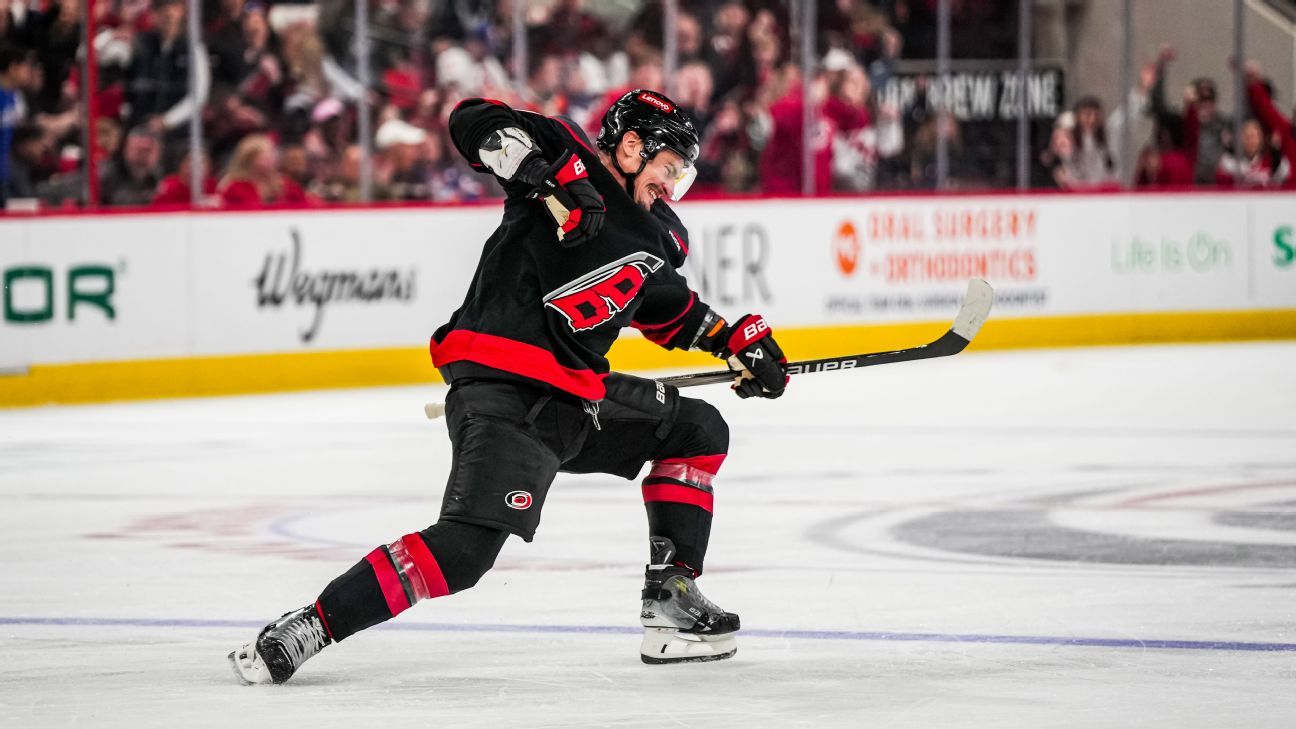
The Hurricanes have signed the most coveted free agent left on the board; former Jet Nikolaj Ehlers is heading to Carolina via a six-year, $8.5 million AAV contract.

The Sharks are building an elite young core of skilled players, but the front office is also surrounding them with veterans to show the youngsters the ropes. That latter trend continued Thursday, with San Jose agreeing to terms on a two-year, $6.5 million AAV pact with defenseman Dmitry Orlov.
July 2

One of the most legendary old guys without a Stanley Cup, Brent Burns is joining the Avalanche on a one-year contract to try to fill that gap on his résumé.

Perhaps acknowledging that they will no longer be in the Nikolaj Ehlers business, the Jets added a seasoned middle-six winger instead in Gustav Nyquist, who is agreeing to a one-year, $3.25 million pact.

Defenseman Alexander Alexeyev has switched sides in the Capitals-Penguins rivalry! He’ll patrol the blue line in Pittsburgh next season, thanks to a one-year, $775,000 deal.

The Pius Suter Derby is over. The veteran forward will be plying his trade for the Blues, inking a two-year, $4 million AAV pact with the club.

The big addition for the Golden Knights this offseason was Mitch Marner, but they’re making depth moves too, including signing defenseman Kaedan Korczak to a four-year, $3.25 million AAV contract.

Winnipeg: Cold in the winter. Detroit: Slightly less cold in the winter. Mason Appleton is about to find out after signing a two-year, $2.9 million AAV contract.

The Devils saw enough out of Cody Glass during the 2024-25 season to re-sign him. His new deal is for two years, $2.5 million AAV.

Salmon Arm, British Columbia, native Curtis Lazar is headed back to Western Canada, agreeing to terms on a one-year, $775,000 contract with the Oilers.
Veteran winger Anthony Mantha has made the rounds in recent seasons, and his next NHL home is in Pittsburgh, inking a one-year, $2.5 million pact.
July 1
After a brief stint for an American-based team, Andrew Mangiapane is back in Western Canada, inking a two-year, $3.6 million AAV deal with the Oilers.
Forward Justin Brazeau has chosen the Penguins as his next NHL destination, inking a two-year, $1.5 million AAV contract.
The Devils continued adding to their forward depth, adding veteran scoring winger Evgenii Dadonov via a one-year, $1 million deal.

The July 1 goalie rush continues. The Mammoth are the latest team to make an addition in the crease, inking Stanley Cup champion Vitek Vanecek via a one-year, $1.5 million deal.
Offensive defenseman John Klingberg is headed to San Jose, agreeing to terms on a one-year, $4 million pact with the Sharks.

One of the top remaining free agents available, veteran forward Mikael Granlund has landed with the Ducks on a three-year deal.

Veteran bottom-six forward Lars Eller has chosen the Senators as his next team, agreeing to terms on a one-year, $1.25 million deal.
The Penguins have extended their business relationships with Philip Tomasino (one year, $1.75 million) and Connor Dewar (one year, $1.1 million).

As part of the effort to retake the title of Florida’s best hockey team, the Lightning have inked Pontus Holmberg to a two-year, $1.55 million AAV contract.

The Wild have added Nico Sturm. The former Panther has signed a two-year, $2 million AAV contract.

The Sabres have entered the chat! The club’s first big deal of the day is inking goaltender Alex Lyon to a two-year, $1.5 million AAV contract.

The Kraken add to their goaltending depth, adding former Stanley Cup winner Matt Murray on a one-year, $1 million contract.

The Islanders had themselves a great draft weekend, and they continue the momentum in free agency, adding veteran forward Jonathan Drouin on a two-year, $4 million AAV deal.

The Stars are on the board. Hours after announcing the official hiring of Glen Gulutzan as the club’s new head coach, the Stars have brought back forward Radek Faksa on a two-year, $3 million AAV contract.

Earlier on Tuesday the Kings lost defenseman Vladislav Gavrikov to the Rangers. To help fill that blue-line gap, they signed Cody Ceci (four years, $4.5 million AAV) and Brian Dumoulin (three years, $4 million AAV). They also signed goaltender Anton Forsberg for two years, $2.25 million AAV.

Defenseman Nick Perbix has thus far only known NHL life as a member of the Lightning. He’ll head to Nashville next, agreeing to a two-year, $2.75 million AAV deal with the Predators.

The Panthers have gone to the veteran defenseman well again, signing Jeff Petry to a one-year, $775,000 contract.
Fresh off a Stanley Cup with the Panthers, defenseman Nate Schmidt is joining the Mammoth by way of a three-year, $3.5 million AAV contract.
The NHL career of James van Riemsdyk will continue, as he has agreed to terms with the Red Wings on a one-year, $1 million deal. Separately, the Wings added Jacob Bernard-Docker on a one-year, $875,000 contract.

The Bruins add to their depth, agreeing to terms with Sean Kuraly on a two-year, $1.85 million AAV pact.
Another key member of the Panthers’ championship roster is returning. Veteran forward Tomas Nosek has agreed to a one-year deal.
After completing the 2024-25 season with the Jets, veteran forward Brandon Tanev is sticking in the Central Division, but heading to Utah by way of a three-year, $2.5 million AAV deal.

Take another goalie’s name off the big board! Kaapo Kahkonen has agreed to terms with the Canadiens on a one-year deal worth $1.15 million. In a separate deal, the club also signed forward Sammy Blais.
The winner of the 2020 Hobey Baker Award as the top player in NCAA men’s hockey, defenseman Scott Perunovich has signed a one-year deal with the Mammoth.
In need of some backup goaltending depth, the Islanders agreed to terms with “Big Save” Dave Rittich on a one-year deal.
Diminutive, versatile forward Kailer Yamamoto is the latest player added by the Mammoth, by way of a one-year, $775,000 pact.
Veteran center Nick Bjugstad has made his decision: He’s joining the Blues by way of a two-year contract.
Veteran defenseman Ryan Lindgren finished the 2024-25 season with the Avalanche, and he’ll head northwest for his next NHL home, agreeing to terms on a four-year, $4.5 million AAV contract.
The Senators haven’t been able to lure any new free agents to the club yet, but their re-signing game remains strong. After re-upping with Claude Giroux, the Sens also continued their business relationship with Nick Cousins via a one-year, $825,000 pact.
Sure to be a fan favorite in Beantown, veteran forward Tanner Jeannot has agreed to terms on a five-year contract with the Bruins, with a $3.4 million AAV.

A sixth-round pick in the 2016 draft, winger Michael Pezzetta is going from Montreal to Toronto via a two-year, $787,500 AAV contract.
Connor Brown impressed a lot of viewers with inspired play during the Oilers’ run to the Stanley Cup Final. Now, he’ll bring that energy to the Devils, who have signed him to a four-year, $3 million AAV contract.

The defenseman market is one key player smaller, as the Rangers have agreed to terms with Vladislav Gavrikov on a seven-year, $7 million AAV contract.

One of the top goaltending options available is off the board, with Dan Vladar joining the Flyers via a two-year, $3.35 million AAV contract.
Veteran feisty forward Corey Perry is switching sides in the Oilers-Kings rivalry, agreeing to terms on a one-year deal with salary and bonuses worth $3.5 million. Separately, the Kings also signed veteran forward Joel Armia to a two-year deal with a $2.5 million AAV.

One of the top available free agents has made a decision … and he’ll be re-signing. Brock Boeser is back with the Canucks by way of a seven-year, $7.3 million AAV contract.
Parker Kelly will continue his career with the Avalanche, agreeing to terms on a four-year contract with a $1.7 million AAV.
Veteran forward Colin Blackwell will be returning to the Stars, agreeing to terms on a two-year deal with a $775,000 AAV.
Christian Dvorak has moved on from the Canadiens, agreeing to a one-year, $5.4 million contract with the Flyers.
Noah Juulsen, welcome to Philly! The Flyers have inked the 28-year-old defenseman to a one-year, $900,000 deal.
Defenseman Ryan Johnson is sticking with the Sabres, agreeing to terms on a three-year deal with a $775,000 AAV.
The top-rated goaltender slated to hit free agency this offseason will not make it to market; Jake Allen is back with the Devils via a five-year contract with a $1.8 million AAV.
Veteran offensive defenseman Tony DeAngelo will be back with the Islanders for 2025-26, agreeing to terms on a one-year, $1.75 million contract.
June 30
The Red Wings will be continuing their relationship with veteran forward Patrick Kane, inking a one-year, $3 million extension.
The band is getting back together. After re-upping with Sam Bennett last week, the Panthers re-signed both Aaron Ekblad and Brad Marchand on Monday.
Rumors of a Mitch Marner trade popped up during draft weekend, and they came to fruition Monday, as the Maple Leafs inked Marner to an eight-year, $12 million average annual value extension, then traded him to the Golden Knights for Nicolas Roy.
The Oilers will not be allowing one of their promising young players to leave via offer sheet, as they signed restricted free agent defenseman Evan Bouchard to a four-year, $10.5 million AAV contract.

Veteran defenseman Ivan Provorov would have been one of the most sought-after blueliners on the free agent market. Instead, he’ll be back with the Blue Jackets for the foreseeable future, agreeing to a seven-year, $8.5 million AAV deal.
-
 Sports3 years ago
‘Storybook stuff’: Inside the night Bryce Harper sent the Phillies to the World Series
-
 Sports1 year ago
Story injured on diving stop, exits Red Sox game
-
 Sports2 years ago
Game 1 of WS least-watched in recorded history
-
 Sports2 years ago
MLB Rank 2023: Ranking baseball’s top 100 players
-
Sports4 years ago
Team Europe easily wins 4th straight Laver Cup
-
 Environment2 years ago
Japan and South Korea have a lot at stake in a free and open South China Sea
-
 Sports2 years ago
Button battles heat exhaustion in NASCAR debut
-
 Environment2 years ago
Game-changing Lectric XPedition launched as affordable electric cargo bike