
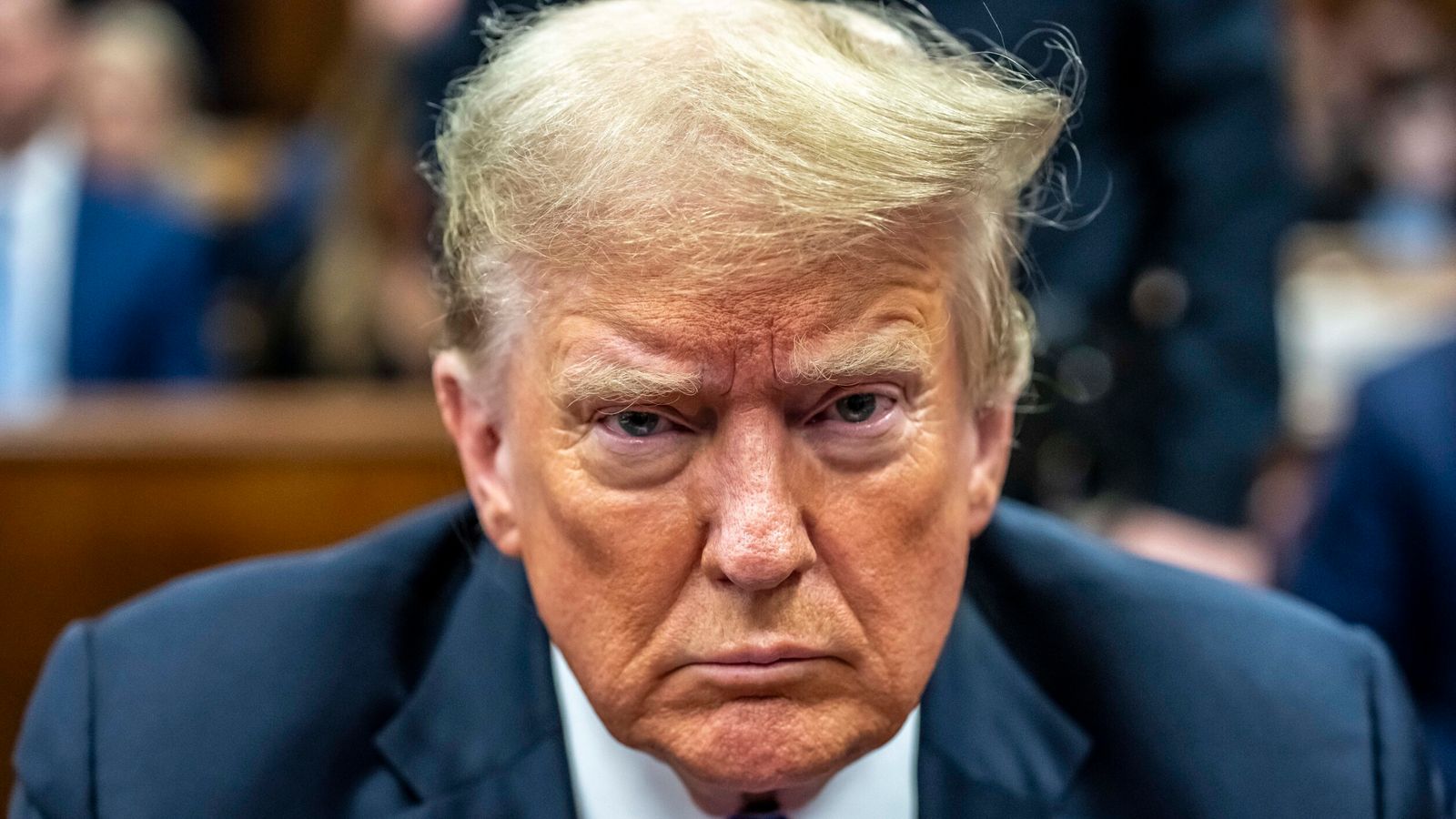
Donald Trump is still facing criminal charges – what happens now he has won US election?

Whoever picked up the keys to the White House, this was always going to be a historic election win.
A Kamala Harris victory would have made her the first female president. Donald Trump is the first convicted felon to become POTUS.
In May, Trump became the first former US president to be criminally convicted, for attempting to cover up a hush money payment to porn star Stormy Daniels during his 2016 campaign.
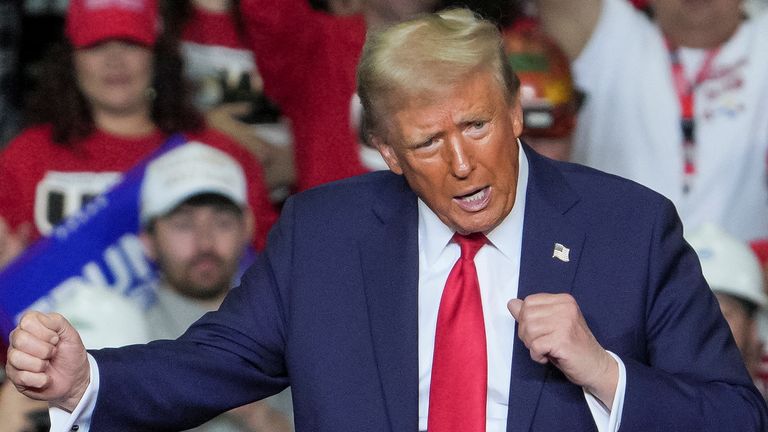
Mr Trump is now due to be inaugurated as president for the second time. Pic: Reuters
He was found guilty of 34 counts of falsifying business records to commit election fraud. As it stands, he is due to be sentenced in this case later in November.
Mr Trump, who is due to be inaugurated as president in January, has also been embroiled in other state and federal criminal cases, as well as civil cases. He has pleaded not guilty to charges against him and alleged prosecutions are politically motivated.
Experts say it is likely the federal cases at least will “go away”.
‘Hush money’ – state case
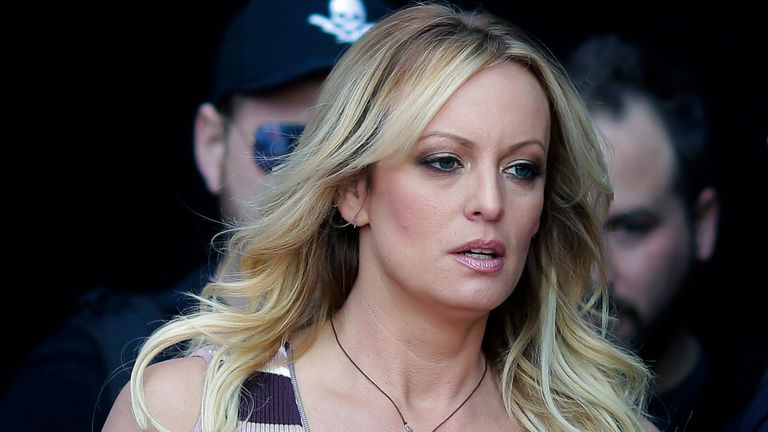
Stormy Daniels. Pic: AP 2018
This is the case relating to Stormy Daniels, for which Trump was found guilty of covering up his then lawyer’s $130,000 (£99,000) payment for her silence before the 2016 election, about a sexual encounter she alleges they had a decade earlier.
Trump is due to be sentenced in New York on 26 November – and could face up to four years in prison. His lawyers are now expected to ask Justice Juan Merchan to delay the hearing.
Initially set for July, Judge Merchan has already twice postponed the sentencing. This is in part due to a US Supreme Court ruling made in July, finding that presidents have broad immunity from prosecution over their official acts.
Mr Trump argues the case should be dismissed based on this, which prosecutors dispute.
Election subversion – federal case
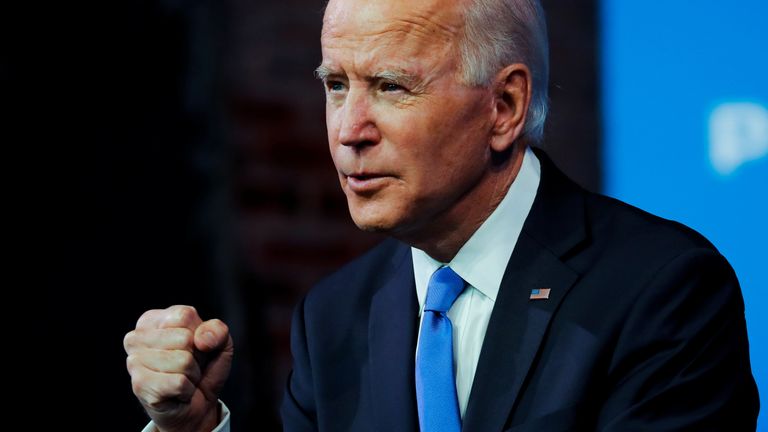
Trump claimed that he won the 2020 election, not Joe Biden. Pic: Reuters
Donald Trump is also charged with attempting to overturn his defeat in the 2020 election, which he lost to Joe Biden.
He has pleaded not guilty to criminal charges accusing him of a conspiracy to obstruct the process to collect and certify the results.
He was accused of using “dishonesty, fraud, and deceit” and spreading “pervasive and destabilising lies about election fraud”.
Again, this case has been slowed by the US Supreme Court ruling on presidents and immunity.
Election interference – state case
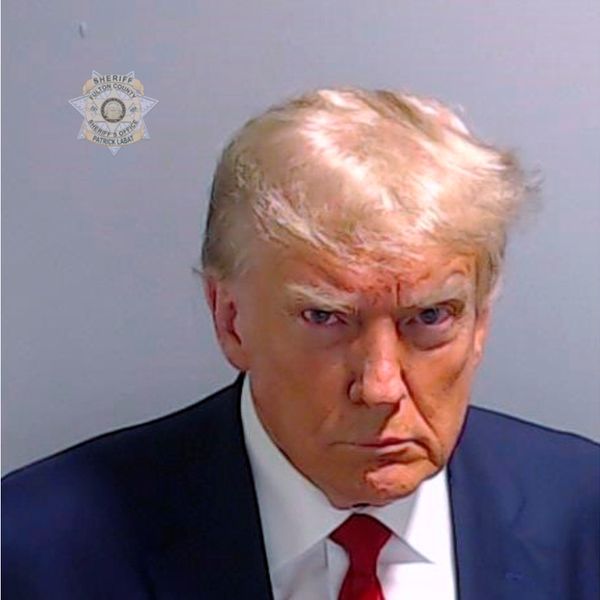
Mugshot from the Fulton County Sherriff’s Office in Georgia. Pic: AP/Fulton County Sherriff
Mr Trump was formally booked at Georgia’s Fulton County jail in August 2023, charged over an alleged conspiracy to reverse his defeat specifically in the battleground state in the 2020 election.
While he was there, he had his mugshot and fingerprints taken before being released on bail. Speaking to media afterwards, he said: “What has taken place here is a travesty of justice. We did nothing wrong. I did nothing wrong and everybody knows that. I’ve never had such support.”
The election result in Georgia was memorably close, triggering two recounts, but ultimately Mr Biden won by 11,779 votes – or 0.23% of the five million cast.
It was certified by both Georgia’s Republican governor Brian Kemp and secretary of state Brad Raffensperger. But Mr Trump did not accept the result.
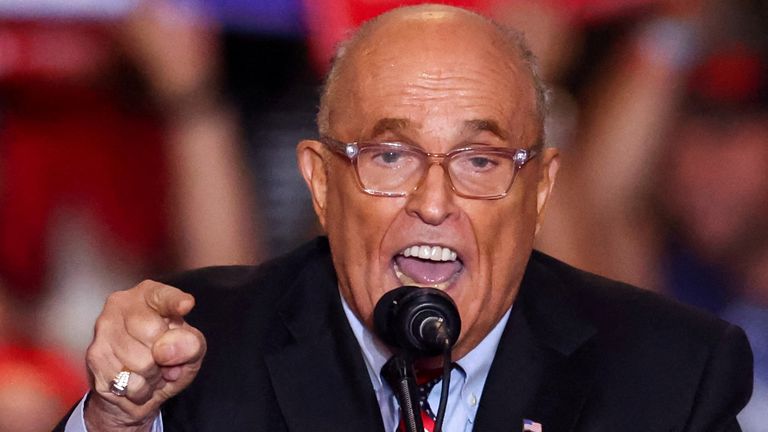
Rudy Giuliani, former mayor of New York City and Trump lawyer, was also charged in the case in Georgia
Prosecutors used state racketeering laws, developed to fight organised crime, to charge him and others, including his former lawyer Rudy Giuliani.
Mr Trump and eight of his 14 co-defendants in the case are appealing. They are seeking to disqualify the lead prosecutor, Fulton County District Attorney Fani Willis, over alleged misconduct.
Misuse of classified documents – federal case
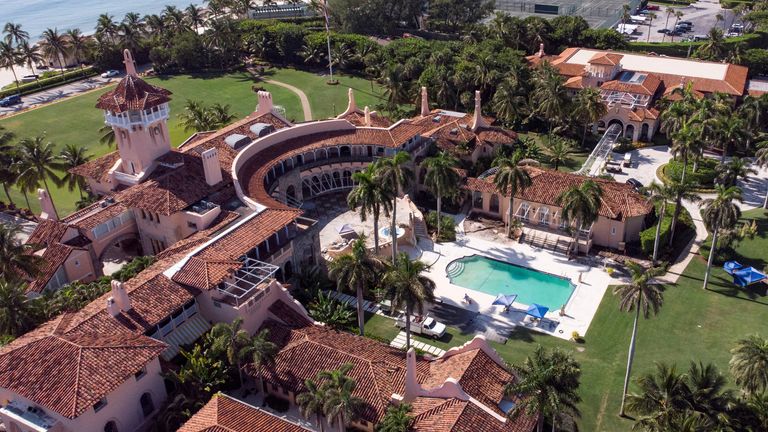
Documents were found at Trump’s Mar-a-Lago home. Pic: REUTERS/Marco Bello 2022
Mr Trump had also faced charges over classified documents he allegedly took from the White House, including deleting CCTV footage of his staff moving boxes at his Florida home.
However, a judge threw out this case against him on 15 July.
Details on the US nuclear weapons programmes, potential vulnerabilities of the nation and its allies, and plans for retaliatory military attacks were in some of the documents, the federal indictment said.
Prosecutors are appealing.
Civil cases
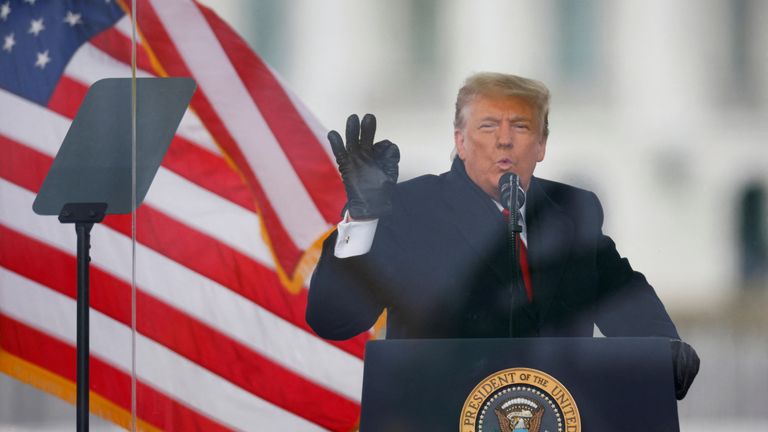
Trump spoke at a rally contesting the result of the 2020 election. Pic: Reuters
He is also appealing several civil lawsuits totalling more than $500m (about £388m), which likely won’t be affected by his win.
These include a civil fraud case in New York state, and cases brought by writer E Jean Carroll, who sued him for allegedly sexually assaulting her in the 1990s, and defaming her while he was president the first time.
The appeals court is expected to rule in the sexual assault case first, with the ruling expected at any time, according to NBC.
Mr Trump is also facing eight pending civil suits related to the attack on the US Capitol on 6 January 2021, following his complaints of voter fraud in the 2020 election.
No trial date has been set, but with appeals these could take months or even longer to be determined, NBC reports.
So what happens now?
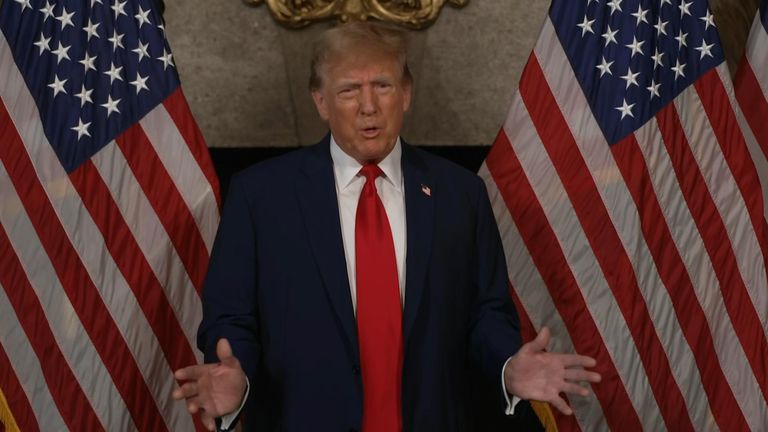
March 2024: Donald Trump on presidential immunity
Experts say his election victory will essentially end the criminal cases brought against him, at least for the time he occupies the White House.
He has previously said that should he become president again, he would fire US Special Counsel Jack Smith – who led the federal prosecutions – “within two seconds” of being sworn in.
While he will indeed have the authority to fire Mr Smith and shut down the federal cases, he will not have the same control over state cases in New York and Georgia.
However, being the US president is a unique position, and means it is unlikely he will face legal consequences in either case during his term in office.
Does that mean he gets off?
Sky News US correspondent James Matthews says this is a possibility, although he adds that the two state cases “are more complicated”.
As president, Mr Trump would have the power “to appoint officials of his choice at the Department of Justice,” Matthews added, and it is “probably fair to say their brief would include dropping the two federal cases”.
Can Trump pardon himself?
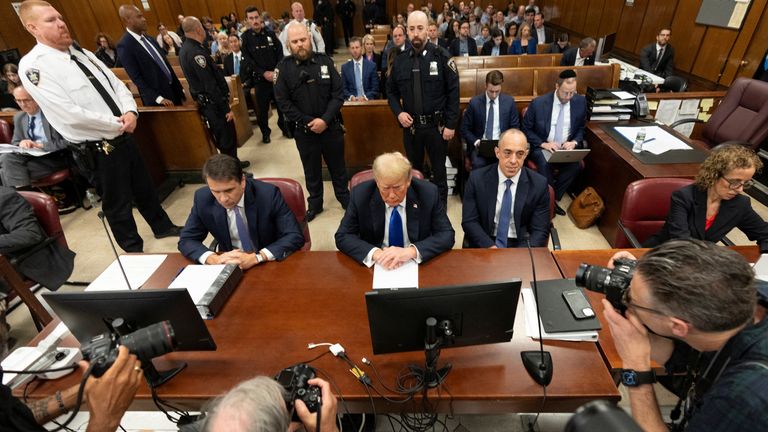
Pic: Steven Hirsch/pool via Reuters – May 2024
This is also a possibility, Matthews said. It falls within the power of the president, although a self-pardon has never been tested legally.
The issue of a pardon doesn’t apply in state cases – however, the conviction and prosecution are weakened by the Supreme Court ruling.
“Nor can evidence of official acts be used in evidence to support the prosecution of a crime committed out of office,” Matthews said.
“In both the New York appeal and Georgia case, expect Trump’s lawyers to point to evidence used to convict him – phone calls and behaviour whilst in the role of president – and claim it relates to official acts and, under the Supreme Court ruling, should be ruled inadmissible.”
Read more:
Trump’s main pledges for second term
Harris team will be searching for answers
Danny Cevallos, legal analyst for Sky News’ US partner NBC, said he could say with “a lot of confidence” that the federal cases “are going to go away”.
Mr Trump could appoint an attorney general “who will simply do his bidding and dismiss the case,” he said, or he could instruct the justice department “to not even bother with the appeal of the already dismissed federal case. Those cases are, for all intents and purposes, gone”.
Next up, the hush money case. Even if sentencing does happen on 26 November, “in all likelihood, it’s not a case that he’s going to get prison time”, Mr Cevallos said, due to a number of factors.
He added: “You have someone over 75 years old, no guns, no drugs, no violence… in the spectrum of criminals who might be able to get a probation-only or house arrest sentence, Donald Trump is in a high likelihood. That’s even if the case goes forward this month for sentencing, it might not.”
Finally, the case in Georgia is “mired in appeal”, Mr Cevallos said.
“In all likelihood, those cases will be put on pause. And four years from now, who knows what the political situation will be in Fulton County, Georgia.”
Fulton County is “not good at speedy trials in complex cases,” he added, so “Donald Trump’s case may never see the light of day in Georgia”.
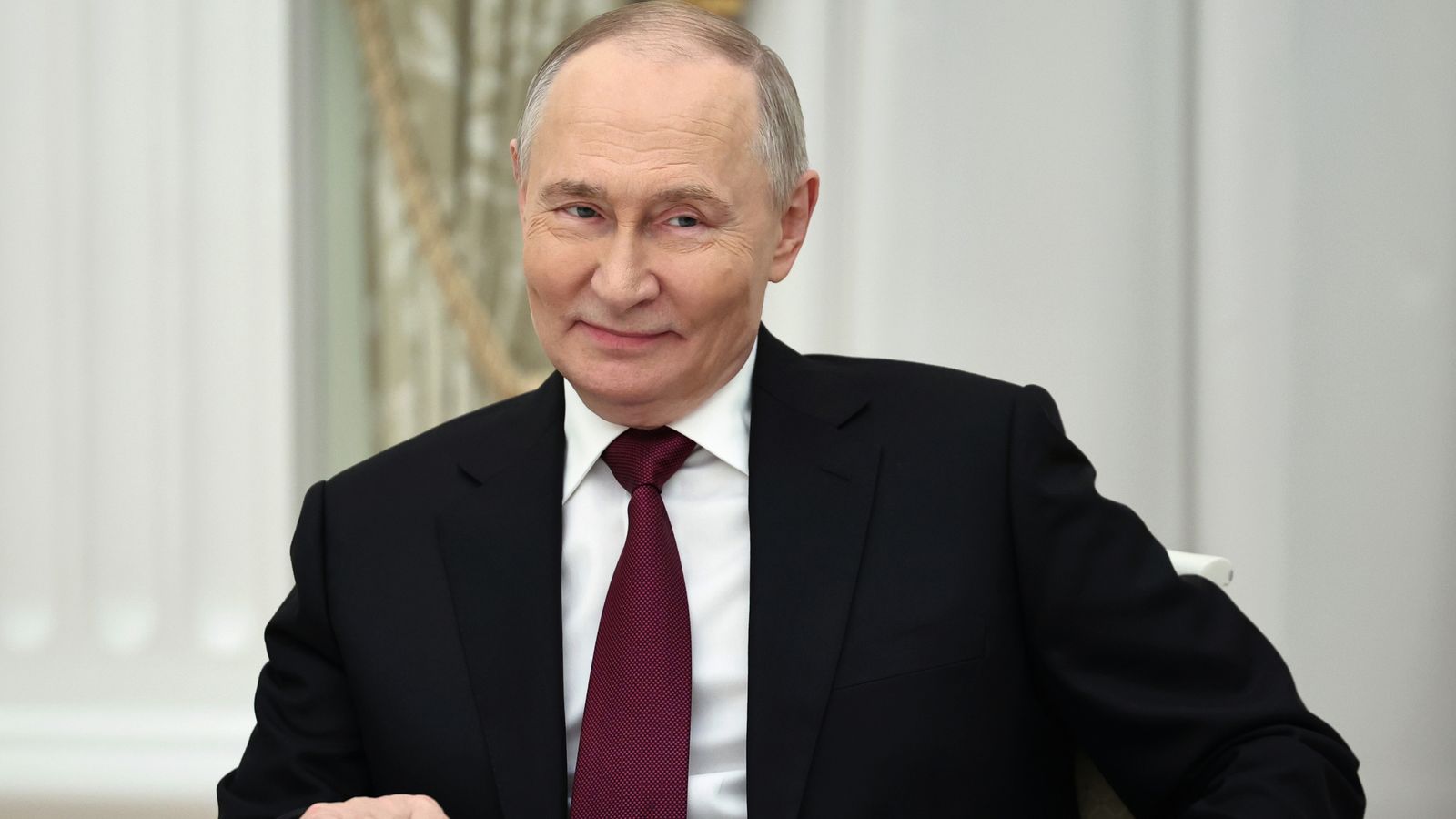
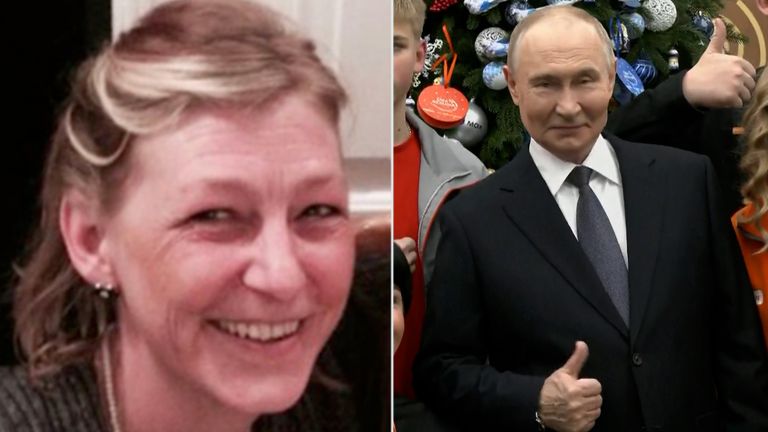
There is a sense of impotent futility to the latest sanctions imposed by the UK on Russia in the wake of the Dawn Sturgess public inquiry report released today.
And it’s not just the UK.
For all Europe’s handwringing, rhetoric and sanctions, Vladimir Putin remains unmoved.
This week, he was more belligerent than ever, warning that while Russia does not want a war, if Europe starts one, it’s more than ready.
Ukraine war latest: Putin says Donald Trump has an agenda
As we approach a fourth year of Russia’s war with Ukraine, the world is operating under new management and new rules, but the penny has not yet dropped in Europe.
The much-vaunted ‘rules-based world order’ is falling apart. America, so long its guardian, has deserted it and is now in league more and more with Russia.
The role Putin played in Briton’s death
The Trump administration is more interested in the promise of renewed trading ties and business deals with Putin’s Russia, despite all its murderous faults.
Putin is winning on the battlefield, slowly but steadily, and Ukraine is running out of money. America has turned off the tap and is now acting as an arms dealer, selling Ukraine weapons via Europe.
Ukraine needs in excess of a hundred billion dollars a year to continue fighting. Europe is bickering over how to use frozen Russian assets to fund that.
And there is certainly no sign of European governments biting the bullet and asking taxpayers to do so instead.
Read more:
Briton detained in Ukraine
Putin ‘morally responsible’ for Salisbury novichok death
The alternative way of stopping Russia’s grinding advance is sending troops to Ukraine, which remains out of the question.
So for now, we have just words and sanctions instead.
Sir Keir Starmer may wring his hands about the “Kremlin’s disregard for innocent lives” in the wake of the inquiry into Dawn Sturgess’s death in Salisbury in 2018. It holds the Russian leader “morally responsible” for the Skripal poisoning.
But if Europe is not prepared to put its money where its rhetoric and sanctions are, does this add up to much more than posturing?
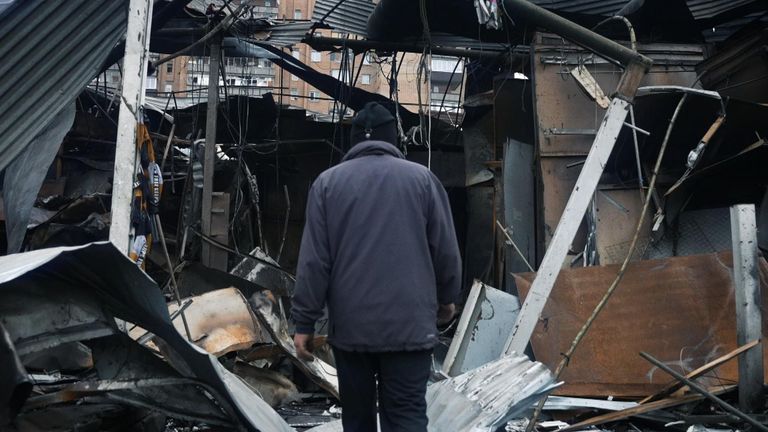
Ukrainian troops react to Trump’s peace plan
European governments have for almost a year seemed in denial, acting like a cheated spouse. As America’s affections for Russia have become more and more obvious, Europe has hoped against hope to win back its partner.
The affair between Trump and Putin is now, it seems, in full sight.
America no longer wants to support either Europe or Ukraine, only to profit from arms sales to the conflict.
Tantalising deals dangled by Moscow are all it takes, it seems, to keep Donald Trump’s interest.
Substituting impotent sanctions and rhetoric for solid financial support for Ukraine at some point becomes worse than pointless.
It encourages Kyiv to carry on fighting, as Putin put it recently, “to the last Ukrainian” in the mistaken belief that Europe has its back.
The moment of reckoning approaches for Europe, but there is no sign of its leaders accepting that fact.
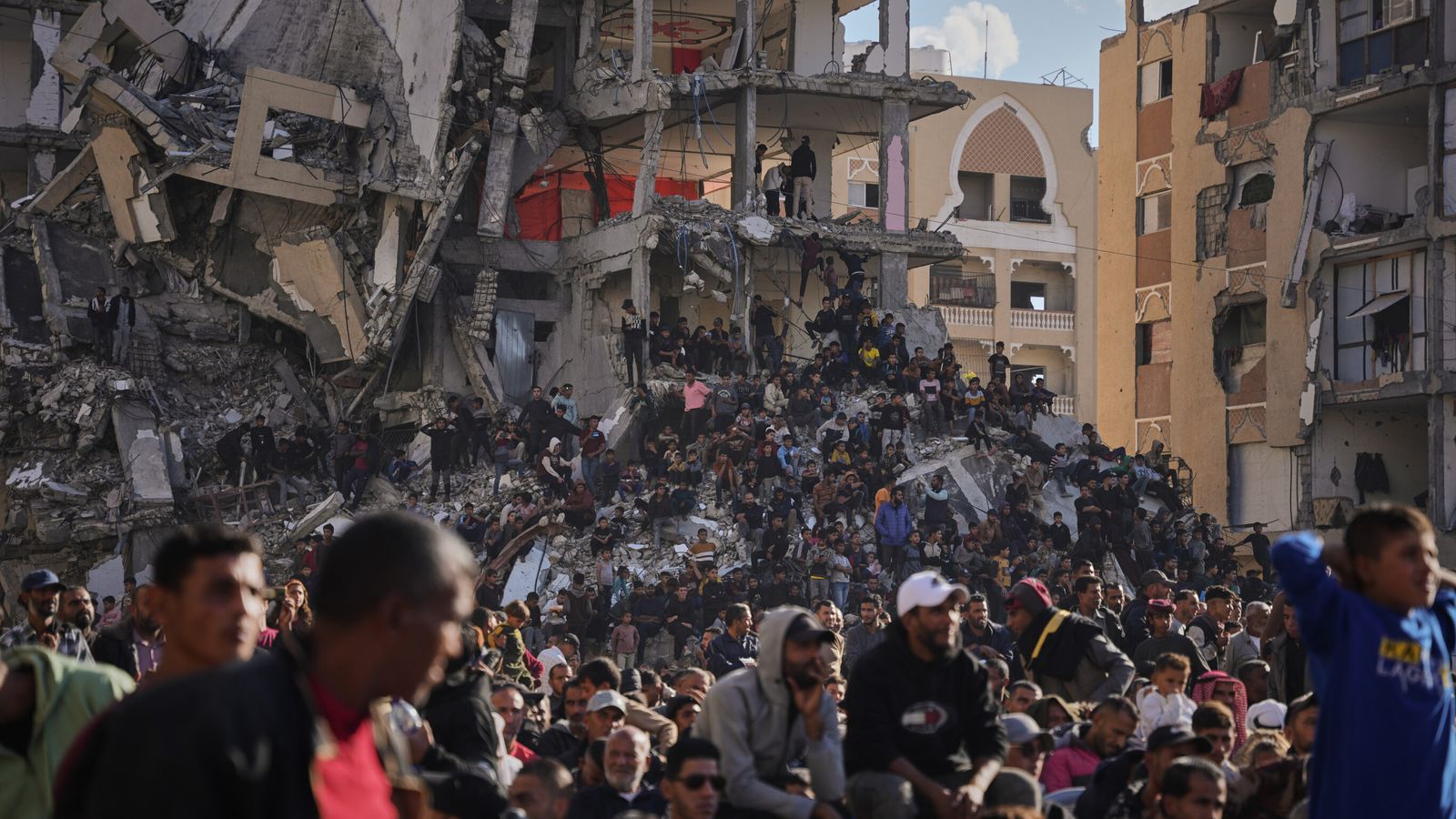
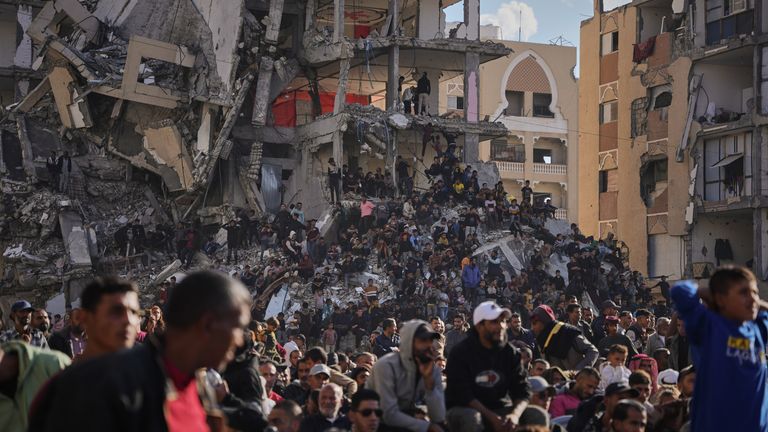
There is a desperate desire for normality in Gaza – for full shops, functioning hospitals, open schools, habitable homes and usable roads. For electricity that comes on reliably, skies that don’t hum with drones and days that don’t crackle with gunfire.
In Khan Younis, 54 couples got married at one enormous shared ceremony. The event attracted crowds who clambered on to a smashed-out building opposite the dais to wave at the brides and grooms, and to celebrate. Amid a grey landscape of dust and destruction, the image was one of colour and cheer.
It is a captivating vision of a better world, but it is an illusion. Gaza is still being ripped by tides of danger, violence and volatility. And it all sits within a cobweb of conflicting interests that makes security so precarious that you wonder how peace can ever return.
Take the past day or two. First, the Israeli military says that five of their soldiers have been injured after being attacked by Hamas fighters who may have emerged from hiding in tunnels.
Palestinians celebrate a mass wedding ceremony in Khan Younis, on 2 December: Pic: AP
As has happened after all such incidents previously, Israel responds with a show of might – with an airstrike that, it says, was aimed at a senior Hamas official. In the ensuing fallout, civilians, including two children, are killed.
Israel also announces that it will open the Rafah Crossing, but only to allow people out of Gaza. Egypt says it won’t co-operate unless the crossing allows people to go in both directions. Israel, which suspects Egypt of offering financial support to Hamas, does not agree. Stalemate.
Also in Rafah, Yasser Abu Shabab, leader of a militant group that opposed Hamas and was getting covert backing from Israel, is killed, presumably by Hamas fighters. Exactly how they got into his territory is hard to guess, but his killing suggests that, far from being degraded, Hamas is once again exerting control.
Read more:
Anti-Hamas militia leader killed in Gaza Strip – reports
Rafah crossing to open ‘in coming days’, Israel says
And then there is the return of the remains of the penultimate hostage, Sudthisak Rinthalak, from Gaza to Israel. Only one body now remains to be handed back, that of police officer Ran Gvili, and once that has been returned, then we wonder what will happen next.
In theory, we enter Phase Two, which will see a flood of aid, the disarmament of Hamas, the rebuilding of Gaza and a new governance structure. But the obstacles ahead are monumental, ranging from questions about exactly who is going to take Hamas’s weapons away from them, to how Palestinians are going to feel about Gaza being governed by foreigners.
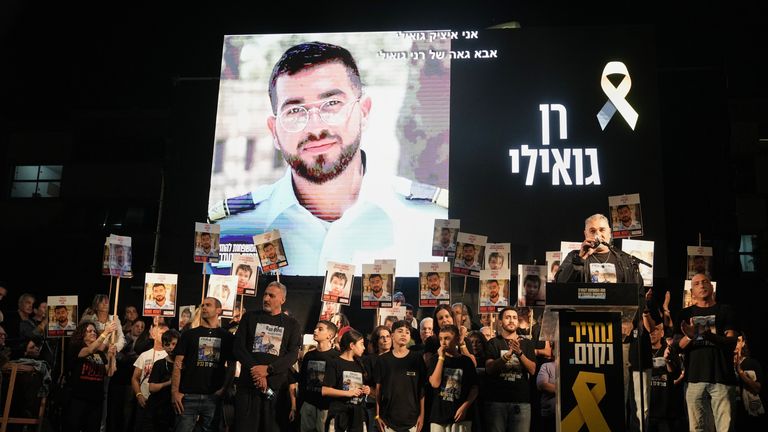
Hostage Ran Gvili, whose remains have yet to be returned. Pic: AP
Sources say that a huge amount of effort has been invested, largely by American diplomats, soldiers, planners and business people, in trying to plan for this future. America has a huge co-ordination centre set up in southern Israel and President Trump believes that peace in the Middle East is his ticket to the Nobel Prize.
But it would be a huge – strike that, impossible – stretch of faith to think that these plans will come into play effortlessly. They won’t. The ambitions outlined in Phase Two are still little more than hopes.
For one thing, half of Gaza is still under Israeli military control and the IDF are not going anywhere. For another, the other half of Gaza is in a state of quasi-anarchy.
The idea of a military supervisory force has been signed off by the United Nations, but has not yet been created. Nor has a set of rules of engagement – imagine if an Egyptian military unit comes across a firefight between Hamas and a different militia – who would they shoot at first? What rules would cover their actions? How do you maintain peace in Gaza?
The questions go on into the distance. And, as long as Hamas regroups, so the concept of it then choosing to voluntarily disarm and largely disband seems harder and harder to believe. If that doesn’t happen, then Israel will not stop worrying about another October 7 attack.
We could go on like this, but the point is clear. The return of the final hostage will bring into play a mass of new questions, none of which appear to have answers. And for the people of Gaza, the anxiety of life will roll on.
World
Salisbury novichok poisonings: Putin ‘morally responsible’ for woman’s death after authorising botched spy assassination bid
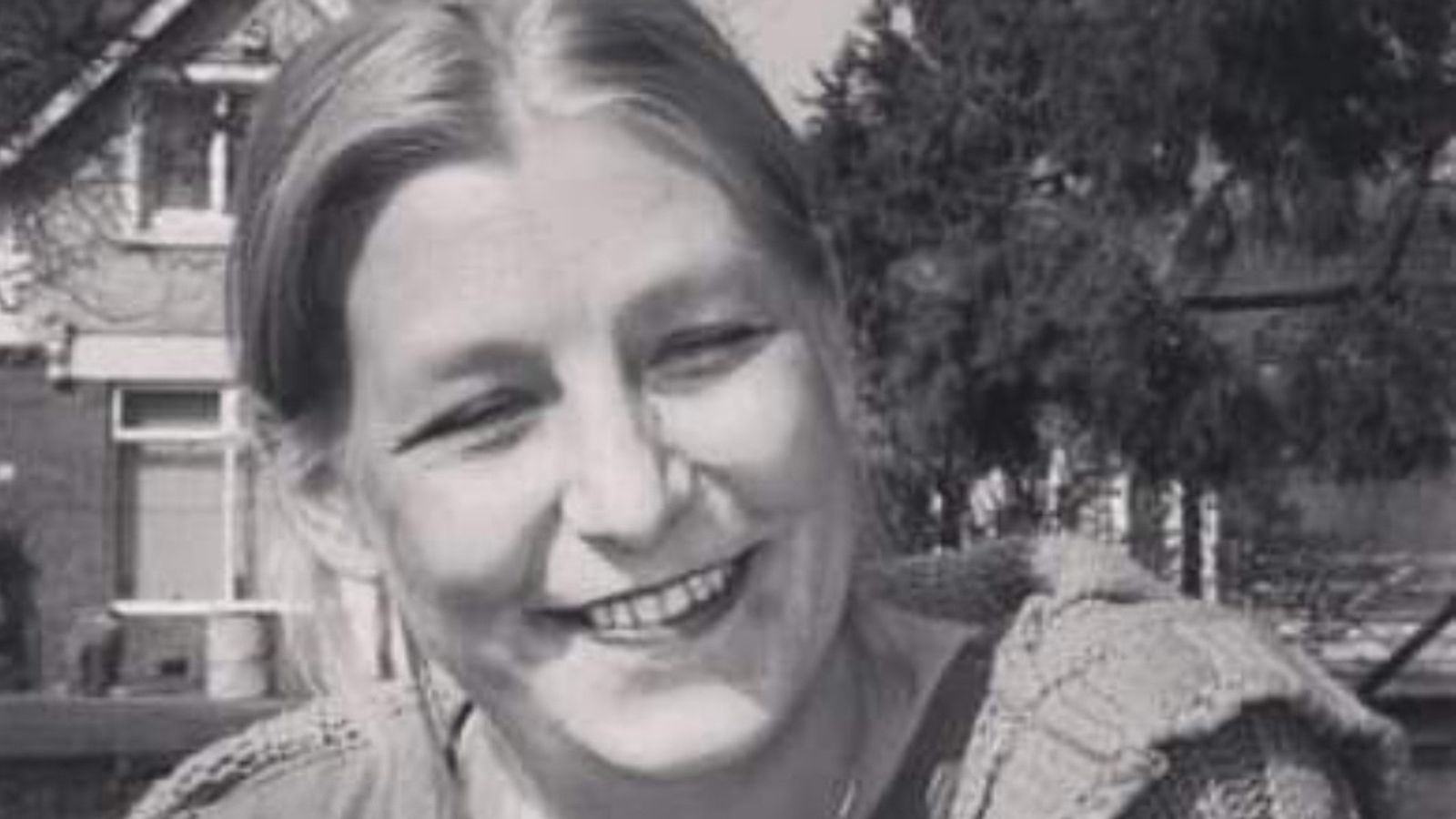
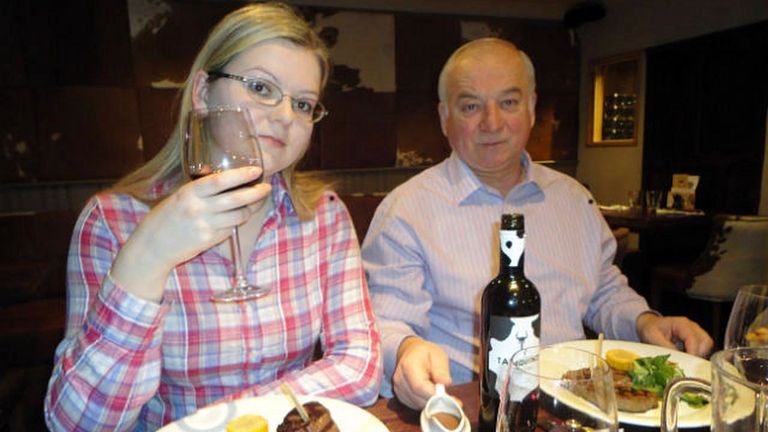
The assassination attempt on a former Russian spy was authorised by Vladimir Putin, who is “morally responsible” for the death of a woman poisoned by the nerve agent used in the attack, a public inquiry has found.
The chairman, Lord Hughes, found there were “failings” in the management of Sergei Skripal, 74, who was a member of Russian military intelligence, the GRU, before coming to the UK in 2010 on a prisoner exchange after being convicted of spying for Britain.
But he found the assessment that he wasn’t at “significant risk” of assassination was not “unreasonable” at the time of the attack in Salisbury on 4 March 2018, which could only have been avoided by hiding him with a completely new identity.
Mr Skripal and his daughter Yulia, 41, who was also poisoned, were left seriously ill, along with then police officer Nick Bailey, who was sent to search their home, but they all survived.
Sergei Skripal and Yulia Skripal.
Pic: Shutterstock
Dawn Sturgess, 44, died on 8 July, just over a week after unwittingly spraying herself with novichok given to her by her partner, Charlie Rowley, 52, in a perfume bottle in nearby Amesbury on 30 June 2018. Mr Rowley was left seriously ill but survived.
In his 174-page report, following last year’s seven-week inquiry, costing more than £8m, former Supreme Court judge Lord Hughes said she received “entirely appropriate” medical care but her condition was “unsurvivable” from a very early stage.
The inquiry found GRU officers using the aliases Alexander Petrov, 46, and Ruslan Boshirov, 47, had brought the Nina Ricci bottle containing the novichok to Salisbury after arriving in London from Moscow with a third agent known as Sergey Fedotov to kill Mr Skripal on 2 March.
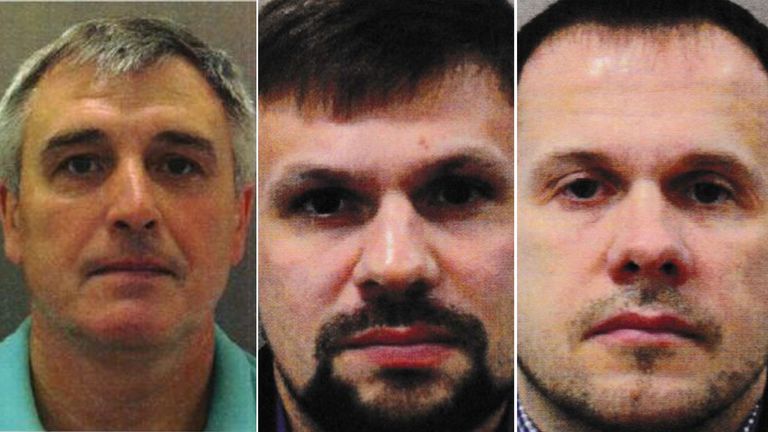
L-R Suspects who used the names of Sergey Fedotov, Ruslan Boshirov and Alexander Petrov. Pics: UK Counter Terrorism Policing
The report said it was likely the same bottle Petrov and Boshirov used to apply the military-grade nerve agent to the handle of Mr Skripal’s front door before it was “recklessly discarded”.
“They can have had no regard to the hazard thus created, of the death of, or serious injury to, an uncountable number of innocent people,” it said.
It is “impossible to say” where Mr Rowley found the bottle, but was likely within a few days of it being abandoned on 4 March, meaning there is “clear causative link” with the death of mother-of-three Ms Sturgess.
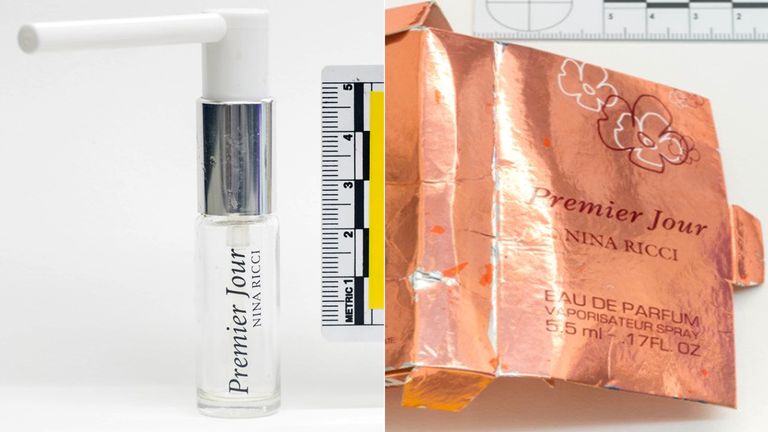
Novichok was in perfume bottle. Pic: Reuters
Lord Hughes said he was sure the three GRU agents “were acting on instructions”, adding: “I have concluded that the operation to assassinate Sergei Skripal must have been authorised at the highest level, by President Putin.
“I therefore conclude that those involved in the assassination attempt (not only Petrov, Boshirov and Fedotov, but also those who sent them, and anyone else giving authorisation or knowing assistance in Russia or elsewhere) were morally responsible for Dawn Sturgess’s death,” he said.
Russian ambassador summonsed
After the publication of the report, the government announced the GRU has been sanctioned in its entirety, and the Russian Ambassador has been summonsed to the Foreign Office to answer for Russia’s ongoing campaign of alleged hostile activity against the UK.
Sir Keir Starmer said the findings “are a grave reminder of the Kremlin’s disregard for innocent lives” and that Ms Sturgess’s “needless” death was a tragedy that “will forever be a reminder of Russia’s reckless aggression”.
“The UK will always stand up to Putin’s brutal regime and call out his murderous machine for what it is,” the prime minister said.
He said deploying the “highly toxic nerve agent in a busy city centre was an astonishingly reckless act” with an “entirely foreseeable” risk that others beyond the intended target would be killed or injured.
The inquiry heard a total of 87 people presented at A&E.
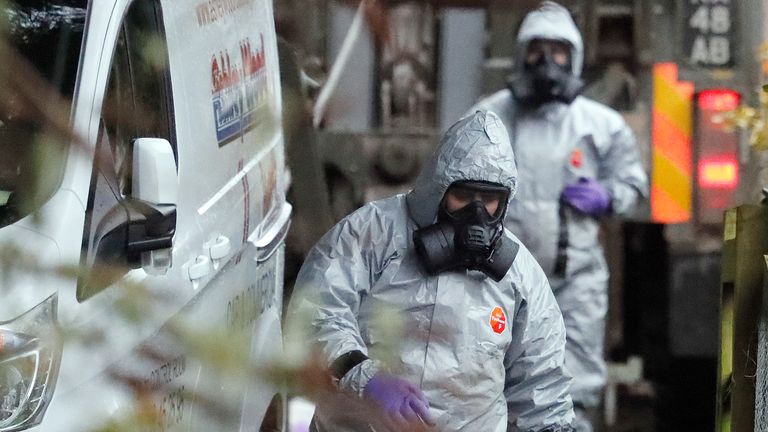
Pic AP
Lord Hughes said there was a decision taken not to issue advice to the public not to pick anything up which they hadn’t dropped, which was a “reasonable conclusion” at the time, so as not to cause “widespread panic”.
He also said there had been no need for training beyond specialist medics before the “completely unexpected use of a nerve agent in an English city”.
After the initial attack, wider training was “appropriate” and was given but should have been more widely circulated.
In a statement following the publication of his report, Lord Hughes said Ms Sturgess’s death was “needless and arbitrary”, while the circumstances are “clear but quite extraordinary”.
“She was the entirely innocent victim of the cruel and cynical acts of others,” he said.
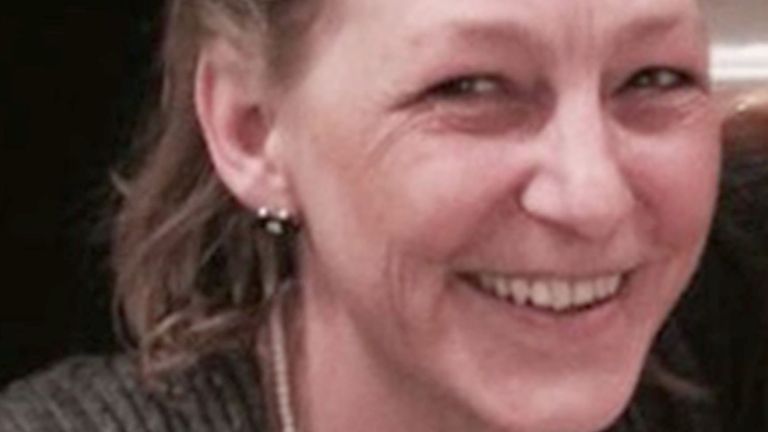
‘We can finally put her to peace’ . Pic: Met Police/PA
‘We can have Dawn back now’
Speaking after the report was published, Ms Sturgess’s father, Stanley Sturgess, said: “We can have Dawn back now. She’s been public for seven years. We can finally put her to peace.”
In a statement, her family said they felt “vindicated” by the report, which recognised how Wiltshire police wrongly characterised Ms Sturgess as a drug user.
But they said: “Today’s report has left us with some answers, but also a number of unanswered questions.
“We have always wanted to ensure that what happened to Dawn will not happen to others; that lessons should be learned and that meaningful changes should be made.
“The report contains no recommendations. That is a matter of real concern. There should, there must, be reflection and real change.”
Wiltshire Police Chief Constable Catherine Roper admitted the pain of Ms Sturgess’s family was “compounded by mistakes made” by the force, adding: “For this, I am truly sorry.”
Russia has denied involvement
The Russian Embassy has firmly denied any connection between Russia and the attack on the Skripals.
But the chairman dismissed Russia’s explanation that the Salisbury and Amesbury poisonings were the result of a scheme devised by the UK authorities to blame Russia, and the claims of Petrov and Borisov in a television interview that they were sightseeing.
The inquiry chairman said the evidence of a Russian state attack was “overwhelming” and was designed not only as a revenge attack against Mr Skripal, but amounted to a “public statement” that Russia “will act decisively in its own interests”.
Lord Hughes found “some features of the management” of Mr Skripal “could and should have been improved”, including insufficient regular written risk assessments.
But although there was “inevitably” some risk of harm at Russia’s hands, the analysis that it was not likely was “reasonable”, he said.
“There is no sufficient basis for concluding that there ought to have been assessed to be an enhanced risk to him of lethal attack on British soil, such as to call for security measures,” such as living under a new identity or at a secret address, the chairman said.
He added that CCTV cameras, alarms or hidden bugs inside Mr Skripal’s house might have been possible but wouldn’t have prevented the “professionally mounted attack with a nerve agent”.
Sky News has approached the Russian Embassy for comment on the report.
-
 Sports2 years ago
Story injured on diving stop, exits Red Sox game
-
 Sports3 years ago
‘Storybook stuff’: Inside the night Bryce Harper sent the Phillies to the World Series
-
 Sports2 years ago
Game 1 of WS least-watched in recorded history
-
 Sports3 years ago
Button battles heat exhaustion in NASCAR debut
-
 Sports3 years ago
MLB Rank 2023: Ranking baseball’s top 100 players
-
Sports4 years ago
Team Europe easily wins 4th straight Laver Cup
-
 Environment3 years ago
Japan and South Korea have a lot at stake in a free and open South China Sea
-
 Environment1 year ago
Here are the best electric bikes you can buy at every price level in October 2024