
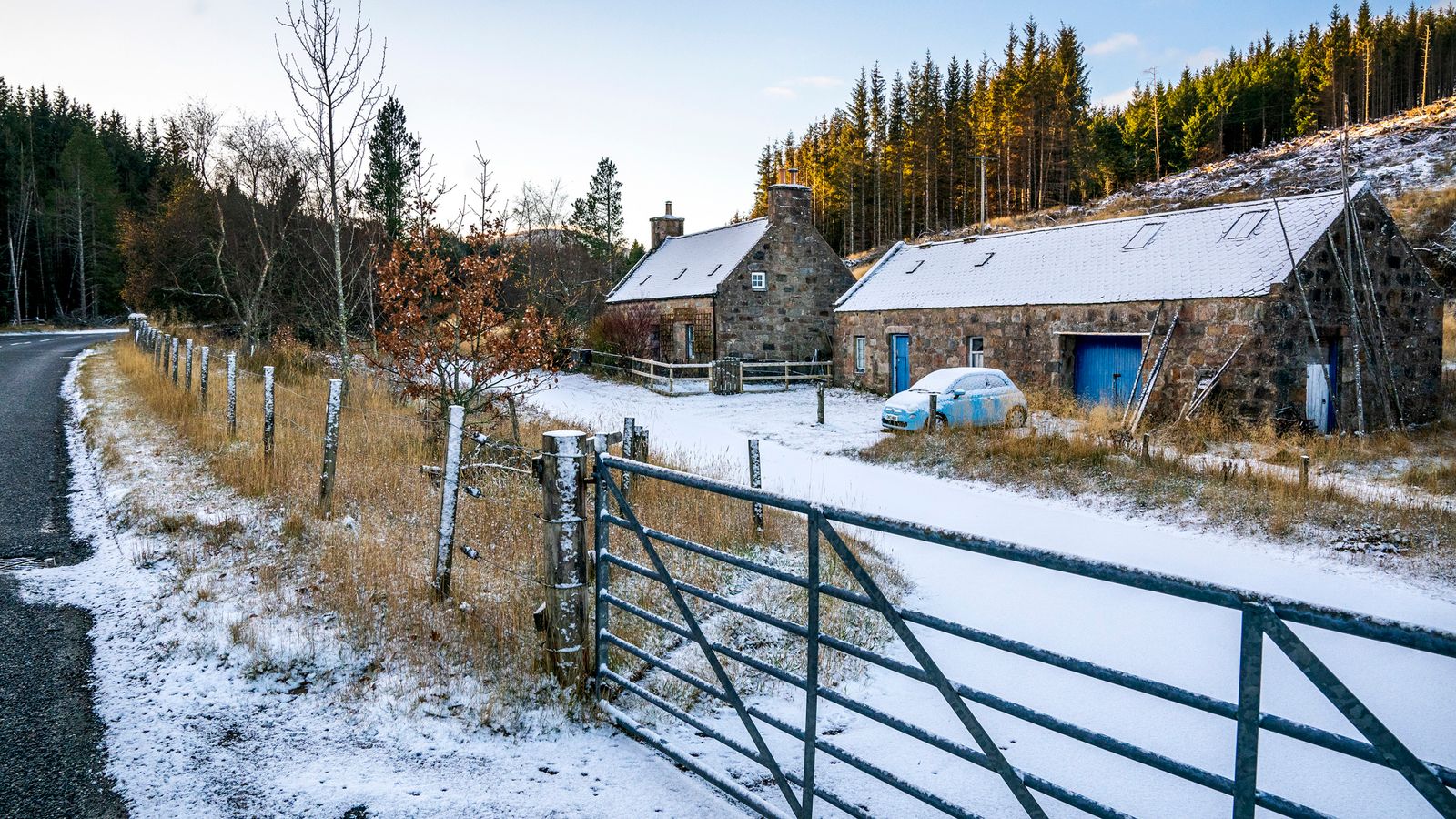
UK told to expect ‘disruptive snow’ as warnings cover large parts of country

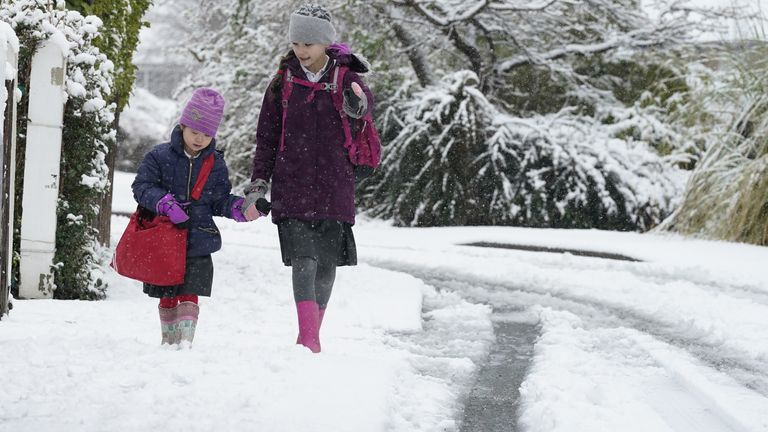
The UK is braced for “disruptive snow” as yellow weather warnings cover large parts of the country until Tuesday – with the Met Office saying there is the “potential” for the alerts to be “escalated”.
The forecaster has warned up to 20cm of snow may accumulate in the worst affected areas as the country experiences its “first taste of winter”.
The Met Office has also told people to expect ice, cold temperatures and wintry showers this week.
Check the forecast in your area
A yellow warning for snow and ice is in place for much of the north of the country – covering areas in the East Midlands, Yorkshire, Wales and the north of England – from 7pm on Monday night to 10am on Tuesday morning.
Those in the impacted areas have been told power cuts are possible and mobile phone coverage might be affected.
The Met Office has said there is a “slight chance” some rural communities could be cut off and that bus and train services may be delayed or cancelled.
People are also warned to be careful not to slip or fall on icy surfaces.
The Met Office has said there will be bright spells across northern and eastern areas throughout today, but rain in the south and west will gradually spread northeastwards and turn to snow over northern hills.
Parts of the UK are experiencing their ‘first taste of winter’, says the Met Office. File pic: PA
Tom Morgan, Met Office meteorologist, said: “We could see some disruptive snow in the Pennine regions, in particular, the Peak District as well, especially Monday night, but we could well see some impacts lasting on until Tuesday morning’s rush hour.
“Even down to lower levels, we could well see some snow as well, so quite a bit of disruption possible by Tuesday morning, and then the week ahead is likely to stay cold nationwide, a windy day on Tuesday, and then winter showers through the week ahead.”
Mr Morgan said that despite a “mild” start to the month, the cold conditions are more typical of “mid-winter to late-winter”.
“What we can say is that it’s going to be very cold for the time of year, there will be widespread overnight frosts, and a few locations where there’s snow on the ground,” he continued.
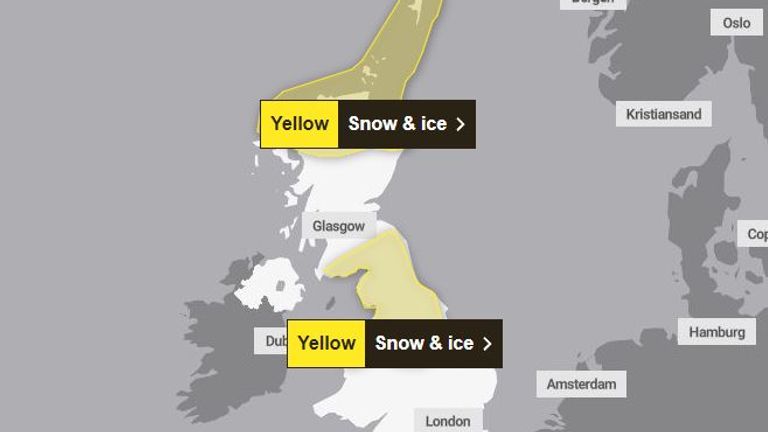
The yellow weather warnings in place across the UK
Meanwhile, a yellow snow and ice weather warning that came into force at 4pm on Sunday will end at 11am this morning.
The warning covers the northern tip of Scotland and people there have been told there may be icy patches on some untreated roads, pavements and cycle paths.
The Met Office has said there is “potential” for both yellow warnings to be “escalated”.
In southern England, a typical maximum temperature for this time of year is 11C (52F), but daytime highs for the week ahead are forecast to be around 5C (41F), while some parts of Scotland will reach “only just above freezing”, Mr Morgan said.
The meteorologist said the public can best prepare for the wintry weather by checking their cars are suitable for icy and potentially snowy conditions and to take extra supplies including food, blankets and a fully charged mobile phone with them on journeys.
He added there were “likely” to be changes to the weather warnings in the coming days, and that “winter flurries” could be seen in the south of England later in the week.
Read more from Sky News:
Starmer to push for ‘pragmatic’ relationship with China
Manhunt under way for husband after woman’s body found in car boot
Keep up with all the latest news from the UK and around the world by following Sky News
Despite the cold conditions, the “whole of the UK” will enjoy more sunshine this week, the meteorologist added.
He said: “There’ll be some snow showers in the peripheries of the UK, particularly northern Scotland, and down the east and the west coast, but if you live inland and you live in the south, there’ll be lots of sparkly blue skies on the most days through Tuesday to Friday.”
It comes as a cold weather alert issued by the UK Health Security Agency, which was introduced at 9am on Sunday, will be in place until 9am on Thursday.
It covers a large area of England, north of Northhampton. The alert is triggered when there is a risk that healthcare services might face extra pressure and is designed to prepare those who are “particularly vulnerable” and “likely to struggle to cope”.

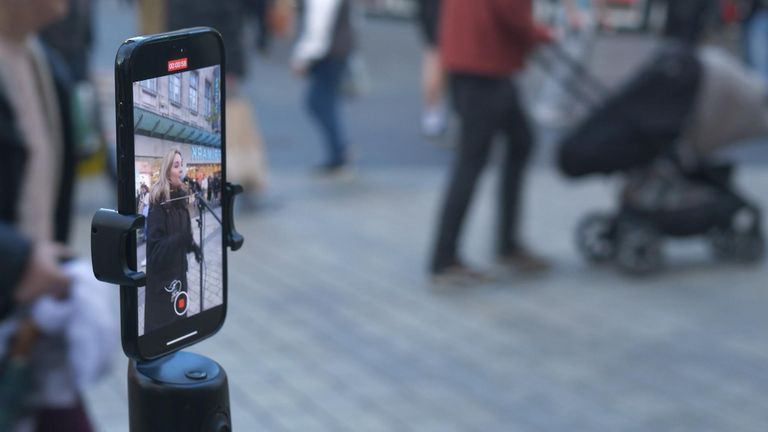
In the middle of Liverpool city centre, musician Ami Alex is showing me a TikTok she posted while busking on the street.
But instead of showcasing her singing, it shows a man approaching her repeatedly, coming closer and closer. He reaches out and touches her – wiping something wet on her arm.
“At first I thought it was coffee,” she says. “But when I watched the video back – you can hear him saying ‘that’s my pee’. My jaw dropped. I was horrified.”
It’s hard to believe what she’s showing me, but she says this kind of behaviour is “unfortunately standard for a woman doing this kind of work”.
She has many more videos – of men touching her without her consent, or demanding hugs or kisses for the money they’ve given.
“I’ve gotten a lot better at dealing with it,” she says. “When I was 21, 22, when I first started doing this, I would go home in tears.
“It’s just so degrading. It makes you feel objectified. Like – is that all you think of me?”

Sarah Everard’s murder in 2021 caused outrage across the country. There was an outpouring of anger as women shared their stories of feeling unsafe, threatened and sexualised on the streets.
At the time there were promises – assurances to women that things would have to change. But four years on, many women here in Merseyside say they have the same feelings they did then.
“Men are honestly shocked when we tell them ‘we don’t feel safe’,” says Kate Chadwick, from the Wirral charity Tomorrow’s Women. “Pretty much every woman has had some kind of experience.”
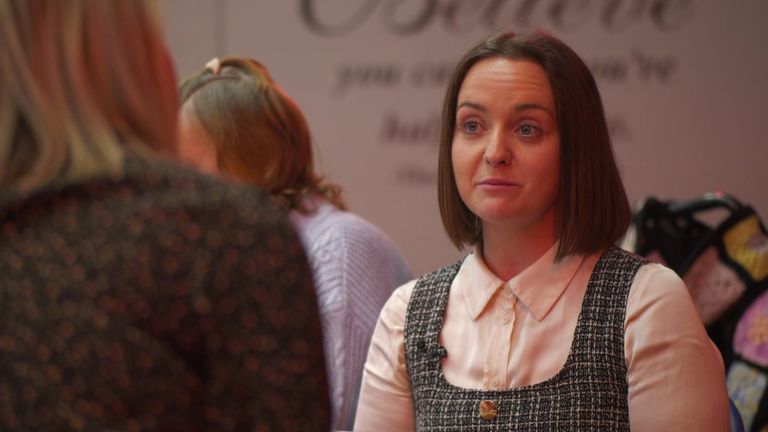
Kate Chadwick
I meet her at a regular lunch club they host – at their building where men are not allowed inside. It’s intended as a safe space for their members, who they are helping through everything from domestic violence to sexual assault. There’s a medical clinic here, beauty treatment rooms, a computer lab – all staffed by women.
Kate shows me the pocket rape alarm they give out to the women who come here. She hopes they never have to use it, but “it makes them feel safer just having it”.
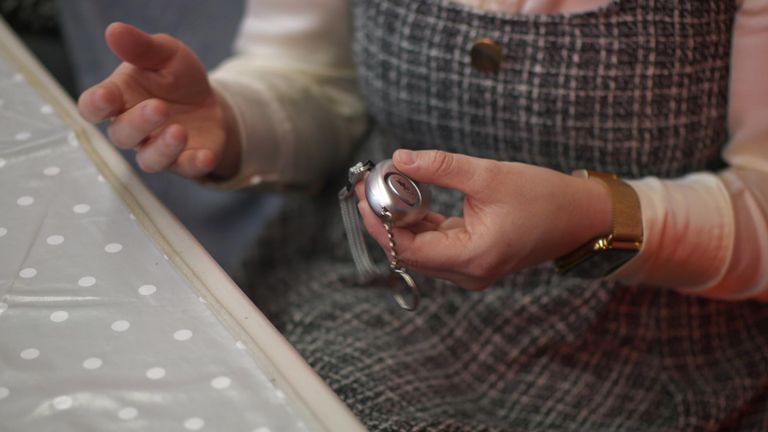
Women helped by the charity are given pocket rape alarms
“As a woman, in the winter it’s a hard time just to exist,” Kate says. “Women don’t feel safe coming out of their homes. Routines will change. They don’t want to walk in certain places.
“One of our members gets two buses home because it’s safer than waiting at a dark bus stop to just get the one.”
They are about to launch a photography exhibition around stalking and harassment. For this, they gave their members a camera and asked them to submit photos that show their experience being a woman.
There are several photos of dimly lit streets, bus stops with no one else there. One photo is a fist holding a key through the knuckles – an image most women will recognise.

Another picture is of an outfit laid out on the floor – a T-shirt, denim skirt and tights. It’s titled What Were They Wearing?
“This can often be the first question in a sexual assault case,” Kate says. “It really doesn’t matter what the woman was wearing.”
“It’s definitely not getting better,” she says. “In 2024, violence against women and girls was declared a national emergency. The statistics you read every day are shocking.”
Later that evening, back in Liverpool, we meet Girls on the Go – a running club started with the express purpose of allowing women to exercise safely in the winter. It’s 5.15pm when we meet for the run, and already dark.
The women running here list a collection of similar experiences. They have been catcalled, yelled at from cars, even chased while out running alone.
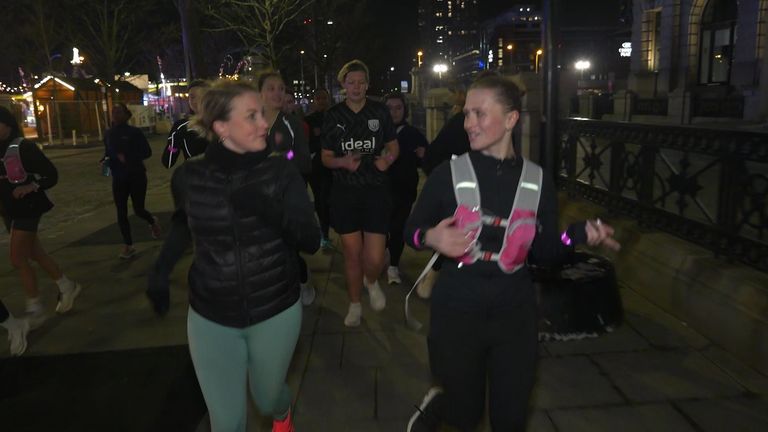
Girls on the Go helps women exercise safely in winter
Run leader Madeline Cole tells me that, as a women-only club, they have had to modify their warm-ups because “as soon as you bend over to touch your toes, or go into a squat, the shouting starts”.
Founder Steph Barney says she started the club because it is still “intimidating running alone as woman”.
“Far too many women experience harassment and catcalling – we wanted to create a group where women would feel safer doing it together” she says. “Even in the summer you get sexualised just for wearing shorts. You have to restrict what you do. None of my male friends have ever had to worry about that.”
I ask if anything would help them feel safer when out on their runs. “Better street lighting is a really obvious one,” she says. “And one of the issues is that it’s still not taken seriously by society. When you’re catcalled, it feels embarrassing to say ‘this is scary’.
“If it was taken more seriously – more women would speak out. And more could be done.”
Read more UK news:
OBR chief resigns after budget leak investigation
King officially strips Andrew of two more titles
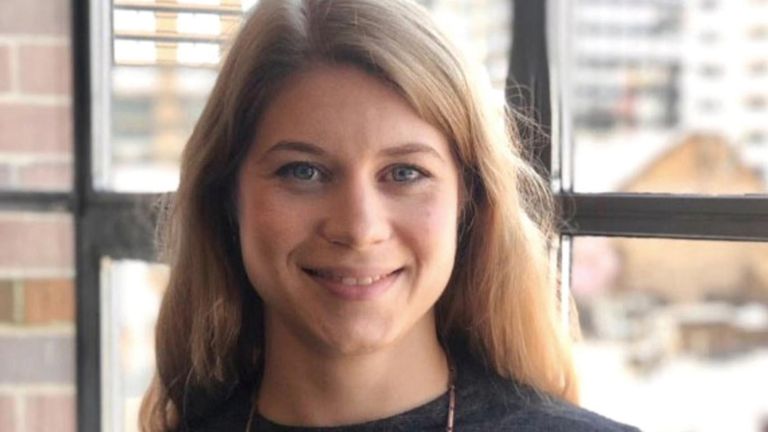
Sarah Everard
The Angiolini Inquiry – which was established to investigate the circumstances surrounding Sarah Everard’s murder – is due to publish its latest report later today.
It is examining whether there a risk of it happening again, police culture, and broader concerns surrounding women’s safety in public spaces.
UK
Hillsborough: Long-awaited report into Britain’s worst-ever sporting disaster to be published today
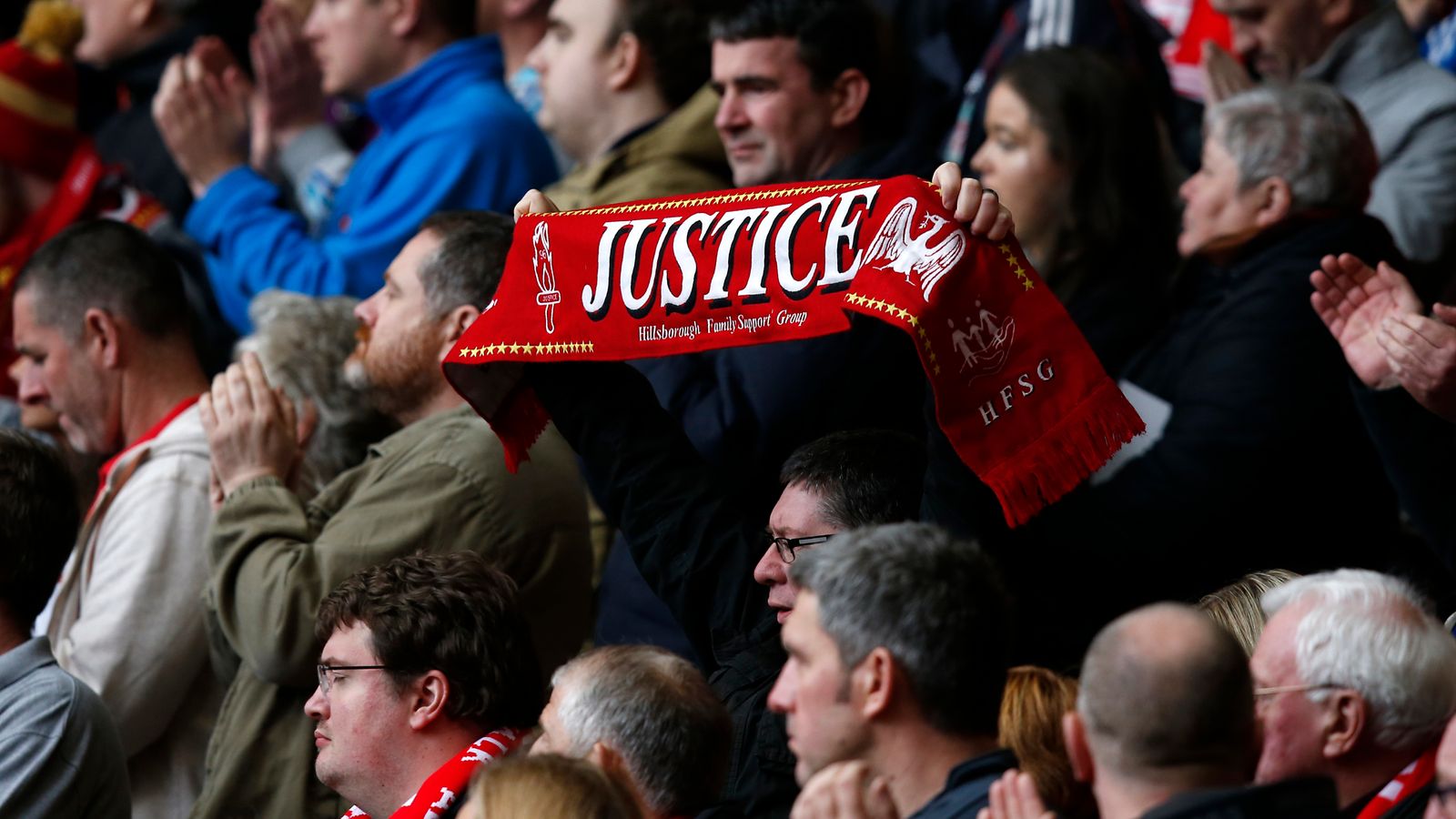
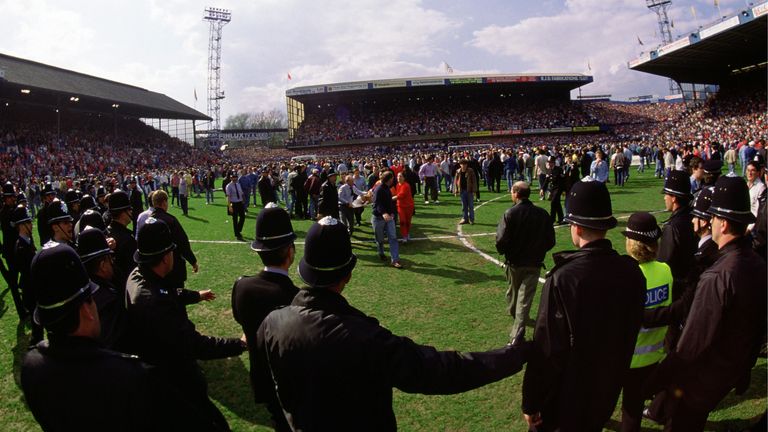
The police watchdog will today publish its report into the actions of officers during and after the Hillsborough disaster in 1989.
The Independent Office for Police Misconduct (IOPC) has been investigating South Yorkshire Police since 2012.
It is the largest independent investigation into alleged police misconduct and criminality ever carried out in England and Wales.
Hillsborough remains to this day the worst disaster in British sporting history.
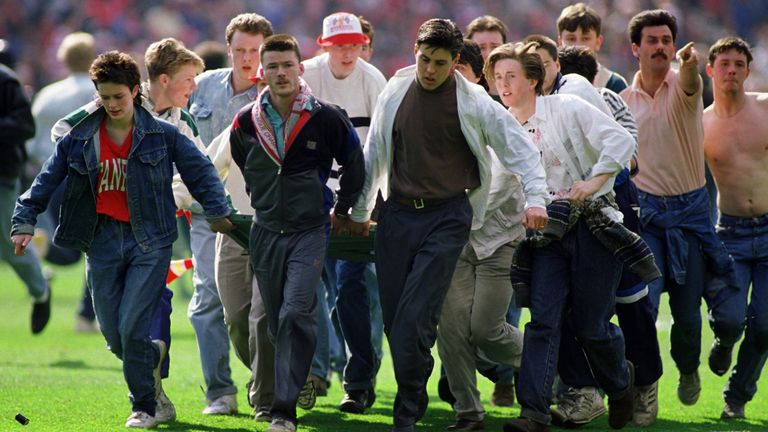

Fans, police, and emergency services on the pitch during the disaster. All pics: Action Images via Reuters
How did we get here?
A crush on the terraces during the FA Cup semi-final at the stadium in Sheffield resulted in the death of 97 Liverpool fans – men, women, and children aged from 10 to 67.
Even as fans lay dying, police were claiming that Liverpool supporters, arriving in large numbers late, drunk and without tickets, caused the disaster. But after decades of campaigning, that narrative was debunked.
In April 2016, new inquests – held after the original verdicts of accidental death were quashed in 2012 – determined that those who died had been unlawfully killed.
The IOPC told victims’ families in March that no officers would face misconduct proceedings because legislation in place at the time did not require police to have a duty of candour.
Dozens of allegations of misconduct against officers had been upheld, it said, but none would face disciplinary proceedings because they had all left the police service.
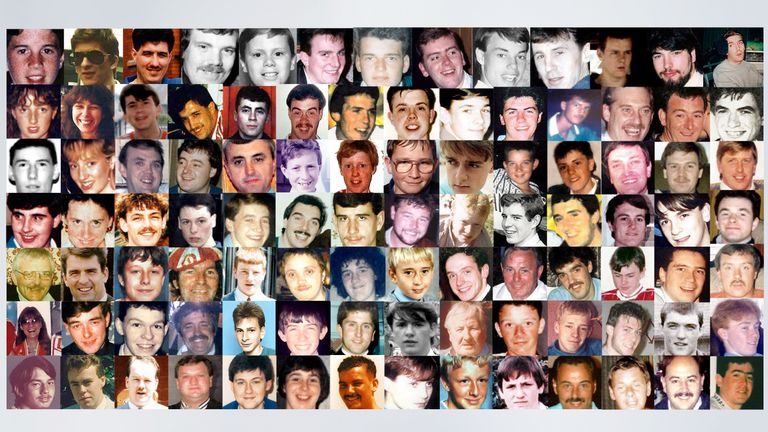
The 97 victims of the Hillsborough disaster
What has this probe looked at?
The IOPC investigation focused on amendments made in accounts of officers who were present at Hillsborough and allegations that misleading information was passed by the police to the media, MPs, parliament, and the inquiries set up immediately after the disaster.
It has also been looking into the role of West Midlands Police, which led the investigation into the disaster, and allegations that family members and campaigners were subject to surveillance by the police.
The IOPC has already confirmed that its investigation “aligned” with the findings of the Hillsborough Independent Panel investigation and the 2016 inquests.
It said: “We found no evidence to support police accounts to the media, the Taylor Inquiry and both sets of inquests, which suggested that the behaviour of supporters caused or in any way contributed to the disaster.”
Read more from Sky News:
PM emotional talking about Hillsborough
Long-awaited Hillsborough Law introduced
Officer cleared of gross negligence manslaughter
In September, the government introduced the so-called Hillsborough Law to the House of Commons.
The legislation will include a duty of candour, forcing public officials to act with honesty and integrity at all times or face criminal sanctions.

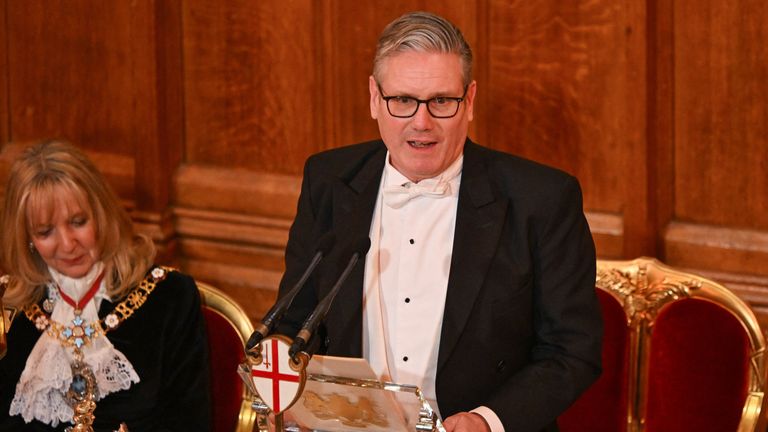
Sir Keir Starmer has warned China poses “real national security threats to the United Kingdom”.
But the prime minister also described China as a “nation of immense scale, ambition and ingenuity” and a “defining force in technology, trade and global governance”.
“The UK needs a China policy that recognises this reality,” he added in a speech at the Guildhall in London.
“Instead, for years we have blown hot and cold.
“So our response will not be driven by fear, nor softened by illusion. It will be grounded in strength, clarity and sober realism.”
Prime Minister Keir Starmer giving his speech. Pic: Reuters
Describing the absence of engagement with China – the world’s second-biggest economy – as “staggering” and “a dereliction of duty”, Sir Keir said: “This is not a question of balancing economic and security considerations. We don’t trade off security in one area, for a bit more economic access somewhere else.
“Protecting our security is non-negotiable – our first duty. But by taking tough steps to keep us secure, we enable ourselves to cooperate in other areas.”
Sir Keir’s remarks come after MPs and parliamentarians were warned last month of new attempts to spy on them by China.
And they follow the collapse of a prosecution of two people suspected of spying on behalf of China.
That case led to controversy over how the government under Labour responded to the Crown Prosecution Service’s requests for evidence.
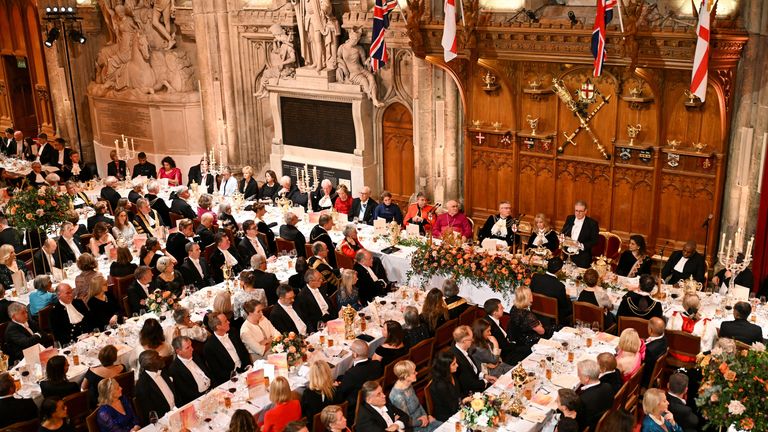
Speech at the annual Lady Mayor’s Banquet. Pic: Reuters
At the time, Sir Keir sought to blame the previous Conservative government for the issues, which centred on whether China could be designated an “enemy” under First World War-era legislation.
Meanwhile, Sky News understands the prime minister is set to approve plans for a controversial Chinese “super embassy” in central London.
Read more:
MI5 spying warning aims to send signal to China
‘Many options’ on table for Venezuela
A final decision on the planning application for the former Royal Mint site near the Tower of London is due on 10 December, after numerous previous delays.
Sir Keir is also understood to be preparing for a likely visit to China in the new year.
Since he was elected last year, Sir Keir has been active on the world stage, trumpeting deals with the US, India and the EU and leading the “coalition of the willing” in support of Ukraine.
PM preparing for likely China visit
But he has also faced criticism from his opponents, who accuse him of spending too much time out of the UK attending international summits rather than focusing on domestic issues.
Sir Keir offered a defence of his approach, describing it as “the biggest shift in British foreign policy since Brexit” and “a decisive move to face outward again”.
While saying he would “always respect” the Brexit vote as a “fair, democratic expression”, he said the way the UK’s departure from the EU had been “sold and delivered” was “simply wrong”.
He said: “Wild promises were made to the British people and not fulfilled. We are still dealing with the consequences today.”
In his speech on Monday, the prime minister accused opposition politicians of offering a “corrosive, inward-looking attitude” on international affairs.
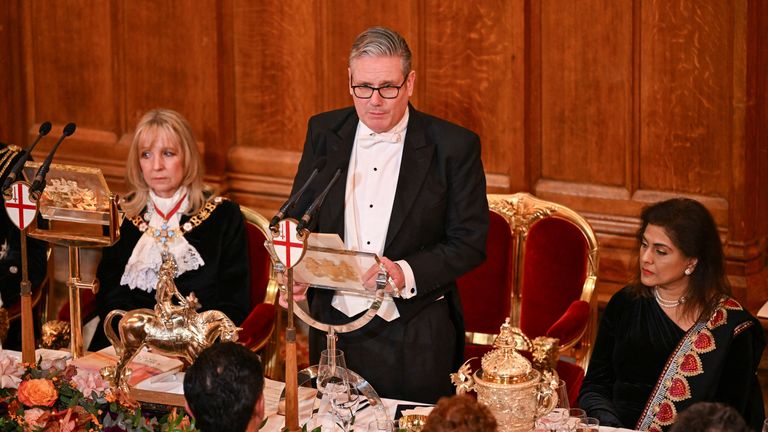
Sir Keir Starmer. Pic: Reuters
Taking aim at those who advocate leaving the European Convention on Human Rights or NATO, he said they offered “grievance rather than hope” and “a declinist vision of a lesser Britain”.
Sir Keir said: “Moreover, it is a fatal misreading of the moment, ducking the fundamental challenge posed by a chaotic world – a world which is more dangerous and unstable than at any point for a generation, where international events reach directly into our lives, whether we like it or not.”
He added: “In these times, we deliver for Britain by looking outward with renewed purpose and pride, not by shrinking back. In these times, internationalism is patriotism.”
Responding to the prime minister’s speech, shadow foreign secretary Dame Priti Patel said: “From China’s continued flouting of economic rules to transnational repression of Hong Kongers in Britain, Starmer’s ‘reset’ with Beijing is a naive one-way street, which puts Britain at risk while Beijing gets everything it wants.
“Starmer continues to kowtow to China and is captivated by half-baked promises of trade.
“Coming just days after the latest Chinese plot to interfere in our democracy was exposed, his love letter to the Chinese Communist Party is a desperate ploy to generate economic growth following his budget of lies and is completely ill-judged.
“While China poses a clear threat to Britain, China continues to back Iran and Russia, and plots to undermine our institutions. Keir Starmer has become Beijing’s useful idiot in Britain.”
-
 Sports2 years ago
Story injured on diving stop, exits Red Sox game
-
 Sports3 years ago
‘Storybook stuff’: Inside the night Bryce Harper sent the Phillies to the World Series
-
 Sports2 years ago
Game 1 of WS least-watched in recorded history
-
 Sports3 years ago
Button battles heat exhaustion in NASCAR debut
-
 Sports3 years ago
MLB Rank 2023: Ranking baseball’s top 100 players
-
Sports4 years ago
Team Europe easily wins 4th straight Laver Cup
-
 Environment3 years ago
Japan and South Korea have a lot at stake in a free and open South China Sea
-
 Environment1 year ago
Here are the best electric bikes you can buy at every price level in October 2024