
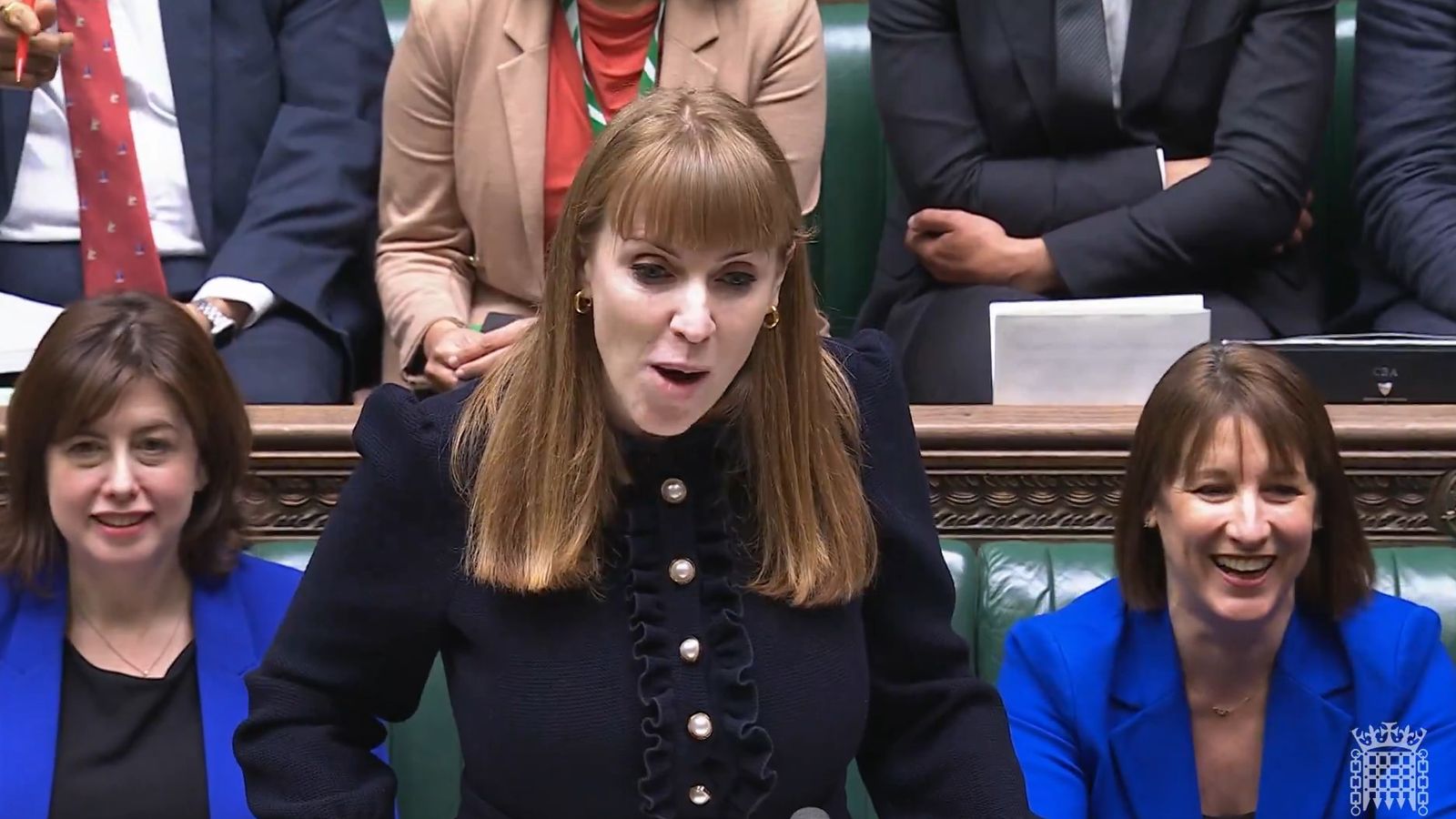
Angela Rayner criticises ‘scaremongering’ over inheritance tax changes for farmers

Angela Rayner has criticised “scaremongering” over Labour’s reforms to inheritance tax on farms.
The deputy prime minister had to defend the government’s changes to the levy in a bruising House of Commons session, as she stood in for Sir Keir Starmer while the prime minister was away at a G20 summit.
It came a day after more than 10,000 farmers gathered in Westminster to protest against the announcement in last month’s budget.
Politics latest: Rayner faces hostile crowd
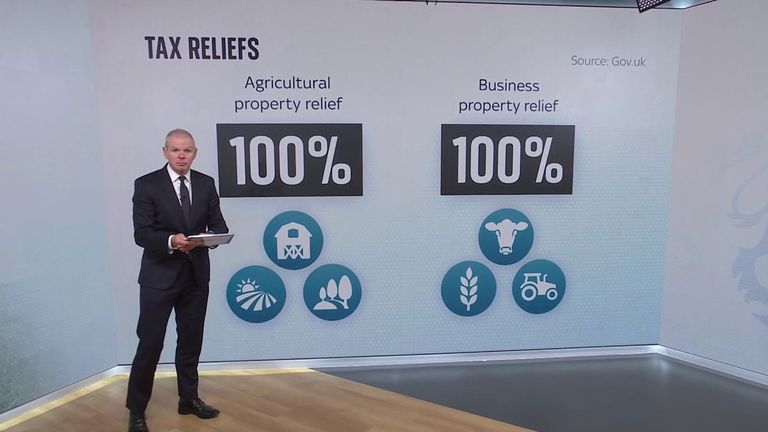
The government will reduce inheritance tax relief applied to farms from 6 April 2026. The full 100% relief will only apply to the first £1m of property. Above this amount, landowners will pay inheritance tax at a reduced rate of 20%, rather than the standard 40%.
Farmers will still benefit from reductions, with Labour saying that a “typical” couple handing their estate to their children can gift up to £3m tax-free, and then pay the 20% tax. They will also have 10 years to pay the charge, interest-free.
However, many in agriculture have criticised the decision, and political parties from across the spectrum questioned Ms Rayner on it.
Daisy Cooper, the Liberal Democrat deputy leader and MP for St Albans in Hertfordshire, said farmers felt “betrayed” by the Conservative government and “lied to by Labour”.
Ms Rayner said she was “sorry” to hear that farmers were “distressed by what I would say is scaremongering around what the Labour Party is doing”.
Why should farmers be taxed more?
Alex Burghart, the shadow chancellor for the Duchy of Lancaster, was standing in for Kemi Badenoch – as it is convention for the leader of the Opposition to stand aside from Prime Minister’s Questions if the prime minister is away.
He asked Ms Rayner about a “typical, mid-sized, 360-acre” farm in Yorkshire – saying a family had spoken to their accountant and been told they could be liable to pay £500,000 in inheritance tax – equivalent to 12 years of profit.
The Tory MP added that the NFU is set to publish a report showing 75% of all commercial farms will fall above the threshold of paying inheritance tax.
Read more on farming:
Thousands protest at Downing Street
Jeremy Clarkson says govt should ‘back down’
Rowdy PMQs had ‘teacher is away vibes’

From the outset, this session of PMQs had a distinct “the teacher is away” vibe.
It was rowdy, shouty and prickly.
Labour MPs chuckled as their opposite numbers loudly cheered Alex Burghart – the relatively unknown shadow minister standing in for Kemi Badenoch today.
Angela Rayner quickly reminded colleagues he was the “minister for growth” during Liz Truss’s disastrous spell in Downing Street, sparking whooping from the government benches.
Burghart responded by referencing the views of “city economists… real economists” – a stinging reference to a story around the chancellor changing her LinkedIn profile to remove an apparently erroneous reference to being an economist at Halifax Bank of Scotland before entering politics.
With his microphone frequently cracking and topping out, the shadow Cabinet Office minister zeroed in loudly on inflation and changes to inheritance tax for farmers.
Other Tory backbenchers and the Lib Dem deputy followed suit, seizing on the farming protests that engulfed Westminster yesterday.
It led to what may be the main news line from this session – as Angela Rayner accused critics of “scaremongering” over the impact of the agriculture changes.
There were reprimands from the Speaker as well, with one Labour backbencher told off and the Tory MP Danny Kruger admonished.
He bit back though, saying to the Speaker “are you talking to me? I haven’t opened my mouth” and gestured to colleagues behind to shift the blame.
Sir Lindsay Hoyle later apologised to Mr Kruger – saying his colleague James Wild had put his hand up to being the naughty Tory.
The Speaker warned the pair they should maybe not sit next to each other again.
An appropriately classroom-like exchange in a session where calm maturity was not always at the front of many minds.
Ms Rayner says she “stands by the figures” the government had previously laid out.
She said: “The vast majority of estate owners will see no change and pay no tax on land valued at £1m.
“Couples can pass on £3m tax-free, and those above the thresholds will pay only half the normal rate, and can pay over ten years interest-free.”
👉 Listen to Sky News Daily on your podcast app 👈
Reform’s Lee Anderson also criticised the policy, and Conservative Saqib Bhatti asked Ms Rayner why Labour has “declared war on British farmers”.
Ms Rayner said the government “hasn’t declared war on farmers” – before reiterating her response on thresholds.
She also said Labour needed to raise money to account for the “£22bn black hole from the Conservatives”.


Ghana has legalized cryptocurrency trading by establishing a regulatory framework targeting the industry.
Ghana’s parliament has passed the Virtual Asset Service Providers Bill into law, Bank of Ghana (BoG) Governor Johnson Asiama said, according to a report on Sunday by the state-owned Daily Graphic news agency.
“Virtual asset trading is now legal, and no one will be arrested for engaging in cryptocurrency, but we now have a framework to manage the risks involved,” Asiama said on Friday at the BoG’s annual Nine Lessons, Carols and Thanksgiving Service.
The timing aligns with earlier central bank communications, as Asiama had previously indicated Ghana was targeting the introduction of crypto regulation by the end of 2025.
Ghana’s central bank gains supervisory powers
Under the legislation, the Bank of Ghana becomes the primary regulator for cryptocurrency activity, with powers to license and supervise crypto asset service providers (CASPs).
The law positions Ghana to better protect consumers from fraud, money laundering and systemic risks, while removing uncertainty over the legal status of cryptocurrency, Asiama said, adding:
“What this means is that now we have the framework to manage it and to manage the risks that can involve that kind of activity […] These are not just legal milestones; they are enablers of better policies, stronger supervision and more effective regulation.”
The governor also mentioned that the crypto law is intended to support innovation and expand Ghana’s financial inclusion, particularly among young people and tech-driven entrepreneurs.
Ghana ranks among Sub-Saharan Africa’s top five crypto economies
Ghana’s move to regulate cryptocurrency activity comes as the country emerges as a significant player in crypto adoption across the region.
According to Chainalysis’ 2025 Geography of Cryptocurrency Report, Ghana ranked among the top five Sub-Saharan African countries by total crypto value received between July 2024 and June 2025.
In the meantime, Nigeria continued to dominate the region, receiving at least $92 billion in crypto value over the period, or nearly three times the amount recorded by South Africa, the report showed.
Related: CAR’s crypto push fueled ‘state capture’ by elites, criminal networks: Report
The Sub-Saharan region received over $205 billion in on-chain value, up about 52% from the previous year. This growth makes it the third-fastest growing region in the world, just behind Asia-Pacific and Latin America, according to Chainalysis.


Crypto investment products saw $952 million in outflows, marking the first red week in four, as investor sentiment took a hit due to delays to a key US crypto regulatory bill.
Crypto exchange-traded products (ETPs) recorded $952 million in outflows, led by $555 million for Ether (ETH) funds and $460 million for Bitcoin (BTC) funds.
The large-scale outflows were mainly attributed to delays to the Digital Asset Market Clarity Act, or Clarity Act, a matter that prolonged “regulatory uncertainty and concerns over whale selling,” according to a CoinShares report published Monday.
“As a result, it now appears highly unlikely that ETPs will exceed last year’s inflows, with total assets under management standing at $46.7bn compared with $48.7bn in 2024,” CoinShares said.
The lion’s share, or $990 million of the outflows, came from the US, marginally offset by $46 million in inflows from Canadian investors and $15.6 million from Germany.
Related: Fidelity macro lead calls $65K Bitcoin bottom in 2026, end of bull cycle
Clarity Act delays were the main catalyst for crypto fund outflows: Analyst
On Thursday, White House AI and crypto czar David Sacks said that the Senate markup for the long-awaited Clarity Act will occur in January 2026, as opposed to previous expectations that the bill would get to President Donald Trump’s desk before the end of 2025.
”We are closer than ever to passing the landmark crypto market structure legislation that President Trump has called for. We look forward to finishing the job in January,” Sacks wrote in a Thursday X post.
CoinShares’ head of research, James Butterfill, attributed the erosion in investor sentiment to the delays related to the bill.
“Ethereum saw the largest outflows, totaling $555m, this is understandable given it has the most to gain or lose from the Clarity Act,” wrote Butterfill.

The Clarity Act seeks to define crypto securities and commodities, providing much-awaited clarity on the jurisdictions of the Securities and Exchange Commission and the Commodity Futures Trading Commission relating to digital assets.
Related: Bitcoin dips below $85K as DATs face ‘mNAV rollercoaster’: Finance Redefined
Despite the delays, the crypto industry’s best-performing traders by returns, who are tracked as “smart money” traders on Nansen’s blockchain intelligence platform, continued betting on Ether’s short-term price increase.

Smart money traders were net long on Ether with a cumulative $476 million worth of leveraged long positions, while being net short on Bitcoin for $109 million, according to Nansen.
Magazine: Solana vs Ethereum ETFs, Facebook’s influence on Bitwise — Hunter Horsley


Binance reportedly continued to allow suspicious accounts to move funds in crypto even after the exchange pledged to tighten controls as part of its $4.3 billion US criminal settlement in 2023.
According to internal data reviewed by the Financial Times, a network of 13 user accounts processed about $1.7 billion in transactions from 2021, including roughly $144 million after the November 2023 plea agreement.
The files reportedly include Know-Your-Customer (KYC) documents, IP and device logs, and transaction histories for users in countries including Venezuela, Brazil, Syria, Niger and China.
Regulatory and AML specialists cited by the Financial Times said that the findings raise fresh questions about how effectively Binance has implemented the governance and surveillance upgrades promised US authorities after the settlement.
Binance did not provide a comment to Cointelegraph by press time.
Related: Binance alleges fake listing agents, offers up to $5M whistleblower reward
Suspicious account behaviors
In one case, a Binance account linked to a 25-year-old Venezuelan woman received more than $177 million over two years and changed its linked bank details 647 times in 14 months.
Former prosecutors told the Financial Times that such activity would normally be treated as highly suspicious and potentially consistent with an unregistered money-transmitting business.
Another account, held by a junior bank employee living in a poor district of Caracas, saw about $93 million flow in and out between 2022 and May 2025. Internal logs showed the account was accessed from Caracas one afternoon and from Osaka, Japan, less than 10 hours later, a sequence experts told the FT was physically impossible and the type of anomaly that should automatically trigger review at a regulated institution.
Nick Heather, head of trading at ONE.io, a financial services company providing digital asset trading services, told Cointelegraph that such cases underline the importance of adaptive governance frameworks in digital asset markets.
“When accounts displaying repeated red flags remain active, that points to an escalation and oversight challenge rather than one of market structure. Robust governance, sanctions screening, and post-trade surveillance are of critical importance, and institutional and retail traders operating in regulated markets are already accustomed to these requirements,” Heather said.
All 13 accounts shared markers of suspicious behavior and collectively received about $29 million in stablecoin USDt (USDT) from wallets later frozen by Israel under anti-terrorism laws.
Related: CZ pardon was considered with ‘utmost seriousness,’ White House says
Plea deal promises and Trump pardon backdrop
Binance in its 2023 plea deal promised to implement real-time monitoring, enhanced due diligence and regular customer reviews to detect suspicious activities.
At the time, US authorities said Binance had failed to report more than 100,000 suspicious transactions involving activities including ransomware, child sexual abuse, narcotics trafficking and transfers linked to groups including al-Qaeda and ISIS.
The Financial Times report comes after US President Donald Trump pardoned Binance founder Changpeng Zhao in October.
-
 Sports2 years ago
Story injured on diving stop, exits Red Sox game
-
 Sports3 years ago
‘Storybook stuff’: Inside the night Bryce Harper sent the Phillies to the World Series
-
 Sports2 years ago
Game 1 of WS least-watched in recorded history
-
 Sports3 years ago
Button battles heat exhaustion in NASCAR debut
-
 Sports3 years ago
MLB Rank 2023: Ranking baseball’s top 100 players
-
Sports4 years ago
Team Europe easily wins 4th straight Laver Cup
-
 Environment3 years ago
Japan and South Korea have a lot at stake in a free and open South China Sea
-
 Environment1 year ago
Here are the best electric bikes you can buy at every price level in October 2024