

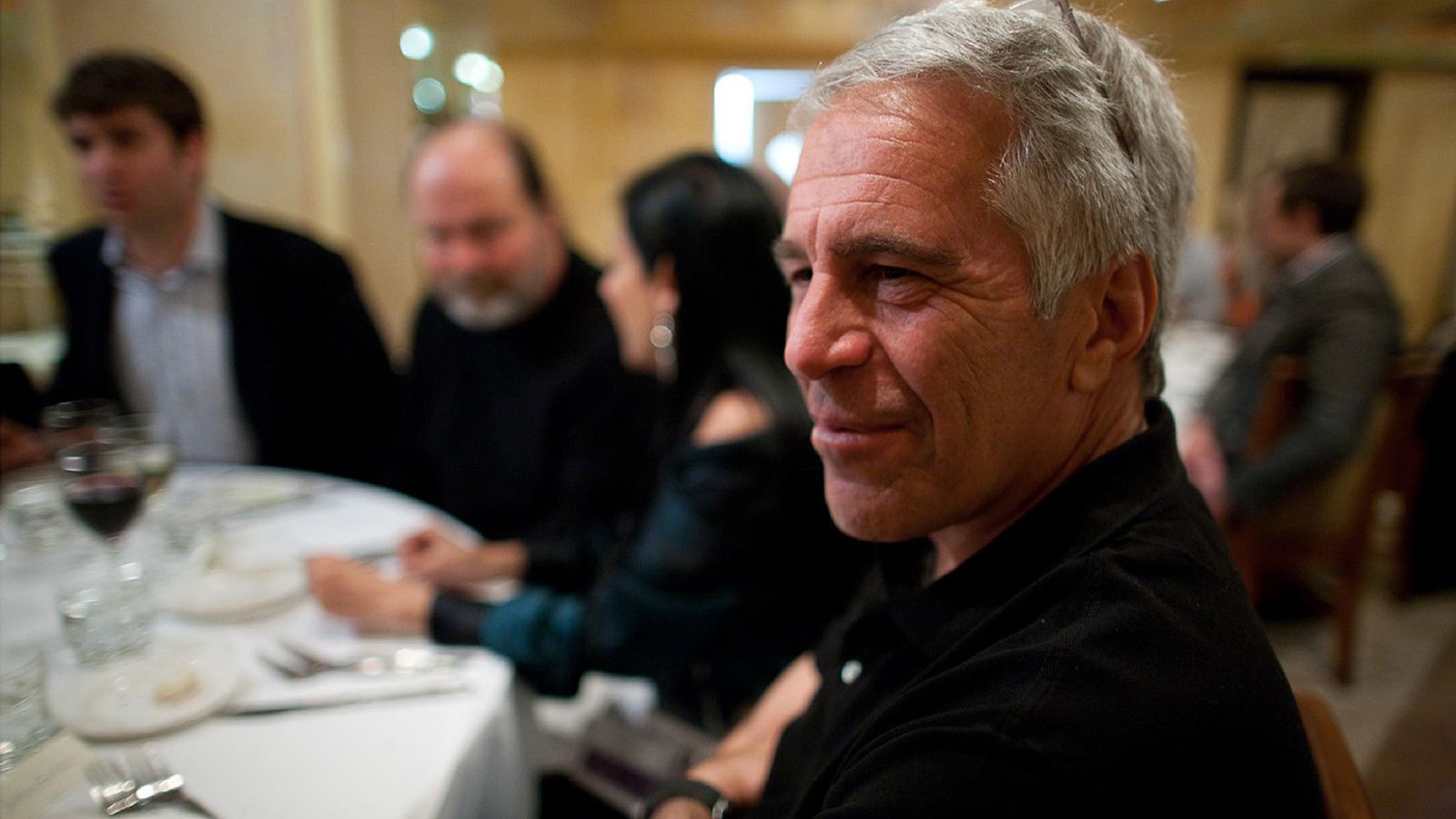

A trove of newly released Epstein files include emails that appear to involve Andrew Mountbatten-Windsor, while another suggests Donald Trump travelled on the billionaire’s private jet “many more times than previously has been reported”.
The US Department of Justice released at least 11,000 more files on Tuesday.
It went on to claim that some of them “contain untrue and sensationalist claims” about President Trump.
Here are some of the latest news lines from this release of Epstein files. Being named in these papers does not suggest wrongdoing.
Who is ‘The Invisible Man’?
Among the documents released is an email sent to Ghislaine Maxwell that speaks about “the girls” being “completely shattered” at a Royal Family summer camp at Balmoral.
It is dated 16 August 2001 and sent by a person referred to only as “The Invisible Man”, but whom Sky News is reporting appears to be the former prince, Andrew.
We have come to that conclusion from reviewing the email address used, which is assigned to the Duke of York in Epstein’s contacts book and the chain of correspondence.
In the correspondence, “The Invisible Man” asks Maxwell: “How’s LA? Have you found me some new inappropriate friends?”
Andrew Mountbatten-Windsor has previously denied any allegations against him.
The Peru trip
Another email appears to show Maxwell arranging “two-legged sight seeing” for “The Invisible Man” during a trip to Peru.
She appears to forward to “The Invisible Man” part of a conversation between herself and another person.
The email says: “I just gave Andrew your telephone no. He is interested in seeing the Nazca lines. He can ride but it is not his favorite sport ie pass on the horses.”
“Some sight seeing some 2 legged sight seeing (read intelligent pretty fun and from good families) and he will be very happy. I know I can rely on you to show him a wonderful time and will only introduce him to friends that you can trust,” Maxwell said.
The context of the email is unclear and there is no suggestion of any wrongdoing.
Trump on Epstein’s jet?
The latest bunch of files also includes an email from an unidentified prosecutor dated 7 January, 2020, in which President Trump is mentioned.
The email accuses him of travelling on Epstein’s private jet “many more times than previously has been reported”.
It adds that President Trump “is listed as a passenger on at least eight flights between 1993 and 1996, including at least four flights on which Maxwell was also present”.
The email’s sender and receiver have been redacted. However, at the bottom of the email it says assistant US attorney, Southern District of New York. The name has also been redacted.
President Trump has denied any wrongdoing in relation to his relationship with Epstein, and being on any of Epstein’s flights does not indicate any wrongdoing.
Read more:
Trump defends ‘big boy’ Clinton after Epstein files release
Why Andrew photo in Epstein files is awkward for Royal Family
Limousine driver report about Trump
One of the documents in the release shows a report made to the FBI that was recorded on 27 October 2020.
It includes an unverified claim by a limousine driver that he overheard the US president discussing “abusing some girl” in 1995.
The driver also mentions Trump said “Jeffrey” while on the phone during a journey to Dallas Fort Worth Airport in Texas.
A significant part of the statement, along with the driver’s identity, has been redacted.
The US justice department has said that some of the documents in the latest Epstein files release “contain untrue and sensationalist claims made against President Trump that were submitted to the FBI right before the 2020 election”.
“To be clear: the claims are unfounded and false, and if they had a shred of credibility, they certainly would have been weaponized against President Trump already,” it said.
Postcard mentions ‘our president’
Also among the documents is a postcard that claims to have been sent by Jeffrey Epstein, but has been refuted by the justice department.
In it, the sender tells the recipient: “Our president also shares our love of young, nubile girls.”
It’s not clear who “our president” refers to and the context of the postcard is also unclear.
The US justice department initially said it was “looking into the validity” of the postcard but later said on X that the “FBI has confirmed” the postcard is “FAKE”.
It cited reasons including a claim that the writing does not appear to match Epstein’s and another that the letter was postmarked three days after his death.
Row over unreleased documents
It is believed that many files relating to Epstein are yet to be made public.
There has been anger at the justice department’s slow release of the files, with politicians threatening to launch legal action against Attorney General Pam Bondi.
The deadline for the release of all the documents has passed.
“The DOJ needs to quit protecting the rich, powerful, and politically connected,” Republican congressman Thomas Massie said.


Annealed neodymium iron boron magnets sit in a barrel at a Neo Material Technologies Inc. factory in Tianjin, China on June 11, 2010.
Bloomberg | Bloomberg | Getty Images
Rare earth magnet makers are having a moment as Western nations scramble to build domestic “mine-to-magnet” supply chains and reduce their dependence on China.
A turbulent year of supply restrictions and tariff threats has thrust the strategic importance of magnet manufacturers firmly into the spotlight, with rare earths surging toward the top of the agenda amid the U.S. and China’s ongoing geopolitical rivalry.
Magnets made from rare earths are vital components for everything from electric vehicles, wind turbines, and smartphones to medical equipment, artificial intelligence applications, and precision weaponry.
It’s in this context that the U.S., European Union and Australia, among others, have sought to break China’s mineral dominance by taking a series of strategic measures to support magnet makers, including heavily investing in factories, supporting the buildout of new plants, and boosting processing capacity.
The U.S. and Europe, in particular, are expected to emerge as key growth markets for rare earth magnet production over the next decade. Analysts, however, remain skeptical that Western nations will be able to escape China’s mineral orbit anytime soon.
“Frankly, we were the solution to the problem that the world didn’t know it had,” Rahim Suleman, CEO of Canadian group Neo Performance Materials, told CNBC by video call.
Photo taken on Sept. 19, 2025 shows rare-earth magnetic bars at NEO magnetic plant in Narva, a city in northeastern Estonia.
Xinhua News Agency | Xinhua News Agency | Getty Images
“The end-market is growing from the point of physics, not software, so therefore it has to grow in this way,” he continued. “And it’s not dependent on any single end market, so it’s not dependent on automotive or battery electric vehicles or drones or wind farms. It’s any energy-efficient motor across the spectrum,” Suleman said, referring to the demand for magnets from fast-growing industries such as robotics.
His comments came around three months after Neo launched the grand opening of its rare earth magnet factory in Narva, Estonia.
Situated directly on Russia’s doorstep, the facility is widely expected to play an integral role in Europe’s plan to reduce its dependence on China. European Union industry chief Stéphane Séjourné, for example, lauded the plant’s strategic importance, saying at an event in early December that the project marked “a high point of Europe’s sovereignty.”
Neo’s Suleman said the Estonian facility is on track to produce 2,000 metric tons of rare earth magnets this year, before scaling up to 5,000 tons and beyond.
“Globally, the market is 250,000 tons and going to 600,000 tons, so more than doubling in ten years,” Suleman said. “And more importantly, our concentration is 93% in a single jurisdiction, so when you put those two factors together, I think you’ll find an enormously quick growing market.”
‘Skyrocketing demand’
To be sure, the global supply of rare earths has long been dominated by Beijing. China is responsible for nearly 60% of the world’s rare earths mining and more than 90% of magnet manufacturing, according to the International Energy Agency.
A recent report from consultancy IDTechEx estimated that rare earth magnet capacity in the U.S. is on track to grow nearly six times by 2036, with the expansion driven by strategic support and funding from the Department of Defense, as well as increasing midstream activity.
Magnet production in Europe, meanwhile, was forecast to grow 3.1 times over the same time period, bolstered by the EU’s Critical Raw Materials Act, which aims for domestic production to satisfy 40% of the region’s demand by 2030.
Regional composition of rare earths and permanent magnet production in 2024, according to data compiled by the International Energy Agency.
IEA
John Maslin, CEO of Vulcan Elements, a North Carolina-based rare earth magnet producer, told CNBC that the company is seeking to scale up as fast as possible “so that this fundamental supply chain doesn’t hold America back.”
Vulcan Elements is one of the companies to have received direct funding from the Trump administration. The magnet maker received a $620 million direct federal loan last month from the Department of Defense to support domestic magnet production.
“Rare earth magnets convert electricity into motion, which means that virtually all advanced machines and technologies—the innovations that shape our daily lives and keep us safe—require them in order to be operational,” Maslin told CNBC by email.
“The need for high-performance magnets is accelerating exponentially amid a surge in demand and production of advanced technologies, including hard disk drives, semiconductor fabrication equipment, hybrid/electric motors, satellites, aircraft, drones, and almost every military capability,” he added.
Separately, Wade Senti, president of Florida-based magnet maker Advanced Magnet Lab, said the only way to deliver on alternative supply chains is to be innovative.
“The demand for non-China sourced rare earth permanent magnets is skyrocketing,” Senti told CNBC by email.
“The challenge is can United States magnet producers create a fully domestic (non-China) supply chain for these magnets. This requires the magnet manufacturer to take the lead and bring the supply chain together – from mine to magnet to customers,” he added.


Direxion signage at the New York Stock Exchange (NYSE) in New York, US, on Monday, Dec. 22, 2025. The holiday-shortened week started with gains in stocks amid a broad advance that saw a continuation of the bullish momentum on Wall Street.
Michael Nagle | Bloomberg | Getty Images
Motive, a company with software for managing corporate trucks and drivers, on Tuesday filed for an initial public offering on the New York Stock Exchange under the symbol “MTVE.”
The paperwork puts Motive among a fast-growing group of tech companies looking to go public in 2026. Anthropic, OpenAI and SpaceX have all reportedly considered making their shares widely available for trading next year.
Motive is smaller, reporting a $62.7 million net loss on $115.8 million in revenue in the third quarter. The loss widened from $41.3 million in the same quarter of 2024, while revenue grew about 23% year over year. The company had almost 100,000 clients at the end of September.
Ryan Johns, Obaid Khan and Shoaib Makani started Motive in 2013, originally under the name Keep Truckin. Makani, the CEO, is Khan’s brother-in-law.
Investors include Alphabet’s GV, Base10 Partners, Greenoaks, Index Ventures, Kleiner Perkins and Scale Venture Partners.
Motive’s AI Dashcam device for detecting unsafe driving “has prevented 170,000 collisions and saved 1,500 lives on our roads,” Makani wrote in a letter to investors. Most revenue comes from subscriptions, although Motive does sell replacement hardware and professional services.
The San Francisco company changed its name to Motive in 2022, and as of Sept. 30, it employed 4,508 people. Motive employs 400 full-time data annotators who apply labels that are meant to enhance artificial intelligence models.
Motive has ongoing patent-infringement litigation with competitor Samsara, which went public in 2021 and today has a $22 billion market capitalization.
WATCH: AI IPO boom next year? The changing 2026 IPO landscape
-
 Sports2 years ago
Story injured on diving stop, exits Red Sox game
-
 Sports3 years ago
‘Storybook stuff’: Inside the night Bryce Harper sent the Phillies to the World Series
-
 Sports2 years ago
Game 1 of WS least-watched in recorded history
-
 Sports3 years ago
Button battles heat exhaustion in NASCAR debut
-
 Sports3 years ago
MLB Rank 2023: Ranking baseball’s top 100 players
-
Sports4 years ago
Team Europe easily wins 4th straight Laver Cup
-
 Environment3 years ago
Japan and South Korea have a lot at stake in a free and open South China Sea
-
 Environment1 year ago
Here are the best electric bikes you can buy at every price level in October 2024