Connect with us

Published

on

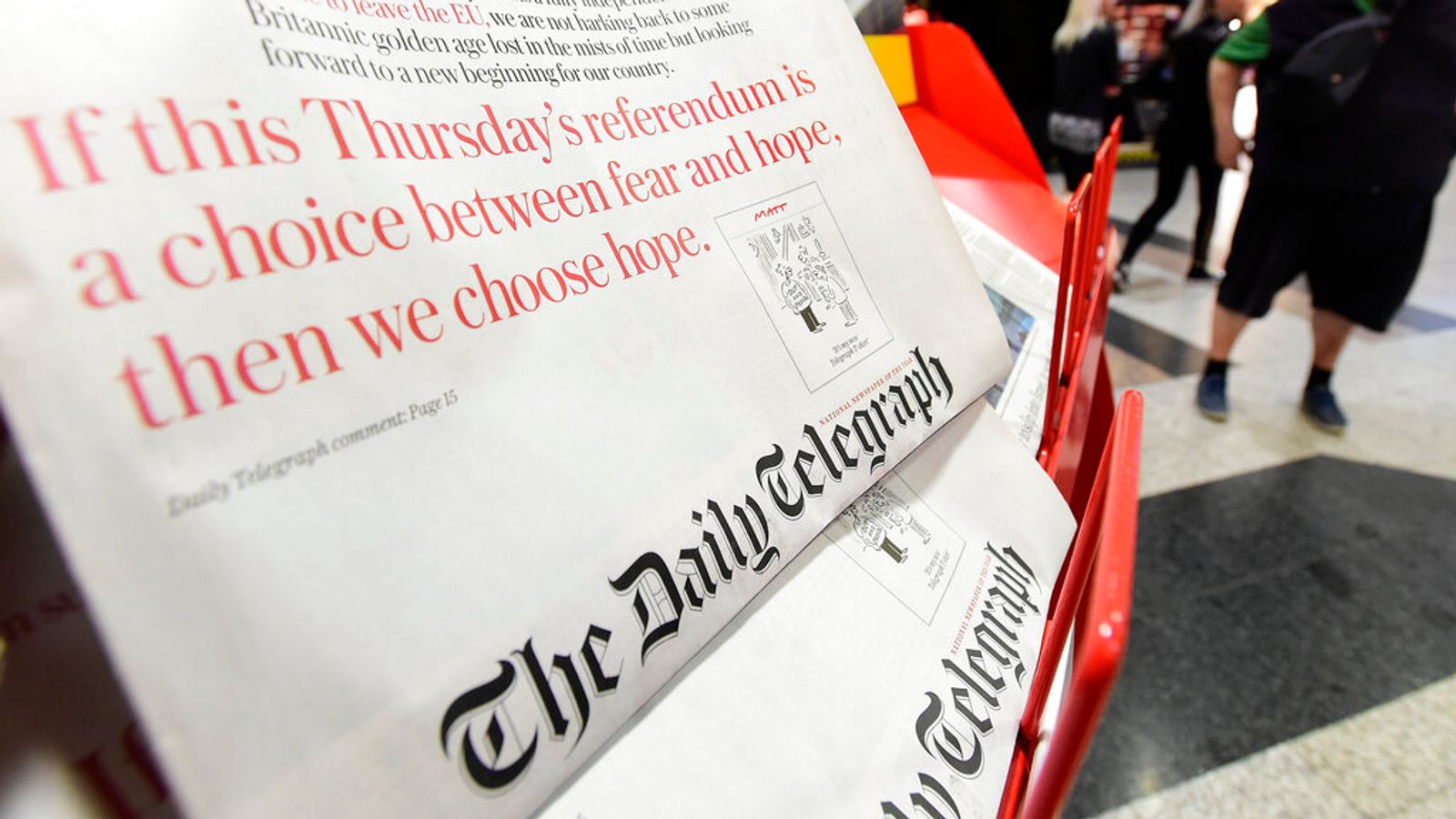
One of the world’s largest investment groups is in talks to help finance a £550m takeover of The Daily Telegraph by the owner of The New York Sun.

Sky News has learnt that Apollo Global Management, which oversees assets worth $733bn, has been holding initial talks with Dovid Efune and his advisers in recent days about lending part of the money required for the deal.

Banking sources said on Tuesday that the discussions were preliminary in nature and might not lead to an agreement.

Other debt providers are also in talks with Mr Efune, the sources added.

The development has emerged just three days before an exclusivity period for the US-based businessman expires, although insiders say it is almost certain to be extended.

Apollo ranks among the world’s biggest financial institutions and is a major player in both private equity and private credit around the globe.

In the last fortnight, a string of media reports have cast doubt on Mr Efune’s ability to complete the deal, with potential lenders including Oaktree Capital Management and Hudson Bay Capital said to have withdrawn from the process.

More on Daily Telegraph

Sky News revealed at the start of November that the former Conservative chancellor Nadhim Zahawi and the party’s former treasurer, Sir Mohamed Mansour, had been enlisted by Mr Efune to aid his bid for the right-leaning newspapers.

Mr Zahawi, who has been tipped for a peerage in Rishi Sunak’s resignation honours list, and Sir Mohamed are expected to invest tens of millions of pounds in the deal if it goes ahead.

In September, Sky News revealed that Sir Mohamed had been approached to provide as much as £150m to a standalone bid for the Telegraph titles that were being spearheaded at the time by Mr Zahawi.

If completed, the transaction will crystallise an unlikely profit for RedBird IMI, the Abu Dhabi-backed vehicle which paid £600m to acquire a call option that was intended to convert into ownership of the Telegraph newspapers and The Spectator magazine.

Depending on the final structuring of the deal, it could be worth as much as £575m, with less than a third of that expected to be in the form of debt.

The Spectator was recently sold for £100m to Sir Paul Marshall, the hedge fund billionaire, who has installed Michael Gove, the former cabinet minister, as its editor.

Insiders said that Mr Zahawi was likely to be handed an ongoing role at the Telegraph if the bid from Mr Efune was successful.

The former chancellor, education secretary and vaccines minister has been involved in the Telegraph process in various guises, initially helping broker a deal with RedBird IMI before assembling his own offer.

He has close connections to many of the Gulf-based figures involved in the process, including Sultan Ahmed al-Jaber, chairman of the bidding vehicle.

Mr Zahawi has also since been named chairman of Very Group, the online retailer owned by the Barclay family which controlled the Telegraph for two decades, and which is now part-funded by IMI.

The UAE-based IMI, which is controlled by the UAE’s deputy prime minister and ultimate owner of Manchester City Football Club, Sheikh Mansour bin Zayed Al Nahyan, extended a further £600m to the Barclays to pay off a loan owed to Lloyds Banking Group, with the balance secured against other family assets.

Mr Efune’s bid has raised the extraordinary possibility of a return to the British newspaper group for Conrad Black, its former proprietor, Sky News reported earlier in the autumn.

Other bidders for the Telegraph included National World, the London-listed vehicle headed by former Mirror newspapers chief David Montgomery, and Lord Saatchi, the former advertising mogul, who offered £350m.

Lord Rothermere, the Daily Mail proprietor, pulled out of the bidding earlier in the summer amid concerns that he would be blocked on competition grounds.

The Telegraph auction is being run by Raine Group and Robey Warshaw, the advisers to the Abu Dhabi-backed entity which was thwarted in its efforts to buy the media titles by a change in ownership law.

Apollo declined to comment.

Continue Reading

Business

Unemployment rate jumps to highest level since late 2020 ahead of budget

Published

on

By

Unemployment rate jumps to highest level since late 2020 ahead of budget

The UK’s jobless rate has risen to a level not seen since late 2020, according to official figures released ahead of the budget.

The Office for National Statistics (ONS) reported a figure of 5% covering the three months to September – up from 4.8% reported last month. It was a larger leap than economists had predicted, and the ONS said that men were worst affected by the shift.

It leaves the jobless rate at its highest level since December 2020-February 2021.

It had stood at 4.1% when Labour took office last year.

Money latest: How private pensions are treated in divorce

There was no better news for Chancellor Rachel Reeves in wider, experimental, HMRC data released by the ONS, which showed a 32,000 decline in payrolled employment during October.

That suggested a pause to a more recent trend of declines slowing since sharp falls first witnessed in the spring of this year.

More from Money

It was April when measures introduced in Ms Reeves’s first budget came into effect, with hikes in minimum pay and employer national insurance contributions hammering employment and investment sentiment in the private sector.

It also coincided with peak US trade war uncertainty as Donald Trump ramped up his tariffs.

Please use Chrome browser for a more accessible video player

Where Reeves stands on tax rises

ONS director of economic statistics Liz McKeown said of the data: “Taken together these figures point to a weakening labour market.

“The number of people on payroll is falling, with revised tax data now showing falls in most of the last 12 months.

“Meanwhile the unemployment rate is up in the latest quarter to a post pandemic high. The number of job vacancies, however, remains broadly unchanged.

“Wage growth in the private sector slowed further, but we continue to see stronger public sector pay growth, reflecting some pay rises being awarded earlier than they were last year.”

In good news, the overall slowing in the pace of wage growth and weakening jobs market should help bolster the case for an interest rate cut by the Bank of England next month, assuming inflationary pressures continue to ease after last week’s rate hold.

The ONS figures were released as the clock ticks down to the chancellor’s second budget due on 26 November.

Please use Chrome browser for a more accessible video player

The state of UK economy ahead of budget

Ms Reeves used an event in Downing Street last week to prepare the ground for a painful series of measures that are expected to be only partly offset by some announcements to keep Labour MPs onside, as she stares down a black hole in the public finances believed to be in the region of £30bn.

She has signalled a break from Labour’s manifesto tax pledge not to raise income tax, national insurance or VAT, on the grounds that the world has changed since that promise was made.

The chancellor’s gripes include Brexit and the effects of the US trade war.

Nevertheless, a spending priority would appear to be the lifting of the two-child benefit cap. That would take an estimated 350,000 children out of poverty, according to the Child Poverty Action Group.

Liberal Democrat Treasury spokesperson, Daisy Cooper, said of the employment data: “Surely the writing is on the wall now for the chancellor’s jobs tax.

“Everyone except Rachel Reeves seems to have woken up to the fact that forcing small businesses to pay more in tax for giving people jobs would damage job opportunities. Now the proof is staring her in the face.

“The government must reverse their damaging national insurance hike at the budget, and commit to saving the small businesses who employ millions in Britain and are at risk of collapse, if they’re to have any hope of reversing today’s concerning trend.”

The Conservatives accused Ms Reeves of presiding over a “high-tax, anti-business” agenda.

Secretary of State for Work and Pensions, Pat McFadden, said: “Over 329,000 more people have moved into work this year already, but today’s figures are exactly why we’re stepping up our plan to Get Britain Working.

“We’ve introduced the most ambitious employment reforms in a generation to modernise jobcentres, expand youth hubs and tackle ill-health through stronger partnerships with employers.

“And this week we’re going further by launching an independent investigation that will bolster our drive to ensure all young people are earning or learning.

“We’re backing businesses to grow and create jobs by cutting red tape, signing trade deals and securing hundreds of billions in investment, which helped make the UK the fastest growing economy in the G7 in the first half of this year.”

Continue Reading

Business

Sky News joins police raid on Turkish barbershop – and all is not as it appeared

Published

on

By

Sky News joins police raid on Turkish barbershop - and all is not as it appeared

In a small town in Suffolk, a team of police officers walk into a Turkish barbershop.

It’s clean and brightly painted, the local football team’s shirt displayed on one wall. Two young men, awaiting customers, hair and beards immaculate, tell officers they commute to work here from London.

Step through the door at the back of the shop and things look very different.

In a dingy stairwell, a bed has been crammed on to a landing, and a sofa just big enough to sleep on is squeezed under the stairs. The floor and steps are covered with empty pizza boxes, food containers and drink bottles. There’s a pair of socks on the floor and a T-shirt on the bed. An unopened prescription sits on a table.

At least one person is clearly living here, but possibly not by choice.

“This could be linked to exploitation, this could be linked to some forms of modern slavery,” says John French, the modern slavery vulnerability advisor for Suffolk Constabulary.

“You have to ask yourself when you come across this sort of situation, why would someone want to live in these sorts of conditions?”

John French speaks to Paul Kelso
Image:
John French speaks to Paul Kelso

Behind a second door, this one padlocked, is a second room. This one cleaner, but clearly not safe.

Phrases in Turkish and English have been scribbled on post-it notes stuck to the wall and officers find a driving licence with a local address.

“Judging by the state of the room, this could be an ‘Alpha’ living in here,” says Mr French.

“An ‘Alpha’ is someone who’s previously been exploited,” he explains. “They have been given a little bit of trust and act like a kind of supervisor. They are very important to us, because we want to get them away from others before they can influence them.”

A brand-new Audi SUV is parked at the back.

What’s going on here?

We are in Haverhill, a small town in Suffolk bypassed by the rail network and the prosperity enjoyed elsewhere in the county, its central street bearing the familiar markers of town-centre decline.

There’s a Costa, a Boots, a branch of Peacocks, and several pubs and cafes, but they’re punctuated by “cash intensive” businesses including barbers, vape stores and takeaways, and several vacant premises that stand out like missing teeth.

It’s the cash intensive businesses that have brought the attention of police, these local raids part of the National Crime Agency’s (NCA’s) Operation Machinize, targeting money laundering, criminality and immigration offences hidden in plain sight on high streets across England.

There are 17 premises of interest in Haverhill alone, among more than 2,500 sites visited since the start of October, resulting in 924 arrests and more than £2.7m of contraband seized.

In a single block of five shops on the High Street, four are raided. A sweet shop yields a haul of smuggled cigarettes stashed in food delivery boxes.

In the Indian restaurant three doors down a young Asian man is interviewed via an interpreter dialling in on an officer’s phone. They establish his student visa has been revoked, and he has had a claim for asylum rejected.

The aim is to disrupt criminality using any means possible, be they criminal or civil. Criminal or not, the living conditions at the barbers are likely to fall foul of planning and building regulations enforceable with penalties including fines and closure, so officials from the council and fire safety are on hand.

Trading Standards are here to handle counterfeit goods seizures, and immigration officers are on hand to check the status of those questioned, pursuing anyone without permission to be in the UK.

Please use Chrome browser for a more accessible video player

UK could use Denmark’s immigration model

‘A full spectrum of criminality’

Sal Melki, the NCA’s deputy director of financial crime, explains why the agency is targeting apparently small operations.

“We’re finding everything from the laundering of millions of pounds into high value goods like really expensive watches, through to the illicit trade of tobacco and vapes, and people that have been trafficked into the country working in modern slavery conditions. We’re seeing a full spectrum of criminality.

“We want to disrupt them with seizures, arrests, and prosecutions and make sure bad businesses are replaced with successful, thriving businesses that make us all feel safer and more prosperous.”

Read more from Sky News:
British journalist held in US to be freed
Reeves all but admits tax rises to come

The last visit is to a small supermarket. Through the back door is another hidden bedroom, this one not much larger than a broom cupboard, with a makeshift bed made from a sheet of plywood and a duvet.

The man behind the counter, who says he’s from Brazil via Pakistan, claims not to live in the shop, but his luggage is in a storeroom. He’s handcuffed and questioned by immigration officers, and admits working illegally on a visitor visa.

“If he is proven to be working illegally he’ll be taken to a detention centre and administratively removed,” an immigration officer tells me. “That’s not the same as deportation, the media always gets that wrong. He’ll be given the chance to book his own ticket, and if not, he’ll be removed.”

Shortly afterwards he’s put in a police car, his large red suitcase squeezed onto the front seat, and driven away.

Continue Reading

Business

Post Office agrees fresh extension to scandal-hit Fujitsu Horizon deal

Published

on

By

Post Office agrees fresh extension to scandal-hit Fujitsu Horizon deal

The Post Office has agreed a further extension to its scandal-hit software deal with the Japanese company Fujitsu as it plots a move to a rival supplier in the next couple of years.

Sky News has learnt that the Post Office, which is owned by the government, is to pay another £41m to Fujitsu for the use of the Horizon system from next April until 31 March 2027.

The move comes as Post Office bosses prepare to sever the company’s partnership with Fujitsu, which is under pressure to pay hundreds of millions of pounds for its part in the scandal.

Money latest: BA partnership with Musk’s Starlink

Hundreds of sub-postmasters were wrongfully imprisoned for fraud and theft because of flaws with Fujitsu’s software, which it subsequently emerged were suspected by executives involved in its management.

Last week, Sky News revealed that Sir Alan Bates, who led efforts to seek justice for the victims of what has been dubbed Britain’s biggest miscarriage of justice, had settled his multimillion pound compensation claim with the government.

Sir Alan received a seven-figure sum, which one source said may have amounted to between £4m and £5m.

More on Post Office Scandal

Please use Chrome browser for a more accessible video player

Alan Bates: New redress scheme ‘half-baked’

In a statement issued in response to an enquiry from Sky News, a Post Office spokesperson said: “The Post Office has agreed with Fujitsu a one-year bridging extension to the Horizon contract for the period 1 April 2026 to 31 March 2027.

“We are committed to moving away from Fujitsu and off the Horizon system as soon as possible.

“We are bringing in a different supplier to take over Horizon whilst a new system is developed, and this process is well underway.

“We expect to award a contract for a new supplier to manage Horizon by July 2026, according to current timelines.”

Please use Chrome browser for a more accessible video player

Will Post Office victims be cleared?

Fujitsu executives have acknowledged that the company has a “moral obligation” to contribute financially as a result of the Horizon scandal, but has yet to agree a final figure with the government.

It is said to be unlikely to do so until the conclusion of Sir Wyn Williams’ public inquiry.

The Department for Business and Trade has been contacted for comment.

Continue Reading

Trending