
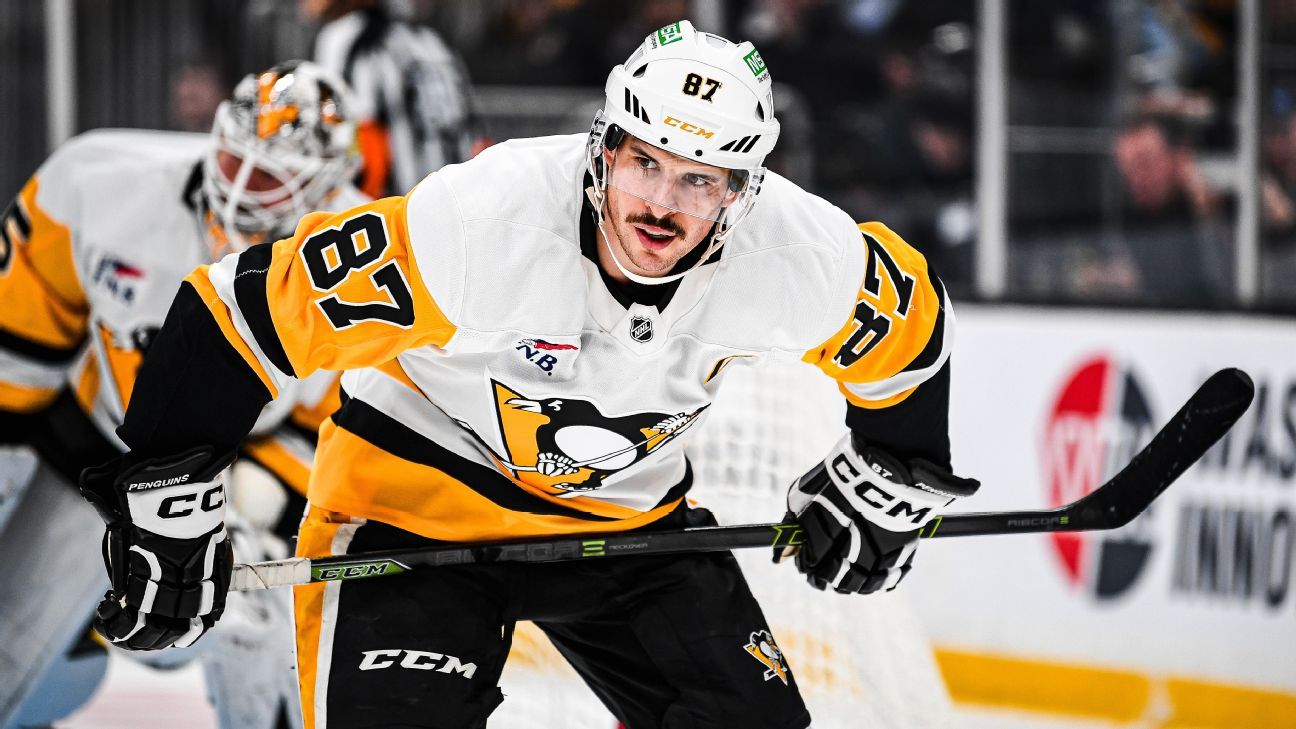
Rebuild? Retool? How the Penguins should approach the rest of 2024-25


-
Rachel Doerrie, ESPN
The Pittsburgh Penguins are in a precarious position. The franchise has been blessed for decades with Mount Rushmore-level players like Mario Lemieux and Sidney Crosby, and supported by future Hall of Famers like Jaromir Jagr, Evgeni Malkin and Kris Letang. Whether the team was good or not, there was always the chance that something special would occur on a nightly basis.
For years, the Penguins were the class of the NHL. Brilliant playoff series against the Washington Capitals, incredible Game 7 victories and three Stanley Cups in four Cup Final appearances in the salary cap era (since 2005-06). There is an argument to be made that they have been the most consistently successful team in the cap era.
Now, things are different. Gone are the days of Stanley Cup expectations, and the playoffs are a stretch.
What should management do in the short and medium term to get this team back in contention? Make some additions this year for another kick at the can with the core veterans? Begin the process of building more for the future? Or try to thread the needle and do both?

ONE THING REMAINS consistent from the dominant era: the Penguins are being carried by players who will soon have their number in the rafters. Sidney Crosby and Evgeni Malkin are scoring nearly a point per game in the twilight of their careers.
However, Crosby’s even-strength value ranks the worst in his illustrious career, just above break-even. Malkin has never been a defensive stalwart, but he’s losing the expected goals and scoring chance battle by more than 10% this season. While both are producing admirably, the Penguins need them to win their minutes on a more consistent basis.
Rickard Rakell has been excellent, providing tangible value on both sides of the puck at even strength. He’s projected for 52 points this season, a total that would be the third best of his 12-year career. His resurgence playing alongside Crosby has helped the Penguins find their footing over the last fortnight.
Meanwhile, Bryan Rust‘s production has dropped by 25%, and his defensive numbers have him as the worst defensive forward in the NHL this season. Drew O’Connor is struggling to produce offense, and is bottom-five in even-strength defensive value.
The team has an heir of nonchalance in their play, with careless turnovers, not finishing checks and fly-bys prevalent in all three zones. That can come with losing, but those are not habits that lead to winning. Even when the Penguins win, it is never comfortable. The Calgary Flames scored two quick goals in the third period this past Saturday, and you could feel the tension in the building. On Tuesday, the Penguins coughed up a 4-1 lead in the third period and needed an OT winner from Rust to take two points.
They are starting to win games, albeit in an unsustainable manner, and rank seventh by points percentage in the Metropolitan Division.
0:38
Bryan Rust wins it for the Pens in OT with a wrister
Bryan Rust glides toward the net and scores on a wrister to give the Penguins an overtime win over the Panthers.
THE BIGGEST ISSUE is that every player mentioned except for O’Connor — who is better suited for a bottom-six role — is above the age of 30. The Penguins are old in NHL terms, relying on their legends to prop them up, and Father Time is catching up. On Saturday, the Penguins dressed only two players aged 25 or younger. Teams that have sustained success do so because they are able to inject young players in the lineup to complement veterans and continue the cycle.
The Boston Bruins added David Pastrnak and Charlie McAvoy to their core of Patrice Bergeron, Brad Marchand and Zdeno Chara. There doesn’t appear to be a Pastrnak-level player available to the Penguins, unless they pick in the top 10 of the upcoming draft.
Owen Pickering has taken a step forward this season, and has shown signs he can become a quality top-four defenseman. Joel Blomqvist seems to be developing into an NHL starter. The acquisitions of Phil Tomasino and Cody Glass were good ones, and signal that GM Kyle Dubas is employing a different approach than a typical rebuild.
Crosby, Malkin, Letang and Karlsson are too good for the team to bottom out but aren’t good enough to carry a team on their own. Surrounding them with young NHL players who bring speed, skill and tenacity increases the potential of success. It is much more complex than a tear-down and rebuild, but Dubas has made a few shrewd moves to begin the process.
Should the Penguins have interest in continuing that path, there are two player archetypes to target in the trade market: the young player needing a change of scenery because he’s buried or not getting the opportunity in his current organization (as applies to Tomasino) or an AHL prospect that is on the cusp of making the NHL, who the Penguins believe could play sooner than with his current team (McGroarty).
More importantly, given the makeup of the Penguins’ lineup, contending teams will likely have interest in their veterans that need to be moved out as part of this process:
-
Anthony Beauvillier is providing value on both sides of the puck, and could prove to be a savvy acquisition for a playoff-bound team.
-
O’Connor has proven to be a versatile player capable of providing depth for a playoff team.
-
Noel Acciari and Blake Lizotte each have a year remaining on their contracts at reasonable numbers for fourth-line players that bring physicality and defensive value to a contending team.
Each of those players could likely return a mid-round pick or young player that has fallen out of favor. Tomasino was acquired for a fourth-round pick, and given the price for depth players at trade deadline, Dubas offloading players for picks (Lars Eller), and flipping those picks for players like Tomasino is tidy business.
Marcus Pettersson is generating interest from Vancouver, and should have other suitors as a pending free agent currently in a top-pairing role. Vancouver could have interest in Lizotte and/or Acciari, given the need to improve the bottom-six. Nils Hoglander is a player Pittsburgh has interest in, and fits the mold of a young player fallen out of favor with his current club who would benefit from a change of scenery.
While it would surely be more than Hoglander heading back to Pittsburgh for Pettersson, perhaps Pittsburgh would have interest in Sawyer Mynio, Nils Aman or Danila Klimovich. Hoglander’s value has tanked given his lack of ice time and production this season, and the Penguins should expect to get more than five-point player averaging under 12 minutes per game for a defenseman who’s performed admirably in a top-pairing role this season.
The price for defensemen at trade deadline is outrageous. Bottom-pairing blueliners such as Joel Edmundson, Ilya Lyubushkin, Chad Ruhwedel, Andrew Peeke, Colin Miller and Erik Johnson all returned picks in the third or fourth rounds. Pettersson is going to be one of the best defensemen available at the deadline, allowing Pittsburgh to command a hefty price for the pending free agent.
THERE ARE A FEW players who fit the pattern of players the Penguins would like to add, with Glass, Tomasino and McGroarty already acquired. Hoglander, as noted, seems to make the most sense. The Toronto Maple Leafs have their sights set on a deep playoff run and may be willing to part with Nick Robertson for a player they believe can help them win. Nashville’s Luke Evangelista and Montreal’s Jayden Struble or Justin Barron also come to mind as players who may benefit from a change of scenery.
Each of those players is 23 or younger, and has demonstrated potential to play a bigger role than their current situation.
Then, there is Trevor Zegras. The former cover athlete of NHL23, Zegras seems to have fallen out of favor in Anaheim after a contractual dispute that delayed the start of his 2023-24 season. Zegras played only 31 games last season, a disappointing outcome both for the 22-year-old and the Ducks. His overall value has steadily declined since the contract dispute; he’s projected for just 38 points this season.
Originally viewed as a top-six, playmaking center with dazzling skill, Zegras now finds himself on the wing. Anaheim has quite the cupboard of impressive young players up front (Leo Carlsson, Mason McTavish, Cutter Gauthier, Beckett Sennecke) and a change of scenery for Zegras may help him find the point-per-game pace of which he’s capable. He’s exactly the type of player that Pittsburgh should covet: A player with sky-high potential and proven ability to play top-six minutes in the NHL. Complicating matters, Zegras sustained a lower-body injury on Wednesday, so a trade may have to wait until the offseason.
The Ottawa Senators are a curious case. It seems that a core piece may be on the move, whether that’s now or in the offseason. Could one of Josh Norris or Shane Pinto be a fit for Pittsburgh down the middle? Jacob Bernard-Docker is getting squeezed on the blue line, and could step in on Pittsburgh’s right side. Again, if the Senators are looking to make a move.
The Dallas Stars are a contender, and will be without Tyler Seguin for the remainder of the season. Given the significant LTIR space that opens, could a much larger trade materialize allowing the Penguins to land one of Logan Stankoven, Mavrik Bourque or Thomas Harley? If the Stars want to add a major player, the Penguins may be the perfect trade partner.
To be clear: Pittsburgh will not trade any of its franchise legends without being asked by that player to do so. They must do right by them, and Dubas has a track record of doing so. They will surely be interest if Crosby or Malkin want out and Pittsburgh will have an opportunity to recoup significant assets for them. That day has not arrived yet, but Dallas is a team to watch if it does.
Regardless of which players the Penguins acquire, none of it will matter if the organization doesn’t buy in from top to bottom. The young players need long runs in offensive roles to build confidence, learn from their mistakes and develop. Tomasino and Glass need to play in key situations, on special teams and develop into all-around players. Pickering should get an increased role if Pettersson is moved. When other young players are acquired, they need the same opportunity.
A tear-down and rebuild from the bottom is much easier than navigating the task that Kyle Dubas and his staff have here now. Skill does not evaporate into thin air, and if young players can rejuvenate the lineup at reduced cap hits, perhaps the Penguins will be competitive sooner rather than later.

-
David Hale
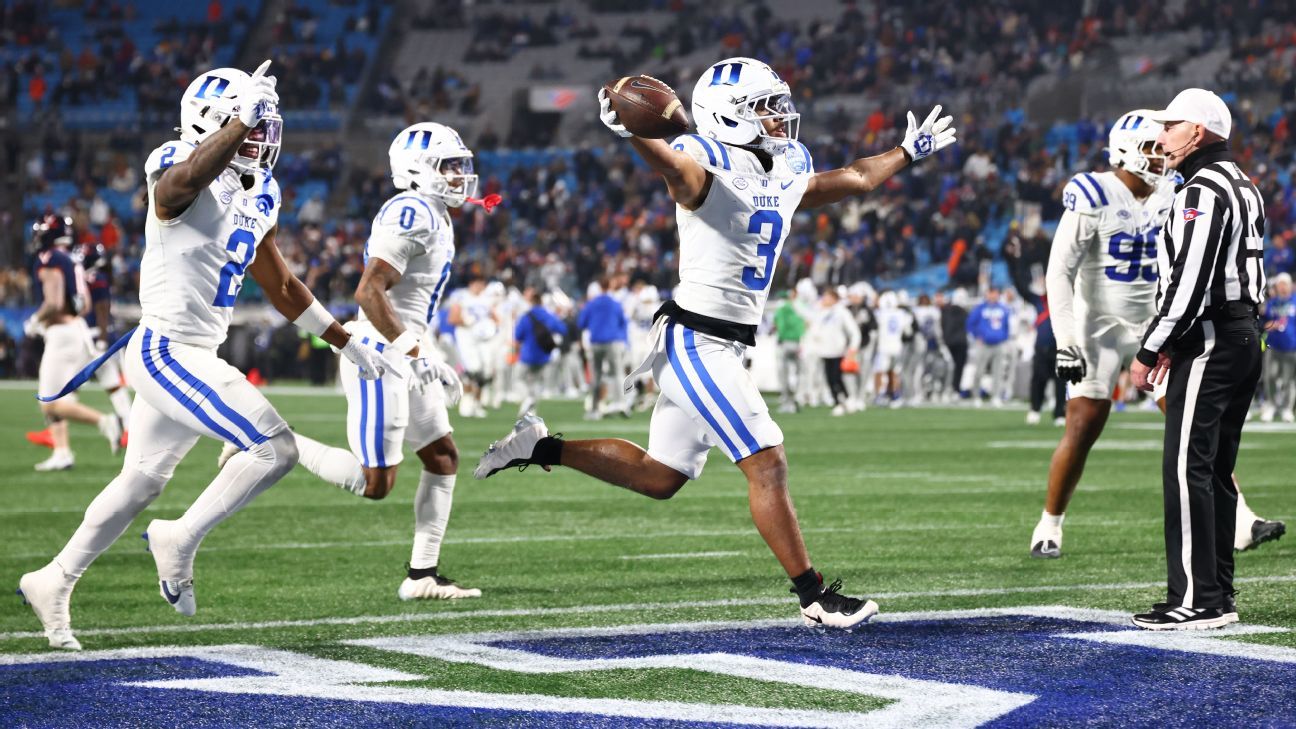
CHARLOTTE, N.C. — Duke defensive end Wesley Williams said he heard the refrain throughout the run-up to Saturday’s ACC championship game: A Blue Devils win would be “a doomsday scenario.”
At 7-5 and unranked, Duke arrived in Charlotte with a chance to win the conference and, in doing so, knock the ACC out of the College Football Playoff entirely, with two teams from the Group of 5 — Tulane and James Madison — potentially making it instead.
Well, doomsday has arrived, thanks to a series of fourth-down calls by Duke coach Manny Diaz, including one in overtime that resulted in the game-deciding touchdown in a 27-20 Blue Devils victory over No. 17 Virginia.
“Coach Diaz said this week, ‘If you think people hate Duke now, just wait until we win the ACC,'” Williams said.
The ACC’s fifth tiebreaker — combined win percentage of conference opponents — sent Duke to the league’s title game from among five teams tied for second place in the standings, including No. 12 Miami, a team on the fringe of an at-large CFP bid that could have benefited significantly from an extra game to wow the selection committee.
Instead, it was Duke that got the chance to avenge a Nov. 15 loss to Virginia and make its own case for playoff inclusion.
“I’m not going to take anything away from James Madison,” Diaz said. “They had a really great season. … The Sun Belt has been a really good conference in years past, but most of their top teams are having a down year. So when you start comparing strength of schedule — you can’t just look at wins and losses. It’s who you play against. That’s the whole point of playing a Power 4 schedule. There’s a reason all these coaches are all leaving for Power 4 jobs. There’s recognition that’s where the best competition is.
“The ACC champion should go to the College Football Playoff this year and every year. And we’ll be very excited to see how they rule on that tomorrow.”
James Madison coach Bob Chesney has accepted the head coaching position at UCLA, but he is expected to stay with the Dukes through any potential playoff run.
The Dukes finished the season 12-1 but lost their lone game against a Power 4 foe, Louisville, in September. James Madison beat Troy 31-14 on Friday to win the Sun Belt championship.
James Madison athletic director Matt Roan offered a counterpoint, noting that Dukes quarterback Alonza Barnett III was just coming back after a long-term injury and the Dukes still played Louisville close before losing 28-14.
“The next week, we started what is now the second-longest winning streak in the country,” Roan said. “This team is clicking since that time and separated itself as one of the five best conference champions in the country after winning the Sun Belt. JMU led the nation in wins over bowl-eligible teams with seven, matching Indiana and Ohio State. We can score points and stop points with anyone in the country. Our second halves, and fourth quarter in particular, have been untouchable. Who you play matters, but more important is how you play. Our players and our coaches have been elite all season and are deserving of this opportunity.”
James Madison was No. 25 in the most recent CFP rankings. Duke was unranked.
Diaz said after Saturday’s win, however, that the committee now has a more complete body of work to consider.
According to ESPN’s metrics, James Madison has the No. 18 strength of record but the No. 123 strength of schedule. Duke entered Saturday’s game with the No. 59 strength of record and No. 74 strength of schedule. Two of the Blue Devils’ losses were to teams outside the Power 4: playoff hopeful Tulane and 9-3 UConn.
“Having been on the selection committee, I understand it’s complicated,” Duke athletic director Nina King said. “I think we’re deserving when you look at some of these numbers like strength of schedule, number of Power 4 teams we’ve played and won. I think we’re deserving, but I fully appreciate the challenge [for the committee].”
The ACC’s doomsday scenario was in some ways more of a “Mission: Impossible.” After Duke lost to Virginia in Week 11, the Blue Devils were +1800 to win the conference and, according to ESPN’s FPI, had a 3.8% chance of winning the ACC.
Now, the conference will wait for the committee to deliver a verdict on both Duke and Miami on Sunday. The Hurricanes are 10-2 but have consistently been ranked behind several other two-loss teams, including Notre Dame, a team they beat in Week 1.
“Miami should get in,” Diaz said after Saturday’s win. “The head-to-head should matter. And so should we, because we’re the conference champion.”
ACC commissioner Jim Phillips argued the same before Saturday’s kickoff, but he declined to comment after Duke’s win over Virginia that might have left the conference with no playoff bids.
The doomsday scenario for the ACC, however, could just as easily turn into a boon with two teams in, should the committee buy into Duke’s sales pitch. Blue Devils linebacker Luke Mergott, who hauled in the championship-clinching interception in overtime, believes it will.
“We represent the ACC, and the ACC is a respected conference,” Mergott said. “I think we’ll be in, and I’m confident our name will be called.”


-
Adam Rittenberg
INDIANAPOLIS — Indiana assistant coach Ola Adams put his hands on his head in disbelief as confetti fell and the crowd roared at Lucas Oil Stadium.
But the scene unfolding before Adams on Saturday night was very believable. Since the moment coach Curt Cignetti swaggered onto campus two years earlier and outlined a success plan for the losingest program in college football, Indiana has been climbing.
On a magical night 50 miles from their home stadium, the Hoosiers reached the top, outlasting Ohio State 13-10 in a Big Ten championship game that matched the nation’s top two teams, both undefeated. Indiana beat No. 1 to become No. 1.
“We’re going to go in the playoffs as the No. 1 seed,” Cignetti said. “A lot of people probably thought that wasn’t possible.”
The milestones achieved are seemingly endless. The Hoosiers won their first Big Ten championship since 1967 and their first outright title since 1945. They beat Ohio State for the first time since 1988, ending a 32-game losing streak. And quarterback Fernando Mendoza likely clinched the school’s first Heisman Trophy with several heroic throws, rallying his team from a 10-3 deficit.
“It shows everybody: Why not? Why would you not want to come to Indiana?” linebacker Isaiah Jones said. “For any of the doubters out there, this kind of was the final nail in the coffin for any of the Indiana doubters, the Curt Cignetti doubters, the Hoosier doubters.
“This was the last thing that needed to be proved, and we did it.”
Indiana beat a top-ranked team for the first time in 17 tries, holding Ohio State scoreless for the final 40:08 and twice turning away the Buckeyes inside the 10-yard line.
“As a basketball manager, Keith Smart’s shot that won the national championship [in 1987],” Indiana athletic director Scott Dolson, who worked under coach Bob Knight for that title team, told ESPN. “This is right up there with that. This is a big moment.”
Cignetti guided the Hoosiers to a team-record 11 wins in his debut season, but when Indiana faced Ohio State, the eventual national champion, and Notre Dame, the eventual runner-up, its deficiencies were exposed in double-digit losses. Although Indiana faced a tougher regular-season schedule this fall, recorded a signature road win against Oregon and had shown clear improvement in several areas, it still entered Saturday’s game as the underdog.
But the Hoosiers (13-0) were better at the line of scrimmage, recording five sacks against an Ohio State team (12-1) that had allowed six the entire regular season. Facing Heisman Trophy contenders in quarterback Julian Sayin and wide receiver Jeremiah Smith, Indiana’s defense never yielded, making several memorable plays, including linebacker Rolijah Hardy‘s end zone pass deflection to prevent the go-ahead touchdown with 2:51 to play.
“We envisioned it,” defensive lineman Tyrique Tucker said. “We felt like we needed to handle business, especially due to last year. We felt like we had to finish some things and we had some unfinished business.”
Cignetti and his players thought that if they could keep the game close late, they would have an edge. Indiana rallied late to beat Iowa and Penn State and pulled away from Oregon with the score tied early in the fourth quarter. Ohio State, meanwhile, had not faced a second-half deficit this season until Mendoza found Elijah Sarratt for a 17-yard score with 8:02 to play in the third quarter.
“That’s what we dwell on, like, we come out and we take on a challenge,” said cornerback D’Angelo Ponds, who was matched up against Smith in man coverage throughout the game. “They haven’t been challenged all year. … We challenged them.”
Mendoza’s night began with a massive hit by Ohio State’s Caden Curry that left him writhing on the turf and forced him to miss a play. He also threw an interception that led to Ohio State’s only touchdown. But Mendoza steadied himself, even without top wideout Omar Cooper Jr., and found Charlie Becker for completions of 51 and 33 yards, the latter on third-and-6 in the final minutes.
Indiana fans gathered in the north end of the stadium chanted “Heis-Mendoza!” as Mendoza received game MVP honors.
“I don’t want to go in deep depth with the Heisman, but I remember Coach Cignetti brought me in, I think it was after UCLA, and he told me, ‘Hey, the Heisman’s a team game, it’s a team award. It’s not a player award. And if you win, then you can get nominated for it,'” Mendoza said. “Hopefully, I would love the opportunity to get the invite to New York, which would be fantastic.”
The Heisman ceremony awaits Mendoza next week, and Indiana will prepare for its first trip to the Rose Bowl since the 1967 season. But no one associated with the program will forget what happened Saturday night, just a few dozen miles from campus.
“It was just a dream come true,” Ponds said. “It actually didn’t feel real. We believed in ourselves, and we went out there and executed. It all just came together.”
-
 Sports2 years ago
Story injured on diving stop, exits Red Sox game
-
 Sports3 years ago
‘Storybook stuff’: Inside the night Bryce Harper sent the Phillies to the World Series
-
 Sports2 years ago
Game 1 of WS least-watched in recorded history
-
 Sports3 years ago
Button battles heat exhaustion in NASCAR debut
-
 Sports3 years ago
MLB Rank 2023: Ranking baseball’s top 100 players
-
Sports4 years ago
Team Europe easily wins 4th straight Laver Cup
-
 Environment3 years ago
Japan and South Korea have a lot at stake in a free and open South China Sea
-
 Environment1 year ago
Here are the best electric bikes you can buy at every price level in October 2024