
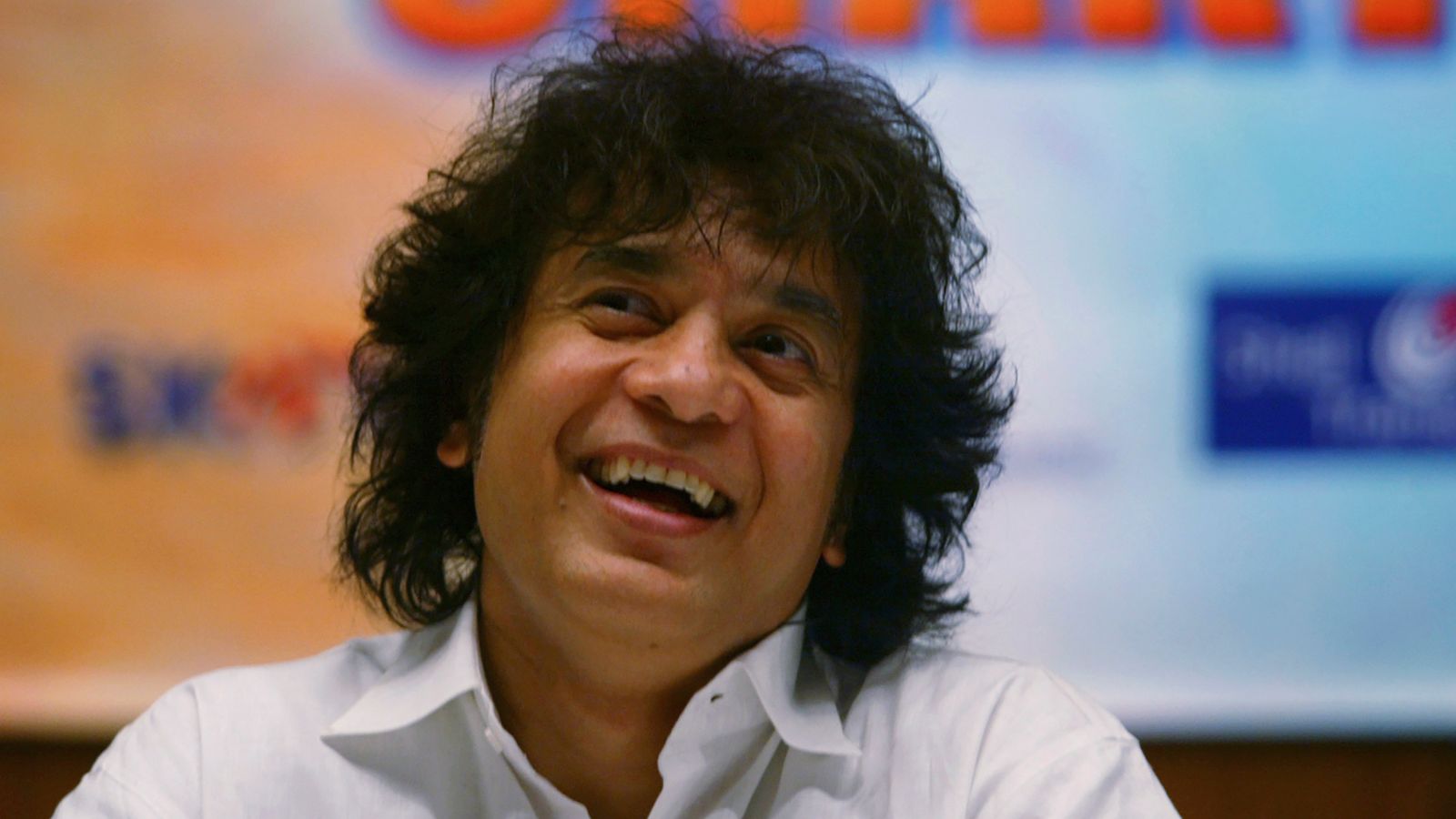
Zakir Hussain: Indian tabla maestro and Grammy-winning musician dies

Zakir Hussain, one of the greatest exponents of tabla music, a form of Indian drumming, has died.
Hussain, who during his career worked with George Harrison and Van Morrison among others, died at a hospital in San Francisco from complications arising out of idiopathic pulmonary fibrosis, his family said.
A family statement said: “He leaves behind an extraordinary legacy cherished by countless music lovers around the globe, with an influence that will resonate for generations to come. His prolific work as a teacher, mentor and educator has left an indelible mark on countless musicians.
“He hoped to inspire the next generation to go further. He leaves behind an unparalleled legacy as a cultural ambassador and one of the greatest musicians of all time. The family requests privacy at this time.”
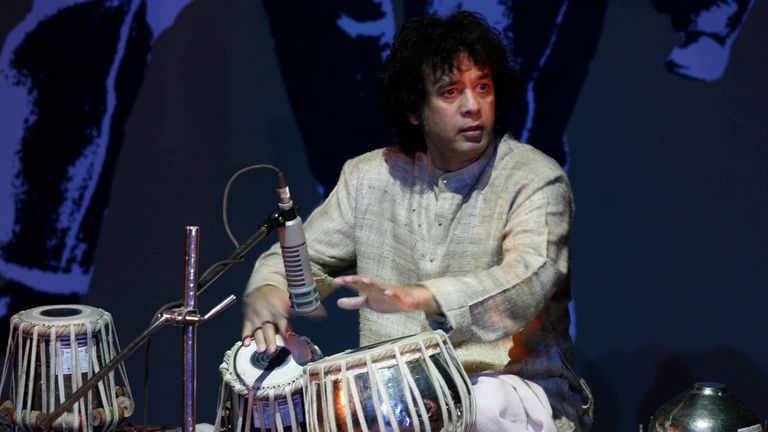
Zakir Hussain performing in New Delhi in 2009. File pic: AP
Hussain, 73, has won four Grammys, the most for an Indian musician, including for Best Global Music Album, Global Music Performance, and Best Contemporary Instrumental Album at this year’s awards in February.
Among the many tributes posted on social media, Indian Prime Minister Narendra Modi called him a “legendary tabla maestro” and a “true genius” on X.
Cricket legend Sachin Tendulkar said “we were fortunate to witness your magic” and “the beats will continue to echo in our hearts forever”.
Fellow cricketer Yuvraj Singh called Hussain a “true maestro”.
In a music career spanning six decades, Hussain worked with several renowned international musicians.
In 1972, he met British guitarist John McLaughlin, leading to the formation of the groundbreaking Shakti band the following year.
It also included violinist, L Shankar, and percussionist, T H Vinayakram, and their blend of Indian classical music with Western jazz won the group a Grammy for Best Global Music.
He transformed the art of tabla playing and during his long career collaborated with Jerry Garcia, the lead vocalist and guitarist of the Grateful Dread, with Irish singer Van Morrison, American percussionist Mickey Hart, Latin jazz percussionist Giovanni Hidalgo as well as playing on George Harrison’s 1973 album Living In The Material World, which reached number one in several countries’ album charts
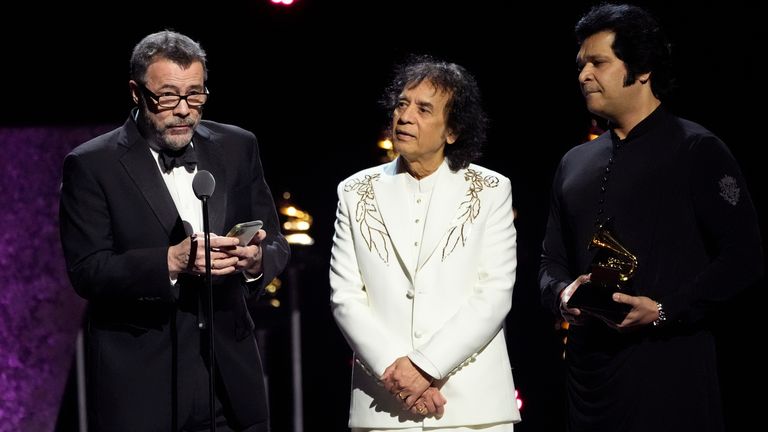
Zakir Hussain (C), with Edgar Meyer (L), and Rakesh Chaurasia, won Best Global Music Performance for Pashto at the 2024 Grammys in Los Angeles. Pic: AP
In the 1990s he delved into Asian Underground music that fused Western music with Asian classics, but made sure to retain the prominence of the tabla.
His collaboration with banjo legend Béla Fleck, double bass artist Edgar Meyer and flautist Rakesh Chaurasia, took home this year’s Grammy for Best Contemporary Instrumental Album with the album As We Speak. Pashto by the collaboration won the award for Best Global Music Performance. The group was set to tour India in January.
He has also made music for Bollywood and Hollywood films, including this year’s Monkey Man with Dev Patel, and acted in 1983’s Heat And Dust, a Merchant-Ivory production in which his character romanced Julie Christie.
His life and career were littered with awards, including receiving the Padma Vibhushan, India’s second-highest civilian award for “exceptional and distinguished service”. He had previously won the third and fourth-highest civilian awards.
A child prodigy, Hussain learned early from his father Alla Rakha, another of India’s greatest tabla players.
He often claimed he learned the basic rhythm of the tabla from the first words his father whispered into his ears when he was first brought home after birth.
He played his first concert aged just seven and began touring a mere five years later.
After completing his education in Mumbai, where he was born, he left for America in 1970. By 19, Hussain was teaching at the University of Washington before joining Ustad Ali Akbar Khan’s music college in San Francisco.
He was also voted “sexiest man” by female readers of the Indian magazine Gentleman in 1994 in a competition against the likes of Bollywood superstar Amitabh Bachchan.
The jugalbandi, a duet between two solo musicians in Indian classical music has been a remarkable part of his performance.
Read more:
Indian actor arrested after woman dies
Indian farmers clash with police
Golden Temple assassination attempt
Fans of the style treasured the playful melodramatic musical banter between Hussain and sitar legend Pandit Ravi Shankar, santoor maestro Pandit Shiv Kumar Sharma, flautist Hari Prasad Chaurasia, and sarangi stalwart Ustad Sultan Khan, as well as other classical Indian musicians.
Hussain is survived by his wife, Antonia Minnecola, and his daughters, Anisa Qureshi and Isabella Qureshi.
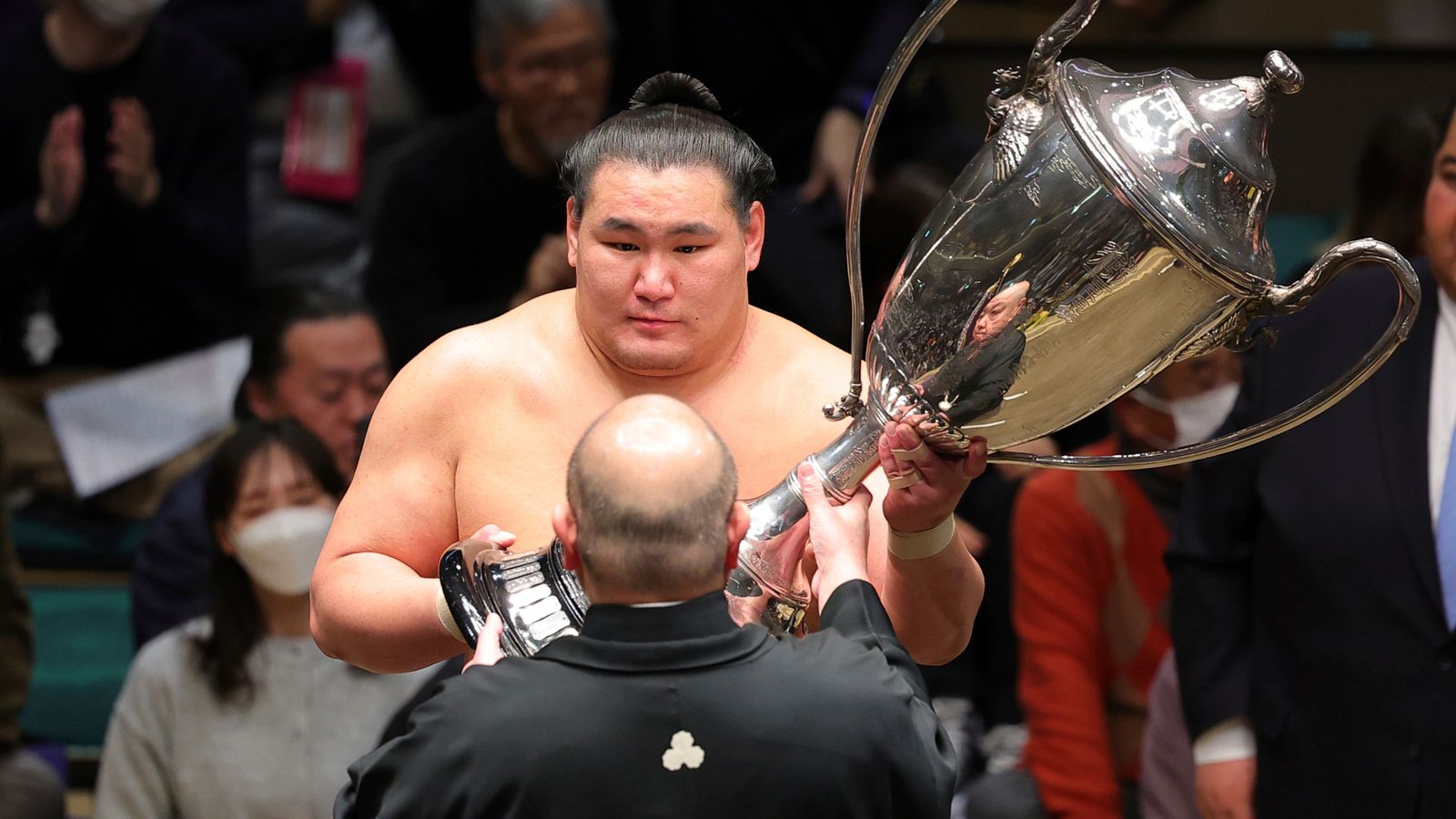
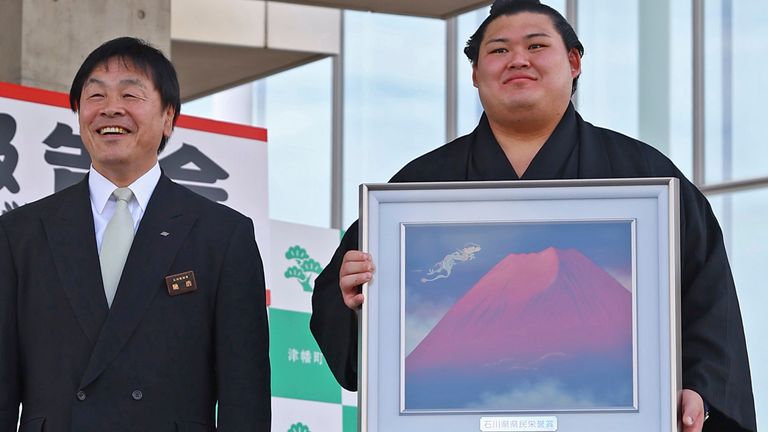
They’re getting through 70kg of rice a day and the wholesaler has run out of noodles. Yes, Sumo returns to London on Wednesday.
It’s just the second time a Grand Tournament has been held outside of Japan – and this is a sport that has records going back more than 1,500 years.
It’s 34 years since the Royal Albert Hall hosted the only previous such event on foreign soil – and the appetite for tickets meant all five days sold out immediately.
Much of the focus is on the two grand champions or yokozuna, the 74th and 75th men to attain the rank.
They’re the Mongolian Hoshoryu Tomokatsu, plus Japan’s Onosato Daiki – who this year became the quickest wrestler to achieve the rank in the modern era.
“I’m happy that Sumo is back after so many years,” Onosato said. “I hope I can show the UK fans how fantastic Sumo is.”
“Being a yokozuna has a lot of responsibility,” Hoshoryu told Sky Sports. “We have to show everyone an example of what a yokozuna is – and that’s very difficult.
“My uncle was a yokozuna – and I’m happy to follow in his footsteps. But I came here to London as a yokozuna which he didn’t, so I’m even happier.”
The two are already great rivals.
Onosato Daiki became the quickest ever to achieve yokozuna rank. Pic: AP
At the recent Aki Basho – the most prestigious tournament on the sumo calendar – the pair finished with identical records after 15 days of bouts.
It all came down to a final play-off between the two yokozuna – the first time that had happened in 16 years. It was Onosato who came out on top on that occasion.
Hoshoryu says he is a big fan of basketball and football. He follows Chelsea, although his favourite players are going back a bit: “Didier Drogba and Petr Cech. He’s the ‘keeper. I like this guy!”
Early starts and a hearty stew: The life of a rikishi
The wrestlers – or rikishi – have a rigorous training regime.
They live in communal blocks called stables and practice starts early. Perhaps surprisingly, everyone skips breakfast. After training and practice – and for the younger rikishi, chores – the wrestlers all eat together.
The staple of their diet is chankonabe, a hearty stew packed with meat and vegetables. The feeding of the 40 rikishi who have come over for the five-day tournament is a challenge in itself.
Donagh Collins, the CEO of co-organisers Askonas Holt, said: “We are going through 70 kilos of rice a day. Somebody told me that the wholesaler for the noodles has run out of noodles. We’re really pushing the system here.”
The ring – or dohyo – is just 4.55m in diameter and quite small when two giant wrestlers leap at each other.
The aim of the fights is to either get your opponent onto the floor – or, more spectacularly, shove or hurl them out of the dohyo, so spectators in the ringside seats may be getting extremely up-close to the wrestlers.
The last time the tournament was in Britain, the massive Konishiki, known as the Dump Truck, took centre stage.
The giant Hawaiian was the heaviest-ever rikishi coming in at 287kg – or 45 stone. That’s a lot of wrestler to dodge if he comes falling out of the ring towards you.
Read more from Sky News:
Wildlife award revealed – see stunning snaps
Premier League players to take the knee again
The Royal Albert Hall may be firstly a concert venue, but it has hosted the likes of John McEnroe, Lennox Lewis and even Muhammad Ali.
And for the next five days, the cream of the world of sumo will be thrilling the crowds – provided a new noodle supplier is found.
What is a yokozuna?
Yokozuna is the highest rank in sumo, with its name meaning “horizontal rope” and refers to the rope worn around a competitor’s waist as they enter the ring.

-
 Sports3 years ago
‘Storybook stuff’: Inside the night Bryce Harper sent the Phillies to the World Series
-
 Sports2 years ago
Story injured on diving stop, exits Red Sox game
-
 Sports2 years ago
Game 1 of WS least-watched in recorded history
-
 Sports3 years ago
Button battles heat exhaustion in NASCAR debut
-
 Sports3 years ago
MLB Rank 2023: Ranking baseball’s top 100 players
-
Sports4 years ago
Team Europe easily wins 4th straight Laver Cup
-
 Environment2 years ago
Japan and South Korea have a lot at stake in a free and open South China Sea
-
 Environment1 year ago
Here are the best electric bikes you can buy at every price level in October 2024