Connect with us

Published

on

TikTok has described a report it could sell its threatened US business to Elon Musk as “pure fiction”.

The short video platform’s Chinese owners ByteDance are facing the prospect of TikTok being shut down permanently in America on Sunday.

That is when a US government ban, on national security grounds, is due to take effect.

Money latest: Spain proposes 100% tax on foreign-owned homes

But Bloomberg News reported that officials in Beijing, where TikTok’s parent firm is based, were considering whether to allow a possible sale to the billionaire X owner, if the order could not be overturned or delayed.

The authorities in China were said to prefer that TikTok’s US business remained under ByteDance’s control.

They have always denied having an influence over ByteDance let alone TikTok – a position that both entities have supported, consistently denying any suggestion of collusion that would represent any kind of threat to US interests.

More on Tiktok

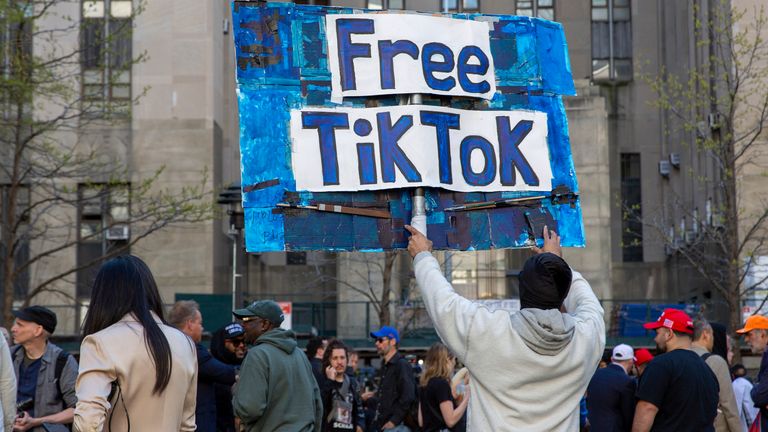
A man carries a Free TikTok sign in April 2024. File pic: AP
Image:
TikTok has 170 million users in the US. File pic: AP

The US Supreme Court has indicated that it is minded to accept the Biden administration’s ban on the grounds that national security concerns outweigh the rights of TikTok’s 170 million US users to free speech.

It is not clear when the final ruling will be delivered but the ban is due to take effect on Sunday, a day before Donald Trump’s inauguration.

Ahead of the start of his second term in the White House, he has called for the court to push back the deadline to allow for a “political resolution”.

Such a move would not rule out Musk, a political ally, from potentially snapping up TikTok if the impasse can not be broken.

A TikTok spokesperson said in response to the report of talks: “We can’t be expected to comment on pure fiction.”

Other potential buyers are said to include Mr Trump’s former treasury secretary Steven Mnuchin and billionaire businessman Frank McCourt.
Continue Reading

Business

Blackrock arm in talks to back Six Nations Rugby investor

Published

on

By

Blackrock arm in talks to back Six Nations Rugby investor

A division of Blackrock, the world’s biggest asset manager, is in talks to provide hundreds of millions of pounds of funding to a company which owns stakes in Six Nations Rugby and the women’s professional tennis tour.

Sky News has learnt that HPS, the global private credit giant, is among the parties negotiating with CVC Capital Partners over the financing of its Global Sports Group (GSG) holding company.

The talks, which are not exclusive, would see HPS help provide firepower for the CVC-backed vehicle to make further acquisitions to expand its portfolio.

Chaired by Marc Allera, the former BT Group consumer boss, GSG holds stakes in Premiership Rugby, the top flights of French and Spanish football and the international volleyball tour.

In recent weeks, Mr Allera has outlined his ambitions to acquire further global sports properties.

HPS, which was acquired by Blackrock for $12bn late last year, is said to be serious about becoming involved in GSG.

Other parties with whom CVC is in discussions include Ares Management, which is interested in providing both debt and equity to GSG, according to insiders.

More from Money

Any new financing package was expected to be secured on favourable terms for the CVC-controlled group because of the underlying credit quality of the assets in the portfolio.

Sky News revealed during the summer that CVC had engaged a trio of banks to explore plans for a refinancing of what was at the time referred to internally as SportsCo and which has since been renamed Global Sport Group.

The portfolio also includes an Indian Premier League cricket franchise, several of which are currently exploring sales at valuations of well over $1bn.

Goldman Sachs, PJT Partners and Raine Group are advising on the refinancing of GSG, which has been set up to optimise CVC’s investments in the sector.

The deal is expected to allow CVC to remain invested in its sports portfolio for longer, while also paving the way for the sale of a minority stake in SportsCo or a future initial public offering.

Having made billions of dollars from its ownership of Formula One motor racing – one of the most lucrative deals in the history of sport – CVC has bought stakes in leagues and other assets spanning a spectrum of elite sporting assets over the last two decades.

Its investment in the media rights to La Liga – Spain’s equivalent of the Premier League – is expected to generate a handsome return for the firm, although a comparable deal in France has faced significant challenges amid broadcasters’ financial challenges in the country.

CVC’s backing of global sports properties is intended to position it to maximise their commercial potential through new media and sponsorship rights deals, as well as their expansion into new formats aimed at drawing wider audiences amid rapid shifts in media consumption.

In rugby union, its acquisition of a stake in Premiership Rugby’s commercial rights was hit by the pandemic and the subsequent financial pressures on clubs which saw a number of the league’s teams forced into insolvency.

CVC, which bought into Premiership Rugby in 2019, owns a 27% stake in the league.

Its sporting assets will continue to remain autonomous and independent of one another, despite the new umbrella holding entity.

One expected benefit of the SportsCo approach would be the sourcing of new investment opportunities, with CVC being linked to a bid for one of the new European NBA basketball franchises which is expected to be sold in the coming months.

Global sports properties have become one of the hottest growth areas for private capital in recent years, with firms such as Ares, Silver Lake Partners and Bridgepoint all investing substantial sums in teams, leagues and other assets across the industry.

CVC and Blackrock declined to comment.

Continue Reading

Business

Next plots swoop on family-owned shoe chain Russell & Bromley

Published

on

By

Next plots swoop on family-owned shoe chain Russell & Bromley

Next, the high street fashion giant, is plotting a swoop on Russell & Bromley, the 145 year-old shoe retailer.

Sky News has learnt that Next, which has a market capitalisation of £16.6bn, is among the parties in talks with Russell & Bromley’s advisers about a deal.

City sources said this weekend that a number of other suitors were also in the frame to make an investment in the chain, although their identities were unclear.

The talks come amid the peak Christmas trading period, with retail bosses hopeful that consumer confidence holds up over the coming weeks despite the stuttering economy.

Russell & Bromley confirmed several weeks ago that it had drafted in Interpath, the advisory firm, to explore options for raising new financing for the business.

The chain trades from 37 stores and employs more than 450 people.

It was formed in 1880 when the first Russell & Bromley store opened in Eastbourne.

More from Money

Seven years earlier, George Bromley and Elizabeth Russell, both of whom hailed from shoemaking families, were married, paving the way for the establishment of the business.

Russell & Bromley is now run by Andrew Bromley, the fifth generation of his family to hold the reins.

Billie Piper, the actress and singer, is the current face of the brand as it tries to appeal to younger consumers as part of a five-year turnaround plan.

If it materialised, an acquisition or investment by Next would mark the latest in a string of brand deals struck by Britain’s most successful London-listed fashion retailer.

In recent years, it has bought brands such as Cath Kidston, Joules and Seraphine, the maternitywear retailer for knockdown prices.

Next also owns Made.com, the online furniture retailer, and FatFace, the high street fashion brand.

Under Lord Wolfson, its veteran chief executive, Next has defied the wider high street gloom to become one of the UK’s best-run businesses.

Its Total Platform infrastructure solution has enabled it to plug in other retail brands in order to provide logistics, e-commerce and digital service capabilities.

Both Victoria’s Secret and Gap also have partnerships with Next using the Total Platform offering.

It was unclear whether any deal between Next and Russell & Bromley would involve acquiring the latter’s brand outright or making an investment into the business.

This weekend, Next declined to comment, while neither Russell & Bromley nor Interpath could be reached for comment.

In a statement in October, Mr Bromley said: “We are currently exploring opportunities to help take Russell & Bromley into the next phase of our ‘Re Boot’ vision.

“Since the announcement of the ‘Re Boot’ earlier this year we have made significant progress, positioning us well to build on our momentum and continue along our journey.

“We are looking forward to working with our advisory team to secure the necessary investment to accelerate our expansion plans.”

Continue Reading

Business

UK economy shrank by 0.1% in October, official figures show

Published

on

By

UK economy shrank by 0.1% in October, official figures show

The UK economy contracted by 0.1% in October, according to official figures.

The surprise fall in gross domestic product (GDP) – a measure of economic output – comes after a similar unexpected 0.1% drop in September and 0% growth in August.

Economists polled by the Reuters news agency had predicted that October GDP would grow by 0.1%.

The figures, from the Office for National Statistics (ONS), represent more bad news for the chancellor over the state of the UK economy.

Commentators had warned that consumer spending was likely to be restrained in the run-up to November’s budget, amid concerns about the impact of Rachel Reeves’s potential measures on households and businesses.

UK GDP has also been hit hard by disruption to car production caused by a cyber attack on Jaguar Land Rover.

The ONS said that during October, the UK’s services sector fell by 0.3%, while construction was down 0.6%. However, production grew by 1.1%.

It found that GDP on a rolling three-month basis, to October, also fell by 0.1%.

Read more from Sky News:
Appeal court delay for first Post Office Capture case

Mail owner lines up NatWest to help fund Telegraph bid
Burger King UK lands new backing

The ONS’s director of economic statistics, Liz McKeown, said: “Within production, there was continued weakness in car manufacturing, with the industry only making a slight recovery in October from the substantial fall in output seen in the previous month.

“Overall services showed no growth in the latest three months, continuing the recent trend of slowing in this sector. There were falls in wholesale and scientific research, offset by growth in rental and leasing and retail.”

Interest rate cut ‘nailed on’

Commentators also blamed rumours and leaks in the run-up to the budget for dampening demand.

Scott Gardner, from banking giant JP Morgan, said that despite expectations of a return to growth, the economy continued to “battle a period of inconsistent productivity”.

He added: “Speculation about potential budget announcements had a numbing effect on consumers and businesses in the lead up to the chancellor’s speech at the end of November.”

Suren Thiru, from the Institute of Chartered Accountants, said the data increased the likelihood of the Bank of England cutting interest rates next week.

He said: “With these downbeat figures likely to further fuel fears among rate-setters over the health of the UK economy, a December policy loosening looks nailed on, particularly given the likely deflationary impact of the budget.”

Figures ‘extremely concerning’

Barret Kupelian, chief economist at PwC, said that while some of the blame could be attributed to the Jaguar Land Rover cyber attack, “the bigger story is that speculation around the autumn budget kept households and businesses in wait-and-see mode”.

He added: “Given the timing of the budget, November’s GDP print is likely to look similarly subdued before any post-budget effects start to show up.”

Sir Mel Stride, the Tory shadow chancellor, described the figures as “extremely concerning”, claiming they were “a direct result of Labour’s economic mismanagement”.

A Treasury spokesperson said: “We are determined to defy the forecasts on growth and create good jobs, so everyone is better off, while also helping us invest in better public services.”

Continue Reading

Trending