
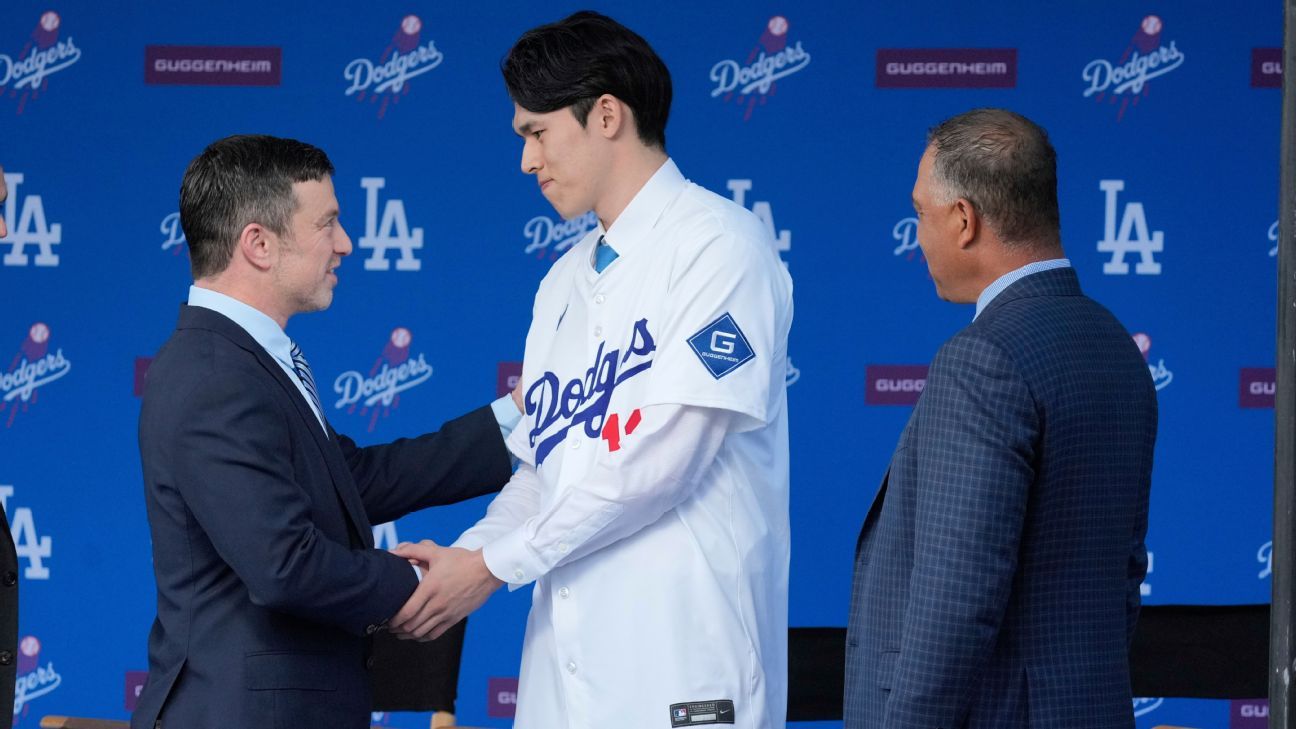
Are the Dodgers ruining baseball? Inside the Roki Sasaki signing — and a spending spree that has rocked MLB

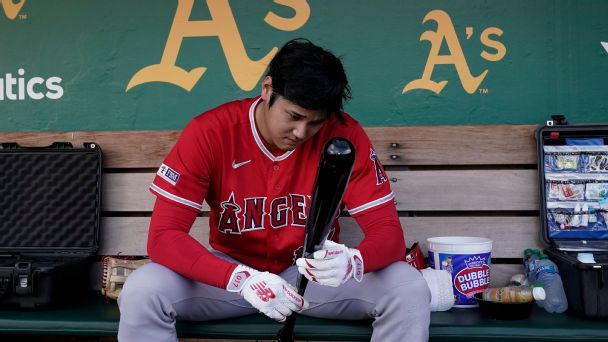
SIX YEARS AGO, when the world knew next to nothing of a gangly 17-year-old pitcher in Japan, a Los Angeles Dodgers evaluator sat in the stands at his high school games with a video camera to capture the splendor. Roki Sasaki’s fastball regularly reached 100 mph, his right arm a whirling force of nature. The Dodgers were smitten. Sasaki could eventually be the best pitcher in the world, team officials told one another. And when the time came for his inevitable move to Major League Baseball, they wanted to ensure he felt as strongly about them as they did him.
In the time since, the Dodgers have conquered baseball in nearly every fashion imaginable. Armed with immense wealth from their owners and buoyed by the largest local television contract in the game, the Dodgers have spared no expense in trying to win. Their major league payroll consistently ranks at the top of the game, yes, but other line items are best-in-class, too, from their technology infrastructure to their coaching staff’s compensation to the quality of the food they serve their minor league players.
When this winter arrived and Sasaki, now 23, declared his intentions to come to MLB, the Dodgers didn’t need a sales pitch because the allure for players is obvious: If you covet winning, come join a burgeoning dynasty. Since being sold to the Guggenheim Baseball Management group in 2012 following the disastrous ownership of Frank McCourt that led the team to file for bankruptcy, the Dodgers have remade themselves into conquerors: of the National League West (11 titles in 12 years), their October demons (two World Series championships in five years), and the Japanese baseball market (the signings of Shohei Ohtani and Yoshinobu Yamamoto for more than $1 billion guaranteed).
Every front office pined for the latest Japanese ace this offseason. Eight teams were granted an audience with Sasaki. Three became finalists. The Dodgers were one. The San Diego Padres, Los Angeles’ chief rival in the NL West and another team whose early scouting of Sasaki won favor, were the second. The third came down to the Toronto Blue Jays, Texas Rangers, Chicago Cubs and New York Yankees — four other teams whose years of work in Japan and history with Japanese players spoke to an understanding of Sasaki and his desires. The rapport built with Toronto’s international scouting apparatus won the Blue Jays the third finalist slot.
Toronto impressed Sasaki with its answer to a burning question: Why had his sizzling fastball lost velocity in 2024? The explanation from Frank Herrmann, a Blue Jays baseball operations staffer who had pitched in the big leagues and was Sasaki’s teammate with the Chiba Lotte Marines, and Sam Greene, the Blue Jays’ assistant pitching coach, blended a discussion of data, mechanics and feel that boosted their pursuit. Sasaki spent multiple days in Toronto, and as he departed, the Blue Jays were confident that whatever advantages the Dodgers might have, they were surmountable.
The visit to San Diego left the Padres similarly assured. Star third baseman Manny Machado held a gathering at his house, where a Japanese chef cooked familiar cuisine. Jackson Merrill, the Padres’ 21-year-old center fielder expected to blossom into a superstar in coming seasons, attended, as did Ethan Salas, the 18-year-old catcher seen as a linchpin in future seasons. And San Diego had an ace in the hole: Yu Darvish, the progenitor of modern Japanese pitching, whom Sasaki regards as a mentor with peerless knowledge.
The successful meetings put that much more pressure on the Dodgers, who hosted Sasaki Jan. 14 at minority owner Peter Guber’s Bel Air home and summoned an array of players, all locked up to long-term deals: superstars Ohtani, Mookie Betts and Freddie Freeman, catcher Will Smith, and super-utility man Tommy Edman. Ohtani, knowing Sasaki loves dogs, brought his Dutch kooikerhondje, Decoy, to the presentation.
With the international signing period opening Jan. 15 and the window for Sasaki to sign closing Jan. 23, the decision zone arrived and forced action. All three teams lined up trades to acquire more international bonus money to help their pursuit. San Diego was eliminated first. Toronto, attempting to demonstrate its willingness to go above and beyond for Sasaki, struck a deal with Cleveland to take on $11.75 million remaining on center fielder Myles Straw‘s contract along with an additional $2 million in international money even before Sasaki had made his decision.
Soon thereafter, he did — and it wasn’t the Blue Jays. What so many in baseball saw as a fait accompli — to the point MLB did a preemptive investigation into whether Sasaki had any sort of prearranged deal (and determined he didn’t) — played out. While some teams in meetings asked if Sasaki wanted to be Kevin Durant or Michael Jordan — to join a superteam or help build one — the allure of the Dodgers was impossible to ignore. All of their games are broadcast on national TV in Japan. The stores at Nippon Professional Baseball stadiums that include racks of Dodgers gear will now feature jerseys with his name on them. The Dodgers’ plan when they signed Ohtani — “One of our goals is for baseball fans in Japan to convert to Dodger Blue,” president of baseball operations Andrew Friedman said — had borne fruit.
In executing that vision, the team has set off alarms inside the sport. The Dodgers’ signing of Sasaki for $6.5 million — a sum artificially deflated by MLB’s rules on international amateurs that offers Los Angeles hundreds of millions of dollars in surplus value — left front offices and fans alike gobsmacked. Watching the Dodgers pick off free agent after free agent with heavily deferred deals has built a wave of frustration. Seeing them land one of the most valuable contracts in the game — the sort typically reserved for the worst teams via the draft — reinforced something that has become increasingly clear.
The Dodgers are no longer just a team chasing championships. They are a stress test for the game itself.
THE ANGER — from disillusioned fans, from dispirited front offices, from owners made to look as if they don’t care — is very real. And it’s growing to the point that people at the highest levels of Major League Baseball acknowledge it concerns them. Most worrisome is the rhetoric that fans are done with the game. That what L.A. is doing is unfair. That the financial imbalance ruins the sport.
A villain around which people can rally is tolerable; an unbeatable monolith is not. An exemplar for how teams can operate is instructive; an extinguishing of hope is not. With every transaction pushing the Dodgers further from the former and more toward the latter, MLB faces growing cynicism that has reignited calls for a salary cap — and made collective bargaining discussions set to start a year from now, before the current basic agreement expires following the 2026 season, that much more fraught with peril.
Over the past 13 months, the Dodgers have morphed from a large-market, big-money jewel franchise that spent exceptional sums of money and didn’t have much to show for it into a referendum on the state of MLB in 2025. Because baseball is the last of the major North American professional sports leagues without a salary cap or floor, the difference between the Dodgers — who carry a payroll in the $375 million range — and the next-highest team, the Philadelphia Phillies, is nearly $70 million. That’s to say nothing of the gap between the Dodgers and the 30th-ranked Miami Marlins: around $300 million. The $120 million or so the Dodgers are in line to pay in luxury tax penalties on top of their payroll is more than the projected Opening Day payroll of 10 teams.
In the past 411 days, the Dodgers have:
-
Signed Ohtani to a 10-year, $700 million contract, with $680 million deferred
-
Traded for right-hander Tyler Glasnow and signed him to a five-year, $136.5 million contract extension
-
Signed right-hander Yamamoto to a 12-year, $325 million contract
-
Signed Smith to a 10-year, $140 million contract extension, with $50 million deferred
-
Signed two-time Cy Young winner Blake Snell to a five-year, $182 million contract, with $66 million deferred
-
Signed Edman, acquired at the 2024 trade deadline, to a five-year, $74 million contract extension, with $25 million deferred
-
Signed outfielder Michael Conforto to a one-year, $17 million contract
-
Signed reliever Blake Treinen to a two-year, $22 million contract
-
Signed outfielder Teoscar Hernández to a pair of deals totaling $89.5 million over four years, with $32 million deferred
-
Signed Korean infielder Hyeseong Kim to a three-year, $12.5 million contract
-
Signed Sasaki
-
Signed closer Tanner Scott to a four-year, $72 million contract, with $21 million deferred
In total, they have guaranteed $1.778 billion — nearly half of it ($874 million) deferred. For a team that already had Betts and Freeman under contract — a team that over its six previous full seasons won at least 100 games five times — to turn over more than half its roster and add nearly a dozen impact players registered as baseball gluttony.
A day after Sasaki’s signing, Chicago Cubs owner Tom Ricketts told 670 AM in Chicago that “it’s really hard to compete” with the Dodgers. Ricketts bought the Cubs for $845 million in 2009. They are worth around $5 billion now, according to a person who values professional sports franchises. The Cubs, according to Forbes, have the third-highest revenue in MLB, behind the Yankees and Dodgers. They are the epitome of a big-market, high-earning franchise. Ricketts said the Cubs attempt to break even every year. Forbes estimates they have earned more than $585 million before interest, taxes, depreciation and amortization over the past decade in addition to the more than $4 billion appreciation of the team.
At the time, the Cubs were attempting to sign Scott, among the most coveted relievers this winter. The next day, with a final offer of four years and $66 million — $6 million shy of where the Dodgers landed — they lost. The $18 million-a-year salary Scott received fell in line with those of other elite closers.
This is not a chicken-and-egg situation. Teams like the Cubs and Boston Red Sox — should-be powerhouses — earn reputations quickly among players by not spending. When franchises show they care about winning, players take note. The flocking of talented players to the Dodgers is not a function of a willingness to overpay. The vast majority of the long-term deals handed out by the Dodgers are market price or club-friendly. Betts’, Freeman’s, Smith’s. Ohtani’s deal — with $68 million of his annual $70 million salary deferred for a decade — was proposed by him to the Dodgers as well as to the other teams that pursued him: Toronto, San Francisco and the Los Angeles Angels.
While the Dodgers are among the rare teams that can carry three $300 million-plus deals (and four other nine-figure pacts on top of that) without bleeding money, they also thrive in the middle market. They took advantage of Ricketts’ unwillingness to push — he has limited the Cubs’ budget this winter, even after trading for Kyle Tucker — and won the bidding for Scott. Any team could have pursued Hernández, whose deal this winter was at market value. Every team passed on signing Snell to a long-term deal in the 2023-24 offseason. Edman was widely available at the trade deadline.
Every MLB club, even those with the lowest revenues, can compete for that sort of talent. So many operate with unbending devotion to their computer models, though, that the simple act of spending has become an even greater advantage for the Dodgers. With a history of teams on limited budgets annually performing among the best in the game, those franchises could fare even better stretching themselves financially and investing in winning, at the very least proportionally to those who devote a higher percentage of revenue to payroll. The Dodgers’ willingness to spend in grand sums and success with it should motivate other teams to keep up, not preclude them from doing so.
THREE DECADES AFTER the longest work stoppage in MLB history, the inequity baked into the game’s financial system remains. MLB’s pursuit of a salary cap in 1994 led to the cancellation of the World Series that year. The rekindling of a cap conversation has already begun — particularly by owners peeved by the Dodgers’ spending and the sheer size of Juan Soto‘s 15-year, $765 million, no-deferred-money deal with the New York Mets. Proposing a cap in next year’s CBA negotiations would be tantamount to a declaration of war by MLB — and already those owners are prepared for commissioner Rob Manfred to lock the players out Dec. 1, 2026.
It’s clear, by now, that the punitive elements the most recent collective bargaining agreement put in place — the luxury tax, the qualifying offer system, draft-pick punishment — are anti-spending measures that just don’t apply to some. The Mets have spent exceptional amounts of money and been OK. The Dodgers clearly see money as a competitive advantage they’re willing to flaunt. There is room to incentivize other teams to spend without having to institute a cap and a floor.
For now, though, this is the game. These are the rules. Players overwhelmingly supported the collective bargaining agreement that governs baseball. Owners voted unanimously in favor of it.
The Dodgers are the symptom, not the cause.
Players will point out that a cap is not a panacea. Without one, baseball has found parity on par with or better than capped leagues. In the past quarter-century, the team with the largest payroll in baseball has won the World Series just four times. Over the past 15 years, it’s just twice. No team has captured back-to-back championships since the Yankees won three straight 1998-2000. MLB’s postseason this year featured teams from Kansas City, Milwaukee, Detroit, Cleveland, Baltimore and San Diego. Perhaps most important: The randomness of baseball’s postseason typically serves as an equalizer, keeping even the most talented teams from their most dynastic aspirations.
As the Dodgers exceed the base luxury tax threshold of $241 million by more than 50%, it’s worth remembering that baseball has seen financial disparity like this before. There’s little solace to take in that this year, though, because the team the Dodgers have put together is genuinely great, extraordinarily deep, and prepared to weather injury, ineffectiveness and the other vagaries that would torpedo opponents’ seasons.
For all of the Dodgers’ advantages, it’s worth acknowledging the most overblown element of their approach. The deep misunderstanding of deferred money has painted it as a tool to avoid paying salaries for long periods of time and lessen a team’s luxury tax payroll. Neither of these is true.
Within two years of agreeing to a contract with deferred money, teams must place cash to cover future payments in an account and show statements annually to the league, according to the collective bargaining agreement. Deferrals are regarded by MLB the same way any business in any industry would: accounting for the time value of money. A dollar tomorrow is not worth as much as a dollar today. And a dollar 10 years down the road is worth much less than it is today. While Ohtani’s contract will ultimately pay him $70 million a year, its present-day worth is closer to the $46 million he counts against the luxury tax. This is not a loophole. It’s math. So is the fact that what they pay under luxury tax accounting — which uses the average annual value of a contract — exceeds the cash they’ll spend on payroll this year. The reality: They’re paying more in luxury tax this year.
An actual loophole does exist in the California tax system, incentivizing players who don’t live in the state to defer money and secure large signing bonuses, both of which allow them to skirt state taxes. This is nothing new for professional athletes across sports. Teams in Texas and Florida have been using a lack of state taxes to their advantage for decades. It’s not a particularly significant advantage — except for Ohtani, who California lawmakers said could avoid around $90 million in state taxes as they pursue legislation to fix the law.
What’s undeniable — and undeniably frustrating to fans and owners alike — is that despite the inflated dollar figure, Ohtani’s contract is the team-friendliest free agent deal in baseball history. Between his production and the revenue he helps the Dodgers generate, he is worth well over $100 million annually, not $46 million. And once the Dodgers were able to secure his services for the next decade, the franchise could still turn around and spend more than a billion dollars however it saw fit, perfectly content to pay the luxury tax.
Under McCourt’s ownership, the Dodgers were directionless underachievers. They became a fury-inducing juggernaut when they sought to maximize themselves, and that is the ultimate endgame of the stress test: Have they mastered this system to the point that it must be overhauled?
As the 2025 season unfolds and attempts to answer that question, they will wear the boos and the chirping and all of the nastiness in opposing ballparks. But this is not their fight. It is the commissioner’s and the owners’ and the union’s. Those stakeholders need to find an answer that isn’t just kicking the can down the road for five years but actually, actively changing baseball’s economic structure so players continue to make what they’re worth and fans see a tolerably fair system.
The greatest drug of sports fandom is belief, and right now, belief in baseball is waning. October has always been the great equalizer, a time when hot teams regularly beat more talented teams. If that happens to the Dodgers in 2025, the schadenfreude will be strong enough to part the Red Sea. Should the Dodgers become repeat champions, though, the chorus will grow louder and the distrust deeper. The stress test has arrived, and for all of the game’s resiliency, baseball’s future depends on its ability to navigate a situation of its own making.

-
Adam Rittenberg
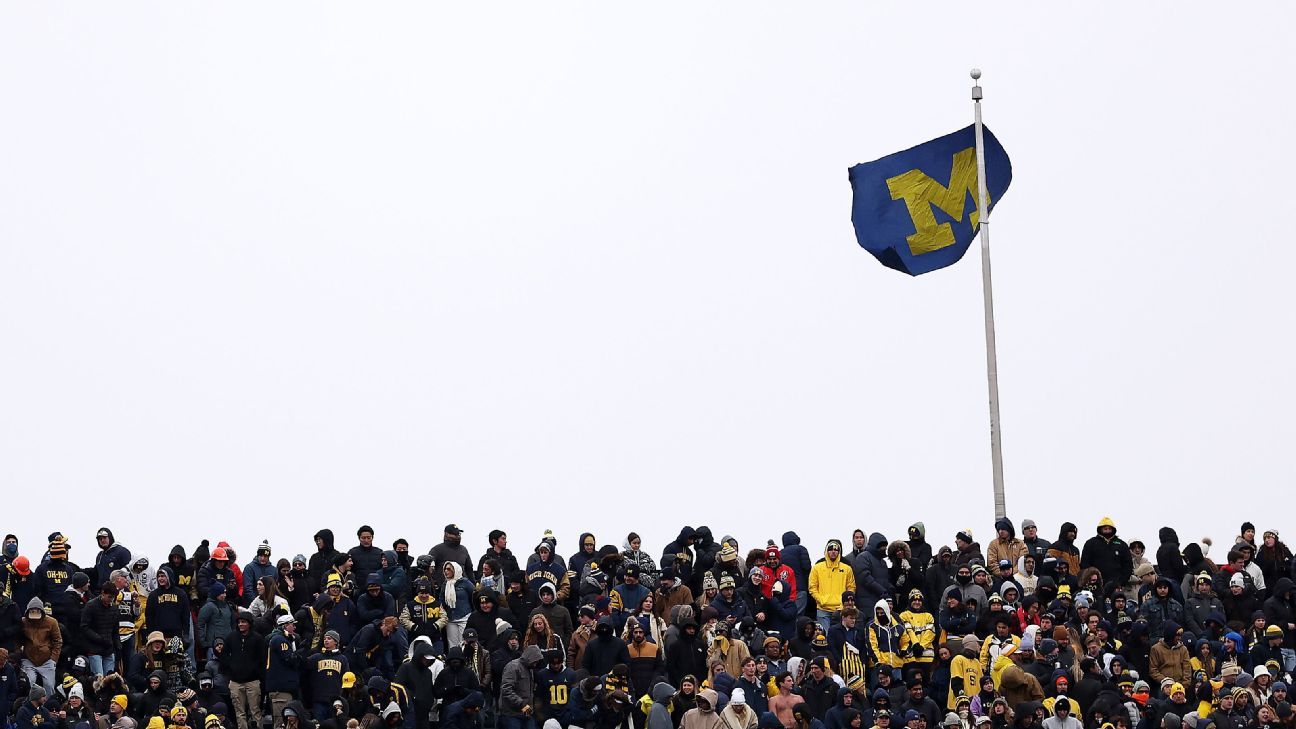
Michigan’s investigation into its football program and wider athletic department could lead to findings of additional misconduct that might trigger more employment terminations, interim university president Domenico Grasso said Wednesday.
In a video statement, Grasso described the week since football coach Sherrone Moore’s firing as “no doubt a challenging time for our university community.”
Michigan fired Moore on Dec. 10 for engaging in an inappropriate relationship with a staff member, discovered through a university investigation. Moore faces three criminal charges, including felony third-degree home invasion, for allegedly confronting the staff member at her residence after being fired.
Michigan’s investigation into Moore’s conduct and the football program continues, and the university commissioned Chicago-based law firm Jenner & Block to conduct a larger review of the athletic department culture, conduct and procedures following a series of scandals.
“We will take whatever steps are necessary to ensure that conduct like this does not happen again,” said Grasso, who took over as interim president in May and will step down when a permanent president is installed. “Make no mistake. We will leave no stone unturned, and any further action we take will be based on credible evidence and findings, developed through a rigorous investigation.
“If the university learns of information through this investigation or otherwise that warrants a termination of any employee, we will act swiftly, just as we did in the case of Coach Moore.”
Grasso encouraged those who have information regarding misconduct within the football program or athletic department to contact Jenner & Block.
“Our focus is strictly on uncovering the facts,” Grasso said. “It is my job, my duty, to ensure the integrity of this investigation.”
Grasso also briefly addressed Michigan’s search for its next football coach. Athletic director Warde Manuel, who has led the department since 2016, has not publicly addressed the search, which he is expected to lead.
Biff Poggi, a Michigan staff member under both Moore and predecessor Jim Harbaugh, is serving as interim head coach for Michigan’s upcoming Cheez-It Citrus Bowl matchup against Texas on Dec. 31.
“We will hire an individual who is of the highest moral character and who will serve as a role model and a respected leader for the entire football program,” Grasso said. “And who will, with dignity and integrity, be a fierce competitor.”

-
Greg Wyshynski
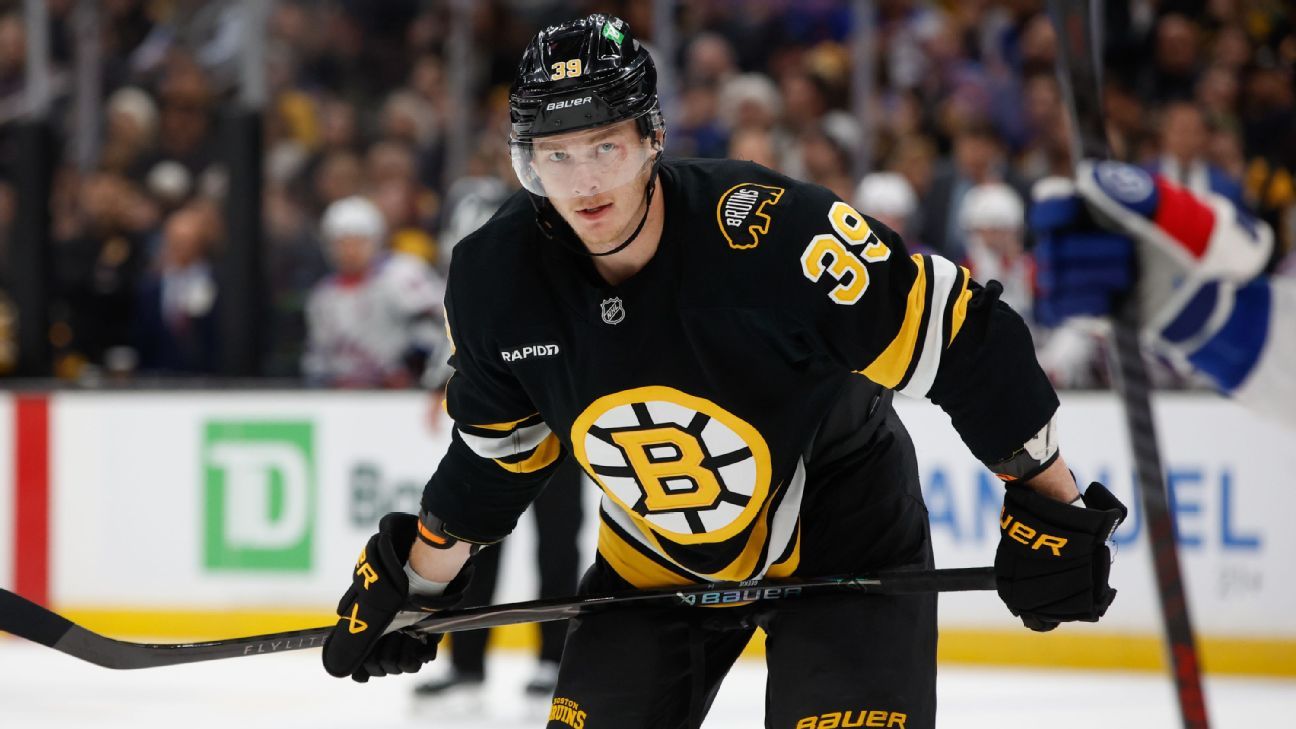
Boston Bruins forward Morgan Geekie can finish a Rubik’s Cube in under a minute.
“I mean, right now I’d be pretty rusty,” he said. “I’m not insane, like those kids that you see on TV, but I’m pretty good at them.”
When Geekie was around 10 years old, a cousin taught him how to speed solve the puzzle. While some have never found a way to line up that mosaic of colors despite years of trying, Geekie said it’s doable once one cracks the code. One summer at their lake cottage, his cousin wrote down its patterns. Geekie spent two weeks memorizing them and working out solutions while fiddling with the cube.
“It’s basically just all algorithms. You just do the same moves all the time once you get the pieces in the right spot. Once you do that, I mean, it’s pretty cut and dry. Everything goes in order,” he said. “I haven’t really forgot. It’s just one of those things that once you know it, you know it.”
Perhaps Geekie just knows how to score goals now, too.
That’s the simplest rationalization for the 27-year-old’s unexpected transformation into one of the NHL’s premier goal scorers. Through 34 games, Geekie is second in the NHL with 24 goals, trailing only the dominant Nathan MacKinnon of the Colorado Avalanche (28). Going back to the start of last season, Geekie is tied for 11th in goals scored (57).
Geekie scored 33 goals in 2024-25, which is 16 more than his previous career high set two years ago with the Bruins. He shot 22%, which obliterated his previous career best of 13.1% set in 2023-24.
There’s always an offensive player whose unexpected scoring surge in one season makes him the consensus choice for regression the following season. Entering this season, that player was Geekie.
He was the first player listed on ESPN’s rundown of regression candidates, with the expectation that he would top out at 26 goals. Sports Illustrated did the same thing, writing that his “offensive numbers are set to dip next season.” Daily Faceoff wrote that Geekie’s shooting percentage was “a strong indication that his performance isn’t sustainable, at least at this level” for the Bruins.
Geekie gets it. He called the predictions “a fair statement” given that he was scoring less than 10 goals in a season with the Seattle Kraken just a few seasons ago.
“I see it all. It’s an easy cherry to pick to be like, ‘Obviously he’s shooting 22%, it’s going to go down.’ It didn’t bother me at all,” Geekie said.
Rather than regress, Geekie has progressed this season. Through 34 games, he is shooting 28.2%.
“I mean, it’s got to go down at some point,” he said, with a laugh. “Like I said, I don’t really pay attention to that and I’m not somebody that has 10 shots a game, so I just try to make the most of my opportunities when I get the puck.”
GEEKIE IS AMUSED by the focus on his shooting percentage, because he feels there are easy explanations for it. The first is that he doesn’t believe he shoots the puck all that much. Over the past two seasons, David Pastrnak averaged 3.79 shots per game in 110 games. Geekie averaged 2.11 in that same span. Only Sidney Crosby (2.45 shots per game) has a lower average than Geekie (2.48) among the top 10 goal-scorers this season.
“I feel like I’m a big quality over quantity person,” he said.
His first season in Boston, coach Jim Montgomery stressed the need for Geekie to get chances from deep inside the attacking zone.
“I think a high-danger chance is better than just shooting it from the wall. That’s kind of the mentality that I’ve had always. I’m not trying to waste shots that aren’t good for anybody,” Geekie said. “Unless I’m trying to create something off it, I’m honestly not trying to put it on net. Maybe that’s why I end up where I end up.”
Pastrnak recently said the Bruins were reminding Geekie to shoot the puck more often. In fairness, Geekie is shooting more this season. Pastrnak said Geekie is “definitely trying to be a little more selfish to take them” when he fights into high-danger areas of the ice. But Geekie acknowledged there are sometimes philosophical differences between his striving for quality over his team’s desire for quantity.
“I think it’s a push and pull,” he said. “It’s like, I don’t think I need to be shooting this, but other people think that it still gives us an opportunity to create a chance. So I just try to keep that in mind when I have the puck”
This is Geekie’s seventh season in the NHL. He was selected by the Carolina Hurricanes with the 67th pick in the 2017 draft as a goal-scoring forward with the WHL Tri-City Americans. His first two seasons as a pro were mostly spent in the AHL with the Charlotte Checkers, before playing 36 games with the Hurricanes in 2020-21.
That summer, the Seattle Kraken held their expansion draft as the NHL’s newest team. Geekie was left off Carolina’s protected list. At the time, it wasn’t expected that former Hurricanes GM Ron Francis would select him for the Kraken, with options like defenseman Jake Bean and forward Nino Niederreiter available from Carolina. But Geekie was the choice, a player whom Francis had drafted while with the Canes.
Geekie had 22 points in 73 games in his first season in Seattle, skating 12:36 per game with just seven goals. His second campaign saw him jump to 28 points in 69 games, but with even less ice time (10:27).
He was a restricted free agent after the 2022-23 season. Francis attempted to re-sign him before the deadline for submitting qualifying offers, but Geekie and his representatives declined it. The two sides couldn’t find common ground. Rather than go to arbitration, where the Kraken weren’t keen on Geekie potentially setting the terms of his next deal, they chose not to qualify him, making him an unrestricted free agent.
“With Morgan, we did make what I felt was a pretty fair offer,” Francis said at the time, via Sound of Hockey. “It didn’t work out, and he has the right once we don’t qualify him to go elsewhere.”
And so he went to Boston, signing a two-year deal worth $4 million in total.
While he wasn’t seeing much time with the Kraken, Geekie felt he was improving as a player. He said a “integral part” of that development was thanks to Jonathan Sigalet, a skills coach who improved all facets of his game.
“When I first started working with him, he was adamant that he wasn’t going to try and make me play like I’m on the first line,” Geekie recalled. “He said, ‘We both know that trying to do things that you do on the first line on the fourth line is going to get you in the press box.'”
He said working with Siglet slowed the game down for him. He started to see the game differently. He began to see “little tendencies” that all of the NHL’s good players share. Geekie also appreciated having a “third party” assessment for his play, apart from that of his coaches and his own.
Geekie was immediately given an opportunity to thrive in Boston in 2023-24, playing 15:21 in his first game with the Bruins. He ended up averaging 15:25 per game, with 17 goals and 22 assists in 76 games. He earned time with Pastrnak and Pavel Zacha on the Bruins’ top line.
His follow-up season didn’t start well. Geekie scored one goal in his first 17 games and was a healthy scratch early in the season. Some trade whispers started about him as a pending restricted free agent. He had eight goals by the end of the 2024 calendar year.
How did he end up with 33 of them? With one of the greatest goal-scoring heaters this side of Alex Ovechkin: Geekie scored 14 goals in his last 20 games of the season. His chemistry with Pastrnak was undeniable — the Bruins scoring ace assisted on 21 of Geekie’s 33 goals last season.
Geekie expressed a desire to stay with the Bruins. The feeling was mutual, as GM Don Sweeney in June handed him a six-year, $33 million contract for a team-friendly $5.5 million annual cap hit.
WHEN GEEKIE SIGNED his new contract, he decided he wanted to join in the tradition of NHL players celebrating a windfall with their teammates. It’s usually a dinner or something of that nature.
But Geekie wanted to do something different.
“Everybody’s eating at the same restaurants in every city. And I’m sure they’d remember it for a little while, but I think it would be just one of those things like, ‘Hey, thanks for dinner.’ So I wanted to do something a little more nostalgic,” he said.
Geekie is a huge baseball fan who played competitively until his late teens. He was in the process of designing a personalized baseball glove for himself through a company called 44 Pro Custom Gloves when his wife, Emma, suggested that he design ones for all of his teammates as a gift.
Geekie started the process in July, sketching out what he wanted on the gloves for 30 teammates — including players that were on the bubble for the Bruins’ roster this season. He had the biographical information for them, from their birth cities and countries to their schools to where they played junior hockey.
“Honestly, for probably three weeks, I just sat in front of my TV watching baseball and I would just draft gloves up. I thought it was so fun,” Geekie said. “My wife got sick of me for a little while.”
He would FaceTime his brother Noah, a coach at Okotoks Dawgs Academy in Alberta, to bounce the designs off him and get input. He was cognizant of having the designs as unique as possible, despite some of the school colors being similar for his teammates.
Before a practice in October, Geekie delivered the gloves to the locker room stalls of his teammates. It went over well.
“Baseball is not that big in Sweden, but it’s obviously cool to have,” center Elias Lindholm told the Bruins website, having received a glove with a Swedish flag on it. “Hopefully, when my kids get a little bit older, we can play a little game or something. For now, it is just going to be at home, resting.”
0:17
Morgan Geekie nets goal for Bruins
Morgan Geekie nets goal for Bruins
While the gloves were a chance to celebrate with his teammates, there weren’t many celebrations anticipated for Boston this season. The Bruins were trading players away at last season’s trade deadline, sending mainstays like captain Brad Marchand (Florida), center Charlie Coyle (Colorado) and defenseman Brandon Carlo (Toronto) elsewhere. They had an incoming first-year coach in Marco Sturm. At best, it was supposed to be a transition year for the Bruins.
But through 34 games, Boston is second in the Atlantic Division with a 20-14-0 record, within a point of division-leading Detroit in the crowded Eastern Conference.
Many around the NHL were surprised. Geekie wasn’t.
“We underperformed. Last season was like the perfect storm of bad events with our kind of discombobulated training camp and then having a coaching change and just kind of everything that could have went wrong went wrong,” Geekie said. “The core group we have is just too good to be written off. But I understand why people had doubts about us.”
But defying doubts is what Morgan Geekie’s all about, whether it’s his team’s predicted finish in the standings or his own predicted regression as a scorer.
“He has everything to score 50 in this league,” Pastrnak said. “He has a heck of a shot. He has the goal-scoring instincts. He is going to get it one day.”
-
 Sports2 years ago
Story injured on diving stop, exits Red Sox game
-
 Sports3 years ago
‘Storybook stuff’: Inside the night Bryce Harper sent the Phillies to the World Series
-
 Sports2 years ago
Game 1 of WS least-watched in recorded history
-
 Sports3 years ago
Button battles heat exhaustion in NASCAR debut
-
 Sports3 years ago
MLB Rank 2023: Ranking baseball’s top 100 players
-
Sports4 years ago
Team Europe easily wins 4th straight Laver Cup
-
 Environment3 years ago
Japan and South Korea have a lot at stake in a free and open South China Sea
-
 Environment1 year ago
Here are the best electric bikes you can buy at every price level in October 2024