
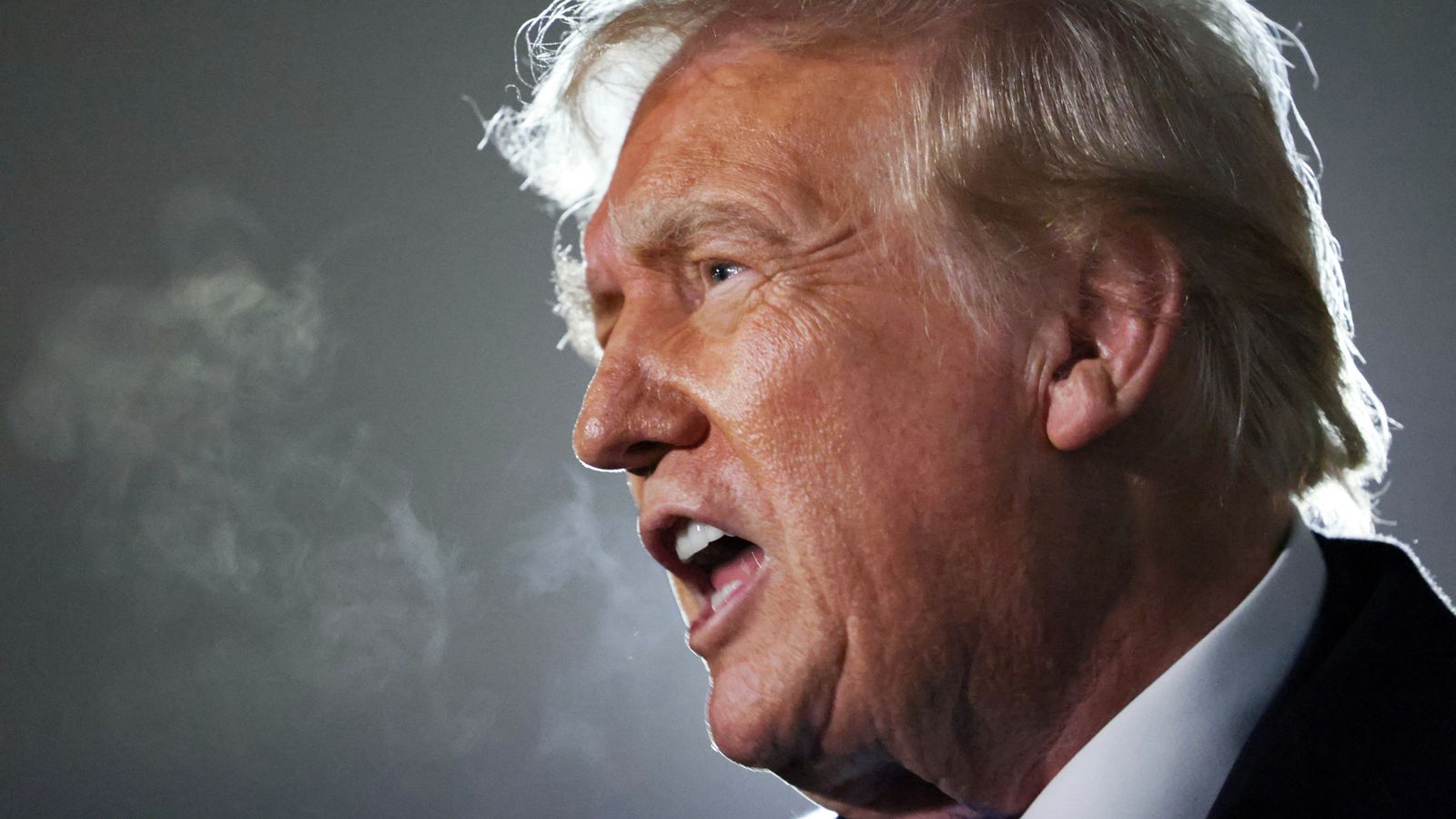
Donald Trump’s tariffs: What’s going on and what does it all mean?

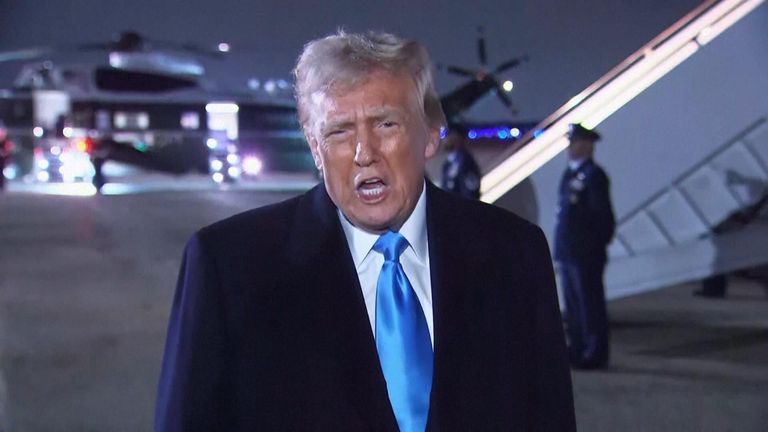
Donald Trump has announced sweeping tariffs on Mexico, Canada and China, kicking off a trade war that will affect the globe.
Here we look at the tariffs and what they all mean for the world:
What did Trump announce?
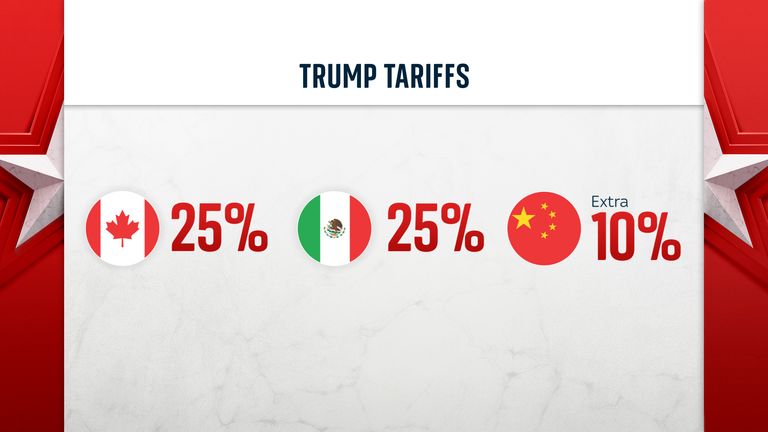
On Sunday the US president said goods from Mexico and Canada will face 25% tariffs, while 10% taxes will be implemented on imports from China.
Canadian energy, including oil, natural gas and electricity, will be taxed at a 10% rate.
Trade war latest: Follow live updates
The levies were expected to all take effect on Tuesday, with Mexico and Canada both announcing counter-tariffs of their own in response.
However, on Monday both Mexican President Claudia Sheinbaum and Canadian Prime Minister Justin Trudeau said the implementation of tariffs would be paused for a month after they had calls with Mr Trump.
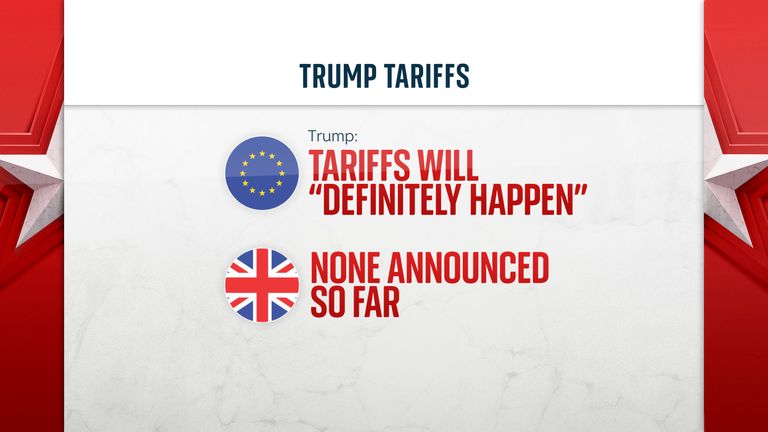
But Mr Trump has also threatened to go further, saying tariffs on the European Union would be implemented “pretty soon”.
Trump’s proposed tariffs
When questioned about the UK, the president said Britain was “out of line” when it came to trade but he thought the situation could be “worked out” without the use of tariffs.
What are tariffs, and how do they work?
Put simply, tariffs are taxes on goods brought in from other countries.
By raising the price of imports, tariffs aim to protect domestic manufacturers by making locally made goods cheaper.
Contrary to what Mr Trump has said, it is not foreign countries that pay tariffs, but the importing companies that buy the goods.
For example, American businesses like Walmart or Target pay tariffs directly to the US treasury.
In the US, these tariffs are collected by customs and border protection agents, who are stationed at 328 ports of entry across the country.
Mr Trump’s proposed tariffs
To compensate for tariffs, companies then put up their prices, so customers end up paying more for goods.
Tariffs can also damage foreign countries as it makes their products pricier and harder to sell.
This can lead to them cutting prices (and sacrificing profits) to offset levies and maintain their market share in the US.
Why is Trump doing this?
Mr Trump has argued imposing higher levies will help reduce illegal migration and the smuggling of the synthetic opioid fentanyl to the US.
On Mexico, the US leader claimed drug traffickers and the country’s government “have an intolerable alliance” that in turn impacts national security.
He further claimed Mexican drug cartels are operating in Canada.
On China, he said the country’s government provides a “safe haven” for criminal organisations.
He has also pledged to use tariffs to boost domestic manufacturing.
“We may have short term some little pain, and people understand that. But long term, the United States has been ripped off by virtually every country in the world,” he said.
His aim appears to be to force governments in those countries to work much harder to prevent what he calls illegal migration and the smuggling of the deadly drug fentanyl – as appears to have been agreed by Mexico. But, even if the countries do not do what America wants, it will still potentially benefit firms that produce goods in the US.
What could the consequences be?
Mexico and Canada are two of America’s largest trading partners, with the tariffs upending decades-old trade relationships.
Goods that could be affected most by the incoming tariffs include fruit and veg, petrol and oil, cars and vehicle parts and electronic goods.
New analysis by the Budget Lab at Yale University found the average US household would lose the equivalent of $1,170 US dollars (£944) in income from the tariffs.
Read more: This is how US consumers will be affected
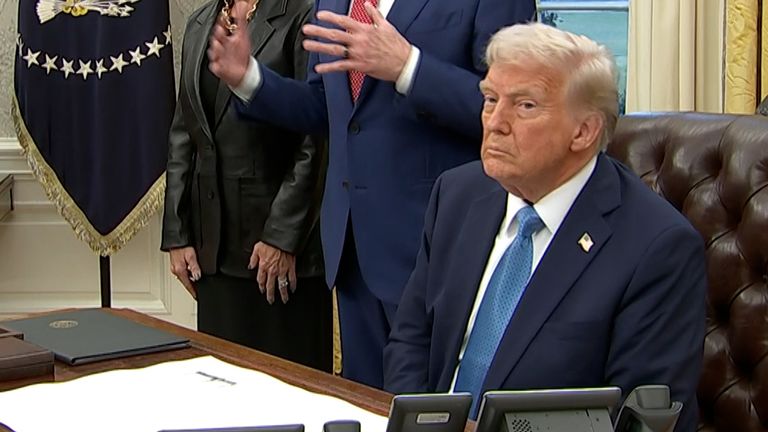
Why Trump’s tariffs could cost you
The research also found economic growth would slow and inflation would worsen, as the tariffs forced up prices.
Immediate consequences were felt on Monday morning, as shares on Asian markets took a tumble.
Japan’s Nikkei opened down 2.9% while Australia’s benchmark – often a proxy trade for Chinese markets – fell 1.8%. Stocks in Hong Kong, which include listings of Chinese companies, fell 1.1%.
UK stocks were also significantly down, with the benchmark FTSE 100 index – containing the most valuable companies on the London Stock Exchange – dropped more than 1.3% on the open.
In Europe, stock markets opened sharply lower while the euro slid 1.3%. The Europe-wide index of companies, the Stoxx 600 dropped as much as 1.5%.
While Mexico’s peso hit its lowest in nearly three years.
‘Very scary path’
Sky News’ data and economics editor Ed Conway said the long-term consequences of a trade war is “everyone gets poorer”, which is what happened to the world before World War Two.
“As countries get poorer, they get frustrated and you get more nationalism,” Conway said, speaking on Friday’s Sky News Daily podcast.
“This is exactly what happened in the 1930s, and the world ended up at war with each other. It is a very, very scary path, and yes, we are basically on a potential of that path.”
However, Conway added one positive of Mr Trump’s tariffs could be highlighting “massive imbalances” within the global economy.
He said Mr Trump may be able to shift the conversation to problems “economists don’t want to talk about”.
👉 Follow Trump 100 on your podcast app 👈
“At the moment, we have a dysfunctional global economy,” he explained.
“You have got massive imbalances like trade deficits [when a country’s imports exceeds the value of its exports] and trade surpluses [when a country’s exports exceeds the cost of its imports].
“There might well be a better way of everyone getting together and having a conversation and working out how to align their affairs, so we don’t have these imbalances in the future.
“And tariffs help to get you to this point.”
How has the world reacted?
Canadian Prime Minister Justin Trudeau reacted strongly against Mr Trump’s tariffs, saying his country would impose 25% tariffs on $155bn Canadian dollars (£85.9bn) of US goods in response.
He added the move would split the two countries apart, and urged Canadians to choose domestic products rather than American ones.
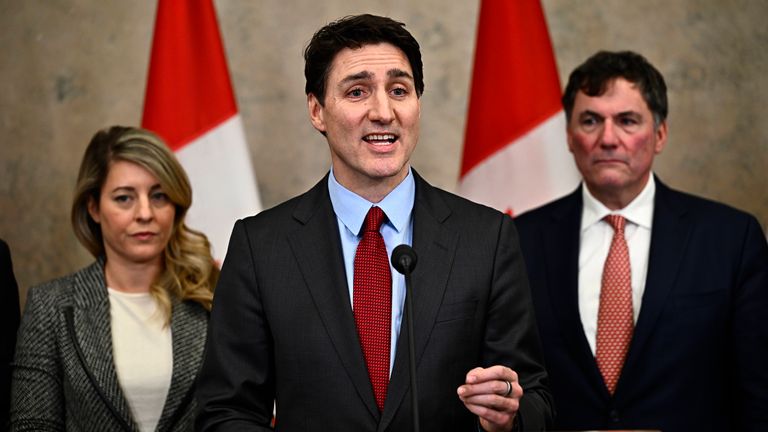
Tariffs against Canada ‘will put US jobs at risk’
Mexican President Ms Sheinbaum posted on X on Sunday to say she had ordered her economy minister to implement tariff and non-tariff measures to defend Mexico’s interests.
She said her government “categorically rejects” the claim it has “alliances with criminal organisations” and called on the White House to “fight the sale of drugs on the streets of their major cities”.
A day later, she posted saying she and Mr Trump had a “good conversation” and “reached a series of agreements”.
These agreements include Mexico sending 10,000 troops to the border to “prevent drug trafficking from Mexico to the United States, particularly fentanyl”.
Mr Trump responded to the agreement with Ms Sheinbaum, saying negotiations between the two will be ongoing to try and achieve a “deal”.
Meanwhile, China has retaliated by imposing 10% tariffs on American crude oil, agricultural machinery, large-displacement cars and pickup trucks.
There will also be 15% tariffs on coal and liquefied natural gas, as well as an investigation into Google.
China also said it is imposing export controls on rare earth metals such as tungsten, tellurium, ruthenium, molybdenum and ruthenium-related items – the country controls much of the world’s supply of such metals, which are critical for the transition to clean energy.
They will not come into effect until Monday 10 February, however.
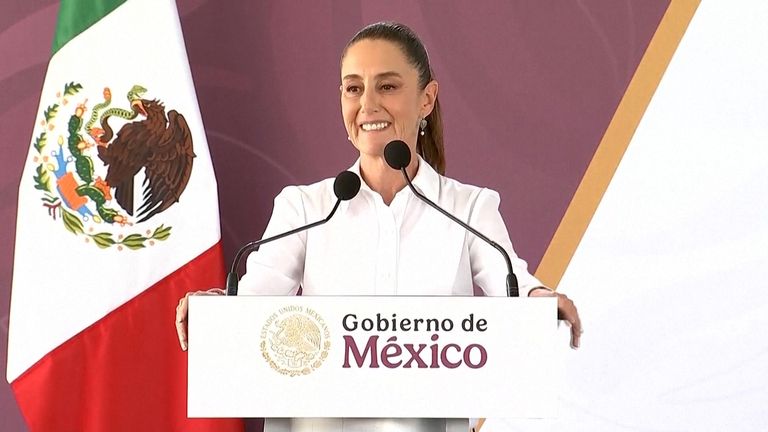
Mexico responds to Trump’s tariffs
A spokesperson for the UK government reiterated that the US is an “indispensable ally” and one of the country’s “closest trading partners”.
They added that the trading relationship was “fair and balanced”, after Mr Trump criticised the UK, saying it was “out of line”.
European Union (EU) leaders have also taken a strong stance against looming US tariffs.
Kaja Kallas, the chief of foreign policy for the bloc, said there were no winners in a trade war, and if the US and Europe started one “then the one laughing on the side is China”.
German Chancellor Olaf Scholz added that the EU is strong enough to “respond to tariffs with our own tariffs”, while French President Emmanuel Macron said declarations by the US were pushing Europe to be “stronger and more united”.
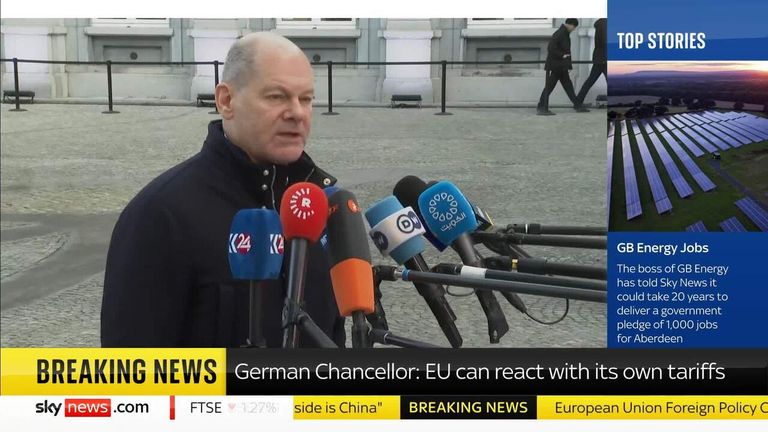
EU can react with its own tariffs
What’s the history of trade wars?
Imposing tariffs is not new to Mr Trump, or the US for that matter.
During his first term in the White House, he imposed higher levies on China and Vietnam.
In 2018, he imposed 25% tariffs on imported steel and 10% on imported aluminium from most countries, a response to what he said was the unfair impact of Chinese steel driving down prices and negatively affecting the US steel industry.
China then hit back with retaliatory tariffs on US imports, including 15% on 120 American products such as fruits, nuts, wine and steel pipes and a 25% tariff on US pork and recycled aluminium.
Before that, Democrat Jimmy Carter went so far as to completely ban the sale of wheat to Russia, which remained in effect until Ronald Reagan ended it in 1981.
Read more:
Breaking economies could be just Trump’s first step
Trump’s changed tack to focus on Mexico and Canada – why?
Toronto Raptors fans boo US national anthem
In 2019, Mr Trump also used the threat of tariffs as leverage to persuade Mexico to crack down on migrants crossing Mexican territory on their way to the US.
A study by economists at the Massachusetts Institute of Technology, the University of Zurich, Harvard and the World Bank concluded Mr Trump’s tariffs the first time around failed to restore jobs to the American heartland.
The tariffs “neither raised nor lowered US employment” when they were supposed to protect jobs, according to Sky News’ US partner network NBC News.
Donald Trump’s eldest son has said his father may walk away from the Ukraine peace process, claiming the issue is not a priority for Americans, and signalling Europe needs a better plan.
In a wide-ranging discussion with Sky’s lead world news presenter Yalda Hakim at Doha Forum 2025, Donald Trump Jr addressed issues including the US administration’s recent diplomatic efforts around the world.
He was speaking in his capacity as a business leader, setting out his agenda for “America first” investments in defence technology and artificial intelligence (AI), drawing a direct line between global stability and economic prosperity.
Ukraine war latest – follow live updates
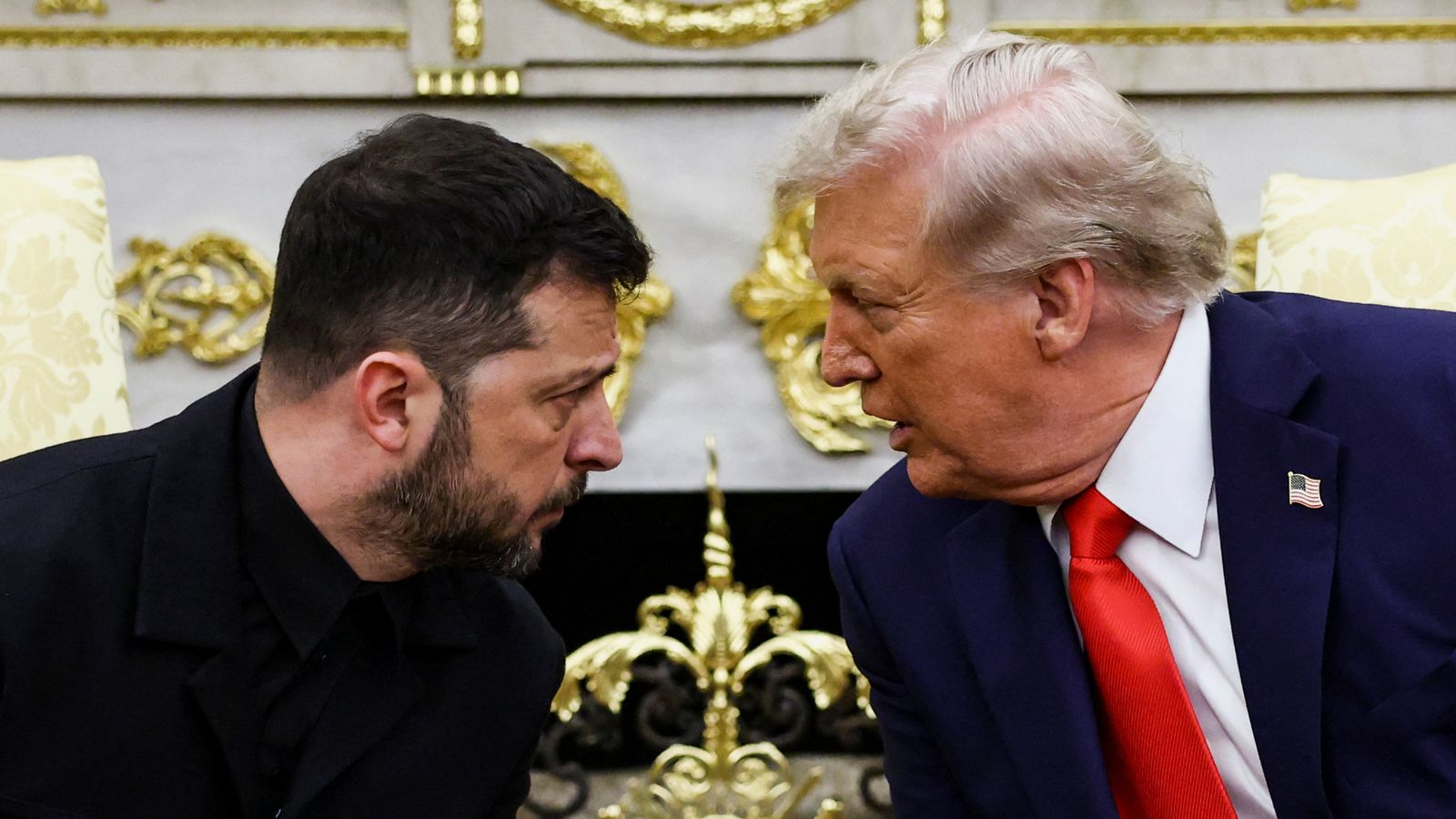
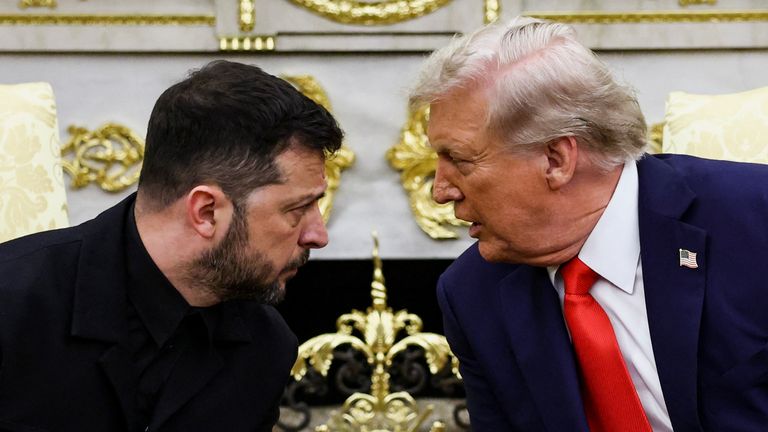
Donald Trump meeting Volodymyr Zelenskyy in Washington earlier this year. Pic: Reuters
When asked directly if he believed the US president would walk away from Ukraine, he answered: “I think he may, what’s good about my father and what’s unique about my father is you don’t know what he’s going to do. He’s unpredictable.”
President Trump has led renewed efforts for a ceasefire deal with Russia in recent months.
Drawing a parallel with his father’s current “war” on drug cartels, Donald Trump Jr described gangs bringing illegal drugs into America as a “far greater clear and present danger to the US than anything [going on] in the Ukraine or Russia”.
While he said he did not believe Ukraine would be “abandoned”, he said: “The American public doesn’t have the appetite [for endless wars and further funding of Ukraine’s military efforts].”
Describing Ukraine as “a far more corrupt country than Russia”, he characterised Ukrainian President Zelenskyy as “one of the great marketeers of all time”, who he said had become “a borderline deity, especially to the left”.
He went on to describe President Trump’s approach as “common sense”.
China rivalry was the focus, but Musk got a mention

In a country and at a conference which is friendly, even admiring of the Trump administration, Don Jr was in his element.
He’s here in his capacity as a business leader, promoting his venture, 1789 Capital which claims to be focused on “America First” investments.
But he wasn’t shy about discussing his father’s foreign policy achievements, boasting that Donald Trump had resolved seven or eight wars – conflicts that most ordinary Americans were unaware of.
His pitch is bullish and direct – the current US administration is projecting strength globally, stopping wars and creating investment opportunities which serves the American economy. It’s the MAGA mentality for the global audience.
It’s clear that the rivalry with China is their biggest focus, especially finding ways to combat their dominance over critical minerals.
“America can no longer just sit there and hope that China is going to be a good actor… I think the rest of the world understands that they want America to be at the forefront of all of that.”
When I asked him about recent efforts by President Trump to bring the war in Ukraine to an end, he responded forcefully. “We want peace, we want to stop the death.”
But he went on to say that Europe needed to shoulder the burden and currently they have no plan.
As he sat on the stage in Qatar, the country which has been at the centre of the ceasefire efforts for Gaza, he expressed hope that peace would prevail, but balanced expectations America would fund its re-construction. This would have to be a global effort.
“If there’s one thing my father is, it’s a builder… I think he can be the greatest construction manager in the history of the world, but no one in America wants to bear the entire responsibility of that.”
And, away from international diplomatic efforts, he was happy to announce a breakthrough closer to home.
The “bromance” with Elon Musk and President Trump is back on – calling the entrepreneur a “generational talent, a generational level of genius”.
‘Bromance’ back on
He also confirmed that Tesla billionaire Elon Musk was “100% back in the fold”, after previously appearing to fall out with the president.
Earlier this year, Donald Trump Jr’s investment company, 1789 Capital, heavily invested in some of Musk’s companies, including SpaceX.

Elon Musk and Donald Trump in the Oval Office at the White House in May. Pic: AP
Directly comparing President Trump with Musk, he said: “Imagine dealing with one Donald Trump – now I have to deal with two.
“They’re very similar that way, so it created some headaches… but the reality is they’re both very much aligned, they’re on message with what we want to do with our country. What we want to do with freedom of speech.”
He went on: “Elon did incredible things for Twitter, really allowed the democratisation of truth and freedom and free speech to occur. That’s something that is a true threat in America right now.”
He also praised Musk as “changing the face of free speech, science and technology”, adding, “we have to protect our geniuses”.
When asked whether Mr Trump would stand for a third term, he joked that he could be “just trolling” those on the left.
He went on, “He’s the most unpredictable person, probably in the history of politics. Which is why he’s able to get something done. We’ll see.”
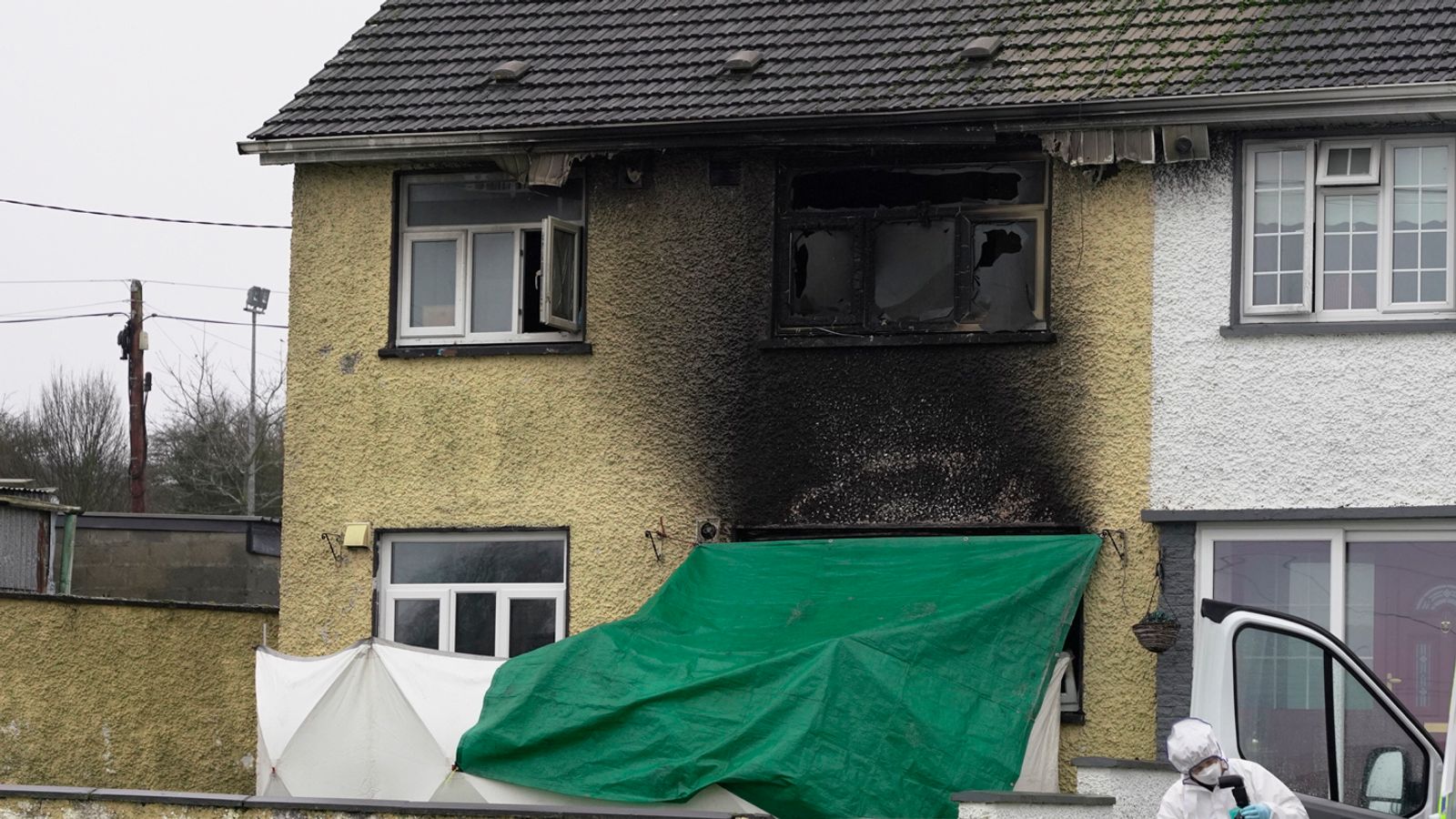
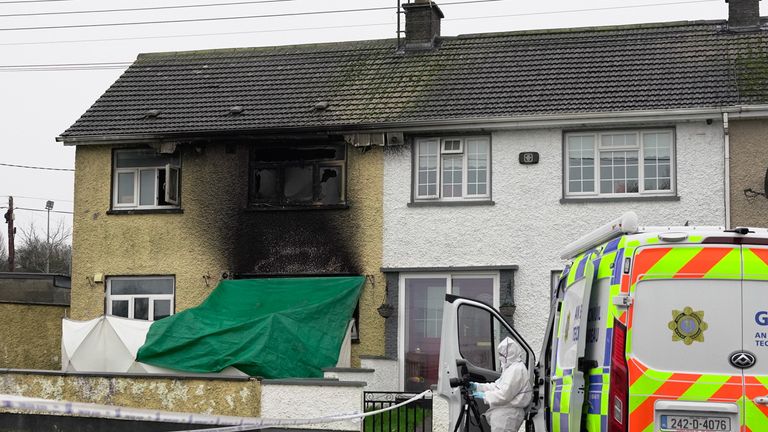
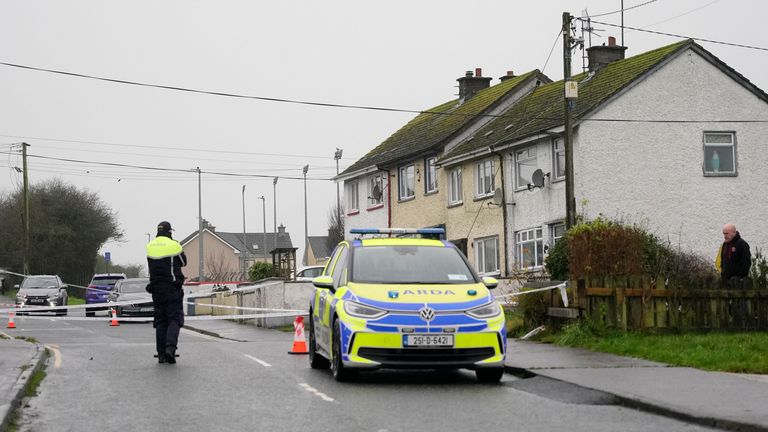
A murder investigation is underway after a woman and young boy died in a house fire in Edenderry, Co Offaly.
Another woman is being treated in hospital for her injuries following the blaze on Saturday at roughly 7.45pm.
Pic: PA
Pic: PA
Irish police said the house on Castleview Park had been declared a crime scene.
A Garda spokesperson said on Sunday morning that they could confirm two people had died as a result of the fire.
“A female, aged 60 years, and a young boy were fatally injured,” they said.
“A second female, aged in her 50s, is receiving treatment for serious injuries at a hospital in the Midlands.
Gardai in Tullamore are appealing for witnesses to come forward.
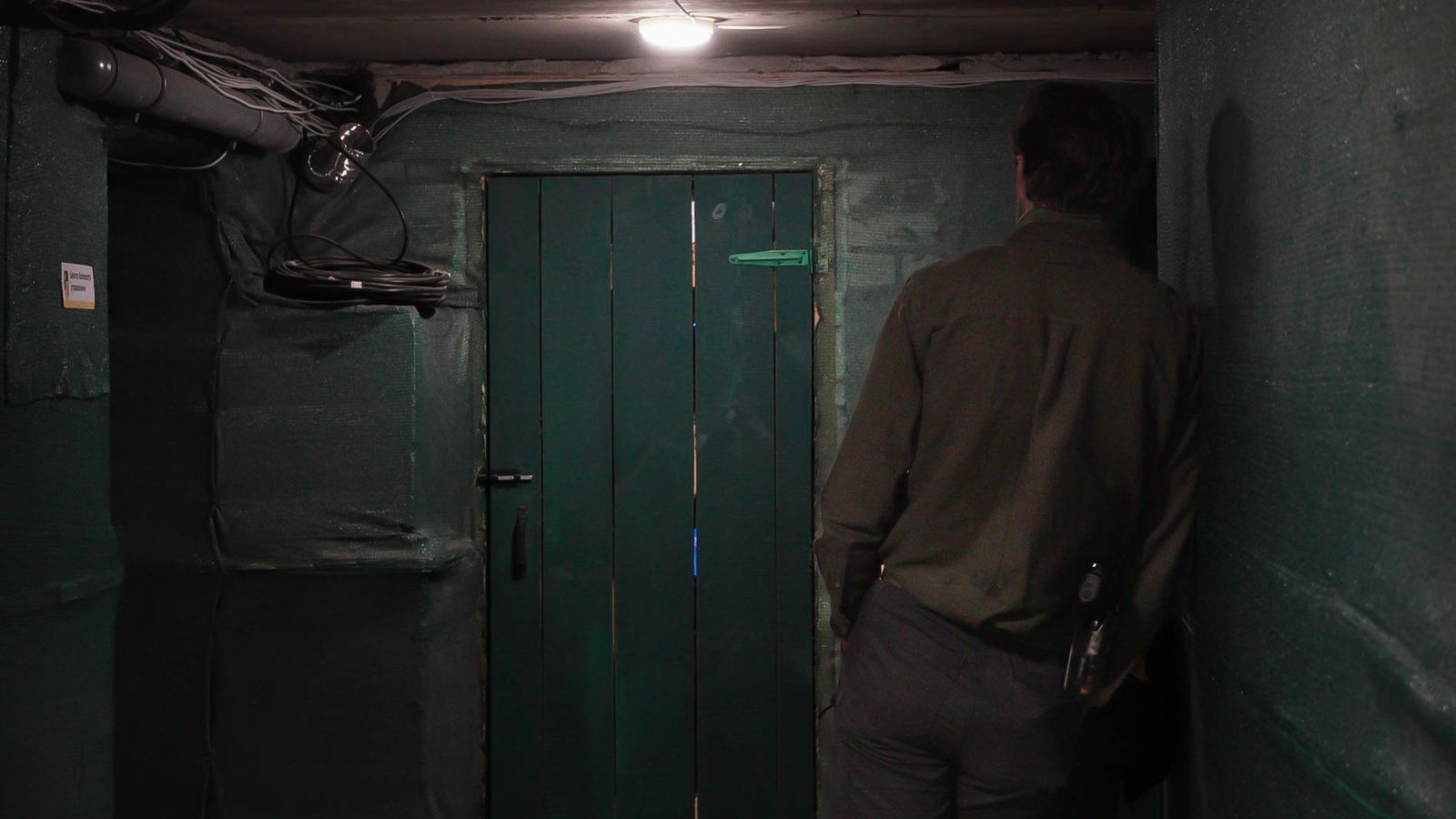

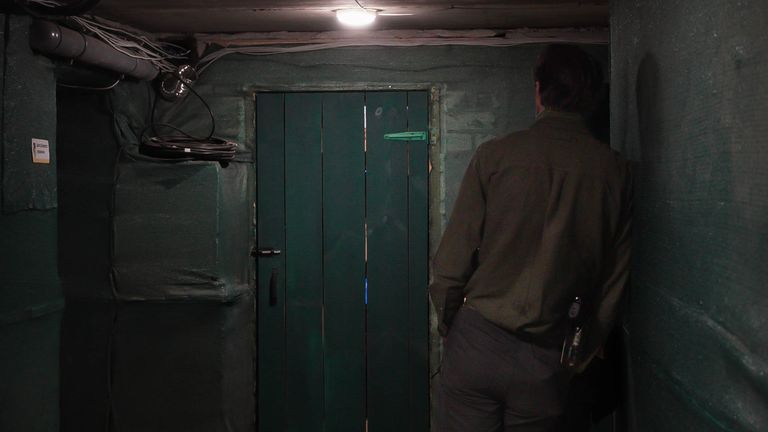
A hidden, underground military base in eastern Ukraine is so secret, soldiers change into civilian clothes whenever they step outside to avoid drawing attention.
Journalists are not usually allowed access.
But the unit that has been using this vast, subterranean warren of war rooms, a dormitory, kitchen, canteen and makeshift gym as its headquarters since the summer is imminently relocating, so Sky News was invited inside.
Lieutenant Colonel Arsen Dimitric – call sign Lemko – is the chief of staff of 1st Corps Azov of the National Guard of Ukraine, one of the country’s most effective combat forces.
Lemko
He sat with us in the base, next to a large square table, covered by a map of the Donbas region.
His soldiers have been fighting in this area since the summer, countering a surge in Russian attacks in and around the frontline city of Pokrovsk.
“We aim to destroy as much of the enemy as possible,” he said.
“Will we take losses? Yes. Will it hurt? Absolutely.”
But he said if Russia is allowed to advance, even more Ukrainians will suffer.
“Their [the Russians’] only advantage is numbers,” he said.
“They don’t care how many people they lose.”
Lemko said almost 17,000 Russian soldiers had been killed or wounded fighting in this section of the warzone alone between August to November.
Read more:
Russia hits Ukraine with massive missile and drone attack

Ukrainian video footage of the battlefield showed Russian armoured vehicles being taken out by drones and artillery fire.
At one point, Russian soldiers mounted on motorbikes try to advance, only to be stopped by Ukrainian fire.
“Our task is to hit them as hard as possible in various areas,” Lemko said. “We focus on our operations, others on theirs, and leadership will negotiate the best possible terms.”
The Azov Corps soldiers are fighting over land that should be handed over to Russia, according to an initial draft of a peace deal proposal between Kyiv and Moscow put forward by the United States. This is despite swathes of the Donbas remaining under Ukrainian control.
But General Oleksandr Syrskyi, the head of the Ukrainian armed forces, has since told Sky News that simply surrendering territory would be “unacceptable”.
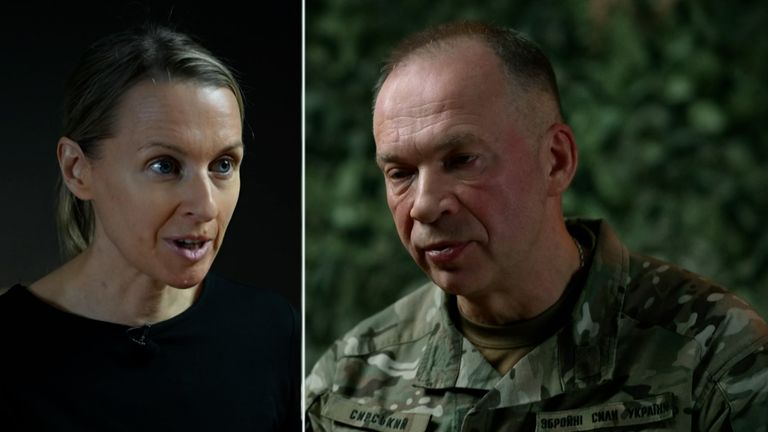
Giving up territory ‘unacceptable’, Ukraine’s military chief says
For Lemko, he says the job of his troops is to inflict as much damage as possible on the Russian side to help strengthen Ukraine’s hand in negotiations.
“Simply giving it [land] away isn’t the way,” he said.
“Diplomats do their work, we do ours. Our job as soldiers is to give as many advantages as possible to our negotiating team. And we’re doing exactly that.”
Lemko, who has been battling against Russia since the Crimean annexation in 2014, also had a warning for the rest of Europe about a rise in hybrid attacks, such as mysterious drone sightings, acts of sabotage and cyber hacks suspected of being linked to Moscow.
He said Ukraine’s experience showed that if attacks by Russia that fall under the threshold of conventional war are not successfully countered, full-scale conflict could follow.
“Ukraine once lost a hybrid war that had been waged since the very start of our independence,” he said.
“Because of that defeat, there was a physical operation against us in Crimea and then a physical operation in 2022.
“Now the hybrid war has reached its climax, and it is moving into the Baltic States and Europe.
“That is why, in my opinion – and in the opinion of most of our officers – now is the moment for all countries to unite and counter this hybrid war. Because the consequence may be a physical one.”
Production: Katy Scholes, security and defence producer, and Azad Safarov, Ukraine producer.
Camera operator: Mostyn Pryce
-
 Sports2 years ago
Story injured on diving stop, exits Red Sox game
-
 Sports3 years ago
‘Storybook stuff’: Inside the night Bryce Harper sent the Phillies to the World Series
-
 Sports2 years ago
Game 1 of WS least-watched in recorded history
-
 Sports3 years ago
Button battles heat exhaustion in NASCAR debut
-
 Sports3 years ago
MLB Rank 2023: Ranking baseball’s top 100 players
-
Sports4 years ago
Team Europe easily wins 4th straight Laver Cup
-
 Environment3 years ago
Japan and South Korea have a lot at stake in a free and open South China Sea
-
 Environment1 year ago
Here are the best electric bikes you can buy at every price level in October 2024