
Five people shot at adult education centre in Sweden

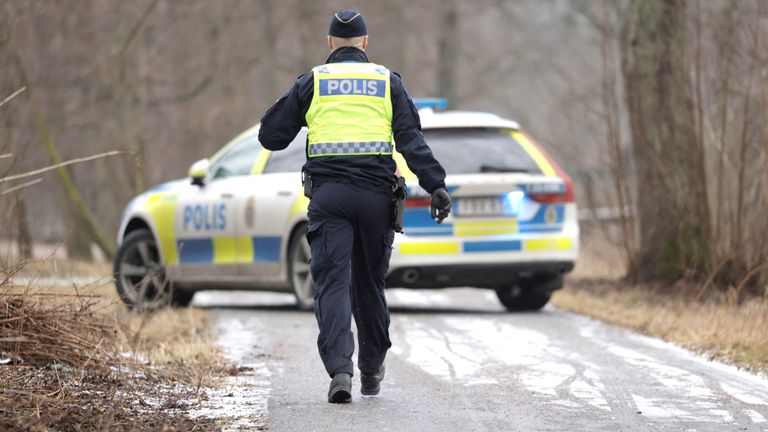
Five people have been shot at an adult education centre in Sweden, according to police.
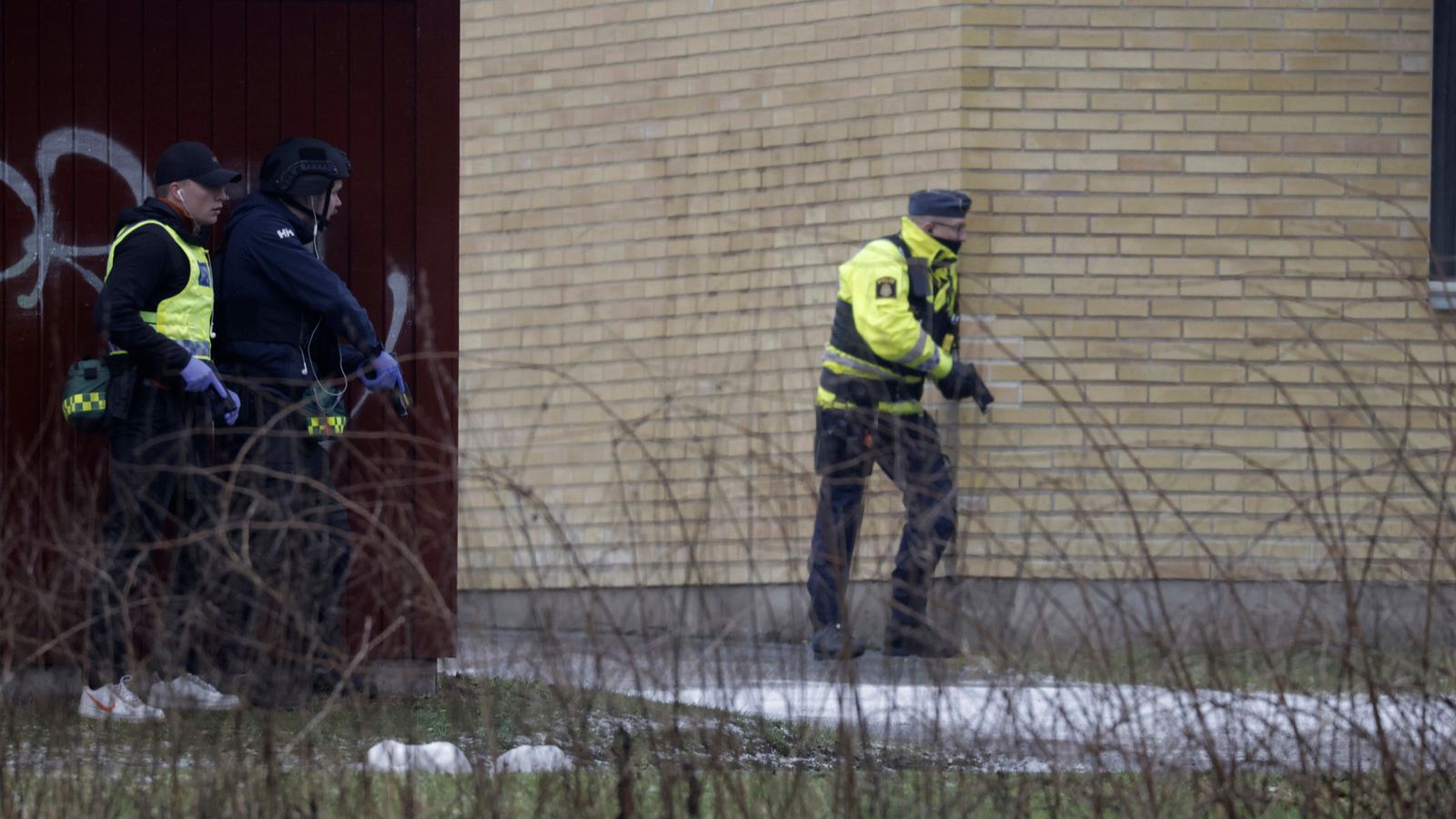
A major police operation is currently under way at the school, called Campus Risbergska, in the town of Orebro, around 200km (125 miles) west of the capital Stockholm.
Police urged the public to stay away from the school.
“This is currently seen as attempted murder, arson and aggravated weapons offence,” the force said.
Sweden shooting latest: Danger ‘not over’, police warn
A police officer at the school. Pic: Reuters
Five people were taken to hospital. Four underwent surgery and two are critically injured, two are stable and one is lightly injured, police said at a press conference.
The male suspect is among the wounded, the force said.
A spokesperson said they could not rule out further perpetrators.
Officers were searching the school premises and could not say if anyone had been killed.
Swedish newspaper Dagens Nyheter said police officers had been shot at, but police said no officers had been shot.
The school is for students over the age of 20, according to its website. It offers primary and upper secondary school courses, as well as Swedish classes for immigrants, vocational training and programmes for people with intellectual disabilities.
Read more: What we know about Sweden shooting so far
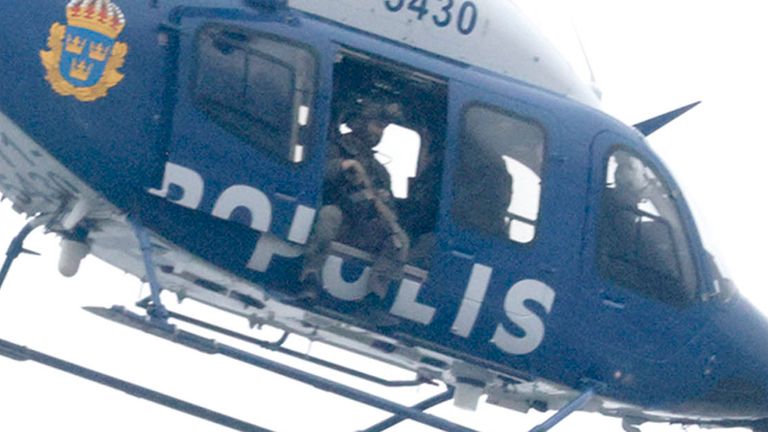
A police helicopter above the scene. Pic: AP
Students were taking shelter in nearby buildings and other parts of the adult education centre have been evacuated.
One person who was among those forced to barricade themselves inside the school said they “heard three bangs and loud screams”.
“Now we’re sitting here waiting to be evacuated from the school. The information we have received is that we should sit and wait,” they told Expressen newspaper.
Swedish newspaper Aftonbladet reported one person trapped in the school saying “we have heard several shots outside”.
The newspaper also quoted a person who had received a text from a teacher at the school saying “there was a shooting with automatic weapons”.
It said local emergency and intensive care departments are being made ready for casualties.
“The reports of violence in Orebro are very serious. The police are on site and the operation is in full swing,” Justice Minister Gunnar Strommer told news agency TT. “The government is in close contact with the police, and is closely following developments.”
Fatal attacks at schools in Sweden are rare, with 10 killed in seven incidents between 2010 and 2022, according to the Swedish National Council for Crime Prevention.
This breaking news story is being updated and more details will be published shortly.
Please refresh the page for the fullest version.
You can receive breaking news alerts on a smartphone or tablet via the Sky News app. You can also follow us on WhatsApp and subscribe to our YouTube channel to keep up with the latest news.
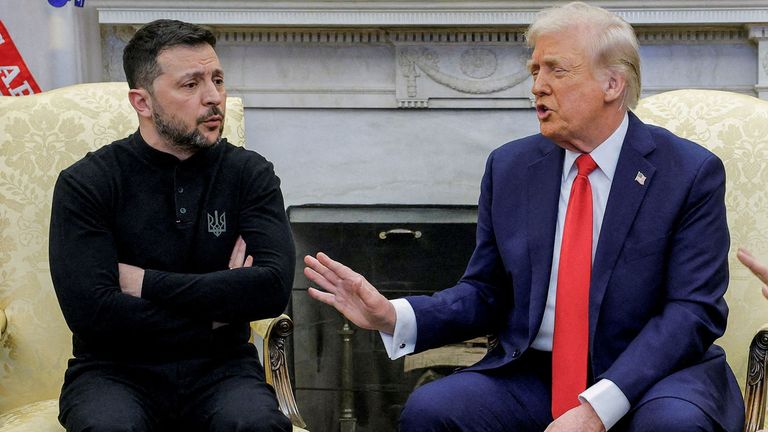
Volodymyr Zelenskyy says the US has offered to create a “free economic zone” in the contested Donbas region of eastern Ukraine in a bid to push a peace deal over the line.
The Donbas – an industrial and coal-mining area primarily made up of the Donetsk and Luhansk regions – has become one of the key sticking points in the US-proposed peace plan.
The first draft of the plan, widely leaked last month, stipulated that Ukraine must withdraw from areas of the Donbas it currently controls, thought to be a minority portion, as a condition for peace.
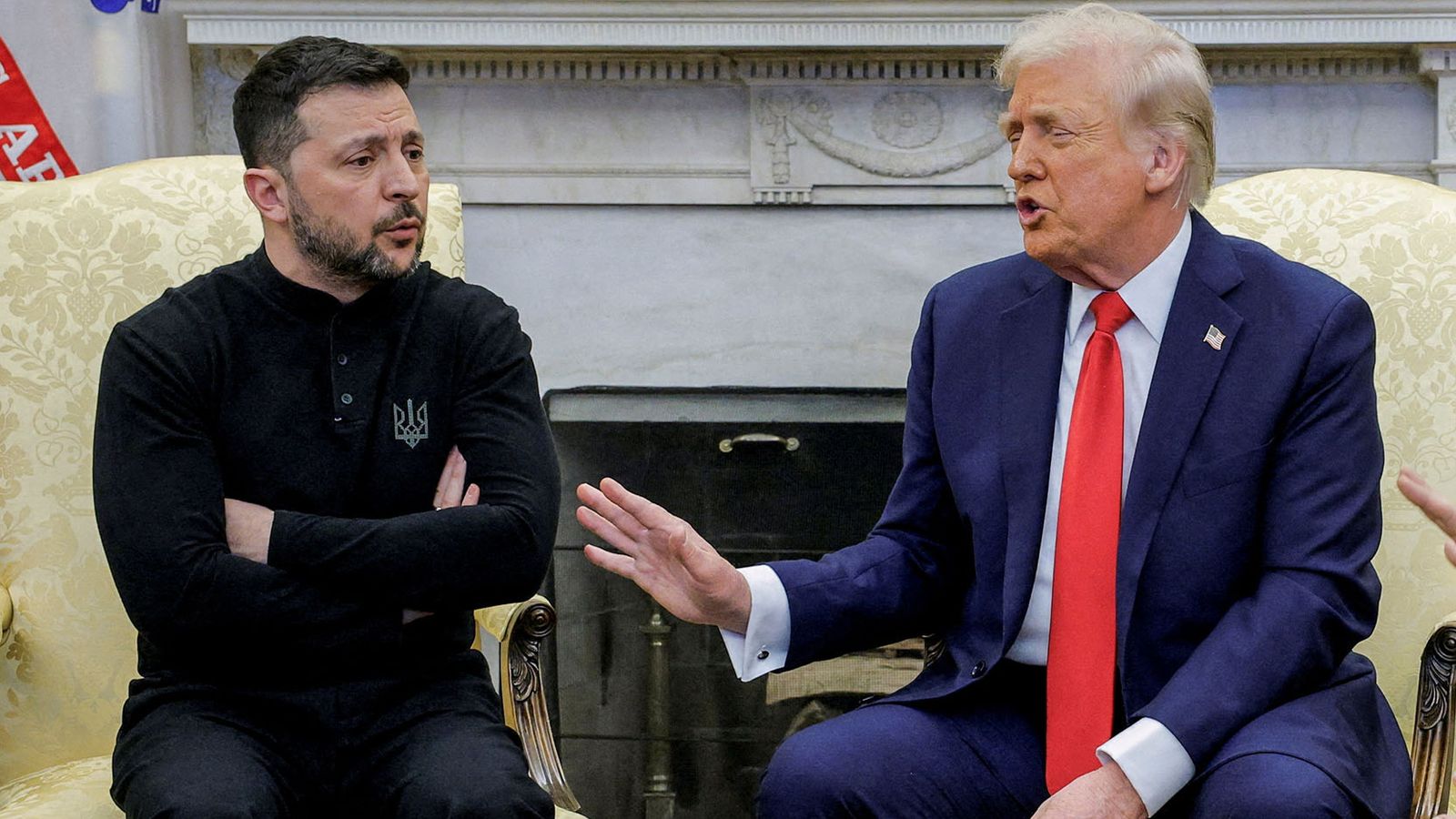
Donald Trump meeting with Ukrainian President Volodymyr Zelenskyy at the White House in February. Pic: Reuters
Ukraine considered that point “unacceptable”, and Mr Zelenskyy has spent the last few weeks drafting a response to the plan that removed “obvious anti-Ukraine points”.
After a series of meetings with Ukraine’s European allies, including a trip to London to meet Sir Keir Starmer on Monday, Zelenskyy said on Thursday that he’d sent Washington a revised peace plan, whittled down to just 20 points.
The new US proposal envisions Ukraine withdrawing from its territory in the Donbas without the Russians advancing, creating a neutral zone.
But Zelenskyy poured cold water on the plans as he briefed journalists in Kyiv.
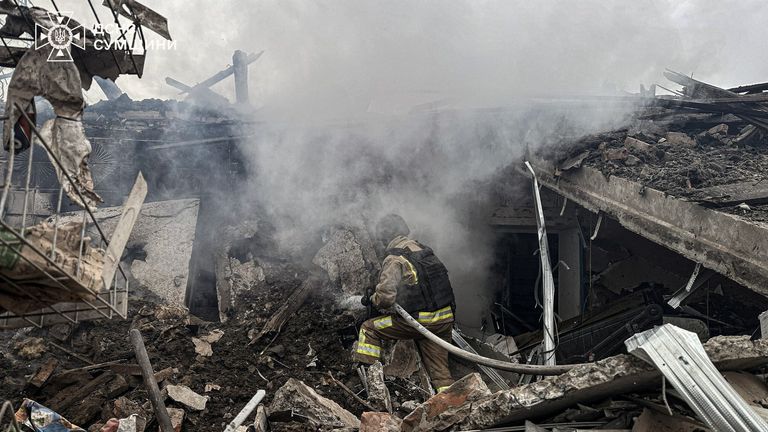
Rescuers work after a Russian air strike in Sumy region, Ukraine. Pic: Reuters
“Who will govern this territory, which they are calling a ‘free economic zone’ or a ‘demilitarised zone’ – they don’t know,” he said.
“If one side’s troops have to retreat and the other side stays where they are, then what will hold back these other troops, the Russians? Or what will stop them disguising themselves as civilians and taking over this free economic zone? This is all very serious.
“It’s not a fact that Ukraine would agree to it, but if you are talking about a compromise then it has to be a fair compromise.”
Sky News military analyst Michael Clarke gave an ominous assessment of the proposal, saying it left “no physical solution” to resolve the problem of future attacks.
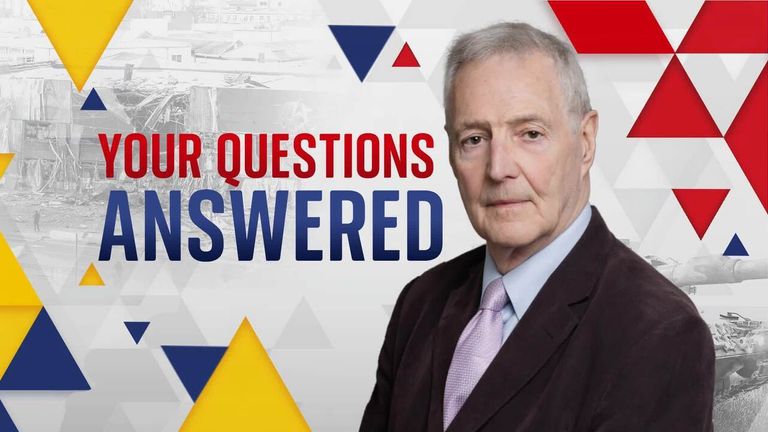
Michael Clarke assesses the state of the war in Ukraine
He said: “If Ukraine gives up the fortress cities in the Donbas, the only security they can have is by being heavily armed and being backed by their allies in some way.”
“The only thing that would stop Russia is deterrence: the knowledge that either the European forces were sitting in Ukraine ready to fight for them, which is hard to imagine at the moment, and even harder to imagine that they are backed up by American forces.”
Matthew Savill, director of military sciences at the Royal United Service Institute, was similarly sceptical.
“The general view is that the Russians will be too tempted to… try and come back for more,” he told Sky News.
He added that “some kind of temporary ceasefire” might work, but it would require “the Europeans to demonstrate they can put their forces where their mouth is in terms of a reassurance force”.
Amid this backdrop there was a meeting today of the coalition of the willing – the 34-strong bloc of nations pledged to support Ukraine against Russian aggression, of which Britain is a part.
Read more:
Analysis: Russia may exploit death of British soldier in Ukraine
Russia sending Ukrainian children to ‘abusive’ camp in North Korea
There was agreement to continue to fund military support, “progress on mobilising frozen Russian sovereign assets”, and an update from Zelenskyy on Russia’s continued bombardment of his country, according to Downing Street.
Afterwards, Zelenskyy said the bloc was working to ensure any peace deal contains “serious components of European deterrence”.
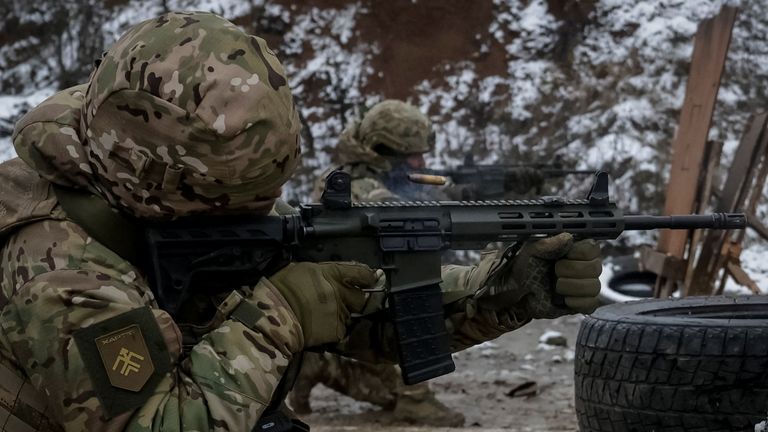
A Ukrainian serviceman in combat practice in Kharkiv region, Ukraine. Pic: Reuters
He added: “It is important that the United States is with us and supports these efforts. No one is interested in a third Russian invasion.”
He also addressed growing pressure from the US for an election in Ukraine, saying “there must be a ceasefire” before the country can go to the polls.
👉 Tap to follow Trump100 wherever you get your podcasts👈
Zelenskyy’s term expired last year, but wartime elections are forbidden by law in Ukraine.
Meanwhile, the tone tonight from the White House was one of impatience, with Trump’s team saying he wouldn’t attend further meetings until there’s a real chance of signing a peace deal.
“The president is extremely frustrated with both sides of this war, and he is sick of meetings just for the sake of meeting,” said White House spokeswoman Karoline Leavitt.
An oil tanker seized by the US off the Venezuelan coast on Wednesday spent years trying to sail the seas unnoticed.
Changing names, switching flags, and vanishing from tracking systems.
That all came to an end this week, when American coast guard teams descending from helicopters with guns drawn stormed the ship, named Skipper.
A US official said the helicopters that took the teams to the tanker came from the aircraft carrier USS Gerald R Ford.
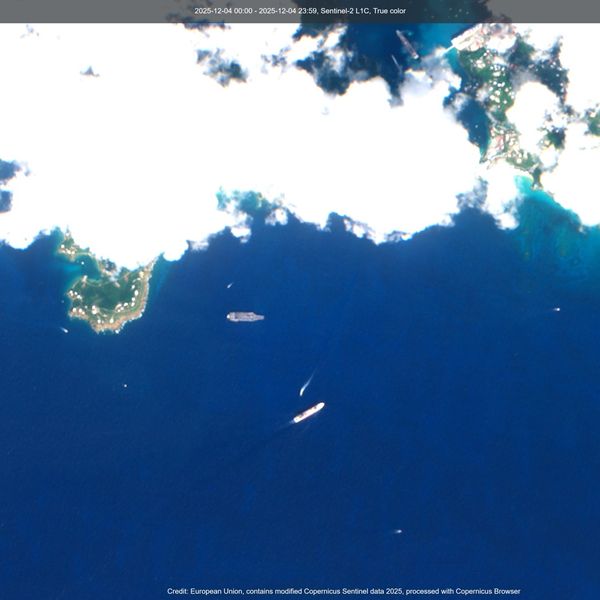
The USS Gerald R Ford (in grey) off the US Virgin Islands on 4 December. Source: Copernicus
The sanctioned tanker
Over the past two years, Skipper has been tracked to countries under US sanctions including Iran.
TankerTrackers.com, which monitors crude oil shipments, estimates Skipper has transported nearly 13 million barrels of Iranian and Venezuelan oil since 2021.
And in 2022, the US Treasury Office of Foreign Assets Control (OFAC) placed Skipper, then known as Adisa, on its sanctions list.
But that did not stop the ship’s activities.
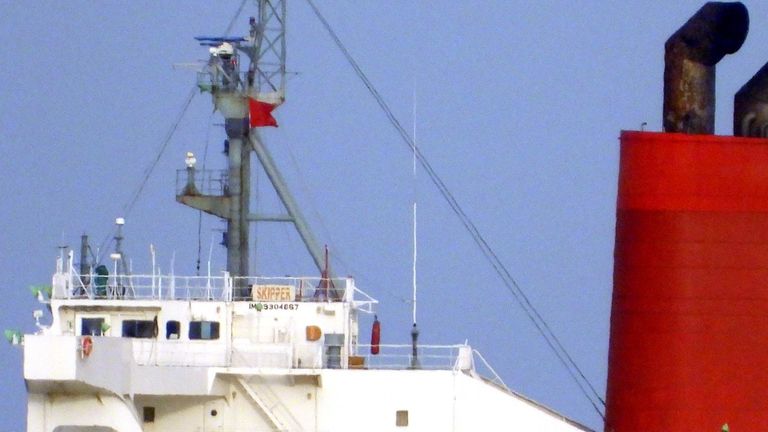
Skipper pictured from the Venezuelan shore. Source: TankerTrackers.com
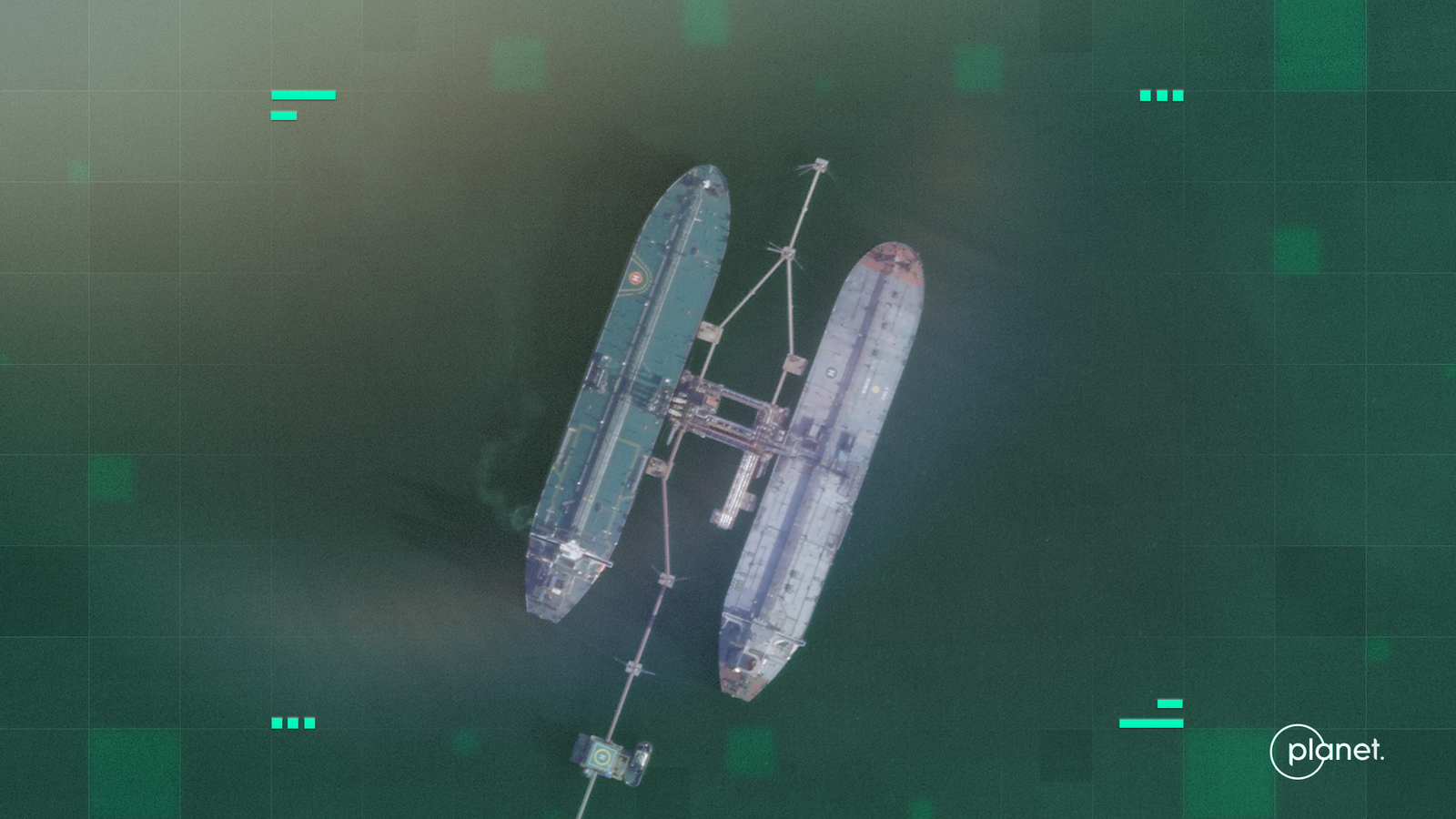
In mid-November 2025, it was pictured at the Jose Oil Export Terminal in Venezuela, where it was loaded with more than one million barrels of crude oil.

Skipper (R) loads up with crude oil at the Jose Oil Export Terminal in Venezuela. Source: Planet
It left Jose Oil Export Terminal between 4 and 5 December, according to TankerTrackers.com.
And on 6 or 7 December, Skipper did a ship-to-ship transfer with another tanker in the Caribbean, the Neptune 6.
Ship-to-ship transfers allow sanctioned vessels to obscure where oil shipments have come from.
The transfer with Neptune 6 took place while Skipper’s tracking system, known as AIS, was turned off.
Read more:
Everything we know about dramatic ship seizure
Is this what the beginning of a war looks like?
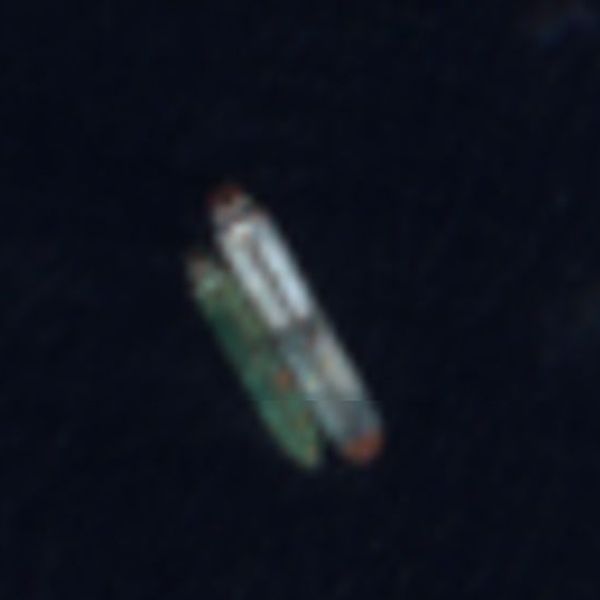
Skipper (R) and Neptune 6 in the Caribbean Sea during an AIS gap. Source: European Union Copernicus Sentinel and Kpler
Dimitris Ampatzidis, senior risk and compliance manager at Kpler, told Sky News: “Vessels, when they are trying to hide the origin of the cargo or a port call or any operation that they are taking, they can just switch off the AIS.”
Matt Smith, head analyst US at Kpler, said they believe the ship’s destination was Cuba.
Around five days after leaving the Venezuelan port, it was seized around 70 miles off the coast.
Moving in the shadows
Skipper has tried to go unnoticed by using a method called ‘spoofing’.
This is where a ship transmits a false location to hide its real movements.
“When we’re talking about spoofing, we’re talking about when the vessel manipulates the AIS data in order to present that she’s in a specific region,” Mr Ampatzidis explained.
“So you declare false AIS data and everyone else in the region, they are not aware about your real location, they are only aware of the false location that you are transmitted.”
When it was intercepted by the US, it was sharing a different location more than 400 miles away from its actual position.
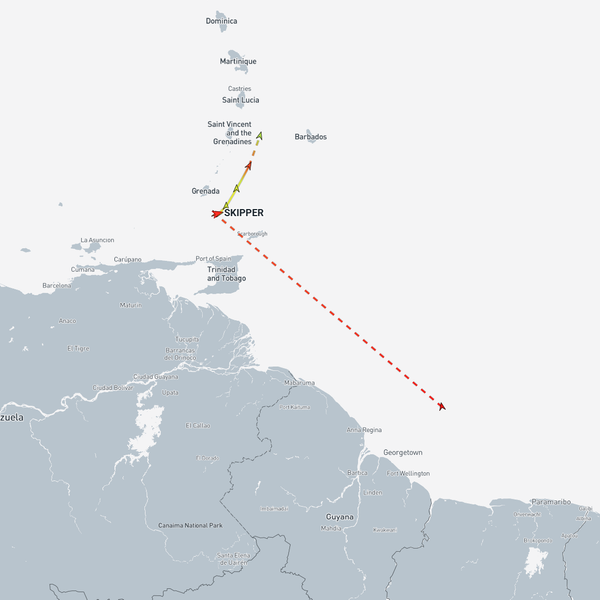
The distance between Skipper’s spoofed position on AIS (towards the bottom right hand corner) and its real position when seized by the US. Source: MarineTraffic
Skipper was manipulating its tracking signals to falsely place itself in Guyanese waters and fraudulently flying the flag of Guyana.
“We have really real concerns about the spoofing events,” Mr Ampatzidis told Sky News.
“It’s about the safety on the seas. As a shipping industry, we have inserted the AIS data, the AIS technology, this GPS tracking technology, more than a decade back, in order to ensure that vessels and crew on board on these vessels are safe when they’re travelling.”
Dozens of sanctioned tankers ‘operating off Venezuela’
Skipper is not the only sanctioned ship off the coast of Venezuela.
According to analysis by Windward, 30 sanctioned tankers were operating in Venezuelan ports and waters as of 11 December.
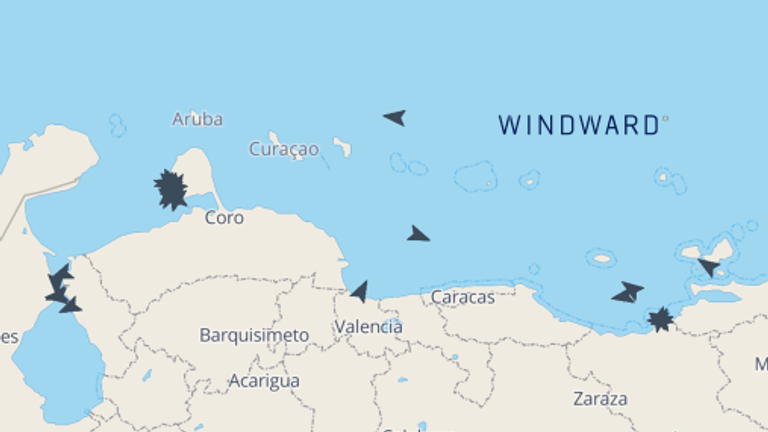
About 30 sanctioned tankers are currently operating in Venezuelan waters. Source: Windward Maritime AI Platform
The tanker seizure is a highly unusual move from the US government and is part of the Trump administration’s increasing pressure on Venezuelan President Nicolas Maduro.
In recent months, the largest US military presence in the region in decades has built up, and a series of deadly strikes has been launched on alleged drug-smuggling boats in the Caribbean Sea and eastern Pacific Ocean.
In the past, Mr Ampatzidis explained, actions like sanctions have had a limited effect on illegally operating tankers.
But the seizure of Skipper will send a signal to other dark fleet ships.
“From today, they will know that if they are doing spoofing, if they are doing dark activities in closer regions of the US, they will be in the spotlight and they will be the key targets from the US Navy.”
The Data X Forensics team is a multi-skilled unit dedicated to providing transparent journalism from Sky News. We gather, analyse and visualise data to tell data-driven stories. We combine traditional reporting skills with advanced analysis of satellite images, social media and other open source information. Through multimedia storytelling we aim to better explain the world while also showing how our journalism is done.
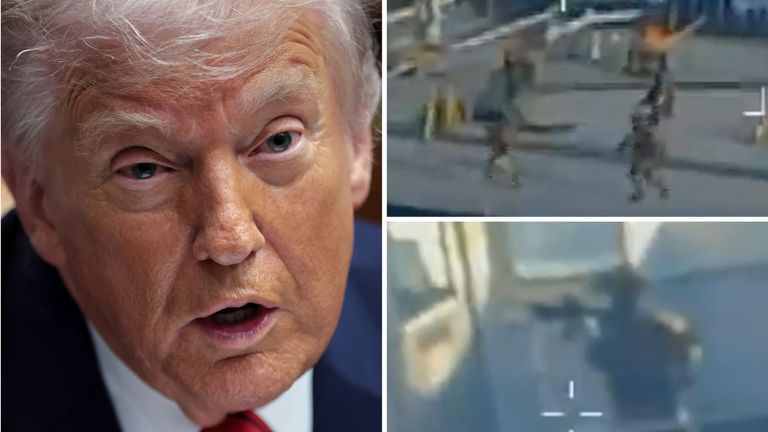
Donald Trump wants you to know that there is one leading reason why he is bearing down militarily on Venezuela: drugs.
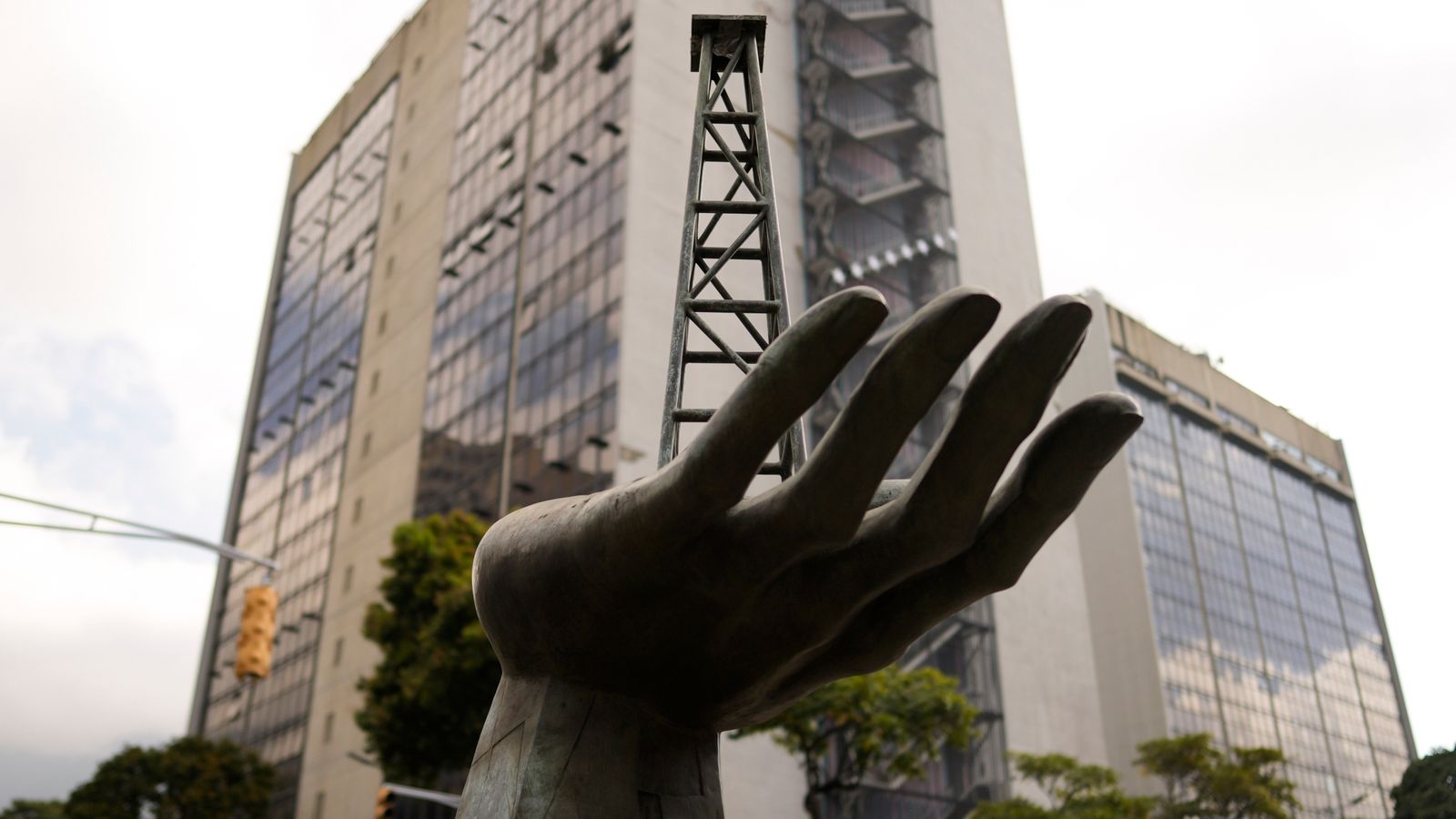
It is, he has said repeatedly, that country’s part in the production and smuggling of illegal narcotics into America that lies behind the ratcheting up of forces in the Caribbean in recent weeks. But what if there’s something else going on here too? What if this is really all about oil?
In one respect this is clearly preposterous. After all, the United States is, by a country mile, the world’s biggest oil producer. Venezuela is a comparative minnow these days, the 21st biggest producer in the world, its output having been depressed under the Chavez and then Maduro regimes. Why should America care about Venezuelan oil?
Money latest: Urgent warning over tumble dryers
For the answer, one needs to spend a moment – strange as this will sound – contemplating the chemistry of oil. Crude oil is, as the name suggests, quite crude. It’s an organic compound, the product of ancient organisms that have been compressed and heated up under the earth’s surface for hundreds of millions of years. And as such, crude oil is subtly different depending on the conditions under which those organisms were compressed.
In some parts of the world, crude oil comes out of the ground as clear, flowing liquid. Sometimes it is green. Sometimes it is heavy, thick gloopy stuff. Oil producers have a word for these differing varieties: light, medium and heavy.
Venezuela accuses US of ‘piracy’
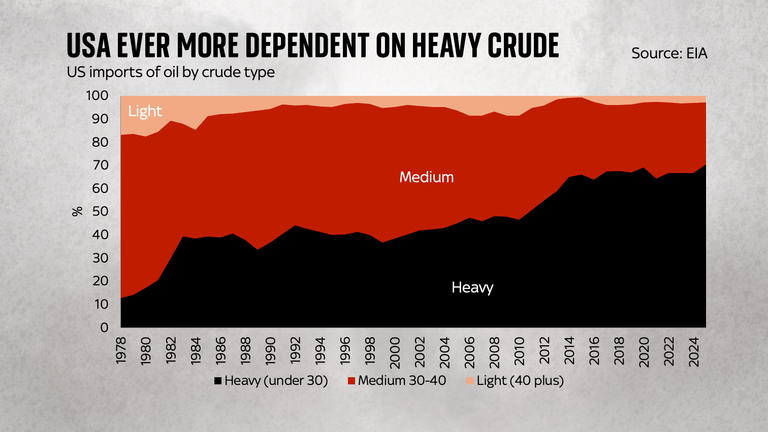
US imports
And here’s the first thing you need to know. Most of America’s refineries are set up to process the heavy stuff. In other words, if America is going to keep its cars fed with gasoline, it needs heavy, gloopy crude. And since it costs many, many billions of dollars to overhaul refineries, no-one particularly wants to do that anytime soon.
Read more:
Why did the US seize tanker off Venezuela?
But the second thing you need to know is the vast majority of that oil produced in America, thanks to the shale revolution, is light crude. In other words, America’s refineries are not compatible with most of the oil America produces.
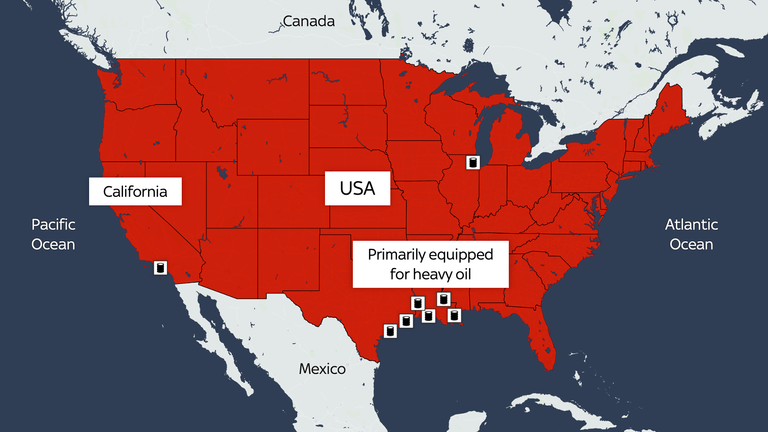
US oil map
The upshot is that for all that America theoretically pumps more crude oil than it would ever need out of its own territories, it is still totally dependent on trade to meet its demands for heavy oil. Most American crude is exported overseas. And America imports well over 6,000 barrels of oil a day to feed its refineries in Texas and Louisiana with the heavy stuff they can digest.
All of which brings us to Venezuela, because it is, alongside Canada and Russia, sitting on the world’s biggest reserves of heavy oil. Right now, most American oil comes from Canada but were Donald Trump keen to wean himself off Canadian crude, he is well aware there is a vast resource of it sitting on the other side of the Caribbean for all those Texas and Louisiana refineries.
-
 Sports2 years ago
Story injured on diving stop, exits Red Sox game
-
 Sports3 years ago
‘Storybook stuff’: Inside the night Bryce Harper sent the Phillies to the World Series
-
 Sports2 years ago
Game 1 of WS least-watched in recorded history
-
 Sports3 years ago
Button battles heat exhaustion in NASCAR debut
-
 Sports3 years ago
MLB Rank 2023: Ranking baseball’s top 100 players
-
Sports4 years ago
Team Europe easily wins 4th straight Laver Cup
-
 Environment3 years ago
Japan and South Korea have a lot at stake in a free and open South China Sea
-
 Environment1 year ago
Here are the best electric bikes you can buy at every price level in October 2024