

Stripe closes $1.1 billion Bridge deal, prepares for aggressive stablecoin push


Patrick Collison, CEO and co-founder of Stripe, speaking at 2022’s Italian Tech Week in Turin, Italy.
Giuliano Berti | Bloomberg | Getty Images
SAN FRANCISCO — What started as a casual roundtable at Stripe’s headquarters to discuss issues facing fintech companies turned into a billion-dollar acquisition that could become a defining moment for the industry.
Last summer, Stripe hosted Wally Adeyemo, who was then deputy secretary of the Treasury Department, for a chat with a number of financial services providers. Among the attendees were Stripe CEO Patrick Collison and Bridge co-founder Zach Abrams. The two entrepreneurs had never met.
Abrams, whose startup specialized in stablecoin infrastructure, said the session surprised him, as it quickly morphed into a conversation specific to his company.
“It was shocking to me,” Abrams told CNBC this week, recalling the event. The group “spent 90-plus percent of the meeting talking about stablecoins — even though we were the only stablecoin company” in the room, he said.
By the end, Bridge was firmly on Stripe’s radar. Months later, that initial meeting led to Stripe’s biggest acquisition to date, a $1.1 billion purchase of Bridge. The deal, which closed Tuesday after clearing regulatory hurdles, gives Stripe a firm foothold in crypto, a market where it previously struggled to gain traction.
“In the course of us spending time together, he probably developed more of an understanding of our business,” said Abrams, who co-founded Bridge in 2022. “And I think there was a growing excitement around the ways that our business can grow, and probably the ways our business could help support and grow the Stripe ecosystem.”
Bridge’s roughly 60-person team convened in San Francisco on Tuesday for the official onboarding. The newcomers were introduced to Stripe’s culture with a crash course on how to write like a Stripe employee and an intro to the business from Collison.
It’s all part of Stripe’s standard fintech boot camp, a program that runs every two weeks for new hires.
Bridge focuses on making it easier for businesses to accept stablecoin payments without having to directly deal in digital tokens. Stablecoins are a type of cryptocurrency whose value is pegged to the value of a real-world asset, such as the U.S. dollar. Customers include Coinbase and SpaceX.
Companies across the financial services landscape, from legacy banks to startup payment providers, are adopting stablecoins or exploring launching their own because they make it easier and cheaper to switch between currencies and to move money digitally. Standard Chartered predicted in a recent report that stablecoins could grow to become about 10% of foreign exchange transactions, up from 1% today.
Prior to Abrams’ first interaction with Collison at the roundtable, Bridge had been aggressively courting Stripe as a customer, hoping to integrate its technology into the payment giant’s ecosystem. As the two CEOs spent more time together in the weeks that followed, Collison’s interest in Bridge deepened.
Previous failure
Stripe had already taken a shot at crypto — and failed. It was one of the first major fintech firms to support bitcoin payments in 2014, but pulled the plug in 2018, citing scalability issues and high transaction fees. Still, the company insisted at the time that it remained “very optimistic about cryptocurrencies overall.”
Stablecoins would be Stripe’s next foray. At its flagship Sessions conference in April, the company said it would enable merchants to accept stablecoins for online purchases. In its first week of the offering, Stripe saw more stablecoin volume than in its entire history of offering bitcoin transactions.
However, Stripe was still missing a key component to make it all work. It needed a way to seamlessly handle cross-border transactions.
That’s precisely what Bridge offered, said Neetika Bansal, Stripe’s head of money movement products.
“If you think about Stripe and what we’ve focused on for the past seven years — what I personally have focused on — it’s been about breaking down the barriers for global commerce,” Bansal told CNBC in an interview at Stripe’s office. “We’ve done it, to a large part, on traditional financial rails.”
Stripe’s approach to global payments for years involved navigating the complex regulatory and operational challenges in each market it entered. Bridge had developed “a super elegant solution to cross-border use cases” and had “meaningful traction with companies of all sizes,” Bansal said. “It just felt almost like a no-brainer to go and acquire them.”

Stripe paid a hefty price for a two-year old company, an amount that was about three times higher than Bridge’s valuation in a funding round in August.
Bansal framed the acquisition as a strategic step toward modernizing Stripe’s global money movement capabilities.
“We are working very closely together to figure out the right opportunities, where we should power our products with Bridge and, in fact, where we should do new product development on Bridge infrastructure,” she said. “That’s what the next few weeks look like.”
Stripe processes millions of cross-border transactions daily, a segment that’s growing 50% annually. Bansal said stablecoins could meaningfully reduce costs and streamline transactions compared to traditional financial networks.
Bansal used as an example a company in the U.S. paying a contractor in the Philippines, which she called “a common use case as company workforces are going global.”
Stripe has partnered with Remote.com, a global human resources and contractor platform, to process payouts using stablecoin infrastructure in more than 70 countries. Bansal said she sees stablecoins playing a growing role in foreign exchange and treasury management for large enterprises.
For now, Bridge will continue running its existing products, but the teams are working together to determine the best integrations and explore new products that can be built on Bridge’s technology.
“They’re clearly a leader in the space,” Bansal said about Bridge. “A lot of our conversations are about absorbing what Bridge has learned about stablecoins.”
WATCH: Fintechs soar after election

Environment
Tenways AGO T mid-drive e-bike at $2,399 low, DJI Power 2000 station hits new $999 low, EcoFlow 48-hour flash sale, tools, more


Today’s Green Deals are headlined by the low price on Tenways’ AGO T Premium Mid-Drive Urban e-bike that comes with a free front carrier ($50 value) for $2,399, among other models seeing discounts during this sale. We also spotted DJI’s recently released Power 2000 Portable Power Station hitting a new $999 low, as well as EcoFlow’s latest four 48-hour flash sale offers that include two power stations, a WAVE 3 bundle, and a DELTA Pro 3 expansion battery at up to 53% off starting from $1,199. From there, we have Greenworks’ 40V 20-inch Cordless Pole Hedge Trimmer kit at its $114 low alongside the Worx Aerocart 8-in-1 Yard Cart down at $169.50. Plus, there’s all the hangover Prime Day savings in our Prime Day Green Deals hub at the bottom of the page, as well as yesterday’s EcoFlow phase 3 Prime Day Sale, and more.
Head below for other New Green Deals we’ve found today and, of course, Electrek’s best EV buying and leasing deals. Also, check out the new Electrek Tesla Shop for the best deals on Tesla accessories.
Tenways AGO T mid-drive e-bike with a 62-mile range and $50 in free gear at $2,399 low in latest sale
Tenways has launched a new Summer Sale that is taking up to $600 off its e-bike lineup while also offering an additional $300 savings when buying two models together. Among the offers this time, we’re seeing the lowest price to date continuing on the AGO T Premium Mid-Drive Urban e-bike for $2,399 shipped while also getting a free front carrier valued at $50. Normally, this higher-end model would cost you $2,699 at full price, which we saw brought down to the $2,399 low for the first time during the brand’s July 4th Sale. Now you’re getting another chance at that $300 markdown here while the savings last, dropping the costs back to the best price we have tracked. As always, there is an extra $150 savings available for medical providers, first responders, military personnel, and teachers with verification through ID.me on any of the e-bikes’ landing pages.
Aside from Tenways’ new CARGO ONE e-bike that recently released, the AGO T Urban e-bike is the highest-end of the brand’s models, cruising into view with a Bafang M420 mid-drive motor coupled with a 504Wh battery to provide up to 62 miles of pedal-assisted travel at up to 20 MPH top speeds. It shouldn’t be surprising that this premium model also comes with a superior torque sensor to support its PAS capabilities, with the settings controlled via the TFT LCD color display screen.
There’s plenty of high-quality features you’ll be getting here too, like a hydraulic front lockout fork, the hydraulic disc brakes, puncture-resistant tires with fenders over each, a Gates CDX carbon belt drive, an Enviolo stepless shifting hub, an integrated rear cargo rack, integrated front and rear lighting, a suspension seat post, and more. There are even connectivity options through its companion app, the standout of which is the ability to cast directions from your phone onto the bike’s display for more seamless navigation.
If you want to check out the full lineup of e-bike deals that we’re seeing in this current sale, be sure to check out our original coverage here.
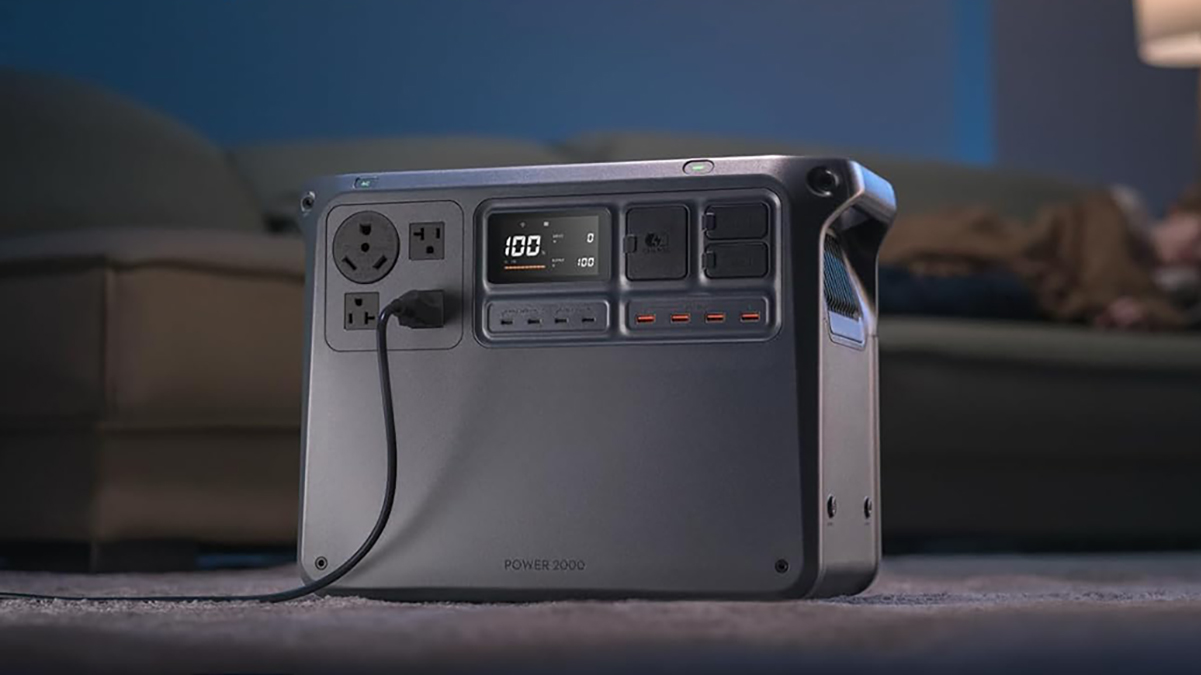
Score DJI’s latest Power 2000 2,048Wh LiFePO4 station with $900 savings at a new $999 low
By way of its official Amazon storefront, DJI is giving folks a lower-than-ever price on its new Power 2000 Portable Power Station at $999 shipped, after using the promo code DJIPOWER2000 at checkout. This model was just released at the top of the month, with it waiting no time before dropping from its original $1,899 price tag to $1,299, which held out all of last week until falling to $1,099, with the promo code taking things even further. You’re looking at a combined 47% markdown that gives you $900 off its tag, landing it at a new all-time low price. You can also alternatively pick up its Power 1000 predecessor at $549 shipped right now, after redeeming the on-page coupon.
If you want to learn more about this all-new backup power solution, be sure to check out our original coverage here.

EcoFlow flash sale takes up to 53% off two power station offers, a WAVE 3 bundle, and an extra battery starting from $1,199
As part of its ongoing Phase 3 Prime Day Sale, EcoFlow has launched the next 48-hour flash sale through July 16, with four units getting up to 53% discounts to some of the best prices we have tracked. Among the two power station deals, you’ll find the brand’s DELTA Pro Portable Power Station with a free protective bag at $1,749 shipped, with the extra savings unfortunately not applicable here. Priced at $3,699 in full, we regularly see it down between $1,799 and $1,999, especially at Amazon, where it’s currently sitting $50 higher in price. While we have seen it go as low as $1,694 in the past, you’re still looking at a larger-than-normal 53% markdown off the going rate, giving you $1,950 in savings and landing it $55 above the all-time low. Head below for more on this unit and the others we’re seeing included in this flash sale.
If you want to learn more about this power station or the other units included in this flash sale, be sure to check out our original coverage here.

Cover hedge jobs with this Greenworks 40V 20-inch pole trimmer at $114 low
Amazon is offering the Greenworks 40V 20-inch Cordless Pole Hedge Trimmer for $113.99 shipped. Coming down from its usual $170 pricing, where the brand’s direct website currently has it listed, we only saw discounts in 2025 dropping costs to $140 until this past week, when Prime Day brought it lower than ever to the rate that is continuing into this week. You’re looking at a $56 markdown to the best price we have tracked and giving you the chance to save big while Prime Day benefits linger.
To learn more about this lawn care solution’s capabilities, be sure to check out our original coverage here.

Tackle yard work with 8-in-1 versatility using Worx’s transforming Aerocart at $169.50
Amazon is offering the Worx Aerocart 8-in-1 Yard Cart at $169.50 shipped, which comes in $0.50 under the current Best Buy Deals of the Day pricing. Usually going for $200 to $230 at full price, we’ve mainly seen it in 2025 keeping near $173, with it more recently keeping down between $169 and $170 at the lowest. While it’s fallen lower in the past, those rates haven’t reappeared this year at all, with today’s deal being a solid $60.50 markdown at the second-best price of the year – just $0.50 above the annual low.
If you want to learn more about this handy yard cart, be sure to check out our original coverage here.
Best Summer EV deals!
- Ford Bronco e-bike (use code PDSG5OFF): $4,000 (Reg. $4,500)
- Ford Mustang e-bike (use code PDSG5OFF): $3,500 (Reg. $4,000)
- Aventon Ramblas Electric Mountain Bike: $2,599 (Reg. $2,899)
- Heybike Hero Carbon Fiber All-Terrain 750W mid-drive e-bike: $2,599 (Reg. $3,099)
- Ride1Up Prodigy v2 Brose Mid-Drive Gates Belt CVT e-bike: $2,595 (Reg. $2,795)
- Velotric Nomad 2X Multi-Terrain Camo e-bike with $50 bundle: $2,499 (No price cut)
- Ride1Up Revv 1 DRT Off-Road Moped-Style e-bike: $2,495 (Reg. $2,595)
- Ride1Up Revv 1 Full Suspension Moped-Style e-bike: $2,395 (Reg. $2,595)
- Heybike Hero Carbon Fiber All-Terrain 1,000W rear-hub e-bike: $2,299 (Reg. $2,599)
- Ride1Up Prodigy v2 Brose Mid-Drive 9-Speed e-bike: $2,095 (Reg. $2,495)
- Velotric Nomad 2 All-Terrain e-bike with $120 bundle (new model): $1,999 (No price cut)
- Rad Power Radster Road Commuter e-bike: $1,999 (Reg. $2,199)
- Rad Power Radster Trail Off-Road e-bike: $1,999 (Reg. $2,199)
- Lectric XPedition 2.0 35Ah Cargo e-bike w/ up to $703 bundle: $1,999 (Reg. $2,702)
- Tenways AGO X All-Terrain e-bike with $307 bundle: $1,899 (Reg. $2,499)
- Velotric Breeze 1 Cruiser e-bike with $150 bundle (new model): $1,799 (No price cut)
- Aventon Pace 4 Smart Cruiser e-bike (new model, first discount): $1,699 (Reg. $1,799)
- Lectric XPedition 2.0 26Ah Cargo e-bike w/ $554 bundle: $1,699 (Reg. $2,253)
- Lectric XPeak 2.0 Long-Range Off-Road e-bike with $316 bundle: $1,699 (Reg. $1,915)
- Aventon Abound Cargo e-bike: $1,599 (Reg. $1,999)
- Aventon Aventure 2 All-Terrain e-bike (2025 low): $1,599 (Reg. $1,999)
- Lectric XPeak 2.0 Standard Off-Road e-bike with $227 bundle: $1,499 (Reg. $1,726)
- Lectric XP Trike2 with $227 preorder bundle (through July 28): $1,499 (Reg. $1,726)
- Tenways CGO600 Pro e-bikes with $118 bundle: $1,499 (Reg. $1,899)
- Velotric Nomad 1 Plus All-Terrain e-bike with $69 bundle : $1,399 (Reg. $1,899)
- Fold 1 Plus e-bike with $120 bundle (new model): $1,499 (No price cut)
- Lectric XP Trike with $405 bundle: $1,499 (Reg. $1,904)
- Lectric XPedition 2.0 13Ah Cargo e-bike with $326 bundle: $1,399 (Reg. $1,725)
- Aventon Level 2 Commuter e-bike (2025 low): $1,399 (Reg. $1,899)
- Ride1Up Roadster V3 Lightweight Premium e-bike: $1,395 (Reg. $1,495)
- Velotric T1 ST Plus e-bike with $82 bundle (2025 low): $1,299 (Reg. $1,649)
- Lectric XPress 750 Commuter e-bikes with $336 bundle: $1,299 (Reg. $1,635)
- Lectric XP4 750 LR Folding Utility e-bikes with $356 bundle: $1,299 (Reg. $1,655)
- Heybike Brawn Off-Road e-bike: $1,299 (Reg. $1,799)
- Velotric Discover 1 Plus Commuter e-bike with $83 bundle (2025 low): $1,199 (Reg. $1,699)
- Lectric XP Lite 2.0 JW Black LR e-bike with $414 bundle: $1,099 (Reg. $1,513)
- Ride1Up Portola Folding e-bike with BOGO accessory promo: $995 (Reg. $1,095)
- Lectric XP4 Standard Folding Utility e-bikes with $79 bundle: $999 (Reg. $1,078)
- Lectric XP 3.0 Long-Range e-bikes (clearance price cut): $999 (Reg. $1,199)
- Lectric XP Lite 2.0 Long-Range e-bikes with up to $414 bundles: $999 (Reg. $1,413)
- Heybike Hauler Single-Battery Cargo e-bike: $999 (Reg. $1,499)
- Rad Power RadExpand 5 Folding e-bike (new low): $999 (Reg. $1,599)
- Segway ZT3 pro eKickScooter (new low): $850 (Reg. $1,300)
- Navee ST3 Pro Electric Scooter (new model): $760 (Reg. $1,014)
- Fold 1 Lite e-bike (new all-time low): $599 (Reg. $1,099)
- Navee GT3 Pro Electric Scooter (new model): $520 (Reg. $714)

Best new Green Deals landing this week
The savings this week are also continuing to a collection of other markdowns. To the same tune as the offers above, these all help you take a more energy-conscious approach to your routine. Winter means you can lock in even better off-season price cuts on electric tools for the lawn while saving on EVs and tons of other gear.
FTC: We use income earning auto affiliate links. More.


Range Rover’s first electric SUV will finally arrive later this year. Ahead of its official launch, early reviews show the upcoming EV stays true to the Range Rover heritage, but there are a few things you should know.
Range Rover will launch its first EV later this year
Since launching its first vehicle 55 years ago, the Range Rover brand has become an iconic symbol of off-road capabilities, elegant design, and luxurious interiors.
With its first all-electric SUV due out later this year, Range Rover promises it will “refine and craft the epitome” of the luxury brand.
Although Range Rover is currently putting the electric SUV through “the most intensive testing” any of its vehicles has endured, Autocar got their hands on a prototype for an early review.
The Range Rover Electric may look like the iconic SUV we’ve grown to love, but with an electric powertrain, it offers even more.
“A Range Rover more calm and assured, almost regardless of circumstance, than any in its 55-year lineage. Electrification yields a lot, but sacrifices little,” Matt Sanders, Autocar’s chief car tester, said after driving the prototype.

Based on the MLA platform, the electric SUV features JLR’s new in-house powertrain. The dual-motor setup packs a combined 542 hp and 627 lb-ft of torque.
The EV draws power from a massive 118 kWh battery, which is expected to deliver around 300 miles of real-world range. Sanders said he had about 160 miles of range remaining at half charge during the review.

However, even JLR’s engineers admit that due to the SUV’s (not so) aerodynamic profile, 300 miles may be optimistic during longer-range highway driving. The engineers highlighted that the vehicle’s 800V architecture offers some of the fastest DC charging speeds on the market.
The electric SUV can also tow over 7,700 lbs (2.5 tons). Although this is less than the current Range Rover’s 3.5-ton towing capacity, it’s still on par with other luxury SUVs, such as the Mercedes G-Class.

To add more power, more motors, and bigger batteries would be required, according to Simon Fairbrother, Range Rover’s Chief Program Engineer.
Inside, the cabin is nearly identical to that of the current Range Rover SUV, featuring a plethora of digital screens and physical buttons in front of the driver. If anything, the only thing that could be changed is that the “Range Rover Electric deserves bigger heating and ventilation controls than other derivatives,” Sanders wrote.

JLR’s new in-house thermal management system (ThermAssist) is about 40% more efficient than the system of the Jaguar I-Pace, its first all-electric vehicle.
Range Rover’s first E will be offered in standard and long wheelbase variants. The extended wheelbase model will be about the same size as the outgoing Range Rover SUV, but it’s expected to still include enough second-row space to take it into “Bentley or Rolls-Royce territory for sheer lounging space.”

Since Autocar only drove the vehicle at speeds under 20 mph, we’ll have to wait to hear more about on- and off-road performance.
Sanders did mention that “the Range Rover Electric can simply ease itself up, down, over and around everything before it inspires incredible confidence in its capabilities” while driving through forest racks.
We will learn the prices closer to launch, but JLR is reportedly aiming for a price around the same as the V8 Autobiography, at just under £150,000 ($200,000).
Range Rover’s first EV has already secured over 61,000 clients on the waitlist ahead of its upcoming debut. JLR also revealed the luxury brand’s first logo, which we could see debut on the new electric SUV.
Source: Autocar
FTC: We use income earning auto affiliate links. More.


Circle Internet Group Initial Public Offering at the New York Stock Exchange in New York City, U.S., June 5, 2025.
NYSE
Circle shares slid on Tuesday after the U.S. House of Representatives failed to clear a key procedural hurdle that would have teed up votes on long-awaited crypto-related bills.
The move dealt a major setback to the digital asset industry, which had framed this week as a turning point for regulatory clarity in Washington, D.C.
Circle, the stablecoin issuer that’s soared in value since its public market debut last month, fell about 5% after the vote. Crypto exchange Coinbase and bitcoin miner MARA Holdings both slipped about 2%.
Even after Tuesday’s drop, Circle shares are still up more than sixfold from their IPO price. The company is the issuer of USDC, the second-largest dollar-pegged stablecoin, with about 24% of the global market. Circle didn’t immediately respond to a request for comment.
The legislation, including the GENIUS Act, would mark the first time the U.S. sets federal rules for stablecoins, a $260 billion corner of the crypto market that underpins most digital asset trading. The bill establishes full-reserve requirements, mandates monthly audits, and creates a path for private companies to issue regulated digital dollars under the blessing of the U.S. government.
The GENIUS Act passed the Senate last month, a milestone for both the crypto industry and for President Donald Trump, who has pushed to align his administration with digital asset innovation. It also marked a win for the industry, which spent more than $245 million in the 2024 cycle to help elect what’s now seen as the most pro-crypto Congress in U.S. history.
Treasury Secretary Scott Bessent has said the market for U.S. stablecoins could grow eightfold to more than $2 trillion in the coming years if this bill is enacted. White House AI and crypto czar David Sacks had predicted it could unlock “trillions” of dollars in demand for U.S. Treasury notes virtually overnight.
The vote came just hours after Fairshake, the crypto industry’s most powerful PAC, disclosed $141 million in cash on hand as it fights for regulatory victories and backs pro-crypto candidates heading into the 2026 midterms. The committee didn’t provide a comment for this story.
House leadership is tentatively planning a second vote as early as Tuesday evening, though it’s unclear whether the rule or bill text will be modified to satisfy holdouts.
WATCH: Stablecoin showdown moves to the House after Senate clears crypto’s landmark bill
-
 Sports3 years ago
‘Storybook stuff’: Inside the night Bryce Harper sent the Phillies to the World Series
-
 Sports1 year ago
Story injured on diving stop, exits Red Sox game
-
 Sports2 years ago
Game 1 of WS least-watched in recorded history
-
 Sports2 years ago
MLB Rank 2023: Ranking baseball’s top 100 players
-
Sports4 years ago
Team Europe easily wins 4th straight Laver Cup
-
 Sports2 years ago
Button battles heat exhaustion in NASCAR debut
-
 Environment2 years ago
Japan and South Korea have a lot at stake in a free and open South China Sea
-
 Environment2 years ago
Game-changing Lectric XPedition launched as affordable electric cargo bike