
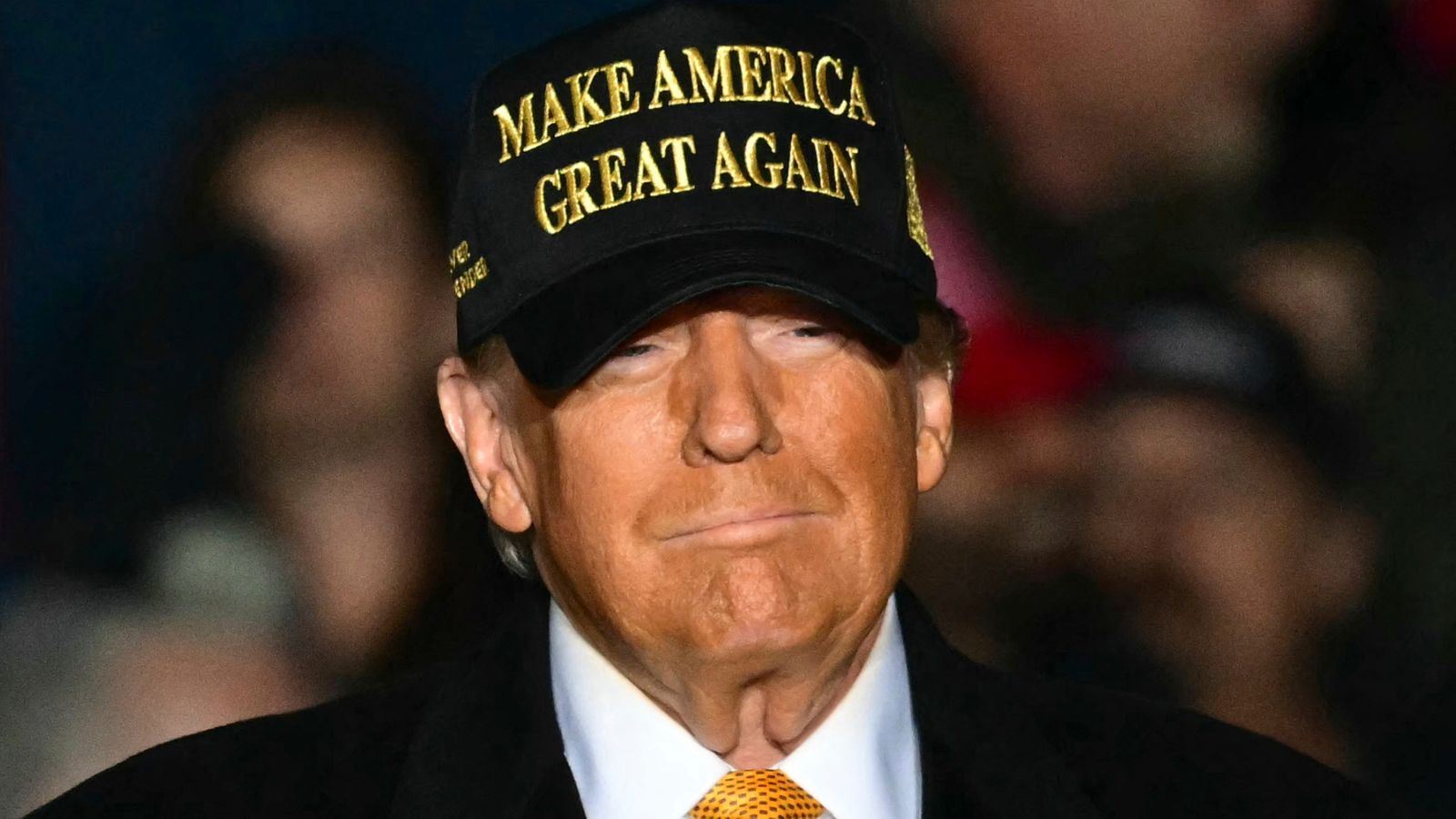
Why China has not retaliated more in Donald Trump trade spat

China has, as expected, hit back at Donald Trump’s imposition of a 10% tariff on its exports to the United States.
Beijing has slapped levies of between 10-15% on a range of energy products that imports from the US.
But what has surprised observers – particularly when Mr Trump kicked off the trade war over the weekend – has been the president’s comparatively lenient treatment of China and, moreover, Beijing’s calm response.
While America’s two closest neighbours, Canada and Mexico, were hit with 25% tariffs (falling to 10% for Canadian energy exports) – since put on ice – China was merely hit with a 10% levy.
Money blog: Now we know why Guinness tastes worse in Britain
That struck many observers as curious since China is regarded as a bigger trade adversary by the US than Mexico and Canada, with the latter traditionally seen as a close friend to the US, particularly through the pair’s involvement in the ‘Five Eyes’ security alliance along with Australia, New Zealand and the UK.
The big question raised by this is what motivated Mr Trump to do this.
The thinking is that the president was trying to bring China to the negotiating table and that, by initially hitting a close ally like Canada harder, he was trying to send a message to China’s leaders as to what they might face further down the line.
That impression was reinforced by Mr Trump’s overnight description of his 10% tariff on China as an “opening salvo”.
Why is China so calm?
That is not the only curiosity concerning this affair.
The other is the relatively calm response from Beijing. While Canada immediately responded with retaliatory measures and Mexico indicated that it would, China merely murmured in the first instance about taking “necessary countermeasures” and indicated that it would raise a complaint about the US with the World Trade Organisation.
Since then, Beijing has of course hit back with tariffs of its own on US energy imports, as well as launching an antitrust investigation into Google and adding the parent company of Tommy Hilfiger and Calvin Klein on a blacklist of “unreliable entities”.
That gives Chinese president Xi Jinping something to take back off the table if, as expected, he speaks to Mr Trump in coming days as the pair seek to de-escalate this row.
But it all feels relatively restrained and raises the question of why China has responded in this way.
There is certainly a view in Beijing that, with Mr Trump’s first moves, China got off rather lightly compared with the Canadians and Mexicans.
That sanguine response may also indicate that Beijing knows it has other weapons it can deploy other than retaliatory measures.
Cards in China’s back pocket
For a start, China owns $769bn worth of US Treasury bonds. Dumping some of those aggressively – while hurting the Chinese – would push up America’s implied borrowing costs.
Alternatively, Beijing could allow its currency, the renminbi, to weaken on the foreign exchange markets, just as it did during Mr Trump’s first term of office.
Trump tariffs: What is America’s trade position?
Either way, Mr Trump’s latest measures are unlikely to change the way Chinese businesses operate, particularly the country’s manufacturers.
They have become accustomed over several years, dating back to Mr Trump’s first term, to aggression from the US. They have adapted the way they do business accordingly, for example by shipping a lot of their exports to the US via third countries, most notably Vietnam.
Chinese businesses relieved
Even Chinese companies specifically targeted by Mr Trump – the e-commerce giants Temu and Shein – may not be too badly affected.
They were both singled out as the president closed the so-called “de minimis” loophole, dating back to 1938, which allows goods worth less than $800 to be sent directly to US consumers without incurring import duties or rigorous customs inspections.
Read more:
What’s going on with Trump and tariffs?
How UK finds itself in a strong position to avoid Trump tariffs
This has been a constant thorn in the side of US retailers and its removal helps explain why, for example, shares of Walmart were on Monday spared the spanking meted out to other US stocks.
Yet Shein and Temu are said to be taking the news calmly.
They may even be calculating that this is a short-term squall that will soon blow over – or calculating that, such is the enormity of their buying power and supply chains, they can simply ship inventory elsewhere in the meantime or even just warehouse it.
It is also worth noting that Shein, having been banned by India in 2020, has just begun selling in the country again.
Overall, then, Chinese businesses have reacted with relief to what has happened. They know it could have been worse.
It explains why, even though the Chinese economy is presently misfiring, the authorities in Beijing have reacted relatively calmly to what Mr Trump has done.

The UK economy unexpectedly shrank in May, even after the worst of Donald Trump’s tariffs were paused, official figures showed.
A standard measure of economic growth, gross domestic product (GDP), contracted 0.1% in May, according to the Office for National Statistics (ONS).
Rather than a fall being anticipated, growth of 0.1% was forecast by economists polled by Reuters as big falls in production and construction were seen.
It followed a 0.3% contraction in April, when Mr Trump announced his country-specific tariffs and sparked a global trade war.
A 90-day pause on these import taxes, which has been extended, allowed more normality to resume.
This was borne out by other figures released by the ONS on Friday.
Exports to the United States rose £300m but “remained relatively low” following a “substantial decrease” in April, the data said.
Overall, there was a “large rise in goods imports and a fall in goods exports”.
A ‘disappointing’ but mixed picture
It’s “disappointing” news, Chancellor Rachel Reeves said. She and the government as a whole have repeatedly said growing the economy was their number one priority.
“I am determined to kickstart economic growth and deliver on that promise”, she added.
But the picture was not all bad.
Growth recorded in March was revised upwards, further indicating that companies invested to prepare for tariffs. Rather than GDP of 0.2%, the ONS said on Friday the figure was actually 0.4%.
It showed businesses moved forward activity to be ready for the extra taxes. Businesses were hit with higher employer national insurance contributions in April.
Read more:
Trump plans to hit Canada with 35% tariff – warning of blanket hike for other countries
Woman and three teenagers arrested over M&S, Co-op and Harrods cyber attacks
The expansion in March means the economy still grew when the three months are looked at together.
While an interest rate cut in August had already been expected, investors upped their bets of a 0.25 percentage point fall in the Bank of England’s base interest rate.
Such a cut would bring down the rate to 4% and make borrowing cheaper.
Is Britain going bankrupt?
Analysts from economic research firm Pantheon Macro said the data was not as bad as it looked.
“The size of the manufacturing drop looks erratic to us and should partly unwind… There are signs that GDP growth can rebound in June”, said Pantheon’s chief UK economist, Rob Wood.
Why did the economy shrink?
The drops in manufacturing came mostly due to slowed car-making, less oil and gas extraction and the pharmaceutical industry.
The fall was not larger because the services industry – the largest part of the economy – expanded, with law firms and computer programmers having a good month.
It made up for a “very weak” month for retailers, the ONS said.

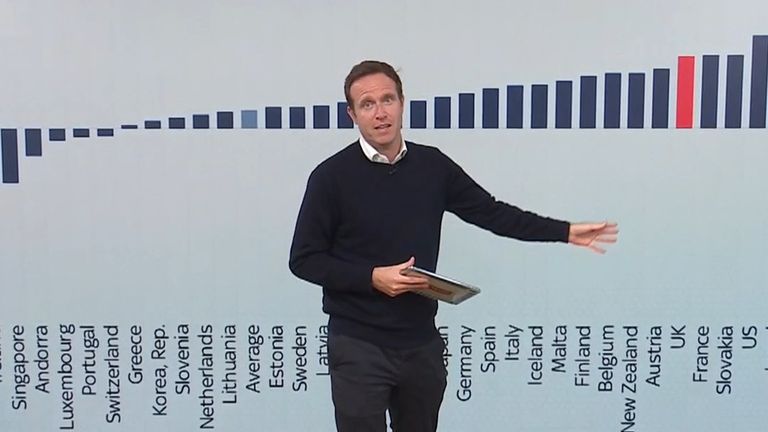
Monthly Gross Domestic Product (GDP) figures are volatile and, on their own, don’t tell us much.
However, the picture emerging a year since the election of the Labour government is not hugely comforting.
This is a government that promised to turbocharge economic growth, the key to improving livelihoods and the public finances. Instead, the economy is mainly flatlining.
Output shrank in May by 0.1%. That followed a 0.3% drop in April.
Ministers were celebrating a few months ago as data showed the economy grew by 0.7% in the first quarter.
Hangover from artificial growth
However, the subsequent data has shown us that much of that growth was artificial, with businesses racing to get orders out of the door to beat the possible introduction of tariffs. Property transactions were also brought forward to beat stamp duty changes.
Read more:
Trump to hit Canada with 35% tariff
Woman and three teens arrested over cyber attacks
In April, we experienced the hangover as orders and industrial output dropped. Services also struggled as demand for legal and conveyancing services dropped after the stamp duty changes.
Many of those distortions have now been smoothed out, but the manufacturing sector still struggled in May.
Signs of recovery
Manufacturing output fell by 1% in May, but more up-to-date data suggests the sector is recovering.
“We expect both cars and pharma output to improve as the UK-US trade deal comes into force and the volatility unwinds,” economists at Pantheon Macroeconomics said.
Meanwhile, the services sector eked out growth of 0.1%.
A 2.7% month-to-month fall in retail sales suppressed growth in the sector, but that should improve with hot weather likely to boost demand at restaurants and pubs.
Struggles ahead
It is unlikely, however, to massively shift the dial for the economy, the kind of shift the Labour government has promised and needs in order to give it some breathing room against its fiscal rules.
The economy remains fragile, and there are risks and traps lurking around the corner.
Is Britain going bankrupt?
Concerns that the chancellor, Rachel Reeves, is considering tax hikes could weigh on consumer confidence, at a time when businesses are already scaling back hiring because of national insurance tax hikes.
Inflation is also expected to climb in the second half of the year, further weighing on consumers and businesses.
-
 Sports3 years ago
‘Storybook stuff’: Inside the night Bryce Harper sent the Phillies to the World Series
-
 Sports1 year ago
Story injured on diving stop, exits Red Sox game
-
 Sports2 years ago
Game 1 of WS least-watched in recorded history
-
 Sports2 years ago
MLB Rank 2023: Ranking baseball’s top 100 players
-
Sports4 years ago
Team Europe easily wins 4th straight Laver Cup
-
 Sports2 years ago
Button battles heat exhaustion in NASCAR debut
-
 Environment2 years ago
Japan and South Korea have a lot at stake in a free and open South China Sea
-
 Environment2 years ago
Game-changing Lectric XPedition launched as affordable electric cargo bike