
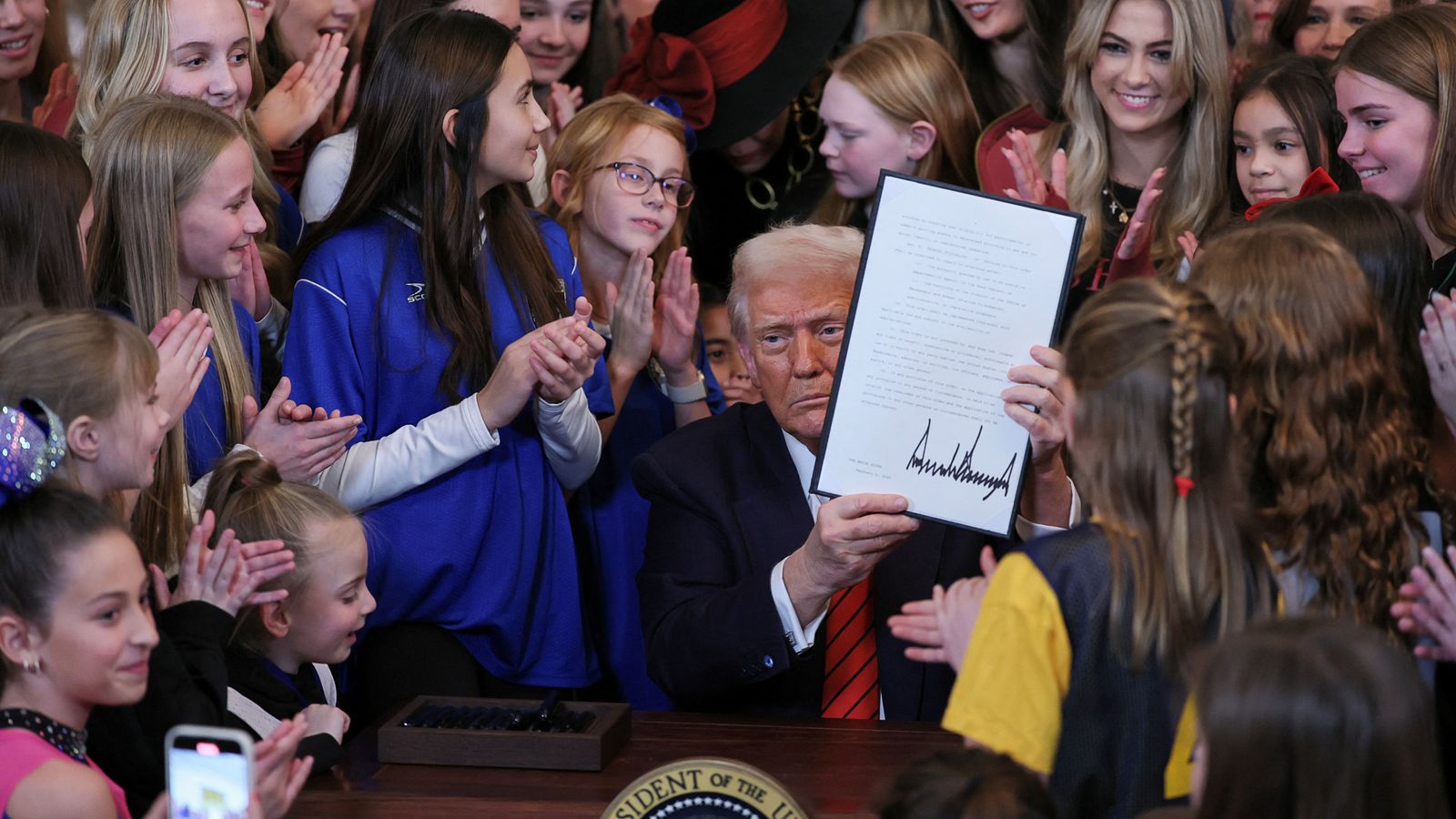
Donald Trump signs executive order banning trans women athletes from competing in female sports

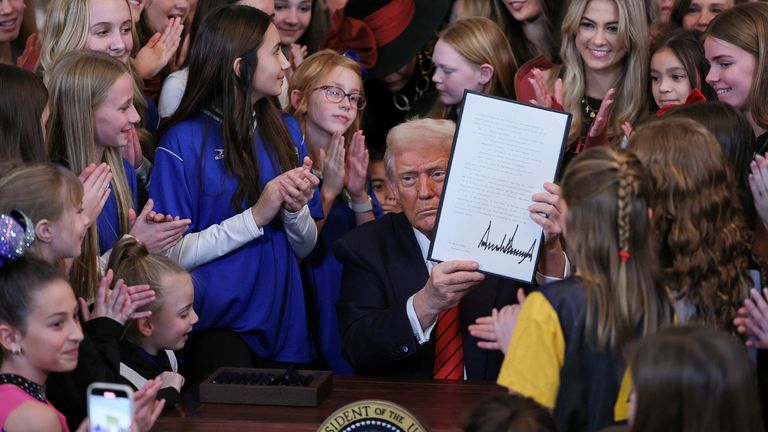
Donald Trump has signed an executive order banning trans women athletes from competing in female sports.
The move is designed to prevent people who were biologically assigned male at birth from participating in certain sporting events, including those at school.
The order, titled “Keeping Men Out of Women’s Sports”, will call for “immediate enforcement” against schools and athletic associations that deny women single-sex sports and single-sex changing rooms.
It also coincides with National Girls and Women in Sports Day and it marks another notable shift in the way the federal government treats transgender people under Mr Trump.
Follow live: Donald Trump latest
Pic: Reuters
Ahead of signing the order, Mr Trump said: “From now on women’s sports will be only for women.
“We’ve gotten the woke lunacy out of our military and now we’re getting it out of women’s sports.”
He also spoke about the coming Olympics and World Cup which the US is hosting, and said he wouldn’t allow any transgender athletes to compete.
He went on: “In Los Angeles in 2028, my administration will not stand by and watch men beat and batter female athletes.
“We’re not going to let it happen.
“Just to make sure, I’m also directing our secretary of homeland security to deny any and all visa applications made by men attempting to fraudulently enter the US while identifying as women athletes to try and get into the games.”
In signing the order, surrounded by a number of women and girls, Mr Trump claimed “the war on women’s sports is over”.
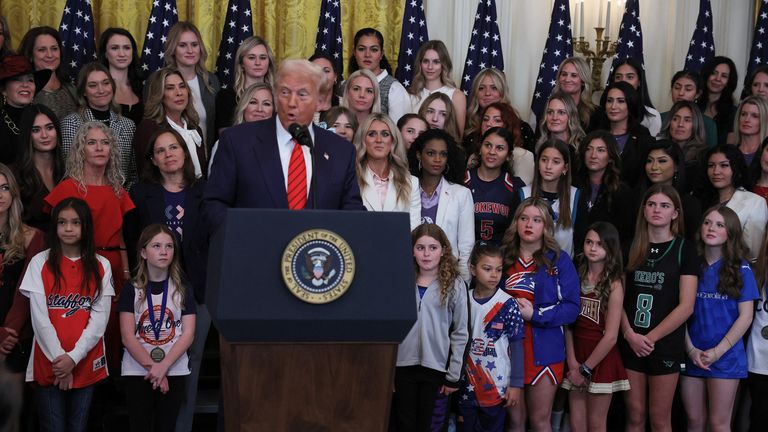
Donald Trump speaking ahead of signing the order.
Pic: Reuters/Leah Millis
The order authorises the education department to penalise schools that allow transgender athletes to compete and any school found in violation could lose its federal funding.
Despite their small numbers within America, transgender people have been the target of three orders signed by Mr Trump since coming into office, Sky News’ US partner NBC News reported.
These targeted participation in the military and access to gender-affirming care.
On his very first day in office last month, Mr Trump passed one order that called on the federal government to only recognise two genders – male and female.
During his campaign, he pledged to “keep men out of women’s sports” and get rid of the “transgender insanity” but his office offered little in the way of details.
Olivia Hunt, director of federal policy at Advocates for Trans Equality, told Sky News’ Yalda Hakim that the order wasn’t just about elite athletes but would impact young children and their development too.
She said: “We’re basically taking those children and saying to them we don’t think it’s vital that you learn the same sets of skills that your peers develop [playing sports].
“We are setting you aside, putting you apart, and saying you’re different and it’s okay for you to be set aside, treated differently, and bullied by your peers.
“Children should be protected. Children should be allowed to follow their interests, follow the sports they want to participate in and not have to worry that public officials will treat their existence as a cheap round of applause.”
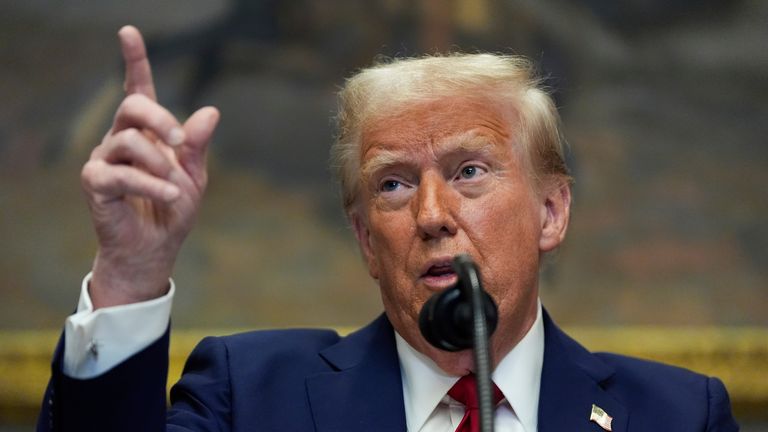
Trump’s trans sport stance welcomed
This is the latest in a flurry of executive orders the Republican president has enacted in his first days and weeks in office.
Some of these have been blocked by judges, and it is not yet clear if this order will avoid such a fate.
It will likely involve how the Trump administration interprets Title IX – a civil rights law that prevents sex-based discrimination in education programmes or activities that receive federal funding.
Ahead of the signing, White House press secretary Karoline Leavitt said the order “upholds the promise of Title IX”.
Read more:
Trump says Iran would be ‘obliterated’ if it assassinates him
Why China has not retaliated more in trade spat
What you need to know about Trump’s Gaza plan
‘A solution looking for a problem’
It is not clear how many trans athletes are competing in the US, but cases like Lia Thomas swimming for the University of Pennsylvania have drawn attention in the past.
Cheryl Cooky, a professor at Purdue University who studies the intersection of gender, sports, media and culture, described the order as a “solution looking for a problem”.
👉 Listen to Sky News Daily on your podcast app 👈
Doriane Lambelet Coleman, a professor at Duke Law School, pointed out that Mr Trump could have just “read the [existing] regulation traditionally” to achieve the same goals, instead of introducing the new executive orders.
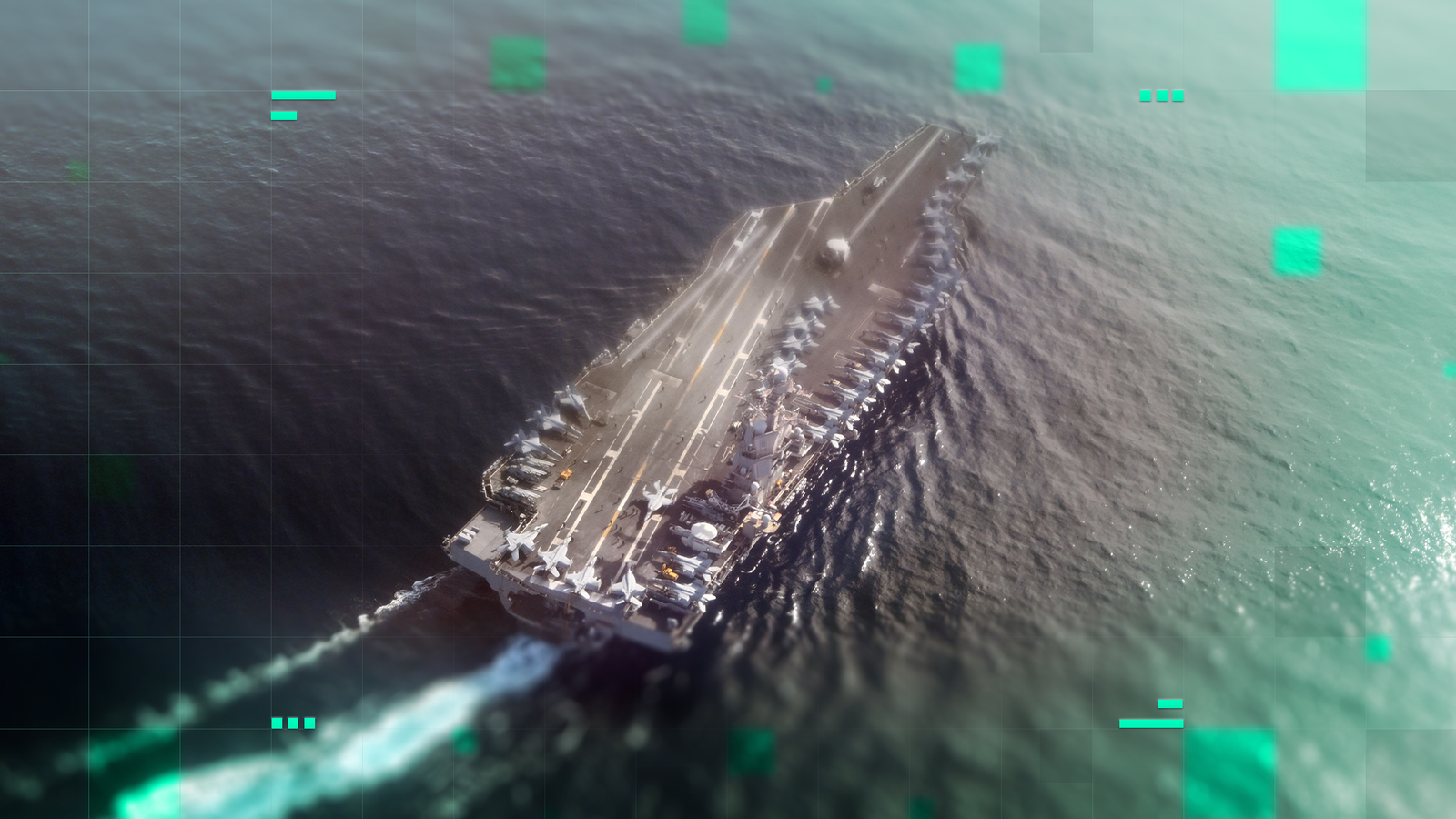
Is this what the beginning of a war looks like?
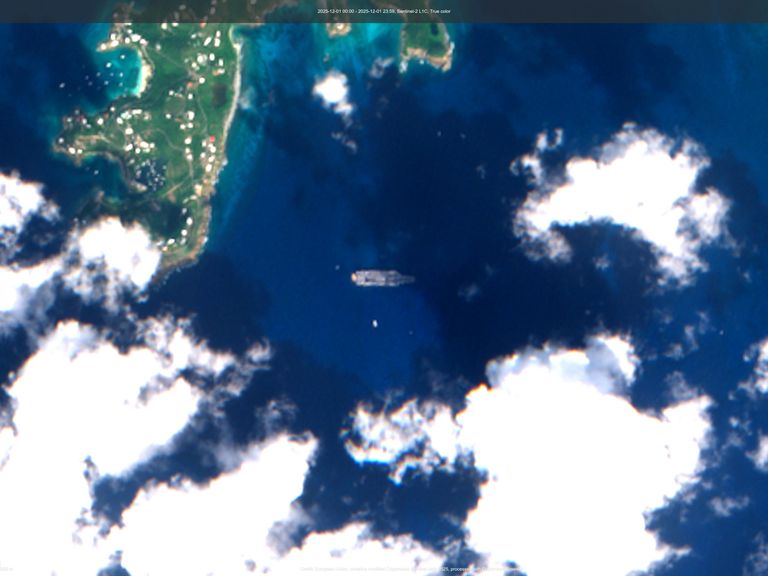
In the deep blue waters of the Caribbean, visible from space, an unremarkable grey smudge.
The USS Gerald R Ford seen off the US Virgin Islands on 1 December. Credit: Copernicus
But this is the USS Gerald R Ford: the largest, most deadly aircraft carrier in the world. And it is only part of an armada, apparently set on Venezuela.
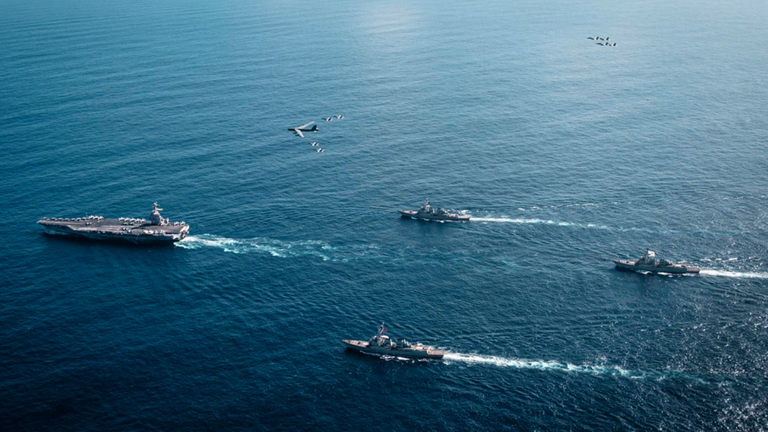
The Gerald R Ford, USS Winston S Churchill, USS Mahan and USS Bainbridge in the Atlantic on 13 November. Source: US Department of Defense
From being able to count on one hand the number of warships and boats in the Caribbean, since August we can see the build-up of the number, and variety of ships under US command.
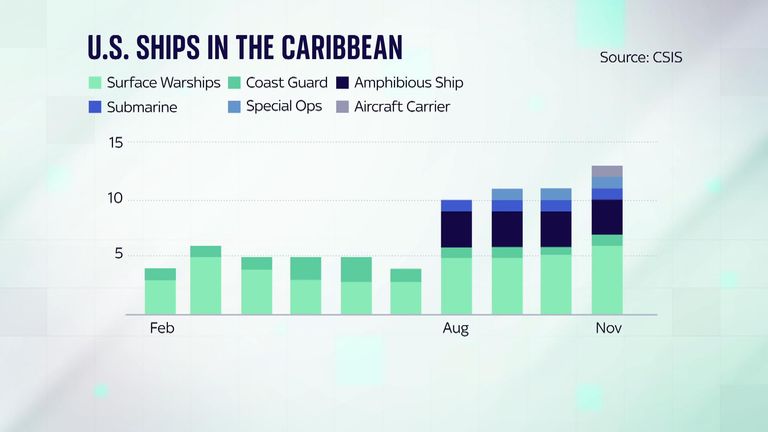
And that’s only at sea – air power has also been deployed, with bombers flying over the Caribbean, and even along the Venezuelan coast, as recently as this week.
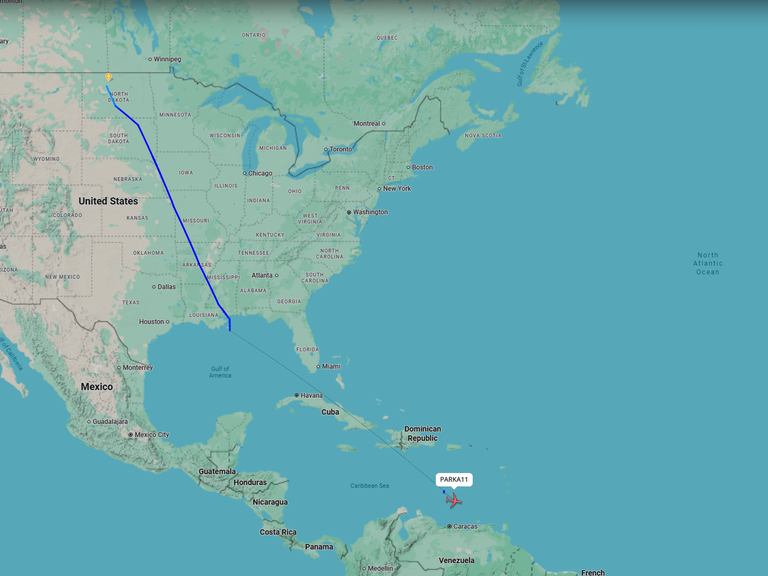
A Boeing B-52H Stratofortress near Venezuelan coast from Minot Air Force Base, North Dakota, on 3 December. Credit: FlightRadar24
Venezuela’s President Nicolas Maduro told crowds his country has endured 22 weeks of aggression from the US and Donald Trump.
Things could be about to get worse.
So let’s rewind those 22 weeks to understand how we got here…
‘Drug boat’ strike
On 2 September, the White House posted on X that it had conducted a strike against so-called “narcoterrorists” shipping fentanyl to the US, without providing direct evidence of the alleged crime.
Sky’s Data & Forensics unit has verified that in the past four months since strikes began, 23 boats have been targeted in 22 strikes, killing 87 people.
Read more: The US-Venezuela crisis explained
The latest was on 4 December, after which US Southern Command announced it had conducted another strike on an alleged drug smuggling boat in the eastern Pacific.
It was the first such strike since 15 November and since the defence secretary, sometimes referred to as secretary of war, Pete Hegseth, came under scrutiny for an alleged “second strike” in an earlier attack.
The US says it carried out the action because of drugs – and there has been some evidence to support its assertion.
The Dominican Republic said it had recovered the contents of one boat hit by a strike – a huge haul of cocaine.
Legal issues
Whatever the cargo, though, there are serious, disputed legal issues.
Firstly, it is contested whether by designating the people on the boats as narcoterrorists, it makes them lawful military targets – or whether the strikes are in fact extra judicial murders of civilians at sea.
And more specifically… well, let’s go back to that very first video, of the very first strike.
What this footage doesn’t show is what came afterwards – an alleged “second strike” that targeted people in the water posing no apparent threat.
That has created a crisis for Hegseth.
Speaking at a cabinet meeting last week, the defence secretary said he did not see that there were survivors in the water when the second strike was ordered and launched in early September, saying that “the thing was on fire”.
And the 4 December strike shows this strategy isn’t over.
The strikes are just part of the story, as warships and planes have headed toward the region in huge numbers.
Drugs or oil?
Some have said this isn’t about drugs at all, but oil.
Venezuela has lots – the world’s largest proven reserves.
Speaking to the faithful on Fox News, Republican congresswoman – and Trump supporter – Maria Salazar said access to Venezuela would be a “field day” for American oil companies.
And Maduro himself has taken up that theme. A few days later, he wrote this letter to OPEC – which represents major oil producing nations – to “address the growing and illegal threats made by the government of the United States against Venezuela”.
That’s how Maduro has framed this – a plan by the US “to seize Venezuela’s vast oil reserves… through lethal military force”.
Lethal military force – an understatement when you think of the armada lying in wait.
And it may be called upon soon. Trump on Tuesday said he’s preparing to take these strikes from international waters on to Venezuelan territory.
Maduro has complained of 22 weeks of “aggression”. There may be many more to come.
Additional reporting by Sophia Massam, junior digital investigations journalist.
The Data X Forensics team is a multi-skilled unit dedicated to providing transparent journalism from Sky News. We gather, analyse and visualise data to tell data-driven stories. We combine traditional reporting skills with advanced analysis of satellite images, social media and other open source information. Through multimedia storytelling we aim to better explain the world while also showing how our journalism is done.
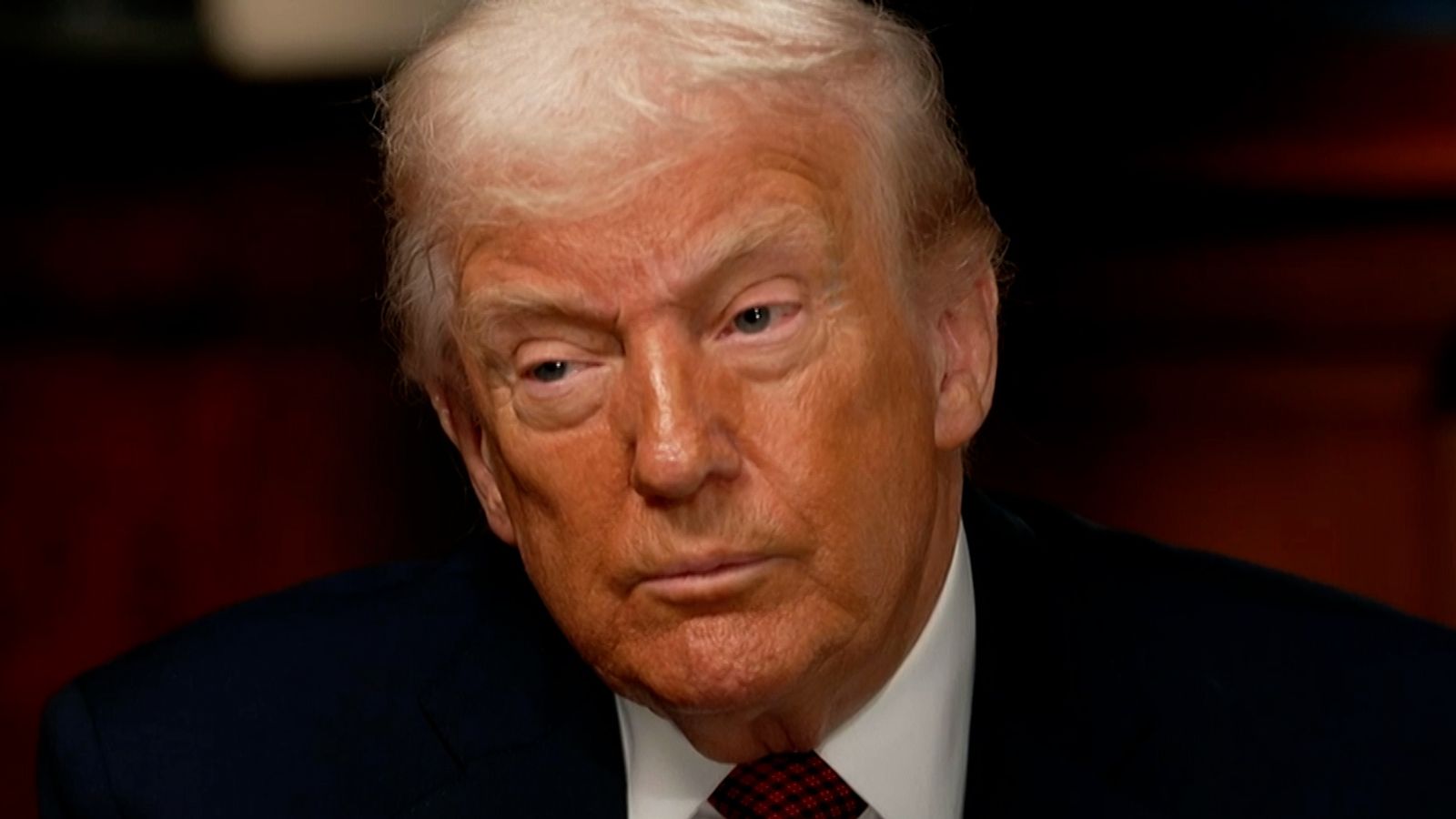
Donald Trump’s bruising assessment of Europe as “weak” and “decaying” is a bitter blow to nations already reeling from the release of his national security strategy.
At the end of the 45-minute interview with Politico, EU leaders might be forgiven for thinking, with friends like these, who needs enemies?
“Europe doesn’t know what to do,” Trump said, “They want to be politically correct, and it makes them weak.”
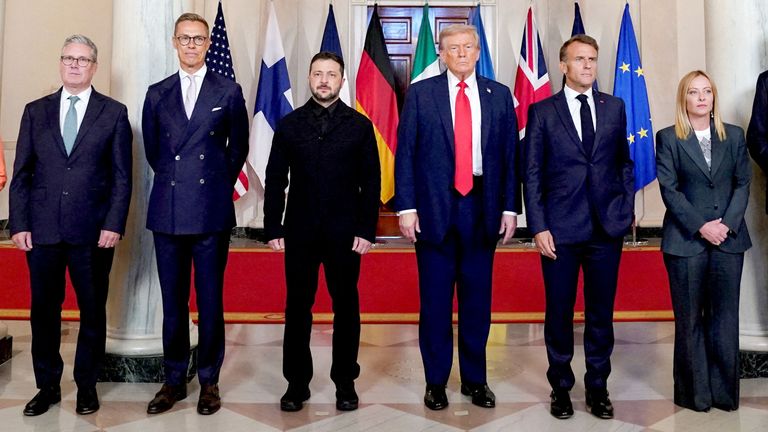
Trump meets leaders from Ukraine, Germany, France, the UK, Italy, and Finland, as well as the EU and NATO, in August Pic: Reuters
On the contrary, I would imagine some choice words were being uttered in European capitals as they waded through the string of insults.
First up, the US president criticised European leaders for failing to end the war between Russia and Ukraine.
“They talk but they don’t produce. And the war just keeps going on and on,” he said.
The fact that the Russians have shown no real commitment to stopping the invasion they started is not mentioned.
EU Flags at the European Commission Building. Pic: iStock
Instead, the blame is laid squarely at the feet of Ukraine and its allies in Europe.
“I think if I weren’t president, we would have had World War III,” Trump suggested, while concluding that Moscow is in the stronger position.
Critics claim that the White House has emboldened the Kremlin and brought Putin in from the cold with a summit and photo opportunities.
Trump highlights the fact that his return to office forced many European NATO members to increase defence spending drastically.
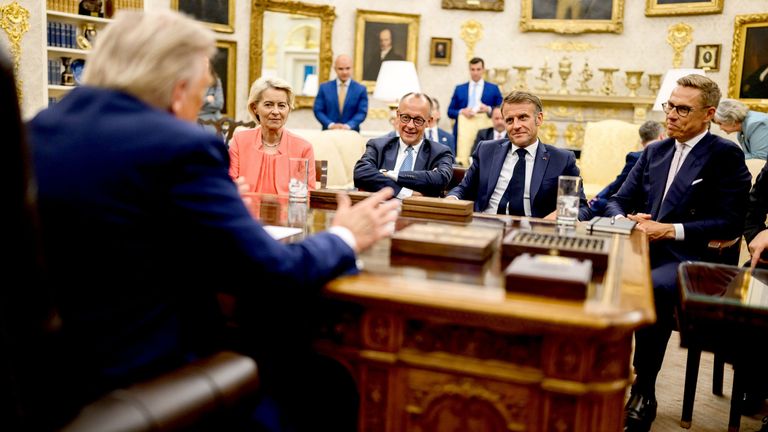
Trump meeting European leaders in the Oval Office in August. Pic: @RapidResponse47
On this, he is correct – the growing insecurity around how long America can be relied on has brought security into sharp focus.
The release of the new US national security strategy has only added to the feelings of unease.
German Chancellor Friedrich Merz on Tuesday claimed some of its contents were unacceptable from a European point of view.
“I see no need for America to want to save democracy in Europe. If it was necessary to save it, we would manage it on our own,” he told a news conference in Rhineland-Palatinate, the German state where Trump’s paternal grandfather was born.
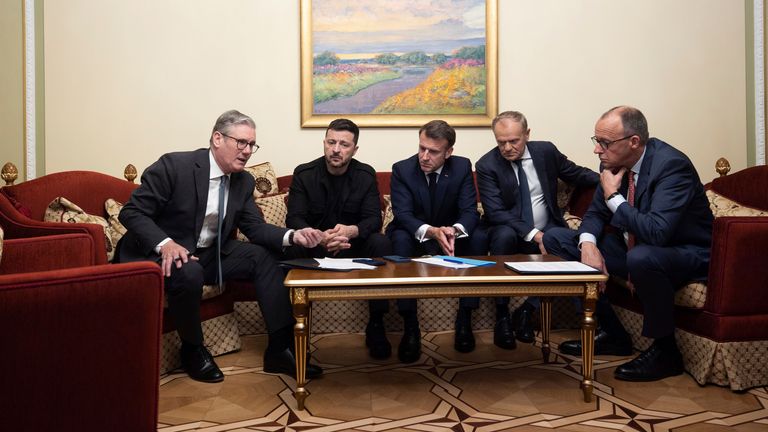
Meeting between, left to right, Keir Starmer of the UK, Volodymyr Zelenskyy of Ukraine, Emmanuel Macron of France, Donald Tusk of Poland, and Friedrich Merz of Germany. Pic: AP
The leader of the EU’s biggest power also said that the new US strategy was not a surprise and largely chimed with the vice president’s speech at the Munich Security Conference in February.
For this reason, Merz reiterated that Europe and Germany must become more independent from America for their security policies.
However, he noted, “I say in my discussions with the Americans, ‘America first’ is fine, but America alone cannot be in your interests.”
For his part, while Trump said he liked most of Europe’s current leaders, he warned they were “destroying” their countries with their migration policies.
He said: “Europe is a different place, and if it keeps going the way it’s going, Europe will not be…in my opinion, many of those countries will not be viable countries any longer. Their immigration policy is a disaster”.
He added: “Most European nations… they’re decaying.”
Read more:
Analysis: Putin preparing for more war, not less
White House: Europe ‘unrecognisable in 20 years or less’
Again, the comments echoed his security strategy, which warned immigration risked “civilisation erasure” in Europe.
There’s no doubt immigration is a major concern for many of the continent’s leaders and voters.
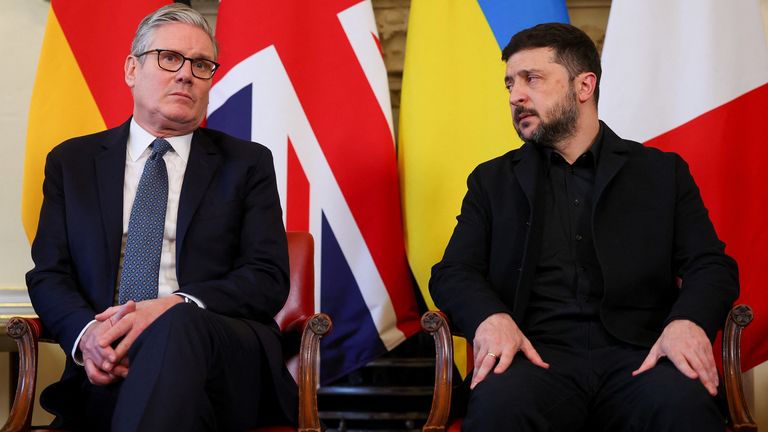
Zelenskyy meets European leaders
However, irregular crossings into the EU fell 22% in the first 10 months of 2025 according to Frontex, a fact which seems to have passed the president and his team by.
“Within a few decades at the latest, certain Nato members will become majority non-European”, his security document warned.
It also suggested “cultivating resistance” in Europe “to restore former greatness” leading to speculation about how America might intervene in European politics.
Trump appeared to add further clarification on Tuesday, saying while he did not “want to run Europe”, he would consider “endorsing” his preferred candidates in future elections.
👉 Tap to follow Trump100 wherever you get your podcasts👈
This comment will also ruffle feathers on the continent where the European Council President has already warned Trump’s administration against interfering in Europe’s affairs.
“Allies do not threaten to interfere in the domestic political choices of their allies,” Antonio Costa said on Monday.
“The US cannot replace Europe in what its vision is of free expression… Europe must be sovereign.”
So, what will happen now, and how will Europe’s leaders respond?
If you are hoping for a showdown, you will likely be disappointed.
Like him or loathe him, Europe’s leaders need Trump.
They need the might of America and want to try to secure continued support for Ukraine.
While the next few days will be filled with politely scripted statements or rejections of the president’s comments, most of his allies know on this occasion they are probably best to grin and bear it.
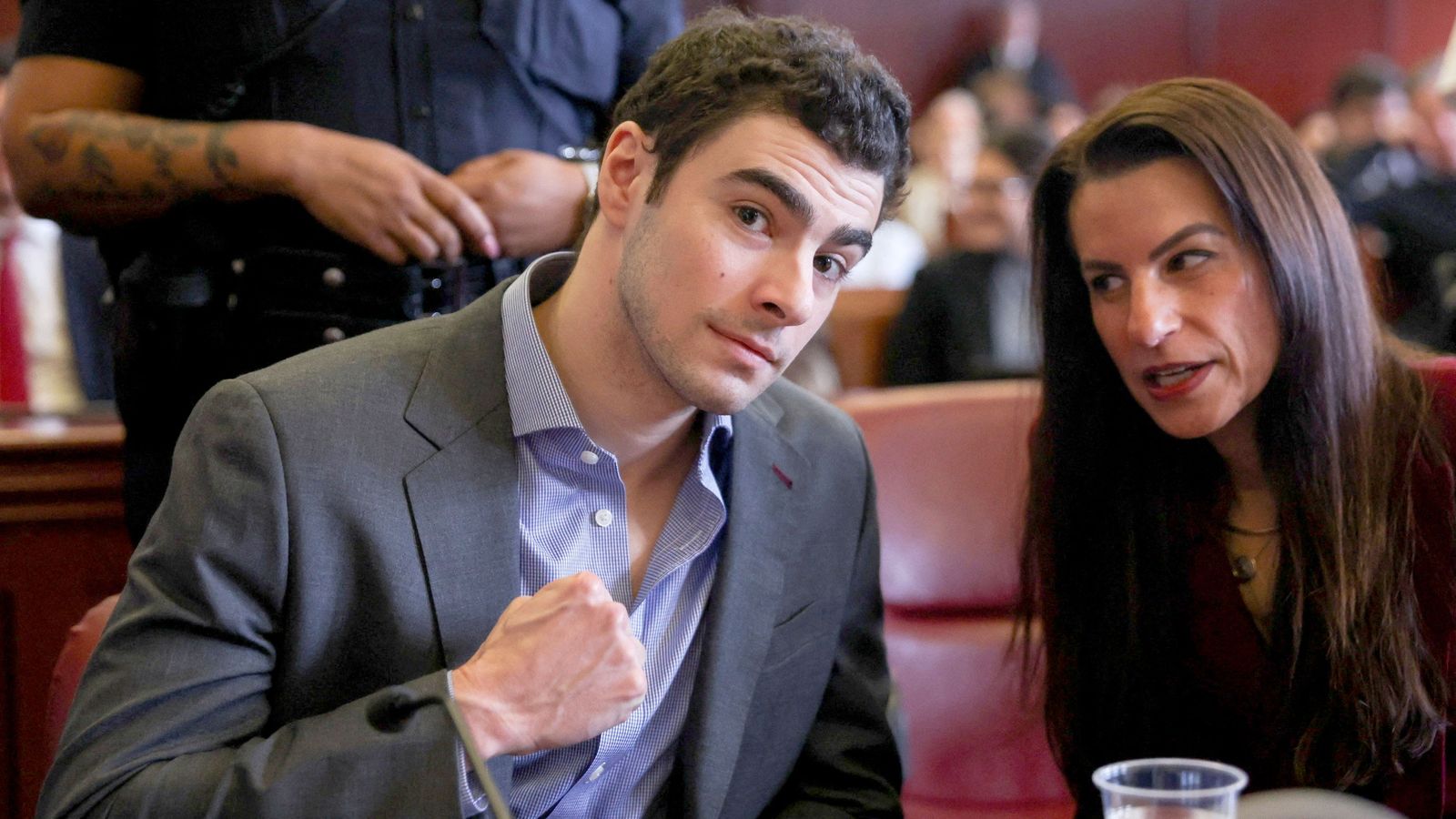
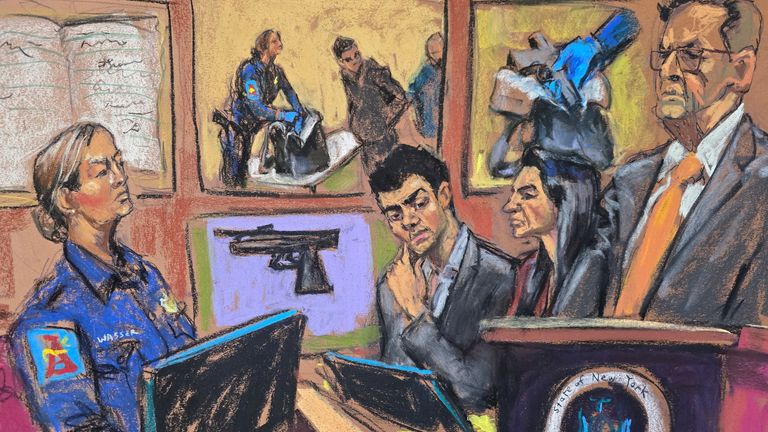
Police officers found a handgun, a silencer and a red notebook described as a “manifesto” when they arrested Luigi Mangione.
The 27-year-old was arrested in December 2024 and charged with killing UnitedHealthcare chief executive Brian Thompson in New York City.
Mangione‘s lawyers want to block prosecutors from showing or telling jurors at his eventual trial in Manhattan about statements he allegedly made and items they said police seized from his backpack during his arrest at a McDonald’s in Pennsylvania.
The objects include a 9mm handgun prosecutors say matches the one used in the killing, a silencer, a magazine with bullets wrapped in underwear and a notebook in which they say Mangione described his intent to “wack” a healthcare executive.
Mangione with his attorney. Pic: Reuters
The defence contends the items should be excluded because police did not get a warrant before searching Mangione’s backpack.
Prosecutors deny claims Mangione was illegally searched and questioned.
They also want to suppress some statements he made to police, such as allegedly giving a false name, because officers asked him questions before telling him he had a right to remain silent.
Last week, Mangione watched surveillance videos of the killing of Mr Thompson, 50, as he walked to a New York City hotel for his company’s annual investor conference.
Mangione has pleaded not guilty to state and federal murder charges.
The state charges carry the possibility of life in prison, while federal prosecutors are seeking the death penalty.
This week’s hearing concerns only the state case, but Mangione’s lawyers want to bar evidence from both cases.
Read more:
The reality of Trump’s trade war
Paramount launches hostile takeover bid for Warner Bros
In September, a judge dismissed two terrorism counts against Mangione, finding prosecutors had not presented enough evidence Mangione intended to intimidate health insurance workers or influence government policy.
Trial dates are yet to be set in either the state or federal cases.
-
 Sports2 years ago
Story injured on diving stop, exits Red Sox game
-
 Sports3 years ago
‘Storybook stuff’: Inside the night Bryce Harper sent the Phillies to the World Series
-
 Sports2 years ago
Game 1 of WS least-watched in recorded history
-
 Sports3 years ago
Button battles heat exhaustion in NASCAR debut
-
 Sports3 years ago
MLB Rank 2023: Ranking baseball’s top 100 players
-
Sports4 years ago
Team Europe easily wins 4th straight Laver Cup
-
 Environment3 years ago
Japan and South Korea have a lot at stake in a free and open South China Sea
-
 Environment1 year ago
Here are the best electric bikes you can buy at every price level in October 2024