
Most areas set to increase council tax by at least 4.99% from April

Most councils are set to increase council tax by the maximum amount of at least 4.99% from April.
Government figures released on Wednesday show 85% of the 139 top-tier authorities in England that have proposed or confirmed rises so far are planning to do so by 4.99%.
If local authorities want to raise council tax by 5% or more, they have to carry out a local referendum, under normal circumstances.
Politics latest: Trump wants to ‘shock’ European into action with false Ukraine claims, Boris Johnson says
However, six councils in severe financial trouble have been granted permission to increase council tax beyond this level without a vote.
When they are included in the figures, the proportion of local authorities increasing council tax above 4.99% rises to nearly 90% of councils.
A total of 17 councils wanting to increase council tax by 4.99% or more have confirmed their intentions, 122 are awaiting approval and 14 are yet to declare their intentions, analysis by the PA news agency shows.
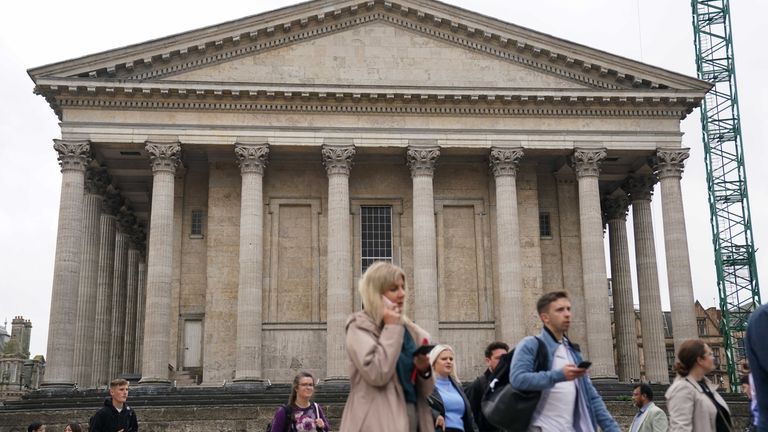
Birmingham is one of six councils that have been allowed to raise their council tax by more than 4.99% without a referendum. Pic: PA
Councils are facing rising costs, especially in areas where they legally have to provide services such as social care, education, housing and waste services.
As they face more pressure to pay for those services, it is unlikely the council tax rises proposed by senior councillors will be rejected by full council ahead of budgets having to be set by the end of February, or March for some.
Some councils are planning increases below 4.99% – but only 15.
For example, Barnet, north London and Warrington in Cheshire are planning 4.98% increases, while Wandsworth in south London is only planning a 2% rise.
Just seven councils are planning to increase council tax by 4% or less.
They are: Kensington and Chelsea (4%), Doncaster (3.99%), North East Lincolnshire (3.98%), Essex (3.75%), Rotherham (3%), Lincolnshire (2.99%) and Wandsworth (2%).
Read more:
Council tax to rise to pay for police funding increase
Councils to receive £1bn boost to tackle homelessness

Social care cuts in the UK
The six councils granted permission to increase council tax by more than 4.99% are:
Bradford 9.9%
Birmingham 7.49%
Newham, London 8.99%
Somerset 7.5%
Trafford, Greater Manchester 7.49%
Windsor and Maidenhead 8.99%
The Resolution Foundation said the poorest fifth of households across the UK paid 4.8% of their income on council tax in 2020-21, up from 2.9% in 2002-3.
The thinktank identified this share of income was three times more than the 1.5% spent by the richest fifth.


Binance, the world’s largest cryptocurrency exchange by trading volume, is considering a strategic reshuffling to strengthen its presence in the US market, a move that could see Binance co-founder Changpeng “CZ” Zhao’s majority stake in the company reduced.
Zhao’s controlling stake in Binance has been a “major hurdle” to the company expanding to strategically critical US states, according to Bloomberg, citing people familiar with the matter. Although no concrete plans have been announced, the conversation surrounding any potential action remains reportedly “fluid.”
The company is also considering partnerships with US-based companies, including asset manager BlackRock and decentralized finance (DeFi) platform World Liberty Financial (WLFI), which is linked to US President Donald Trump, to strengthen its footprint in the country.
Rumors of Binance’s return to the US began to circulate in October after Trump pardoned Zhao, fueled by speculation from crypto industry executives and comments that Zhao made on social media.
“Will do everything we can to help make America the capital of crypto and advance Web3 worldwide,” Zhao said in October after the pardon.
In June 2019, Binance announced that it would stop serving US customers, and a separate company, called Binance.US and operated by BAM Trading Services, was formed to provide regulatory-compliant services to US users.
In 2023, the US Securities and Exchange Commission alleged that Binance Holdings Ltd. operated both Binance.com and BAM Trading Services.
Binance.US does not feature crypto derivatives or access to the global Binance exchange’s liquidity and operates as a completely separate crypto exchange.
Cointelegraph reached out to Binance and Binance.US but did not receive a response by the time of publication.
The US is considered a key market for crypto exchanges and is ranked as the number two for global crypto adoption, according to Chainalysis’ 2025 Global Crypto Adoption Index. Expanding to the US would open up US liquidity to the world’s largest crypto exchange.

Related: Binance names co-founder Yi He co-CEO alongside Richard Teng
Several US lawmakers voice opposition to the CZ pardon and the crypto industry
Trump’s pardon of Zhao in October drew backlash from several Democratic Party lawmakers in the US, including Massachusetts Senator Elizabeth Warren and California Congresswoman Maxine Waters.
Waters said the pardon was a form of pay-to-play and accused Trump of doing political favors for the crypto industry that “helped line his pockets.”
Warren, who is one of the most vocal critics of the crypto industry, also criticized the pardon, characterizing it as “corruption.”
The comments reflect pockets of resistance among some Democratic lawmakers to the crypto industry’s continued expansion in the US and could signal potential opposition to Binance returning to the US.
Magazine: Unstablecoins: Depegging, bank runs and other risks loom



KuCoin announced an exclusive multiyear deal with Tomorrowland Winter and Tomorrowland Belgium from 2026 to 2028, making the exchange the music festival’s exclusive crypto and payments partner.
The move comes just weeks after KuCoin secured a Markets in Crypto-Assets Regulation (MiCA) service provider license in the European Union.
KuCoin’s MiCA play goes mass‑market
KuCoin EU Exchange recently obtained a crypto asset service provider license in Austria under the EU’s MiCA regime, giving it a fully regulated foothold in the bloc as Brussels’ new rulebook for exchanges, custody and stablecoins comes into force.
The Tomorrowland deal signals how KuCoin plans to use that status, not just to run a compliant trading venue, but to plug crypto rails directly into mainstream culture.
KuCoin said the Tomorrowland deal will cover Tomorrowland Winter 2026 in Alpe d’Huez, France, and Tomorrowland Belgium 2026 in Boom, Belgium, with the same arrangement continuing through 2028.
Related: Burning Man-inspired festival in Bali goes full Web3: Here’s how
From sponsorship to payment rails
KuCoin insists this is not just a logo play. A spokesperson at KuCoin told Cointelegraph that as an exclusive payments partner, the exchange is working with Tomorrowland to weave crypto into the festival’s existing payments stack so that “financial tools” sit behind the scenes of ticketing, merch and food and drink.
The stated goal is to keep the rails “intuitive and invisible,” rather than forcing festivalgoers through clunky wallets or unfamiliar flows, with KuCoin positioning itself as facilitating the secure and efficient movement of value while fans focus on the music.
The company declined to spell out exactly which assets and rails will be supported on‑site, or whether every purchase will run natively onchain, but said that KuCoin’s “Trust First. Trade Next.” mantra runs through its messaging.
The spokesperson stressed advanced security, multi‑layer protection and adherence to EU standards as the foundation for taking crypto beyond the trading screen and into live events.
Related: What is Markets in Crypto-Assets (MiCA)?
Learning from FTX’s Tomorrowland flop
Tomorrowland’s organizers have been here before. In 2022, the festival announced a Web3 partnership with FTX Europe that promised NFTs and “the future of music festivals” before collapsing along with the exchange itself months later.
That experience makes the choice of a MiCA‑licensed partner, and the emphasis on user protection, more than cosmetic; it is a second attempt at bridging culture and crypto (this time with regulatory scaffolding and clearer guardrails).
Rather than setting public hard targets for user numbers or payment volumes by 2028, KuCoin is pitching success as “seamless integration” of crypto into the festival experience:
“We aim to demonstrate that digital assets can be a core component of global digital finance, moving from a niche technology to a mainstream utility. “
Related: Spain’s regulator sets out MiCA transition rules for crypto platforms
-
 Sports2 years ago
Story injured on diving stop, exits Red Sox game
-
 Sports3 years ago
‘Storybook stuff’: Inside the night Bryce Harper sent the Phillies to the World Series
-
 Sports2 years ago
Game 1 of WS least-watched in recorded history
-
 Sports3 years ago
Button battles heat exhaustion in NASCAR debut
-
 Sports3 years ago
MLB Rank 2023: Ranking baseball’s top 100 players
-
Sports4 years ago
Team Europe easily wins 4th straight Laver Cup
-
 Environment3 years ago
Japan and South Korea have a lot at stake in a free and open South China Sea
-
 Environment1 year ago
Here are the best electric bikes you can buy at every price level in October 2024