

Lectric XP 3.0 long-range e-bikes get $563 bundle at new $1,139 low, Anker SOLIX EverFrost 2 cooler $809, GE smoker, Jackery, more

Closing out this week’s Green Deals, we have a notable changeup in Lectric’s ongoing Presidents’ Day sale, with the XP 3.0 Long-Range e-bikes getting a price cut to a new $1,139 low along with the $563 in free gear too. We also have secured our readers an early-bird pre-sale offer on Anker’s new 58L SOLIX EverFrost 2 Electric Cooler with free gear at $809. Next, we spotted GE’s Smart Indoor Smoker dropping to a new $499 low while Jackery’s Explorer 2000 v2 Portable Power Station is keeping to its $999 rate despite its recent Tax Season sale ending. Plus, all the other hangover Green Deals are in the links at the bottom of the page, like yesterday’s new low price on Tenways’ 8-speed CGO600 Pro e-bike, the 4-day EcoFlow flash sale, and more.
Head below for other New Green Deals we’ve found today and, of course, Electrek’s best EV buying and leasing deals. Also, check out the new Electrek Tesla Shop for the best deals on Tesla accessories.
Lectric cuts prices on XP 3.0 long-range e-bikes to new $1,139 low along with $563 in free gear
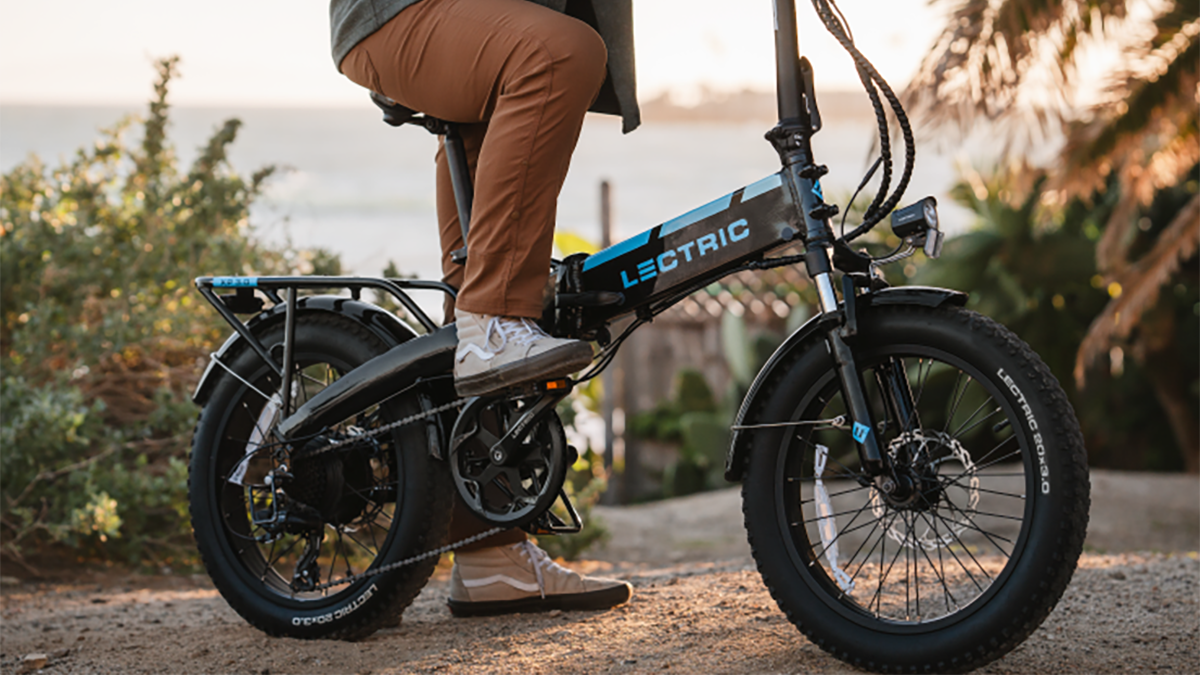
As its Presidents’ Day sale continues through March 1, Lectric has made a slight change to things by cutting the price on its XP 3.0 Long-Range e-bikes to $1,139 shipped along with the $563 in free bundled gear. All-in-all, this package would normally cost you $1,762, with this being up towards the higher end of bundle sizes we’ve seen. The additional $60 being cut off the bike’s price is also a nice surprise, dropping things to a new all-time low price. Along with your e-bike, you’ll be getting a wider saddle, a suspension seat post, steel-encased front and rear baskets, an Elite headlight, an accordion-style bike lock, a 40L storage bag, and a cargo net.
The top-selling e-bike in America, Lectric’s XP 3.0 Long-Range e-bikes, can be seen all over the place here in NYC, which makes sense given its affordable capabilities. The 500W motor (1,000W peak) comes paired with a 48V battery and is supported by both PAS and the brand’s PWR Programming, providing up to 65 miles of travel on one charge at top speeds of 20 to 28 MPH, depending on local laws. Of course, there is a throttle here if you want to go all-electric, just keep in mind that the travel range will get cut down around 30 miles.
Alongside all the listed free gear you’ll be getting, there’s a bunch of solid stock features too, like the integrated rear cargo rack (which the basket connects to), puncture-resistant tires, 180mm hydraulic disc brakes, a foldable body, an LCD display, and more. You’ll have three color options that tie in with the frame designs: the black step-over model, a black step-thru model, and a white step-thru model.
Be sure to check out the full lineup of Lectric’s Presidents’ Day sale here while the $654 savings are lasting, including the largest package we see accompany the new XPeak 2.0 Off-Road e-bikes. There’s also an ongoing clearance sale on the predecessor XPeak 1.0 Off-Road e-bike that comes with $727 in free gear (including an extra battery).

Save $350 before anyone else on Anker’s new 58L SOLIX EverFrost 2 Cooler at $809 (Reg. $1,099) + FREE gear
We have secured 9to5 readers an early savings pre-sale offer at Wellbots on the new 58L Anker SOLIX EverFrost 2 Electric Cooler for $809 shipped. This all-new model is hitting the market today carrying a $1,099 price tag, with shipping not slated to begin until next month. This deal ensures you’ll be getting the latest piece of portable smart coolers while putting $290 back in your pocket. What’s more, you’ll also be getting free Road Trip accessories along with the cooler, including a cup holder, a knife holder, and a fishing rod holder that seems to attach to the body of the device ($60 value).
This new SOLIX EverFrost 2 cooler from Anker is the largest among the three (with the others being 23L and 40L models) and the only one to sport two independent compartments – one for refrigeration, the other for freezing, with everything monitored and controlled through the companion app. Whereas the first generation coolers used direct cooling systems, this model has been upgraded to utilize air-cooled refrigeration, improving temperature uniformity with no more need for manual defrosting while also making the speed by which it cools all the faster – 18 minutes in its eco/smart mode and 15 minutes in max mode.
Another standout feature about this model’s design is that it is the only one with the capability to hold and run off two 288Wh batteries at once, providing up to a 39-hour continuous runtime for the single-battery configuration in eco mode and up to a 78-hour runtime for dual batteries. And don’t think these battery’s usage is limited to the cooler, as they can be disconnected and repurposed as power banks, each delivering a 60W USB-C and a 12W USB-A ports to top off your devices and personal gadgets.
To recharge the batteries, you’ll have four options to choose from: connect its 100W maximum solar input to harness the sun’s rays, or plug it into either a standard wall outlet, USB-C connection, or a 12V car port. All the models in this series carry an IPX3 water-resistance rating, cause let’s face it, these will likely be great companions to the beach, lake, or other swimming hole come summertime. Following in the footsteps – or should I say tracks – of its predecessors, it also sports a body with wheels, albeit larger 6-inch ones that better roll over semi-rough terrain, as well as a fold-down tray that doubles as a handle to pull it along wherever you end up.
GE’s smart indoor smoker lets you enjoy BBQ without setting off alarms at new $499 low
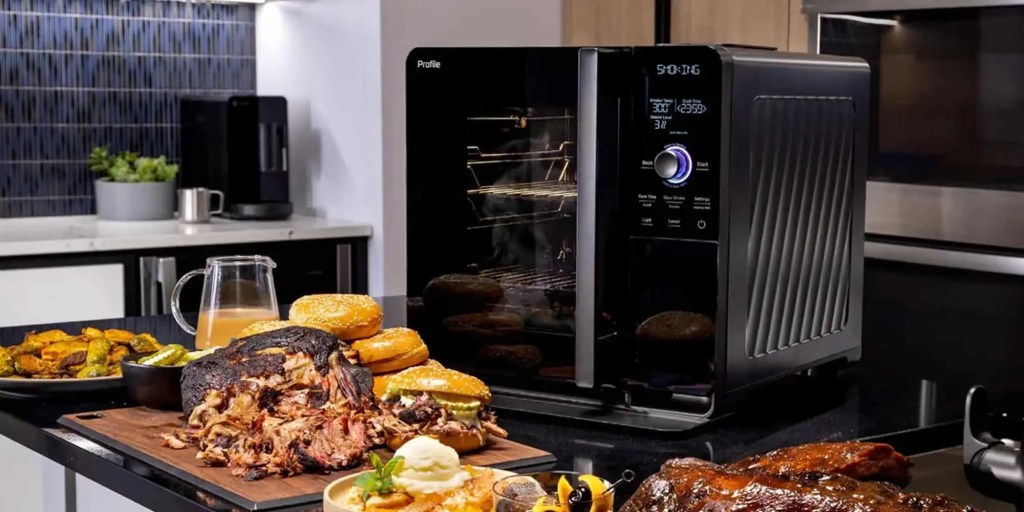
Amazon is currently cutting the price in half on the GE Profile Smart Indoor Smoker that is now down at $499 shipped. This model released at the top of last year carrying a $999 price tag, with most of the discounts we’ve seen in the time since keeping things above $700, though we did see it drop as low as $599 during Black Friday and Christmas sales and one single period of it down at $550 in July. You can upgrade your kitchen today with a larger-than-ever 50% markdown, which saves you $500 at a new all-time low price.
This smart countertop alternative has been a popular option among my friends – especially once the Texan-born member of our circle grabbed one for his Coney Island apartment, making up for the fact that he had no outdoor space for a traditional smoker. You don’t have to worry about setting off smoke alarms here thanks to the Active Smoke Filtration system that converts wood smoke into warm air, channeling it through the main chamber and into your favorite foods. There are two heat sources – one for burning wood pellets, the other for actual cooking – as well as six preset options for brisket, pork ribs, pork butt, chicken wings, chicken breast, and salmon, so don’t worry about having professional pit master skills.
Speaking just on its smoking capabilities, it has five adjustable controls ranging from infusing mild hints of flavor all the way to full-on rich and robust smoky satisfaction that can be tasted through your sense of smell alone. With the SmartHQ app, you’ll have total remote smart controls so you can manage longer-timed cooking periods, even when you’re away from home, with it even allowing for hands-free voice controls via Alexa or Google Assistant.
You can still grab Jackery’s Explorer 2000 v2 LiFePO4 power station for your backup needs at $999
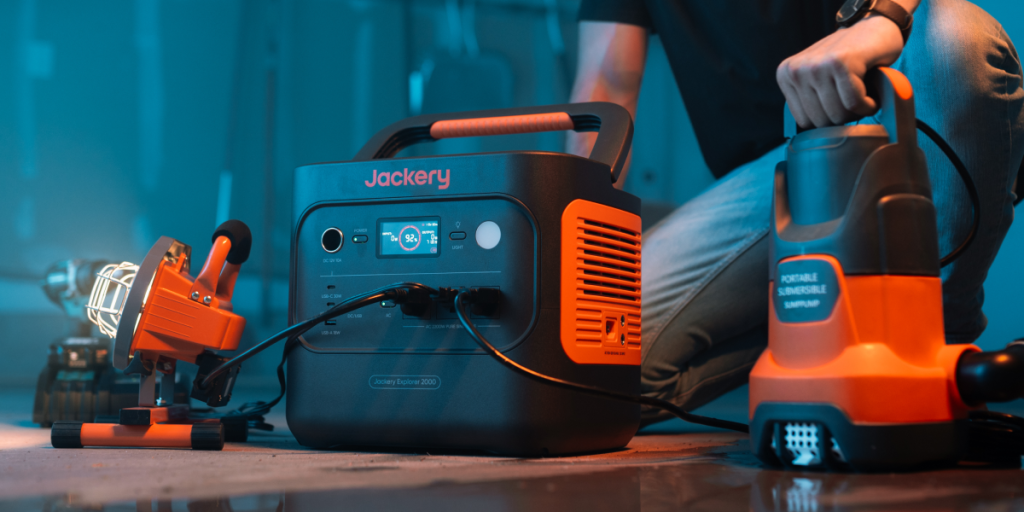
Jackery’s official Amazon storefront is offering its Explorer 2000 v2 Portable Power Station for $999 shipped. Normally costing you $1,499 at full price, if you missed out on the brand’s recent Tax Season sale, this is your chance to score it at the same rate we saw there. It’s only fallen lower during Black Friday and Cyber Monday when things hit $899, though we haven’t seen those same rates reappear since. Today’s deal gives you the second-lowest price we have tracked, giving you one of the brand’s latest releases while saving $500 in the process. You can even find it matching in price direct from Jackery’s website right now too.
Whether you’re planning to use it for outdoor work, DIY jobs, covering camping sites, or just want a reliable means to keep essentials running during emergencies and blackouts, Jackery’s Explorer 2000 v2 tackles it all with a 2,042Wh LiFePO4 battery and a 2,200W output through its seven ports (peaking to 4,400W). Thanks to Jackery’s honeycomb design paired alongside exclusive CBT tech, it comes in a much smaller and lighter form factor than you may expect, complete with 62 different forms of charging protections and a silent mode for when you plug it in while you sleep.
You’ll be able to get it back to an 80% battery capacity in around 66+ minutes when plugging it into a wall outlet, though if you’re rushing to meet last-minute plans, the supercharge feature gives you a full battery in 102+ minutes. You can even plug it into your car’s auxiliary port for a 24-hour charge, or invest in solar panels to utilize the sun’s rays to refill the battery. On that note, there’s the option to grab the power station with two 200W solar panels for $1,599, down from $2,499.
If you want a similarly updated new model but want it in a smaller package, the brand’s Explorer 1000 v2 Portable Power Station is down at $495.38 shipped right now too, after clipping the on-page 38% off coupon. It comes with the same array of protections, a 1,070Wh LiFePO4 capacity, and a 1,500W output (peaking to 3,000W). Like the above model, there are seven ports to utilize, plus a similar emergency charging feature that gets it to full via a wall outlet in just one hour.
Best New Year EV deals!
- Rad Power RadWagon 5 Cargo e-bike with 50% off four accessories (new): $2,399
- Lectric ONE Long-Range e-bike with $467 bundle: $2,399 (Reg. $2,507)
- Rad Power Radster Road Commuter e-bike with 50% off four accessories (new): $2,199
- Rad Power Radster Trail Off-Road e-bike with 50% off four accessories (new): $2,199
- Lectric XPedition 2.0 35Ah Cargo e-bike w/ $654 bundle (new): $1,999 (Reg. $2,741)
- Rad Power RadExpand 5 Plus Folding e-bike with 50% off four accessories (new): $1,899
- Lectric XPedition 2.0 26Ah Cargo e-bike w/ $505 bundle: $1,699 (Reg. $2,292)
- Lectric XPeak 2.0 Long-Range Off-Road e-bike w/ $562 bundle: $1,699 (Reg. $2,261)
- Rad Power RadRunner 3 Plus Utility e-bike (new low price): $1,699 (Reg. $2,199)
- Blix Packa Genie Cargo e-bike with $148 in free gear: $1,599 (Reg. $2,099)
- Aventon Pace 500.3 Step-Over e-bike with free extra battery: $1,599 (Reg. $1,799)
- Aventon Pace 500.3 Step-Through e-bike with free extra battery: $1,599 (Reg. $1,799)
- Heybike ALPHA All-Terrain e-bike (new model preorder): $1,599 (Reg. $1,699)
- Tenways CGO600 Pro belt-drive e-bike with $118 bundle: $1,499 (Reg. $1,899)
- Rad Power RadWagon 4 Cargo e-bike: $1,499 (Reg. $1,799)
- Lectric XPeak 2.0 Standard Off-Road e-bike with $316 bundle: $1,399 (Reg. $1,715)
- Lectric XPeak 1.0 Step-Thru e-bike with $727 bundle (extra battery): $1,399 (Reg. $2,126)
- Lectric XPedition 2.0 13Ah Cargo e-bike with $326 bundle: $1,399 (Reg. $1,813)
- RadRover 6 Plus Fat Tire e-bike: $1,399 (Reg. $1,599)
- Tenways CGO600 Pro chain-drive e-bike with $118 bundle (new low price): $1,299 (Reg. $1,899)
- Rad Power RadRunner Plus Utility e-bike (new low price): $1,299 (Reg. $1,799)
- Rad Power RadExpand 5 Folding e-bike: $1,299 (Reg. $1,599)
- Velotric T1 ST Plus e-bike: $1,299 (Reg. $1,549)
- Velotric 2024 Discover 1 Plus Commuter e-bike: $1,199 (Reg. $1,599)
- Lectric XP 3.0 Long-Range e-bikes with $563 bundle: $1,199 (Reg. $1,386)
- Heybike Hauler Cargo e-bike with large rear basket: $1,199 (Reg. $1,499)
- Heybike Ranger S Folding e-bike with $208 in free gear: $1,099 (Reg. $1,499)
- Rad Power RadRunner 2 Utility e-bike (new low price): $999 (Reg. $1,499)
- Aventon Soltera.2 Urban Commuter e-bike: $999 (Reg. $1,199)
- Lectric XP 3.0 Standard e-bikes with $277 bundle: $999 (Reg. $1,276)

Best new Green Deals landing this week
The savings this week are also continuing to a collection of other markdowns. To the same tune as the offers above, these all help you take a more energy-conscious approach to your routine. Winter means you can lock in even better off-season price cuts on electric tools for the lawn while saving on EVs and tons of other gear.
- Rad Power now delivering up to $500 off e-bikes with several new all-time lows starting from $999
- Lectric’s Presidents’ Day sale offers largest bundle yet on new XPeak 2.0 long-range e-bikes ($562 in free gear) at $1,699
- Tenways flash sale drops Shimano 8-speed CGO600 Pro e-bike to new $1,299 low (Reg. $1,899)
- Heybike drops its Hauler Cargo e-bike with 440-pound payload and 55 to 85-mile range to new $1,199 low (Reg. $1,499)
- EcoFlow 4-day flash sale drops expandable DELTA Pro Ultra 6.1kWh LiFePO4 power station to $4,799 (Reg. $,6098)
- Aiper’s upgraded Surfer S2 solar pool skimmer drops to new $320 low at Amazon (Reg. $540)
- Cultivate greenery with intelligence by installing meross’ new Wi-Fi smart water hose timer at $66 (Reg. $100, First discount)
- NIU takes 40% off KQi e-scooter series with the 25-mile KQi2 Pro down at $450 (Reg. $649)
- Amazon cuts up to 22% off EGO Power+ 56V cordless single and double stage snow blowers starting from $549
- Keep edges sharp and straight with Greenworks’ 60V 16-inch cordless string trimmer at $160 (Reg. $200), more from $127
- Score Anker’s SOLIX C1000 1,056Wh LiFePO4 power station for your spring trips at $479 (Reg. $999), more
- Aventon’s urban-friendly Soltera.2 commuter e-bike gives you reliable commuting support at just $999 (Reg. $1,199)
- Travel 12 miles on the budget-friendly GoTrax APEX XL e-scooter down at $244 (Reg. $350)
- Electrified Weekly – Rad’s RadRunner Plus e-bike at new $1,499 low, Valentine’s sale lows from EcoFlow, Bluetti, Jackery, more
FTC: We use income earning auto affiliate links. More.

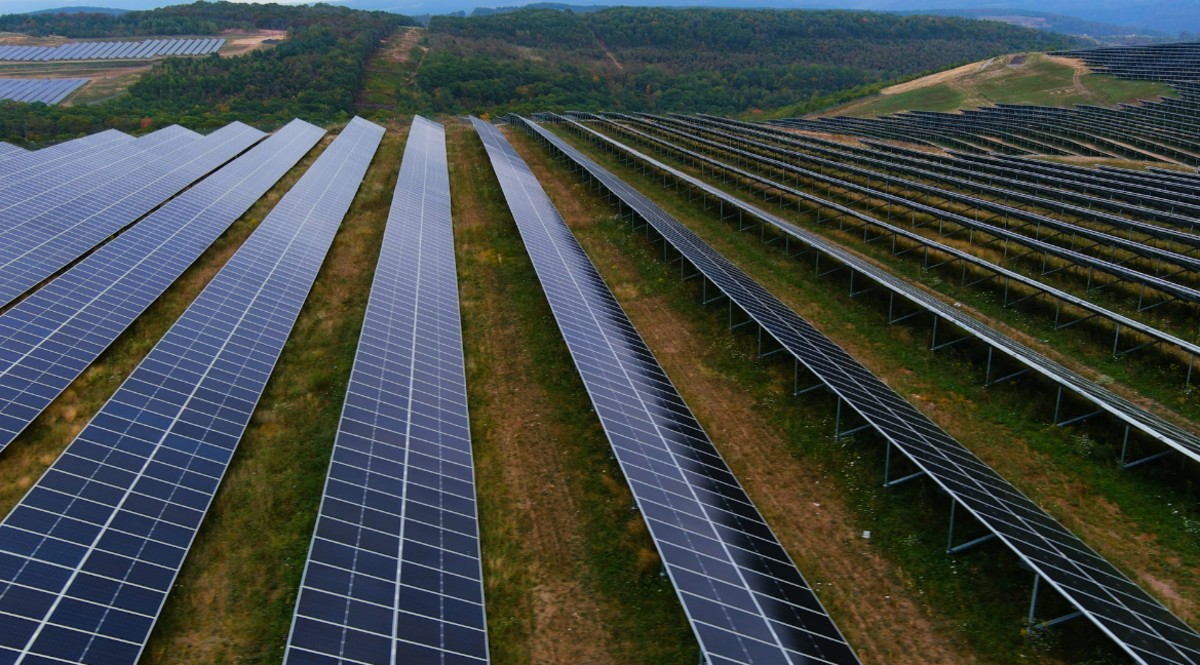
A former coal mine in western Maryland is now generating solar power – and it’s the largest solar farm in the state. Competitive Power Ventures (CPV) has brought Maryland’s largest solar project online in Garrett County, turning reclaimed coal mine land into a source of clean electricity.
CPV Renewable Power, an affiliate of CPV, and investment partner Harrison Street Asset Management have started commercial operations at CPV Backbone Solar, a 160-megawatt solar project in western Maryland. The site sits on a reclaimed, decommissioned coal mine, turning previously disturbed land into a new source of clean power.
Construction of the project was handled by Vanguard Energy Partners, a solar engineering, procurement, and construction firm.
The project comprises approximately 324,000 solar panels and is expected to generate enough electricity to power around 30,000 homes. For Maryland, it adds new in‑state generation while giving former fossil fuel land a second life.
CPV says that the project aims to demonstrate the role of brownfield redevelopment in the energy transition. The company’s CEO, Sherman Knight, said Backbone Solar shows “how brownfield redevelopment, innovative engineering, and strategic partnerships can meet complex project challenges and deliver new power generation in Maryland.”
Local officials have welcomed the project. Garrett County Board Chairman Paul Edwards said bringing the solar facility to the county helps protect the region’s natural landscape while also creating economic value for local residents.
CPV Backbone Solar also includes a community and environmental investment tied to the project. CPV has committed $100,000 over four years to the Deep Creek Watershed Foundation.
Backbone Solar becomes part of CPV’s growing renewable portfolio, which includes four operating wind and solar projects. The company also says it has a 4.8-gigawatt renewable development pipeline.
A second phase of the Backbone Solar project is already under construction. Once completed, it’s expected to increase the site’s total installed capacity from 160 MW to 175 MW.
Read more: Fast charge your EV while grabbing Royal Farms fried chicken

If you’re looking to replace your old HVAC equipment, it’s always a good idea to get quotes from a few installers. To make sure you’re finding a trusted, reliable HVAC installer near you that offers competitive pricing on heat pumps, check out EnergySage. EnergySage is a free service that makes it easy for you to get a heat pump. They have pre-vetted heat pump installers competing for your business, ensuring you get high quality solutions. Plus, it’s free to use!
Your personalized heat pump quotes are easy to compare online and you’ll get access to unbiased Energy Advisors to help you every step of the way. Get started here. – *ad


FTC: We use income earning auto affiliate links. More.


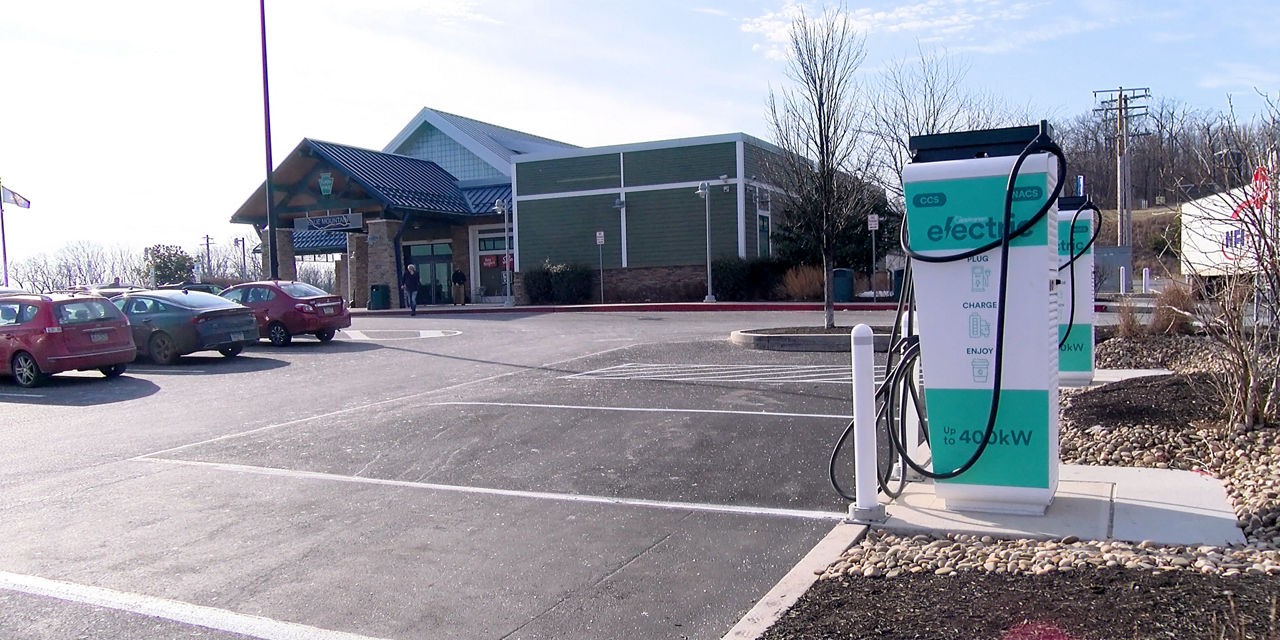
Pennsylvania just opened its first federally funded EV charging station on the Pennsylvania Turnpike — a key step toward making long-distance EV travel easier across the state.
The new station just opened at the Blue Mountain Service Plaza at Exit 202 westbound. Another NEVI-funded site at the New Stanton Service Plaza (Exit 77 westbound) is expected to open next week, according to the Pennsylvania Department of Transportation (PennDOT).
The chargers were built using funds from the federal National Electric Vehicle Infrastructure (NEVI) program, which is designed to install fast, reliable charging stations where drivers already stop — especially along busy highway corridors.
The Pennsylvania Turnpike is one of the state’s most heavily traveled roads, particularly during holiday travel, making service plazas a natural location for en-route EV charging. This first Turnpike site marks the beginning of NEVI-funded charging directly on the state’s toll road.
The Blue Mountain and New Stanton locations are part of the Turnpike’s larger, systemwide EV charging rollout. Working with Applegreen Electric, the Turnpike plans to install 80 new universal EV charging stations across all 17 service plazas by the end of 2027.
In addition to the NEVI-funded sites, the Turnpike has already brought new chargers online at the North Somerset, South Somerset, and Hickory Run service plazas using funding from Pennsylvania’s Driving PA Forward program. Each location offers high-speed charging with four ports per site, and all chargers are designed to work with all EV models without the need for adapters.
The project was awarded under the first round of PennDOT’s NEVI Alternative Fuel Corridor program. The next phase of funding, known as Corridor Connections, is focused on filling in charging gaps along major roadways that fall outside previously designated alternative fuel corridors. The goal is to make longer EV trips across Pennsylvania easier and more predictable.
The announcement also comes as Pennsylvania continues to push back against federal attempts to block EV funding. The US Department of Transportation is currently withholding congressionally approved money that would have supported EV infrastructure projects and jobs in the state. Governor Josh Shapiro (D-PA) sued the Trump administration over the move and, alongside 15 other states, successfully challenged an earlier attempt to derail the NEVI program. That legal fight helped keep projects like these Turnpike charging stations moving forward across the Commonwealth.
Electrek’s Take
This is precisely what the Biden administration’s NEVI program was meant to do: put fast, reliable charging stations where drivers already stop. Service plazas on major turnpikes are prime real estate for EV charging, particularly during holiday and long-distance travel. Pennsylvania’s rollout is still early days, but once chargers are live at all 17 plazas – assuming the federal funding spigot stays open – one of the Northeast’s busiest corridors is going to be a great place to road-trip in an EV.
Read more: PA Turnpike to add 80 new Applegreen DC fast chargers by 2027

FTC: We use income earning auto affiliate links. More.
-
 Sports2 years ago
Story injured on diving stop, exits Red Sox game
-
 Sports3 years ago
‘Storybook stuff’: Inside the night Bryce Harper sent the Phillies to the World Series
-
 Sports2 years ago
Game 1 of WS least-watched in recorded history
-
 Sports3 years ago
Button battles heat exhaustion in NASCAR debut
-
 Sports3 years ago
MLB Rank 2023: Ranking baseball’s top 100 players
-
Sports4 years ago
Team Europe easily wins 4th straight Laver Cup
-
 Environment3 years ago
Japan and South Korea have a lot at stake in a free and open South China Sea
-
 Environment1 year ago
Here are the best electric bikes you can buy at every price level in October 2024