

The UK’s National Grid to sell its US renewables arm for $1.74B

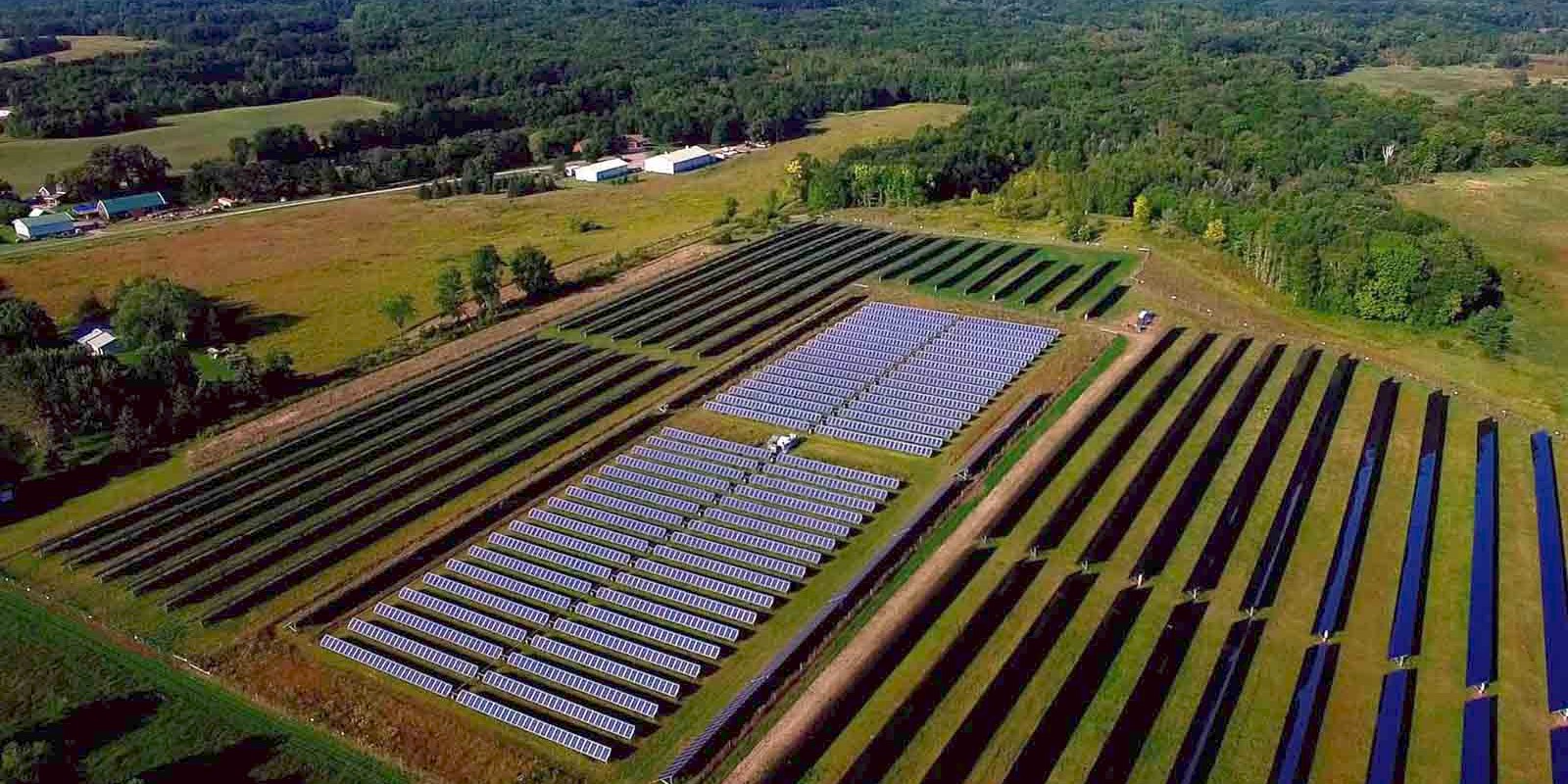
British energy giant National Grid has reached a deal to sell National Grid Renewables in the US to Canadian investment firm Brookfield Asset Management for $1.74 billion.
Minneapolis-based National Grid Renewables develops, constructs, owns, and operates utility-scale solar, onshore wind, and battery storage assets in 34 states, with 1.8 gigawatts (GW) in operation and 1.3 GW under construction.
National Grid said in its announcement that the sale is another step in its “previously communicated strategy to focus on networks and streamline our business, as announced in May 2024.” It’s the UK’s grid operator, and it wants to raise £6.8 billion to improve that network. (National Grid also operates parts of the grid in Massachusetts and New York State.)
The company expects the sale of National Grid Renewables to be completed in the first half of the financial year ending March 31, 2026.
Brookfield operates around 15 GW of renewables in the US and has 69 GW of projects in development. It operates in the solar, wind, and hydroelectric industries. The company said earlier this month, when it announced its fourth quarter and full-year results for 2024, that it was “more confident than ever on the growth prospects of the business, particularly in the US.”
National Grid joins other large energy companies such as Shell, Equinor, and Duke Energy, which are shifting their strategies away from renewables, citing reduced profitability.

Read more: South Dakota’s largest solar farm just came online
If you live in an area that has frequent natural disaster events, and are interested in making your home more resilient to power outages, consider going solar and adding a battery storage system. To make sure you find a trusted, reliable solar installer near you that offers competitive pricing, check out EnergySage, a free service that makes it easy for you to go solar. They have hundreds of pre-vetted solar installers competing for your business, ensuring you get high quality solutions and save 20-30% compared to going it alone. Plus, it’s free to use and you won’t get sales calls until you select an installer and share your phone number with them.
Your personalized solar quotes are easy to compare online and you’ll get access to unbiased Energy Advisers to help you every step of the way. Get started here. –trusted affiliate link*
FTC: We use income earning auto affiliate links. More.


BP has appointed Woodside Energy boss Meg O’Neill as its next CEO, reinforcing the British oil giant’s back-to-basics strategy.
O’Neill will replace Murray Auchincloss, after less than two years in the role.
Auchincloss will step down today, with Carol Howle, BP’s executive vice president for supply, trading and shipping set to serve as interim CEO until O’Neill takes over the role on April 1. She will be BP’s fourth CEO in six years.
Stephen Isaacs, strategic advisor at Alvine Capital, which holds a position in BP, told CNBC’s “Squawk Box Europe” on Thursday that while BP has been “a very poor performer for a long, long time,” this move could be “the last piece of the jigsaw” in getting its house in order.
“It rather kind of drank a bit too much Kool Aid on the whole energy transition and neglected its core businesses … So I think [the replacement of the CEO is] a kind of confirmation that we’re going to get back to basics. And I think that’s pretty good for the stock,” Isaacs said.
BP’s share price ended the previous session up 0.7% following the news. It initially extended gains into Thursday before moving into negative territory. Shares were last seen 0.1% lower.
A graph showing BP’s share price
Auchincloss stepped up from his previous role as chief financial officer to the top job in January 2024, after his predecessor Bernard Looney left the company for failing to disclose a relationship with a colleague.
Looney, who had been in the role since early 2020 when he succeeded Bob Dudley, had sought to transform the oil major into a green energy giant but came under investor pressure amid share underperformance.
Auchincloss reversed that strategy, and focused on the company’s core gas and oil units.
In the Wednesday statement, Auchincloss said he’d told recently appointed Chair Albert Manifold he was open to stepping down if an “appropriate leader” was identified.
BP fielded off takeover rumors earlier this year, with fellow U.K. energy incumbent Shell denying reports that it was in talks to snap up its its struggling competitor.
The London-listed oil exploration company that was founded in 1909 under the name Anglo-Persian Oil Company, has underperformed compared with its peers, having reported declining annual profits in both 2023 and 2024.
Meg O’Neill, chief executive officer of Woodside Energy Group Ltd., attends the company’s annual general meeting in Perth, Australia on Thursday, May 8, 2025. Photographer: Matt Jelonek/Bloomberg via Getty Images
Bloomberg | Bloomberg | Getty Images
However, BP’s fundamental strategic reset that saw it U-turn on green pledges, shake-up its leadership, launch a cost-cutting program and a string of oil discoveries, helped ease pressure.
BP’s share price is up over 15% year-to-date and 21% over the past five years. The stock ended Wednesday up 0.7% as investors responded to the leadership announcement.
Holding the line
O’Neill will likely hold the line, drawing on more than two-and-a-half decades of experience in the oil and gas industry, including 23 yeas at U.S. giant ExxonMobil. She chairs the Australian oil and gas industry body Australian Energy Producers (AEP) and is a board member of the American Petroleum Institute. She also served on the board of the Business Council of Australia.
Speaking to CNBC’s Dan Murphy at the Future Investment Initiative Institute in Saudi Arabia in October about Woodside Energy’s strategy, O’Neill said that the firm’s investments are made by looking at the demand profile “for decades to come” — which led it to liquified natural gas (LNG).
Oil majors, including BP, have pushed hard into LNG production, which is considered a bridge fuel by the likes of the European Commission, given it is cleaner than coal.

“We’ve got deep conviction around the role of LNG as in many ways, finding the sweet spot between reliability, affordability and sustainability. When we talk to customers in places like North Asia and Europe and ask them what they want, they say ‘we want all three factors’,” she said.
When customers are asked whether they are willing to pay for more climate-friendly products, “the answer is often zero or near zero,” she added. “So that has underpinned our focus on LNG.”
At the time, Woodside expected LNG demand to grow 50% over the coming decade.
Isaacs tips “natural energy” stocks to rebound from recent damp investor sentiment. “They’re relatively cheap compared to the rest of the market, and they go with my general thesis of rotation — rotation out of tech into value,” he said.
Woodside Energy’s stock price closed Wednesday’s session 1.3% lower.

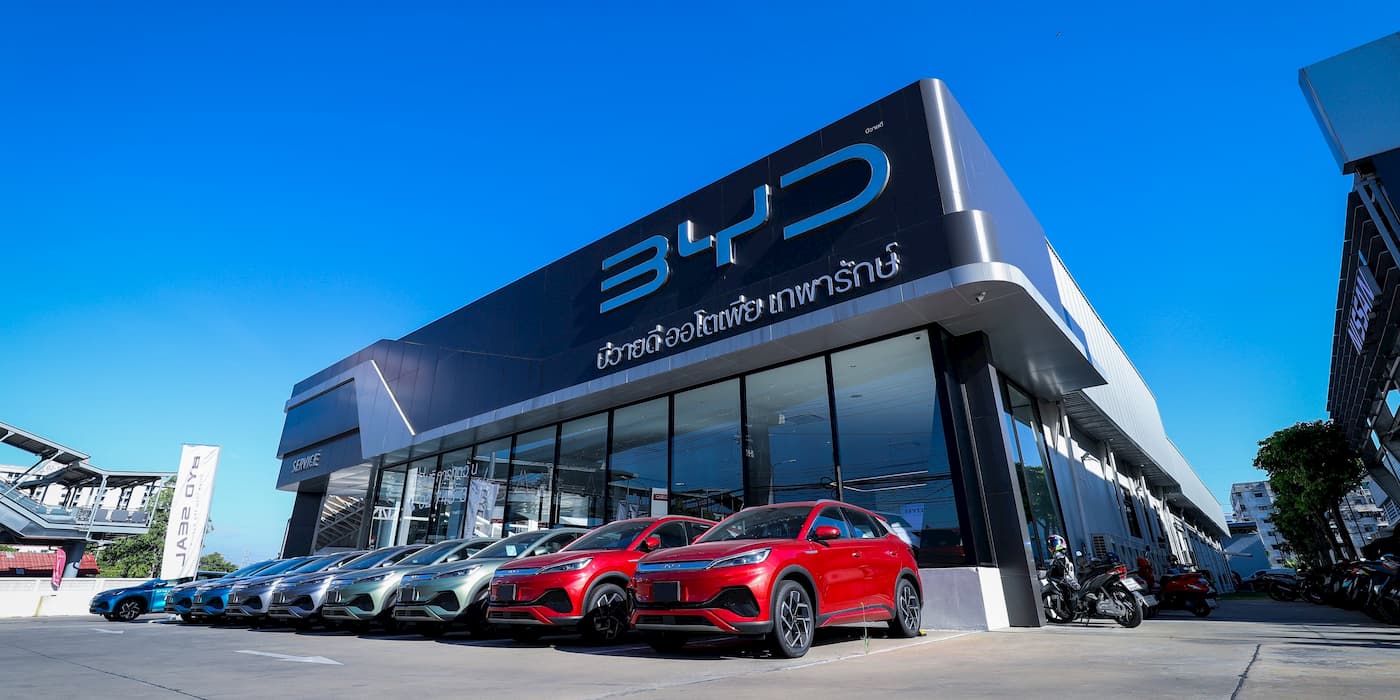
More than 25% of new cars sold globally in 2025 are now electric, according to new analysis from energy think tank Ember. This growth is increasingly driven by emerging markets that, only a few years ago, had minimal adoption of EVs.
Where the EVs sold in 2025
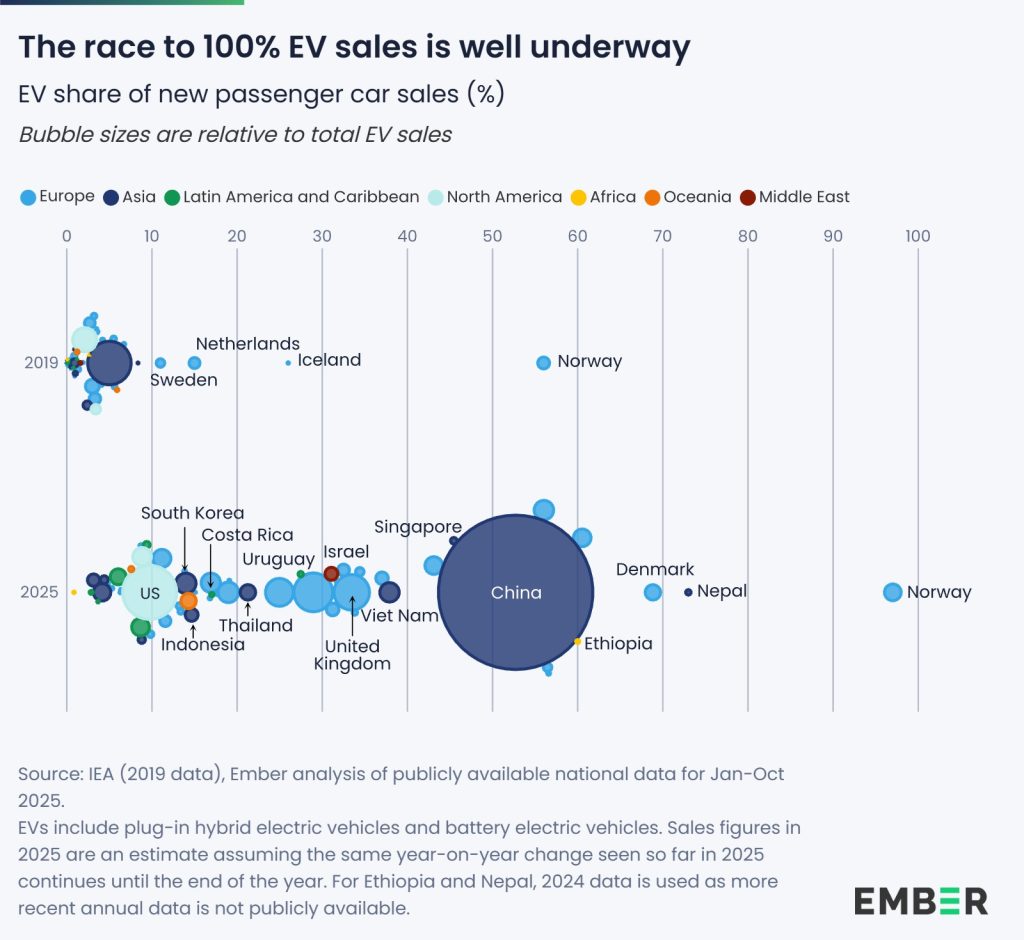
The analysis reveals that the EV race has truly gone global. There are now 39 countries where EVs make up more than 10% of new car sales, compared with just four in 2019.
The Association of Southeast Asian Nations (ASEAN) became a significant force in global EV adoption in 2025. Singapore and Vietnam have reached EV sales shares of around 40%, overtaking levels seen in the UK and the EU.
Indonesia has reached 15% this year, surpassing the US for the first time. Thailand has reached 20% and has sold more EVs in the first three quarters of 2025 than Denmark. These shifts demonstrate how rapidly the region is transitioning from a low base to a position of leadership.
Euan Graham, electricity and data analyst at Ember, said: “This is a major turning point. In 2025, the center of gravity has moved. Emerging markets are no longer catching up; they are leading the shift to electric mobility. These countries see the strategic advantages of EVs, from cleaner air to reduced fossil fuel imports.”
Other regions are also gaining momentum. In Latin America, Uruguay has reached a 27% EV share, roughly in line with the EU. Mexico and Brazil continue to show steady growth, now surpassing Japan, where the EV share has remained around 3% since 2022. Türkiye has reached 17%, overtaking Belgium to become Europe’s fourth-largest BEV market by volume.
Emerging markets are buying Chinese EVs
Since mid-2023, almost all the growth in Chinese EV exports has come from non-OECD markets. Brazil, Mexico, the UAE, and Indonesia are among the top 10 destinations for Chinese EV exports this year, as their governments have introduced policies to support EV adoption, including reduced taxes and incentives for domestic manufacturing.
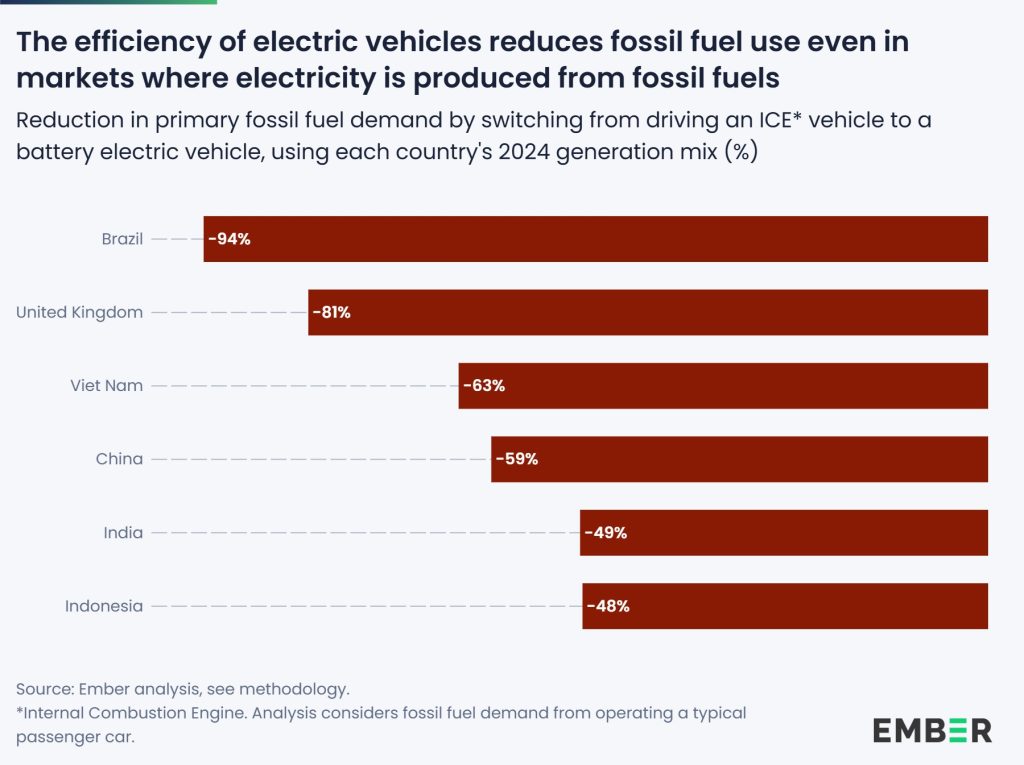
As more countries take up EVs, the impact on fossil fuel demand is already tangible. EVs are three times more efficient than ICE vehicles, which means they deliver significant reductions in oil use even in countries that still rely heavily on fossil fuels for power generation. In Brazil, where electricity is mostly clean, BEVs cut fossil fuel demand by around 90%. In Indonesia, the number was reduced by nearly half.
Graham said, “Emerging markets will shape the future of the global car market. The choices made now on charging infrastructure and early support will determine how fast this momentum continues.”
Read more: LAZ Parking plans EV chargers in 50,000 everyday parking spots

If you’re looking to replace your old HVAC equipment, it’s always a good idea to get quotes from a few installers. To make sure you’re finding a trusted, reliable HVAC installer near you that offers competitive pricing on heat pumps, check out EnergySage. EnergySage is a free service that makes it easy for you to get a heat pump. They have pre-vetted heat pump installers competing for your business, ensuring you get high quality solutions. Plus, it’s free to use!
Your personalized heat pump quotes are easy to compare online and you’ll get access to unbiased Energy Advisors to help you every step of the way. Get started here. – *ad


FTC: We use income earning auto affiliate links. More.


Brian Armstrong, chief executive officer of Coinbase Global Inc., speaks during the Messari Mainnet summit in New York, on Thursday, Sept. 21, 2023.
Michael Nagle | Bloomberg | Getty Images
Coinbase is making its biggest push yet to reposition itself as a mainstream trading and financial platform, moving beyond crypto and into the broader retail investing stack as competitors show there’s real money in always-on engagement products.
The digital asset exchange announced Wednesday that it’s rolling out a major slate of new products designed to turn Coinbase into a one-stop financial app, expanding into stocks, more advanced trading, and prediction markets, while doubling down on its on-chain ecosystem and new tools for businesses, developers, and automated financial guidance.
While many of these offerings have been telegraphed for months, Coinbase says the products are now built, and ready to go.
CEO Brian Armstrong is looking to make his platform the place to trade everything.
That includes stocks, a streamlined futures and perpetuals experience, and prediction markets through Kalshi, alongside a tokenization roadmap aimed at eventually bringing more traditional assets on-chain, including equities.
The area of prediction markets, in particular, is quickly getting crowded.
DraftKings has moved to buy its own exchange, FanDuel is teaming up with CME, and Polymarket is entering the U.S. through a newly approved venue. Robinhood, meanwhile, is putting LedgerX at the center of its regulated push.
The defining rivalry in the space remains Kalshi versus Polymarket, regulated rails versus crypto-native liquidity.
Armstrong said the category’s appeal isn’t just trading, but its insight into sentiment, and what people think will happen next on any given topic.
“If you look at things like economic indicators … or elections, people are using prediction markets to try to figure out what is going to happen next month,” Armstrong told CNBC. “Maybe1% of people use it as an asset class to trade, and 99% of people are using it as a way to figure out what’s going to happen — almost like a competitor to traditional media or maybe even entertainment.”
In the company’s third-quarter earnings call with analysts in October, Armstrong showed just how easily prediction market wagers can be manipulated, rattling off several words that were being bet on.
“I was a little distracted because I was tracking the prediction market about what Coinbase will say on their next earnings call,” Armstrong said. “And I just want to add here the words bitcoin, ethereum, blockchain, staking and Web3 to make sure we get those in before the end of the call.”
Robinhood underscored that shift this week by expanding prediction markets into sports-style contracts that resemble parlays and prop bets, and by touting the category as its fastest-growing business by revenue.
Coinbase is now bringing the same kind of outcome trading into its own ecosystem, but as a part of a much wider bet that the next-generation brokerage is a single app that blends traditional assets, derivatives, and on-chain rails.
Coinbase is pairing the trading expansion with a tokenization roadmap that signals where it wants the platform to go next, bringing more traditional assets on-chain, including equities.
The company is launching Coinbase Tokenize, an institutional stack intended to support real-world asset tokenization.
Armstrong framed the expansion as a bridge to something bigger.
Trading stocks, he said, is “a good first step,” but the real goal is tokenized equities. If Coinbase can get tokenized equity live, he said, it could “democratize access for people over the world,” and unlock new market structure in the U.S., including more robust, professional futures markets tied to equities.
“So this is the starting point,” he said.
The announcement also extends Coinbase’s push to become a provider of on-chain liquidity — not just a venue for listed tokens.
For businesses and developers, Coinbase is widening its platform story beyond retail trading. The company said Coinbase Business is becoming available to eligible customers in the U.S. and Singapore, and it’s rolling out an expanded API suite spanning custody, payments, trading, and stablecoins.
Armstrong’s broader thesis is that crypto isn’t a niche category, it’s an upgrade cycle for the financial system itself.
“Crypto is updating all financial services,” he said, suggesting that every major asset class will move on-chain over time, from prediction markets and equities to commodities, and eventually real-world assets like real estate.
Even the largest asset managers, he said, are signaling they want to migrate funds on-chain, positioning Coinbase as a central platform for that transition.
Coinbase is also introducing “custom stablecoins” for companies that want branded stablecoin rails, and spotlighting x402, a payments standard the company says is meant to make stablecoin payments easier to attach to web requests — including for automated commerce and agent-driven transactions.
The strategic throughline is retention and diversification.
Coinbase already owns a large crypto-native audience, and it wants that customer to stay on its platform for every asset class, even when crypto volumes cool and transaction revenue compresses.
WATCH: What to know about Robinhood’s new prediction market features
-
 Sports2 years ago
Story injured on diving stop, exits Red Sox game
-
 Sports3 years ago
‘Storybook stuff’: Inside the night Bryce Harper sent the Phillies to the World Series
-
 Sports2 years ago
Game 1 of WS least-watched in recorded history
-
 Sports3 years ago
Button battles heat exhaustion in NASCAR debut
-
 Sports3 years ago
MLB Rank 2023: Ranking baseball’s top 100 players
-
Sports4 years ago
Team Europe easily wins 4th straight Laver Cup
-
 Environment3 years ago
Japan and South Korea have a lot at stake in a free and open South China Sea
-
 Environment1 year ago
Here are the best electric bikes you can buy at every price level in October 2024