
Leagues back bill to disable drones at stadiums


-
Tisha Thompson
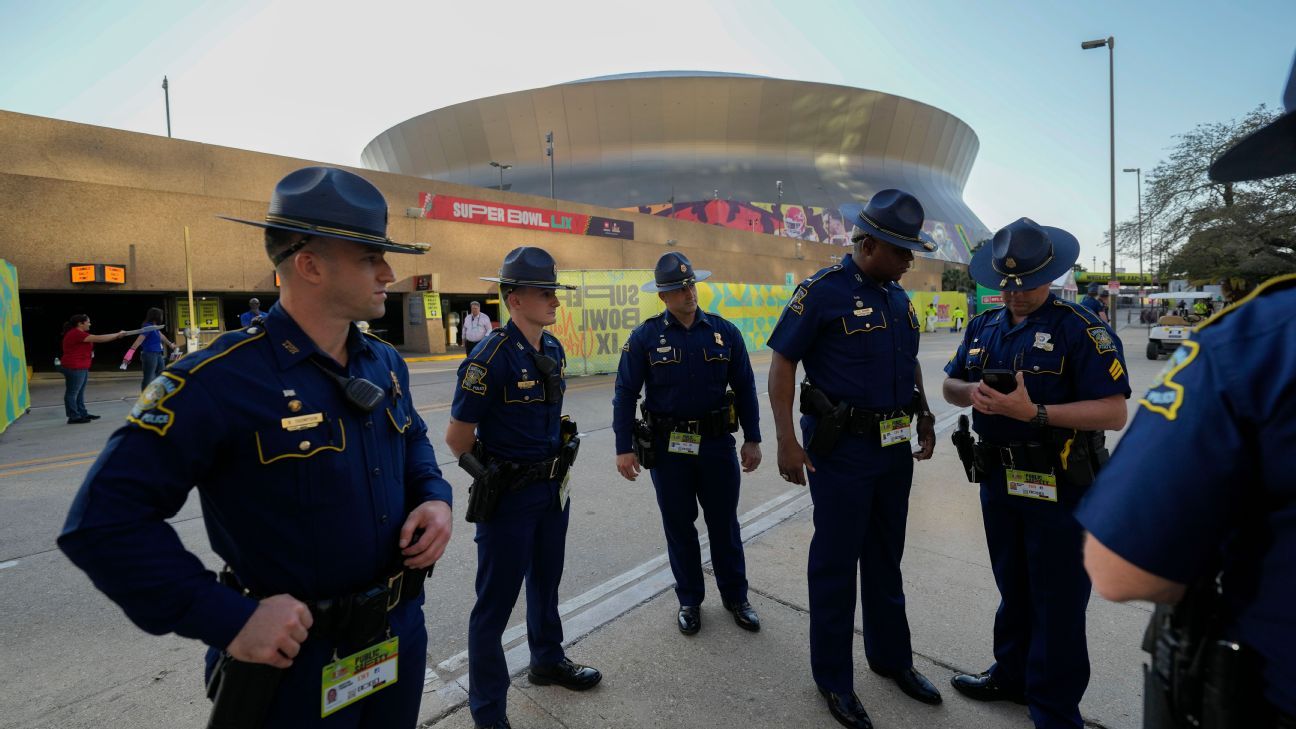
The NFL, MLB, NCAA and NASCAR said they support a bill introduced in Congress on Thursday that would give state and local law enforcement the ability to disable drones during sporting events, which the leagues say have become an increasing threat.
The bill, sponsored by Sen. Tom Cotton (R-Arkansas) and Sen. Jacky Rosen (D-Nevada) and entitled the Disabling Enemy Flight Entry and Neutralizing Suspect Equipment (DEFENSE) Act, would provide “the tools for local and state law enforcement to protect citizens,” Cotton told ESPN.
“Local law enforcement already protects the perimeter of these events,” he said. “We already expect them to stop a dump truck that would cause harm, so we need to also give them the tools to protect the airspace from weapons and biological threats.”
Currently, only federal law enforcement on-site at events such as the Super Bowl, the World Series, the Rose Bowl and the Boston Marathon can disable unauthorized drones. Nearly all other major sporting events, including thousands of NFL and MLB games, do not have officials on-site with the legal authorization to quickly remove a drone threat.
Cotton said federal agents represent “a small fraction of law enforcement” and that there are “not enough” to man large-scale sporting events on-site. “They need these local and state authorities to protect the restricted airspace,” he said.
In a press release, Cotton’s office said the four leagues endorsed the bill, as did the SEC.
“If enacted, this legislation would dramatically increase the security of our stadiums and the safety of the 70,000,000 fans who attend our games annually,” MLB’s senior vice president of security and ballpark operations David Thomas said in a statement.
The NFL said that in the 2023 season alone, it experienced more than 2,800 drone incursions into the temporary restricted airspace around its stadiums, which the FAA defines as below 3,000 feet and within three nautical miles of the stadium from one hour before until one hour after the game.
The NFL paused the AFC Championship Game in January 2024 between the Baltimore Ravens and the Kansas City Chiefs after a drone entered the stadium’s restricted airspace. The drone operator pleaded guilty to violating national defense airspace. More recently, on Jan. 11, a wild-card game between the Ravens and Pittsburgh Steelers was temporarily suspended when a drone flew over the bowl of M&T Bank Stadium. That alleged drone operator is facing multiple federal charges.
“Many drones around large athletic events are hobbyists or enthusiasts or practical jokers,” Cotton said. “But we can’t take the risk of fan lives because some of these drones can be equipped to carry explosives or most chillingly can be equipped with some kind of biological weapon.”
The new bill would apply only to sporting events that already have temporary flight restrictions, including stadiums and ballparks with more than 30,000 people and outdoor gatherings with more than 100,000 people. That would include all NFL, MLB and NCAA Division I football games, NASCAR, IndyCar and Champ Series races.
NFL chief security officer Cathy Lanier told Congress in December that intelligence agencies continue to warn that terrorist groups could target stadiums and other mass gatherings.
“Earlier this year, Islamic State propaganda specifically encouraged attacks on stadiums, including referencing the Paris Summer Olympics,” Lanier testified. “Social media posts recently threatened drone attacks at the Cricket World Cup on Long Island.”
The bill would require eligible law enforcement officers to complete counter-drone training and mandate federal agencies to create a list of approved drone mitigation technology.
Drones can be disabled a number of ways, according to Michael Robbins, president and CEO of the Association of Uncrewed Vehicle Systems International, a trade association that represents the drone industry. “The most effective way, the way that is used in most cases, is to find the operator and ask, or demand, that the operator land the drone.”
If not, law enforcement can jam a drone’s radio frequency, grab it with a net, ram it with another drone or shoot it out of the sky, Robbins said. Most commercially available drones are programmed to land or return to their point of origin if they lose their link to the operator.
While it’s not yet clear what opposition this bill will face, Sen. Rand Paul (R-Kentucky) blocked a bill last year that would have provided state and local law enforcement the ability to track drones after several sightings alarmed residents in New Jersey and New York.
In a speech on the Senate floor in December, Paul said, “History has shown us time and time again how fear and manufactured urgency are used as pretext to expand government power at the expense of freedom.” He expressed concerns about surveillance powers potentially violating Americans’ privacy rights “in the name of security.”
The leagues have been lobbying Congress for a number of years to expand law enforcement’s ability to disable drones.
“For several years, the NCAA has expressed concern for the threat that unauthorized drones pose at NCAA championships and college sporting events,” said Tim Buckley, the NCAA’s senior vice president of external affairs, in a statement to ESPN. “The safety of the competitors, fans, and staff that work at NCAA events is our top priority.”
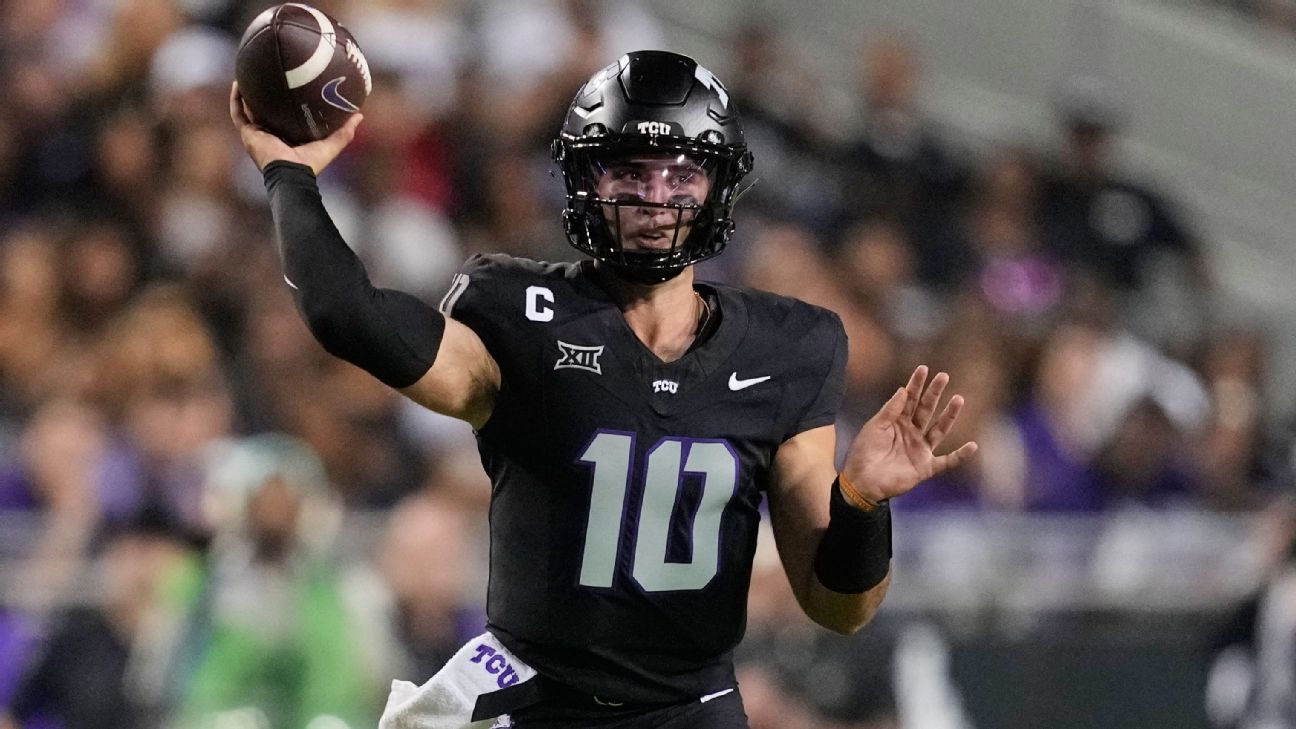
TCU quarterback Josh Hoover intends to enter the NCAA transfer portal, he announced on social media Thursday.
Hoover will be one of the most productive and coveted players available, as he projects to have the most passing yards (9,629) and touchdown passes (71) of any player returning to college football next season. Hoover says he will not play for TCU in the Alamo Bowl.
Hoover reflected on his decision in a post on Instagram, writing, “I’ve prayed about this and decided that I will be entering the transfer portal,” and thanking his Horned Frogs coaches and teammates, among others.
“I’m so thankful to have had the opportunity to represent TCU for an incredible 4 years,” his post continued. “It has been a dream to be able to play and graduate from this university and I will forever be grateful for that.”
Hoover has been TCU’s starting quarterback since midway through the 2023 season, throwing for 439 yards and four touchdowns in his first start against BYU. In 2024, he set a school record with 3,949 passing yards.
Hoover will draw interest from the highest levels of the sport, as he is already considered a draftable prospect. Instead of entering the draft, sources said he intends to play out his final year of eligibility and polish his game for the next level. He will bring with him 19 wins as a starter over his four seasons, including nine wins in 2024 and eight this season.
He blistered North Carolina this year in a season-opening blowout, throwing for 284 yards and two touchdowns. He had four touchdown passes in the regular-season finale against Cincinnati and threw for 379 yards and five touchdowns against SMU in September.

-
Adam Rittenberg
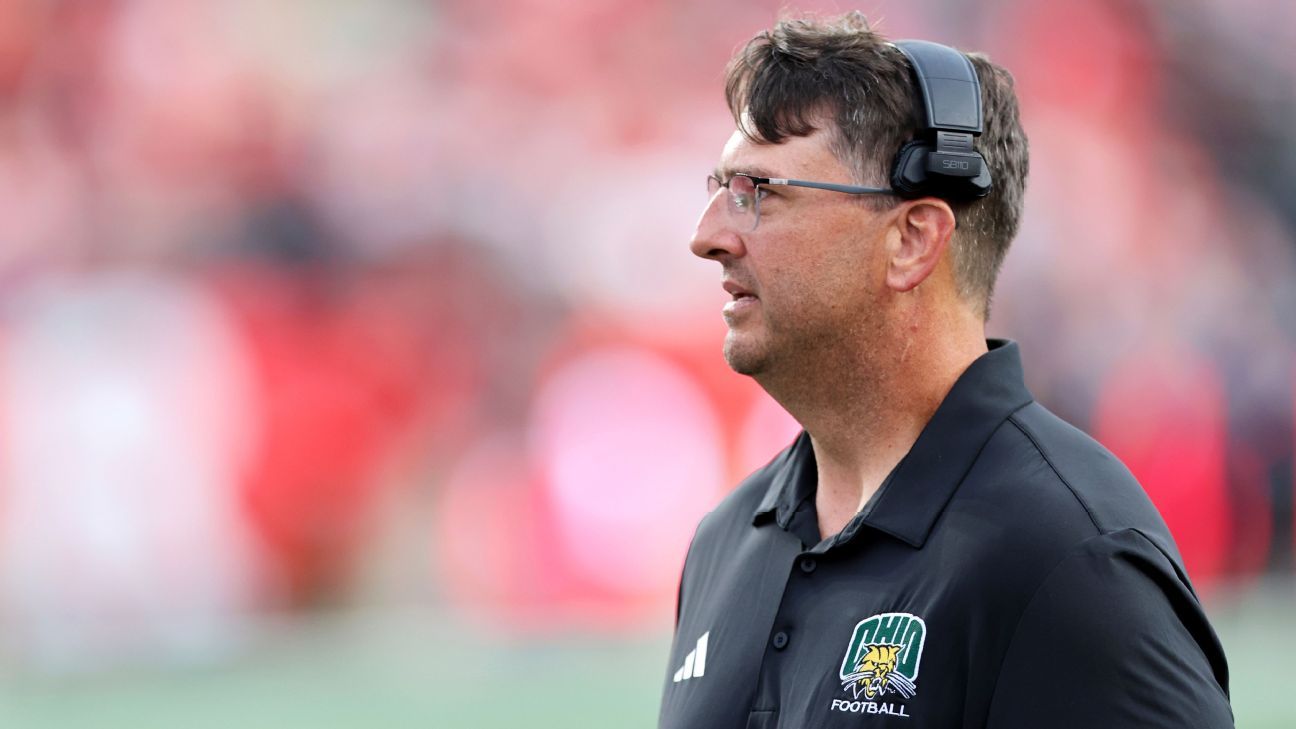
Ohio University cited football coach Brian Smith’s romantic relationships, including one he admitted to with a student, as well as an allegation of public intoxication in a letter stating its intent to fire him for cause.
Smith, put on leave Dec. 1, was fired Wednesday for what the university called “serious professional misconduct and participating in activities that reflect unfavorably on the University.” The school did not provide specifics on Smith’s misconduct before Thursday.
In the intent to terminate letter, obtained by multiple media outlets through a public records requests, university president Lori Stewart Gonzalez wrote that Smith’s “extramarital affairs,” including one with an undergraduate student, brought “disrepute, scandal and ridicule,” which violated his employment agreement with the school.
Gonzalez also wrote that Smith told athletic director Slade Larscheid that he “carried on an affair” while at the Ohio University Inn, where he could be observed by athletes’ families, donors and others connected to the university. Smith had been under contract through the 2029 season and was owed about $2.5 million in remaining salary.
Rex Elliott, Smith’s attorney, responded in a letter to Gonzalez, obtained by media outlets through a records requests, and stated that Smith “didn’t participate in an extramarital affair and you know it.” Elliott added that Smith and his wife separated earlier this year, were going through a divorce and were living apart during the fall. Smith had been living at the OU Inn while looking for permanent housing and had told Larscheid that he saw athletes’ families there while with a 41-year-old woman he was seeing at the time, after he broke off the relationship with the Ohio student.
Elliott wrote that Ohio University had no policy prohibiting employees from dating students, and that Smith and a student engaged in a “perfectly appropriate consensual adult relationship that did not violate any OU rule or policy.” He said Smith and the student dated for about four months until early November, and that the student was part of the athletic department.
Elliott also responded to Gonzalez citing a reprimand for Smith for consuming alcohol in his office at the school, as a reason for his termination. Gonzalez wrote that the university was aware of a public appearance where Smith “smelled strongly of alcohol” and was “intoxicated in your demeanor.” Elliott wrote that Smith has “never been inebriated at an OU event” and that the reprimand and a meeting that occurred around it, which took place in late November, never mentioned other concerns related to Smith’s alcohol use. He added that Ohio University serves and encourages alcohol usage at other university-sponsored events and cited examples of faculty and staff drinking in their offices and other campus facilities.
“The reprimand related to coaches toasting in the [football] offices after home victories,” Elliott wrote to Gonzalez. “Finally, the coaches were toasting with Bourbon provided by your husband to Coach Smith in his office.”
In his letter, sent before Ohio terminated Smith, Elliott said Smith would “vigorously pursue” litigation for wrongful termination if Ohio fired him for cause.
Smith went 8-4 is his lone season as Ohio’s coach, after being promoted to the role from offensive coordinator. He had been on the football staff since 2022.

-
Adam Rittenberg
Indiana is expected to finalize a new three-year contract with offensive coordinator Mike Shanahan, a source confirmed to ESPN on Thursday, as the school reinforces its commitment to coach Curt Cignetti’s staff.
The deal will keep Shanahan as Indiana’s offensive playcaller for the 2026 season and potentially through 2028. Shanahan has worked on Cignetti’s staffs since 2016, at IU-Pennsylvania, Elon and James Madison before coming to Indiana in 2024.
Indiana last week secured a new contract for defensive coordinator Bryant Haines that will make him among the nation’s highest-paid assistants. Cignetti lost only one assistant from the 2024 staff and will have at least his two primary coordinators back next fall.
The (Bloomington) Herald-Times first reported Shanahan’s new deal with the Hoosiers, who secured their first outright Big Ten title since 1945 and have the top seed entering the College Football Playoff. Indiana will face Oklahoma or Alabama on Jan. 1 in the College Football Playoff quarterfinal at the Rose Bowl presented by Prudential.
Led by Heisman Trophy-winning quarterback Fernando Mendoza, Indiana’s offense ranks third nationally in scoring (41.9 PPG) and rose to 10th in rushing (221 YPG), a significant increase from 2024. Since Shanahan’s arrival, Indiana leads the FBS in scoring at 41.6 points per game.
Shanahan, 35, is a former Pitt wide receiver who started his career at his alma mater before joining Cignetti.
-
 Sports2 years ago
Story injured on diving stop, exits Red Sox game
-
 Sports3 years ago
‘Storybook stuff’: Inside the night Bryce Harper sent the Phillies to the World Series
-
 Sports2 years ago
Game 1 of WS least-watched in recorded history
-
 Sports3 years ago
Button battles heat exhaustion in NASCAR debut
-
 Sports3 years ago
MLB Rank 2023: Ranking baseball’s top 100 players
-
Sports4 years ago
Team Europe easily wins 4th straight Laver Cup
-
 Environment3 years ago
Japan and South Korea have a lot at stake in a free and open South China Sea
-
 Environment1 year ago
Here are the best electric bikes you can buy at every price level in October 2024