
SEC says most meme coins are not securities


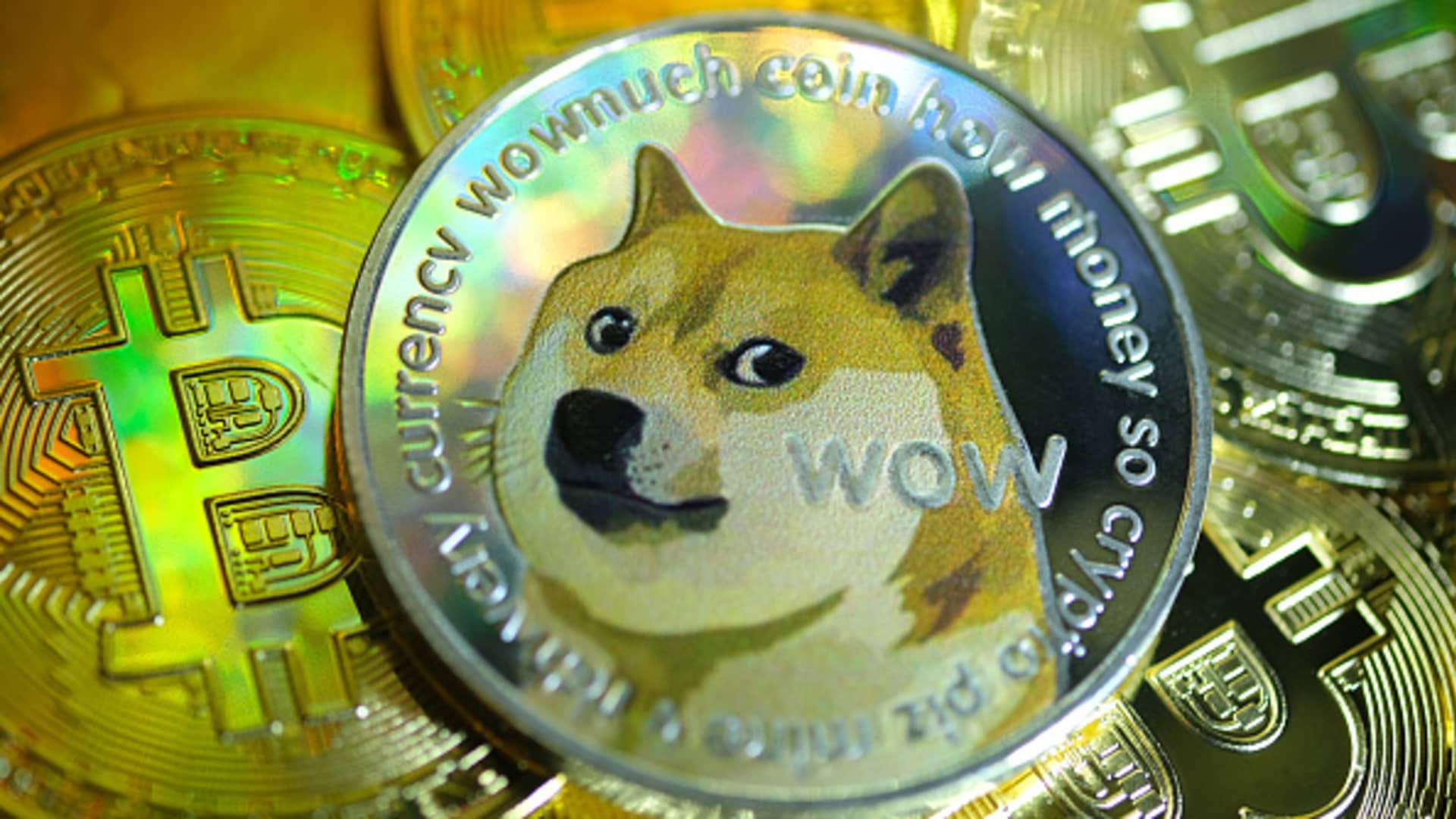
A visual representation of dogecoin and other cryptocurrencies.
Yuriko Nakao | Getty Images
The Securities and Exchange Commission issued long sought after guidance Thursday evening saying it does not deem most meme coins securities under U.S. federal law.
Meme coins “typically have limited or no use or functionality” and are “more akin to collectibles,” according to the agency’s Division of Corporation Finance.
“It is the Division’s view that transactions in the types of meme coins described in this statement do not involve the offer and sale of securities under the federal securities laws,” the statement says. “Persons who participate in the offer and sale of meme coins do not need to register their transactions with the Commission. … Accordingly, neither meme coin purchasers nor holders are protected by the federal securities laws.”
It also said “a meme coin does not constitute any of the common financial instruments specifically enumerated in the definition of ‘security’ because, among other things, it does not generate a yield or convey rights to future income, profits, or assets of a business. In other words, a meme coin is not itself a security.”
The clarification comes after the latest rapid rise of such cryptocurrencies following the election of President Donald Trump, as well as their crash in recent weeks. It’s also another notch in the belt of the new administration, which has promised to create clearer and perhaps more favorable regulatory conditions for the crypto industry, and to do so swiftly.
“The SEC’s recent statement on meme coins is the clarity that the digital asset space has been demanding for years,” said Ishmael Green, a crypto attorney and partner at the law firm Diaz Reus. “This will drive continued investment in the U.S. crypto space, as the vast majority of meme coins launched in the last 12 months with multibillion dollar market caps have been released on Solana, an American blockchain.”
Dogecoin has suffered from the recent meme coin crash but is still holding on to postelection gains
“[It] also comports with the current administration’s promise to the crypto community to end needless and frivolous enforcement actions which stifle innovation and investment,” he added.
Dogecoin, the original meme coin and sixth largest cryptocurrency by market cap, rose 3%. The token tied to Solana, which has become the go-to host for meme coins – including the Official Trump meme coin – rose 2%.
Shares of both Coinbase and Robinhood rose about 1% in after hours trading.
The clarity could pave the way for both exchange operators to list more meme coins without the risk of regulatory enforcement.
In January, at the height of the Trump-fueled meme mania, Coinbase CEO Brian Armstrong said that “given there are [about 1 million] tokens a week being created now, and growing … evaluating each one by one is no longer feasible,” in a post on X. “And regulators need to understand that applying for approval for each one is totally infeasible at this point,” he said.
Meme coins, of which there are thousands, sit at the furthest end of the risk spectrum. They’re three to four times more actively traded than bitcoin and ether, adjusting for market cap, which makes them lucrative offerings for newcomers to the market who feel they may have missed the boat on bitcoin. Historically, they’ve been a gauge of retail interest and risk appetite in crypto, though most market participants warn strongly against them.
Despite their purely speculative nature and lack of intrinsic value, they’re widely viewed as a significant sector of the crypto market and an important part of internet culture that reflects the origins, culture and permissionless nature of the crypto community.


Sam Altman, chief executive officer of OpenAI Inc., during a media tour of the Stargate AI data center in Abilene, Texas, US, on Tuesday, Sept. 23, 2025.
Kyle Grillot | Bloomberg | Getty Images
OpenAI is in discussions with Amazon about a potential investment and an agreement to use its artificial intelligence chips, CNBC confirmed on Tuesday.
The details are fluid and still subject to change but the investment could exceed $10 billion, according to a person familiar with the matter who asked not to be named because the talks are confidential. The Information first reported on the potential deal.
The discussions come after OpenAI completed a restructuring in October and formally outlined the details of its partnership with Microsoft, giving it more freedom to raise capital and partner with companies across the broader AI ecosystem.
Microsoft has invested more than $13 billion in OpenAI and backed the company since 2019, but it no longer has a right of first refusal to be OpenAI’s compute provider, according to an October release. OpenAI can now also develop some products with third parties.
Amazon has invested at least $8 billion into OpenAI rival Anthropic, but the e-commerce giant could be looking to expand its exposure to the booming generative AI market. Microsoft has taken a similar step and announced last month that it will invest up to $5 billion into Anthropic, while Nvidia will invest up to $10 billion in the startup.
Amazon Web Services has been designing its own AI chips since around 2015, and the hardware has become crucial for AI companies that are trying to train models and meet growing demand for compute. AWS announced its Inferentia chips in 2018, and the latest generation of its Trainium chips earlier this month.
OpenAI has made more than $1.4 trillion of infrastructure commitments in recent months, including agreements with chipmakers Nvidia, Advanced Micro Devices and Broadcom. Last month, OpenAI signed a deal to buy $38 billion worth of capacity from AWS, its first contract with the leader in cloud infrastructure leader.
In October, OpenAI finalized a secondary share sale totaling $6.6 billion, allowing current and former employees to sell stock at a $500 billion valuation.
WATCH: Oracle says there have been ‘no delays’ in OpenAI arrangement after stock slide

-
 Sports2 years ago
Story injured on diving stop, exits Red Sox game
-
 Sports3 years ago
‘Storybook stuff’: Inside the night Bryce Harper sent the Phillies to the World Series
-
 Sports2 years ago
Game 1 of WS least-watched in recorded history
-
 Sports3 years ago
Button battles heat exhaustion in NASCAR debut
-
 Sports3 years ago
MLB Rank 2023: Ranking baseball’s top 100 players
-
Sports4 years ago
Team Europe easily wins 4th straight Laver Cup
-
 Environment3 years ago
Japan and South Korea have a lot at stake in a free and open South China Sea
-
 Environment1 year ago
Here are the best electric bikes you can buy at every price level in October 2024