

Shares of iRobot tank 30% after Roomba maker raises doubt about its survival

Roomba vacuums by iRobot are displayed at Best Buy store on January 19, 2024 in San Rafael, California.
Justin Sullivan | Getty Images
Shares of iRobot plunged more than 30% on Wednesday after it said there is “substantial doubt” about its ability to stay in business.
The Roomba maker’s financial outlook has darkened since Amazon abandoned its planned $1.7 billion acquisition of the company in January 2024, citing regulatory scrutiny. Since then, iRobot has struggled to generate cash and pay off debts.
Massachusetts-based iRobot has been restructuring since the Amazon deal plunged into uncertainty. The company has laid off 51% of its workforce since the end of 2023, and iRobot has looked to reignite revenue growth by overhauling its product lineup. The company on Tuesday launched eight new Roombas in the hopes of “better positioning iRobot as the leader in the category that we created,” CEO Gary Cohen said in a statement.
“There can be no assurance that the new product launches will be successful,” iRobot said in its Wednesday earnings statement, citing limited consumer demand, tariff uncertainty and heightened competition.
“Given these uncertainties and the implication they may have on the company’s financials, there is substantial doubt about the company’s ability to continue as a going concern for a period of at least 12 months,” iRobot said in its earnings report.
The company’s fourth-quarter revenue sagged 44% year over year to $172 million, missing estimates of $180.8 million, according to FactSet. The Roomba maker posted a net loss of $77.1 million, or $2.52 per share. Excluding a one-time “manufacturing transition charge,” iRobot had a loss of $2.06 a share, exceeding the $1.73 per share projected by analysts surveyed by FactSet.
In July 2023, iRobot took a $200 million loan from the Carlyle Group to fund the company’s operations as a stopgap until the Amazon deal closed. The company amended the loan for a temporary waiver on certain financial obligations, which requires iRobot to pay a fee of $3.6 million.
As part of Wednesday’s report, iRobot said its board has initiated a strategic review of the business and is considering alternatives that could include refinancing its debt and exploring a potential sale. The board hasn’t set a deadline for when its review will conclude, the company said.
Shortly after the Amazon deal fell apart, Amazon CEO Andy Jassy criticized regulators’ approach to its iRobot acquisition. European Union regulators threatened to block the deal, and the Federal Trade Commission in the U.S. was reportedly expected to challenge the acquisition in court.
The proposed merger, which was announced in late 2022, would have allowed iRobot to scale and better compete with its rivals, Jassy said. Several of the fastest-growing robotic vacuum businesses are based in China, such as Anker, Ecovacs and Roborock, all of which have eaten into iRobot’s share of the market.
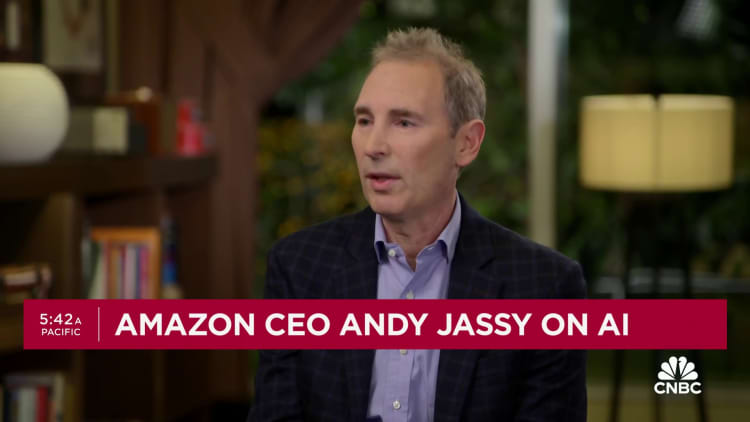
“We abdicate the acquisition, iRobot lays off a third of its staff, the stock price completely tanks, and now, there’s a real question of whether they’re going to be a going concern,” Jassy told CNBC’s Andrew Ross Sorkin in an interview last April.


Formula One F1 – United States Grand Prix – Circuit of the Americas, Austin, Texas, U.S. – October 23, 2022 Tim Cook waves the chequered flag to the race winner Red Bull’s Max Verstappen
Mike Segar | Reuters
Apple had two major launches last month. They couldn’t have been more different.
First, Apple revealed some of the artificial intelligence advancements it had been working on in the past year when it released developer versions of its operating systems to muted applause at its annual developer’s conference, WWDC. Then, at the end of the month, Apple hit the red carpet as its first true blockbuster movie, “F1,” debuted to over $155 million — and glowing reviews — in its first weekend.
While “F1” was a victory lap for Apple, highlighting the strength of its long-term outlook, the growth of its services business and its ability to tap into culture, Wall Street’s reaction to the company’s AI announcements at WWDC suggest there’s some trouble underneath the hood.
“F1” showed Apple at its best — in particular, its ability to invest in new, long-term projects. When Apple TV+ launched in 2019, it had only a handful of original shows and one movie, a film festival darling called “Hala” that didn’t even share its box office revenue.
Despite Apple TV+ being written off as a costly side-project, Apple stuck with its plan over the years, expanding its staff and operation in Culver City, California. That allowed the company to build up Hollywood connections, especially for TV shows, and build an entertainment track record. Now, an Apple Original can lead the box office on a summer weekend, the prime season for blockbuster films.
The success of “F1” also highlights Apple’s significant marketing machine and ability to get big-name talent to appear with its leadership. Apple pulled out all the stops to market the movie, including using its Wallet app to send a push notification with a discount for tickets to the film. To promote “F1,” Cook appeared with movie star Brad Pitt at an Apple store in New York and posted a video with actual F1 racer Lewis Hamilton, who was one of the film’s producers.
(L-R) Brad Pitt, Lewis Hamilton, Tim Cook, and Damson Idris attend the World Premiere of “F1: The Movie” in Times Square on June 16, 2025 in New York City.
Jamie Mccarthy | Getty Images Entertainment | Getty Images
Although Apple services chief Eddy Cue said in a recent interview that Apple needs the its film business to be profitable to “continue to do great things,” “F1” isn’t just about the bottom line for the company.
Apple’s Hollywood productions are perhaps the most prominent face of the company’s services business, a profit engine that has been an investor favorite since the iPhone maker started highlighting the division in 2016.
Films will only ever be a small fraction of the services unit, which also includes payments, iCloud subscriptions, magazine bundles, Apple Music, game bundles, warranties, fees related to digital payments and ad sales. Plus, even the biggest box office smashes would be small on Apple’s scale — the company does over $1 billion in sales on average every day.
But movies are the only services component that can get celebrities like Pitt or George Clooney to appear next to an Apple logo — and the success of “F1” means that Apple could do more big popcorn films in the future.
“Nothing breeds success or inspires future investment like a current success,” said Comscore senior media analyst Paul Dergarabedian.
But if “F1” is a sign that Apple’s services business is in full throttle, the company’s AI struggles are a “check engine” light that won’t turn off.
Replacing Siri’s engine
At WWDC last month, Wall Street was eager to hear about the company’s plans for Apple Intelligence, its suite of AI features that it first revealed in 2024. Apple Intelligence, which is a key tenet of the company’s hardware products, had a rollout marred by delays and underwhelming features.
Apple spent most of WWDC going over smaller machine learning features, but did not reveal what investors and consumers increasingly want: A sophisticated Siri that can converse fluidly and get stuff done, like making a restaurant reservation. In the age of OpenAI’s ChatGPT, Anthropic’s Claude and Google’s Gemini, the expectation of AI assistants among consumers is growing beyond “Siri, how’s the weather?”
The company had previewed a significantly improved Siri in the summer of 2024, but earlier this year, those features were delayed to sometime in 2026. At WWDC, Apple didn’t offer any updates about the improved Siri beyond that the company was “continuing its work to deliver” the features in the “coming year.” Some observers reduced their expectations for Apple’s AI after the conference.
“Current expectations for Apple Intelligence to kickstart a super upgrade cycle are too high, in our view,” wrote Jefferies analysts this week.
Siri should be an example of how Apple’s ability to improve products and projects over the long-term makes it tough to compete with.
It beat nearly every other voice assistant to market when it first debuted on iPhones in 2011. Fourteen years later, Siri remains essentially the same one-off, rigid, question-and-answer system that struggles with open-ended questions and dates, even after the invention in recent years of sophisticated voice bots based on generative AI technology that can hold a conversation.
Apple’s strongest rivals, including Android parent Google, have done way more to integrate sophisticated AI assistants into their devices than Apple has. And Google doesn’t have the same reflex against collecting data and cloud processing as privacy-obsessed Apple.
Some analysts have said they believe Apple has a few years before the company’s lack of competitive AI features will start to show up in device sales, given the company’s large installed base and high customer loyalty. But Apple can’t get lapped before it re-enters the race, and its former design guru Jony Ive is now working on new hardware with OpenAI, ramping up the pressure in Cupertino.
“The three-year problem, which is within an investment time frame, is that Android is racing ahead,” Needham senior internet analyst Laura Martin said on CNBC this week.
Apple’s services success with projects like “F1” is an example of what the company can do when it sets clear goals in public and then executes them over extended time-frames.
Its AI strategy could use a similar long-term plan, as customers and investors wonder when Apple will fully embrace the technology that has captivated Silicon Valley.
Wall Street’s anxiety over Apple’s AI struggles was evident this week after Bloomberg reported that Apple was considering replacing Siri’s engine with Anthropic or OpenAI’s technology, as opposed to its own foundation models.
The move, if it were to happen, would contradict one of Apple’s most important strategies in the Cook era: Apple wants to own its core technologies, like the touchscreen, processor, modem and maps software, not buy them from suppliers.
Using external technology would be an admission that Apple Foundation Models aren’t good enough yet for what the company wants to do with Siri.
“They’ve fallen farther and farther behind, and they need to supercharge their generative AI efforts” Martin said. “They can’t do that internally.”
Apple might even pay billions for the use of Anthropic’s AI software, according to the Bloomberg report. If Apple were to pay for AI, it would be a reversal from current services deals, like the search deal with Alphabet where the Cupertino company gets paid $20 billion per year to push iPhone traffic to Google Search.
The company didn’t confirm the report and declined comment, but Wall Street welcomed the report and Apple shares rose.
In the world of AI in Silicon Valley, signing bonuses for the kinds of engineers that can develop new models can range up to $100 million, according to OpenAI CEO Sam Altman.
“I can’t see Apple doing that,” Martin said.
Earlier this week, Meta CEO Mark Zuckerberg sent a memo bragging about hiring 11 AI experts from companies such as OpenAI, Anthropic, and Google’s DeepMind. That came after Zuckerberg hired Scale AI CEO Alexandr Wang to lead a new AI division as part of a $14.3 billion deal.
Meta’s not the only company to spend hundreds of millions on AI celebrities to get them in the building. Google spent big to hire away the founders of Character.AI, Microsoft got its AI leader by striking a deal with Inflection and Amazon hired the executive team of Adept to bulk up its AI roster.
Apple, on the other hand, hasn’t announced any big AI hires in recent years. While Cook rubs shoulders with Pitt, the actual race may be passing Apple by.


Tesla CEO Elon Musk speaks alongside U.S. President Donald Trump to reporters in the Oval Office of the White House on May 30, 2025 in Washington, DC.
Kevin Dietsch | Getty Images
Tesla CEO Elon Musk, who bombarded President Donald Trump‘s signature spending bill for weeks, on Friday made his first comments since the legislation passed.
Musk backed a post on X by Sen. Rand Paul, R-Ky., who said the bill’s budget “explodes the deficit” and continues a pattern of “short-term politicking over long-term sustainability.”
The House of Representatives narrowly passed the One Big Beautiful Bill Act on Thursday, sending it to Trump to sign into law.
Paul and Musk have been vocal opponents of Trump’s tax and spending bill, and repeatedly called out the potential for the spending package to increase the national debt.
On Monday, Musk called it the “DEBT SLAVERY bill.”
The independent Congressional Budget Office has said the bill could add $3.4 trillion to the $36.2 trillion of U.S. debt over the next decade. The White House has labeled the agency as “partisan” and continuously refuted the CBO’s estimates.
The bill includes trillions of dollars in tax cuts, increased spending for immigration enforcement and large cuts to funding for Medicaid and other programs.
It also cuts tax credits and support for solar and wind energy and electric vehicles, a particularly sore spot for Musk, who has several companies that benefit from the programs.
“I took away his EV Mandate that forced everyone to buy Electric Cars that nobody else wanted (that he knew for months I was going to do!), and he just went CRAZY!” Trump wrote in a social media post in early June as the pair traded insults and threats.
Shares of Tesla plummeted as the feud intensified, with the company losing $152 billion in market cap on June 5 and putting the company below $1 trillion in value. The stock has largely rebounded since, but is still below where it was trading before the ruckus with Trump.
Tesla one-month stock chart.
— CNBC’s Kevin Breuninger and Erin Doherty contributed to this article.
-
 Sports3 years ago
‘Storybook stuff’: Inside the night Bryce Harper sent the Phillies to the World Series
-
 Sports1 year ago
Story injured on diving stop, exits Red Sox game
-
 Sports2 years ago
Game 1 of WS least-watched in recorded history
-
 Sports2 years ago
MLB Rank 2023: Ranking baseball’s top 100 players
-
Sports4 years ago
Team Europe easily wins 4th straight Laver Cup
-
 Environment2 years ago
Japan and South Korea have a lot at stake in a free and open South China Sea
-
 Sports2 years ago
Button battles heat exhaustion in NASCAR debut
-
 Environment2 years ago
Game-changing Lectric XPedition launched as affordable electric cargo bike