
A 40-year-old throwing 94.5 mph? A .696 batting average!? Spring training numbers we do (and don’t) believe in


Three weeks into spring training, the Athletics and Colorado Rockies have better Cactus League records than the mighty Los Angeles Dodgers. The Toronto Blue Jays, coming off a last-place finish, are atop the Grapefruit League while the New York Mets and Philadelphia Phillies, considered top contenders for a National League pennant, sit near the bottom of the standings. Boston Red Sox journeyman Trayce Thompson leads the majors with six spring home runs.
It’s hard to know what to believe regarding spring training numbers, but every year some spring stats foretell a breakout season or the emergence of an unexpected contender — if you know where to look.
With that in mind, we asked our MLB experts to identify the most fascinating number of the spring so far and break down what it tells us about the regular season.
Jorge Castillo: 9⅔. That’s how many scoreless innings Clay Holmes has thrown over three starts this spring. The converted closer has surrendered two hits, struck out 13 and walked four. On Sunday, he compiled eight strikeouts and three walks in 67 pitches across 3⅔ innings — the most pitches he has thrown in a major league game since 2018.
That was also the last time Holmes started a game before this spring. He made four starts that season for the Pittsburgh Pirates, posting a 7.80 ERA in 15 innings. He became a full-time reliever the following season, was traded to the Yankees during summer 2021 and spent three-plus seasons as the club’s closer, making two All-Star teams in the role. So, it came as a surprise when rumblings surfaced that he could sign in the offseason as a starter entering his age-32 season.
The biggest challenge is obvious: figuring out how to maintain his stuff for longer durations while navigating lineups multiple times. Besides building up his pitch count, the sinker specialist has added a changeup for his return to starting. He threw the pitch seven times Sunday and induced five swing-and-misses. He was throwing 95 to 96 mph late in the outing. It’s just spring training. It’s super early. The sample size is small. But Holmes’ dominance is a promising development for a Mets rotation that will be without Sean Manaea and Frankie Montas to begin the season.
Bradford Doolittle: 110.7 mph, which is the average exit velocity of Kris Bryant‘s first two extra-base hits this spring. Is it right? I don’t know! Does it mean anything? Beats me! What I do know is that Bryant’s career with the Rockies has been painful to witness and with each season, he’s looking increasingly feeble.
Those hits included a homer at 111.8 mph and a double at 109.6. If those numbers are correct, both balls were hit harder than any regular-season exit velocity reading he has recorded since joining Colorado. It’s great to see Bryant air out a swing again that once produced such jaw-dropping power. I hope it translates to a big and healthy season for him.
Alden Gonzalez: 1.444. That’s Corbin Carroll‘s OPS this spring. Before this year, he had played in 47 Cactus League games in his career and had never produced a home run. Through six games in 2025 — a stint briefly interrupted by what was described as a mild case of lower back tightness — he has three.
And though it’s easy to dismiss star players’ spring training stats, keep in mind that Carroll spent four months last season searching for answers before finally working out of a dreadful slump. With that version of Carroll, the Arizona Diamondbacks won 89 games in 2024 — five more than in 2023, when they advanced to the World Series — but still not enough to get into the playoffs.
D-backs officials watched Carroll recover after struggling for the first time, and they believe he’ll be much better for it. A big year is anticipated. If Carroll is unlocked, the D-backs’ offense will be a force. If that happens, and they pair it with what looks like a dominant starting rotation … well, maybe the Dodgers might have something to worry about.
Kiley McDaniel: 518 rpm, which was the average spin rate of Roki Sasaki’s 18 splitters in his debut outing. Those splitters averaged an induced vertical break (IVB) of -4.3 and an average velocity of 85.8 mph. For context, no splitter in the big leagues last year averaged a spin rate that low or had that much sink.
Due to the low spin, there’s an unpredictable knuckleball-like quality to Sasaki’s splitter, with a wide variance of vertical and horizontal movement from pitch to pitch. Some have five inches of glove-side cut, with the velocity and shape of a slider, and some have seven inches or arm-side run, like roughly an average splitter; the vertical break also ranged from +1 to -10. Sasaki threw 10 of 18 splitters for strikes and seven of eight swings against the pitch were misses, with the other swing producing a flyout from Jake Fraley that had an expected batting average of .000.
Sasaki’s splitter averaged over 90 mph and about 1,100 rpm in the World Baseball Classic in 2023. Scouts I spoke with this winter either put a 70- or 80-grade on the pitch (with 80 being the highest on the scouting scale) and now I’m leaning more toward the latter.
Buster Olney: 9-to-1. That’s the ratio of walks-to-strikeouts this spring for 30-year-old outfielder Alex Call, and these are numbers I’ve never seen. Nine walks and one strikeout in his first 27 plate appearances this spring. And he has an OPS of 1.056. We don’t think of plate discipline as a skill that improves significantly over a career, but it seems like that’s what has happened with Call, a third-round pick of the White Sox in 2016. He has bounced around the minor leagues for a while, accumulating 22 walks and 93 strikeouts over 81 games in Double-A in 2019. And in 30 games for the Nationals last year, he had a slash line of .343/.425/.525. He has figured out something.
“He’s always given us good at-bats,” Nationals GM Mike Rizzo wrote in a text. “He’s got a grinder-type approach at the plate that has served him well, and I think that with consistent at-bats, he’s seeing it well. Great guy to have.”
Jeff Passan: .696. The list of single-season spring training batting average leaders over the past half-decade is mostly a who’s who of “Who?” The top three: Max Schrock, Kevin Newman and Christian Encarnacion-Strand. So this is not to suggest that Curtis Mead — he of that otherworldly batting average above — is about to be a world-beater. But Mead gained 20 pounds of muscle and leaned up this winter, and the results have thrust the 24-year-old, once a top prospect, into contention for real at-bats on a Tampa Bay team teeming with talented young position players.
Mead started the spring 10-for-12, went into an 0-for-2 slump, uncorked a 4-for-4 afternoon and has tallied a hit in each of his last two games since. In total, he is 16-for-23. Only two of those hits are for extra bases, but who cares? Mead’s 1.611 OPS ranks sixth among players with at least 20 plate appearances this spring, and if he keeps hitting like this, the Rays will find those ABs one way or another.
Jesse Rogers: .309. It’s what the Chicago Cubs are hitting, 28 points higher than the next-best offense in either Arizona or Florida.
What’s behind the hot spring for so many Chicago hitters? An early start to the regular season, for one. The Cubs and Dodgers face off in Japan on March 18 so everyone is a little ahead of schedule. The team also turned over all its backups from last year’s roster so there’s fierce competition for playing time behind the regulars.
For example, Rule 5 pick Gage Workman is hitting .438 with three home runs while OF Greg Allen is 9-for-16. Meanwhile, young players such as Pete Crow-Armstrong and Miguel Amaya have picked up where they left off last season. Crow-Armstong looks like a star in the making. And the Cubs are doing this with newcomer Kyle Tucker struggling so far. Tucker was 0-for-20 before finally hitting a home run Sunday — yet the Cubs are the lone team hitting .300 this spring. It feels like the floor and ceiling have been raised at the plate for Chicago this year. Just how much remains to be seen.
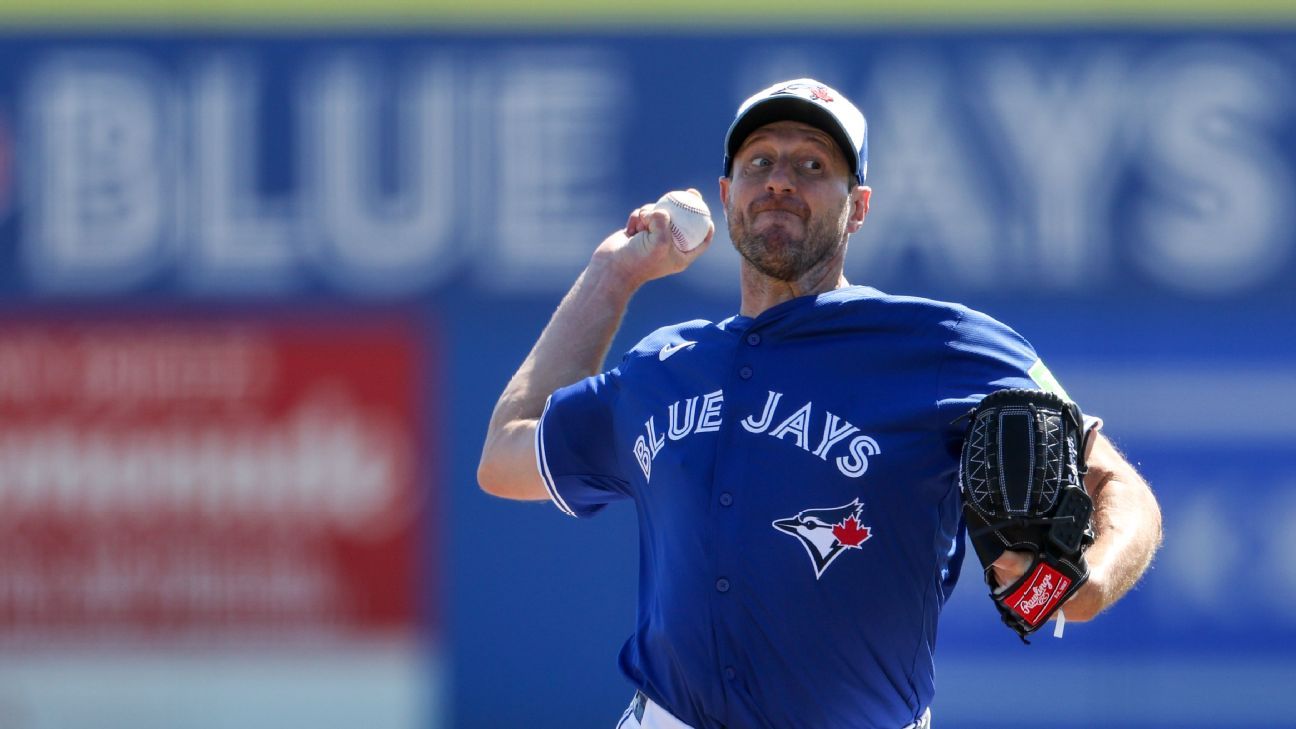
David Schoenfield: 94.5 mph. That’s what Max Scherzer‘s fastball hit during Saturday’s dominant 10-out start against the Tigers, in which the new Blue Jays starter allowed just one hit and struck out six. His numbers through three spring appearances look like vintage Scherzer: 9 IP, 3 H, 2 R, 0 BB, 14 SO. Scherzer missed time last season after offseason back surgery followed by shoulder and hamstring injuries that limited him to nine starts and 43 innings while his fastball averaged just 92.5 mph.
He’s 40 years old and looks healthy. The Blue Jays’ one-year, $15.5 million deal could be one of the offseason’s biggest bargains.

-
Adam Rittenberg
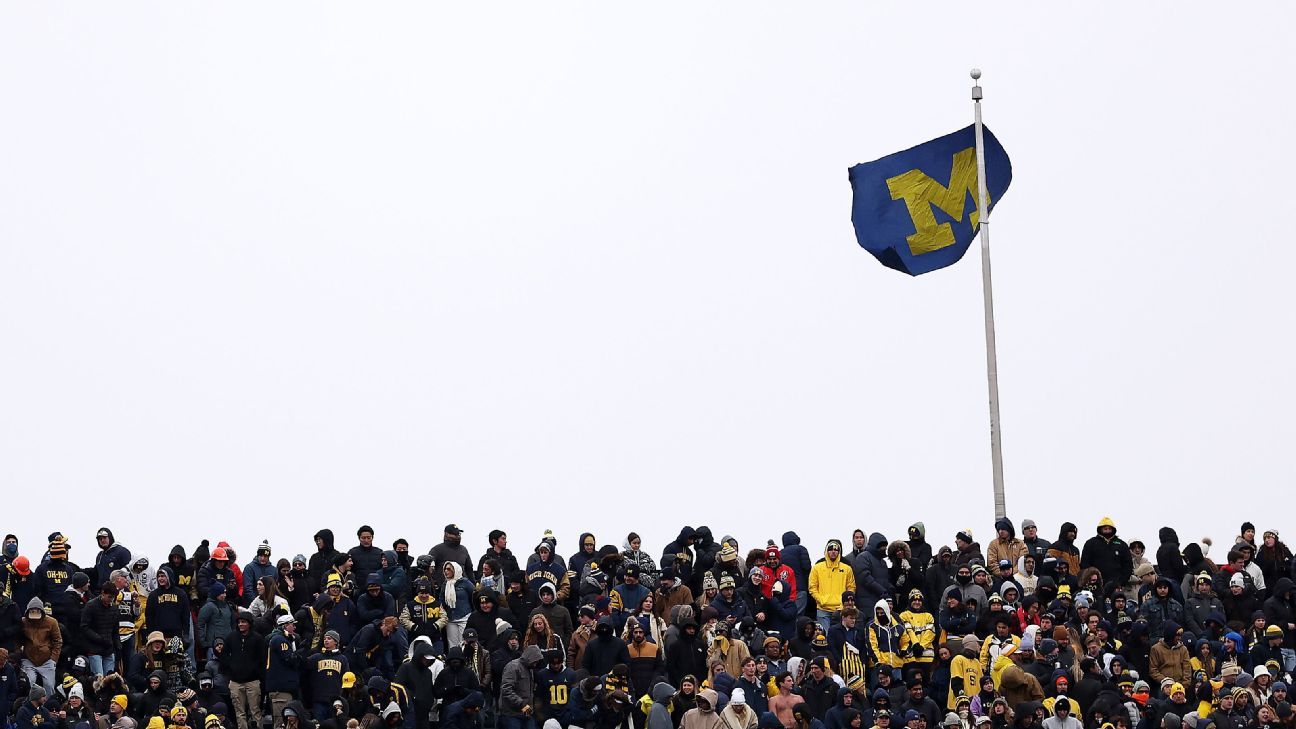
Michigan’s investigation into its football program and wider athletic department could lead to findings of additional misconduct that might trigger more employment terminations, interim university president Domenico Grasso said Wednesday.
In a video statement, Grasso described the week since football coach Sherrone Moore’s firing as “no doubt a challenging time for our university community.”
Michigan fired Moore on Dec. 10 for engaging in an inappropriate relationship with a staff member, discovered through a university investigation. Moore faces three criminal charges, including felony third-degree home invasion, for allegedly confronting the staff member at her residence after being fired.
Michigan’s investigation into Moore’s conduct and the football program continues, and the university commissioned Chicago-based law firm Jenner & Block to conduct a larger review of the athletic department culture, conduct and procedures following a series of scandals.
“We will take whatever steps are necessary to ensure that conduct like this does not happen again,” said Grasso, who took over as interim president in May and will step down when a permanent president is installed. “Make no mistake. We will leave no stone unturned, and any further action we take will be based on credible evidence and findings, developed through a rigorous investigation.
“If the university learns of information through this investigation or otherwise that warrants a termination of any employee, we will act swiftly, just as we did in the case of Coach Moore.”
Grasso encouraged those who have information regarding misconduct within the football program or athletic department to contact Jenner & Block.
“Our focus is strictly on uncovering the facts,” Grasso said. “It is my job, my duty, to ensure the integrity of this investigation.”
Grasso also briefly addressed Michigan’s search for its next football coach. Athletic director Warde Manuel, who has led the department since 2016, has not publicly addressed the search, which he is expected to lead.
Biff Poggi, a Michigan staff member under both Moore and predecessor Jim Harbaugh, is serving as interim head coach for Michigan’s upcoming Cheez-It Citrus Bowl matchup against Texas on Dec. 31.
“We will hire an individual who is of the highest moral character and who will serve as a role model and a respected leader for the entire football program,” Grasso said. “And who will, with dignity and integrity, be a fierce competitor.”

-
Greg Wyshynski
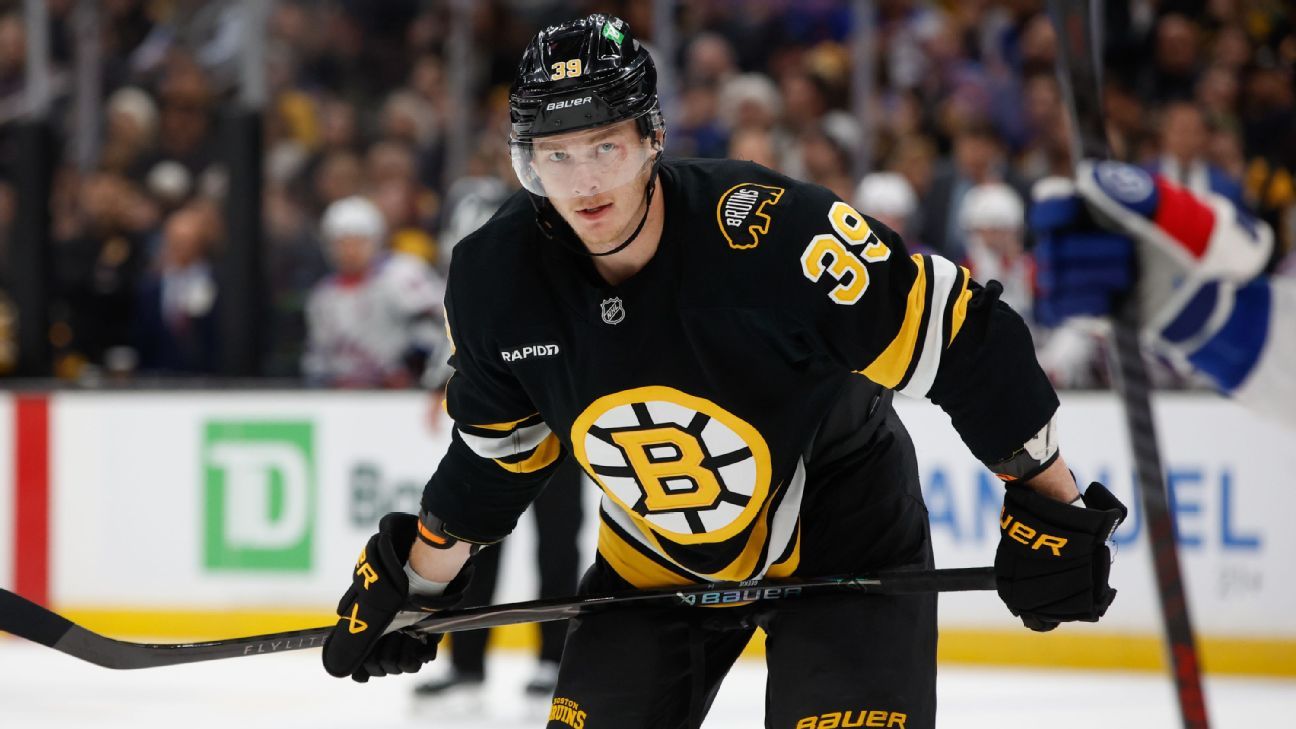
Boston Bruins forward Morgan Geekie can finish a Rubik’s Cube in under a minute.
“I mean, right now I’d be pretty rusty,” he said. “I’m not insane, like those kids that you see on TV, but I’m pretty good at them.”
When Geekie was around 10 years old, a cousin taught him how to speed solve the puzzle. While some have never found a way to line up that mosaic of colors despite years of trying, Geekie said it’s doable once one cracks the code. One summer at their lake cottage, his cousin wrote down its patterns. Geekie spent two weeks memorizing them and working out solutions while fiddling with the cube.
“It’s basically just all algorithms. You just do the same moves all the time once you get the pieces in the right spot. Once you do that, I mean, it’s pretty cut and dry. Everything goes in order,” he said. “I haven’t really forgot. It’s just one of those things that once you know it, you know it.”
Perhaps Geekie just knows how to score goals now, too.
That’s the simplest rationalization for the 27-year-old’s unexpected transformation into one of the NHL’s premier goal scorers. Through 34 games, Geekie is second in the NHL with 24 goals, trailing only the dominant Nathan MacKinnon of the Colorado Avalanche (28). Going back to the start of last season, Geekie is tied for 11th in goals scored (57).
Geekie scored 33 goals in 2024-25, which is 16 more than his previous career high set two years ago with the Bruins. He shot 22%, which obliterated his previous career best of 13.1% set in 2023-24.
There’s always an offensive player whose unexpected scoring surge in one season makes him the consensus choice for regression the following season. Entering this season, that player was Geekie.
He was the first player listed on ESPN’s rundown of regression candidates, with the expectation that he would top out at 26 goals. Sports Illustrated did the same thing, writing that his “offensive numbers are set to dip next season.” Daily Faceoff wrote that Geekie’s shooting percentage was “a strong indication that his performance isn’t sustainable, at least at this level” for the Bruins.
Geekie gets it. He called the predictions “a fair statement” given that he was scoring less than 10 goals in a season with the Seattle Kraken just a few seasons ago.
“I see it all. It’s an easy cherry to pick to be like, ‘Obviously he’s shooting 22%, it’s going to go down.’ It didn’t bother me at all,” Geekie said.
Rather than regress, Geekie has progressed this season. Through 34 games, he is shooting 28.2%.
“I mean, it’s got to go down at some point,” he said, with a laugh. “Like I said, I don’t really pay attention to that and I’m not somebody that has 10 shots a game, so I just try to make the most of my opportunities when I get the puck.”
GEEKIE IS AMUSED by the focus on his shooting percentage, because he feels there are easy explanations for it. The first is that he doesn’t believe he shoots the puck all that much. Over the past two seasons, David Pastrnak averaged 3.79 shots per game in 110 games. Geekie averaged 2.11 in that same span. Only Sidney Crosby (2.45 shots per game) has a lower average than Geekie (2.48) among the top 10 goal-scorers this season.
“I feel like I’m a big quality over quantity person,” he said.
His first season in Boston, coach Jim Montgomery stressed the need for Geekie to get chances from deep inside the attacking zone.
“I think a high-danger chance is better than just shooting it from the wall. That’s kind of the mentality that I’ve had always. I’m not trying to waste shots that aren’t good for anybody,” Geekie said. “Unless I’m trying to create something off it, I’m honestly not trying to put it on net. Maybe that’s why I end up where I end up.”
Pastrnak recently said the Bruins were reminding Geekie to shoot the puck more often. In fairness, Geekie is shooting more this season. Pastrnak said Geekie is “definitely trying to be a little more selfish to take them” when he fights into high-danger areas of the ice. But Geekie acknowledged there are sometimes philosophical differences between his striving for quality over his team’s desire for quantity.
“I think it’s a push and pull,” he said. “It’s like, I don’t think I need to be shooting this, but other people think that it still gives us an opportunity to create a chance. So I just try to keep that in mind when I have the puck”
This is Geekie’s seventh season in the NHL. He was selected by the Carolina Hurricanes with the 67th pick in the 2017 draft as a goal-scoring forward with the WHL Tri-City Americans. His first two seasons as a pro were mostly spent in the AHL with the Charlotte Checkers, before playing 36 games with the Hurricanes in 2020-21.
That summer, the Seattle Kraken held their expansion draft as the NHL’s newest team. Geekie was left off Carolina’s protected list. At the time, it wasn’t expected that former Hurricanes GM Ron Francis would select him for the Kraken, with options like defenseman Jake Bean and forward Nino Niederreiter available from Carolina. But Geekie was the choice, a player whom Francis had drafted while with the Canes.
Geekie had 22 points in 73 games in his first season in Seattle, skating 12:36 per game with just seven goals. His second campaign saw him jump to 28 points in 69 games, but with even less ice time (10:27).
He was a restricted free agent after the 2022-23 season. Francis attempted to re-sign him before the deadline for submitting qualifying offers, but Geekie and his representatives declined it. The two sides couldn’t find common ground. Rather than go to arbitration, where the Kraken weren’t keen on Geekie potentially setting the terms of his next deal, they chose not to qualify him, making him an unrestricted free agent.
“With Morgan, we did make what I felt was a pretty fair offer,” Francis said at the time, via Sound of Hockey. “It didn’t work out, and he has the right once we don’t qualify him to go elsewhere.”
And so he went to Boston, signing a two-year deal worth $4 million in total.
While he wasn’t seeing much time with the Kraken, Geekie felt he was improving as a player. He said a “integral part” of that development was thanks to Jonathan Sigalet, a skills coach who improved all facets of his game.
“When I first started working with him, he was adamant that he wasn’t going to try and make me play like I’m on the first line,” Geekie recalled. “He said, ‘We both know that trying to do things that you do on the first line on the fourth line is going to get you in the press box.'”
He said working with Siglet slowed the game down for him. He started to see the game differently. He began to see “little tendencies” that all of the NHL’s good players share. Geekie also appreciated having a “third party” assessment for his play, apart from that of his coaches and his own.
Geekie was immediately given an opportunity to thrive in Boston in 2023-24, playing 15:21 in his first game with the Bruins. He ended up averaging 15:25 per game, with 17 goals and 22 assists in 76 games. He earned time with Pastrnak and Pavel Zacha on the Bruins’ top line.
His follow-up season didn’t start well. Geekie scored one goal in his first 17 games and was a healthy scratch early in the season. Some trade whispers started about him as a pending restricted free agent. He had eight goals by the end of the 2024 calendar year.
How did he end up with 33 of them? With one of the greatest goal-scoring heaters this side of Alex Ovechkin: Geekie scored 14 goals in his last 20 games of the season. His chemistry with Pastrnak was undeniable — the Bruins scoring ace assisted on 21 of Geekie’s 33 goals last season.
Geekie expressed a desire to stay with the Bruins. The feeling was mutual, as GM Don Sweeney in June handed him a six-year, $33 million contract for a team-friendly $5.5 million annual cap hit.
WHEN GEEKIE SIGNED his new contract, he decided he wanted to join in the tradition of NHL players celebrating a windfall with their teammates. It’s usually a dinner or something of that nature.
But Geekie wanted to do something different.
“Everybody’s eating at the same restaurants in every city. And I’m sure they’d remember it for a little while, but I think it would be just one of those things like, ‘Hey, thanks for dinner.’ So I wanted to do something a little more nostalgic,” he said.
Geekie is a huge baseball fan who played competitively until his late teens. He was in the process of designing a personalized baseball glove for himself through a company called 44 Pro Custom Gloves when his wife, Emma, suggested that he design ones for all of his teammates as a gift.
Geekie started the process in July, sketching out what he wanted on the gloves for 30 teammates — including players that were on the bubble for the Bruins’ roster this season. He had the biographical information for them, from their birth cities and countries to their schools to where they played junior hockey.
“Honestly, for probably three weeks, I just sat in front of my TV watching baseball and I would just draft gloves up. I thought it was so fun,” Geekie said. “My wife got sick of me for a little while.”
He would FaceTime his brother Noah, a coach at Okotoks Dawgs Academy in Alberta, to bounce the designs off him and get input. He was cognizant of having the designs as unique as possible, despite some of the school colors being similar for his teammates.
Before a practice in October, Geekie delivered the gloves to the locker room stalls of his teammates. It went over well.
“Baseball is not that big in Sweden, but it’s obviously cool to have,” center Elias Lindholm told the Bruins website, having received a glove with a Swedish flag on it. “Hopefully, when my kids get a little bit older, we can play a little game or something. For now, it is just going to be at home, resting.”
0:17
Morgan Geekie nets goal for Bruins
Morgan Geekie nets goal for Bruins
While the gloves were a chance to celebrate with his teammates, there weren’t many celebrations anticipated for Boston this season. The Bruins were trading players away at last season’s trade deadline, sending mainstays like captain Brad Marchand (Florida), center Charlie Coyle (Colorado) and defenseman Brandon Carlo (Toronto) elsewhere. They had an incoming first-year coach in Marco Sturm. At best, it was supposed to be a transition year for the Bruins.
But through 34 games, Boston is second in the Atlantic Division with a 20-14-0 record, within a point of division-leading Detroit in the crowded Eastern Conference.
Many around the NHL were surprised. Geekie wasn’t.
“We underperformed. Last season was like the perfect storm of bad events with our kind of discombobulated training camp and then having a coaching change and just kind of everything that could have went wrong went wrong,” Geekie said. “The core group we have is just too good to be written off. But I understand why people had doubts about us.”
But defying doubts is what Morgan Geekie’s all about, whether it’s his team’s predicted finish in the standings or his own predicted regression as a scorer.
“He has everything to score 50 in this league,” Pastrnak said. “He has a heck of a shot. He has the goal-scoring instincts. He is going to get it one day.”
-
 Sports2 years ago
Story injured on diving stop, exits Red Sox game
-
 Sports3 years ago
‘Storybook stuff’: Inside the night Bryce Harper sent the Phillies to the World Series
-
 Sports2 years ago
Game 1 of WS least-watched in recorded history
-
 Sports3 years ago
Button battles heat exhaustion in NASCAR debut
-
 Sports3 years ago
MLB Rank 2023: Ranking baseball’s top 100 players
-
Sports4 years ago
Team Europe easily wins 4th straight Laver Cup
-
 Environment3 years ago
Japan and South Korea have a lot at stake in a free and open South China Sea
-
 Environment1 year ago
Here are the best electric bikes you can buy at every price level in October 2024