

ChargePoint deploys DC fast charging stations in upstate New York – why it’s a win

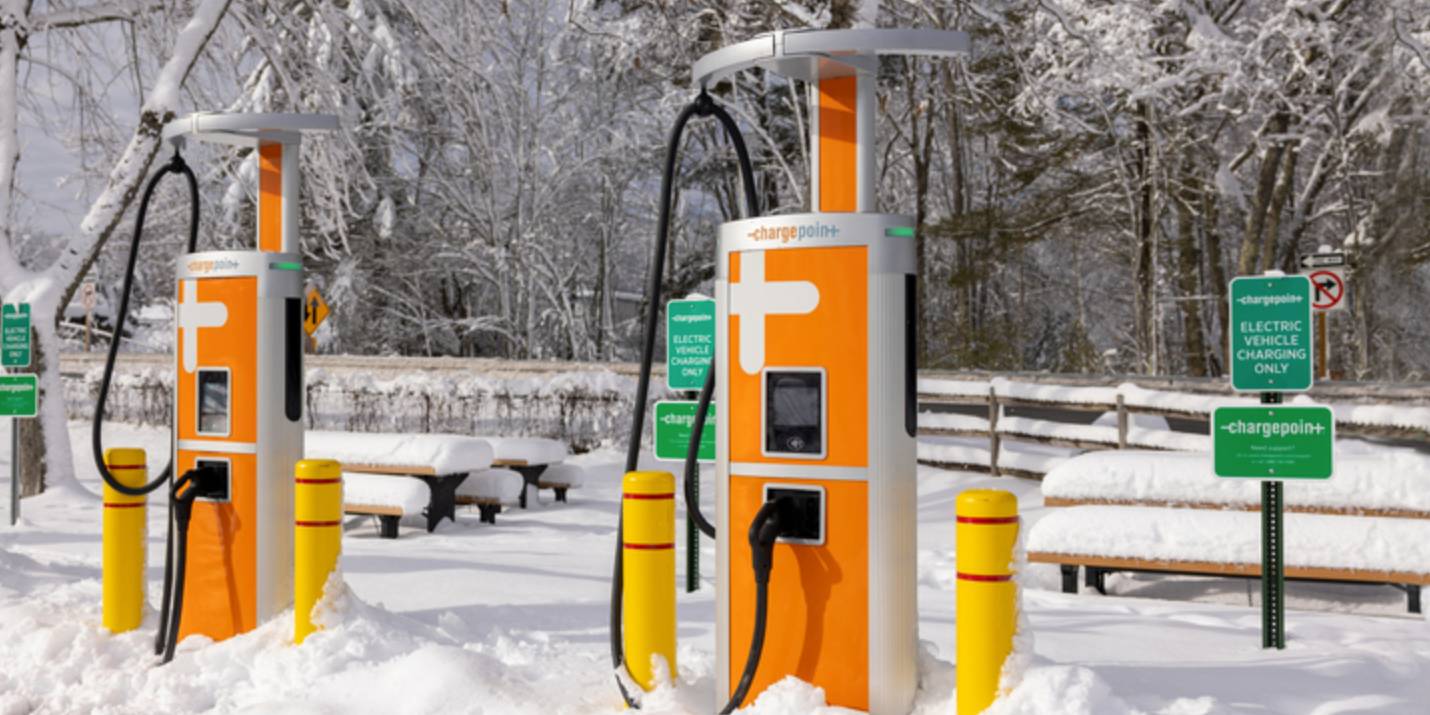
ChargePoint has brought five new DC fast charging stations online in upstate New York, supported by key funding from the New York State Energy Research and Development Authority (NYSERDA).
ChargePoint’s fast charging stations are in Cortland, Waterloo, Lake Placid, Niagara Falls, and Ripley. With ChargePoint’s mobile app, EV drivers can find, use, and pay for charging at the new locations.
“ChargePoint’s collaboration with NYSERDA demonstrates the critical role that public-private partnerships will continue to play in the build out of charging infrastructure, particularly at the state level,” said Rick Wilmer, CEO of ChargePoint. “When all types of institutions work together to defray costs, much-needed EV charging infrastructure can scale at an accelerated pace.”
NYSERDA’s support, through its Clean Transportation program, enables the build-out of critical EV charging infrastructure across New York State, reducing the capital investment needed to deploy public charging sites. This includes building out access in underserved communities, defined as disadvantaged communities by New York State’s Climate Justice Working Group. Fifty percent of the fast-charging stations funded through this program will be located in communities designated as disadvantaged.
Electrek’s Take
The Trump administration is actively working to dismantle federal support for the buildout of the NEVI program and DC fast charger rollout in general. That’s pretty dumb, considering EV adoption is surging, and the electric vehicle industry has already created thousands of American jobs up and down a rapidly expanding supply chain.
But states and utilities are stepping up with their own incentives, and this partnership between ChargePoint and New York State is exactly the kind of success story that keeps the momentum rolling. Trump might tap the brakes on federal support for DC fast chargers, but he can’t derail the progress completely. States like New York that are serious about building out EV charging infrastructure are moving forward – no matter what.

Read more: New York awards $60M to Revel to install 267 DC fast chargers
If you live in an area that has frequent natural disaster events, and are interested in making your home more resilient to power outages, consider going solar and adding a battery storage system. To make sure you find a trusted, reliable solar installer near you that offers competitive pricing, check out EnergySage, a free service that makes it easy for you to go solar. They have hundreds of pre-vetted solar installers competing for your business, ensuring you get high quality solutions and save 20-30% compared to going it alone. Plus, it’s free to use and you won’t get sales calls until you select an installer and share your phone number with them.
Your personalized solar quotes are easy to compare online and you’ll get access to unbiased Energy Advisers to help you every step of the way. Get started here. –trusted affiliate link*
FTC: We use income earning auto affiliate links. More.
Environment
Trump halts wind projects, including Coastal Virginia Offshore Wind, Dominion stock drops 5%


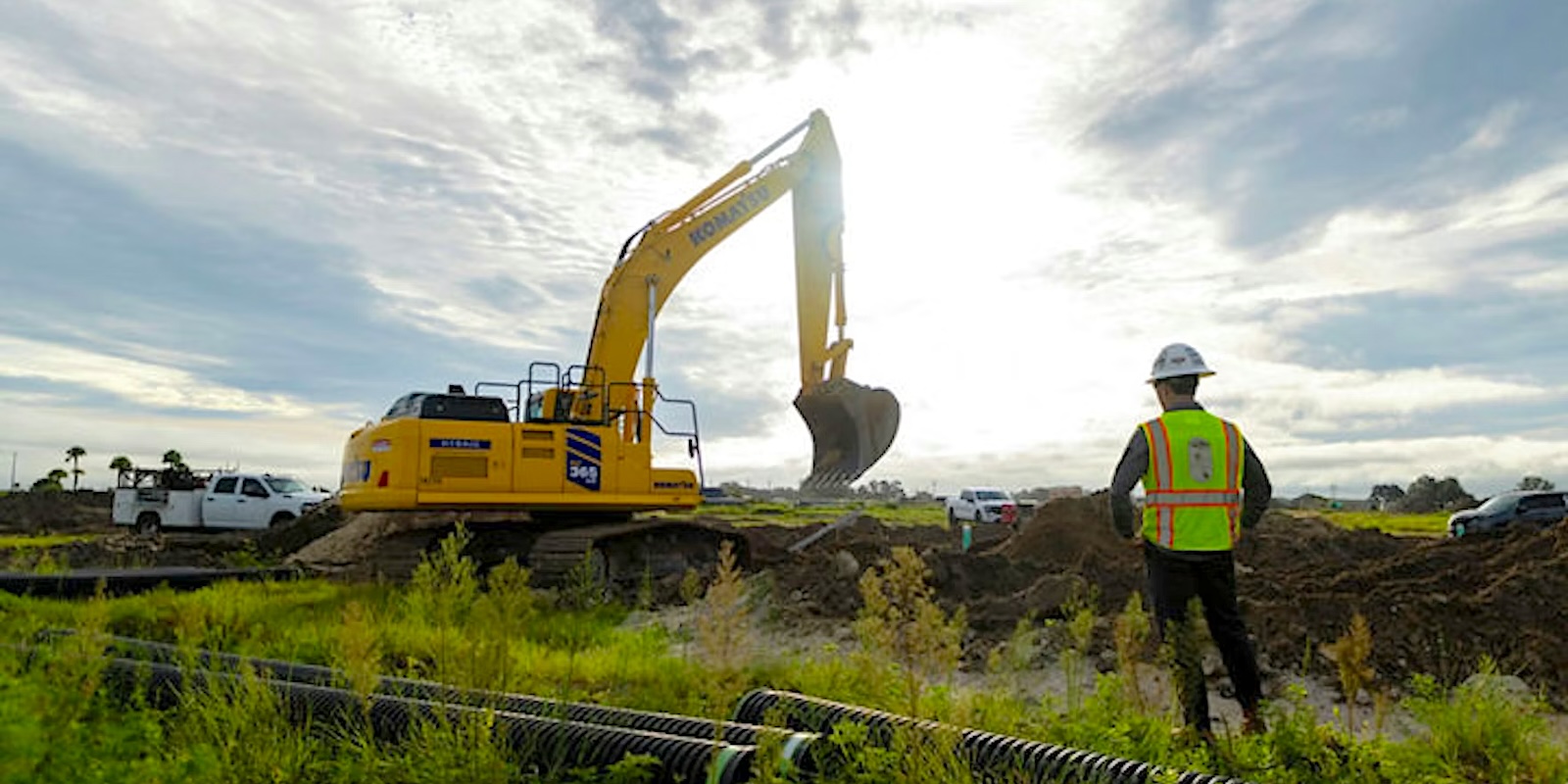
Thanks to a clever, fully electric swing system and “boom up” power assist features, the big PC365-11 hybrid excavator from Komatsu promises better performance and serious fuel savings compared to conventional diesel machines.
Komatsu says its PC365-11 hybrid excavator uses a “boom-up” power assist feature that captures and stores kinetic energy during different operation cycles, then taps into that power to provide an extra energy boost when needed. The result is 15% more productivity and a 20% improvement in fuel efficiency when compared to non-hybrid excavators in ~40 ton class.
“The PC365LC-11 was engineered for excellence in multifunction applications by leveraging its innovative electric powertrain system to boost job site productivity while reducing fuel consumption,” says Matthew Moen, Komatsu’s product manager. “To highlight these performance enhancements, we’re emphasizing the concept of ‘multifunction plus’ as the defining feature of this machine.”
How it works
Komatsu’s hybrid system replaces the conventional hydraulic swing function with a fully electric swing motor that draws power from an ultracapacitor (as opposed to a battery) energy storage unit. As excavator slows or stops swinging, something like a regenerative braking system captures the kinetic energy that would normally be lost as heat and stores it in the capacitor. Once there, the stored energy can be quickly released to power the swing motor or assist the engine, delivering up to an extra 70 hp when needed to support heavy lifting or digging cycles.
And, thanks to Komatsu’s proprietary software, all of this energy capture and reuse happens automagically during normal work, without the need for external charging. The fuel savings happen because removing the hydraulic load from the ICE engine allows it to run at an ultra-low idle, while the productivity comes from the greater power and overall speed of the electric operations vs. conventional hydraulics.
Electrek’s Take
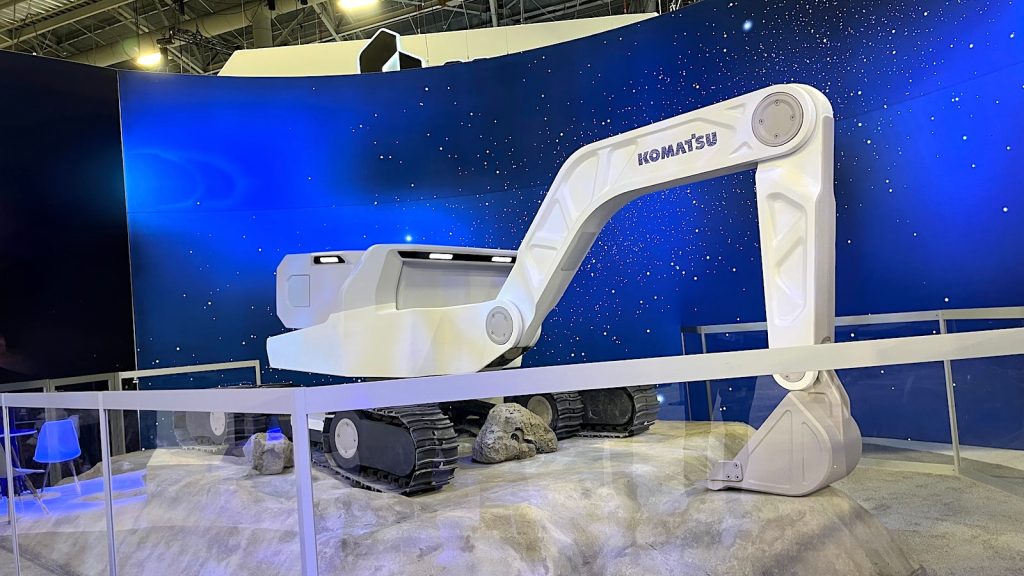
Trust me when I tell you that Komatsu didn’t wake up one day and decide to build a capacitor-based hybrid crane. One of their customers had the idea and came to them, promising orders. That’s what Komatsu does – from undersea remote control dozers to lunar mining rigs (above), if you bring Komatsu an order, they will absolutely find a way to fill it.
As for PC365-11 hybrid excavator, it’s packed with clever tech, overall – offering significant fuel, emissions, and TCO reductions without dramatically changing the operational logistics of an existing fleet’s operations. That’s all the sales pitch it needs.
SOURCE: Komatsu, via Equipment World.

If you’re considering going solar, it’s always a good idea to get quotes from a few installers. To make sure you find a trusted, reliable solar installer near you that offers competitive pricing, check out EnergySage, a free service that makes it easy for you to go solar. It has hundreds of pre-vetted solar installers competing for your business, ensuring you get high-quality solutions and save 20-30% compared to going it alone. Plus, it’s free to use, and you won’t get sales calls until you select an installer and share your phone number with them.
Your personalized solar quotes are easy to compare online and you’ll get access to unbiased Energy Advisors to help you every step of the way. Get started here.


FTC: We use income earning auto affiliate links. More.

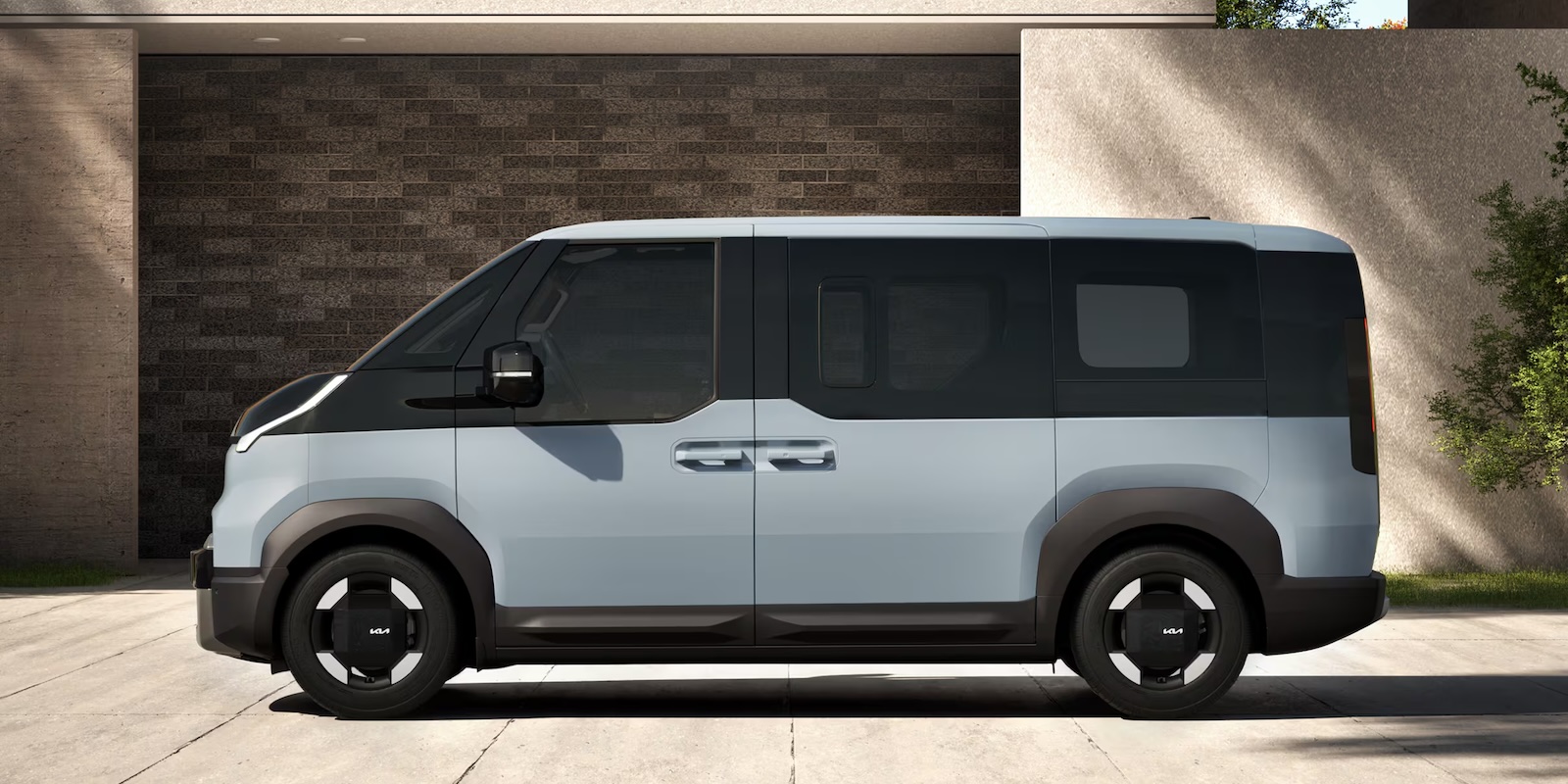
For serious fleet buyers, safety isn’t a “nice-to-have,” it’s an absolute must – and Kia’s new PV5 electric van meets that need with a positively stellar, five-star safety rating on the tough European NCAP safety test.
The new “do-it-all” Kia PV5 showed strong performance across a number of key safety categories, including Occupant Protection, Safety Assist/Crash Avoidance, and Post-Crash Safety. The PV5’s robust suite of standard ADAS technologies that includes AEB, Lane Support System, and Speed Assistance System also helped the new electric work van to deliver top marks in the NCAP’s “real world” test scenarios.
“The PV5 opens a new chapter in practical, electrified mobility, offering generous space and modular versatility for everyday use,” explains Sangdae Kim, Executive Vice President and Head of the (relatively) new PBV Business Division at Kia. “Achieving the top Euro NCAP five-star rating is clear validation of its safety performance and will serve as strong momentum as Kia expands its PBV lineup across Europe.”
The Euro NCAP tests highlighted the strong performance of a number of the PV5’s ADAS features, specifically calling out the following:
- Demonstrated strong responsiveness in vehicle-to-vehicle scenarios
- Provides additional protection for pedestrians behind the vehicle
- Avoided collisions in most pedestrian and cyclist test cases
The Kia PV5 slots into familiar territory for US buyers, landing roughly in the same size class as the Ford Transit Connect or Ram ProMaster City, with ~180 cubic feet of interior cargo space available, which is plenty to make it attractive for last-mile delivery and trade work in tight urban markets.
Globally, the PV5 is offered with a number of battery options, including a smaller 43.3 kWh Lithium-Iron-Phosphate (LFP) pack, as well as larger Nickel-Cobalt-Manganese (NCM) packs at 51.5 kWh and 71.2 kWh. The longest-range versions are good for about 250 miles of estimated range – more than enough for Kia to make a case for it as a practical, city-focused alternative to much larger (and pricier) electric vans.
Larger vans, by the way, that may not have that 5 star Euro NCAP rating.
Kia PV5
SOURCE | IMAGES: Kia; photo by Scooter Doll.
If you’re considering going solar, it’s always a good idea to get quotes from a few installers. To make sure you find a trusted, reliable solar installer near you that offers competitive pricing, check out EnergySage, a free service that makes it easy for you to go solar. It has hundreds of pre-vetted solar installers competing for your business, ensuring you get high-quality solutions and save 20-30% compared to going it alone. Plus, it’s free to use, and you won’t get sales calls until you select an installer and share your phone number with them.
Your personalized solar quotes are easy to compare online and you’ll get access to unbiased Energy Advisors to help you every step of the way. Get started here.
FTC: We use income earning auto affiliate links. More.
-
 Sports2 years ago
Story injured on diving stop, exits Red Sox game
-
 Sports3 years ago
‘Storybook stuff’: Inside the night Bryce Harper sent the Phillies to the World Series
-
 Sports2 years ago
Game 1 of WS least-watched in recorded history
-
 Sports3 years ago
Button battles heat exhaustion in NASCAR debut
-
 Sports3 years ago
MLB Rank 2023: Ranking baseball’s top 100 players
-
Sports4 years ago
Team Europe easily wins 4th straight Laver Cup
-
 Environment3 years ago
Japan and South Korea have a lot at stake in a free and open South China Sea
-
 Environment1 year ago
Here are the best electric bikes you can buy at every price level in October 2024