

Ripple secures Dubai license to offer crypto payments in UAE

Blockchain payment provider Ripple received full regulatory approval from the Dubai Financial Services Authority (DFSA) to offer cross-border crypto payment services in the United Arab Emirates (UAE).
The company announced on March 13 that it had secured its DFSA license, allowing it to operate in the Dubai International Financial Center (DIFC), a UAE free-economic zone with its own tax policies and regulatory framework.
The announcement came almost six months after the company announced its receipt of an in-principle approval of the DFSA license. On Oct. 1, 2024, Ripple revealed that it was working to become licensed by the DFSA as it aimed to roll out its digital asset infrastructure in the UAE.
Enabling blockchain-based global payments for UAE businesses
With this license, Ripple can now provide its global blockchain-based payment solutions to businesses across the UAE. The company said this allows it to cater to financial institutions looking for partners to help them use digital assets in real-world applications.
In a news release sent to Cointelegraph, Ripple CEO Brad Garlinghouse said the UAE is “well-placed” to benefit from tech and crypto innovation, thanks to its early leadership and supportive environment:
“We are entering an unprecedented period of growth for the crypto industry, driven by greater regulatory clarity around the world and increasing institutional adoption.”
Ripple also reported that it had seen increased demand across the Middle East for cross-border payments. The company said the demand was not limited to crypto-native firms but also came from traditional financial institutions.
Related: UAE to introduce legal framework for DAOs
Ripple becomes the first crypto payment provider in the DIFC
With DFSA approval, Ripple has become the first blockchain-enabled payments provider to operate within DIFC’s free zone, according to DIFC CEO Arif Amiri.
”We are thrilled that Ripple is deepening their commitment to Dubai by securing a DFSA license that makes them the first blockchain-enabled payments provider in DIFC,” he said.
The license allows Ripple to tap into opportunities in the UAE and the broader MENA region, he added.
Magazine: The Sandbox’s Sebastien Borget cringes at the word ‘influencer’: X Hall of Flame

The TON Foundation could have avoided its golden visa controversy in the UAE with a brief legal review, a local lawyer told Cointelegraph.
Politics
Norman Tebbit: Former Tory minister who served in Margaret Thatcher’s government dies aged 94
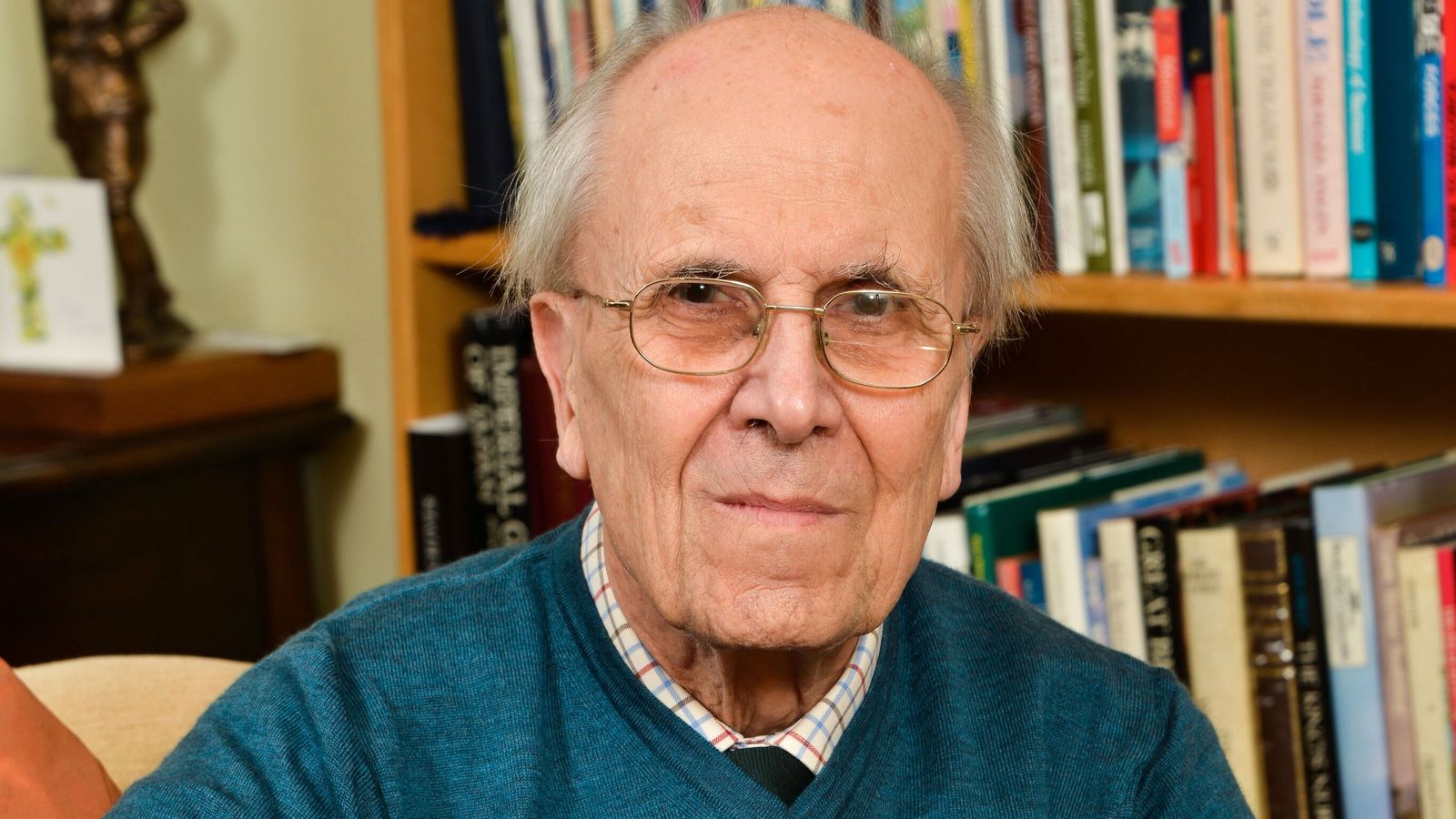
Norman Tebbit, the former Tory minister who served in Margaret Thatcher’s government, has died at the age of 94.
Lord Tebbit died “peacefully at home” late on Monday night, his son William confirmed.
One of Mrs Thatcher’s most loyal cabinet ministers, he was a leading political voice throughout the turbulent 1980s.
He held the posts of employment secretary, trade secretary, Chancellor of the Duchy of Lancaster and Conservative party chairman before resigning as an MP in 1992 after his wife was left disabled by the Provisional IRA’s bombing of the Grand Hotel in Brighton.
He considered standing for the Conservative leadership after Mrs Thatcher’s resignation in 1990, but was committed to taking care of his wife.
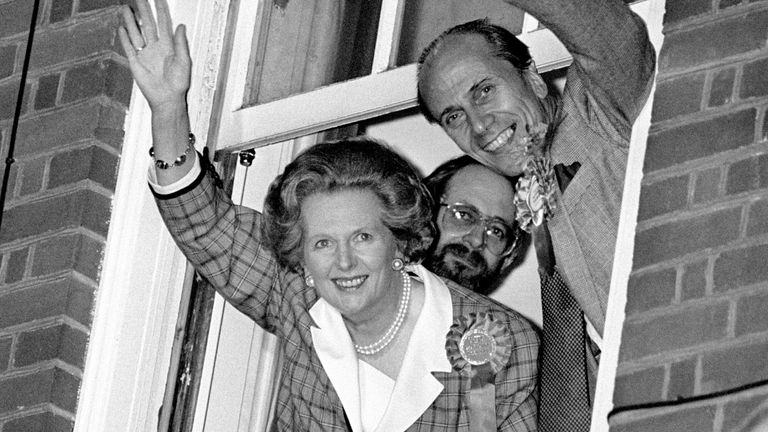
Margaret Thatcher and Norman Tebbit in 1987 after her election victory. Pic: PA
Tory leader Kemi Badenoch called him an “icon” in British politics and was “one of the leading exponents of the philosophy we now know as Thatcherism”.
“But to many of us it was the stoicism and courage he showed in the face of terrorism, which inspired us as he rebuilt his political career after suffering terrible injuries in the Brighton bomb, and cared selflessly for his wife Margaret, who was gravely disabled in the bombing,” she wrote on X.
“He never buckled under pressure and he never compromised. Our nation has lost one of its very best today and I speak for all the Conservative family and beyond in recognising Lord Tebbit’s enormous intellect and profound sense of duty to his country.
“May he rest in peace.”

Lord Tebbit and his wife Margaret stand outside the Grand Hotel in Brighton. Pic: PA
Tory grandee David Davis told Sky News Lord Tebbit was a “great working class Tory, always ready to challenge establishment conventional wisdom for the bogus nonsense it often was”.
“He was one of Thatcher’s bravest and strongest lieutenants, and a great friend,” Sir David said.
“He had to deal with the agony that the IRA visited on him and his wife, and he did so with characteristic unflinching courage. He was a great man.”
Reform leader Nigel Farage said Lord Tebbit “gave me a lot of help in my early days as an MEP”.
He was “a great man. RIP,” he added.
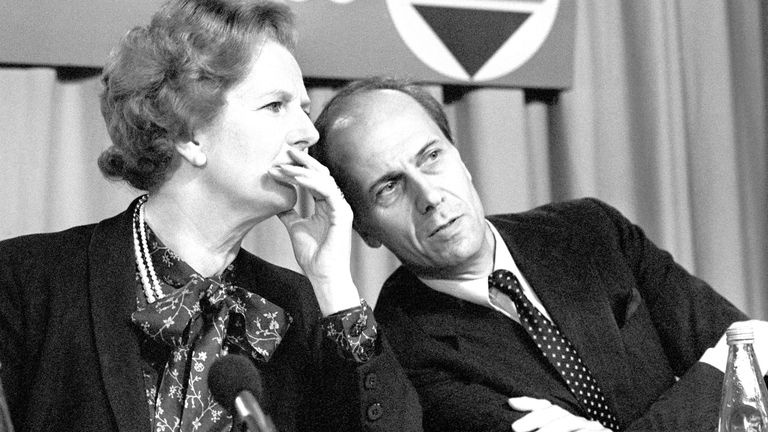
Lord Tebbit as employment secretary in 1983 with Mrs Thatcher. Pic: PA
Born to working-class parents in north London, he was made a life peer in 1992, where he sat until he retired in 2022.
Lord Tebbit was trade secretary when he was injured in the Provisional IRA’s bombing in Brighton during the Conservative Party conference in 1984.
Five people died in the attack and Lord Tebbit’s wife, Margaret, was left paralysed from the neck down. She died in 2020 at the age of 86.
Before entering politics, his first job, aged 16, was at the Financial Times where he had his first experience of trade unions and vowed to “break the power of the closed shop”.
He then trained as a pilot with the RAF – at one point narrowly escaping from the burning cockpit of a Meteor 8 jet – before becoming the MP for Epping in 1970 then for Chingford in 1974.

Lord Tebbit during an EU debate in the House of Lords in 1997. Pic: PA
As a cabinet minister, he was responsible for legislation that weakened the powers of the trade unions and the closed shop, making him the political embodiment of the Thatcherite ideology that was in full swing.
His tough approach was put to the test when riots erupted in Brixton, south London, against the backdrop of high rates of unemployment and mistrust between the black community and the police.
He was frequently misquoted as having told the unemployed to “get on your bike”, and was often referred to as “Onyerbike” for some time afterwards.
What he actually said was he grew up in the ’30s with an unemployed father who did not riot, “he got on his bike and looked for work, and he kept looking till he found it”.

-
 Sports3 years ago
‘Storybook stuff’: Inside the night Bryce Harper sent the Phillies to the World Series
-
 Sports1 year ago
Story injured on diving stop, exits Red Sox game
-
 Sports2 years ago
Game 1 of WS least-watched in recorded history
-
 Sports2 years ago
MLB Rank 2023: Ranking baseball’s top 100 players
-
Sports4 years ago
Team Europe easily wins 4th straight Laver Cup
-
 Environment2 years ago
Japan and South Korea have a lot at stake in a free and open South China Sea
-
 Sports2 years ago
Button battles heat exhaustion in NASCAR debut
-
 Environment2 years ago
Game-changing Lectric XPedition launched as affordable electric cargo bike