
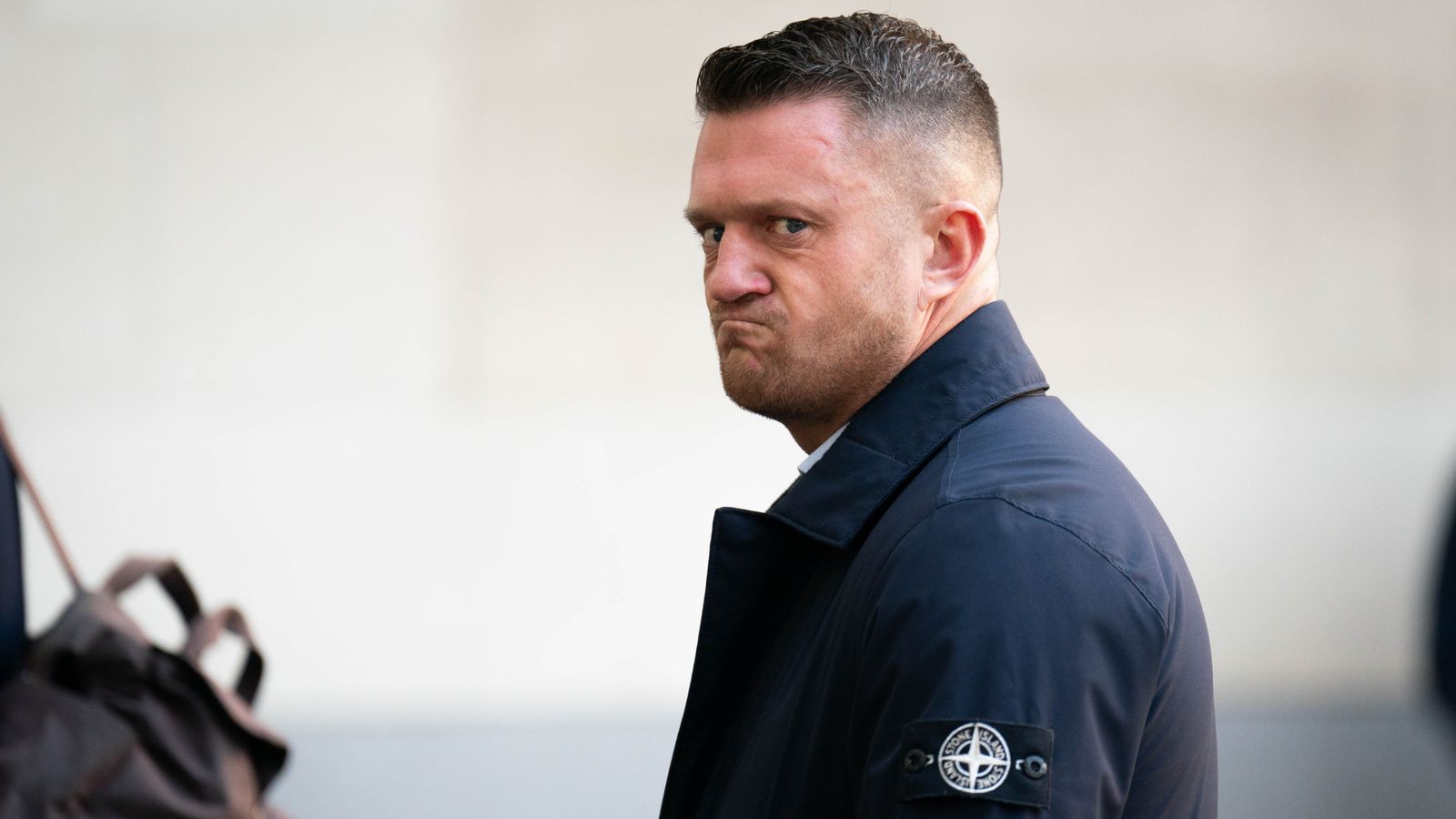
Tommy Robinson loses bid to challenge prison segregation in High Court

Tommy Robinson has lost a bid to bring a High Court challenge over his segregation in prison.
A judge has refused permission for the far-right activist’s application for a judicial review after he brought legal proceedings against Justice Secretary Shabana Mahmood.
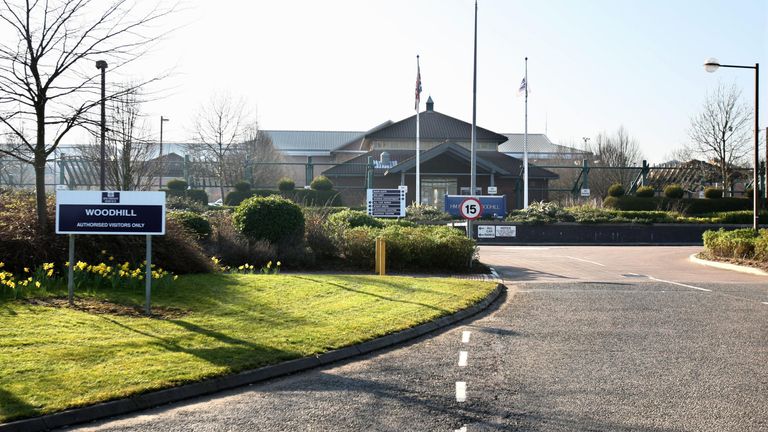
The High Court was told Robinson, 42, whose real name is Stephen Yaxley-Lennon, was moved to a “closed” unit at Woodhill prison in Milton Keynes after intelligence suggested he “would be killed by a lifer if located on a wing”.
He was jailed for 18 months last October after admitting 10 breaches of a High Court injunction, which banned him from repeating false claims about a Syrian refugee.
Robinson was initially taken to Belmarsh prison, in southeast London, where he told staff “his conflict is with followers of Islam”.
HMP Woodhill, Milton Keynes
But he was moved to Woodhill after “a large volume of abusive and racist emails and telephone calls were received from his supporters”, according to the judgment.
They included “threats towards the (Belmarsh) governor” Jenny Louis, who is a black woman, the judge Mr Justice Chamberlain said.
Robinson’s lawyers argued his segregation was a breach of his rights under the European Convention on Human Rights and has caused an “evident decline in his mental health”.
His barrister Alisdair Williamson KC said the “significant Muslim population” in Woodhill appears to be “causing a difficulty” and argued he should be moved to another jail, where he could associate with other prisoners ahead of his release on 26 July.
He said Robinson, who he described as a journalist, suffered from ADHD and complex post-traumatic stress disorder (PTSD) first triggered by his solitary confinement during an earlier prison sentence.
Mr Williamson said that Robinson is worried about his mental health on his release because “he self-harms by abusing substances in order to cope with the stress caused by being held in solitary confinement”.
But Tom Cross, representing the government, said it was “not an arguable claim” and revealed details of the privileges enjoyed by Robinson, who is a Category C civil prisoner, behind bars.
Hundreds of emails, dozens of visits and 1,250 phone calls
Woodhill prison governor Nicola Marfleet said in a statement he gets three hours out of his cell every day – when he can exercise, use the gym or play recreational games such as pool – and another two hours and 45 minutes three times a week when he does painting and decorating work.
She said he has “significantly more visit time than any other prisoner”, with two hours, four times a week, in a room described as “more informal and comfortable”, where he can take in food he’s bought from the canteen.
Robinson has 120 people on his visitors list and has had 93 visits, while he can use the phone for four hours a day and has made more than 1,250 social calls.
Read more from Sky News:
Heathrow passengers shouldn’t travel to airport
Stephen Lawrence killer admits role in attack
Robinson has a television, laptop – on which he receives emails “in their hundreds” – a CD player and a DVD player in his cell, the court heard.
He also attends a weekly bible session and has daily visits from a member of the chaplaincy team and daily visits from an NHS doctor or nurse.
‘Not solitary confinement’
In a ruling, stating Robinson’s case was “not arguable”, the judge said: “It is not accurate to refer to Mr Yaxley-Lennon’s regime as ‘solitary confinement’ at all.”
He accepted the “absence of association with other prisoners has an effect on his mental health” but said it was “not arguable that the regime as a whole gives rise to a breach” of his human rights.
In written submissions, the judge was told after his transfer to Woodhill, Robinson was identified as being of “high interest” to other prisoners and was put in a closed wing at the back of the segregation unit, which can’t be accessed by other inmates.
Intelligence reports suggested two other prisoners were plotting to attack Robinson to gain “kudos and notoriety”, and that he had a “mark on his head” and “would be killed by a lifer if located on a wing”, according to the submissions.
The governor also feared Robinson’s presence on a normal wing would “exacerbate” tensions between Muslim and non-Muslim prisoners and that he may “pose a risk by seeking to radicalise and/or influence other prisoners”, according to her statement.
UK
World Cup 2026 – who England, Scotland, Wales, Northern Ireland and the Republic of Ireland will play
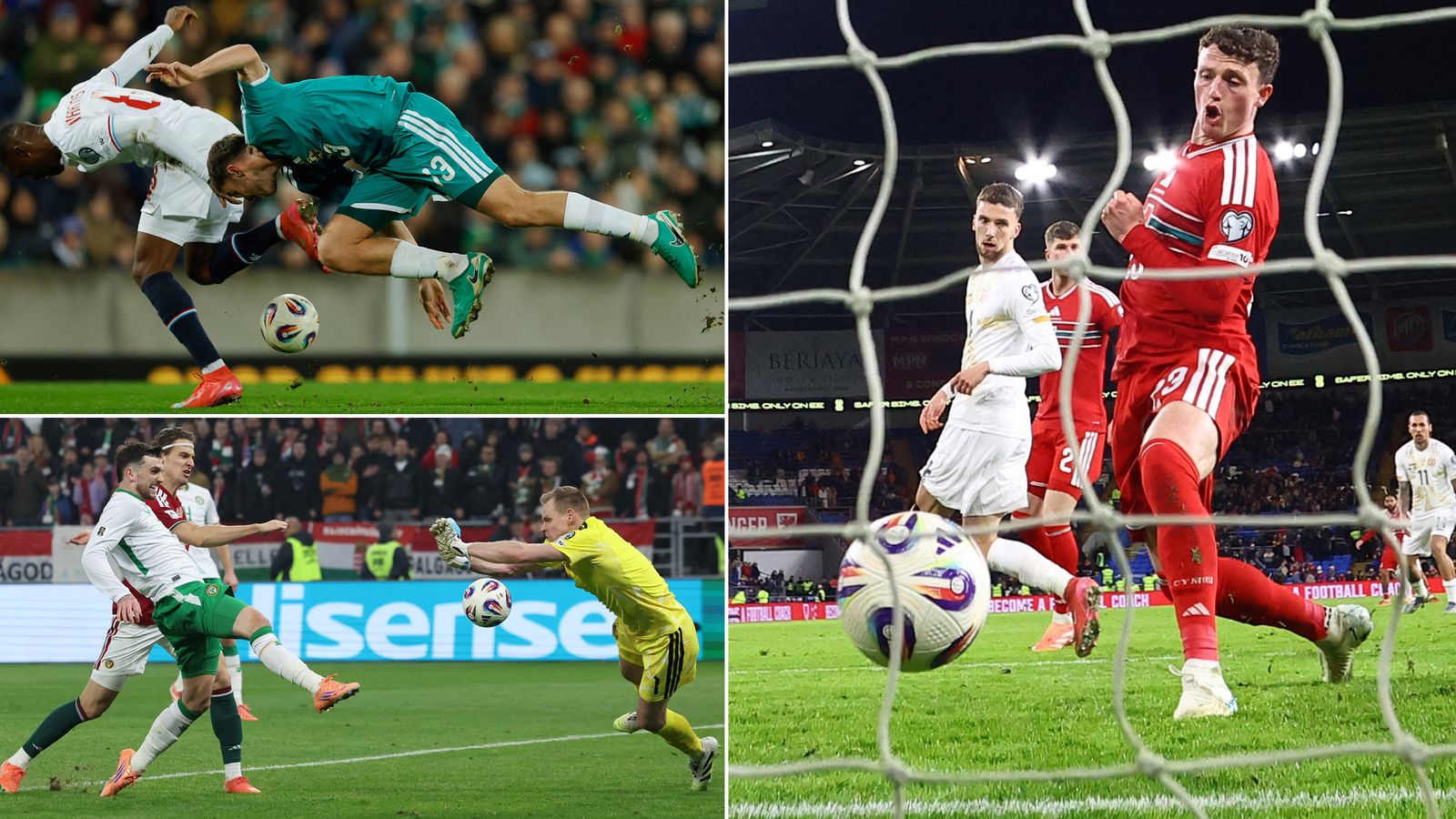
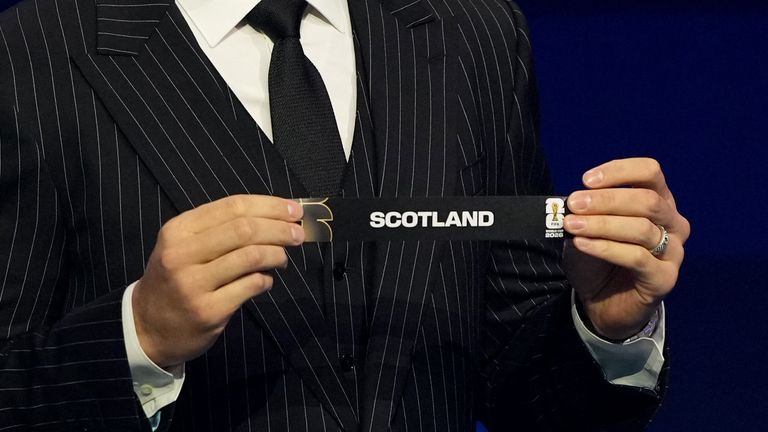
Scotland and England now know who they will face in the group stage of the next summer’s world cup.
But the fates of Northern Ireland, the Republic of Ireland and Wales won’t be determined until they compete in pre-tournament play-off matches in March.
England are in Group L along with Croatia, Panama and Ghana. Their first match will be against Croatia, who beat them in the semi-finals of the 2018 World Cup in Russia.
Pic: Reuters
Scotland’s first match will be against Haiti, in Group C.
Brazil and Morocco are the other Group C teams – both countries were also in the same opening group as Scotland in the 1998 World Cup in France.
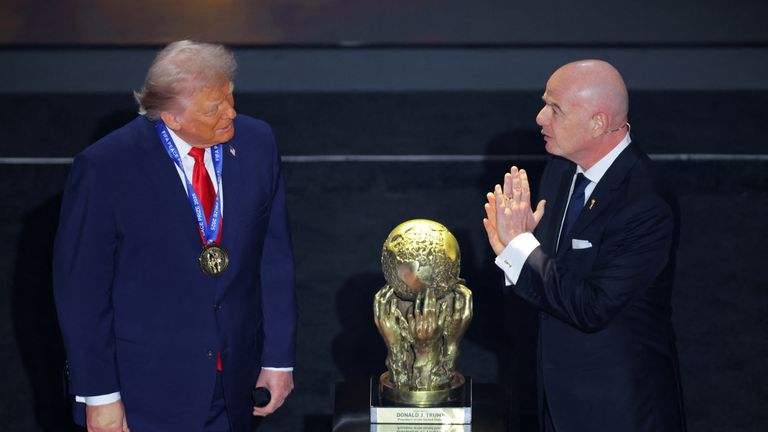
Trump and Infantino at the World Cup draw
Wales have yet to find out if they will qualify as they must face a play-off against Bosnia and Herzegovina in Cardiff, and then either Italy or Northern Ireland, if they are victorious.
Read more:
EasyJet staff at Luton Airport to strike over Christmas
If they can overcome these play-off opponents then they will secure their place in Group B along with Canada, Qatar and Switzerland. But Northern Ireland will also be vying and hoping to guarantee their spot in the same group if they can beat Italy and then either Wales or Bosnia and Herzegovina.
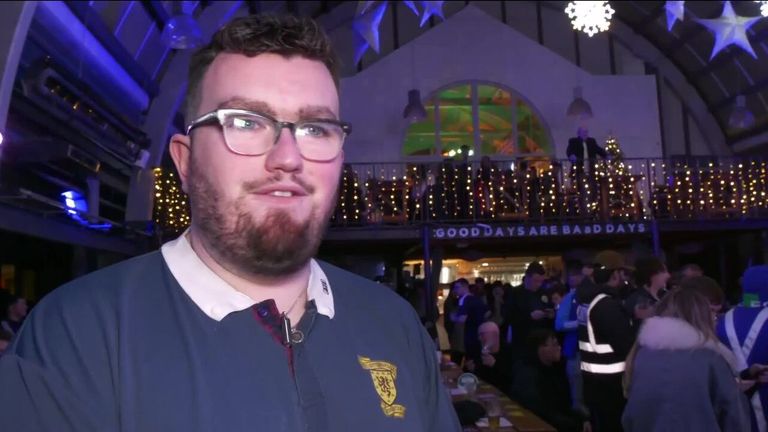
‘Bring it on!’: Scotland fans react to World Cup draw
The Republic of Ireland also need to get through the play-offs first and are paired against the Czech Republic for their semi-final. Should Ireland win that match, they will need to beat either North Macedonia or Denmark to get to the finals where an opening group containing joint hosts Mexico, South Africa and South Korea awaits.
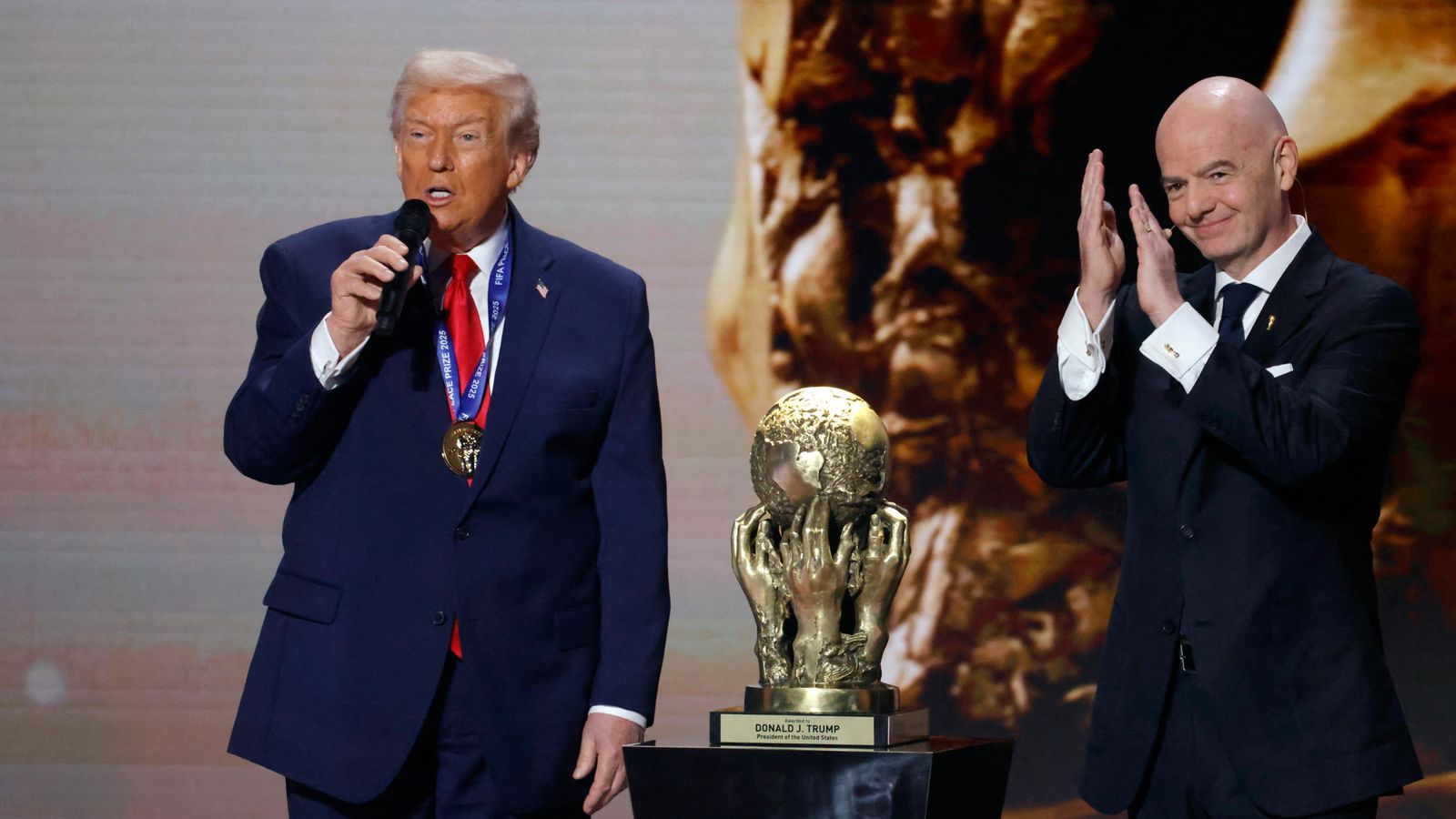
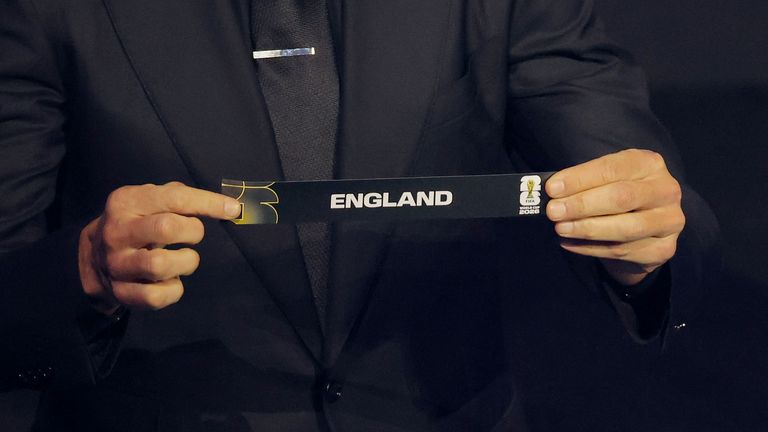
This was a World Cup draw like no other. Crafted less for the teams but for one man.
The choice of venue. The creation of a new trophy. The closing music act.
Donald Trump was lavished with the adulation he craves by FIFA President Gianni Infantino and feels others unfairly deny him.
Knowing how much being overlooked by the Nobel Committee hurt the US president, there was Mr Infantino with FIFA’s newly-created Peace Prize to hand over. And a medal for Mr Trump to wear.
“This is truly one of the great honours of my life,” he said. “And beyond awards, Gianni and I were discussing this. We saved millions and millions of lives.”
This was all on the stage in front of an audience who turned up to find out who they will be playing at the World Cup.
England handed an undaunting route past Croatia, Panama and Ghana. Scotland paired with newcomers Haiti before tricky reunions from their last men’s World Cup in 1998 against Brazil and Morocco.
Pic: Reuters
But the show before the draw could even begin – presided over by Rio Ferdinand – took almost as long as a football match, at 87 minutes after the noon kick-off was delayed.
There was a walk of self-promotion to complete – “I guess they have to wait” – before taking his seat in the Kennedy Center. Or the Trump Kennedy Center as the president takes to calling the venue picked 1.5 miles from the White House.
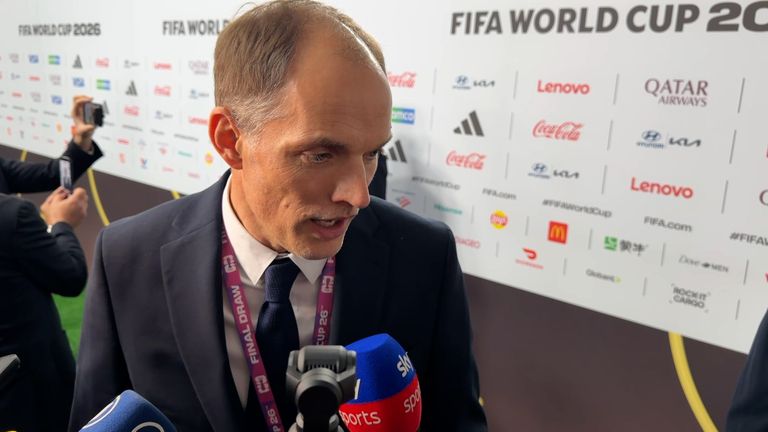
England manager Thomas Tuchel reacts to draw
“It was falling apart,” he said, delaying the walk into the auditorium. “And now it’s, it’s pretty much back.”
Mr Infantino could only watch on, beaming, at his friend.
“We had a dead country,” Mr Trump went on, “and now we have the hottest country anywhere in the world”.
There was the awkwardness of being reminded, before receiving the peace accolade, about threats to launch military strikes on Venezuela to stop the drugs trade.
“I did settle eight wars, and we have a ninth coming,” he swatted away the question. “Which nobody’s ever done before. But I want to really save lives. I don’t need prizes.”
But FIFA knew how much he wanted more gold for the collection with the prize.
More on this story:
What draw means for England, Scotland, Wales, Northern Ireland and Republic of Ireland
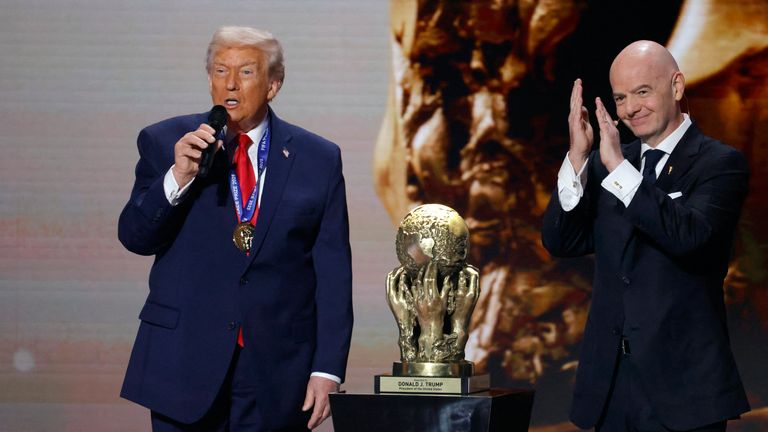
Donald Trump and FIFA president Gianni Infantino. Pic: Reuters
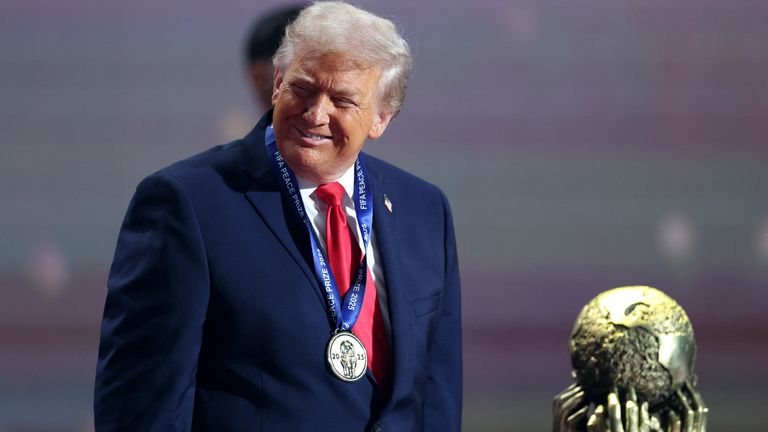
Pic: Reuters
And for all the mockery and disdain targeted at FIFA, how many sports would relish having the US president spend several hours attending a procedural event determining the placing of teams in groups for a tournament?
How many would dish out the same flattery to secure direct lines to the leader of the nation staging their championship?
Many have benefited from Mr Trump’s stardust and swagger being attached to this spectacle.
Even Port Vale’s most famous fan – Robbie Williams – secured a walk-on role, exceeding his profile this side of the Pond.
And the Village People are reaping the rewards of becoming the unlikeliest of Trump hype acts.
The festivities ended with eyes fixed back up to the presidential seating and the YMCA dance being performed.
This was an afternoon that dispelled any pretence that FIFA keeps a distance from politics. It was unapologetically political. But few speak out in the FIFA world as the redistributed wealth keeps rolling back in their direction.
It would be easy to forget this isn’t entirely America’s World Cup. They’re sharing hosting with Canada and Mexico.
Read more from Sky News:
Netflix agrees blockbuster $72bn deal for Warner Bros studios
Several sites go down after Cloudfare outage
‘Bring it on!’: Scotland fans react to World Cup draw
And eventually the spotlight was ceded to their leaders – very briefly – as Mexican President Claudia Sheinbaum and Canadian Prime Minister Mark Carney drew out their countries’ names.
But it did live up to FIFA’s mantra that football can unite the world.
The neighbours were brought together here on a snowy day in Washington. And tensions – often stoked by Mr Trump with Canada and Mexico – thawed in the name of football.
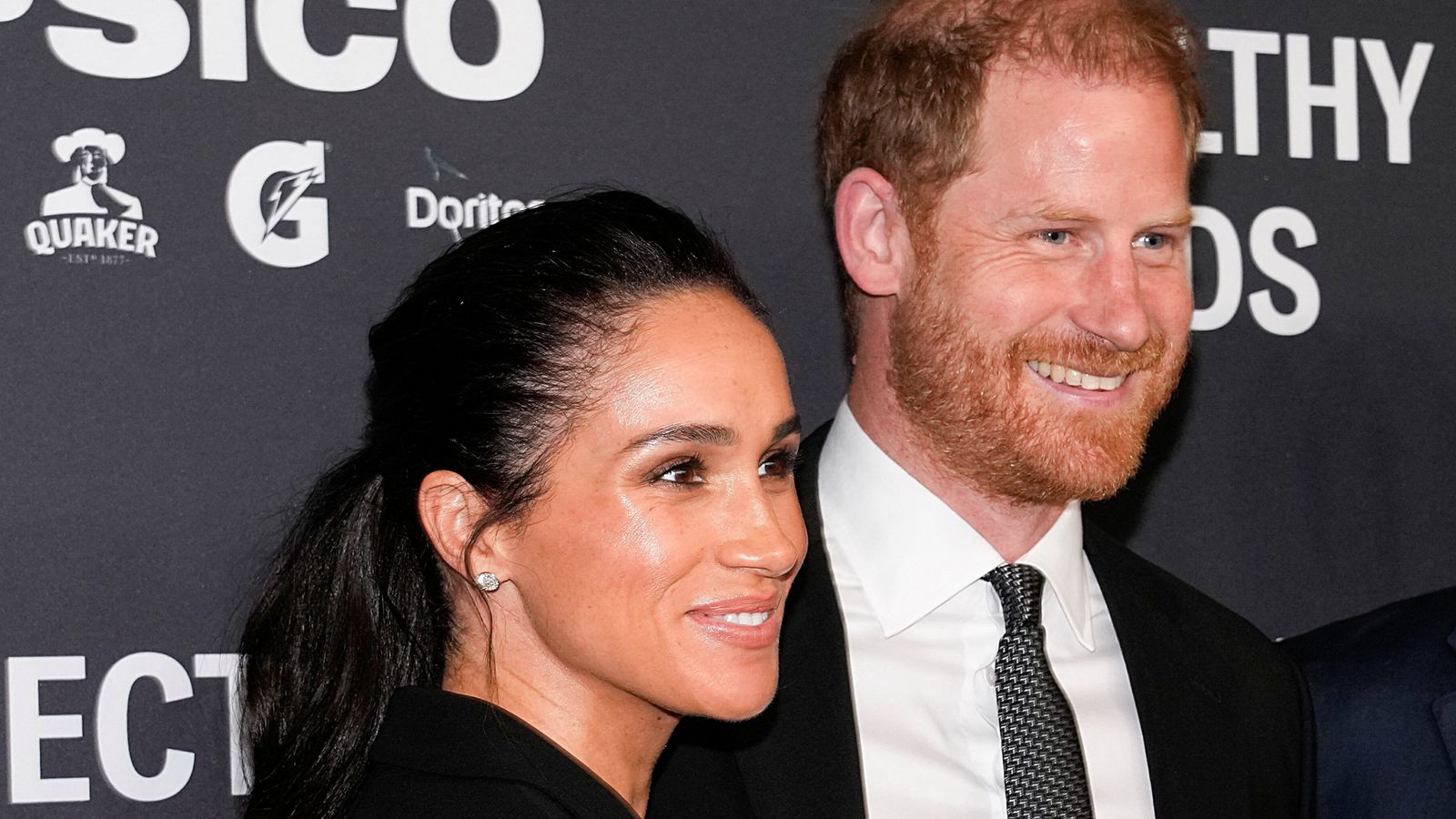
Meghan Markle has “reached out” to her estranged father after reports he had his leg amputated, her spokesperson has said.
Thomas Markle, 81, reportedly had his leg amputated following surgery in the Philippines, where he moved to this year.
Meghan has been estranged from her father since around the time of her wedding to Prince Harry in May 2018.
Mr Markle, a retired television lighting director and director of photography, made headlines across the globe after he was caught staging paparazzi photographs in the days ahead of the ceremony.
A spokesperson for the Duchess of Sussex said: “I can confirm she has reached out to her father.”
Meghan is said to have previously tried to reach out to him in the past.
Mr Markle has never met his grandchildren Prince Archie and Princess Lilibet.
At the start of this year, Mr Markle told of how he dreamed of bringing his “whole family together” and wished his daughter “no ill-will”.
Mr Markle revealed that he didn’t “like some of the things” Meghan had done but would “always love her”.
Read more:
Prince Harry apologises to Canada for wearing cap at World Series
Prince Harry and Meghan named Humanitarians of the Year
His interview with the Mail on Sunday came amid the duchess’ return to Instagram and the release of a trailer for her lifestyle show on Netflix.
Mr Markle said: “I’m not running away. I am going in search of a more positive life.
“Every day I see something about Meghan. This week it has been the new TV show.”
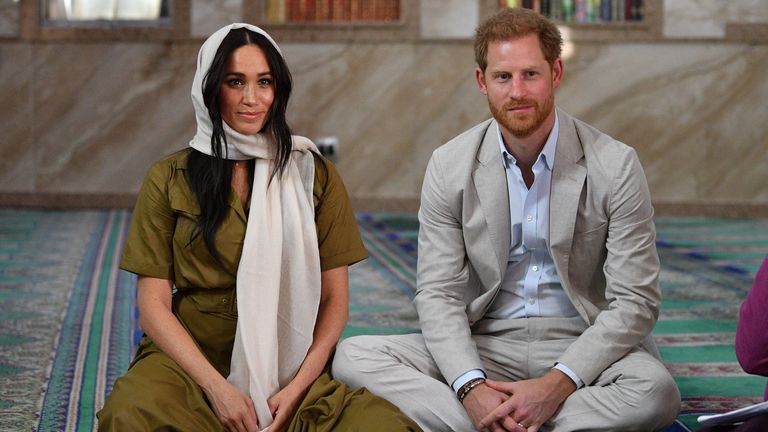
The Duke and Duchess of Sussex during a trip to Cape Town. Pic: Reuters
In his first interview after his daughter’s wedding, Mr Markle said he didn’t attend the big day because he was embarrassed about staging the photos.
“The truth is I couldn’t get over the fact that that had happened. All that stuff was working on me, I had a bit of a heart condition.
“This pushed me a little further to the part where I had heart palpitations. I had to drive at 2am to a hospital. They sent me to another little hospital and then they sent me to a bigger hospital and I had a heart attack.”
A day-and-a-half later he said he felt better and checked himself out against doctors’ wishes in a bid to make it to the wedding, but the heart palpitations returned when he got home, which at the time was in Mexico.
“At that time I started getting chest pains and I said I have to cancel because I didn’t take care of the heart problem before. I had a good friend take me back to a hospital across the border to the States where I was told that my condition was very bad and they had to operate, and I had heart surgery.”
-
 Sports2 years ago
Story injured on diving stop, exits Red Sox game
-
 Sports3 years ago
‘Storybook stuff’: Inside the night Bryce Harper sent the Phillies to the World Series
-
 Sports2 years ago
Game 1 of WS least-watched in recorded history
-
 Sports3 years ago
Button battles heat exhaustion in NASCAR debut
-
 Sports3 years ago
MLB Rank 2023: Ranking baseball’s top 100 players
-
Sports4 years ago
Team Europe easily wins 4th straight Laver Cup
-
 Environment3 years ago
Japan and South Korea have a lot at stake in a free and open South China Sea
-
 Environment1 year ago
Here are the best electric bikes you can buy at every price level in October 2024