

Forget carbon neutral, Northwestern develops carbon NEGATIVE concrete


Depending on who you believe, concrete is responsible for between 5 and 10% of global carbon emissions. That’s a lot of carbon, and the quest for carbon neutral concrete has become a multibillion-dollar endeavor – but a team of scientists from Northwestern University thinks they’ve cracked it, and gone one better: carbon negative concrete.
Using a combination of seawater, electricity, and carbon dioxide (CO2), scientists at Chicago‘s Northwestern University Engineering have developed a new building material that goes beyond reducing emissions. The new material acts like concrete, but actively captures CO2 that’s already in the air and locks it away. Permanently.
Impressive as that is in itself, the Northwestern process goes beyond “just” concrete. The scientists involved claim similar processes could also be applied to cement, paints, and plasters.
We have developed a new approach that allows us to use seawater to create carbon-negative construction materials. Cement, concrete, paint, and plasters are customarily composed of or derived from calcium- and magnesium-based minerals, which are often sourced from aggregates –– what we call sand. Currently, sand is sourced through mining from mountains, riverbeds, coasts and the ocean floor. In collaboration with Cemex, we have devised an alternative approach to source sand — not by digging into the Earth but by harnessing electricity and CO2 to grow sand-like materials in seawater.
Dr. Alessandro Rotta Loria, PhD | NORTHWESTERN
To generate the carbon-negative building materials, Dr. Rotta Loria’s team of inserted electrodes into seawater and applying a low electric current, splitting water molecules into hydrogen gas and hydroxide ions. With the current still on, they bubbled CO2 gas through seawater, changing the chemical composition of the water and increasing the concentration of bicarbonate ions. All those ions then reacted naturally with minerals in the seawater creating solid materials like calcium carbonate and magnesium hydroxide.
The calcium carbonate acts as a carbon sink, while magnesium hydroxide sequesters harmful carbon emissions through further interactions with CO2.
That … kinda looks like concrete

The carbon negative materials are made in a way that’s conceptually similar to the way mollusks and corals make shells and reefs, respectively. “But instead of metabolic energy,” writes Amanda Morris, “(the team) applied electrical energy to initiate the process and boosted mineralization with the injection of CO2.”
“The appeal of such an approach is the attention that is being given to the ecosystem and using science to harness the elements in the contemporary environment to develop valuable products for several industries and preserve resources,” said Davide Zampini, vice president of global R&D at Cemex, a large-scale manufacturer of ready-mix concrete that was recently recognized as one of the world’s most ethical companies (which, I mean– whatever).
This latest Northwestern material study builds on previous work from Dr. Rotta Loria’s lab to store CO2 long term in concrete.
Electrek’s Take

I’ve long held a tin-hat theory that life on Earth has always been artificial life, it’s just so small and evolved so far ahead of what we ourselves can make that we don’t recognize it. Stuff like this just reinforces that insanity – but all that’s beside the point. This is really impressive tech, and we’re well past the point where simply limiting carbon emissions will lead to a meaningful reduction in anthropogenic climate change.
We need to put the bad stuff back in the ground. These guys are doing that.
SOURCE | IMAGES: Northwestern; featured image by Ablazejo, under a CC License.
FTC: We use income earning auto affiliate links. More.


The Delaware Supreme Court made its ruling in the fight over Tesla CEO Elon Musk’s $55 billion pay package from 2018, reversing the Court of Chancery’s decision and reinstating the pay package.
But the Court still penalized Musk $1 plus attorney’s fees due to the award’s unfairness.
The ruling is the latest and likely last step in the long story behind Musk’s excessive pay package, tied to company performance milestones, which was first approved by shareholders in 2018 and worth approximately $55 billion if all milestones were met. At current share prices, the award is worth more like $139 billion.
For a short recap, TSLA shareholders approved a compensation package in 2018 which would award Musk, and dilute all other shareholders by around 8%, if the company reached financial targets the company claimed were difficult to achieve.
That package ended up being subject to a lawsuit, which alleged that Tesla misled investors when campaigning for the compensation package and that the board was too cozy with Musk himself, such that they did his bidding rather than acting in an independent manner.
The Delaware Court of Chancery, where Tesla used to be legally domiciled, found that argument persuasive, and ruled to rescind Musk’s entire pay package.
Delaware has long been known to be one of the most business friendly places for companies to host their legal domiciles. But after the ruling, Musk encouraged companies to leave the state, and moved his own companies out of it as well.
Later, Tesla held another vote on the same package, but Tesla’s captured board used the same misleading tactics in marketing it, and the court did not accept the new vote and again denied Musk’s pay package.
Tesla appealed that decision to bring it to the Delaware Supreme Court.
In the interim, the board gave Musk $26 billion in stock without asking shareholders first, draining the employee stock reserve and giving all of it to Musk. This award was meant to be a partial restoration of the 2018 award, but would be forfeited if the Supreme Court ruled in Musk’s favor.
Finally, TSLA shareholders once again voted for an even more ridiculous pay package last month, awarding Musk with stock worth a potential $1 trillion (and diluting all other shareholders by up to 12%) if all milestones of the award are met.
And one important note: each of these numbers are individually larger than any award ever given to any employee in the history of the world, by at least an order of magnitude, and are targeted towards a man who is currently doing his best to trash the company.
Now this week, we finally got the ruling from the Delaware Supreme Court, and it’s… an interesting one.
Court rules Musk gets his billions, but still has to pay a one dollar penalty (yes, really)
The Delaware Supreme Court ruled late Friday afternoon that the Court of Chancery was wrong in its decision to rescind all of Musk’s pay package, though it still accepted that some sort of penalty (“nominal damages”) is warranted.
It set that penalty in the amount of $1. In addition, the attorneys who sued Tesla (the plaintiffs) will be able to recoup attorneys fees (which will end up amounting in the hundreds of millions).
The court stated that while it may have accepted an argument that Musk should be entitled to part of the package – in recognition of how excessive the final package ended up being – the plaintiffs didn’t actually make that argument. The plaintiffs only offered complete rescission as a remedy, which the court decided was too “extreme.”
The court said that Musk deserves to be compensated for his time, and denied the plaintiffs’ argument that the significant appreciation of his own existing stock should be considered sufficient compensation. It called the decision “inequitable” (though it should be noted that despite this “lack of compensation,” Musk remained the richest man in the world prior to the court’s decision, largely due to the aforementioned stock).
And so, because plaintiffs didn’t make an offer for partial rescission of the pay package, and because the Court of Chancery didn’t itself craft a decision that partially rescinds the package (which it is allowed to do), the Supreme Court had to choose between giving Musk everything or nothing, and it chose to give him everything. Well, minus the attorney’s fees.
Electrek’s Take
I’m not a lawyer, but I did take time to read through the ruling before writing this, and to do my best to figure out the court’s reasoning here.
And, frankly, it seems like an odd decision to me from either perspective.
If Tesla was right all along, then it should be treated like it’s right – don’t hold back attorney’s fees or a $1 penalty saying that the plaintiffs just didn’t ask for the right remedy.
And if plaintiffs are right, then their win shouldn’t be dismissed simply because they didn’t ask for the exact right thing. If the court thinks they’re right but asked for too much, just give them part of what they asked for. If that’s not in the Supreme Court’s purview, then kick the decision back down and ask the Court of Chancery to reconsider and design a proper remedy.
What if Delaware is just spooked?
But maybe the decision isn’t just about what happened in this legal case, and more about Delaware trying to earn back its “pro-business” reputation which led over 2 million businesses to choose the state as their legal home.
That reputation has taken a hit in recent years as Musk has encouraged his ultra-wealthy pals to abandon the state. Despite that Delaware remains the state with the most established business law in the country, Musk moved to Texas hoping that he would be able to benefit from corruption there and push policies that would help him personally and harm shareholder rights – like a new law that bans shareholders from bringing actions like this court case unless they hold billions of dollars in Tesla stock.
Some other companies have also redomiciled, perhaps hoping to benefit from the same corruption Musk sought out.
This has spooked Delaware, and encouraged it to change its laws as a PR exercise to stop companies from leaving.
I wouldn’t be surprised if today’s ruling, beyond the legal rationale, was intended to have the same effect. What’s the big deal about spending $55 billion of Other People’s Money (namely, Tesla shareholders) if it helps Delaware regain its sheen of kowtowing to any corporation that comes its way?
Valuing one bad employee as worth more than all the rest
But past the legal aspects of this, the whole situation around the pay package stinks for just about everyone – employees, shareholders, and humanity as a whole.
There is certainly something “inequitable” about this award, but it’s not what the Supreme Court thinks it is.
Tesla is a company that is driven by its employees – some 120,000 of them. Most of those employees are bright people doing a good job at designing and building good products.
Most of them also don’t actively try to sabotage the company. But one does: Elon Musk.
Musk is bad for Tesla
He’s been an unbelievably bad CEO in recent years, with an unwise entry into politics both in the US and abroad, driven by his twitter addiction. His politics have largely focused on pushing white supremacist nonsense including support for German neo-Nazis and agreeing with a defense of Hitler, and funding and supporting groups that oppose renewable energy and vehicle electrification.
These actions have directly harmed Tesla through loss of expected revenue, and have also reduced the brand’s profile in the public eye. Tesla is now the only EV brand with negative perception, and it’s due to Musk himself. His actions have driven protests against the company, embarrassed owners and pushed many customers away – including business customers.
As a result, Tesla’s sales have been falling both in the US and around the globe in a rising EV market. All told, one study found that he cost Tesla over 1 million sales in the US alone with his braindead political takes. Even his own company had to chide him.
Finally, his actions in the past years have harmed electric vehicles as a whole, and thus been bad for the environment, which is the most important issue facing humanity. Musk has even rhetorically got into climate change denial himself.
Any single one of these actions should be a fireable offense in any normal situation.
And the worst part is, everyone with a brain knew how bad these actions were going to be ahead of time, but this dummy only figured that out last week (anyone want to bet that he’ll actually follow through on that about face? anyone? hello?).
And yet, the pay packages approved for him, improperly marketed by a captured board and voted for by shareholders who were promised vast wealth despite that these packages have and will massively dilute their holdings, value this one bad employee at significantly more than all other Tesla employees combined. And that money is coming out of the pockets of shareholders.
Money taken from shareholders and given to Musk, denying their share in company success
The tens of billions of dollars that will now be channeled to Musk, which he has shown he will use to harm Tesla, come at the cost of value that would have otherwise been created for shareholders and employees who hold shares, by diluting everyone’s holdings in the company.
Tesla could instead have spent its money on stock buybacks or dividends, thus allowing shareholders to enjoy the company’s success (which is the entire point of a public company), but instead it chose to play financial games that channel money from shareholders to the person that is currently acting least in the company’s favor.
So here we have a situation where a man who is causing harm to the company, the mission, the shareholders, and indeed the entire planet, is being valued at more than all of his employees put together and has a court jumping through what it itself deems are “narrow” hoops to uphold an award that is larger than any other employee has received in the history of the world. And regardless of the legal reasoning involved, I just don’t think any of that that is a good idea for anyone.
The 30% federal solar tax credit is ending this year. If you’ve ever considered going solar, now’s the time to act. To make sure you find a trusted, reliable solar installer near you that offers competitive pricing, check out EnergySage, a free service that makes it easy for you to go solar. It has hundreds of pre-vetted solar installers competing for your business, ensuring you get high-quality solutions and save 20-30% compared to going it alone. Plus, it’s free to use, and you won’t get sales calls until you select an installer and share your phone number with them.
Your personalized solar quotes are easy to compare online and you’ll get access to unbiased Energy Advisors to help you every step of the way. Get started here.


FTC: We use income earning auto affiliate links. More.

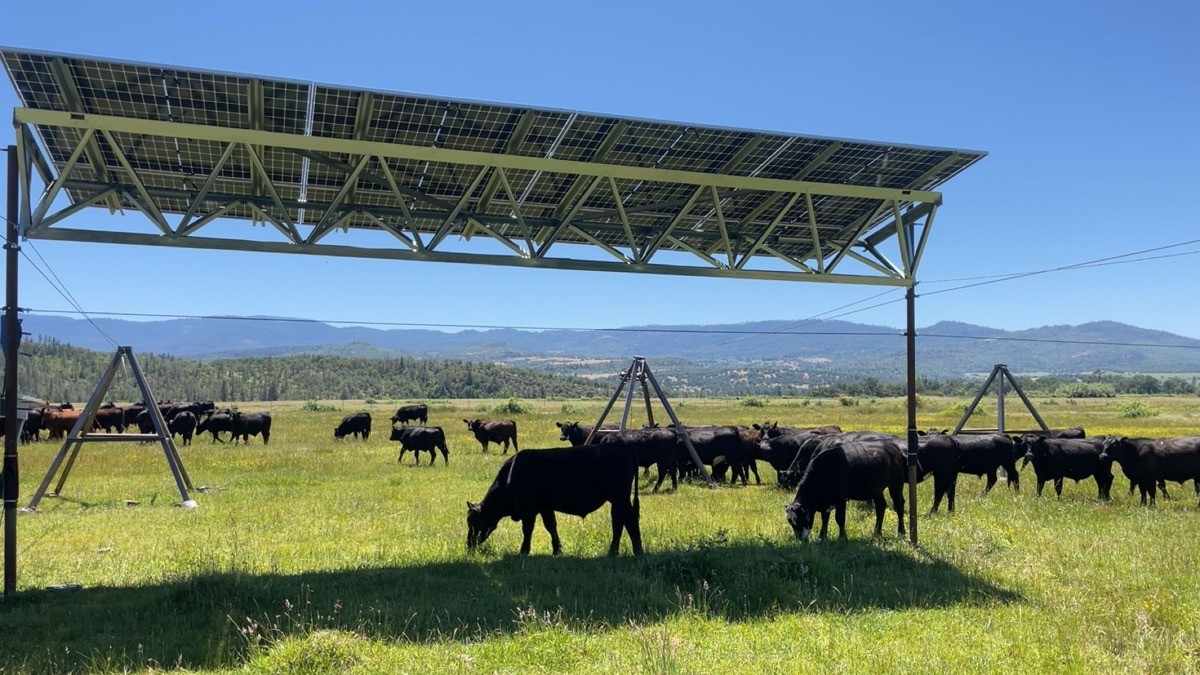
An Angus ranch in southern Oregon has become the test case for a new kind of cattle-friendly solar, hosting RUTE SunTracker’s first commercial project.
The one‑acre, 120‑kilowatt array is the first real‑world installation of RUTE’s patented, cable‑stayed solar tracker designed specifically to coexist with grazing cattle. RUTE supplies the hardware and is also acting as the developer for its first regional cattle‑plus‑solar demonstrations.
What makes the setup different is the clearance. The tracker system provides about 10 feet of headroom, with panel heights reaching up to 16 feet across the array. That gives cattle full access to the pasture underneath while allowing ranchers to keep managing the land as usual. The project is interconnected to Pacific Power’s grid in Jackson County, Oregon.
Projects like this are getting more attention as the solar industry runs into land‑use limits. In the US alone, about 30 gigawatts of new solar capacity installed last year covered roughly 150,000 acres. Meanwhile, the country has close to 120 million acres of cattle pasture, much of it facing rising heat and water stress.
That’s where agrivoltaics come in. By adding solar to working pastureland, ranchers can create a second revenue stream while improving growing conditions for forage through partial shade.
“Within weeks of installing the RUTE canopy, the crew observed leafier forage and increased legume presence inside the array compared to outside,” RUTE president Doug Krause said. “Even on irrigated pasture, direct summer sun can be too intense.”
RUTE’s work has been supported by grants from the US Department of Energy’s American‑Made Solar Prize and the US Department of Agriculture. In October, Oregon State University’s Agrivoltaics Program began quantitative studies at the site to measure pasture production, adding hard data to what ranchers are already seeing on the ground.
Next, RUTE plans to take the project on the road. This winter, the company will present at cattlemen’s association meetings as it looks for ranch partners with onsite electric loads, such as irrigation pivot systems.
“In the near term, our focus is on regional, behind‑the‑meter installations so ranchers and power producers can see the equipment operating in real conditions,” Krause said. “While interconnection timelines are long, these projects allow us to build momentum as we connect with developers and ranches on utility‑scale pipeline.”
Read more: Sunrun + NRG launch a virtual power plant to ease Texas power demand
If you’re looking to replace your old HVAC equipment, it’s always a good idea to get quotes from a few installers. To make sure you’re finding a trusted, reliable HVAC installer near you that offers competitive pricing on heat pumps, check out EnergySage. EnergySage is a free service that makes it easy for you to get a heat pump. They have pre-vetted heat pump installers competing for your business, ensuring you get high quality solutions. Plus, it’s free to use!
Your personalized heat pump quotes are easy to compare online and you’ll get access to unbiased Energy Advisors to help you every step of the way. Get started here. – *ad
FTC: We use income earning auto affiliate links. More.
Environment
Tesla rental fleet that bought into Elon Musk’s self-driving lies goes bankrupt due to depreciation

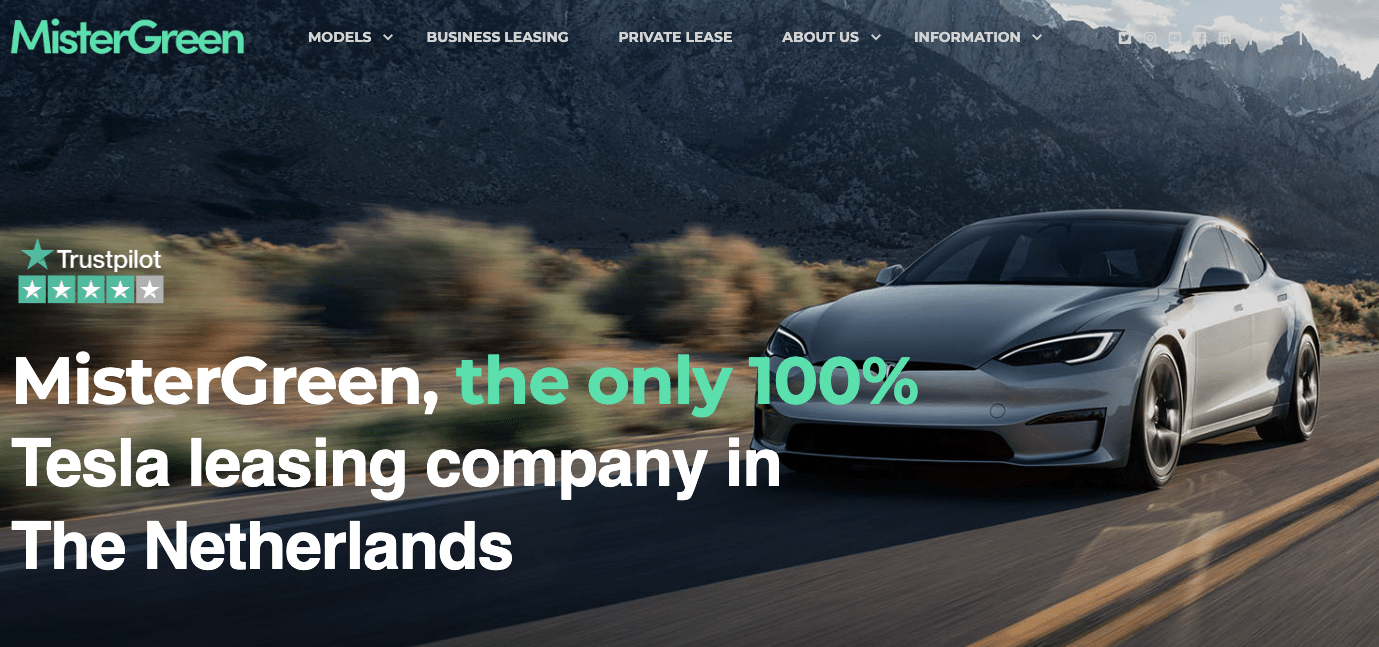
Dutch leasing company Mistergreen, known for its “Tesla only” fleet and bold bets on a future of autonomous robotaxis, is reportedly facing bankruptcy. The company’s financial collapse highlights the danger of buying into Elon Musk’s claims that Tesla vehicles would become “appreciating assets”—a prediction that has faced a harsh reality check in the used EV market.
According to reports from Europe, the Dutch Tesla-only car rental firm Mistergreen has wiped out its bondholders and is selling off its operations.
Mistergreen had built its entire business model around the premise of operating a fleet of Tesla vehicles that would not only hold their value but eventually generate revenue as robotaxis.
Instead, the company has been forced to write down millions in fleet value as Tesla aggressively cut new car prices over the last two years, pulling the rug out from under used EV prices, and never delivered on its promise of consumer vehicles becoming robotaxis.
Back in 2019, Elon Musk famously claimed that Tesla vehicles were now “appreciating assets” because of their Full Self-Driving (FSD) capability. He stated:
“I think the most profound thing is that if you buy a Tesla today, I believe you are buying an appreciating asset – not a depreciating asset.”
He even went so far as to suggest that a Tesla Model 3 could be worth $100,000 to $200,000 as a revenue-generating robotaxi. Mistergreen bought into that claim and was essentially a leveraged bet on this exact scenario.
They wrote their annual report in 2022:
Our focus is driven by the fact that Tesla’s electric vehicles are currently the highest quality electric vehicles on the market (in terms of battery quality, software updates, efficiency and range, charging network and speed), their hardware and software are prepared for future self-driving cars, and the quality and range of the Tesla (supercharger) charging network is superior. As a result, there is a significant market demand for Tesla’s and we anticipate that Tesla’s will have better residual value in the future due to the good quality of the Tesla’s currently on the market.
However, as we discussed in an article earlier this year about Elon Musk’s biggest lie, the reality has been the exact opposite. Tesla vehicles have depreciated faster than the industry average, exacerbated by Tesla’s own decision to slash prices to maintain demand and by the fact that it never delivered on its promise that software updates would make its consumer vehicles autonomous without supervision.
At its peak, Mistergreen had a fleet of over 4,000 Tesla vehicles, which is impressive, but it meant that it was hit even harder by the depreciation.
For buyers, a cheaper Tesla is great news. For owners or leasing companies holding thousands of them on their books, with high residual-value guarantees, it’s a death sentence.
Mistergreen had issued bonds to buy the Tesla vehicles, but it hasn’t been able to repay them since last year. It’s unclear how much of investors’ money has been wiped out by the bet, but it is in the tens of millions of dollars.
A couple of Dutch, Belgian, and German leasing companies will purchase the remaining fleet.
Electrek reached out to CEO Florian Minderop and co-founder Mark Schreurs for comments, but we didn’t hear back by the time of publishing.
Electrek’s Take
They believed Elon and they lost tens of millions of dollars worth of investors’ money for it.
We have been saying for years that while FSD is impressive, there’s no evidence that it can reach level 4 autonomy in consumer vehicles. Banking on it turning cars into appreciating robotaxis in the near term is financial suicide.
Musk has been promising “1 million robotaxis by the end of the year” since 2020. It’s now late 2025, and while we have seen progress, we only have a small pilot program in a geo-fenced area in Texas under constant supervision, and certainly don’t have a fleet of appreciating assets.
If you bought a Tesla for $50,000 in 2022 expecting it to be worth $100,000 today, you are likely disappointed. If you bought 4,000 of them with borrowed money, you are Mistergreen.
FTC: We use income earning auto affiliate links. More.
-
 Sports2 years ago
Story injured on diving stop, exits Red Sox game
-
 Sports3 years ago
‘Storybook stuff’: Inside the night Bryce Harper sent the Phillies to the World Series
-
 Sports2 years ago
Game 1 of WS least-watched in recorded history
-
 Sports3 years ago
Button battles heat exhaustion in NASCAR debut
-
 Sports3 years ago
MLB Rank 2023: Ranking baseball’s top 100 players
-
Sports4 years ago
Team Europe easily wins 4th straight Laver Cup
-
 Environment3 years ago
Japan and South Korea have a lot at stake in a free and open South China Sea
-
 Environment1 year ago
Here are the best electric bikes you can buy at every price level in October 2024