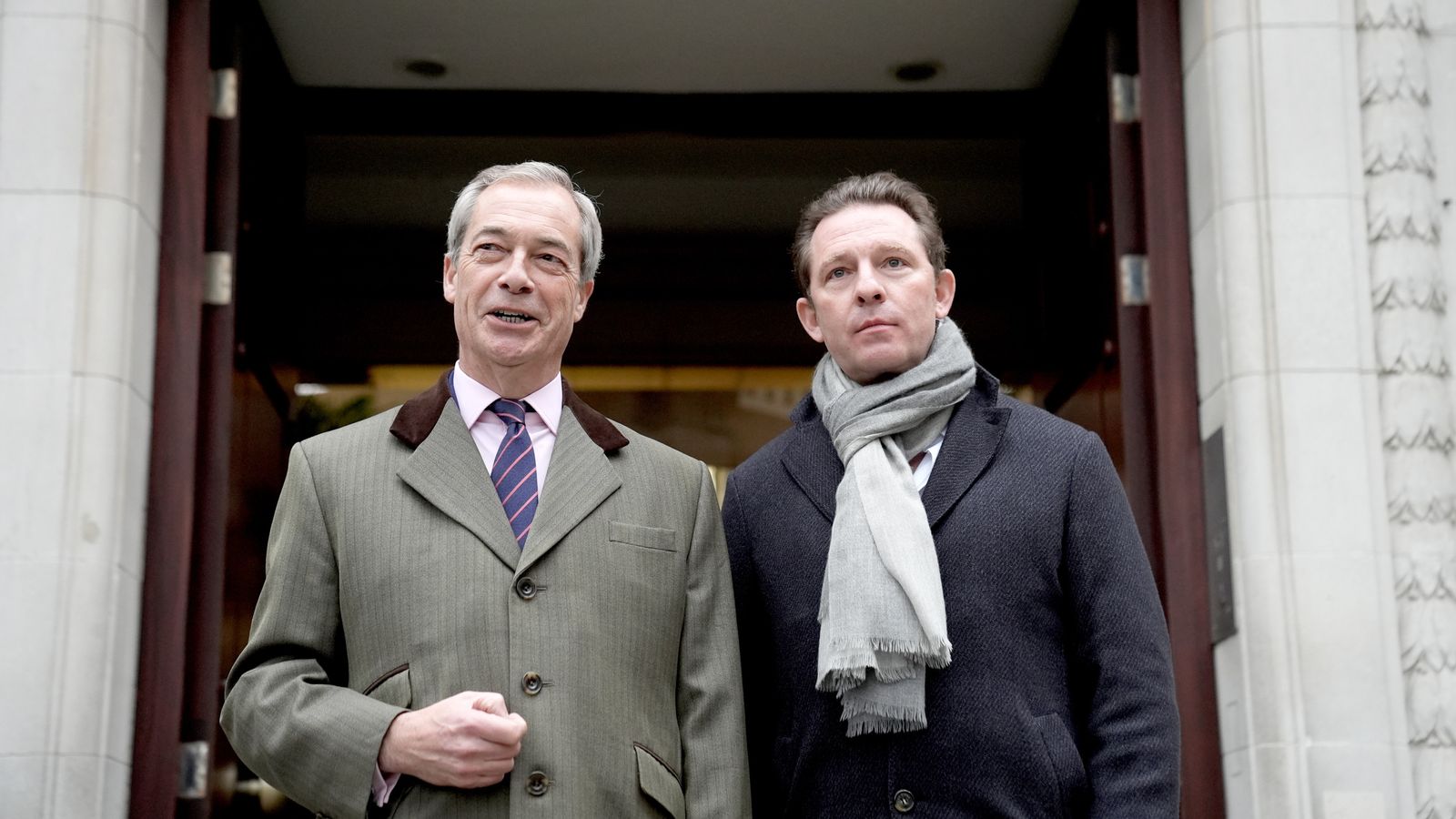
A payments company backed by Nick Candy, the Reform UK treasurer, will this week announce a tie-up with a London-based peer amid a rapidly shifting industry landscape.
Sky News has learnt that VibePay, in which Candy Ventures is the largest shareholder, has agreed a deal to sell itself to Banked, a so-called ‘pay by bank’ platform.
The all-share deal, which is expected to be announced on Tuesday, will see Mr Candy’s investment vehicle holding a stake of roughly 25% in the combined group, according to insiders.
One source said the deal would value the enlarged company at in excess of $100m.
As part of the transaction, the VibePay founder, Luke Massie, and Candy Ventures director Steven Smith will join the board of Banked.
VibePay specialises in ‘conversational commerce’, providing personalised offers and peer-to-peer payments to its users, connecting them to brands, sellers and banks.
People close to the deal said that the takeover would help address a market opportunity by rewarding debit customers who have been overlooked by credit card operators, with debit card payments making up nearly 90% of all UK card payments but representing just a tiny fraction of payment rewards.
Banked counts global financial giants including Bank of America, Citi, FIS and NAB among its strategic investors and partners.
It has previously raised more than $60m in funding, while VibePay has raised over $10m from its backers.
The deal is understood to be awaiting approval from the City regulator.
In response to an enquiry from Sky News, Mr Candy said: “I’ve been a strong supporter of VibePay, and I’m excited about the future with Banked.
“The global vision of the Banked founders is truly inspiring, and I see immense potential in the combined vision for the next generation of payments.
“This is a positive moment for the UK technology sector, with two British companies coming together to drive forward a global ambition.
“I’m proud to be a part of this journey and am eager to champion this story both in the UK and internationally.”
Mr Massie added: “We’ve spent years building technology that genuinely connects people – not just for transactions, but for experiences.
“By joining forces with Banked, we now have the infrastructure, global reach, and merchant access to supercharge what we’ve built, and deliver real value to consumers at scale.”
Banked bought Waave, an Australian pay-by-bank provider, last October, strengthening its international presence, while it has a partnership with NAB – one of Australia’s biggest lenders – to offer a service to Amazon customers in the country.
“The real value in Pay by Bank goes beyond cheap and secure payments; it’s in making spending work for everyone,” said Brad Goodall, Banked’s chief executive.
“The combination of Banked and VibePay will drive Pay by Bank adoption through innovative consumer incentives – on par with credit cards – and empower merchants with deep data insights to drive acquisition and retention like never before.
The companies declined to comment formally on the value of the acquisition or the valuation of the combined entity.
Sir Keir Starmer has denied he and the chancellor misled the public and the cabinet over the state of the UK’s public finances ahead of the budget.
The prime minister told Sky News’ political editor Beth Rigby “there was no misleading”, following claims he and Rachel Reeves deliberately said public finances were in a dire state, when they were not.
He said a productivity review by the Office for Budget Responsibility (OBR), which provides fiscal forecasts to the government, meant there would be £16bn less available so the government had to take that into account.
“To suggest that a government that is saying that’s not a good starting point is misleading is wrong, in my view,” Sir Keir said.
Cabinet ministers have said they felt misled by the chancellor and prime minister, who warned public finances were in a worse state than they thought, so they would have to raise taxes, including income tax, which they had promised not to in the manifesto.
At last Wednesday’s budget, Ms Reeves unveiled a record-breaking £26bn in tax rises.
More from Politics
The OBR published the forecasts it provided to the chancellor in the two months before the budget, which showed there was a £4.2bn headroom on 31 October – ahead of that warning about possible income tax rises on 4 November.
Image: The OBR’s timings and outcomes of the fiscal forecasts reported to the Treasury
Sir Keir added: “There was a point at which we did think we would have to breach the manifesto in order to achieve what we wanted to achieve.
“Late on, it became possible to do it without the manifesto breach. And that’s why we came to the decisions that we did.”
Sir Keir said a productivity review had not taken place in 15 years and questioned why it was not done at the end of the last government, as he blamed the Conservatives for the OBR downgrading medium-term productivity growth by 0.3 percentage points to 1% at the end of the five-year forecast.
Please use Chrome browser for a more accessible video player
0:58
Reeves: I didn’t lie about ‘tax hikes’
The prime minister added: “I wanted to more than double the headroom, and to bear down on the cost of living, because I know that for families and communities across the country, that is the single most important issue, I wanted to achieve all those things.
“Starting that exercise with £16 billion less than we might otherwise have had. Of course, there are other figures in this, but there’s no pretending that that’s a good starting point for a government.”
On Sunday, when asked by Sky’s Trevor Phillips if she lied, Ms Reeves said: “Of course I didn’t.”
She also said the OBR’s downgrade of productivity meant the forecast for tax receipts was £16bn lower than expected, so she needed to increase taxes to create fiscal headroom.
Virgin Media has been fined £23.8m after it disconnected vulnerable customers during a phone line migration.
Regulator, Ofcom, ruled the telecoms company had placed thousands of people “at direct risk of harm”.
The watchdog said users of Telecare – an emergency alarm and monitoring service – were disconnected if they failed to engage with a process, in late 2023, which switched old analogue lines to a digital alternative.
Ofcom said that Virgin Media had disclosed its own failures under consumer protection rules and its full cooperation was taken into account when determining the size of the penalty.
Ian Strawhorne, Ofcom’s director of enforcement, said: “It’s unacceptable that vulnerable customers were put at direct risk of harm and left without appropriate support by Virgin Media, during what should have been a safe and straightforward upgrade to their landline services.
“Today’s fine makes clear to companies that, if they fail to protect their vulnerable customers, they can expect to face similar enforcement action.”
More from Money
Ofcom found that Virgin Media failed properly to identify and record the status of telecare customers, resulting in significant gaps in the screening process.
“This meant that those affected did not receive the appropriate level of tailored support through the migration process”, it said.
It also criticised Virgin Media’s approach to disconnecting Telecare customers who did not engage in the migration process, “despite being aware of the risks posed”.
The watchdog said it had put thousands of vulnerable customers “at a direct risk of harm and prevented their devices from connecting to alarm monitoring centres while the disconnection was in place”.
The money from the fine goes to the Treasury.
A Virgin Media spokesperson said: “As traditional analogue landlines become less reliable and difficult to maintain, it’s essential we move our customers to digital services.
“While historically the majority of migrations were completed without issue, we recognise that we didn’t get everything right and have since addressed the migration issues identified by Ofcom.
“Our customers’ safety is always our top priority and, following an end-to-end review which began in 2023, we have already introduced a comprehensive package of improvements and enhanced support for vulnerable customers including improved communications, additional in-home support and extensive post-migration checks, as well as working with the industry and Government on a joint national awareness campaign.
“We’ve been working closely with Ofcom, telecare providers and local authorities to identify customers requiring additional support and are confident that the processes, policies and procedures we now have in place allow us to safely move customers to digital landlines.”
Sir Keir Starmer will deliver a speech today defending the decisions the government made in the budget, following criticisms of sweeping tax rises and accusations the chancellor lied to the country about the state of public finances.
The prime minister is expected to set out how the budget, which saw £26bn of tax rises imposed across the economy, “moves forward the government’s programme of national renewal”, and set “the right economic course” for Britain, Downing Street says.
He will also confirm that ministers will try again to reform the “broken” welfare system, after Labour MPs forced the government to U-turn on its plans to narrow the eligibility for Personal Independence Payments (PIP) earlier this year.
Image: Sir Keir Starmer will give a speech later defending last week’s budget. Pic: Reuters
“We have to confront the reality that our welfare state is trapping people, not just in poverty, but out of work – young people especially. And that is a poverty of ambition,” Sir Keir will say.
“And so while we will invest in apprenticeships and make sure every young person without a job has a guaranteed offer of training or work, we must also reform the welfare state itself – that is what renewal demands.”
Please use Chrome browser for a more accessible video player
8:46
Sky’s Ed Conway looks at the aftermath of the budget and explains who the winners and losers are
The prime minister will add: “This is not about propping up a broken status quo. Nor is it because we want to look somehow politically ‘tough’. The Tories played that game and the welfare bill went up by £88bn. They left children too poor to eat and young people too ill to work. A total failure.”
More on Budget 2025
Related Topics:
Instead, he will argue it is about “potential”, saying: “If you are ignored that early in your career, if you’re not given the support you need to overcome your mental health issues, or if you are simply written off because you’re neurodivergent or disabled, then it can trap you in a cycle of worklessness and dependency for decades, which costs the country money, is bad for our productivity, but most importantly of all – costs the country opportunity and potential.
“And any Labour Party worthy of the name cannot ignore that. That is why we have asked Alan Milburn on the whole issue of young people, inactivity and work. We need to remove the incentives which hold back the potential of our young people.”
The announcement will come after the Conservative opposition described the budget as one for “benefits street”, following the chancellor’s decision to lift the two-child benefit cap from April, at a cost of £3bn.
Please use Chrome browser for a more accessible video player
4:30
Prime Minister defends the budget
‘Government must go further and faster on growth’
The prime minister is also expected to launch a staunch defence of the budget overall, saying it will bear down on the cost of living through measures like money off energy bills and frozen rail fares; increase economic stability; and protect investment in public services and infrastructure that will drive economic growth.
He will argue that “economic growth is beating the forecasts”, but that the government must go “further and faster” to encourage it.
He will also reiterate his vow to scrap regulation across the economy, which he will argue is not only pro-business, but also a way to deal with the cost of living.
Please use Chrome browser for a more accessible video player
2:57
How will your personal finances change following the budget announced by the chancellor?
“Rooting out excessive costs in every corner of the economy is an essential step to lower the cost of living for good, as well as promoting more dynamic markets for business,” the prime minister will say.
He will confirm reforms to the building of nuclear power plants, after the government’s nuclear regulatory taskforce found that “pointless gold-plating, unnecessary red-tape and well-intentioned, but fundamentally misguided environmental regulation had made Britain the most expensive place to build nuclear power”.
“We urgently need to correct this,” the prime minister will say.
Business secretary Peter Kyle will be tasked with applying the same deregulatory approach to major infrastructure schemes and to accelerate the implementation of Labour’s industrial strategy.
In response, Tory shadow chancellor Sir Mel Stride said: “It is frankly laughable to hear the prime minister say Rachel Reeves’s Benefits Street budget has put the country on the right course and that he wants to fix the welfare system.
“His chancellor has just hiked taxes by £26bn to pay for a welfare splurge, penalising people who work hard and making them pay for those who don’t work at all. And she misrepresented why she was doing it, claiming there was a fiscal black hole to fill that she knew didn’t exist.
“Labour’s leadership have repeatedly shown they lack the backbone to tackle welfare and instead are just acting to placate their left-wing backbenchers.”
Please use Chrome browser for a more accessible video player
0:58
Rachel Reeves tells Sky News she did not lie about the state of the public finances
Chancellor accused of ‘lying’
Sir Mel is referring to the chancellor’s speech on 4 November in which she laid the ground for tax rises due to the decision by the independent Office for Budget Responsibility (OBR) to review and downgrade productivity over recent years, at a cost of £16bn, which led to a black hole in the public finances.
But the OBR revealed on Friday that it had told the Treasury days earlier that there was actually a budget surplus of £4.2bn, leading to outrage and claims that she misled the country about the state of the public finances.
Rachel Reeves was asked directly by Sky’s Trevor Phillips if she lied, and she replied: “Of course I didn’t.”
Please use Chrome browser for a more accessible video player
1:51
Why did Reeves make the situation sound ‘so bleak’?
She said: “I said in that speech that I wanted to achieve three things in the budget – tackling the cost of living, which is why I took £150 off of energy bills and froze prescription charges and rail fares.
“I wanted to continue to cut NHS waiting lists, which is why I protected NHS spending. And I wanted to bring the debt and the borrowing down, which is one of the reasons why I increased the headroom.
“£4bn of headroom would not have been enough, and it would not give the Bank of England space to continue to cut interest rates.”
Ms Reeves also said: “In the context of a downgrade in our productivity, which cost £16bn, I needed to increase taxes, and I was honest and frank about that in the speech that I gave at the beginning of November.”
Please use Chrome browser for a more accessible video player
1:30
Badenoch says Rachel Reeves should resign
But Tory leader Kemi Badenoch said: “I think the chancellor has been doing a terrible job. She’s made a mess of the economy, and […] she has told lies. This is a woman who, in my view, should be resigning.”
Report due on OBR breach
The tumultuous run-up to the 26 November budget culminated in the OBR accidentally publishing its assessment of the chancellor’s measures 45 minutes before the speech began, in what was an unprecedented breach of budget security.
Spotify
This content is provided by Spotify, which may be using cookies and other technologies.
To show you this content, we need your permission to use cookies.
You can use the buttons below to amend your preferences to enable Spotify cookies or to allow those cookies just once.
You can change your settings at any time via the Privacy Options.
Unfortunately we have been unable to verify if you have consented to Spotify cookies.
To view this content you can use the button below to allow Spotify cookies for this session only.
The chair of the OBR, Richard Hughes, apologised for the “error”, and announced an investigation into how it happened.
The chancellor has said that she retains confidence in him, despite the “serious breach of protocol”, and confirmed to Trevor that the investigation report will be delivered to her on Monday, although it is not clear when it will be published.