
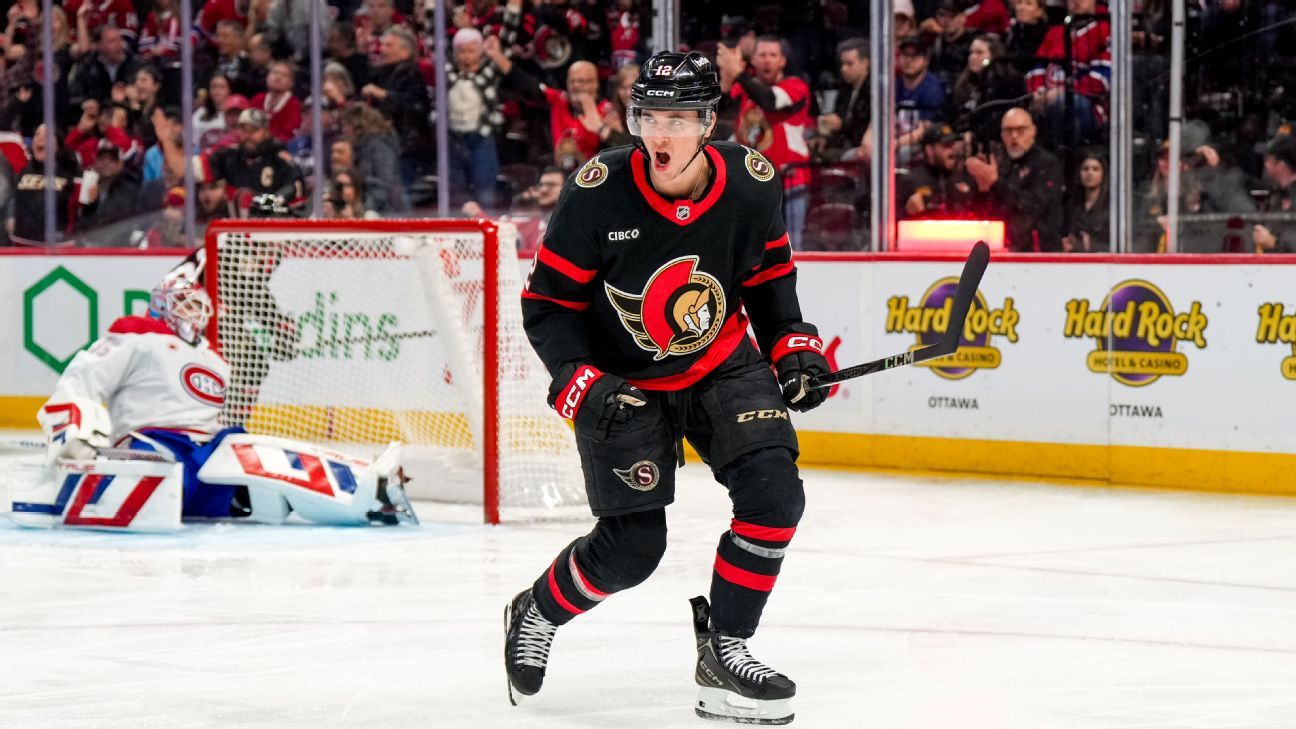
‘I know how badly they want to win’: How the Senators grew into being a playoff team


-
Kristen Shilton
Eugene Melnyk believed in the Ottawa Senators — bullishly, unabashedly and with trademark bravado.
It’s what made the Senators’ late owner such a lightning rod around the league. And his stance was firm until he passed away that Ottawa would rise again to be a playoff contender.
“I truly believe that we are a Stanley Cup winner within four years,” Melnyk said in 2020. “It can happen any time, but within four years.”
The declaration was bold, and totally befitting Melnyk’s persona. At the time, Ottawa hadn’t reached the postseason since falling in Game 7 of the 2017 Eastern Conference finals. The Senators went from being one goal away from a Stanley Cup Final to racking up one losing season after another.
Melnyk backed up his audacious words with a reported 112-page plan devised with then-general manager Pierre Dorion on how Ottawa would clear the high bar Melnyk had newly set. They were prepared to spend right to the salary cap in pursuit of his vision.
What else was written in that document may never be known publicly. What is obvious is that Ottawa failed rather spectacularly in living up to Melnyk’s expectations.
For seven long years the Senators struggled. There were definitive highs and sweeping lows. And now, at last, a breakthrough.
The Ottawa Senators are officially playoff contenders again, staking their claim on Sunday to the Eastern Conference’s first wild-card slot.
It wasn’t the prettiest of landings; Ottawa actually punched their ticket after a dreadful 5-2 loss to the Columbus Blue Jackets. But because the Montreal Canadiens beat the Detroit Red Wings that same night, the Senators clinched anyway.
They don’t ask how, right?
But seriously. How did the Senators do it, exactly? That’s a long story. But there are at minimum a few key elements that pushed Ottawa over the top — and brought them one critical pace closer to possibly making good on Melnyk’s prediction of a championship-caliber future.
“It’s a good first step for this group,” GM Steve Staios said of reaching the postseason. “I’m really excited for our players. From day one when they came into training camp you could see that there was this motivation.”
THE SENATORS DIDN’T get back to the playoffs before Melnyk passed in 2022. Dorion — who came on board with the Senators right before that magical run to the conference finals — failed to guide Ottawa back into the postseason before he was fired in 2023.
The freefall Ottawa took from Eastern Conference darlings to basement dwellers was baffling. The Senators finished the 2017-18 season in 30th place to signal the start of a surprisingly swift rebuild. Top defenseman Erik Karlsson was traded to San Jose in September 2018, before the start of a miserable season which ultimately pushed away Matt Duchene, Mark Stone and Ryan Dzingel — all three veterans were traded by the 2019 deadline. The Senators were in last place by March 2019 and head coach Guy Boucher was axed. Ottawa was desperate for change.
DJ Smith took over Ottawa’s bench for the 2019-20 season and attempted to turn the youthful Senators around — Brady Tkachuk, Josh Norris and Drake Batherson were already in the lineup then, and by 2020 Ottawa had drafted first-rounders Tim Stutzle and Jake Sanderson.
Dorion upped the ante in 2022 in an effort to end the rebuild, trading for Alex DeBrincat (then a pending restricted free agent) and Cam Talbot, and signing free agent Claude Giroux to bolster the Senators’ chances. Ottawa missed the playoff that next season by six points.
DeBrincat, though, had seen enough. He told the Senators he wasn’t open to signing a long-term deal, so Dorion traded him to Detroit. Talbot wasn’t retained, either. Suddenly the Senators were in the swing of significant turnover from seemingly every corner — following Melynk’s death in 2022, the franchise was sold in June 2023 to businessman Michael Andlauer. A new era — at least in that respect — had begun. But it was a bumpy beginning.
Near the start of the 2023-24 season, Ottawa was reprimanded by the league and docked a first-round draft pick for their invalidated 2021 trade involving Evgenii Dadonov and the Anaheim Ducks. That punishment cost Dorion his job in November 2023; Staios, who was Ottawa’s president of hockey operations at the time, took on GM duties, too.
The Senators’ on-ice performance was reprehensible amid the background drama. Their woeful 11-15 record put Smith out by December, to be replaced by former coach and team advisor Jacques Martin. Despite Ottawa’s depth of young talents, the Senators slumped again to finish seventh in the Atlantic.
There were three key philosophical shifts thereafter that led them from the basement to the postseason, with the long-term belief that this is just the beginning of a new era of contention.
Ottawa trusted the process
Stutzle didn’t hold back after the Senators clinched their postseason berth. In fact, he probably spoke aloud what most of his teammates were thinking.
“We’ve been through some s— here,” Stutzle said, directly following that loss to Columbus. “Some tough years. I’m just really proud of the guys, how we’re all hanging in here. I don’t think there’s a team who deserves it more than us. I think we worked really hard this year.”
Ottawa’s current success wouldn’t have come about — or feel nearly so good — if it weren’t for a challenging recent history.
When Thomas Chabot debuted in 2016-17 with the Senators, they had missed the playoffs only four times since 1996-97. The young blueliner thought he would see plenty of postseason action in the NHL. Instead, it would take over 500 career games before Chabot was assured his first crack at Game 83.
“You’re not going to see me smile a whole lot after a loss,” Chabot joked when the Senators secured their spot, “but, man, it feels great.”
Tkachuk can relate. The Senators captain has more than 500 pro games under his belt and over 400 career points. He’s tried willing Ottawa to the postseason in prior seasons, and they’ve come up frustratingly short. Tkachuk’s commitment to the Senators was never in doubt though — something he doubled down on when trade rumors began circulating earlier this season.
The Senators were still clawing their way up the standings in early February when Tkachuk found himself linked by media reports to the New York Rangers.
Andlauer was furious, and even wanted the Rangers investigated for soft tampering with Ottawa’s top forward. Tkachuk let his play do the talking as he continued to lead the Senators up front. The whole situation though was an unneeded distraction for the Senators, and directly opposed to an internal strategy focused entirely on leveraging its young core towards that elusive playoff return.
But those rising stars couldn’t get there alone. It’s veterans like Giroux and David Perron who have supported the club’s maturation with critical leadership. Giroux has been in the fold since signing as a free agent in 2022, proving he hadn’t lost a step by pumping in 35 goals and 79 points the following season. The 35-year-old has continued to play a considerable role in Ottawa’s offense, and keeps the group even-keeled when inevitable roadblocks crop up.
“Some games maybe we weren’t at our best. But we’ve been finding ways,” Giroux said. “When you’re not playing your best and you’re finding ways to win, that’s a good sign. You can just tell that everybody wants to play the right way. It’s fun to play that way.”
Giroux can also lean on past playoff experience — although he hasn’t had much of it in the last decade. Since the 2012-13 season in Philadelphia, Giroux has been to the postseason just five times, most recently as part of Florida’s 2021-22 campaign. And he’s never won a Stanley Cup.
Perron has, with St. Louis in 2019, along with a Cup Final run with Vegas the year prior. He knows what it takes to scale that mountain. And while it’s hard to predict the Senators will be making it all the way there this year, an initial stride towards that loftiest of goals is a crucial stage of Ottawa’s development.
“I’ve won [before], but I see other guys like Claude, and so many other guys [who haven’t],” Perron said. “You want to do it for them. You want them to experience a run, you want to give that experience to the younger players.”
Ottawa slowly, surely put themselves in position to do it now. The lean years toughened up the team’s top skaters. They won’t take this opportunity for granted. But they will want to expect that it becomes an annual event.
Ottawa found the right coach
The Senators needed a new voice to go along with their new owner and general manager. Travis Green — hired in May 2024 — was their guy.
It didn’t take long for Green to recognize Ottawa was ready to put its losing ways on the shelf.
“From day one, they were open-minded, and open to wanting to win badly,” Green said. “They’re open to coaching, and it’s the whole team. That’s not always the case.”
Green’s prior resume included just one other full-time head coaching role — with the Vancouver Canucks from 2017 to 2021 — and an interim head job closing out the New Jersey Devils‘ 2023-24 season.
He was referencing the Senators’ coachability after the club endured its most trying stretch of the season — a 5-8-1 run through November that could have torpedoed all hopes of playoff-level traction.
“[That] was a big part of our season,” Green said. “It’s one thing to say you’re open to coaching. It’s another thing to do it. Being able to have an honest conversation and players be open to hearing things they do not necessarily want to hear. But there are certain parts of every player’s game where they must be a little better. [Then they have to] agree with it, and then try to do it.”
In return, Green has earned praise from Ottawa’s front office for the way he’s steering the ship.
“The vision that Travis had, and how he’s been able to coach this group and turn it from where we were last year to be able to play the type of hockey to give ourselves a chance to make the playoffs [is huge],” Staios said.
It was how Green shifted Ottawa’s mindset — and installed a winning structure — that brought the organization’s playoff vision to life. Staios knew Green was capable of setting the Senators on a path towards winning hockey games. But lots of coaches can draw up the X’s and O’s. What has made Green special is how players received his messaging and actually implemented it — which is ultimately turning the tide for Ottawa.
“I know how badly they want to win,” Green said. “You don’t always get into the playoffs, but being on the side of our room, I truly felt like this group was willing to do whatever it took to take the next step. Now we’ve gotten there.”
Ottawa fixed its defense, and got the right goaltending
This was the Senators’ pièce de résistance: a full-scale buy-in to the defensive side of their game.
Ottawa had to lock in at both ends of the ice if they were ever going to see the playoffs. Green provided a blueprint. The players went to work seeing it through.
“I’ve learned a lot from [Green], especially [with] the defensive side of things,” Tkachuk said. “It’s easy to see now when he shows the mistakes that we’ve made and how we can correct them.”
Again, it goes back to Ottawa’s patience. Because the Senators didn’t start this season as defensive stalwarts. Ottawa opened the season with an 11-12-2 record, sitting 26th overall and eighth in goals against per game (3.20).
Emotions ran high, and often boiled over. But Green stuck to his philosophies and stood behind his players as they absorbed what he was trying to teach them. The faith Green had that he could turn Stutzle, Tkachuk & Co. into 200-foot players was a complement to his belief in their abilities. The Senators’ core only needed to apply itself.
“He’s got a unique way of being hard and holding players accountable,” Staios said of Green. “But also developing that relationship and having a real, honest, open line of communication.”
Eventually, Ottawa was on track. In the next 25 games from early December through January, the Senators showed true progress on the defensive end, going 15-8-2 and giving up the second fewest goals per game in the league (2.20).
All told, Ottawa has improved dramatically. They went from allowing 2.34 goals per game at 5-on-5 last season to just 1.84 this season. The Sens have 21 wins this season where they were outshot by an opponent, tied for fourth most in the NHL. By comparison, that’s more than the Senators had their previous two seasons combined.
Ottawa had to be diligent defensively given they couldn’t always rely on offense to save the day. The Senators rank 22nd this season in scoring (2.89 goals per game) and are 30th in even-strength goals (131). The club’s 15th-ranked power play (22.8%) has come in handy on occasion.
Regardless, what Green is establishing in Ottawa isn’t a one-and-done system. This is a foundation for how the Senators can be reborn as a team that anticipates a postseason run each year. And Ottawa’s defensive upswing is owed not just to Green and the skaters up front, but to the Senators’ (finally) reliable goaltending.
Ottawa had churned through their share of goalies during that seven-year playoff drought. Craig Anderson made the most starts (133) in that span before departing in 2020. There were failed experiments with Matt Murray and Talbot. Anton Forsberg (with 130 starts) did his best to fill the voids and Joonas Korpisalo had a short, unsuccessful stint with the Senators too.
It wasn’t until June that Ottawa reeled in the right No. 1. Staios brokered a deal with Boston to bring on Linus Ullmark, and Ullmark immediately signed a four-year extension to affirm his own commitment to the organization.
Ullmark had just won a Vezina Trophy in 2023 and shared the William M. Jennings Trophy that same season with Bruins’ teammate Jeremy Swayman. That Boston decided to back Swayman as their guy going forward and not Ullmark was all the better for Ottawa; notably, the Senators are in the playoffs this season while Boston is in line for a top-5 draft pick.
Ullmark endured injury issues, but emerged as a bona fide stalwart compared to what Ottawa has been used to in the crease. Last season, the Senators boasted a collective .879 save percentage. This season, Ullmark has a 24-14-3 record, with a .911 SV% and 2.67 goals-against average. That’s the third most wins ever by a goaltender in his first full season with Ottawa. And Ullmark has been a terrific partner to Forsberg, who has seen his own stats improve this season as well (10-12-2, .904 SV% and 2.66 GAA).
0:36
Linus Ullmark fully extends to make a terrific glove save
Linus Ullmark dives and catches the puck to prevent a goal against the Bruins.
Now Ullmark wants the Senators’ tandem to excel in a playoff scene. The veteran has his own memories of long playoff-less stretches from a seven-year run with the Buffalo Sabres. And while Ullmark did get to experience hockey’s second season in three consecutive years with Boston, he still commiserates with Ottawa teammates who are just stepping on that stage now.
“I’m happy now that the guys now that have been there for a long time,” Ullmark said. “Like [Chabot] and [Tkachuk], for example, to have been there the longest, and now have an opportunity to play really meaningful games and get into a position where you can battle for the Cup.”
Ottawa may not hoist Lord Stanley’s chalice this season, or in years to come. The point is that they’re now officially in the fight. That’s all Chabot wanted when he arrived in Ottawa, to be a player — rather than spectator — of late spring hockey.
At long last for the Senators, that dream has officially come to life.

Baseball’s winter meetings are just around the corner, and we’re ready for some blockbuster deals.
We’ve already seen some intriguing trades this offseason with the New York Mets acquiring Marcus Semien from the Texas Rangers for Brandon Nimmo and the Boston Red Sox adding Sonny Gray to their pitching staff — but there are even bigger stars who could move in the weeks ahead.
With that in mind, we asked our MLB insiders to give us their preferred destination for some of the biggest names in our ranking of the top 25 MLB offseason trade candidates.
Where did we send All-Stars Ketel Marte and Byron Buxton? Which Red Sox outfielder is on the move in our deals? And which contenders get starting pitching help? Let’s find out.
The Arizona Diamondbacks should trade Ketel Marte to the …

The Mariners plucked from the D-backs to jolt their offense just five months ago, acquiring corner infielders Eugenio Suarez and Josh Naylor. They should do so again, this time for Marte, the star second baseman who can be had for the right return. The Mariners have a need for another bat, and Marte would represent a massive upgrade over merely re-signing Suarez or Jorge Polanco.
Marte would slide in perfectly ahead of fellow All-Stars Julio Rodriguez and Cal Raleigh, allowing Randy Arozarena to join Naylor in the middle of the lineup and giving Seattle arguably the best offense in the American League — to pair with what is likely the best pitching staff.
Coming off a gut-wrenching loss in Game 7 of the American League Championship Series, it’s the perfect move to push the M’s toward the first World Series berth in franchise history. And whether it’s Cole Young, Michael Arroyo or Felnin Celesten, the Mariners might have enough young, promising middle infielders to satisfy the D-backs’ likely desire for a Marte replacement without parting with Colt Emerson. — Alden Gonzalez

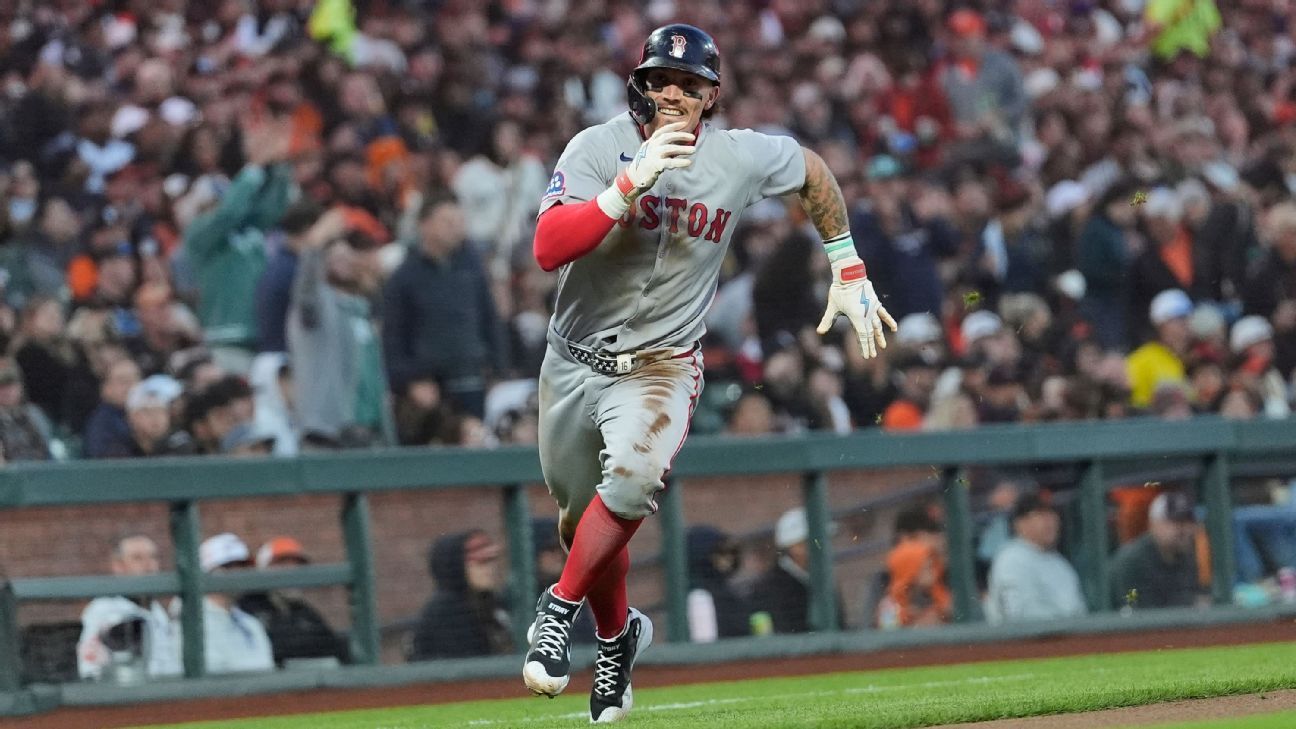
Boston Red Sox for Jarren Duran and Kyson Witherspoon
Roman Anthony‘s 2025 breakout rendered Duran expendable in an outfield already staffed by Ceddanne Rafaela and Wilyer Abreu, both of whom offer more remaining team control. And with presumed second-baseman-of-the-future Kristian Campbell struggling as a rookie (86 OPS+, -1.0 WAR), the door swung open for a move of this magnitude.
Duran’s proclivity for doubles and triples will play beautifully in Arizona (just ask Corbin Carroll), and Witherspoon, the No. 15 pick in the 2025 MLB draft, instantly becomes the club’s best pitching prospect. — Paul Hembekides

The Red Sox should trade Duran to the Philadelphia Phillies for a package including Alec Bohm
These lightning-rod players certainly are not coming off their best seasons and perhaps each needs the proverbial change of scenery. The Red Sox may need someone to play third base, and Bohm, while no match for Alex Bregman, is a capable hitter and defender. The Phillies could then get a more consistent third baseman who enjoys playing in Philadelphia. Duran would fill Philadelphia’s center-field need, and it would create some opportunity in a crowded Boston outfield. See, trades can work out for both teams! — Eric Karabell

The Cleveland Guardians should trade Steven Kwan to the Mariners
I love this idea so much. Kwan would return to the West Coast, about a four-hour drive from Corvallis, where he starred for Oregon State. He would give the Mariners a needed upgrade at a corner outfield spot, teaming with Julio Rodriguez to improve Seattle’s outfield defense. Most importantly, he could slide into the leadoff spot, offering contact and OBP as a poor man’s Ichiro, hitting in front of Cal Raleigh, Rodriguez and his old Cleveland teammate, Josh Naylor. Let’s get this done. — Bradford Doolittle

The Chicago White Sox should trade Luis Robert to the …

Rumor mill whispering has connected the Royals with Boston’s Jarren Duran for the hefty price of Cole Ragans, a swap I can’t abide. The Royals have starting pitching depth, but they don’t have ace depth and Ragans must stay. Duran isn’t an ideal defensive fit for Kauffman Stadium if you view him as a center fielder, and the Royals need to upgrade at that spot badly.
Enter Robert, whose work on strike zone judgment seemed to be paying off in the latter stages of last season. He’s younger than Duran and has more power upside without sacrificing speed and defense. The Royals’ new hitting staff is hyper-focused on improving pitch recognition, and I’d love for them to be new voices in Robert’s ear. The Royals could keep Ragans and modulate their rotation/prospect return based on Chicago’s willingness to pay down some of Robert’s $20 million for next season. Alas, this would be more palatable from a payroll perspective if the Royals had not already committed $8 million to run it back with Jonathan India. — Doolittle
Philadelphia Phillies
It’s time. Time for Robert to find a new home and time for the Phillies to mix up the vibe a little. It’s possible that last season proved to be Robert’s current floor — good defense and 33 stolen bases will help teams win games. But it’s also just as possible the ceiling is still within reach after years of underachieving. First off, getting away from the Sox did wonders for Gavin Sheets and Andrew Vaughn. The same could be true of Robert if he moves on, especially since he’s finally cutting his chase rate down.
Now put him in a good lineup with even better pitches to see — and perhaps a little more pressure to perform — and the Philles could just get the best version of him. He has hit 28 homers in a season. He hit .338 in another (partial year). Put it all together and he might turn into a steal. — Jesse Rogers

The Minnesota Twins should trade …

Byron Buxton to the Los Angeles Dodgers
This falls into the “Why? Because they can, that’s why” category. Enough is never enough for the Dodgers, so this offseason’s installment of making sure they have too much is the acquisition of the best available player at the position they may actually believe they need to upgrade. Move Andy Pages to left, slot Buxton into the top half of the lineup and go for three in a row. — Tim Keown

Joe Ryan and Ryan Jeffers to the New York Yankees
Ryan was a popular name at the trade deadline, and he’s popular again coming off an All-Star season with a rebuilding team and two years of team control remaining. The Yankees don’t need another front-line starter, but Ryan would give them some rotation stability early in the season with Gerrit Cole and Carlos Rodon (and Clarke Schmidt) on the injured list, and he would supply insurance should Cole or Rodón return later than usual or struggle upon return. And as these front offices like to say: You can never have enough starting pitching.
Jeffers would quench the Yankees’ need for a right-handed-hitting catcher after carrying three left-handed-hitting catchers for most of the 2025 season. He would platoon with Austin Wells and allow the Yankees to move Ben Rice, also a left-handed hitter, to first base full time. — Jorge Castillo

The Miami Marlins should trade Edward Cabrera to the New York Yankees for Jasson Dominguez If the Yankees are truly focused on keeping their payroll in check, they’ll need to be creative in how they address their roster shortcomings. Presuming that the team re-signs Cody Bellinger, the Yankees will already have spent a majority of their available free agent budget, and have rendered Dominguez excess with top prospect Spencer Jones also an in-season debut candidate. Dominguez is the kind of high-ceiling youngster the Marlins should be targeting.
Cabrera is a talented, albeit injury-prone, starter who can provide critical rotation depth while the team waits for the healthy returns of Gerrit Cole, Carlos Rodon and Clarke Schmidt. Dominguez’s two additional years of team control might make this a slight overpay for the Yankees, but Cabrera’s projected $3.7 million salary via arbitration could make him an ideal, budget-conscious acquisition. — Tristan Cockcroft

The Miami Marlins should trade Sandy Alcantara to the Athletics
Alcantara’s return from Tommy John surgery was a disaster in the first half of the season, as he entered the All-Star break with an ERA over 7.00. That made him untradeable; it made no sense for the Marlins to deal him at the trade deadline with his value at a low point. Alcantara found his groove over his final 12 starts, however, posting a 3.13 ERA with 69 strikeouts versus 18 walks over 77 innings. That is a pitcher you can trade.
The A’s finished 26th in rotation ERA in 2025. The rotation did struggle at home with a 5.52 ERA in Sacramento, so that led to inflated ERAs, but their only two returning starters with more than 100 innings are Jeffrey Springs (4.11 ERA) and Luis Severino (4.54 ERA). It will be difficult for the A’s to lure a decent free agent starter to Sacramento — they had to overpay to sign Severino — so a trade makes sense. Alcantara is signed to a reasonable $17.3 million for 2026 with a $21 million club option for 2027, which even the A’s can afford.
With the Nick Kurtz-led offense, the A’s will score runs. If they can build out the rotation and bullpen, they have the look of 2026’s sleeper playoff team. Their farm system is improved and they have low-salaried pitching depth with guys like Mason Barnett and Jack Perkins to throw back Miami’s way. — David Schoenfield


The Washington Nationals should trade MacKenzie Gore to the Baltimore Orioles
Gore hasn’t quite made the jump to front-line starter. But he has some qualities in common with higher slot lefties who are front-line types, like Blake Snell and Max Fried, so there could be another gear to be teased out. He also comes with two years of control and his arbitration number this year should land around $5 million.
In return, the Orioles can send a prospect package featuring OFs Slater de Brun and Austin Overn and RHPs Esteban Mejia and J.T. Quinn to the Nationals. Baltimore doesn’t have to include C Samuel Basallo and can probably hang onto OF Dylan Beavers, as well. I have the Nats opting for a larger package of players that includes what I think will be the sorts of prospects we’ll see new president of baseball operations Paul Toboni target. It helps new execs coming from the draft side of evaluation to target recent draftees, with de Brun and Quinn from the 2025 draft and Overn from the 2024 draft. — Kiley McDaniel


The Pittsburgh Pirates should trade Mitch Keller to the San Francisco Giants
The Giants churned through 15 starting pitchers in 2025 and return only three who made more than 10 starts (Logan Webb, Robbie Ray and Landen Roupp), leaving two slots to fill aside from the depth that is required in this era. Hayden Birdsong and Carson Whisenhunt are the top internal candidates, but adding a veteran starter for stability looks like an offseason necessity.
Keller is signed for three more years at an AAV of about $18.5 million. His biggest strength has been durability and consistency, making at least 29 starts four seasons in a row and averaging 183 innings and 2.1 WAR the past three seasons. His strikeout rate has declined from 25.5% to 20.0% since 2023, so that’s a minor cause for concern, but moving to the Giants, with better defense behind him and a stellar catcher in Patrick Bailey should help lower his batting average allowed.
Do the Pirates have enough rotation depth to trade Keller? Probably not, but they do have Paul Skenes, Mike Burrows, Braxton Ashcraft, Johan Oviedo and Bubba Chandler, plus Jared Jones returning from injury, so there at least is the makings of an exciting young rotation even without Keller. They need power, however, so the ask from the Giants would be their top prospect, first baseman Bryce Eldridge.
Too steep for the Giants? Perhaps. Eldridge has 35-homer potential and has produced while being very young for his levels, reaching Triple-A in 2025 at just 20 years old. He does have some holes in his game, with a 3-to-1 strikeout-to-walk ratio, he struggled against breaking balls from left-handers, he has below-average speed and his defense at first base is fringy, so he might be a DH with Rafael Devers playing first. The power is real — enough for the Pirates to gamble on and also real enough that he’ll be difficult to pry away from the Giants. — Schoenfield
Inspirational thought of the week:
Hang on to your hopes, my friend
That’s an easy thing to say
But if your hopes should pass away
Simply pretend that you can build them again
Look around
The grass is high
The fields are ripe
It’s the springtime of my life
Seasons change with the scenery
Weavin’ time in a tapestry
Won’t you stop and remember me?
Look around
Leaves are brown
And the sky is a hazy shade of winter
— “Hazy Shade of Winter” by Simon & Garfunkel (or The Bangles, depending on how old you are)
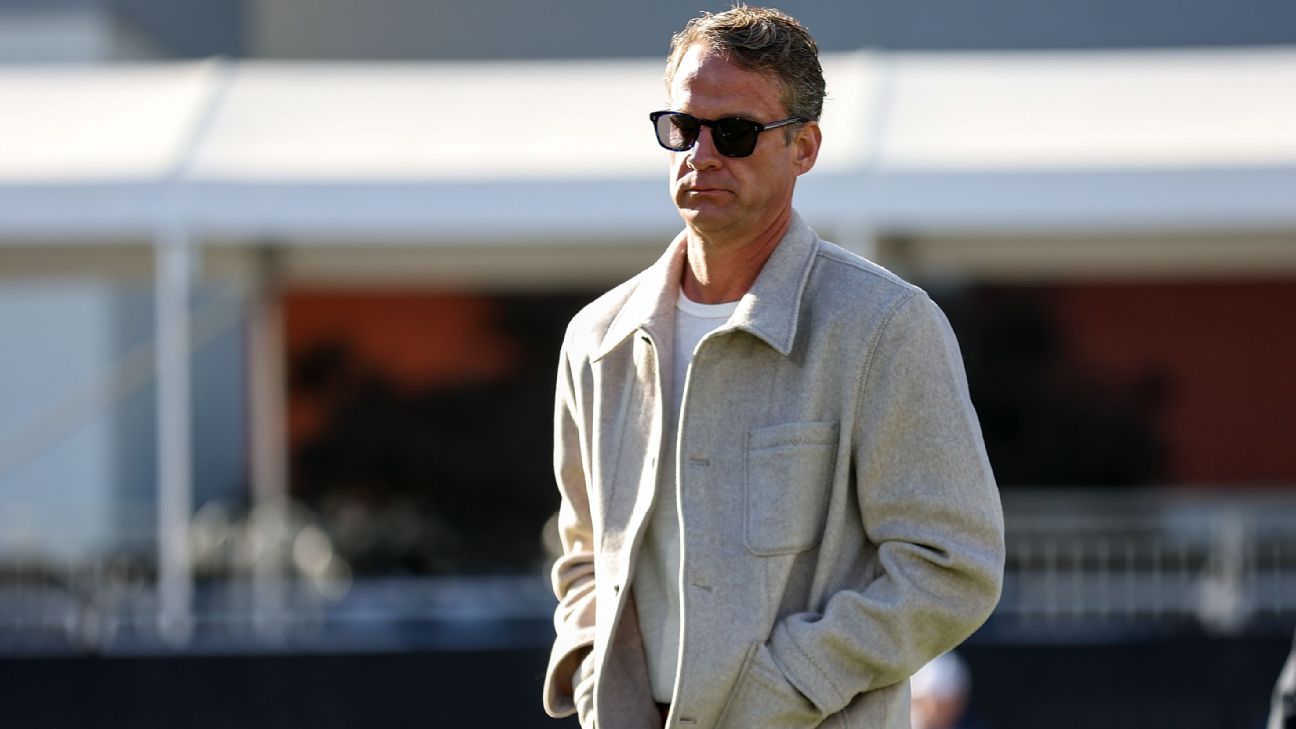
Here at Bottom 10 Headquarters, located behind the bank of telephones used to raise money for the “Free Marty Smith From Oxford” fund, we once again look at the calendar and realize that it is conference championship weekend, which means it’s time for the Bottom 10 to make like Lane Kiffin and run for the exit amid a shower of boos and middle fingers.
The #Bottom10 Selection Committee is currently in session to determine the final 2025 rankings, to be revealed Wednesday morning. pic.twitter.com/WdIvj25gNW
— Ryan McGee (@ESPNMcGee) December 2, 2025
Due to an unprecedented coaching carousel that was so bonkers we’ve renamed it the Coaching Tilt-A-Whirl, the candidates list for this year’s Bottom 10 Selection Committee grew faster than Brian Kelly’s lawyers’ billable hours invoice. The final roster: me, my dad, Captain Morgan (aka my stepdad), Mike Gundy, current Northwest Oklahoma defensive coordinator Jerry Glanville and former Texas State Armadillos head coach Ed “Straight Arrow” Gennero. As our vote began, we were joined by Sam Pittman, who pulled up to our meeting spot, a truck stop behind the Gaylord Texan where the fancy-schmancy CFP committee was gathered, behind the wheel of a shoebox Winnebago blasting Skynyrd and towing a pontoon boat upon which the name “S.S. YESSIR” was airbrushed.
Once again, we leaned on our Bottom 10 FPI formula. No, not the ESPN Football Power Index, but rather the Faux Pas Index. Because everyone loves math.
Teams receive one point for each win, minus one point for each loss, minus one point for each loss of their longest losing streak of the year, plus a minus-10 bonus if that longest losing streak is currently active. We also subtract the number of points they have surrendered on the season from the number of points they scored, subtract or add points based on their season turnover margin and subtract their weakness of schedule (WoS) ranking. If a team fired its head coach, that earns a 50-point subtraction, aka the Randy Edsall Fired Coach Bonus.
Divide all of that by the number of games played, and there’s your Bottom 10 FPI score. Because it’s hard numbers, the results are indisputable. And by hard numbers we mean that we made the formula so badly complicated that it’s too hard to dispute because it’s not worth wasting the effort to do so.
With apologies to Tennessee wide receiver Deon Hardin, Mizzou running back Ahmad Hardy, Rice running back D’Andre Hardeman Jr. and Steve Harvey, here’s the final 2025 Bottom 10 rankings.


Wins: +0
Losses: -12
Longest losing streak: -12 (current -10)
Point differential: -330 (133 for, 463 against)
Turnover margin: -7
WoS: -91
Randy Edsall Fired Coach Bonus: N/A
Total: -450
Games played: 12
Final Bottom 10 Faux Pas Index: -37.5
The Minuetmen had their wet hay in the barn a full week early, having played their final game of the season on the Tuesday afternoon prior to Thanksgiving. Once they got that hay into the barn, they remembered that the Salem witch trials took place in Massachusetts and they immediately burned that barn down in an effort to exorcise their Bottom 10 demons.

Wins: +2
Losses: -10
Longest losing streak: -8
Point differential: -241 (213 for, 454 against)
Turnover margin: +2
WoS: -104
Randy Edsall Fired Coach Bonus: N/A
Total: -359
Games played: 12
Final Bottom 10 Faux Pas Index: -29.9
The Bearkats kompiled a two-win kampaign, but still katapulted kompletely over kontenders who had only one win. How did they akkomplish that? Bekause of a krappy strength of skedule and a defense too frekwently skored upon.

Wins: +1
Losses: -11
Longest losing streak: -11 (current -10)
Point differential: -230 (170 for, 400 against)
Turnover margin: -5
WoS: -30
Randy Edsall Fired Coach Bonus: -50
Total: -346
Games played: 12
Final Bottom 10 Faux Pas Index: -28.8
Many people in the greater Stillwater area had told me that I didn’t have the Kowboys, er, sorry, Cowboys ranked low enough. When we did the FPI math, it backed up those complainers with the same amount of force that it backed down their team.

Wins: +1
Losses: -11
Longest losing streak: -9 (current -10)
Point differential: -217 (237 for, 454 against)
Turnover margin: -11
WoS: -66
Randy Edsall Fired Coach Bonus: N/A
Total: -323
Games played: 12
Final Bottom 10 Faux Pas Index: -26.9
Just as the arithmetic hurt OSU, it helped GSU, which jumped/fell from No. 2 to No. 4. That might not seem like much, but for a team that last won a game more than 80 days ago, you’ll take whatever good news you can get.
5. The Lane Train
Marty said if I didn’t have Kiffin in the Coveted Fifth Spot again this week he would beat me over the head with the turkey leg he wasn’t able to eat with his family on Thanksgiving because he had to go to Oxford and hold a microphone instead.

Wins: +2
Losses: -10
Longest losing streak: -6 (current -10)
Point differential: -148 (222 for, 370 against)
Turnover margin: -4
WoS: -90
Randy Edsall Fired Coach Bonus: -50
Total: -316
Games played: 12
Final Bottom 10 Faux Pas Index: -26.3
Easily, the most vocal “How can we not be ranked?!” #Bottom10Lobbying crowd of 2025 was Rams Nation. And when we did the math, they were proved right as Colorado State leapt like a ram from a rock formation off the Waiting List into the canyon of nearly the top/bottom five. Now they have hired professional Bottom 10 rehabilitation specialist Jim Mora, who totally ruined what used to be the Bottom 10’s version of Chiefs vs. Eagles, UMess vs. U-Can’t, by inexplicably turning the Huskies into winners.

Wins: +1
Losses: -11
Longest losing streak: -9 (current -10)
Point differential: -264 (172 for, 436 against)
Turnover margin: -8
WoS: -70
Randy Edsall Fired Coach Bonus: N/A
Total: -271
Games played: 12
Final Bottom 10 Faux Pas Index: -22.5833333
Niners officials reached out to the Bottom 10 committee to see if perhaps they might receive bonus cool points for the fact that their record was 1-9 when Georgia paid them $1.9 million to play “between the hedges.” We told them no, but only after reaching out to UNCC math professors, who assured us that the laws of natural numerical law would not allow us to add something called “cool points” to something called a “Faux Pas Index.” Speaking of math, Charlotte also is now part of a Bottom 10 FPI first, a numerical tie! With whom … ?

Wins: +2
Losses: -10
Longest losing streak: -7
Point differential: -135 (218 for, 353 against)
Turnover margin: -11
WoS: -60
Randy Edsall Fired Coach Bonus: -50
Total: -271
Games played: 12
Final Bottom 10 Faux Pas Index: -22.5833333
It should be no surprise that the Beavers would be in some weird spot here after spending their entire season stuck in a bizarro Bottom 10 vortex. They won the tiebreaker with Charlotte via one common opponent, Appalachian State. The Niners lost at home to the Mountaineers 34-11, while the Beavs lost in Boone by only four points. One of only a pair of members of the 2Pac conference, Oregon State had already beaten its only league colleague, Warshington State, in Week 10, but then immediately lost to Sam Houston. Then all the Beavers had to do was beat Wazzu again to depart these rankings for good, but they lost 32-8. Now they will do like all beavers and spend the winter not hibernating, but packed into a mud lodge with other beavers, shivering and seeing who has to swim out under the ice to get food. In related news, that’s also how we on the Bottom 10 Selection Committee spent this week. We sent Mike Gundy out to get the food because his haircut totally looks like a beaver.

Wins: +2
Losses: -10
Longest losing streak: -5 (current -10)
Point differential: -85 (280 for, 365 against)
Turnover margin: -12
WoS: -109
Randy Edsall Fired Coach Bonus: N/A
Total: -229
Games played: 12
Final Bottom 10 Faux Pas Index: -19.1
Representatives of the Minors crashed our committee meeting to remind us that while they understood they would likely have to be ranked, no matter what the math said, they had to be ranked above/below Sam Houston because they beat the Bearkats head-to-head. But we didn’t hear any of that because when we say they crashed our meeting, they literally crashed our meeting. Paydirt Pete had to use his pickax to pry the UTEP conversion van free from where it ran into the trailer carrying Pittman’s pontoon boat.

Wins: +2
Losses: -10
Longest losing streak: -10
Point differential: -88 (305 for, 393 against)
Turnover margin: -9
WoS: -54
Randy Edsall Fired Coach Bonus: N/A
Total: -169
Games played: 12
Final Bottom 10 Faux Pas Index: -14.08
The Golden Beagles were in a Bottom 10 peloton to the finish line, which was more like that scene at Oklahoma a few weeks ago when the Sooners got lost in the smoke of their stadium entrance and fell over each other, piling up like firewood for winter. In the end, Arkansaw and Pur-don’t received too big of a Power 4 WoS boost, while Muddled Tennessee and No-vada both had the audacity to win two out of their final three games, hitting the Raise Hell Praise Dale 3-victory mark and moving out of the running. We started to do the FPI math on a few other teams, but when the batteries ran out in our Texas Instruments calculator, Coach Pittman, relieved his former Hogs missed the final cut, announced, “I’ll go to the store, but it won’t be to buy batteries. It’ll be to buy beer.” Meeting adjourned.
Waiting List: Arkansaw Fightin’ Former Petrinos, No-vada, San No-sé State, Pur-don’t, Muddled Tennessee State, Northern Ill-ugh-noise, ULM (pronounced “Uhlm”), conference tiebreakers that require slide rules.
-
 Sports2 years ago
Story injured on diving stop, exits Red Sox game
-
 Sports3 years ago
‘Storybook stuff’: Inside the night Bryce Harper sent the Phillies to the World Series
-
 Sports2 years ago
Game 1 of WS least-watched in recorded history
-
 Sports3 years ago
Button battles heat exhaustion in NASCAR debut
-
 Sports3 years ago
MLB Rank 2023: Ranking baseball’s top 100 players
-
Sports4 years ago
Team Europe easily wins 4th straight Laver Cup
-
 Environment3 years ago
Japan and South Korea have a lot at stake in a free and open South China Sea
-
 Environment1 year ago
Here are the best electric bikes you can buy at every price level in October 2024