Laws may need to be strengthened to crack down on the exploitation of child “influencers”, a senior Labour MP has warned.
Chi Onwurah, chair of the science, technology and innovation committee, said parts of the Online Safety Act – passed in October 2023 – may already be “obsolete or inadequate”.
Experts have raised concerns that there is a lack of provision in industry laws for children who earn money through brand collaborations on social media when compared to child actors and models.
This has led to some children advertising in their underwear on social media, one expert has claimed.
Those working in more traditional entertainment fields are safeguarded by performance laws,which strictly govern the hours a minor can work, the money they earn and who they are accompanied by.
The Child Influencer Project, which has curated the world’s first industry guidelines for the group, has warned of a “large gap in UK law” which is not sufficiently filled by new online safety legislation.
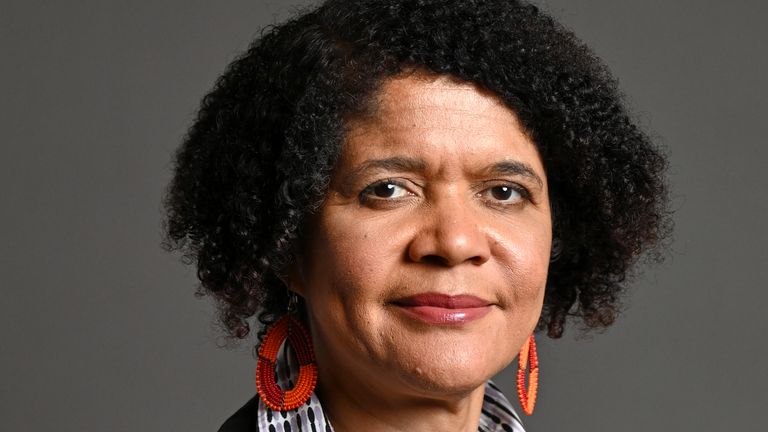
Image: Official portrait of Chi Onwurah.
Pic: UK Parlimeant
The group’s research found that child influencers could be exposed to as many as 20 different risks of harm, including to dignity, identity, family life, education, and their health and safety.
Ms Onwurah told Sky News there needs to be a “much clearer understanding of the nature of child influencers ‘work’ and the legal and regulatory framework around it”.
She said: “The safety and welfare of children are at the heart of the Online Safety Act and rightly so.
“However, as we know in a number of areas the act may already be obsolete or inadequate due to the lack of foresight and rigour of the last government.”
Victoria Collins, the Liberal Democrat spokesperson for science, innovation and technology, agreed that regulations “need to keep pace with the times”, with child influencers on social media “protected in the same way” as child actors or models.
“Liberal Democrats would welcome steps to strengthen the Online Safety Act on this front,” she added.
‘Something has to be done’
MPs warned in 2022 that the government should “urgently address the gap in UK child labour and performance regulation that is leaving child influencers without protection”.
They asked for new laws on working hours and conditions, a mandate for the protection of the child’s earnings, a right to erasure and to bring child labour arrangements under the oversight of local authorities.
However, Dr Francis Rees, the principal investigator for the Child Influencer Project, told Sky News that even after the implementation of the Online Safety Act, “there’s still a lot wanting”.
“Something has to be done to make brands more aware of their own duty of care towards kids in this arena,” she said.
Dr Rees added that achieving performances from children on social media “can involve extremely coercive and disruptive practices”.
“We simply have to do more to protect these children who have very little say or understanding of what is really happening. Most are left without a voice and without a choice.”
What is a child influencer – and how are they at risk?
A child influencer is a person under the age of 18 who makes money through social media, whether that is using their image alone or with their family.
Dr Francis Rees, principal investigator for the Child Influencer Project, explains this is an “escalation” from the sharing of digital images and performances of the child into “some form of commercial gain or brand endorsement”.
She said issues can emerge when young people work with brands – who do not have to comply with standard practise for a child influencer as they would with an in-house production.
Dr Rees explains how, when working with a child model or actor, an advertising agency would have to make sure a performance license is in place, and make sure “everything is in accordance with many layers of legislation and regulation around child protection”.
But, outside of a professional environment, these safeguards are not in place.
She notes that 30-second videos “can take as long as three days to practice and rehearse”.
And, Dr Rees suggests, this can have a strain on the parent-child relationship.
“It’s just not as simple as taking a child on to a set and having them perform to a camera which professionals are involved in.”
The researcher pointed to one particular instance, in which children were advertising an underwear brand on social media.
She said: “The kids in the company’s own marketing material or their own media campaigns are either pulling up the band of the underwear underneath their clothing, or they’re holding the underwear up while they’re fully clothed.
“But whenever you look at any of the sponsored content produced by families with children – mum, dad, and child are in their underwear.”
Dr Rees said it is “night and day” in terms of how companies are behaving when they have responsibility for the material, versus “the lack of responsibility once they hand it over to parents with kids”.

Specialist investigation teams for rape and sexual offences are to be created across England and Wales as the home secretary declares violence against women and girls a “national emergency”.
Shabana Mahmood said the dedicated units will be in place across every force by 2029 as part of Labour’s violence against women and girls (VAWG) strategy due to be launched later this week.
The use of Domestic Abuse Protection Orders (DAPOs), which had been trialled in several areas, will also be rolled out across England and Wales. They are designed to target abusers by imposing curfews, electronic tags and exclusion zones.
The orders cover all forms of domestic abuse, including economic abuse, coercive and controlling behaviour, stalking and ‘honour’-based abuse. Breaching the terms can carry a prison term of up to five years.
Please use Chrome browser for a more accessible video player
2:10
Govt ‘thinking again’ on abuse strategy
Nearly £2m will also be spent funding a network of officers to target offenders operating within the online space.
Teams will use covert and intelligence techniques to tackle violence against women and girls via apps and websites.
A similar undercover network funded by the Home Office to examine child sexual abuse has arrested over 1,700 perpetrators.
More on Domestic Abuse
Related Topics:
Abuse is ‘national emergency’
Ms Mahmood said in a statement: “This government has declared violence against women and girls a national emergency.
“For too long, these crimes have been considered a fact of life. That’s not good enough. We will halve it in a decade.
“Today, we announce a range of measures to bear down on abusers, stopping them in their tracks. Rapists, sex offenders and abusers will have nowhere to hide.”
Please use Chrome browser for a more accessible video player
0:51
Angiolini Inquiry: Recommendations are ‘not difficult’
The government said the measures build on existing policy, including facial recognition technology to identify offenders, improving protections for stalking victims, making strangulation a criminal offence and establishing domestic abuse specialists in 999 control rooms.
But the Conservatives said Labour had “failed women” and “broken its promises” by delaying the publication of the violence against women and girls strategy.
Shadow home secretary Chris Philp said that Labour “shrinks from uncomfortable truths, voting against tougher sentences and presiding over falling sex-offender convictions. At every turn, Labour has failed women”.
Home Secretary Shabana Mahmood will be on Sunday Morning with Trevor Phillips on Sky News this morning from 8.30am.
The United States Securities and Exchange Commission (SEC) published a crypto wallet and custody guide investor bulletin on Friday, outlining best practices and common risks of different forms of crypto storage for the investing public.
The SEC’s bulletin lists the benefits and risks of different methods of crypto custody, including self-custody versus allowing a third-party to hold digital assets on behalf of the investor.
If investors choose third-party custody, they should understand the custodian’s policies, including whether it “rehypothecates” the assets held in custody by lending them out or if the service provider is commingling client assets in a single pool instead of holding the crypto in segregated customer accounts.
The Bitcoin supply broken down by the type of custodial arrangement. Source: River
Crypto wallet types were also outlined in the SEC guide, which broke down the pros and cons of hot wallets, which are connected to the internet, and offline storage in cold wallets.
Hot wallets carry the risk of hacking and other cybersecurity threats, according to the SEC, while cold wallets carry the risk of permanent loss if the offline storage fails, a storage device is stolen, or the private keys are compromised.
The SEC’s crypto custody guide highlights the sweeping regulatory change at the agency, which was hostile to digital assets and the crypto industry under former SEC Chairman Gary Gensler’s leadership.
The crypto community celebrates the SEC guide as a transformational change in the agency
“The same agency that spent years trying to kill the industry is now teaching people how to use it,” Truth For the Commoner (TFTC) said in response to the SEC’s crypto custody guide.
The SEC is providing “huge value” to crypto investors by educating prospective crypto holders about custody and best practices, according to Jake Claver, the CEO of Digital Ascension Group, a company that provides services to family offices.
SEC regulators published the guide one day after SEC Chair Paul Atkins said that the legacy financial system is moving onchain.
On Thursday, the SEC gave the green light to the Depository Trust and Clearing Corporation (DTCC), a clearing and settlement company, to begin tokenizing financial assets, including equities, exchange-traded funds (ETFs) and government debt securities.
Greens leader Zack Polanski has rejected claims his party would push for open borders on immigration, telling Sky News it is “not a pragmatic” solution for a world in “turmoil”.
Mr Polanski distanced himself from his party’s “long-range vision” for open borders, saying it was not in his party’s manifesto and was an “attack line used by opponents” to question his credibility.
It came as Mr Polanski, who has overseen a spike in support in the polls to double figures, refused to apologise over controversial comments he made about care workers on BBC Question Time that were criticised across the political spectrum.
Mr Polanski was speaking to Sky News earlier this week while in Calais, where he joined volunteers and charities to witness how French police handle the arrival of migrants in the town that is used as a departure point for those wanting to make the journey to the UK.
He told Sky News he had made the journey to the French town – once home to the “Jungle” refugee camp before it was demolished in 2016 – to tackle “misinformation” about migration and to make the case for a “compassionate, fair and managed response” to the small boats crisis.
He said that “no manifesto ever said anything about open borders” and that the Greens had never stood at a general election advocating for them.
“Clearly when the world is in political turmoil and we have deep inequality, that is not a situation we can move to right now,” he said.
More on Green Party
Related Topics:
“That would also involve massive international agreements and cooperation. That clearly is not a pragmatic conversation to have right now. And very often the government try to push that attack line to make us look not pragmatic.”
The party’s manifesto last year did not mention open borders, but it did call for an end to the “hostile environment”, more safe and legal routes and for the Home Office to be abolished and replaced with a department of migration.
Asked why the policy of minimal restrictions on migration had been attributed to his party, Mr Polanski said open borders was part of a “long-range vision of what society could look like if there was a Green government and if we’d had a long time to fix some of the systemic problems”.
‘We should recognise the contribution migrants make’
Mr Polanski, who was elected Green Party leader in September and has been compared to Nigel Farage over his populist economic policies, said his position was one of a “fair and managed” migration system – although he did not specify whether that included a cap on numbers.
He acknowledged that there needed to be a “separate conversation” about economic migration but that he did not believe any person who boarded a small boat was in a “good situation”.
While Mr Polanski stressed that he believed asylum seekers should be able to work in Britain and pay taxes, he also said he believed in the need to train British workers in sectors such as care, where one in five are foreign nationals.
Asked what his proposals for a fair and managed migration system looked like, and whether he supported a cap on numbers, Mr Polanski said: “We have 100,000 vacancies in the National Health Service. One in five care workers in the care sector are foreign nationals.
Image: Zack Polanski speaks to Sky News from a warehouse in Calais where charities and organisations provide migrants with essentials.
“Now, of course, that is both British workers and we should be training British workers, but we should recognise the contribution that migrants and people who come over here make.”
I’m not going to apologise’
Mr Polanski also responded to the criticism he attracted over his comments about care workers on Question Time last week, where he told the audience: “I don’t know about you, but I don’t particularly want to wipe someone’s bum” – before adding: “I’m very grateful for the people who do this work.”
His comments have been criticised by a number of Labour MPs, including Wes Streeting, the health secretary, who said: “Social care isn’t just ‘wiping someone’s bum’. It is a hard, rewarding, skilled professional job.
Asked whether he could understand why some care workers might feel he had talked down to them, the Greens leader replied: “I care deeply about care workers. When I made those comments, it’s important to give a full context. I said ‘I’m very grateful to people who do this important work’ and absolutely repeat that it’s vital work.”
“Of course, it is not part of the whole job, and I never pretended it was part of the whole job.”
Mr Polanski said he “totally” rejected the suggestion that he had denigrated the role of care workers in the eyes of the public and said his remarks were made in the context of a “hostile Question Time” where he had “three right-wing panellists shouting at me”.
Pressed on whether he wanted to apologise, he replied: “I’m not going to apologise for being really clear that I’m really grateful to the people who do this really vital work. And yes, we should be paying them properly, too.”