
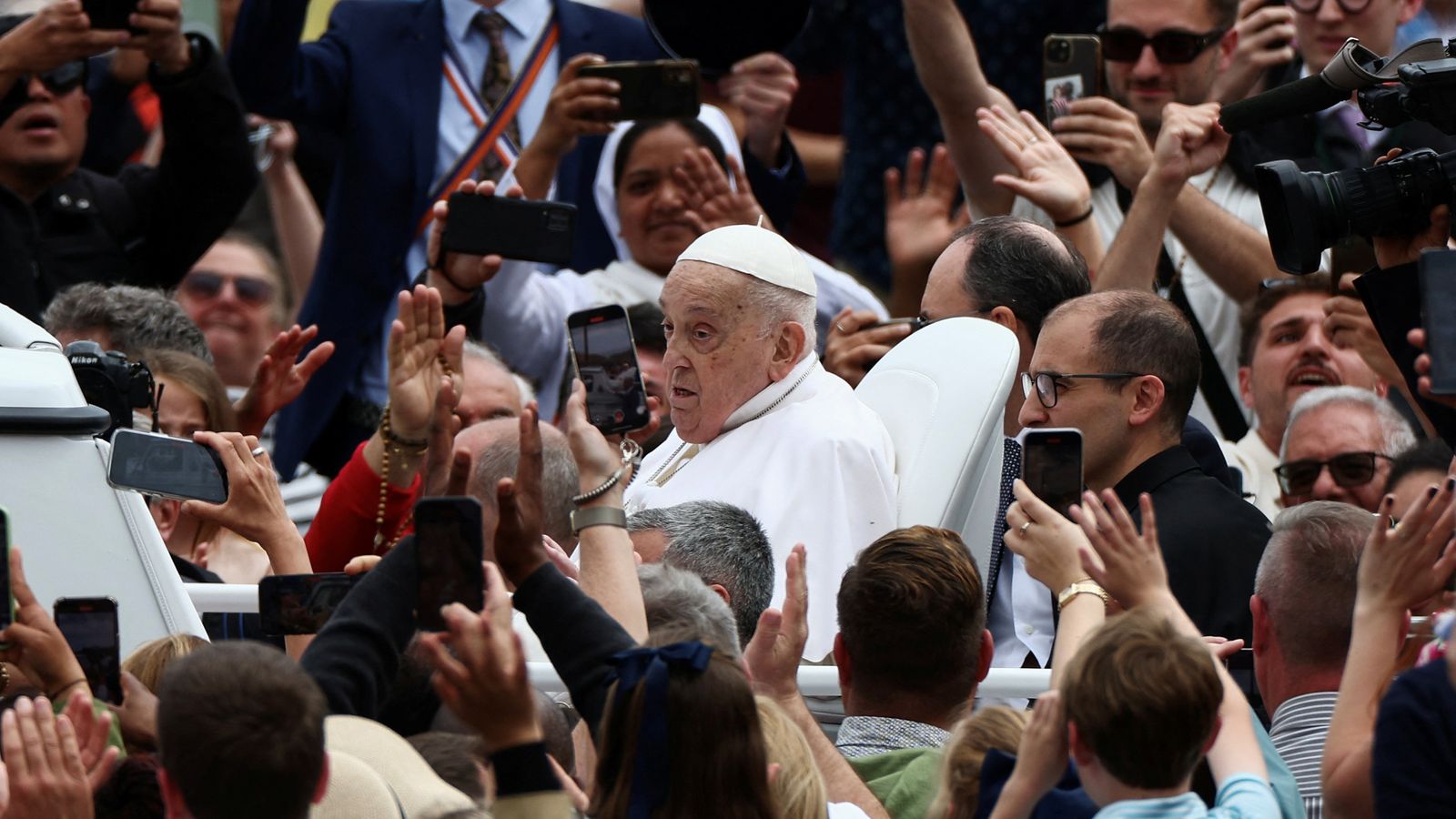
Pope blesses Easter crowds from popemobile in first significant appearance since illness

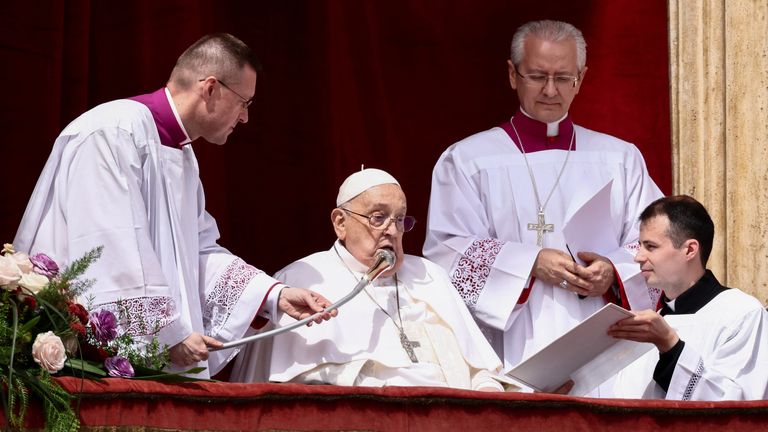
Pope Francis has made his first significant public appearance since he left hospital, greeting cheering crowds from the popemobile.
He blessed the thousands of faithful gathered to celebrate Easter Sunday at the Vatican.
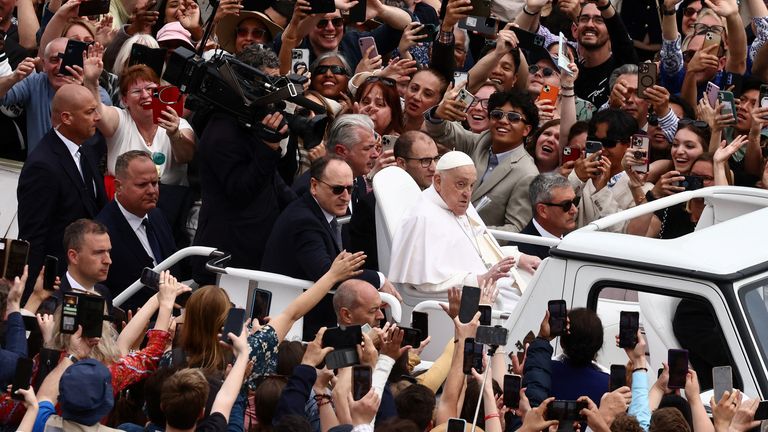
The 88-year-old pontiff appeared frail as he was wheeled out onto the balcony over the entrance of St Peter’s Basilica, before being driven in the popemobile through the crowds of faithful gathered in St Peter’s Square.
He was met with cheers, applause and chants of “Viva il Papa” – meaning long live the Pope.
It is his longest stint out in public since he spent five weeks in hospital being treated for double pneumonia.
Pic: Reuters
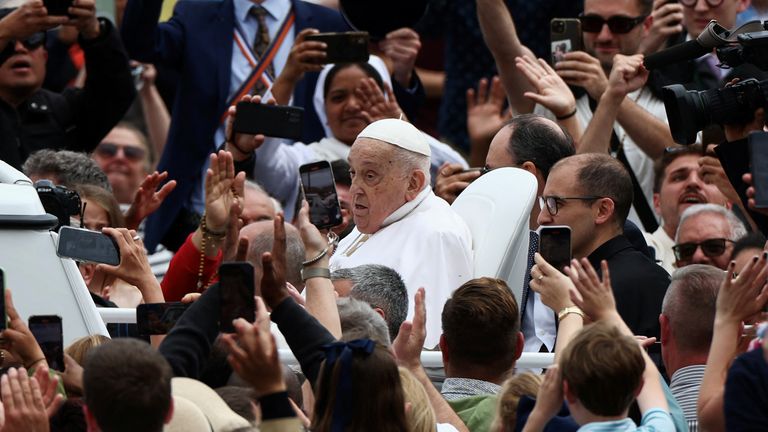
Pope Francis being driven through the crowds in St Peter’s Square. Pic: Reuters
“Brothers and sisters, Happy Easter!” Pope Francis managed to say, before an aide read the rest of his annual Urbi et Orbi blessing and speech, which called for an end to the conflicts in Ukraine and Gaza.
“May the risen Christ grant Ukraine, devastated by war, his Easter gift of peace, and encourage all parties involved to pursue efforts aimed at achieving a just and lasting peace,” the message said.
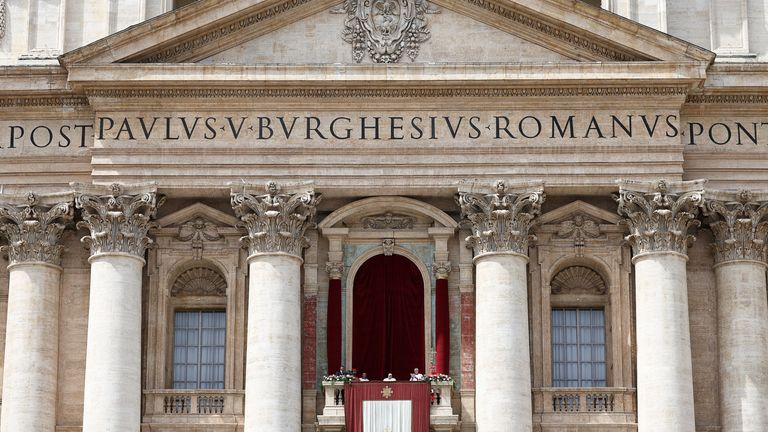
Pic: Reuters
“In this Jubilee year, may Easter also be a fitting occasion for the liberation of prisoners of war and political prisoners!”
Pic: Reuters
Crowds then stretched out their hands and filmed as the Pope was driven past in the special vehicle.
The popemobile stopped a number of times in order for the pontiff to bless babies and small children, appearing to also give them gifts.
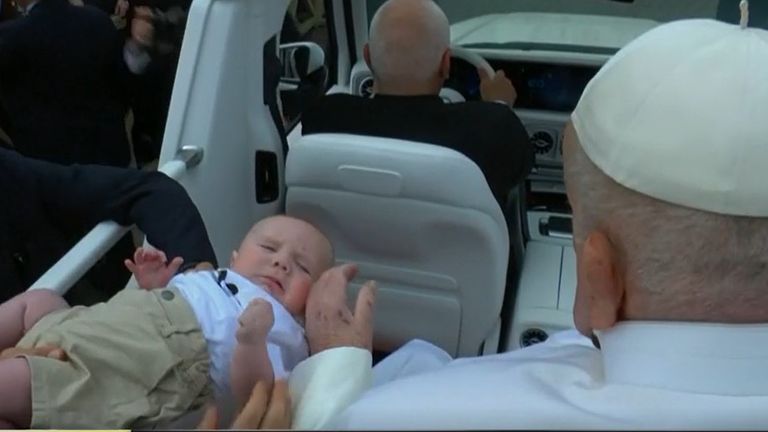
The Pope blesses a baby as he travels around St Peter’s Square
Before the public appearance, the Pope “exchanged good wishes” with US vice president JD Vance during a private audience at the Vatican.
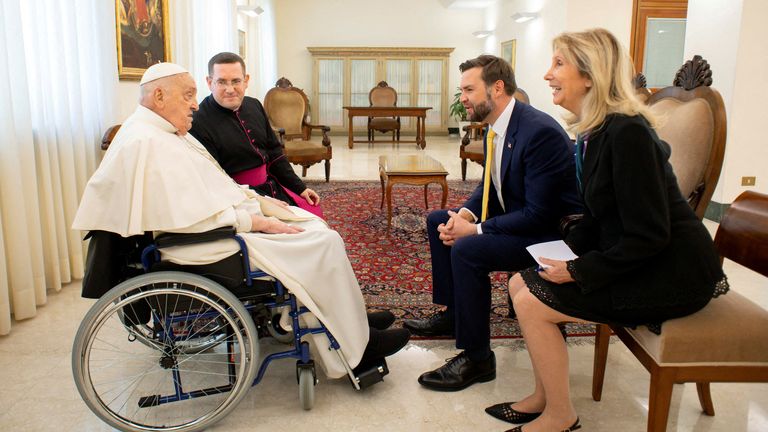
The Pope meeting JD Vance on Easter Sunday. Pic: Vatican Media
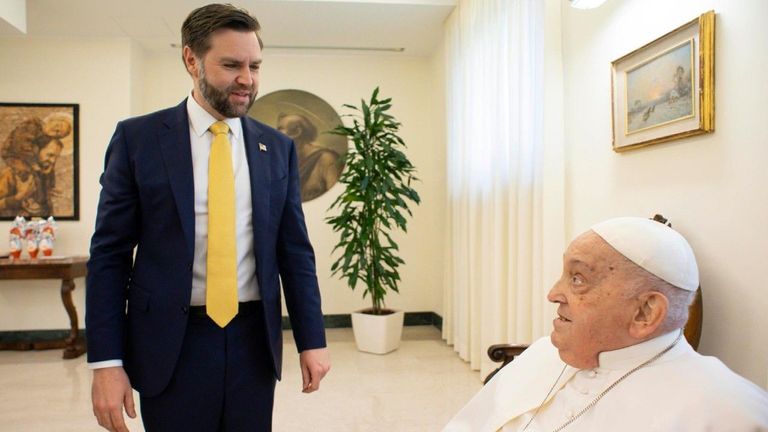
Pic: Vatican Media
Mr Vance, who is in Rome with his family, also met with Pope Francis on Saturday, where the Vatican said there had been “an exchange of opinions” over international conflicts, migrants and prisoners.
The Pope has only appeared in public a handful of times since returning to the Vatican on 23 March.
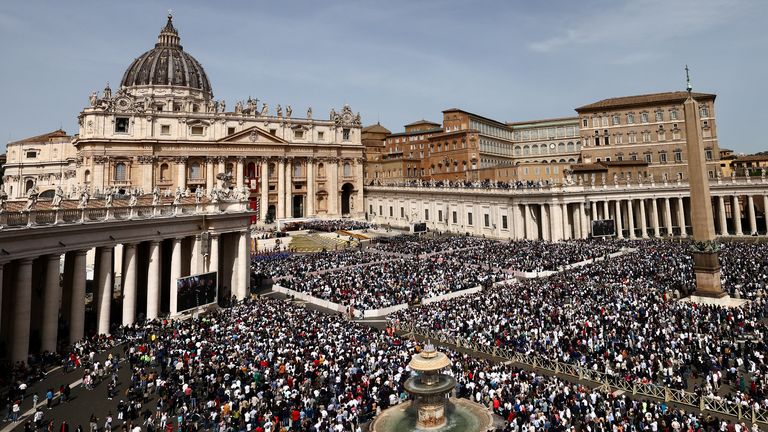
The faithful gather in St. Peter’s Square. Pic: Reuters
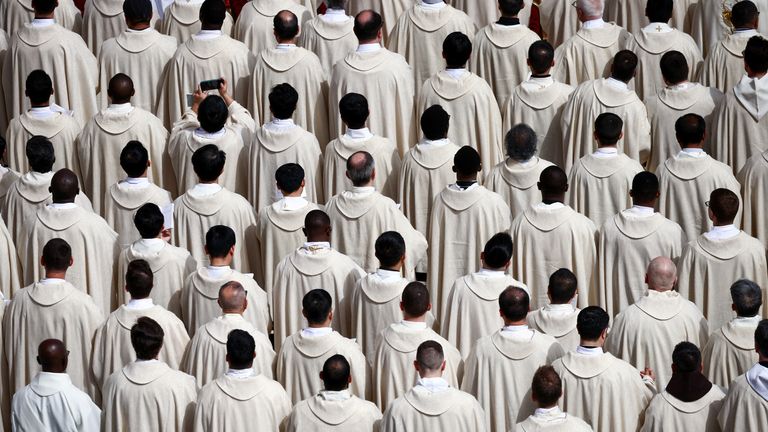
Members of the clergy. Pic: Reuters
Leading up to Easter, he skipped the solemn services of Good Friday and Holy Saturday. Before Sunday, his biggest outing had been a visit to Rome’s central prison to spend Holy Thursday with inmates.
He also missed the Easter Sunday open-air mass, which was led instead by Cardinal Angelo Comastri, the retired archpriest of St Peter’s Basilica.
Read more from Sky News:
London-born teenager about to become a saint
Four mistakes to avoid when running London Marathon
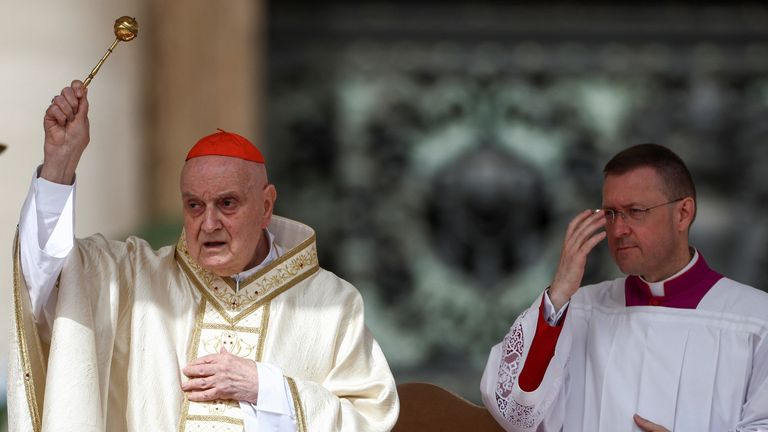
Cardinal Angelo Comastri leading the Easter Sunday mass. Pic: Reuters
Despite cutting down his workload, the Pope was able to meet King Charles and Queen Camilla during the British monarch’s four-day state visit to Italy at the beginning of April.
Charles and Camilla’s 20-minute meeting with the Pope included an exchange of gifts and the pontiff wishing them a happy 20th wedding anniversary.
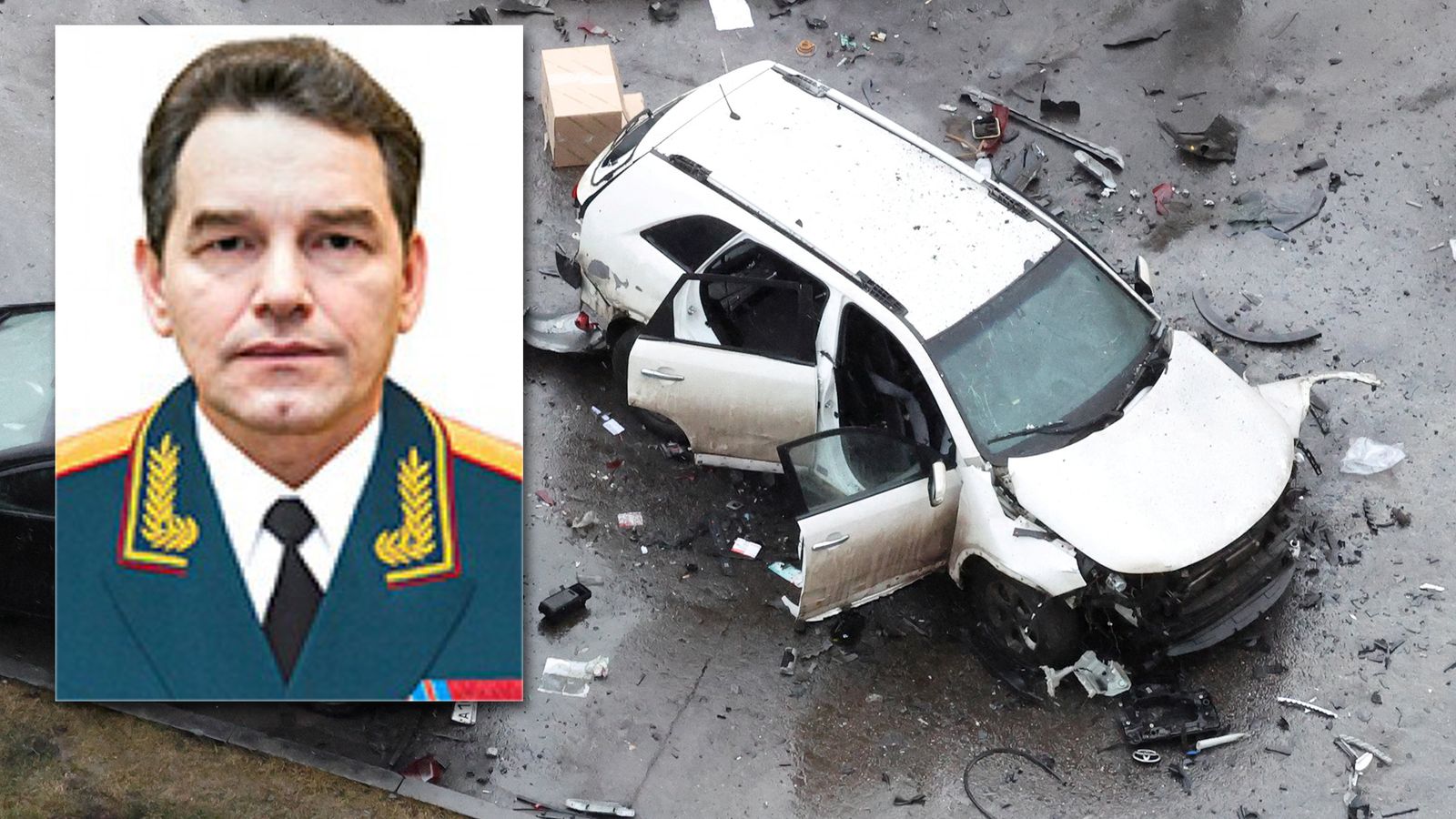

A Russian general being blown up on his own doorstep isn’t a good look for Moscow, and it seems it’s becoming increasingly common.
The latest high-profile figure to be assassinated since Russia‘s invasion of Ukraine is Lieutenant General Fanil Sarvarov.
He was killed by a car bomb that detonated outside a residential complex, little more than 10 miles from the Kremlin.
Ukraine war latest: Kremlin denies Putin plans to invade European countries
He was a senior figure. Head of the operational training directorate of the general staff, Sarvarov prepared forces for future deployment, having previously served in Chechnya and Syria.
There was no immediate claim of responsibility but Moscow believes Kyiv may have been behind it. No wonder – they’ve carried out similar attacks many times before.
This time last year, Ukraine took credit for the assassination of Lieutenant General Igor Kirillov, who Kyiv alleged had ordered chemical weapons to be used against its troops on the battlefield.
He was killed by a bomb hidden in a scooter outside his apartment block, which Vladimir Putin referred to as a “major blunder” by the security services.
Sarvarov was the least senior commander to be killed on Russia soil. Pic: Reuters
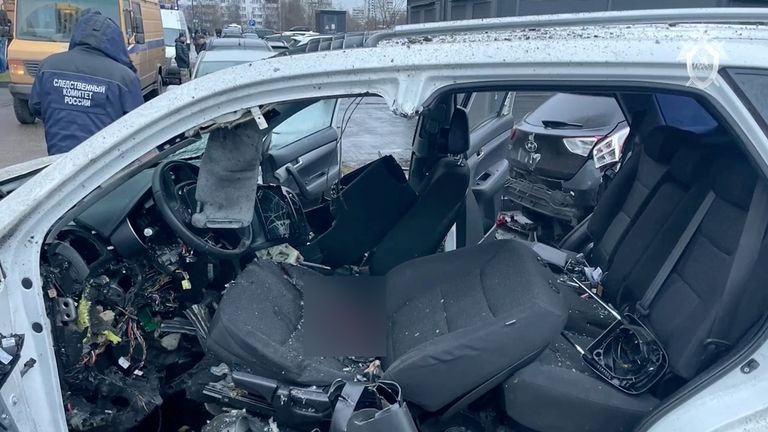
Pics: Reuters
But the attacks didn’t stop there.
In April, Lieutenant General Yaroslav Moskalik was killed after a car exploded in a town just outside Moscow. And two months ago another car bomb in Siberia killed a Russian commander accused of committing war crimes.
It’s unclear why Sarvarov was targeted – perhaps simply because his rank and apparent vulnerability.
The timing appears significant. It follows the latest peace talks between US and Russian officials in Miami over the weekend, where Kremlin envoy Kirill Dmitriev met with Steve Witkoff and Jared Kushner.
In the past, Ukraine has used these kinds of attacks to embarrass Moscow and to bring the war closer to home for Russians.
This time could be Kyiv’s way of undermining Moscow’s narrative in the negotiations.
Read more from Sky News:
Bondi suspect trained with father before attack, police say
Trump’s Greenland envoy intends to make territory ‘a part of US’
The Kremlin has been trying to persuade the White House that a Russian victory is inevitable, and that it’s futile to support Ukraine, in the hope of securing a more preferential settlement.
Ukraine has been trying to convince the Trump administration of the opposite – that it’s still full of fight – and taking out Russian generals in their own backyard is one way of doing that.
It shows Washington that the Kremlin is clearly not in total control.
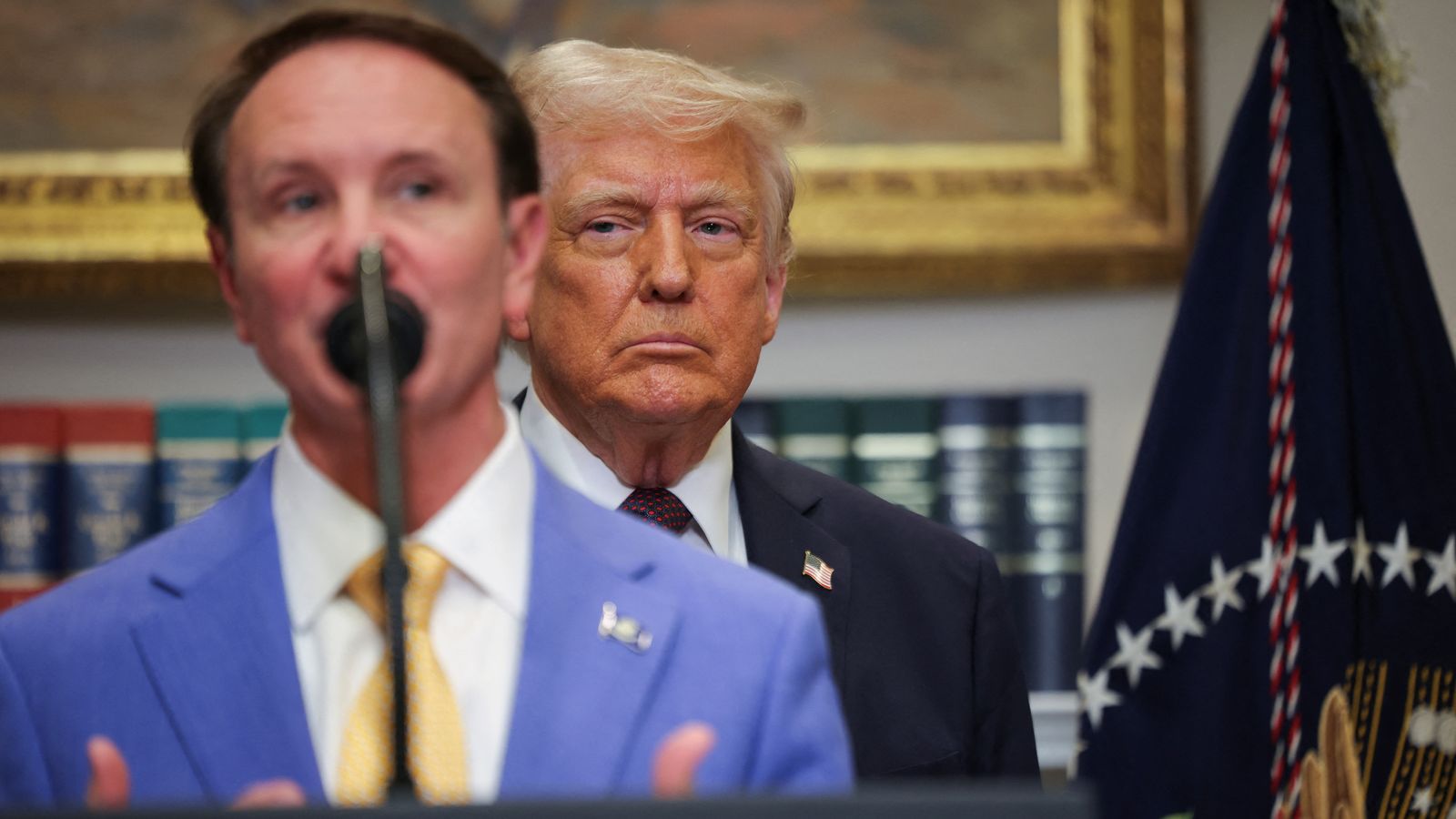
A new row over the future of Greenland has erupted between Denmark and the US after Donald Trump appointed a special envoy to the territory.
The US President announced that he had appointed Louisiana’s governor Jeff Landry to the position on Sunday, saying “Jeff understands how essential Greenland is to our National Security”.
Mr Landry then wrote on X: “It’s an honor to serve you in this volunteer position to make Greenland a part of the US.”
But Greenland is currently a semi-autonomous part of Denmark, which is unhappy about Trump’s latest move. The country has summoned the US ambassador in protest, with its foreign minister saying the move shows the US is still interested in the vast Danish territory.
Trump has repeatedly called for the US to take over over the mineral rich and strategically located Arctic island, since winning his second term, and has not ruled out using military force to achieve it.
Denmark’s foreign minister Lars Løkke Rasmussen said Landry’s comments were “completely unacceptable” and that everyone – including the US – must show respect for Denmark’s territorial integrity.

NATO allies Denmark, Norway, Sweden, Germany and France took part in military drills in Greenland, where the US has a military base, in September. Pic: Reuters
Greenland back in the headlines
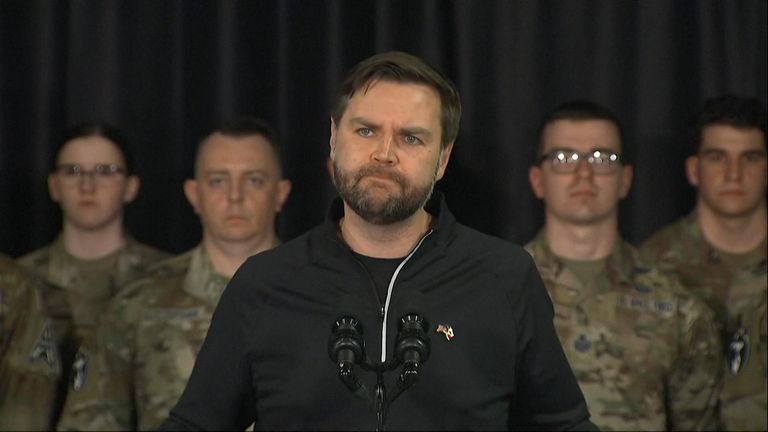
In March, US Vice President JD Vance visited a remote American military base in Greenland and accused Denmark – a NATO ally of the US – of underinvesting there.
The issue then gradually drifted out of the headlines but, in August, Danish officials again summoned the US ambassador – following a report that at least three people with connections to Trump had carried out covert influence operations in Greenland.
On Sunday, Trump said: “Jeff [Louisiana’s governor] understands how essential Greenland is to our national security and will strongly advance our country’s interests for the safety, security, and survival of our allies, and indeed, the world.”
Earlier this month, the Danish Defence Intelligence Service said in an annual report that the US was using its economic power to “assert its will” and threaten military force against friend and foe alike.
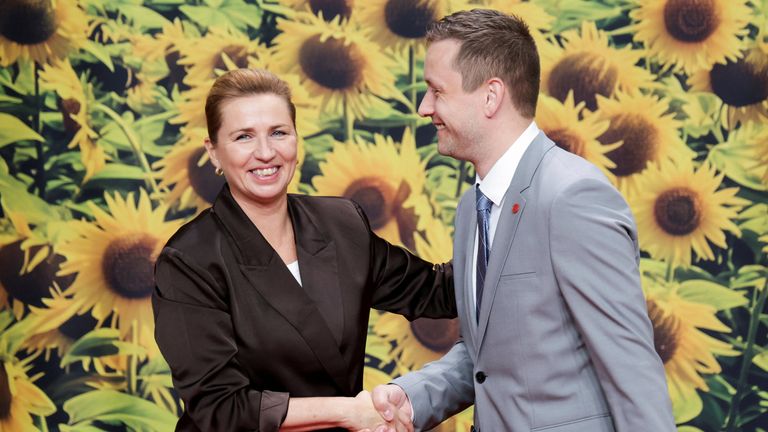
Denmark’s Prime Minister Mette Frederiksen (left) greets Greenland’s Prime Minister, Jens-Frederik Nielsen.
Read more:
Head of US Greenland base sacked after criticising JD Vance
Denmark’s PM says “you can’t spy against an ally”
The report also highlighted the rising strategic importance of the Arctic to great power countries as “conflict between Russia and the West intensifies.
It went on to say that the growing security and strategic focus on the Arctic by the US would “further accelerate these developments”.
Russian President Vladimir Putin has said Russia is worried about NATO’s activities in the Arctic and will respond by strengthening its military capability in the polar region.
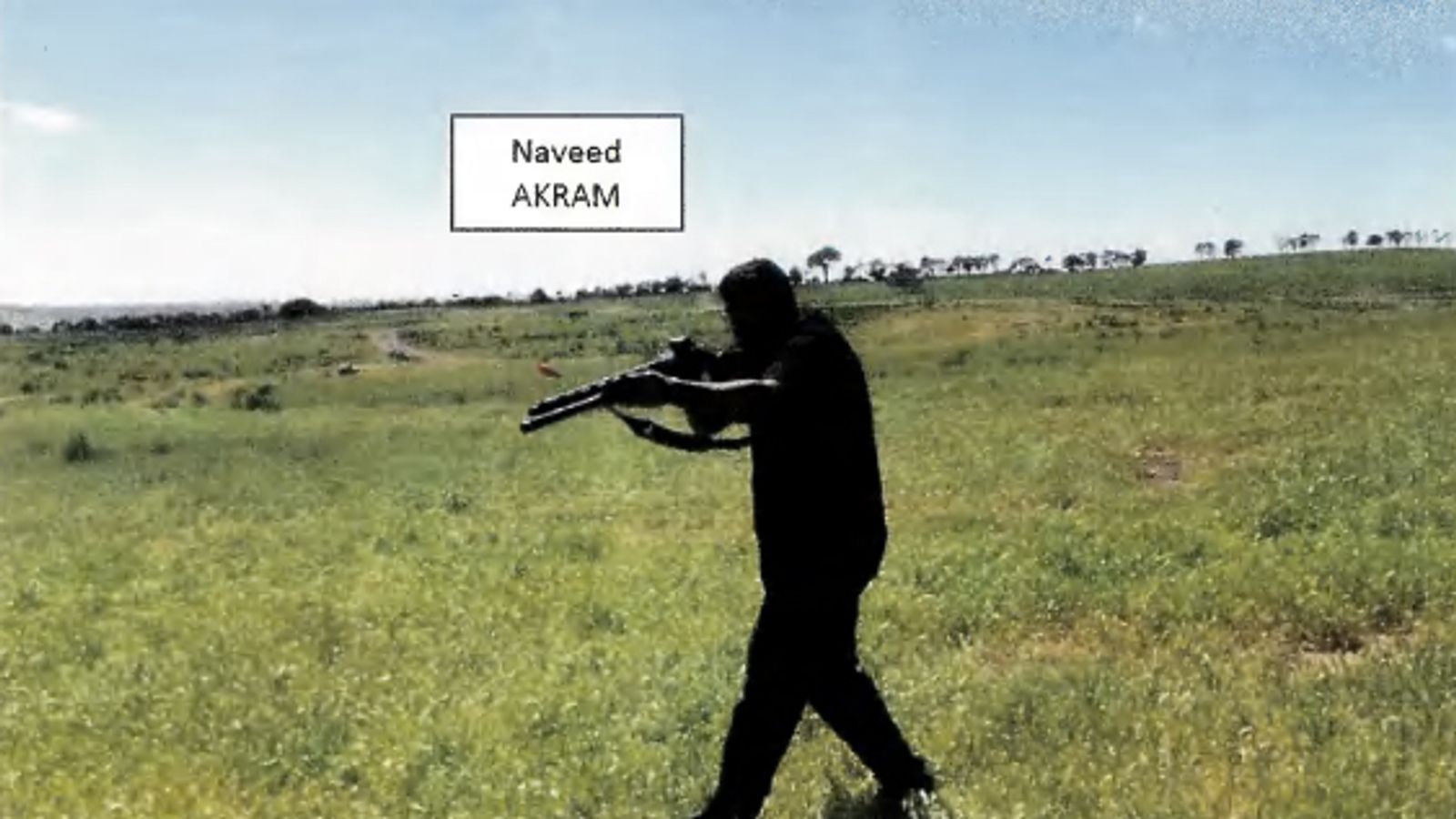
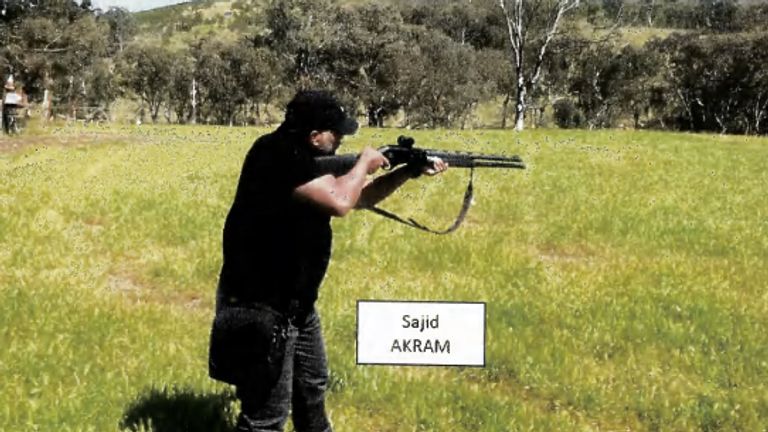
A man suspected of killing 15 people during a shooting in Bondi Beach “conducted firearms training” with his father before the attack on a Jewish event, Australian police have said.
Naveed Akram, 24, and his father, Sajid Akram, allegedly attacked people at a Hanukkah event at Bondi Beach on 14 December, killing victims aged 10 to 87 and injuring 40 others.
Fifty-year-old Sajid Akram was killed by police at the scene, while Naveed was injured and treated in hospital. He has since been charged with 59 offences, including a terror charge, and police transferred him to a prison on Monday.
New South Wales Police have released pictures of Naveed Akram and his father holding guns, as they “conducted firearms training in a countryside location, suspected to be NSW” in late October, according to a police fact sheet seen by Sky News.
Suspected gunman Sajid Akram during the alleged firearms training with his son. Pic: NSW Police/NSW Local Court
“The accused and his father are seen throughout the video firing shotguns and moving in a tactical manner,” police said.
‘Homemade bombs’
On the day of the Bondi Beach attack, the pair allegedly threw homemade bombs and improvised explosive devices (IEDs) at the crowd of people at the gathering near the beach, but these did not detonate.
An analysis indicates that both were “viable” IEDs, according to the police file.
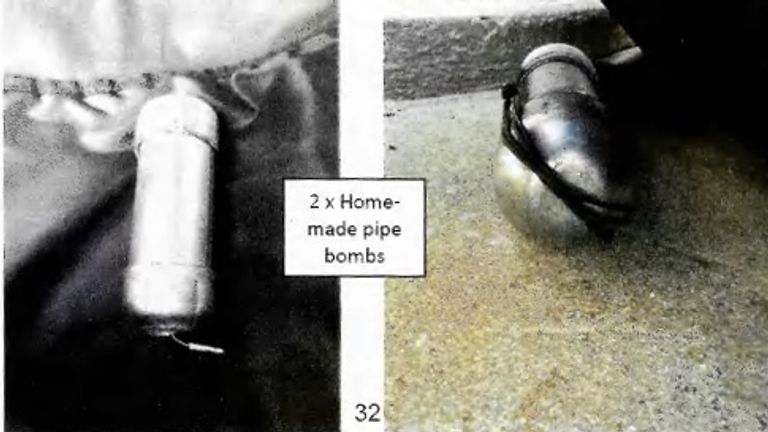
The suspected gunmen were allegedly armed with pipe bombs. Pic: NSW Police/NSW Local Court
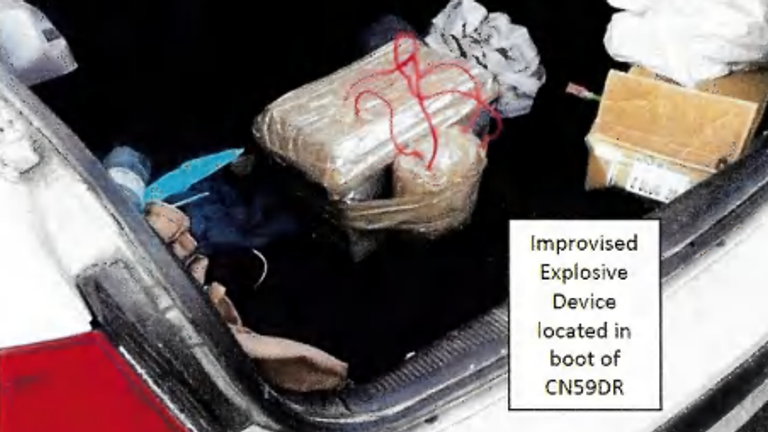
Police said they found an IED in the suspects’ car. Pic: NSW Police/NSW Local Court
The information on the fact sheet was released after a suppression order was lifted by an NSW court.
Police allege the men had stored the explosives – three pipe bombs, one tennis ball bomb and one large IED – in a silver Hyundai vehicle, alongside two single-barrel shotguns, a Beretta rifle and two Islamic State flags.
The Hyundai was parked near the scene of the shooting, with the Islamic State flags allegedly displayed in the front and rear windows.
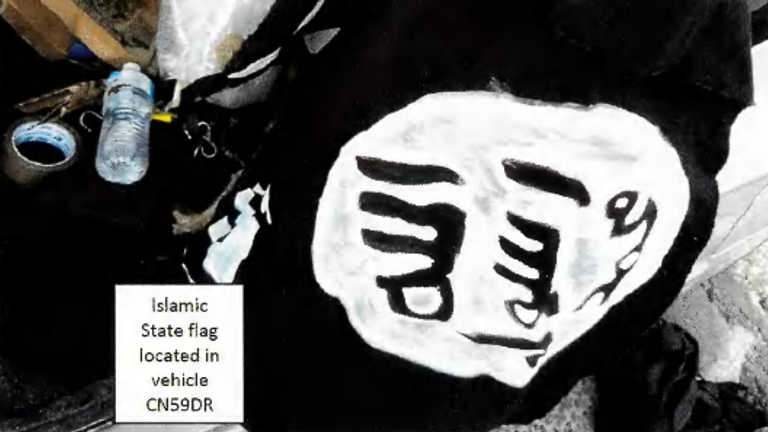
A homemade Islamic State flag was also found in the car, police said. Pic: NSW Police/NSW Local Court
‘Justification’ video found
A phone belonging to Naveed Akram was also found in the car, on which officers identified several videos, including the alleged firearms training video.
Another video shows Naveed Akram and his father sitting in front of an image of an Islamic State flag, with four long-arm guns with rounds attached seen in the background, police said.
The men “appear to summarise their justification for the Bondi terrorist attack” in the footage, according to the fact sheet.
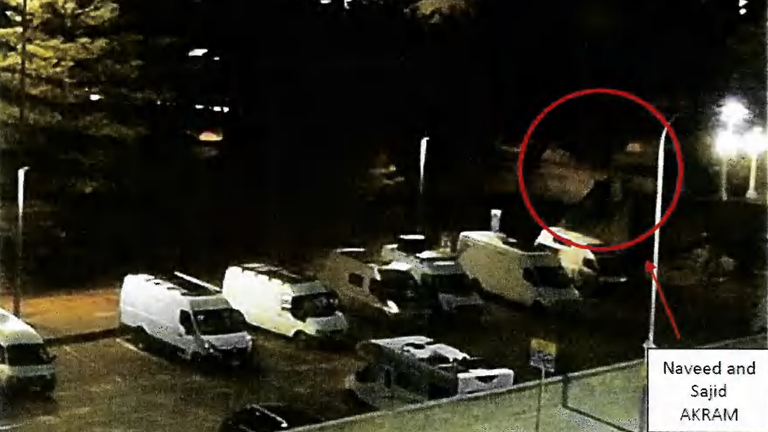
Police said the men walked on the footbridge from where they allegedly shot at crowds two days later. Pic: NSW Local Court
Their Hyundai was previously seen on CCTV entering the car park at Bondi Beach before Naveed Akram and his father walked around the area at around 10pm on 12 December – two days before the shooting.
Police allege that this is evidence of reconnaissance and planning of a terrorist act.
On the day of the shooting, CCTV showed the men leaving a rental house in the nearby suburb of Campsie at around 3pm before driving to Bondi at around 5pm, police said.
The pair were seen carrying bulky items wrapped in blankets, which officers allege were the rifles and homemade bombs.
In the room they rented throughout December, police said they later discovered a firearm scope, ammunition, a suspected IED, 3D-printed parts for a shotgun speed loader, a rifle, a shotgun, numerous firearms parts, bomb-making equipment and two copies of the Koran.
Police said Naveed Akram’s mother told officers that she believed her husband and son were on a fishing trip when they allegedly launched the attack. She said Naveed had been calling her every day from a public phone at around 10.30am.
New gun laws
Meanwhile, the NSW government announced new draft gun laws on Monday, which the state’s premier, Chris Minns, promised would be the toughest in Australia.
The new restrictions would include making Australian citizenship a condition of qualifying for a firearms licence.
But a law like this would have excluded Sajid Akram, who was an Indian citizen with a permanent resident visa for Australia.
Read more from Sky News:
On the ground in Venezuela as US threatens military intervention
NHS reported to police after ‘butcher surgeon’ evidence destroyed
He also legally owned six rifles and shotguns, which would be limited to a maximum of four guns under the new legal limit for recreational shooters.
This comes as Australia’s Prime Minister Anthony Albanese said on Monday that his government would introduce a new offence of adults trying to influence and radicalise children after already introducing legislation to criminalise hate speech and doxing.
-
 Sports2 years ago
Story injured on diving stop, exits Red Sox game
-
 Sports3 years ago
‘Storybook stuff’: Inside the night Bryce Harper sent the Phillies to the World Series
-
 Sports2 years ago
Game 1 of WS least-watched in recorded history
-
 Sports3 years ago
Button battles heat exhaustion in NASCAR debut
-
 Sports3 years ago
MLB Rank 2023: Ranking baseball’s top 100 players
-
Sports4 years ago
Team Europe easily wins 4th straight Laver Cup
-
 Environment3 years ago
Japan and South Korea have a lot at stake in a free and open South China Sea
-
 Environment1 year ago
Here are the best electric bikes you can buy at every price level in October 2024