

Pavel Durov says Telegram would exit markets before betraying users

Telegram CEO Pavel Durov expressed concerns over a growing threat to private messaging in France and other European Union countries, warning that Telegram would rather exit certain markets than implement encryption backdoors that undermine user privacy.
In an April 21 post to his “Du Rove’s channel” on Telegram, he posted a message about the EU’s increasing efforts to weaken messaging encryption by adding backdoors, a method that would allow authorities to bypass encryption and access private user data.
Durov cited initiatives from French and EU lawmakers to require messaging apps like Telegram to implement backdoors for police access and stressed Telegram’s commitment to digital privacy.
“Telegram would rather exit a market than undermine encryption with backdoors and violate basic human rights,” Durov stated, adding: “Unlike some of our competitors, we don’t trade privacy for market share.”
Backdoors can be exploited by criminals
In his message, Durov highlighted that the biggest problem behind encryption backdoors lies in their accessibility not only by authorities but also by hackers and foreign agents.
“It’s technically impossible to guarantee that only the police can access a backdoor,” Durov said, adding that backdoors would put users’ private messages at risk of being compromised.
He added that criminals would likely turn to lesser-known apps and use virtual private networks (VPNs) to avoid detection, rendering such regulations ineffective.
Telegram “never disclosed a single byte” of private messages
Durov said that while Telegram complies with valid court orders in some jurisdictions, such as disclosing IP addresses and phone numbers found to be involved in criminal activity, it has never exposed any private messages:
“In its 12-year history, Telegram has never disclosed a single byte of private messages. In accordance with the EU Digital Services Act, if provided with a valid court order, Telegram would only disclose the IP addresses and phone numbers of criminal suspects — not messages.”
He urged privacy advocates to keep communicating with lawmakers and promote encryption as a protection tool of privacy and safety for ordinary people, rather than see it as a criminal tool. “Losing that protection would be tragic,” Durov said.
“The battle is far from over”
Although the French National Assembly rejected a proposal to allow hidden access to private messages in March, Durov said the EU’s war on digital privacy is far from over.
Durov cited the European Commission’s “ProtectEU” proposal from early April. The proposal aims to find “technological solutions to enable lawful access to data by law enforcement authorities in 2026.”

The proposal has been heavily criticized by digital privacy advocates and some European lawmakers, with Finnish MEP Aura Salla suggesting that introducing encryption backdoors “fundamentally undermines the very cybersecurity principles ProtectEU aims to uphold.”
Related: EU could fine Elon Musk’s X $1B over illicit content, disinformation
“No country is immune to the slow erosion of freedoms. Every day, those freedoms come under attack — and every day, we must defend them,” Durov concluded.
Durov’s warning about threats to privacy and freedom in the EU comes amid an ongoing legal case in France against the Telegram CEO involving allegations of facilitating a platform that enables illicit transactions.
According to French prosecutors, Durov faces up to 10 years of prison time in addition to a $550,000 fine if convicted.
Magazine: Altcoin season to hit in Q2? Mantra’s plan to win trust: Hodler’s Digest, April 13 – 19

Sony Bank, the online lending subsidiary of Sony Financial Group, is reportedly preparing to launch a stablecoin that will enable payments across the Sony ecosystem in the US.
Sony is planning to issue a US dollar-pegged stablecoin in 2026 and expects it to be used for purchases of PlayStation games, subscriptions and anime content, Nikkei reported on Monday.
Targeting US customers — who make up roughly 30% of Sony Group’s external sales — the stablecoin is expected to work alongside existing payment options such as credit cards, helping reduce fees paid to card networks, the report said.
Sony Bank applied in October for a banking license in the US to establish a stablecoin-focused subsidiary and has partnered with the US stablecoin issuer Bastion. Sony’s venture arm also joined Bastion’s $14.6 million raise, led by Coinbase Ventures.
Sony Bank has been actively venturing into Web3
Sony Bank’s stablecoin push in the US comes amid the company’s active venture into Web3, with the bank establishing a dedicated Web3 subsidiary in June.
“Digital assets utilizing blockchain technology are incorporated into a diverse range of services and business models,” Sony Bank said in a statement in May.
“Financial services, such as wallets, which store NFT (non-fungible tokens) and cryptocurrency assets, and crypto exchange providers are becoming increasingly important,” it added.

The Web3 unit, later named BlockBloom, aims to build an ecosystem that blends fans, artists, NFTs, digital and physical experiences, and both fiat and digital currencies.
Related: Animoca eyes stablecoins, AI, DePIN as it expands focus in 2026: Exec
Sony Bank’s stablecoin initiative follows the recent spin-off of its parent, Sony Financial Group, which was separated from Sony Group and listed on the Tokyo Stock Exchange in September.
The move was intended to decouple the financial arm’s balance sheet and operations from the broader Sony conglomerate, allowing each to sharpen its strategic focus.
Cointelegraph reached out to Sony Bank for comment regarding its potential US stablecoin launch, but had not received a response by the time of publication.
Magazine: Koreans ‘pump’ alts after Upbit hack, China BTC mining surge: Asia Express

Ripple Labs has received approval from Singapore’s central bank to expand its payment activities in the region, amid a broader push to grow its business and institutional-focused offerings through acquisitions.
Ripple’s Singapore subsidiary, Ripple Markets APAC, has been approved by the Monetary Authority of Singapore (MAS) to expand the scope of its regulated payment activities under its Major Payment Institution (MPI) license, the company said on Monday.
Monica Long, Ripple’s President, said in a statement that the company values “Singapore’s forward-thinking approach,” and the “expanded license strengthens our ability to continue investing in Singapore and to build the infrastructure financial institutions need to move money efficiently, quickly, and safely.”
Ripple Payments’ system uses digital payment tokens such as its stablecoin RLUSD and XRP (XRP) for cross-border transactions. The service was created to act as an on-ramp and off-ramp that supports collection, holding, swapping and payouts for banks and companies, according to Ripple.

The company has already made several significant acquisitions this year to expand its business and institutional-focused offerings, with one of the more recent instances on Nov. 4, when it acquired crypto custody and wallet company Palisade.
Singapore “pivotal” to Ripple’s global business
Ripple was approved for its MPI license in 2023, which allowed it to offer regulated digital payment token services in Singapore.
As of Monday, the MAS website still only lists digital payment token services under Ripple’s license, which “refers to buying or selling digital payment tokens or providing a platform to allow users to exchange digital payment tokens.”
Related: Singapore’s ‘finance-savvy’ crypto retail prefers trust over low fees: Survey
Ripple has been operating in Singapore since 2017, and the company said the area is “pivotal” to its global business.
Crypto use in the Asia Pacific region surges
Meanwhile, Fiona Murray, Ripple’s vice president and managing director in the Asia Pacific, said the region has also been experiencing huge growth, with onchain activity up roughly 70% year-over-year in the area, and Singapore sitting “at the center of that growth.”
“With this expanded scope of payment activities, we can better support the institutions driving that growth by offering a broad suite of regulated payment services, bringing faster, more efficient payments to our customers.”
The Asia-Pacific region saw the highest year-on-year growth, according to Chainalysis’ 2025 Global Adoption Index published on Sept. 3.
The total value received was up 69% to $2.36 trillion, led by India, Pakistan and Vietnam, while the Philippines, South Korea and Thailand also featured in the top 20.
Magazine: Animoca’s bet on altcoin upside, analyst eyes $100K Bitcoin: Hodler’s Digest, Nov. 23 – 29
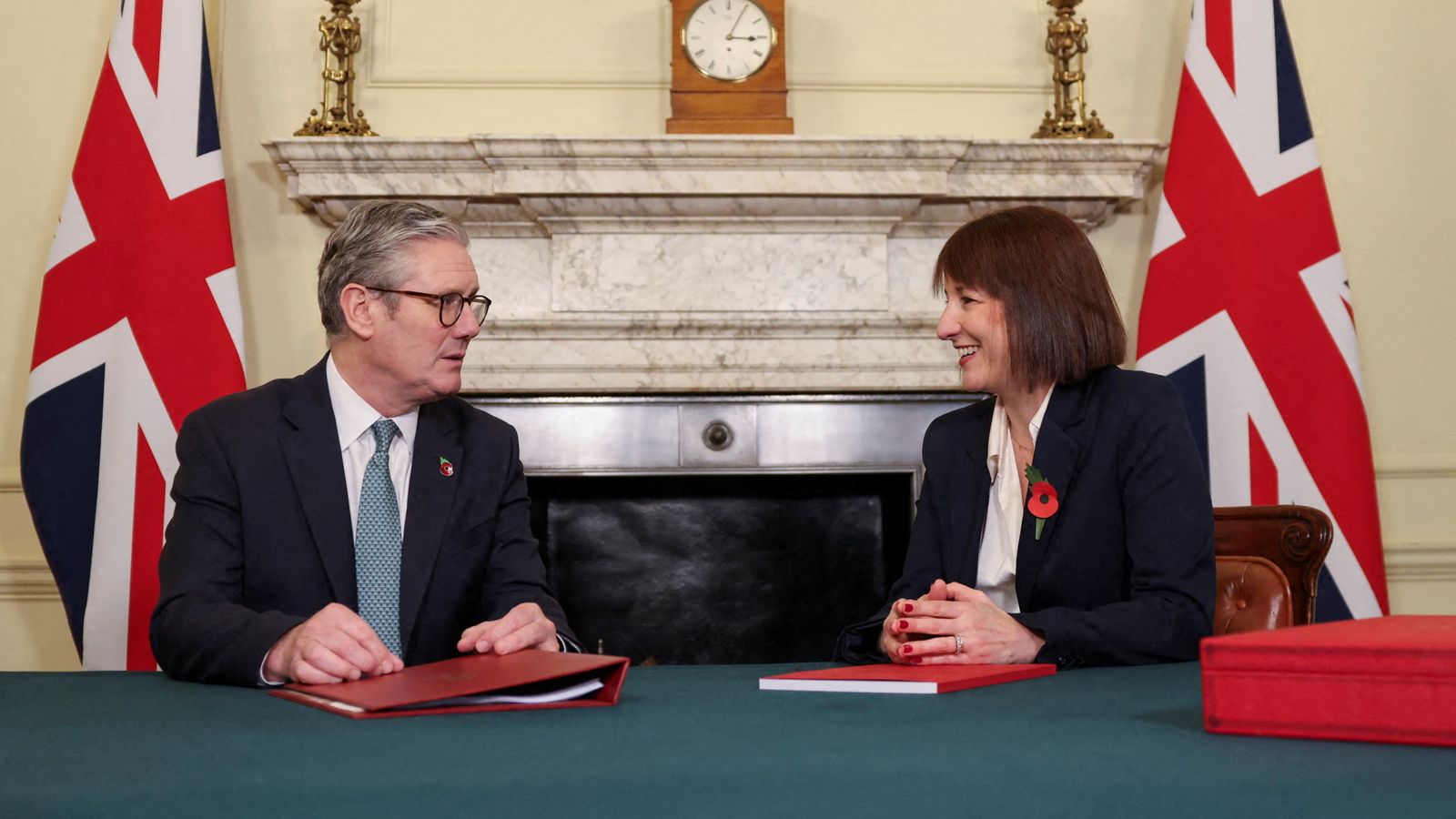
Sir Keir Starmer will deliver a speech today defending the decisions the government made in the budget, following criticisms of sweeping tax rises and accusations the chancellor lied to the country about the state of public finances.
The prime minister is expected to set out how the budget, which saw £26bn of tax rises imposed across the economy, “moves forward the government’s programme of national renewal”, and set “the right economic course” for Britain, Downing Street says.
He will also confirm that ministers will try again to reform the “broken” welfare system, after Labour MPs forced the government to U-turn on its plans to narrow the eligibility for Personal Independence Payments (PIP) earlier this year.
Sir Keir Starmer will give a speech later defending last week’s budget. Pic: Reuters
‘Of course I didn’t’ lie about public finances, says Reeves
“We have to confront the reality that our welfare state is trapping people, not just in poverty, but out of work – young people especially. And that is a poverty of ambition,” Sir Keir will say.
“And so while we will invest in apprenticeships and make sure every young person without a job has a guaranteed offer of training or work, we must also reform the welfare state itself – that is what renewal demands.”
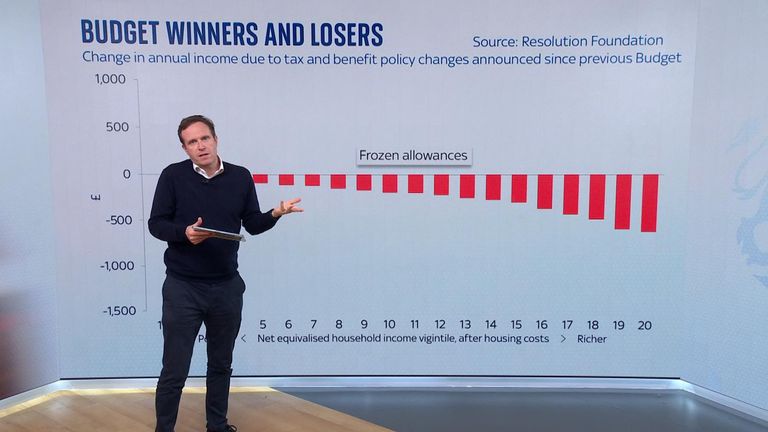
Sky’s Ed Conway looks at the aftermath of the budget and explains who the winners and losers are
The prime minister will add: “This is not about propping up a broken status quo. Nor is it because we want to look somehow politically ‘tough’. The Tories played that game and the welfare bill went up by £88bn. They left children too poor to eat and young people too ill to work. A total failure.”
Instead, he will argue it is about “potential”, saying: “If you are ignored that early in your career, if you’re not given the support you need to overcome your mental health issues, or if you are simply written off because you’re neurodivergent or disabled, then it can trap you in a cycle of worklessness and dependency for decades, which costs the country money, is bad for our productivity, but most importantly of all – costs the country opportunity and potential.
“And any Labour Party worthy of the name cannot ignore that. That is why we have asked Alan Milburn on the whole issue of young people, inactivity and work. We need to remove the incentives which hold back the potential of our young people.”
The announcement will come after the Conservative opposition described the budget as one for “benefits street”, following the chancellor’s decision to lift the two-child benefit cap from April, at a cost of £3bn.

Prime Minister defends the budget
‘Government must go further and faster on growth’
The prime minister is also expected to launch a staunch defence of the budget overall, saying it will bear down on the cost of living through measures like money off energy bills and frozen rail fares; increase economic stability; and protect investment in public services and infrastructure that will drive economic growth.
He will argue that “economic growth is beating the forecasts”, but that the government must go “further and faster” to encourage it.
He will also reiterate his vow to scrap regulation across the economy, which he will argue is not only pro-business, but also a way to deal with the cost of living.

How will your personal finances change following the budget announced by the chancellor?
“Rooting out excessive costs in every corner of the economy is an essential step to lower the cost of living for good, as well as promoting more dynamic markets for business,” the prime minister will say.
He will confirm reforms to the building of nuclear power plants, after the government’s nuclear regulatory taskforce found that “pointless gold-plating, unnecessary red-tape and well-intentioned, but fundamentally misguided environmental regulation had made Britain the most expensive place to build nuclear power”.
“We urgently need to correct this,” the prime minister will say.
Business secretary Peter Kyle will be tasked with applying the same deregulatory approach to major infrastructure schemes and to accelerate the implementation of Labour’s industrial strategy.
In response, Tory shadow chancellor Sir Mel Stride said: “It is frankly laughable to hear the prime minister say Rachel Reeves’s Benefits Street budget has put the country on the right course and that he wants to fix the welfare system.
“His chancellor has just hiked taxes by £26bn to pay for a welfare splurge, penalising people who work hard and making them pay for those who don’t work at all. And she misrepresented why she was doing it, claiming there was a fiscal black hole to fill that she knew didn’t exist.
“Labour’s leadership have repeatedly shown they lack the backbone to tackle welfare and instead are just acting to placate their left-wing backbenchers.”
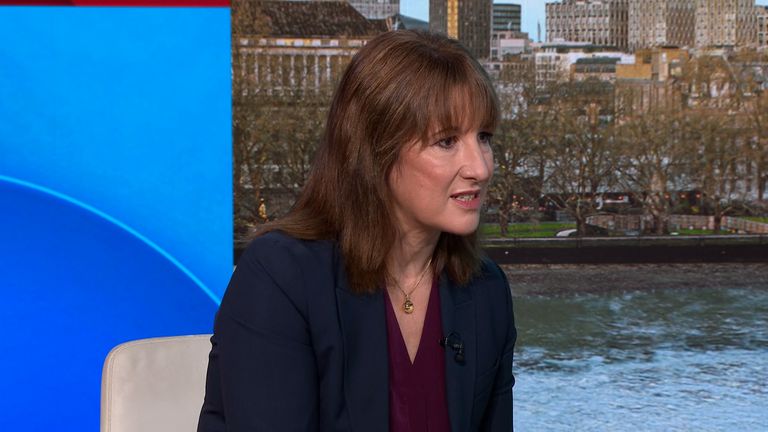
Rachel Reeves tells Sky News she did not lie about the state of the public finances
Chancellor accused of ‘lying’
Sir Mel is referring to the chancellor’s speech on 4 November in which she laid the ground for tax rises due to the decision by the independent Office for Budget Responsibility (OBR) to review and downgrade productivity over recent years, at a cost of £16bn, which led to a black hole in the public finances.
But the OBR revealed on Friday that it had told the Treasury days earlier that there was actually a budget surplus of £4.2bn, leading to outrage and claims that she misled the country about the state of the public finances.
Rachel Reeves was asked directly by Sky’s Trevor Phillips if she lied, and she replied: “Of course I didn’t.”

Why did Reeves make the situation sound ‘so bleak’?
She said: “I said in that speech that I wanted to achieve three things in the budget – tackling the cost of living, which is why I took £150 off of energy bills and froze prescription charges and rail fares.
“I wanted to continue to cut NHS waiting lists, which is why I protected NHS spending. And I wanted to bring the debt and the borrowing down, which is one of the reasons why I increased the headroom.
“£4bn of headroom would not have been enough, and it would not give the Bank of England space to continue to cut interest rates.”
Ms Reeves also said: “In the context of a downgrade in our productivity, which cost £16bn, I needed to increase taxes, and I was honest and frank about that in the speech that I gave at the beginning of November.”

Badenoch says Rachel Reeves should resign
But Tory leader Kemi Badenoch said: “I think the chancellor has been doing a terrible job. She’s made a mess of the economy, and […] she has told lies. This is a woman who, in my view, should be resigning.”
Report due on OBR breach
The tumultuous run-up to the 26 November budget culminated in the OBR accidentally publishing its assessment of the chancellor’s measures 45 minutes before the speech began, in what was an unprecedented breach of budget security.
👉 Listen to Sky News Daily on your podcast app 👈
The chair of the OBR, Richard Hughes, apologised for the “error”, and announced an investigation into how it happened.
The chancellor has said that she retains confidence in him, despite the “serious breach of protocol”, and confirmed to Trevor that the investigation report will be delivered to her on Monday, although it is not clear when it will be published.
-
 Sports2 years ago
Story injured on diving stop, exits Red Sox game
-
 Sports3 years ago
‘Storybook stuff’: Inside the night Bryce Harper sent the Phillies to the World Series
-
 Sports2 years ago
Game 1 of WS least-watched in recorded history
-
 Sports3 years ago
Button battles heat exhaustion in NASCAR debut
-
 Sports3 years ago
MLB Rank 2023: Ranking baseball’s top 100 players
-
Sports4 years ago
Team Europe easily wins 4th straight Laver Cup
-
 Environment3 years ago
Japan and South Korea have a lot at stake in a free and open South China Sea
-
 Environment1 year ago
Here are the best electric bikes you can buy at every price level in October 2024