
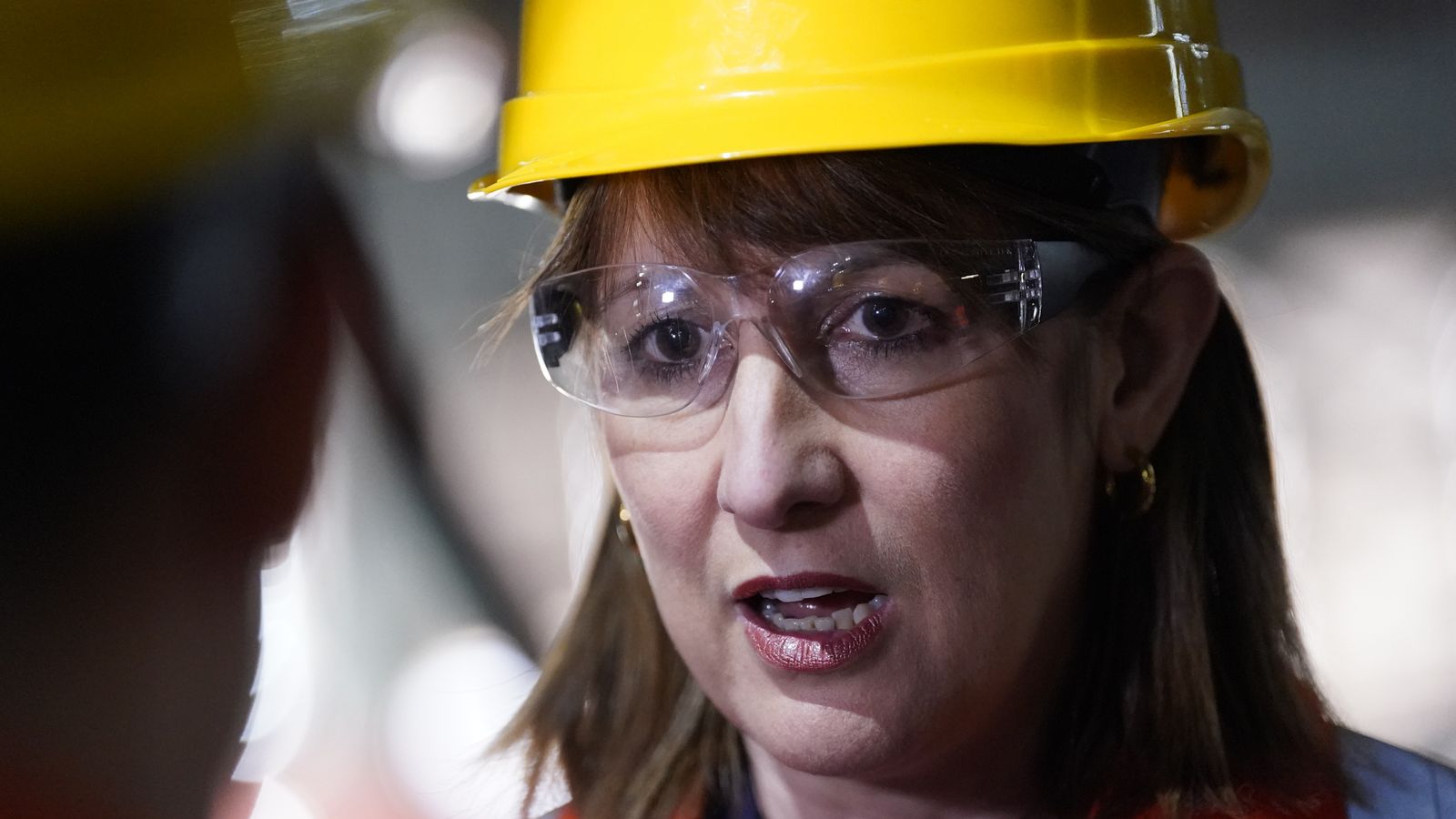
Rachel Reeves to head to Washington amid hopes of US trade deal



Greens leader Zack Polanski has rejected claims his party would push for open borders on immigration, telling Sky News it is “not a pragmatic” solution for a world in “turmoil”.
Mr Polanski distanced himself from his party’s “long-range vision” for open borders, saying it was not in his party’s manifesto and was an “attack line used by opponents” to question his credibility.
It came as Mr Polanski, who has overseen a spike in support in the polls to double figures, refused to apologise over controversial comments he made about care workers on BBC Question Time that were criticised across the political spectrum.
Mr Polanski was speaking to Sky News earlier this week while in Calais, where he joined volunteers and charities to witness how French police handle the arrival of migrants in the town that is used as a departure point for those wanting to make the journey to the UK.
He told Sky News he had made the journey to the French town – once home to the “Jungle” refugee camp before it was demolished in 2016 – to tackle “misinformation” about migration and to make the case for a “compassionate, fair and managed response” to the small boats crisis.
He said that “no manifesto ever said anything about open borders” and that the Greens had never stood at a general election advocating for them.
“Clearly when the world is in political turmoil and we have deep inequality, that is not a situation we can move to right now,” he said.
“That would also involve massive international agreements and cooperation. That clearly is not a pragmatic conversation to have right now. And very often the government try to push that attack line to make us look not pragmatic.”
The party’s manifesto last year did not mention open borders, but it did call for an end to the “hostile environment”, more safe and legal routes and for the Home Office to be abolished and replaced with a department of migration.
Asked why the policy of minimal restrictions on migration had been attributed to his party, Mr Polanski said open borders was part of a “long-range vision of what society could look like if there was a Green government and if we’d had a long time to fix some of the systemic problems”.
‘We should recognise the contribution migrants make’
Mr Polanski, who was elected Green Party leader in September and has been compared to Nigel Farage over his populist economic policies, said his position was one of a “fair and managed” migration system – although he did not specify whether that included a cap on numbers.
He acknowledged that there needed to be a “separate conversation” about economic migration but that he did not believe any person who boarded a small boat was in a “good situation”.
While Mr Polanski stressed that he believed asylum seekers should be able to work in Britain and pay taxes, he also said he believed in the need to train British workers in sectors such as care, where one in five are foreign nationals.
Asked what his proposals for a fair and managed migration system looked like, and whether he supported a cap on numbers, Mr Polanski said: “We have 100,000 vacancies in the National Health Service. One in five care workers in the care sector are foreign nationals.
Zack Polanski speaks to Sky News from a warehouse in Calais where charities and organisations provide migrants with essentials.
“Now, of course, that is both British workers and we should be training British workers, but we should recognise the contribution that migrants and people who come over here make.”
I’m not going to apologise’
Mr Polanski also responded to the criticism he attracted over his comments about care workers on Question Time last week, where he told the audience: “I don’t know about you, but I don’t particularly want to wipe someone’s bum” – before adding: “I’m very grateful for the people who do this work.”
His comments have been criticised by a number of Labour MPs, including Wes Streeting, the health secretary, who said: “Social care isn’t just ‘wiping someone’s bum’. It is a hard, rewarding, skilled professional job.
“This is immigration as exploitation.”
Read more:
The Greens leader who wants to be the Farage of the left
Will Farage racism allegations deter voters?
Asked whether he could understand why some care workers might feel he had talked down to them, the Greens leader replied: “I care deeply about care workers. When I made those comments, it’s important to give a full context. I said ‘I’m very grateful to people who do this important work’ and absolutely repeat that it’s vital work.”
“Of course, it is not part of the whole job, and I never pretended it was part of the whole job.”
Mr Polanski said he “totally” rejected the suggestion that he had denigrated the role of care workers in the eyes of the public and said his remarks were made in the context of a “hostile Question Time” where he had “three right-wing panellists shouting at me”.
Pressed on whether he wanted to apologise, he replied: “I’m not going to apologise for being really clear that I’m really grateful to the people who do this really vital work. And yes, we should be paying them properly, too.”


A group of crypto organizations has pushed back on Citadel Securities’ request that the Securities and Exchange Commission tighten regulations on decentralized finance when it comes to tokenized stocks.
Andreessen Horowitz, the Uniswap Foundation, along with crypto lobby groups the DeFi Education Fund and The Digital Chamber, among others, said they wanted “to correct several factual mischaracterizations and misleading statements” in a letter to the SEC on Friday.
The group was responding to a letter from Citadel earlier this month, which urged the SEC not to give DeFi platforms “broad exemptive relief” for offering trading of tokenized US equities, arguing they could likely be defined as an “exchange” or “broker-dealer” regulated under securities laws.
“Citadel’s letter rests on a flawed analysis of the securities laws that attempts to extend SEC registration requirements to essentially any entity with even the most tangential connection to a DeFi transaction,” the group said.
The group added they shared Citadel’s aims of investor protection and market integrity, but disagreed “that achieving these goals always necessitates registration as traditional SEC intermediaries and cannot, in certain circumstances, be met through thoughtfully designed onchain markets.”
Citadel’s ask would be impractical, group says
The group argued that regulating decentralized platforms under securities laws “would be impracticable given their functions” and could capture a broad range of onchain activities that aren’t usually considered as offering exchange services.
The letter also took aim at Citadel’s characterization that autonomous software was an intermediary, arguing it can’t be a “‘middleman’ in a financial transaction because it is not a person capable of exercising independent discretion or judgment.”
“DeFi technology is a new innovation that was designed to address market risks and resiliency in a different way than traditional financial systems do, and DeFi protects investors in ways that traditional finance cannot,” the group argued.
Related: SEC’s Crenshaw takes aim at crypto in final weeks at agency
In its letter, Citadel had argued that the SEC giving the green light to tokenized shares on DeFi “would create two separate regulatory regimes for the trading of the same security” and would undermine “the ‘technology-neutral’ approach taken by the Exchange Act.”
Citadel argued that exempting DeFi platforms from securities laws could harm investors, as the platforms wouldn’t have protections such as venue transparency, market surveillance and volatility controls, among others.
The letter initially drew considerable backlash, with Blockchain Association CEO Summer Mersinger saying Citadel’s stance was an “overbroad and unworkable approach.”
The letters come as the SEC looks for feedback on how it should approach regulating tokenized stocks, and agency chair Paul Atkins has said that the US financial system could embrace tokenization in a “couple of years.”
Tokenization has exploded in popularity this year, but NYDIG warned on Friday that assets moving onchain won’t immediately be of great benefit to the crypto market until regulations allow them to more deeply integrate with DeFi.
Magazine: SEC’s U-turn on crypto leaves key questions unanswered

A growing rift has emerged in Washington, D.C., between the cryptocurrency industry and labor unions as lawmakers debate whether to ease rules allowing cryptocurrencies in 401(k) retirement accounts.
The dispute centers on proposed market structure legislation that would allow retirement accounts to gain exposure to crypto, a move labor groups say could expose workers to speculative risk. In a letter sent on Wednesday to the US Senate Banking Committee, the American Federation of Teachers argued that cryptocurrencies are too volatile for pension and retirement savings, warning that workers could face significant losses.
The letter drew immediate pushback from crypto investors and industry figures. “The American Federation of Teachers has somehow developed the most logically incoherent, least educated take one could possibly author on the matter of crypto market structure regulation,” a crypto investor said on X.

In response to the letter, Castle Island Ventures partner Sean Judge said the bill would improve oversight and reduce systemic risk, while enabling pension funds to access an asset class that has delivered strong long-term returns.
Consensys attorney Bill Hughes said the AFT’s opposition to the crypto market structure bill was politically motivated, accusing the group of acting as an extension of Democratic lawmakers.

Related: Atkins says SEC has ‘enough authority’ to drive crypto rules forward in 2026
Opposition to crypto in retirement and pension funds mounts
Proponents of allowing crypto in retirement portfolios, on the other hand, argue that it democratizes finance, while trade unions have voiced strong opposition to relaxing current regulations, claiming that crypto is too risky for traditional retirement plans.
“Unregulated, risky currencies and investments are not where we should put pensions and retirement savings. The wild, wild west is not what we need, whether it’s crypto, AI, or social media,” AFT president Randi Weingarten said on Thursday.
The AFT represents 1.8 million teachers and educational professionals in the US and is one of the largest teachers’ unions in the country.
According to Better Markets, a nonprofit and nonpartisan advocacy organization, cryptocurrencies are too volatile for traditional retirement portfolios, and their high volatility can create time-horizon mismatches for pension investors seeking a predictable, low-volatility retirement plan.

In October, the American Federation of Labor and Congress of Industrial Organizations (AFL-CIO) also wrote to Congress opposing provisions within the crypto market structure regulatory bill.
The AFL-CIO, the largest federation of trade unions in the US, wrote that cryptocurrencies are volatile and pose a systemic risk to pension funds and the broader financial system.
Magazine: 13 Christmas gifts that Bitcoin and crypto degens will love
-
 Sports2 years ago
Story injured on diving stop, exits Red Sox game
-
 Sports3 years ago
‘Storybook stuff’: Inside the night Bryce Harper sent the Phillies to the World Series
-
 Sports2 years ago
Game 1 of WS least-watched in recorded history
-
 Sports3 years ago
Button battles heat exhaustion in NASCAR debut
-
 Sports3 years ago
MLB Rank 2023: Ranking baseball’s top 100 players
-
Sports4 years ago
Team Europe easily wins 4th straight Laver Cup
-
 Environment3 years ago
Japan and South Korea have a lot at stake in a free and open South China Sea
-
 Environment1 year ago
Here are the best electric bikes you can buy at every price level in October 2024