
New Study Finds Hercules-Corona Borealis Great Wall Bigger and Nearer Than Thought


Astronomers have revealed that the Hercules-Corona Borealis Great Wall, a massive network of galaxies, might be bigger than they realised. By mapping the cosmos with gamma-ray bursts (GRBs)—the brightest explosions in the universe—astronomers found that this structure is even bigger than previously estimated. Surprisingly, portions of it also lie significantly closer to Earth than previously believed, challenging fundamental assumptions about how the universe is structured and evolves.
This cosmic structure was first observed in 2014 — a dense galaxy forming a filament of a supercluster.
A new study now extends the researchers’ previous work, but with a wider GRB sample. Hakkila and Zsolt Bagoly, authors of the study, have refined the measurements. They detected a number of relatively nearby GRBs in their sample. The evidence also shows the Great Wall is larger and wider than previously predicted.
Gamma-Ray Bursts Expose Structure Too Large for Current Models
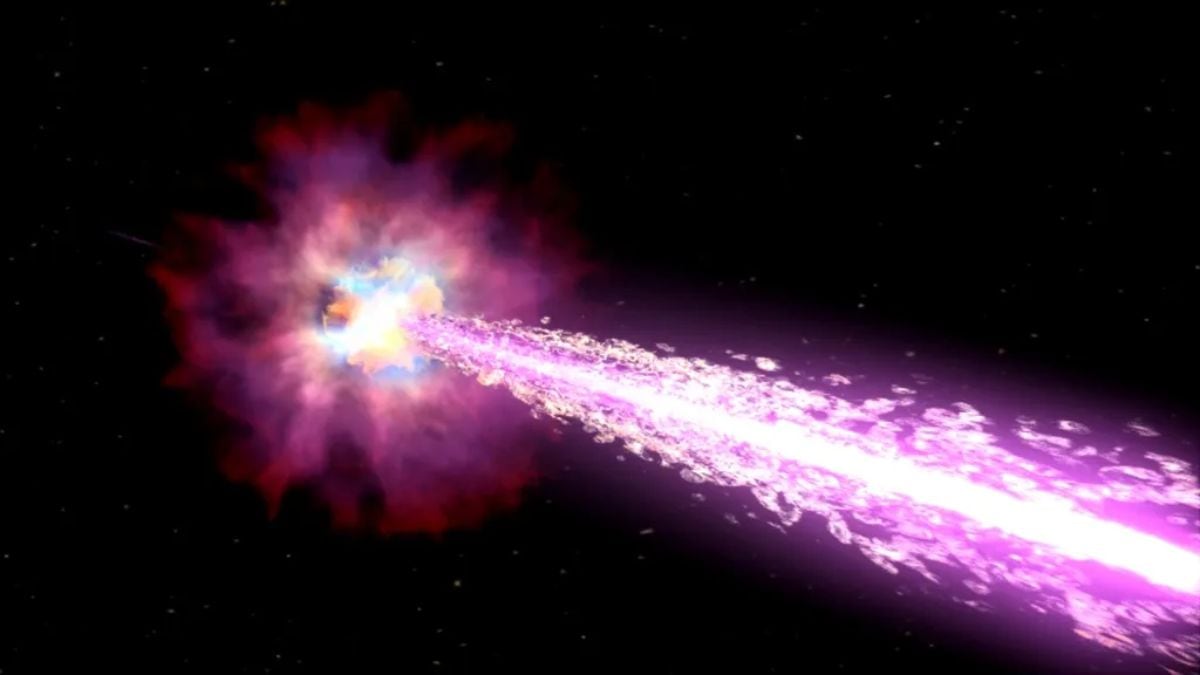
According to a Space.com report, the GRBs figure prominently in the early discovery and more recent growth of the Hercules–Corona Borealis Great Wall. These explosive outbursts — from either collapsing massive stars or colliding neutron stars — produce powerful jets that can be spotted over cosmological distances. Hakkila told the publication that GRBs act as another bright beacon for identifying galaxies, even those too faint to see directly. Because of their brightness, scientists can follow matter throughout the universe more distinctly than ever.
The Great Wall, over 10 billion light-years long, challenges the cosmological principle of uniform universe appearance. Its massive size indicates gaps in current theories and implies that the universe’s formation time was insufficient for such massive structures.
THESEUS May Reveal Full Scale of Cosmic Great Wall
NASA’s Fermi Gamma-ray Burst observations reveal 542 GRB events, but more data is needed to fully understand the Great Wall’s scope due to misidentified origins and sparse sampling. Hakkila points toward the upcoming ESA mission THESEUS — the Transient High Energy Sources and Early Universe Surveyor — as the next major leap.
The mission aims to dramatically expand the catalogue of known GRBs, particularly at extreme distances. “It could finally provide the observational leverage needed to map the Hercules–Corona Borealis Great Wall to its full extent,” Hakkila told Space.com, emphasising its role in refining our understanding of the universe’s large-scale structure.
For the latest tech news and reviews, follow Gadgets 360 on X, Facebook, WhatsApp, Threads and Google News. For the latest videos on gadgets and tech, subscribe to our YouTube channel. If you want to know everything about top influencers, follow our in-house Who’sThat360 on Instagram and YouTube.
Related Stories
-
 Sports2 years ago
Story injured on diving stop, exits Red Sox game
-
 Sports3 years ago
‘Storybook stuff’: Inside the night Bryce Harper sent the Phillies to the World Series
-
 Sports2 years ago
Game 1 of WS least-watched in recorded history
-
 Sports3 years ago
Button battles heat exhaustion in NASCAR debut
-
 Sports3 years ago
MLB Rank 2023: Ranking baseball’s top 100 players
-
Sports4 years ago
Team Europe easily wins 4th straight Laver Cup
-
 Environment3 years ago
Japan and South Korea have a lot at stake in a free and open South China Sea
-
 Environment1 year ago
Here are the best electric bikes you can buy at every price level in October 2024