

Upbit and Bithumb suspend Synthetix token deposits, citing sUSD risks

South Korean exchanges Upbit and Bithumb have suspended deposits for Synthetix (SNX) tokens after it was flagged by the Digital Asset Exchange Alliance (DAXA) for potential risks.
DAXA, the self-regulatory organization establishing industry standards for South Korean exchanges, designated SNX as a cautionary item.
Assets receiving this designation typically undergo rigorous evaluations to determine whether trading can continue or if delisting is necessary.
Exchanges may take action, such as adding a warning tag to the asset and urging investors to take caution when engaging with it. Trading platforms can also perform additional measures, like blocking deposits or suspending trading support temporarily.
Upbit and Bithumb block SNX deposits
In response to the designation, the biggest exchanges in South Korea said they are blocking deposits for SNX tokens on their platforms.
Upbit announced that it had added a trading caution ticker and suspended token deposits. The exchange said it had been monitoring the developments related to the Synthetix USD (sUSD) depegging. It added that this event may damage investors through potential volatility, as SNX is used as collateral for sUSD.
The exchange added that it had determined a lack of use cases for the asset, which may cause investors to suffer losses. Upbit said it would conduct a comprehensive review to decide whether to delist the asset or resume normal operations for the token.
Bithumb has also blocked deposits for SNX and added a cautionary tag for the token. However, the exchange said this decision could be overturned depending on internal circumstances. If the reason for the designation is resolved, Bithumb said it would lift the restrictions.
Korbit and Coinone also published investor alerts to caution traders. The two exchanges added cautionary tags to SNX tokens to alert investors who may want to trade the token.
Cointelegraph reached out to Synthetix for comment but did not get a response by publication.
Related: South Korean crypto emerges from failed coup into crackdown season
sUSD struggles to recover dollar peg
On April 10, the sUSD stablecoin dropped to a five-year low of $0.83 after struggling to maintain its dollar peg in the first quarter of 2025. With the stablecoin being collateralized by the project’s native asset, Cork Protocol co-founder Rob Schmitt compared the token to Terra USD (UST), which collapsed in 2022. However, Schmitt said that sUSD has a “more manageable” debt system.
On April 18, the stablecoin dipped further to $0.68, with SNX falling by 26% in a 30-day period. A Synthetix spokesperson told Cointelegraph that their team has short, medium and long-term plans to mitigate the risks.
On April 21, Synthetix founder Kain Warwick threatened SNX stakers with “the stick” if they didn’t take up a newly launched staking mechanism to fix the sUSD depeg. The executive said they may put extra pressure on stakers if they don’t see enough momentum on the newly implemented mechanism.
Since the warning, sUSD prices increased by 27%. On April 24, the stablecoin briefly reached $0.87. However, the token has still failed to recover its dollar peg.
Magazine: Uni students crypto ‘grooming’ scandal, 67K scammed by fake women: Asia Express

The US Office of the Comptroller of the Currency has affirmed that national banks can intermediate cryptocurrency trades as riskless principals without holding the assets on their balance sheets, a move that brings traditional banks a step closer to offering regulated crypto brokerage services.
In an interpretive letter released on Tuesday, the regulator said banks may act as principals in a crypto trade with one customer while simultaneously entering an offsetting trade with another, a structure that mirrors riskless principal activity in traditional markets.
“Several applicants have discussed how conducting riskless principal crypto-asset transactions would benefit their proposed bank’s customers and business, including by offering additional services in a growing market,” notes the document.
According to the OCC, the move would allow customers “to transact crypto-assets through a regulated bank, as compared to non-regulated or less regulated options.”

The letter also reiterates that banks must confirm the legal permissibility of any crypto activity and ensure it aligns with their chartered powers. Institutions are expected to maintain procedures for monitoring operational, compliance and market risks.
“The main risk in riskless principal transactions is counterparty credit risk (in particular, settlement risk),” reads the letter, adding that “managing counterparty credit risk is integral to the business of banking, and banks are experienced in managing this risk.”
The agency’s guidance cites 12 U.S.C. § 24, which permits national banks to conduct riskless principal transactions as part of the “business of banking.” The letter also draws a distinction between crypto assets that qualify as securities, noting that riskless principal transactions involving securities were already clearly permissible under existing law.
The OCC’s interpretive letter — a nonbinding guidance that outlines the agency’s view of which activities national banks may conduct under existing law — was issued a day after the head of the OCC, Jonathan Gould, said crypto firms seeking a federal bank charter should be treated the same as traditional financial institutions.
According to Gould, the banking system has the “capacity to evolve,” and there is “no justification for considering digital assets differently” than traditional banks, which have offered custody services “electronically for decades.”
Related: Trump’s national security strategy is silent on crypto, blockchain
From ‘Choke Point 2.0’ to pro-crypto policy
Under the Biden administration, some industry groups and lawmakers accused US regulators of pursuing an “Operation Choke Point 2.0” approach that increased supervisory pressure on banks and firms interacting with crypto.
Since President Trump took office in January after pledging to support the sector, the federal government has moved in the opposite direction, adopting a more permissive posture toward digital asset activity.
Magazine: Quantum attacking Bitcoin would be a waste of time: Kevin O’Leary

CryptoUK, a UK-based cryptocurrency trade association, has announced that it will join The Digital Chamber, a US crypto policy advocacy group, potentially marking a significant cross-collaboration on digital asset regulation between the two countries.
In a Tuesday notice, CryptoUK said its team would fall under The Digital Chamber’s umbrella as part of a “unified, cross-border advocacy platform.” Both groups have worked in their respective countries to promote policies favoring the cryptocurrency and blockchain industry, starting with The Digital Chamber in 2014 and CryptoUK in 2018.
“CryptoUK has always aspired to ensure we are driven by policy-led issues, member collaboration, and regulatory engagement,” said Su Carpenter, CryptoUK’s executive director.

The partnership between the two advocacy groups comes as US lawmakers move forward on negotiations to pass a digital asset market structure bill, aiming to establish regulatory clarity for the industry. In the UK, policymakers announced plans to collaborate with their counterparts in the US to explore crypto laws and regulations.
Related: Digital Chamber seeks to guide crypto policy across US states
US-based crypto advocacy organizations, such as The Digital Chamber, have garnered support from former regulators and members of Congress as the Trump White House directs policies toward the industry. Among these groups are the Solana Policy Institute, the Blockchain Association, the Crypto Council for Innovation, and the American Innovation Project.
UK central bank moves forward on stablecoins
On Nov. 10, the Bank of England released a consultation paper to propose a framework for “sterling-denominated systemic stablecoins.” The move by the country’s central bank marked a step toward the UK seeming to play catch-up to the US, where the government passed a law regulating payment stablecoins in July.
Bank of England Deputy Governor Sarah Breeden signaled before the publication of the paper that the central bank’s actions were in response to the US advancing stablecoin policies, and it was “really important” to be synchronized on rules.
Magazine: When privacy and AML laws conflict: Crypto projects’ impossible choice
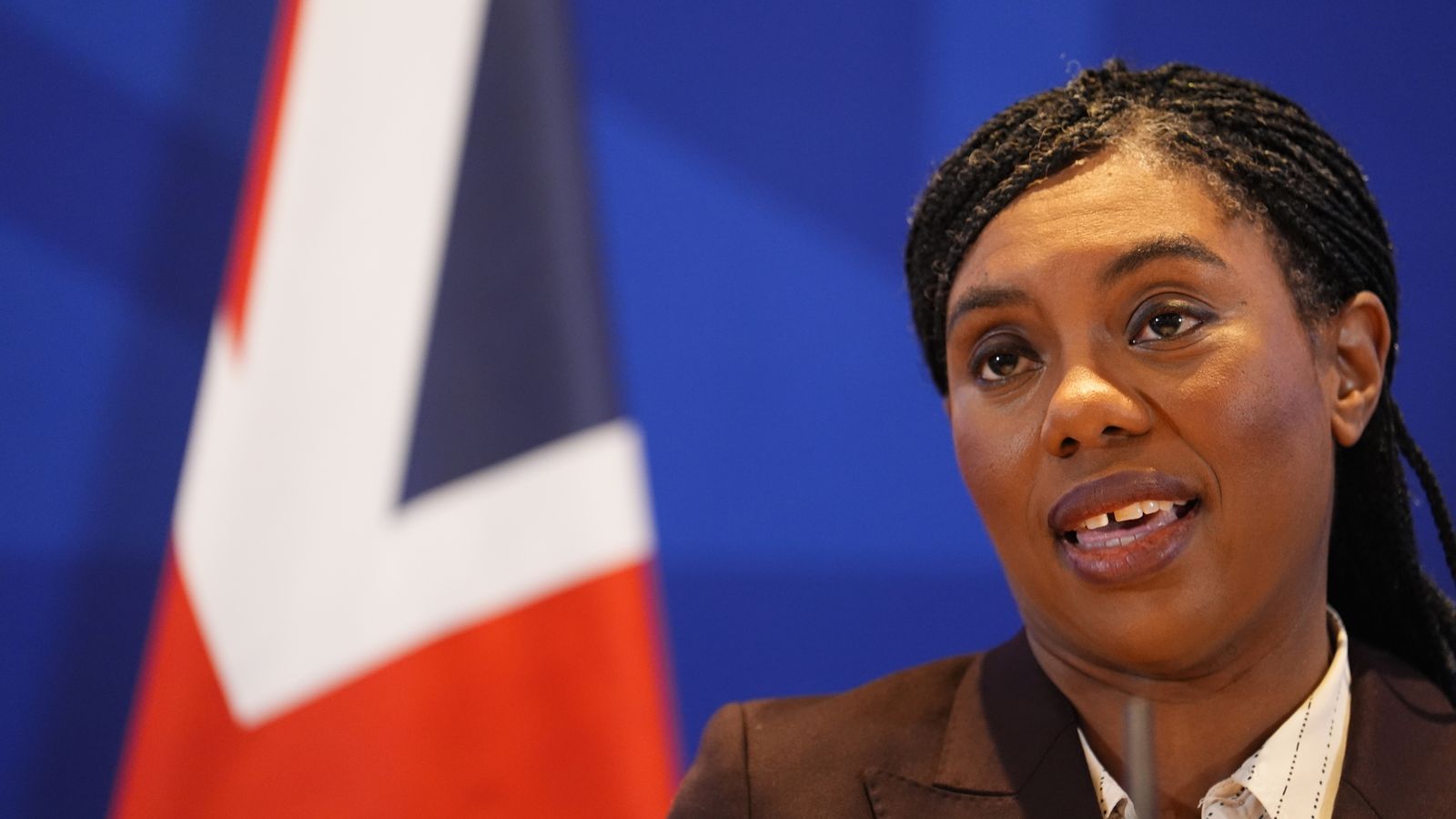
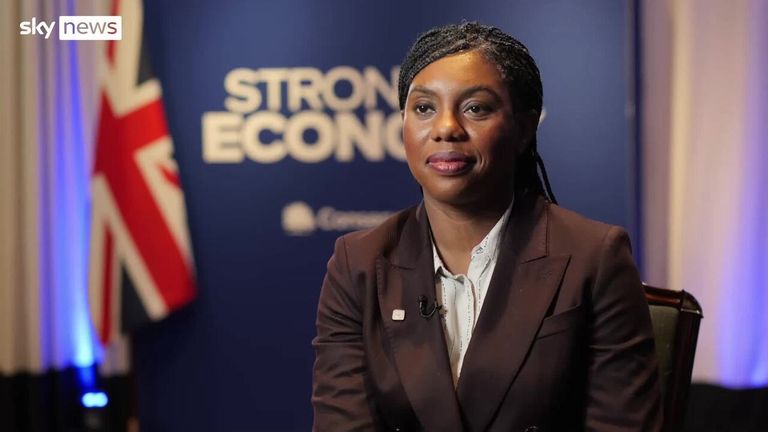
Kemi Badenoch has refused to say that the Conservatives are intending to win next May’s local elections, despite being repeatedly pushed on the issue.
Asked twice to define success for her party at the elections, the Tory leader merely said that she is “going to be fighting for every vote”.
Speaking to Sky News, she added: “Success is going to be people seeing the Conservative Party as the only party that is competent and credible enough to do the tough stuff that this country needs.”
The comments come as the Conservatives continue to trail in the polls.
Watch Kemi Badenoch’s interview with Sky News in full
New data released by YouGov this morning has put the Tories in third place behind Reform and Labour, a space they have largely occupied throughout the year. The pollster’s weekly voting intention analysis put Ms Badenoch’s party on 18%, down one percentage point.
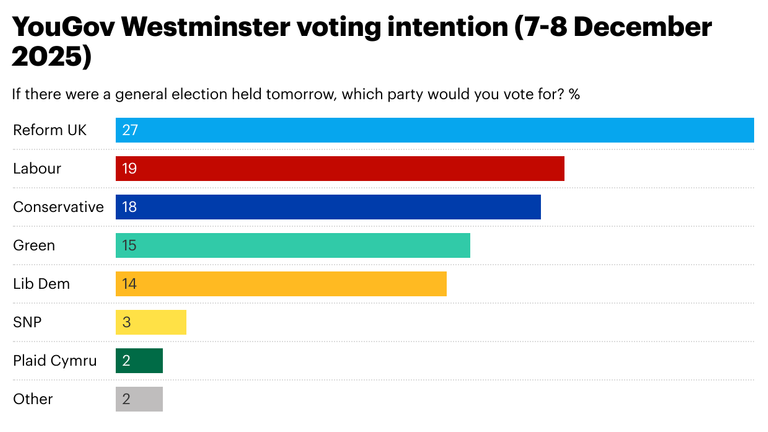
YouGov’s weekly voting intention poll has the Tories down one percent on last week, and just three above the Greens. Pic: YouGov
Ms Badenoch gave a speech on welfare costs in London on Tuesday, where she attacked the government’s plans to tackle child poverty. Afterwards, she sat down with Sky News political correspondent Sam Coates.
Asked about the local elections, she said: “There are going to be local elections all over the country, and there’s a conservative message that I want everyone to hear: Our country’s not working properly.
“There are fundamental things that need to change. We need to create jobs. Otherwise, we’re not going to have money for councils.”
She added: “We’ve seen new parties like Reform come in. They’re making a hash of things at council level. We need to make sure that people can see the benefits of voting Conservative.”
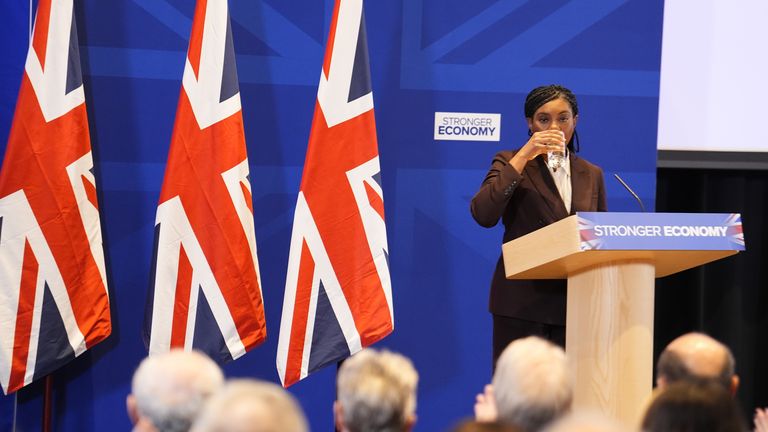
Ms Badenoch also refused to score her party’s performance out of 10. Pic: PA
When it was pointed out that she had not defined success as winning the local elections, Ms Badenoch said: “The country is going to decide. We’re going to put out an offer, and we’re going to fight for every vote.”
May will see local council elections, as well as votes for the Senedd in Wales and the Scottish Parliament. They are seen as a crucial moment for the Tory leader – and also for Prime Minister Sir Keir Starmer.

‘Of course poverty bothers me’
Ms Badenoch also refused to score the party’s performance out of 10, as the year draws to a close, and she marks a little over 12 months as leader.
She told Sky News: “When I look at the historic defeats which Conservatives suffered last year, things are definitely better.”
Read more:
Tory-Reform pact ‘not happening’
Badenoch dismisses Reeves’s ‘mansplaining’ claim
Challenged on the Tories’ position in the polls, Ms Badenoch said: “Of course, we have a mountain to climb.
“We lost more seats [in 2024] than we’ve ever done in our 200-year history. This was always going to be a long road ahead.”
-
 Sports2 years ago
Story injured on diving stop, exits Red Sox game
-
 Sports3 years ago
‘Storybook stuff’: Inside the night Bryce Harper sent the Phillies to the World Series
-
 Sports2 years ago
Game 1 of WS least-watched in recorded history
-
 Sports3 years ago
Button battles heat exhaustion in NASCAR debut
-
 Sports3 years ago
MLB Rank 2023: Ranking baseball’s top 100 players
-
Sports4 years ago
Team Europe easily wins 4th straight Laver Cup
-
 Environment3 years ago
Japan and South Korea have a lot at stake in a free and open South China Sea
-
 Environment1 year ago
Here are the best electric bikes you can buy at every price level in October 2024