
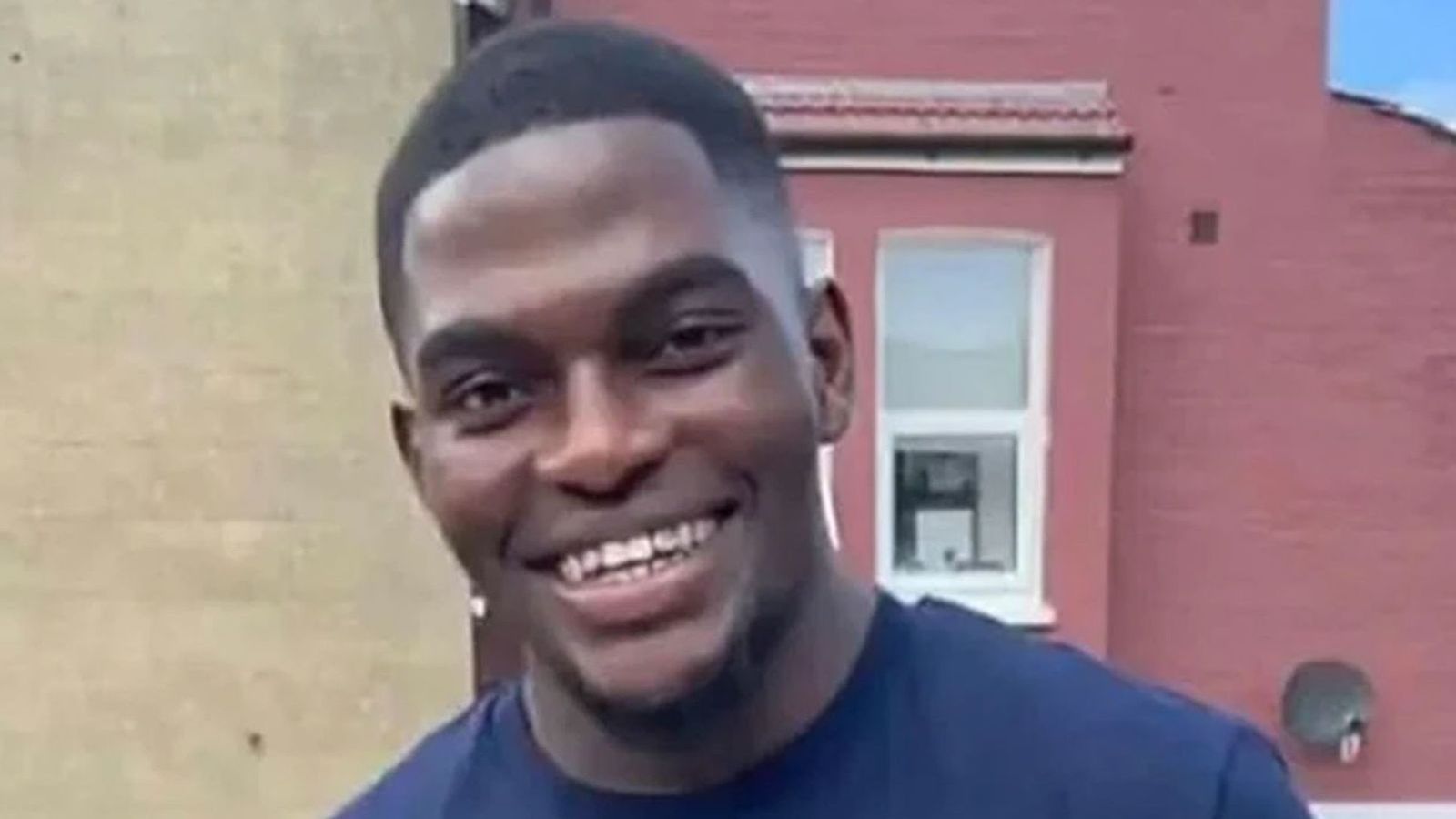
Firearms officer cleared of murdering Chris Kaba to face gross misconduct hearing, after watchdog review


The officer cleared of murder after shooting dead Chris Kaba will face a gross misconduct hearing, following a review by the police watchdog.
The 24-year-old’s family welcomed the decision, saying they hope it leads to sergeant Martyn Blake, 41, being sacked from the Metropolitan Police.
Mr Kaba, who was not armed, had both hands on the steering wheel of his vehicle when he was shot in the head by the firearms officer in Streatham, south London, on 5 September 2022.
A helicopter and six police cars were involved in stopping Mr Kaba after the Audi Q8 he was driving had been linked to a shooting outside a school in nearby Brixton the previous evening.
Mr Kaba had turned into Kirkstall Gardens, where Mr Blake was inside a marked police BMW, before trying to make his escape.
The initial follow of the Audi vehicle driven by Chris Kaba.
Pic: CPS/PA
The murder trial hinged on the following 17 seconds, when Mr Kaba reversed a short distance, hitting an unmarked police car behind, then accelerated forward, reaching an estimated 12mph before colliding with the BMW and a parked Tesla.
Armed officers were heard shouting “go, go, go” and “armed police, get out of the f***ing car,” as they surrounded Mr Kaba’s vehicle in footage played in court.
Mr Kaba then reversed at 8mph, hitting the unmarked Volvo behind, and was stationary as Mr Blake pulled the trigger of his gun less than a second later, followed by shouts of “shots fired” and “where from?”
He died in hospital in the early hours of the next day after the bullet travelled through the windscreen and struck him in the head.
Speaking after Mr Blake was cleared of murder in October, Met Police Commissioner Sir Mark Rowley said the officer made a split-second decision on what he thought was necessary “to protect his colleagues and to protect London”.
Prosecutors had argued Mr Blake may have “become angry, frustrated and annoyed” and Mr Kaba had done nothing in the seconds before he was shot to justify his decision to pull the trigger.
The officer said he didn’t intend to kill Mr Kaba, adding: “I had a genuine belief that there was an imminent threat to life, I thought one or more of my colleagues was about to die.”
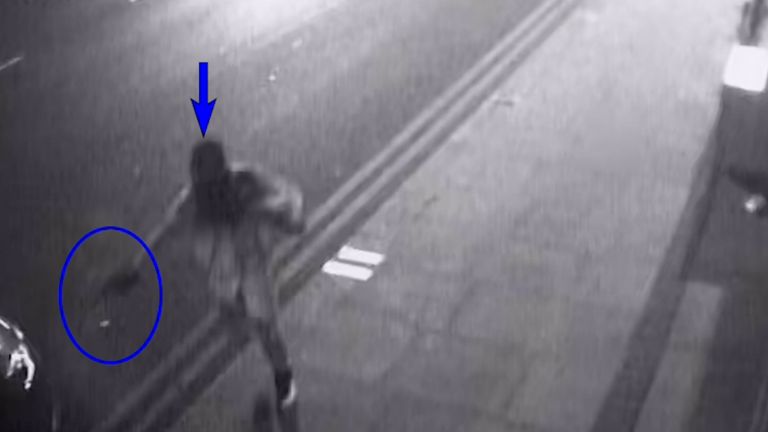
Chris Kaba club shooting
The jury – which was not told Mr Kaba was a core member of a notorious south London gang who was suspected of carrying out a nightclub shooting – deliberated for about three hours before finding Mr Blake not guilty of murder.
But the Independent Office for Police Conduct (IOPC) said he will face a gross misconduct hearing after a “thorough review” of all the evidence in the case.
The threshold is a lower test than for criminal proceedings and a police disciplinary panel will decide whether misconduct is proven or not.
IOPC director Amanda Rowe said: “We understand the impact this decision will have on Chris Kaba’s family and Sergeant Blake and acknowledge the significant public interest in this case, particularly among our black communities, firearms officers and the wider policing community.
“This is a decision we have taken based on examining all the evidence, views of all parties and by applying the thresholds set out in legislation and guidance which govern our work.
“The legal test for deciding whether there is a case to answer is low – is there sufficient evidence upon which, on the balance of probabilities, a disciplinary panel could make a finding of misconduct. This has been met and therefore we need to follow the legal process.
“We appreciate that the Home Office is carrying out a review of the legal test for the use of force in misconduct cases, however, we must apply the law as it currently stands.”
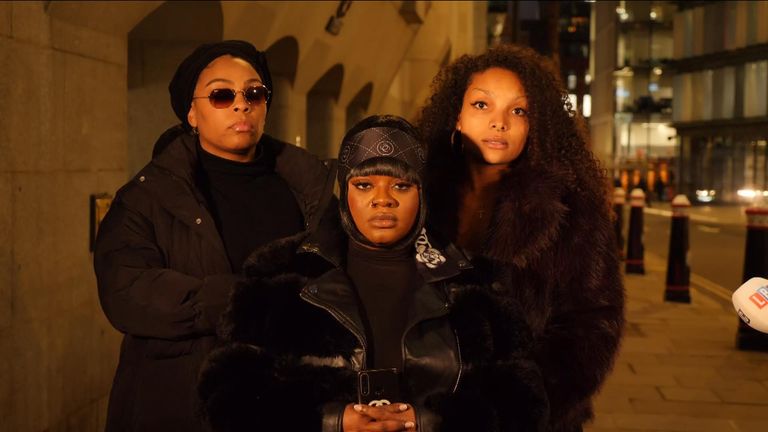
Chris Kaba’s family: ‘We will continue this fight’
Mr Kaba’s family vowed they “won’t be silenced” and would continue fighting for “justice and for real change” following the verdict.
In a statement issued through the charity Inquest after the IOPC’s decision, they said: “We hope this leads to him being removed from the Met Police.
“What Martyn Blake did was deeply wrong. We are still so devastated to have lost Chris – this should never have happened.
“The fact that the Met promoted Martyn Blake after the verdict only deepened our pain and showed a complete disregard for our loss.
“Martyn Blake should not be allowed to remain a police officer. He should lose his job.”
The Met said the force made “strong representations” that Mr Blake, who they referred to by the cypher NX121 used before a judge lifted an anonymity order, should not face any further action.
Assistant Commissioner Laurence Taylor said: “We know any fatal use of force by police understandably prompts concern among communities.
“NX121 made a split-second decision on what he believed was necessary to protect his colleagues and London and a jury unanimously decided that was an honestly-held belief and the force used was reasonable.
“However, the IOPC has now determined that NX121 has a case to answer for his use of force and has directed us to hold a gross misconduct hearing.
“We know another lengthy process will fall heavily on the shoulders of NX121 and more widely our firearms officers, who continue to bravely and tirelessly police the streets of London every day to protect the public.”
Mr Taylor said the Met will ask a chief officer from another force to chair the hearing to ensure independence.
Home Secretary Yvette Cooper has ordered a review into the accountability of firearms officers.
Some of the force’s firearms officers turned in their weapons in protest after Mr Blake was charged with murder and the IOPC’s decision caused more anger among the rank and file.
Matt Cane, general secretary of the Metropolitan Police Federation that represents them, said: “This is frankly a nonsensical ruling by the IOPC that will shock police officers across London and indeed the country.
“Police officers should not have their livelihoods or liberty put at risk for performing what unequivocally, as has been found in a court of law, is their lawful and appropriate function.
“And yet putting this brave officer on trial for murder – as astonishing as that was – was not enough for the IOPC.”
Mr Blake is only the fourth police officer to be charged with murder or manslaughter over a fatal police shooting in England and Wales since 1990, while a total of 83 people have died in such incidents, according to the Inquest charity.
In that time, only one on-duty officer, Benjamin Monk, has been found guilty of manslaughter – over the death of former Aston Villa striker Dalian Atkinson, 48 – while none have been convicted of murder.
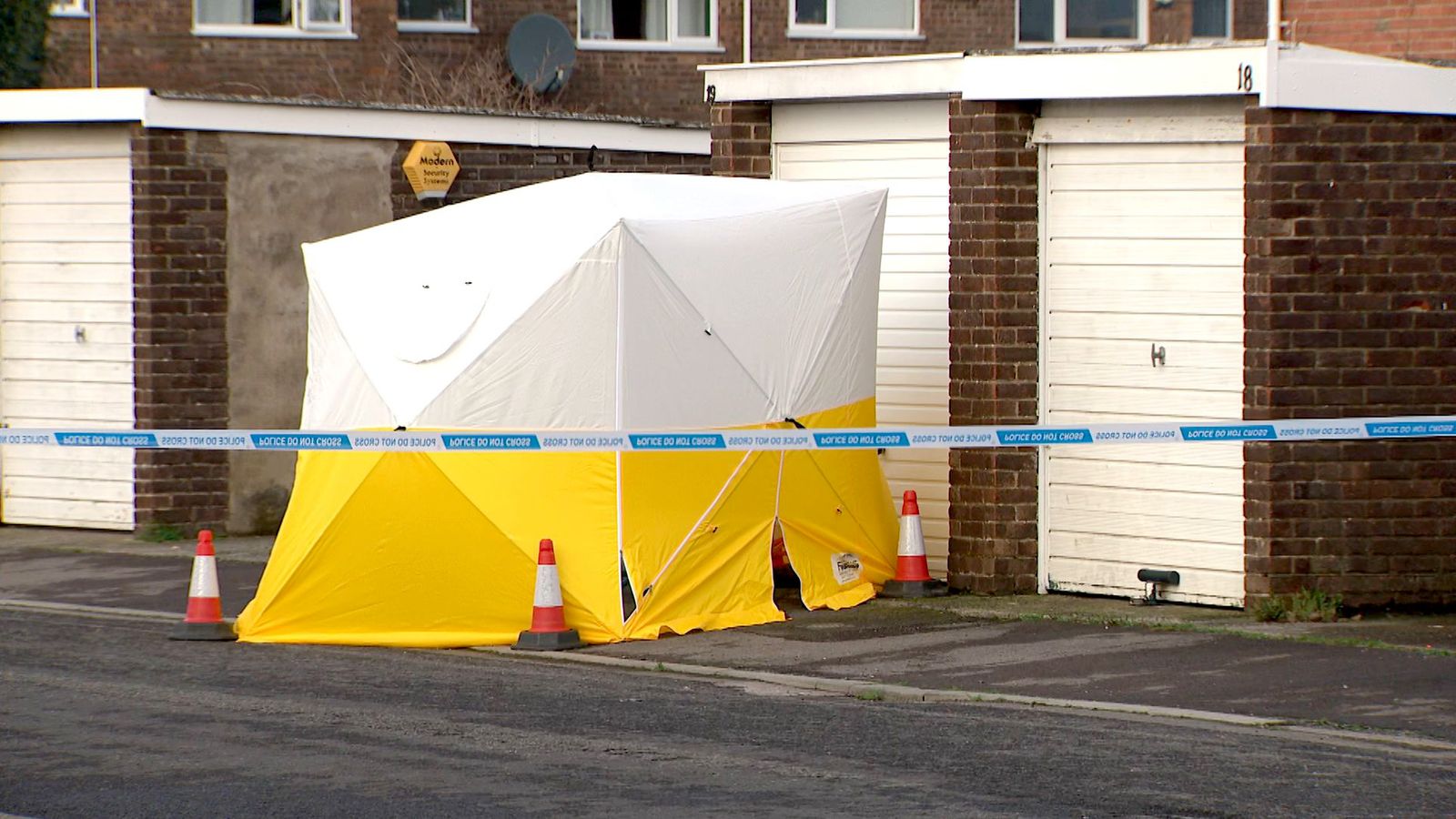
A nine-year-old girl found dead in Weston-super-Mare has been named on the day police revealed a teenager had been charged with her murder.
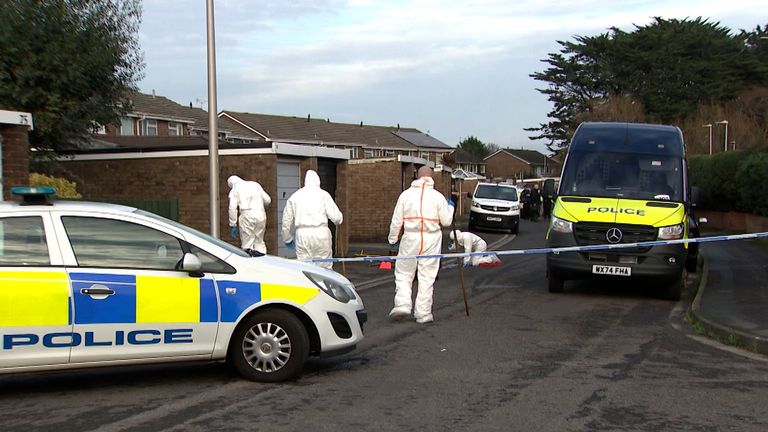
Emergency services were called to Lime Close in the Somerset town at 6.09pm on Monday but Aria Thorpe was pronounced dead at the scene.
Police said a 15-year-old boy had been charged with her murder and that a preliminary post-mortem found she died from a single stab wound.
The teenage boy – who can’t be named due to his age – will appear at Bristol Magistrates’ Court later today.
A police cordon remains in place as forensics officers continue their work.
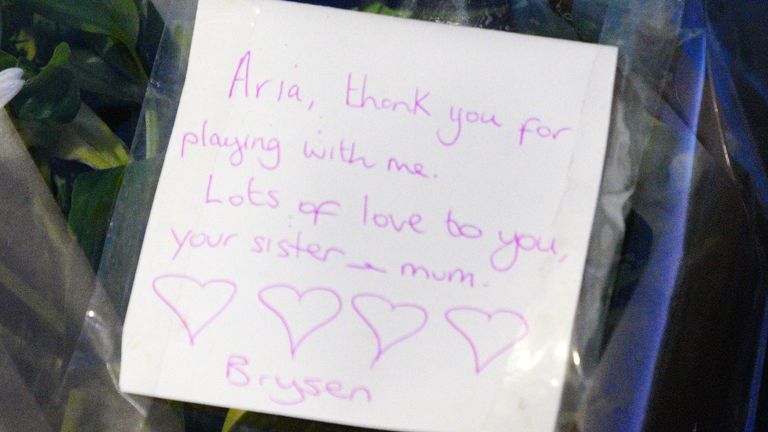
Flowers and tributes have been left at the scene. Pic: PA
Read more from Sky News:
NHS facing ‘worst-case scenario’ as doctors strike
Arrests over plot to steal ‘tonnes’ of charity clothes to fund crime
Superintendent Jen Appleford, from Avon and Somerset Police, said the community was in shock and Aria’s family were being supported by police.
“It is impossible to adequately describe how traumatic the past 36 hours have been for them and we’d like to reiterate in the strongest possible terms their request for privacy,” she said.
Supt Appleford said police were working with local schools and other agencies to make sure support is available.
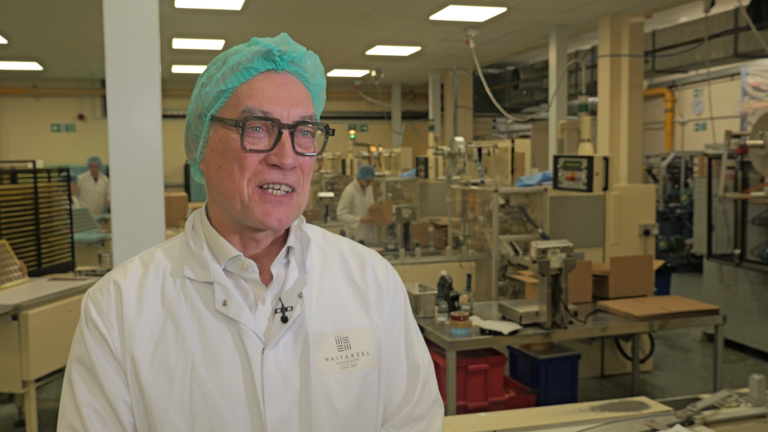
Britain loves chocolate.
We’re estimated to consume 8.2kg each every year, a good chunk of it at Christmas, but the cost of that everyday luxury habit has been rising fast.
Whitakers have been making chocolate in Skipton in North Yorkshire for 135 years, but they have never experienced price pressures as extreme as those in the last five.
“We buy liquid chocolate and since 2023, the price of our chocolate has doubled,” explains William Whitaker, the real-life Willy Wonka and the fourth generation of the family to run the business.
William Whitaker, managing director of the company
“It could have been worse. If we hadn’t been contracted [with a supplier], it would have trebled.
“That represents a £5,000 per-tonne increase, and we use a thousand tonnes a year. And we only sell £12-£13m of product, so it’s a massive effect.”
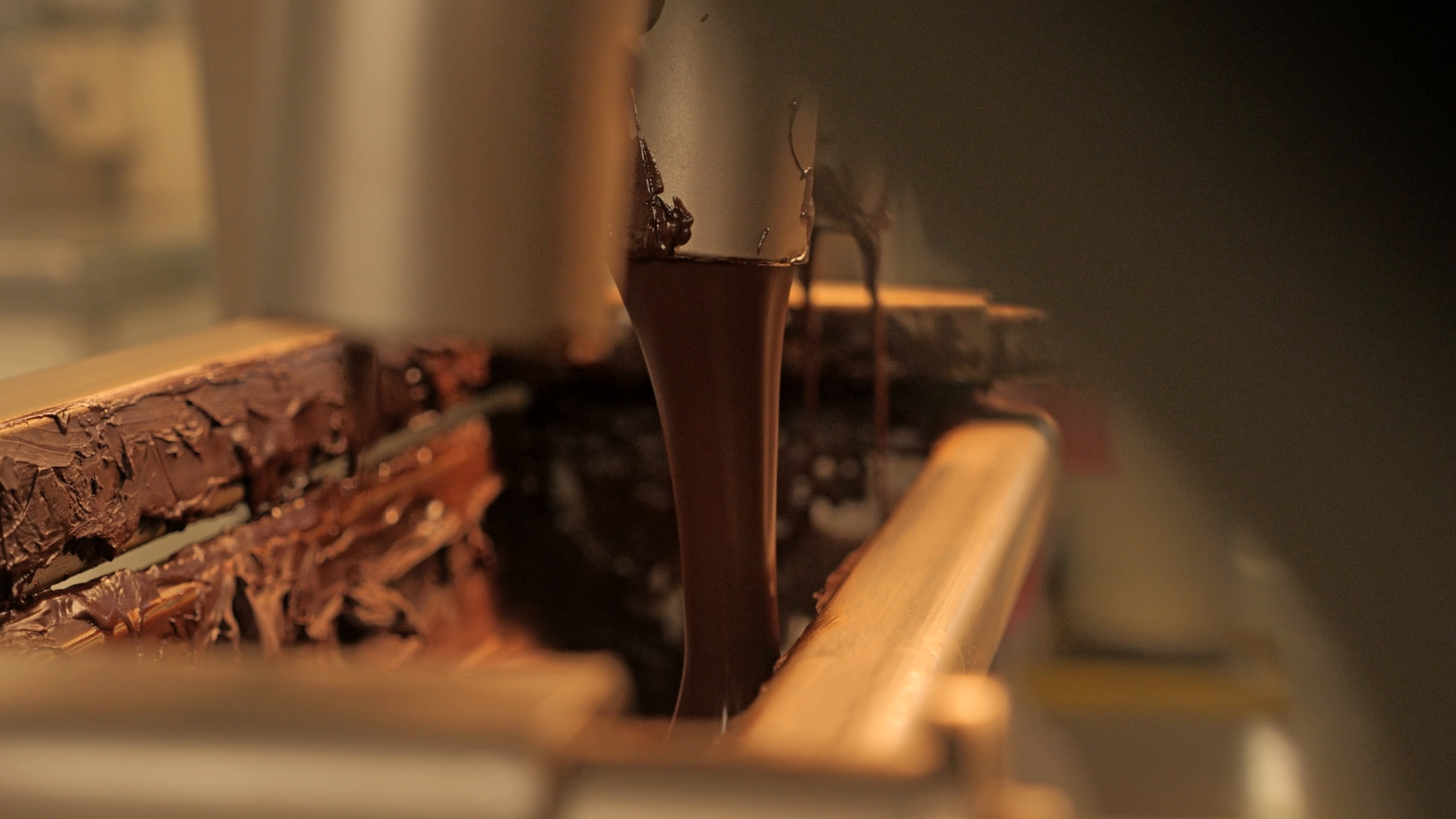
Whitakers makes 10 million pieces of chocolate a week in a factory on the much-expanded site of the original bakery where the business began.
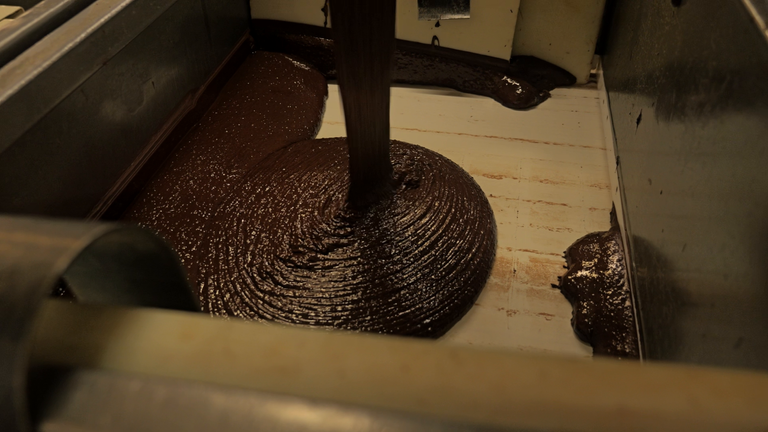
Automated production lines snake through the site moulding, cutting, cooling, coating and wrapping a relentless procession of fondants, cremes, crisps and pure chocolate products for customers, including own-brand retail, supermarkets, and the catering trade.
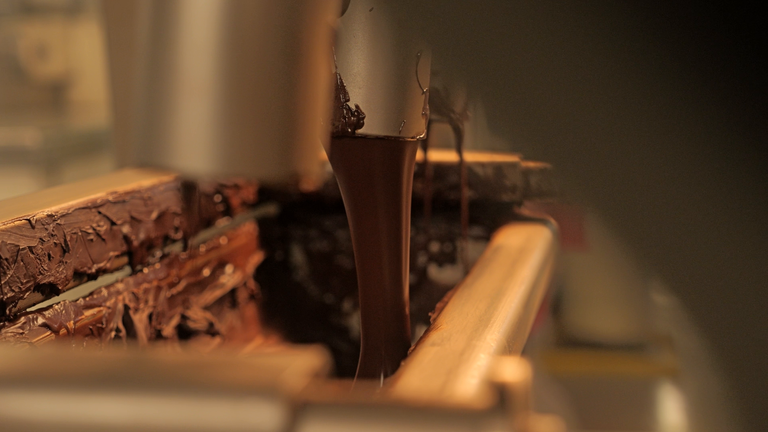
Steepest inflation in the business
All of them have faced price increases as Whitakers has grappled with some of the steepest inflation in the food business.
Cocoa prices have soared in the last two years, largely because of a succession of poor cocoa harvests in West Africa, where Ghana and the Ivory Coast produce around two-thirds of global supply.
A combination of drought and crop disease cut global output by around 14% last year, pushing consumer prices in the other direction, with chocolate inflation passing 17% in the UK in October.
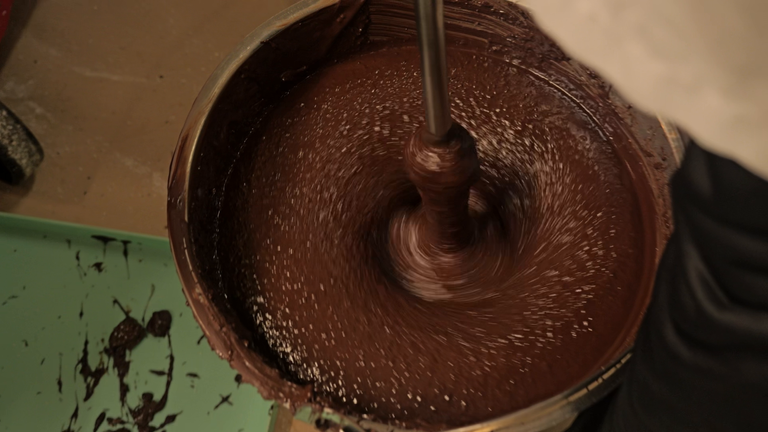
Skimpflation and shrinkflation
Some major brands have responded by cutting the chocolate content of products – “skimpflation” – or charging more for less – “shrinkflation”.
Household-name brands including Penguin and Club have cut the cocoa and milk solid content so far they can no longer be classified as chocolate, and are marketed instead as “chocolate-flavour”.
Whitakers have stuck to their recipes and product sizes, choosing to pass price increases on to customers while adapting products to the new market conditions.
“Not only are major brands putting up prices over 20%, sometimes 40%, they’ve also reduced the size of their pieces and sometimes the ingredients,” says William Whitaker.
“We haven’t done any of that. We knew that long-term, the market will fall again, and that happier days will return.
“We’ve introduced new products where we’ve used chocolate as a coating rather than a solid chocolate because the centre, which is sugar-based, is cheaper than the chocolate.
“We’ve got a big product range of fondant creams, and others like gingers and Brazil nuts, where we’re using that chocolate as a coating.”
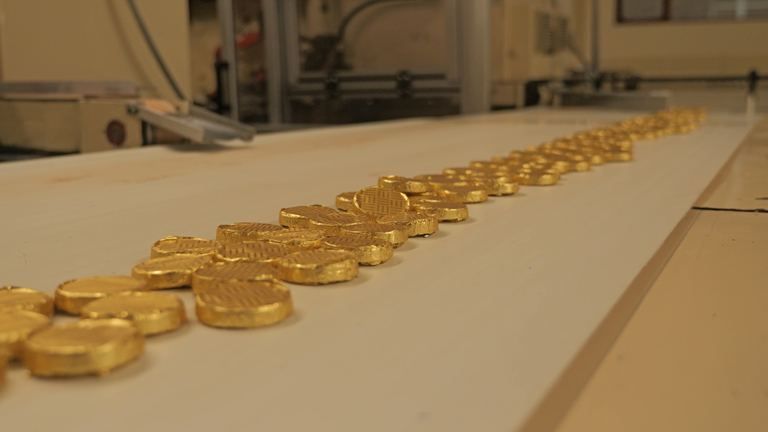
The costs are adding up
A deluge of price rises
Brazil nuts have enjoyed their own spike in price, more than doubling to £15,000 a tonne at one stage.
On top of commodity prices determined by markets beyond their control, Whitakers face the same inflationary pressures as other UK businesses.
“We’ve had the minimum wage increasing every year, we had the national insurance rise last year, and sort of hidden a little bit in this budget is a business rate increase.
“This is a small business, we turn over £12m, but our rates will go up nearly £100,000 next year before any other costs.
“If you add up all the cocoa and all the other cost increases in 2024 and 2025, it’s nearly £3m of cost increases we’ve had to bear. Some of that is returning to a little normality. It does test the relevance of what you do.”
-
 Sports2 years ago
Story injured on diving stop, exits Red Sox game
-
 Sports3 years ago
‘Storybook stuff’: Inside the night Bryce Harper sent the Phillies to the World Series
-
 Sports2 years ago
Game 1 of WS least-watched in recorded history
-
 Sports3 years ago
Button battles heat exhaustion in NASCAR debut
-
 Sports3 years ago
MLB Rank 2023: Ranking baseball’s top 100 players
-
Sports4 years ago
Team Europe easily wins 4th straight Laver Cup
-
 Environment3 years ago
Japan and South Korea have a lot at stake in a free and open South China Sea
-
 Environment1 year ago
Here are the best electric bikes you can buy at every price level in October 2024