

That full-size Genesis electric SUV we’ve been waiting for might take longer than expected

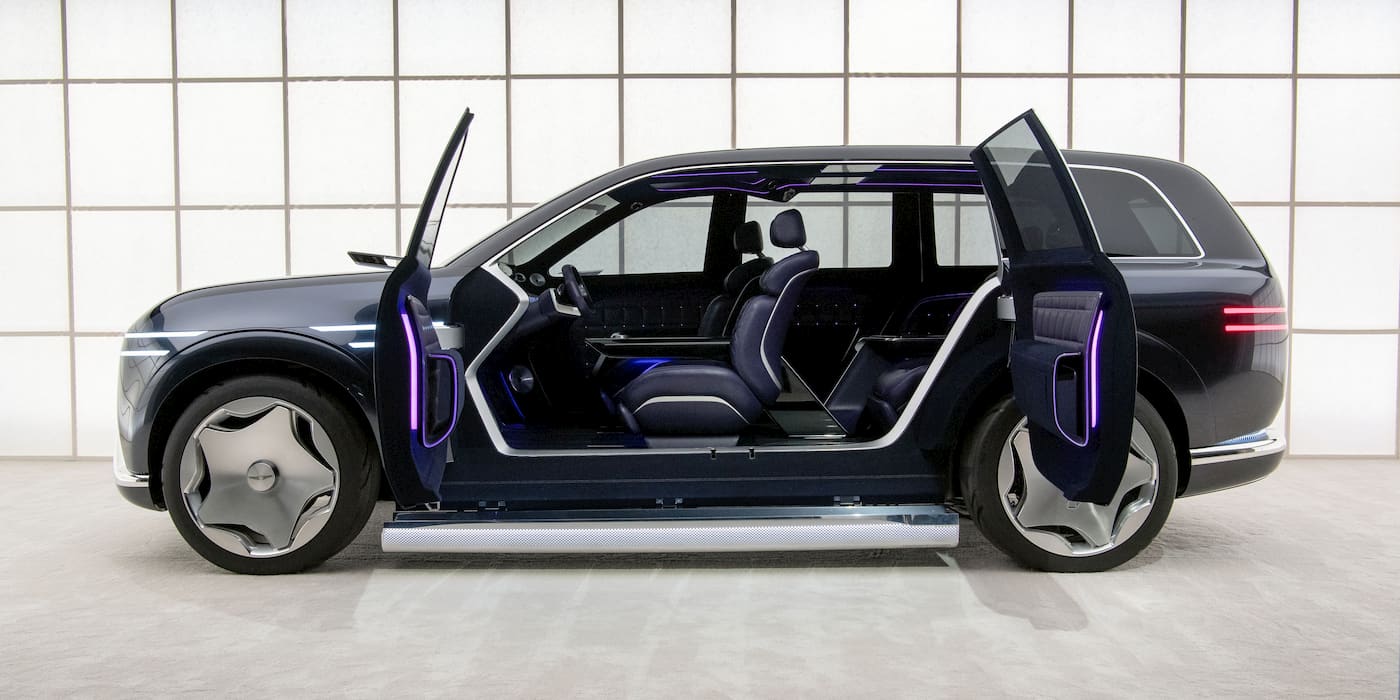
The GV90 is expected to be the most upscale Genesis SUV yet, serving as its new flagship model. But it might be a little longer than expected before we see it on the streets. A new report says production of the first full-size Genesis electric SUV is getting delayed.
Genesis delays production of its full-size electric SUV
It’s been over a year now since Genesis unveiled the Neolun concept, a preview of its first full-size electric SUV. The concept is based on Korean minimalist design, “to create an ultra-luxe vision of luxury SUVs.”
The stylish SUV even had Rolls-Royce-like coach doors. Last month, Genesis’ director of design, Luc Donckerwolke, confirmed to AutoExpress that the Neolun concept will officially enter production as the luxury brand’s new flagship vehicle.
Unlike Hyundai and Kia, Genesis is not “chasing volume,” Donckerwolke explained. Instead, Genesis is upscaling to drive profits and prestige.
Although the GV90 was initially scheduled to enter production at Hyundai’s Ulsan plant in South Korea later this year, it is now being pushed back until mid-2026.
According to Hyundai Motor’s product development plan, as viewed by The Korea Economic Daily, mass production of the first full-size Genesis electric SUV is now planned to start in June 2026.
Hyundai Motor, along with Kia and Genesis, plans to drive growth this year and next with new models in key segments.
Genesis will introduce several new hybrids, including the G80 sedan, which is set to debut in December. The GV80 and GV80 Coupe are scheduled to follow in September 2026.


The luxury brand sold 75,003 vehicles in the US last year, which is nearly a third of its total global sales of 229,532. The new hybrid models are expected to further growth over the next few years.
With the GV90’s official debut coming up, we’ve caught a glimpse of the full-size electric SUV several times now. Most recently, it was spotted with Magma-coloring, Genesis’ new performance branding.
The full-size GV90 will take on other luxury electric SUVs from rivals like Mercedes-Benz EQS SUV and the nd upcoming Range Rover Electric.
Source: TheKoreanCarBlog, The Korea Economic Daily
FTC: We use income earning auto affiliate links. More.

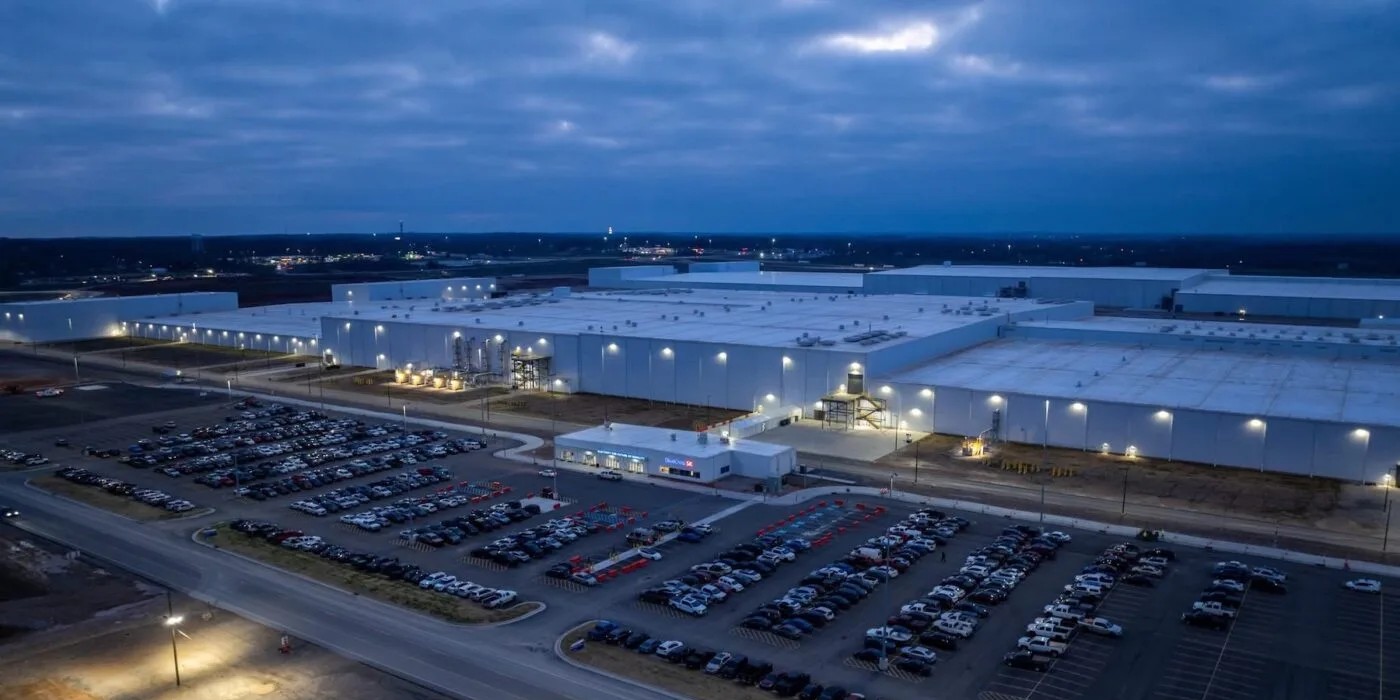
Ford is jumping into the battery energy storage business, betting that booming demand from data centers and the electric grid can absorb the EV battery capacity it says it’s not using.
To achieve this, Ford plans to repurpose its existing EV battery manufacturing capacity in Glendale, Kentucky, into a dedicated hub for manufacturing battery energy storage systems.
Ford pivots from EVs to battery storage for data centers
Ford says it will invest about $2 billion over the next two years to scale the new business. The Kentucky site will be converted to build advanced battery energy storage systems larger than 5 megawatt-hours, including LFP prismatic cells, BESS modules, and 20-foot DC container systems — the kind of hardware increasingly used by data centers, utilities, and large-scale industrial companies.
The company plans to bring initial production online within 18 months, leaning on its manufacturing experience and licensed battery technology. By late 2027, Ford expects the business to deploy at least 20 gigawatt-hours of energy storage annually.
The move follows a joint venture disposition agreement reached last week between Ford, SK On, SK Battery America, and BlueOval SK. Under the agreement, a Ford subsidiary will independently own and operate the Kentucky battery plants, while SK On will fully own and operate the Tennessee battery plant.
Ford is also planning a separate energy storage play in Michigan. At BlueOval Battery Park Michigan in Marshall, the company will produce smaller amp-hour LFP prismatic cells for residential energy storage systems. That plant is on track to begin manufacturing in 2026, and it will also supply batteries for Ford’s upcoming midsize electric truck — the first model built on the company’s new Universal EV Platform.
Electrek’s Take
Overall, the shift reflects Ford’s broader push toward what it calls “higher-return opportunities.” Alongside taking a step backward to add more gas-powered trucks and vans to its US manufacturing footprint, Ford says it will no longer produce some larger EVs, such as the Lightning F-150, where softer demand and higher costs are resulting from the lack of support for EVs by the Trump administration. (Batteries produced at the Glendale plant were for the all-electric Ford F-150 Lightning. The best-selling electric truck in the US in Q3, before the federal tax credit expired, was the Ford F-150 Lightning, with 10,005 EVs sold, a 39.7% year-over-year increase.)
With tax credits eliminated and regulatory uncertainty, Ford is pivoting to adjacent markets, including grid-scale and residential energy storage, to keep its battery plants running and justify billions in sunk investment.

If you’re looking to replace your old HVAC equipment, it’s always a good idea to get quotes from a few installers. To make sure you’re finding a trusted, reliable HVAC installer near you that offers competitive pricing on heat pumps, check out EnergySage. EnergySage is a free service that makes it easy for you to get a heat pump. They have pre-vetted heat pump installers competing for your business, ensuring you get high quality solutions. Plus, it’s free to use!
Your personalized heat pump quotes are easy to compare online and you’ll get access to unbiased Energy Advisors to help you every step of the way. Get started here. – *ad


FTC: We use income earning auto affiliate links. More.

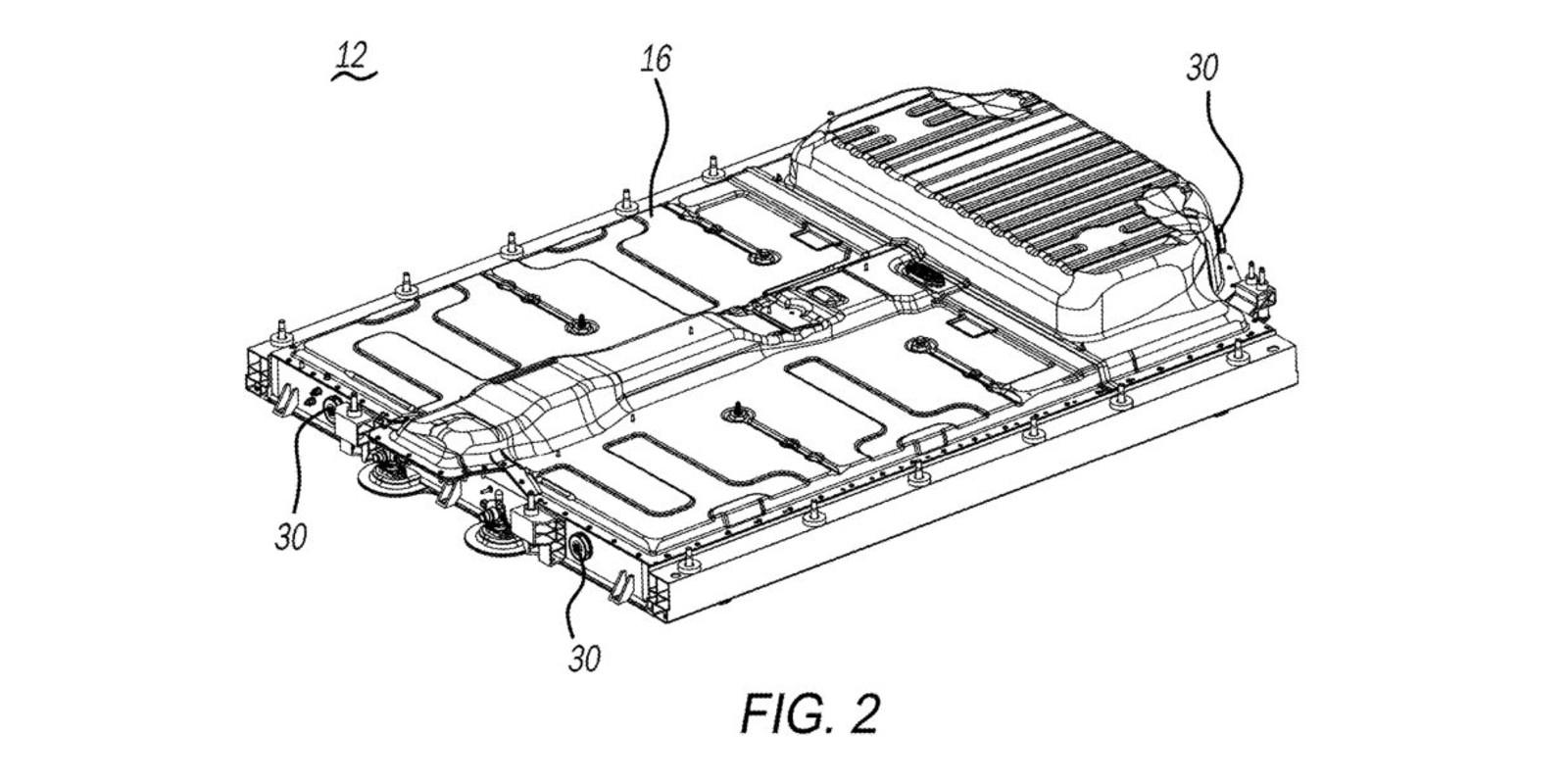
Stellantis may have backed away from planned EVs like the all-electric Ram REV and range-topping Dodge Charger Daytona R/T EV, but the company isn’t standing still. A newly awarded patent outlines an innovative, foam-based thermal runaway suppression system that’s built into an EV’s battery pack.
The indisputable fact of the matter is that electric vehicles catch fire far less often — and far less frequently — than their combustion-powered brethren. Still, a number of highly-publicized early Tesla fires and poorly managed recall on the first-gen Chevy Bolt have linked “electric car” and “fire” in the minds of many Americans, and the ones who have been waiting to test the EV waters until a better safety solution came along are going to absolutely love this latest setup from Chrysler parent company Stellantis.
MoparInsiders is reporting on a new Stellantis patent awarded on a proactive battery safety system that’s designed to stop thermal runaway (read: fire) before it can cascade through an entire EV battery pack.
Rather than relying solely on passive barriers or post-event containment, Stellantis’ freshly patented system uses strategically placed foam channels and deployment mechanisms that can flood the affected cells with high insulation foam when abnormal heat is detected in a cell, isolating the problem area and dramatically slowing (if not outright stopping) the chain reaction that leads to catastrophic battery failure.
The patent describes an electric car battery that, on the outside, will look familiar to EV enthusiasts, but there are some key differences “layered in” around the familiar bits. These include:
- A bladder filled with a fire-retardant chemical; located close to the battery cells, typically between the cells and the top of the pack. It’s made from a flexible polymer, so it can be punctured when needed
- Two sets of blades; the first aimed at the bladder, ready to pierce it and release the fire-retardant chemical while the second targets specific points on the coolant inlet line, outlet line, or heat sinks to rupture them and release cooling foam directly where it’s needed
- Special coolant line sections; designed with small sealed apertures that closed off with a soft plug material that’s easy for the blades to pierce but strong enough to maintain pressure during normal operation
- Actuation devices tied to a controller; that push the blades into the bladder and coolant components when a thermal event is detected
Special coolant lines
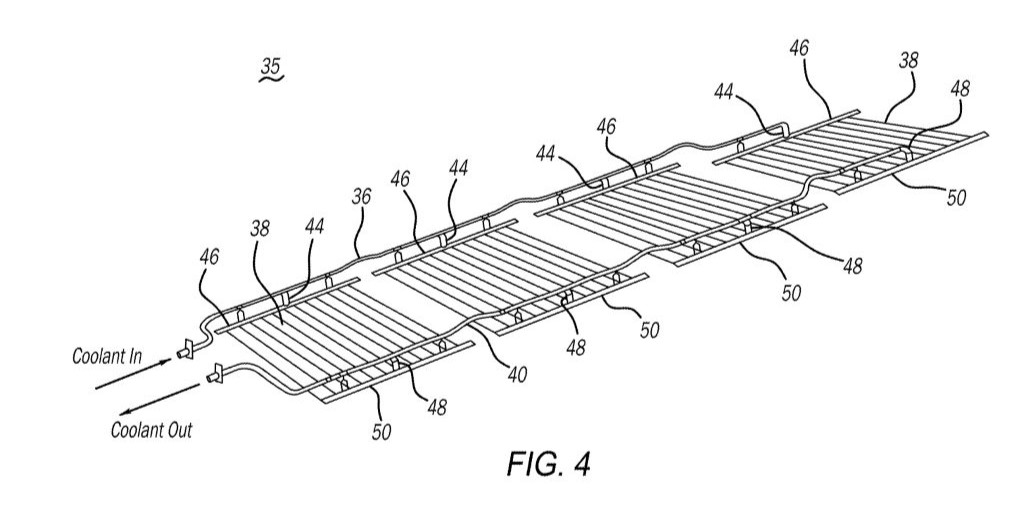
The system relies on a suite of existing temperature sensors throughout the battery pack, and seems like a viable enough solution to a problem that, while rare, certainly exists — and which looms large over America’s Early Majority tech adopters.
As for me, I think Stellantis should focus on bringing more compelling products to market and stop looking for ways to blame the customer, market, and government for its inability to sell Jeep products that, apparently, have enough markup to cover nearly $30,000 in discounts to help dealers move their metal. I look forward to hearing about your take in the comments.
SOURCE | IMAGES: US Patent Office, via MoparInsiders.

If you’re considering going solar, it’s always a good idea to get quotes from a few installers. To make sure you find a trusted, reliable solar installer near you that offers competitive pricing, check out EnergySage, a free service that makes it easy for you to go solar. It has hundreds of pre-vetted solar installers competing for your business, ensuring you get high-quality solutions and save 20-30% compared to going it alone. Plus, it’s free to use, and you won’t get sales calls until you select an installer and share your phone number with them.
Your personalized solar quotes are easy to compare online and you’ll get access to unbiased Energy Advisors to help you every step of the way. Get started here.
FTC: We use income earning auto affiliate links. More.

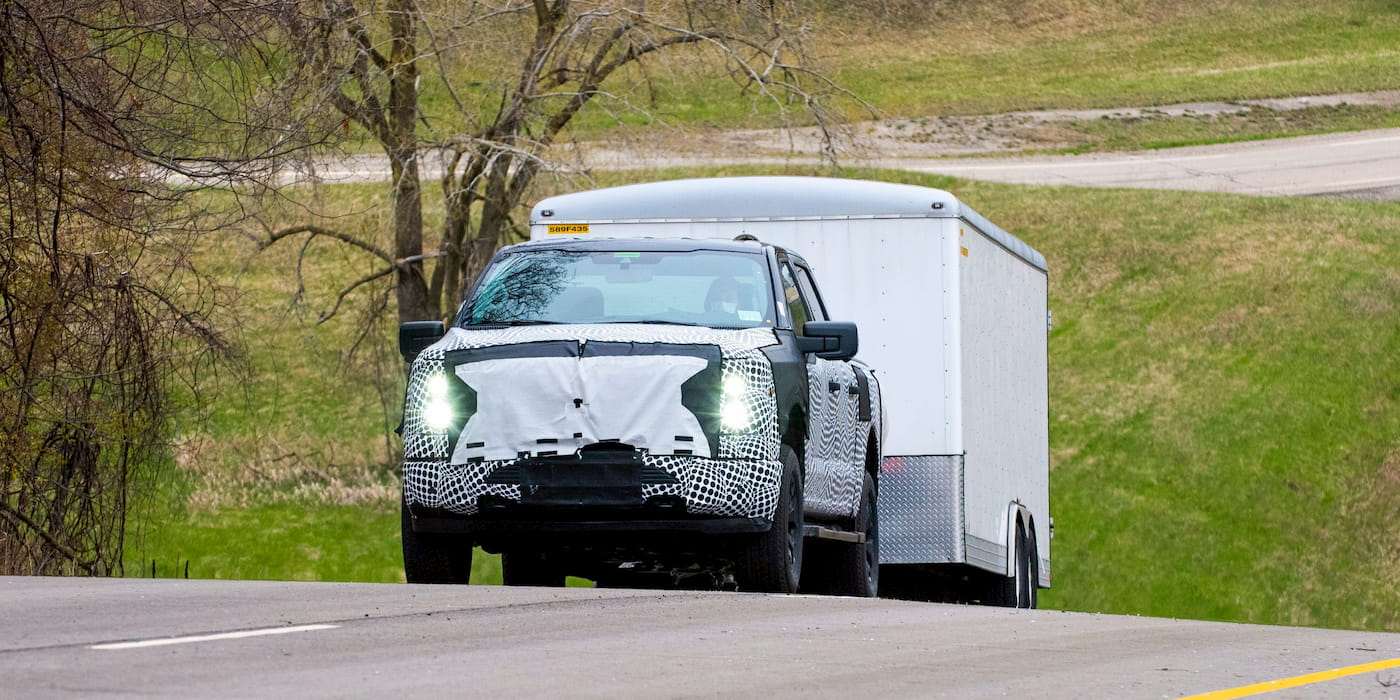
It’s official. The all-electric pickup is dead, but Ford is promising the F-150 Lightning EREV will be “every bit as revolutionary” as it shakes up EV plans once again.
Ford reveals next-gen F-150 Lightning EREV
Ford confirmed production of the current F-150 Lightning has ended as part of its updated Ford+ plan, which the company revealed on Monday.
The changes come as part of a broader shift from larger EVs, like the Lightning, to smaller, more affordable models.
While Ford still plans to launch lower-cost EVs based on its Universal EV Platform, the company is expanding its hybrid and extended range electric vehicle (EREV) lineup. By 2030, Ford expects 50% of its global volume to be hybrids, EREVs, and EVs, up from 17% in 2025.
As part of its new plans, Ford said the next-generation F-150 Lightning will switch to an EREV powertrain. It will be assembled at the Rouge EV Center in Dearborn, Michigan, replacing the current all-electric pickup.
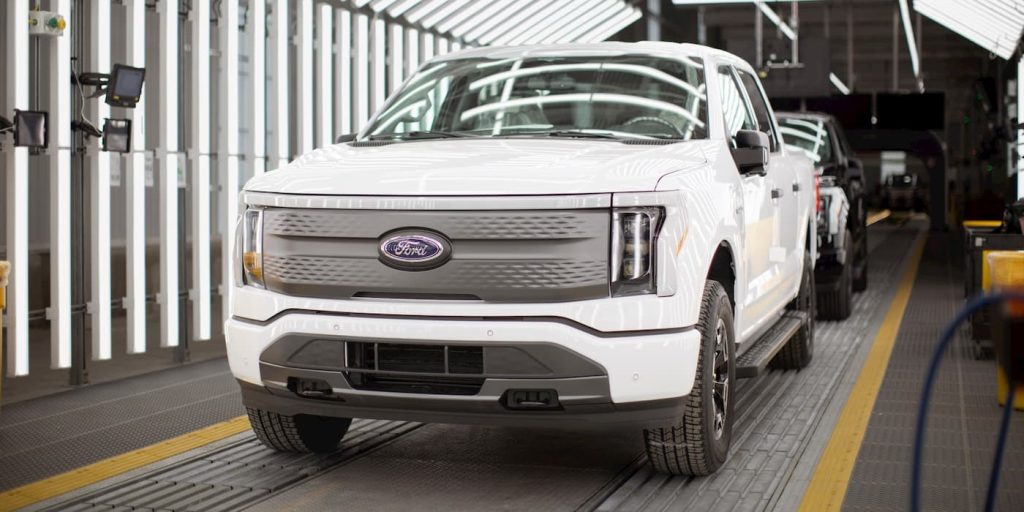
With production of the current-generation Lightning now concluded, Ford is sending workers from the Rouge EV Center to its Dearborn Truck Plant as it doubles down on gas and hybrids.
During its Q3 earnings call last month, Ford said the electric pickup would remain paused following a fire at Novelis’ plant in New York that disrupted aluminum supply.

The F-150 Lightning is a “groundbreaking” vehicle, according to Doug Field, Ford’s chief EV, digital, and design officer, that showed an electric pickup can be a great F-Series.
Field claims the “next-generation Lightning EREV is every bit as revolutionary.” It will still offer 100% electric power delivery, sub-5-second acceleration, an estimated combined range of 700+ miles, and it “tows like a locomotive.”
Ford also plans to replace its electric commercial van for North America with affordable gas- and hybrid-powered versions. It will be assembled at Ford’s Ohio Assembly Plant.
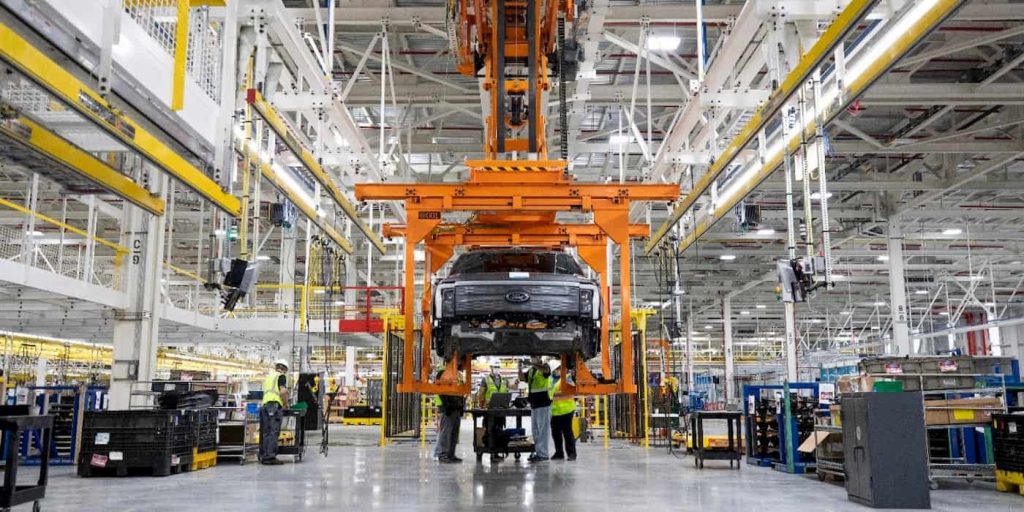
The move comes as part of Ford’s plans to launch five new affordable vehicles by the end of the decade, four of which will be assembled in the US. Ford also plans to offer gas, hybrid, and EREV options across nearly every vehicle in its lineup by then.
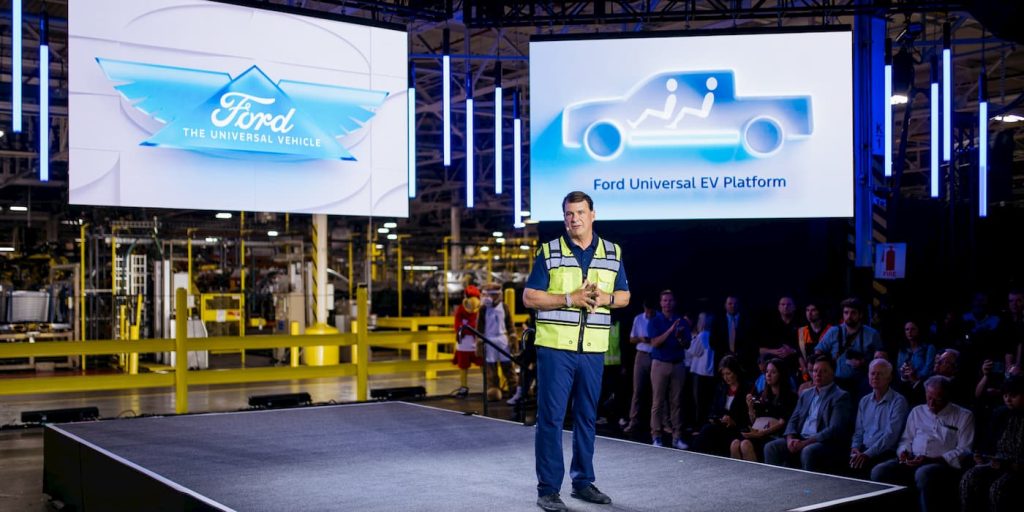
The first vehicle based on Ford’s new Universal EV Platform will be a midsize electric pickup, starting at around $30,000. It’s expected to be about the size of the Ranger or Maverick.
The news comes after SK On announced last week that it planned to end its joint venture with Ford to build EV batteries at three US gigafactories.
Ford is now planning to use the wholly owned EV battery plants in Kentucky and Michigan to launch a new battery energy storage business. The company plans to begin shipping BESS systems in 2027, with an annual capacity of 20 GWh.
“The operating reality has changed, and we are redeploying capital into higher-return growth opportunities: Ford Pro, our market-leading trucks and vans, hybrids, and high-margin opportunities like our new battery energy storage business,” CEO Jim Farley said on Monday.
The changes are designed to improve profitability and returns. Ford’s EV business, Model e, is now expected to reach profitability by 2029 with improvements in 2026.
Model e lost another $1.4 billion in Q3, bringing the total to $3.6 billion through September. Around $3 billion was due to its current EVs, while the other $600 million was spent on its next-gen models.
Although sales of the F-150 Lightning dropped 60.8% last month following the expiration of the $7,500 federal EV tax credit, Ford’s electric pickup remained the best-selling pickup in the US through September.
FTC: We use income earning auto affiliate links. More.
-
 Sports2 years ago
Story injured on diving stop, exits Red Sox game
-
 Sports3 years ago
‘Storybook stuff’: Inside the night Bryce Harper sent the Phillies to the World Series
-
 Sports2 years ago
Game 1 of WS least-watched in recorded history
-
 Sports3 years ago
Button battles heat exhaustion in NASCAR debut
-
 Sports3 years ago
MLB Rank 2023: Ranking baseball’s top 100 players
-
Sports4 years ago
Team Europe easily wins 4th straight Laver Cup
-
 Environment3 years ago
Japan and South Korea have a lot at stake in a free and open South China Sea
-
 Environment1 year ago
Here are the best electric bikes you can buy at every price level in October 2024