
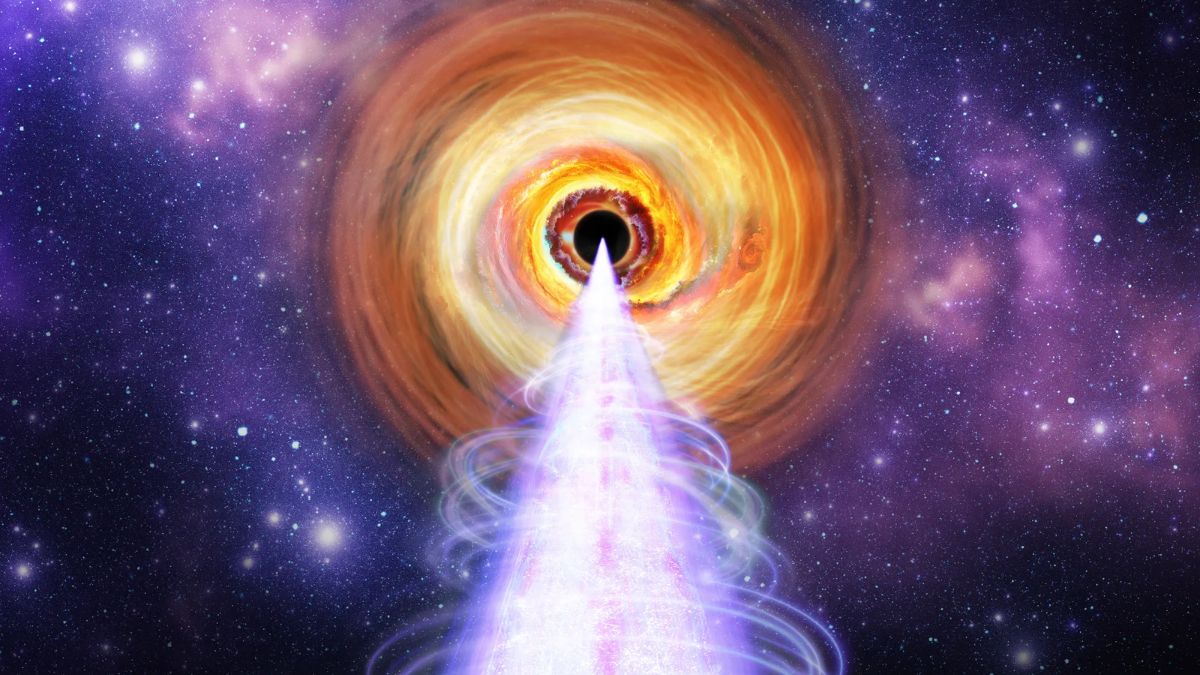
NASA Solves Black Hole Jet X-ray Mystery with IXPE’s Polarization Powers


For the first time, researchers have managed to simulate a fundamental process of cosmic particle acceleration in a laboratory: the first series of discoveries that will transform our understanding of cosmic rays. Now, scientists from the Universities of Birmingham and Chicago have created a tiny, 100-micrometre Fermi accelerator, in which mobile optical potential barriers collide with trapped atoms, in a partial replica of how cosmic particles pick up energy in space. The technique not only replicates cosmic ray behaviour but also sets a new benchmark in quantum acceleration technology.
Lab-Built Fermi Accelerator Using Cold Atoms Validates Cosmic Ray Theory and Advances Quantum Tech
As per findings published in Physical Review Letters, this fully controllable setup demonstrated particle acceleration through the Fermi mechanism first proposed by physicist Enrico Fermi in 1949. Long theorised to underlie cosmic ray generation, the process had never been reliably replicated in a lab. By combining energy gains with particle losses, researchers created energy spectra similar to those observed in space, offering the first direct validation of Bell’s result, a cornerstone of cosmic ray physics.
In Fermi acceleration, ultracold atoms are accelerated to more than 0.5 metres per second using laser-controlled barriers. Dr Amita Deb, a coauthor and researcher at the University of Birmingham, mentioned, ‘Our chimney is more powerful than conventional quantum nano-measurements, which are the best acceleration tools in the world so far, and while its simplicity and small size can be compelling, its lack of a theoretical speed limit is the most attractive feature.’ The ultracold atomic jets could be readily controlled with high precision in the subsequent experiments.
This progress means that, for the first time, complicated astrophysical events like shocks and turbulence can be studied in a laboratory, lead author Dr Vera Guarrera stated. This opens new avenues for high-energy astrophysics and also for applications in quantum wavepacket control and quantum chemistry.
Researchers plan to find out how different behaviour affects energy cutoffs and acceleration rates. A compact Fermi accelerator of this type could be a cornerstone for studies of fundamental physics and also connect to emerging technologies such as atomtronics.
For the latest tech news and reviews, follow Gadgets 360 on X, Facebook, WhatsApp, Threads and Google News. For the latest videos on gadgets and tech, subscribe to our YouTube channel. If you want to know everything about top influencers, follow our in-house Who’sThat360 on Instagram and YouTube.

Astronomers now propose that “failed stars” known as brown dwarfs could be powered by dark matter. Dark matter makes up about 85 percent of the universe’s matter but does not shine; it interacts only via gravity. Brown dwarfs form like stars but lack enough mass to ignite fusion. The theory suggests brown dwarfs in galaxy centers might trap dark matter in their interiors. When that dark matter annihilates, it releases energy that heats the star, turning the dwarf into a brighter “dark dwarf.” If such objects exist, finding them would give scientists a new clue to the nature of dark matter.
Dark Matter in Failed Stars
According to the new model, dense brown dwarfs at the centers of galaxies act like gravity wells that accumulate dark matter. Because dark matter interacts only via gravity, it naturally drifts to galactic cores, where it can be captured by star. As University of Hawai‘i physicist Jeremy Sakstein explains, once inside a star dark matter can annihilate with itself, releasing energy that heats the dwarf. The more dark matter a brown dwarf collects, the more energy it outputs. Crucially, this effect only works if dark matter particles self-annihilate (as with heavy WIMPs); lighter or non-interacting candidates like axions would not create dark dwarfs.
They propose using a chemical signature: a dark dwarf should hold on to lithium-7 that normal brown dwarfs burn away. The researchers say powerful telescopes like NASA’s James Webb Space Telescope might already be sensitive enough to spot cool, dim dark dwarfs near the Milky Way’s center. Detecting even one would strongly suggest that dark matter is made of heavy, self-interacting particles (like WIMPs).
In related work, Colgate astrophysicist Jillian Paulin coauthored studies of ancient “dark stars” fueled by dark matter, while SLAC physicist Rebecca Leane and collaborators have shown that dark matter capture could heat brown dwarfs and exoplanets – a process called “dark kinetic heating”. Together, these ideas highlight how even dim, unusual stars could illuminate the nature of dark matter.
For the latest tech news and reviews, follow Gadgets 360 on X, Facebook, WhatsApp, Threads and Google News. For the latest videos on gadgets and tech, subscribe to our YouTube channel. If you want to know everything about top influencers, follow our in-house Who’sThat360 on Instagram and YouTube.

-
 Sports3 years ago
‘Storybook stuff’: Inside the night Bryce Harper sent the Phillies to the World Series
-
 Sports1 year ago
Story injured on diving stop, exits Red Sox game
-
 Sports2 years ago
Game 1 of WS least-watched in recorded history
-
 Sports2 years ago
MLB Rank 2023: Ranking baseball’s top 100 players
-
Sports4 years ago
Team Europe easily wins 4th straight Laver Cup
-
 Sports2 years ago
Button battles heat exhaustion in NASCAR debut
-
 Environment2 years ago
Japan and South Korea have a lot at stake in a free and open South China Sea
-
 Environment2 years ago
Game-changing Lectric XPedition launched as affordable electric cargo bike