
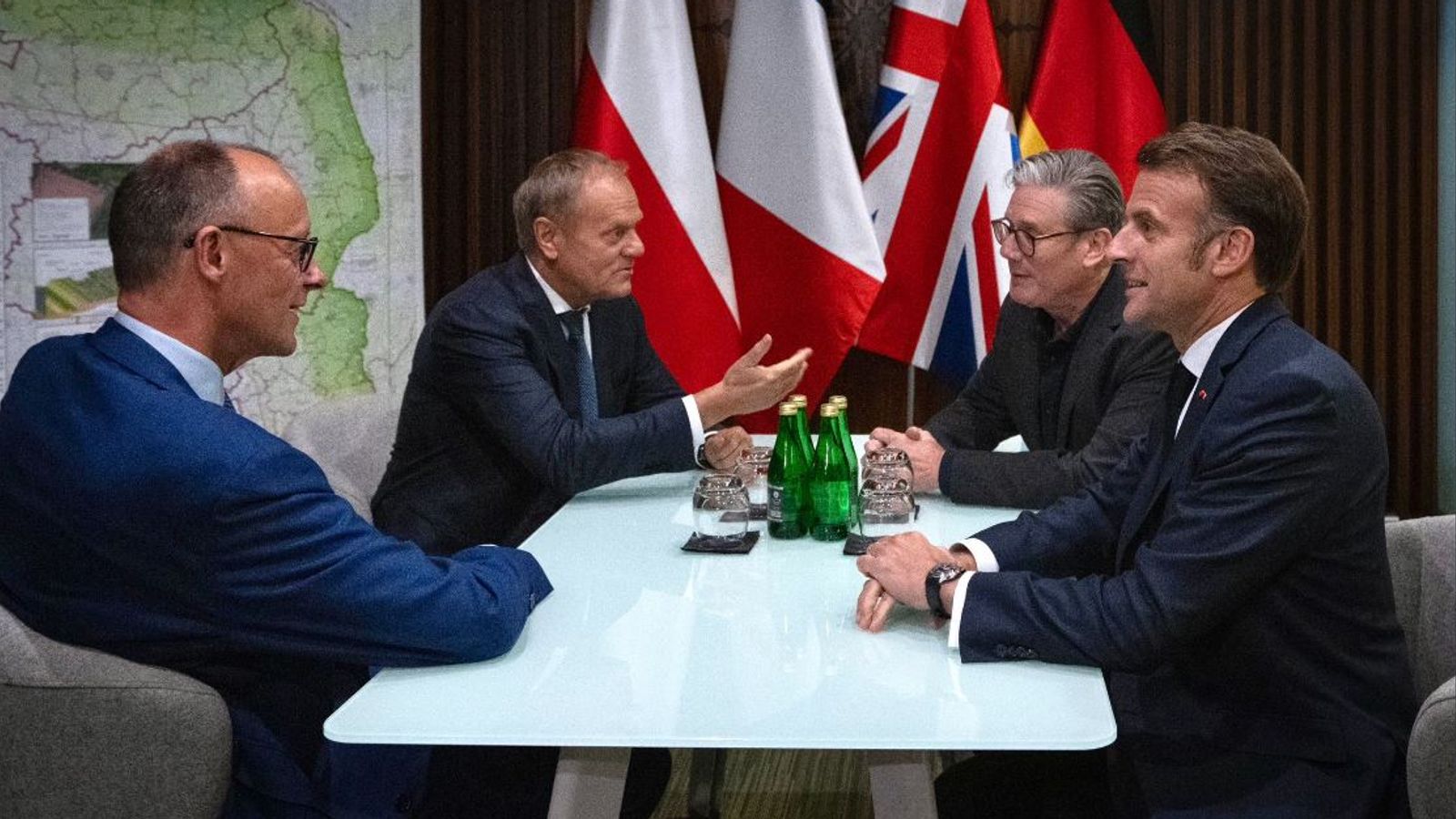
European leaders to meet in Ukraine for ‘coalition of the willing’ talks – and issue call to Russia

Sir Keir Starmer will join other European leaders in Kyiv on Saturday for talks on the “coalition of the willing”.
The prime minister is attending the event alongside French President Emmanuel Macron, recently-elected German Chancellor Friedrich Merz and Polish Prime Minister Donald Tusk.
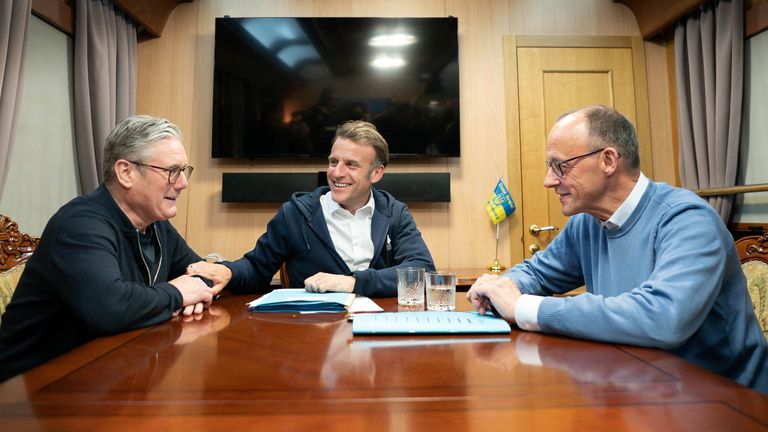
It will be the first time the leaders of the four countries will travel to Ukraine at the same time – on board a train to Kyiv – with their meeting hosted by President Volodymyr Zelenskyy.
Follow latest updates on the Ukraine war
Sir Keir Starmer, Emmanuel Macron and Friedrich Merz travelling in the saloon car of a special train to Kiev. Pic: Reuters
Military officers from around 30 countries have been involved in drawing up plans for the coalition, which would provide a peacekeeping force in the event of a ceasefire being agreed between Russia and Ukraine.
Ahead of the meeting on Saturday, Sir Keir, Mr Macron, Mr Tusk and Mr Merz released a joint statement voicing support for Ukraine and calling on Russia to agree to a 30-day ceasefire.
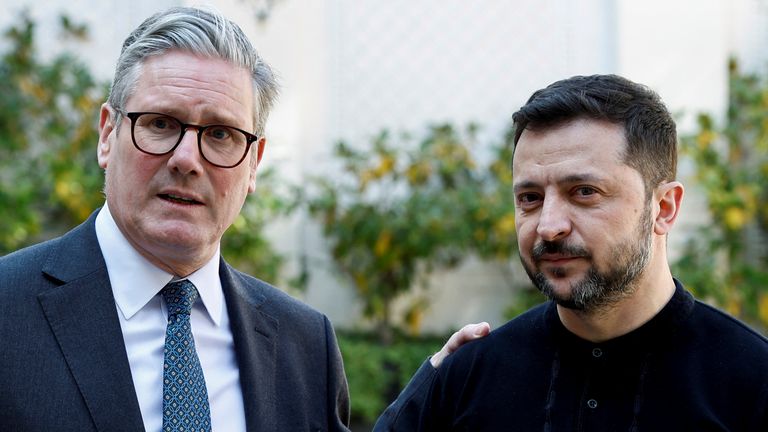
Sir Keir and Volodymyr Zelenskyy during a meeting in March. Pic: AP
“We reiterate our backing for President Trump’s calls for a peace deal and call on Russia to stop obstructing efforts to secure an enduring peace,” they said.
“Alongside the US, we call on Russia to agree a full and unconditional 30-day ceasefire to create the space for talks on a just and lasting peace.”
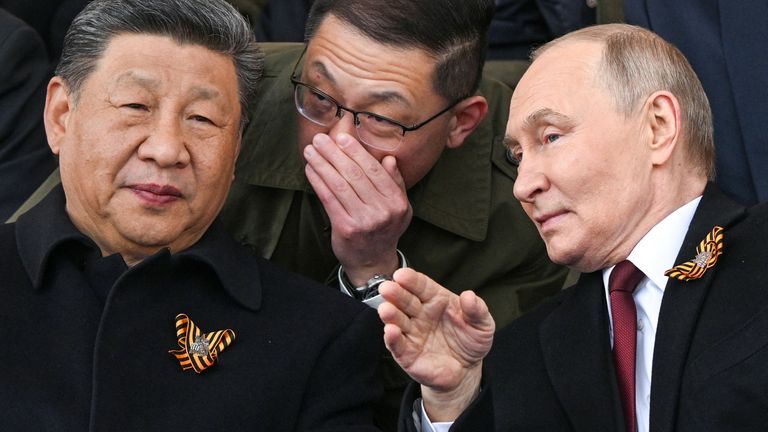
Putin’s Victory Day parade explained
The leaders said they were “ready to support peace talks as soon as possible”.
But they warned that they would continue to “ratchet up pressure on Russia’s war machine” until Moscow agrees to a lasting ceasefire.
“We are clear the bloodshed must end, Russia must stop its illegal invasion, and Ukraine must be able to prosper as a safe, secure and sovereign nation within its internationally recognised borders for generations to come,” their statement added.
“We will continue to increase our support for Ukraine.”
Read more:
Russia’s VE Day parade felt like celebration of war
Michael Clarke Q&A on Ukraine war
Ukraine and Russia accuse each other of breaching ceasefire

Listen to The World with Richard Engel and Yalda Hakim every Wednesday
The European leaders are set to visit the Maidan, a central square in Ukraine’s capital where flags represent those who died in the war.
They are also expected to host a virtual meeting for other leaders in the “coalition of the willing” to update them on progress towards a peacekeeping force.
This force “would help regenerate Ukraine’s armed forces after any peace deal and strengthen confidence in any future peace”, according to Number 10.
Politics
‘Shameful’ that black boys in London more likely to die than white boys, says Met Police chief
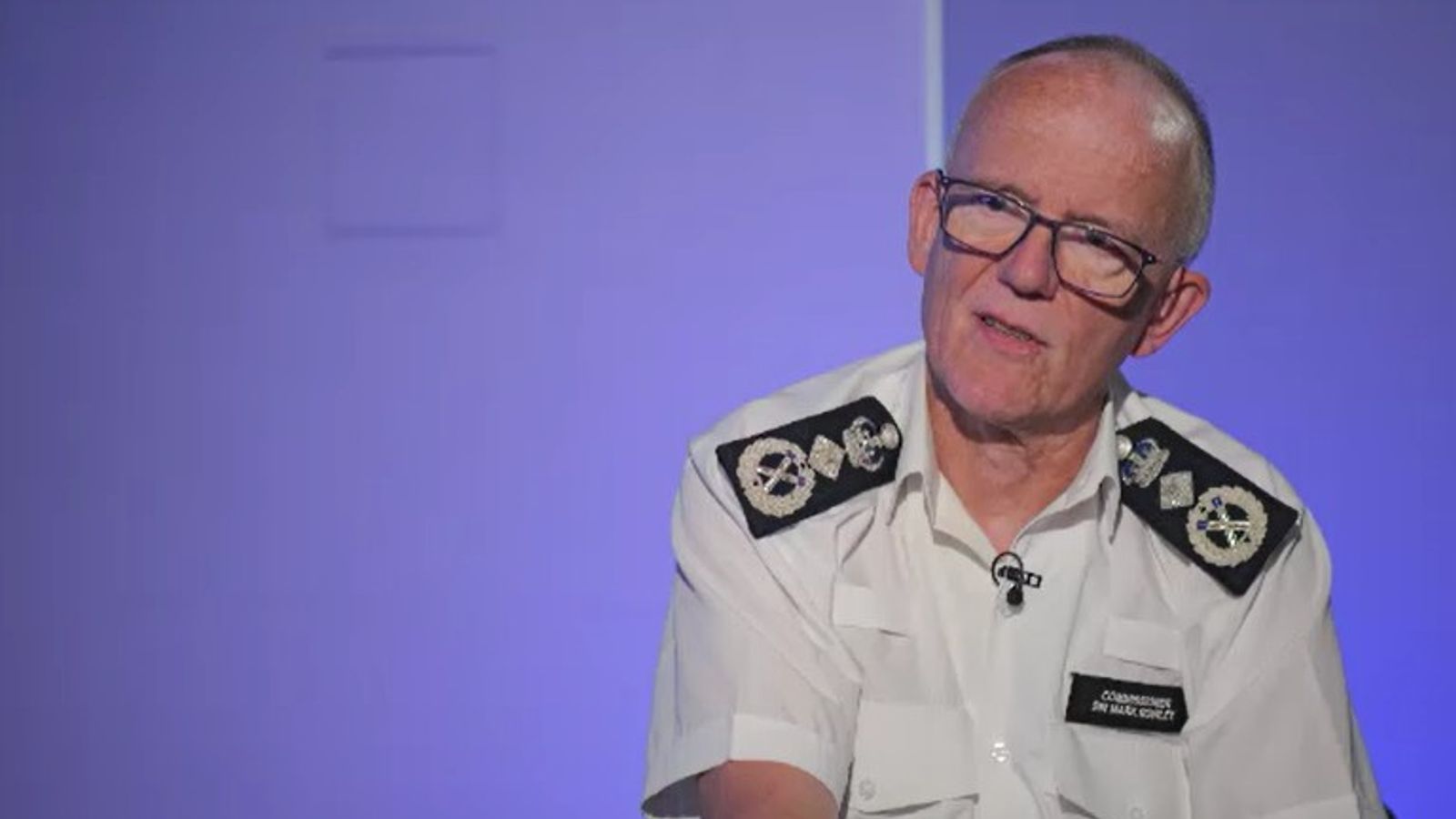
It is “shameful” that black boys growing up in London are “far more likely” to die than white boys, Metropolitan Police chief Sir Mark Rowley has told Sky News.
The commissioner told Sunday Morning with Trevor Phillips that relations with minority communities “is difficult for us”.
Sir Mark, who came out of retirement to become head of the UK’s largest police force in 2022, said: “We can’t pretend otherwise that we’ve got a history between policing and black communities where policing has got a lot wrong.
“And we get a lot more right today, but we do still make mistakes. That’s not in doubt. I’m being as relentless in that as it can be.”
He said the “vast majority” of the force are “good people”.
However, he added: “But that legacy, combined with the tragedy that some of this crime falls most heavily in black communities, that creates a real problem because the legacy creates concern.”
Sir Mark, who also leads the UK’s counter-terrorism policing, said it is “not right” that black boys growing up in London “are far more likely to be dead by the time they’re 18” than white boys.
“That’s, I think, shameful for the city,” he admitted.
The Met Police chief’s admission comes two years after an official report found the force is institutionally racist, misogynistic and homophobic.
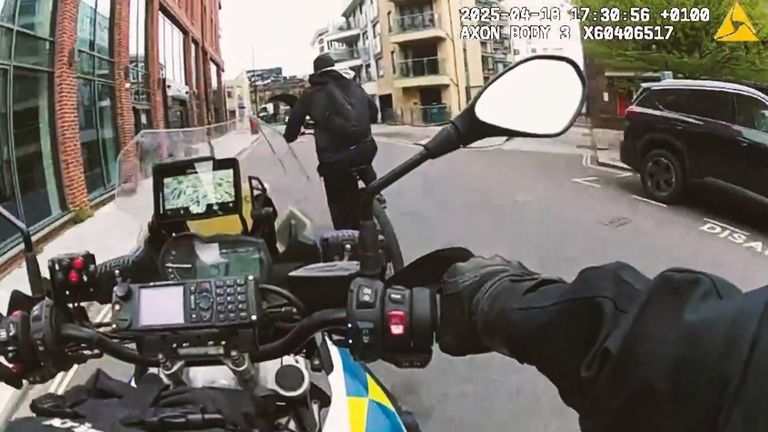
Police chase suspected phone thief
Baroness Casey was commissioned in 2021 to look into the Met Police after serving police officer Wayne Couzens abducted, raped and murdered Sarah Everard.
She pinned the primary blame for the Met’s culture on its past leadership and found that stop and search and the use of force against black people was excessive.
At the time, Sir Mark, who had been commissioner for six months when the report was published, said he would not use the labels of institutionally racist, institutionally misogynistic and institutionally homophobic, which Casey insisted the Met deserved.
However, London Mayor Sadiq Khan, who helped hire Sir Mark – and could fire him – made it clear the commissioner agreed with Baroness Casey’s verdict.
After the report was released, Sir Mark said “institutional” was political language so he was not going to use it, but he accepted “we have racists, misogynists…systematic failings, management failings, cultural failings”.
A few months after the report, Sir Mark launched a two-year £366m plan to overhaul the Met, including increased emphasis on neighbourhood policing to rebuild public trust and plans to recruit 500 more community support officers and an extra 565 people to work with teams investigating domestic violence, sexual offences and child sexual abuse and exploitation.
Watch the full interview on Sunday Morning with Trevor Phillips from 8.30am on Sunday.
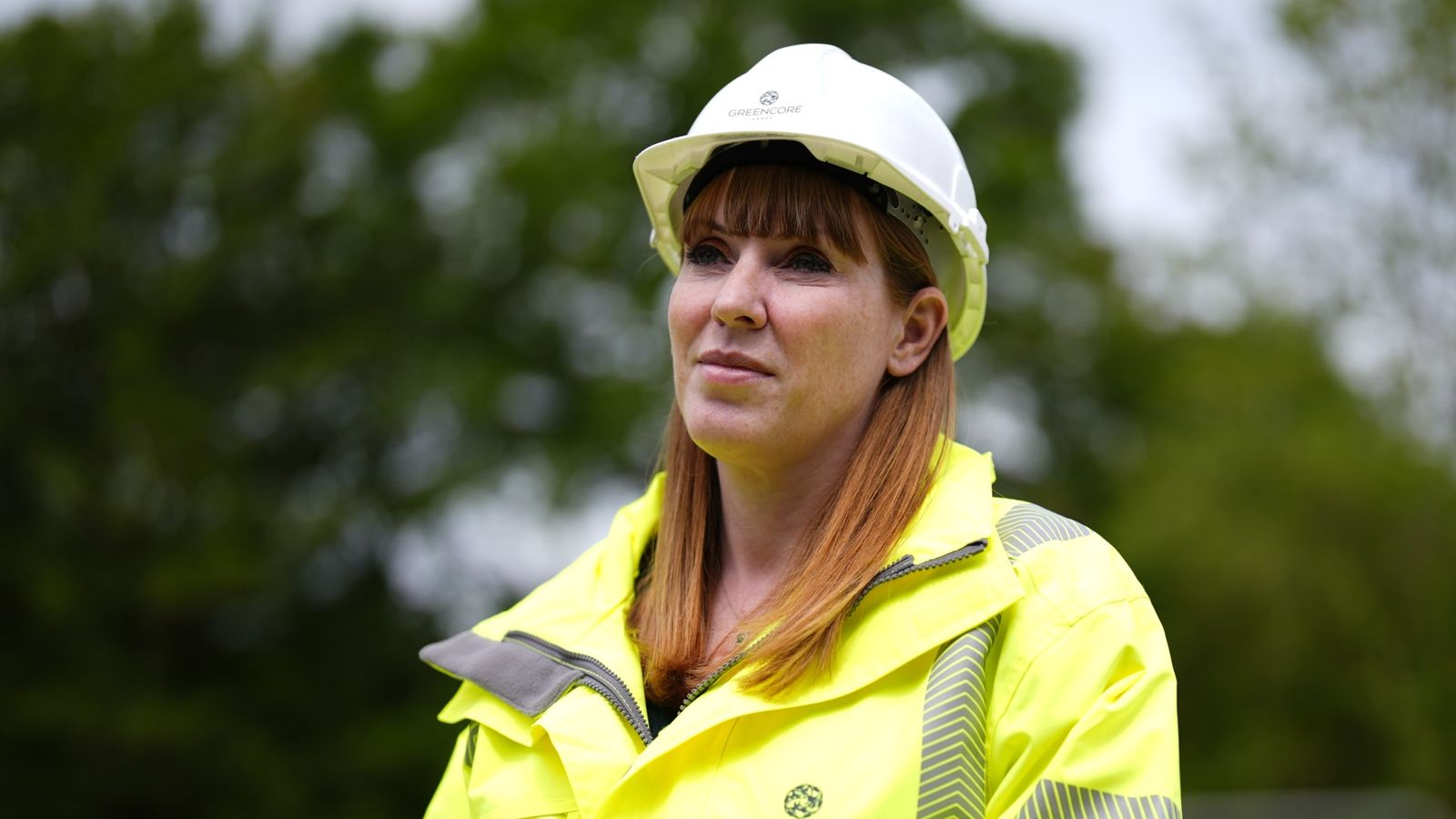
Labour’s largest union donor, Unite, has voted to suspend Deputy Prime Minister Angela Rayner over her role in the Birmingham bin strike row.
Members of the trade union, one of the UK’s largest, also “overwhelmingly” voted to “re-examine its relationship” with Labour over the issue.
They said Ms Rayner, who is also housing, communities and local government secretary, Birmingham Council’s leader, John Cotton, and other Labour councillors had been suspended for “bringing the union into disrepute”.
There was confusion over Ms Rayner’s membership of Unite, with her office having said she was no longer a member and resigned months ago and therefore could not be suspended.
But Unite said she was registered as a member. Parliament’s latest register of interests had her down as a member in May.
Politics latest: Italy and other EU countries have ‘huge doubts’ about legality of UK migrant deal
The union said an emergency motion was put to members at its policy conference in Brighton on Friday.
Unite is one of the Labour Party’s largest union donors, donating £414,610 in the first quarter of 2025 – the highest amount in that period by a union, company or individual.
The union condemned Birmingham’s Labour council and the government for “attacking the bin workers”.
Mountains of rubbish have been piling up in the city since January after workers first went on strike over changes to their pay, with all-out strike action starting in March. An agreement has still not been made.
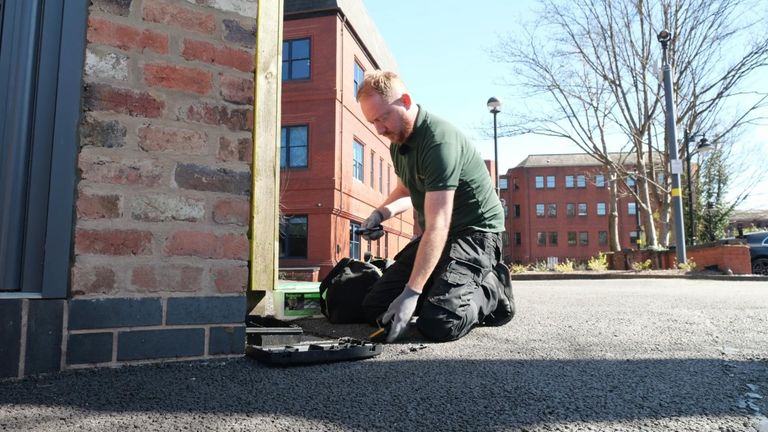
Rat catcher tackling Birmingham’s bins problem
Ms Rayner and the councillors had their membership suspended for “effectively firing and rehiring the workers, who are striking over pay cuts of up to £8,000”, the union added.
‘Missing in action’
General secretary Sharon Graham told Sky News on Saturday morning: “Angela Rayner, who has the power to solve this dispute, has been missing in action, has not been involved, is refusing to come to the table.”
She had earlier said: “Unite is crystal clear, it will call out bad employers regardless of the colour of their rosette.
“Angela Rayner has had every opportunity to intervene and resolve this dispute but has instead backed a rogue council that has peddled lies and smeared its workers fighting huge pay cuts.
“The disgraceful actions of the government and a so-called Labour council, is essentially fire and rehire and makes a joke of the Employment Relations Act promises.
“People up and down the country are asking whose side is the Labour government on and coming up with the answer not workers.”
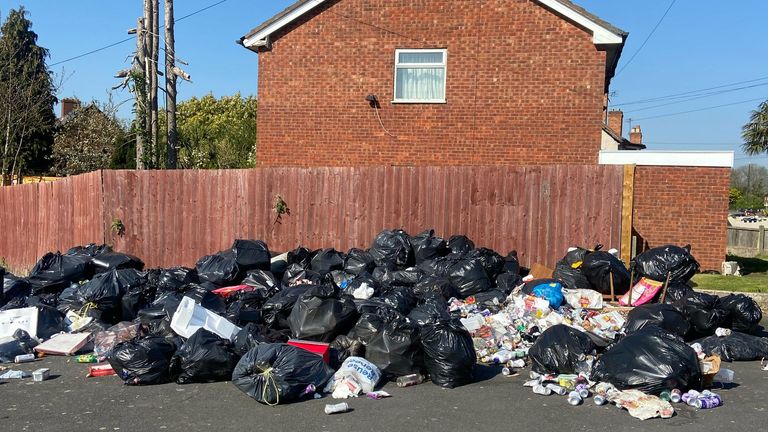
Piles of rubbish built up around Birmingham because of the strike over pay
Sir Keir Starmer’s spokesman said the government’s “priority is and always has been the residents of Birmingham”.
He said the decision by Unite workers to go on strike had “caused disruption” to the city.
“We’ve worked to clean up streets and remain in close contact with the council […] as we support its recovery,” he added.
A total of 800 Unite delegates voted on the motion.

Binance co-founder CZ has dismissed a Bloomberg report linking him to the Trump-backed USD1 stablecoin, threatening legal action over alleged defamation.
-
 Sports3 years ago
‘Storybook stuff’: Inside the night Bryce Harper sent the Phillies to the World Series
-
 Sports1 year ago
Story injured on diving stop, exits Red Sox game
-
 Sports2 years ago
Game 1 of WS least-watched in recorded history
-
 Sports2 years ago
MLB Rank 2023: Ranking baseball’s top 100 players
-
Sports4 years ago
Team Europe easily wins 4th straight Laver Cup
-
 Sports2 years ago
Button battles heat exhaustion in NASCAR debut
-
 Environment2 years ago
Japan and South Korea have a lot at stake in a free and open South China Sea
-
 Environment2 years ago
Game-changing Lectric XPedition launched as affordable electric cargo bike