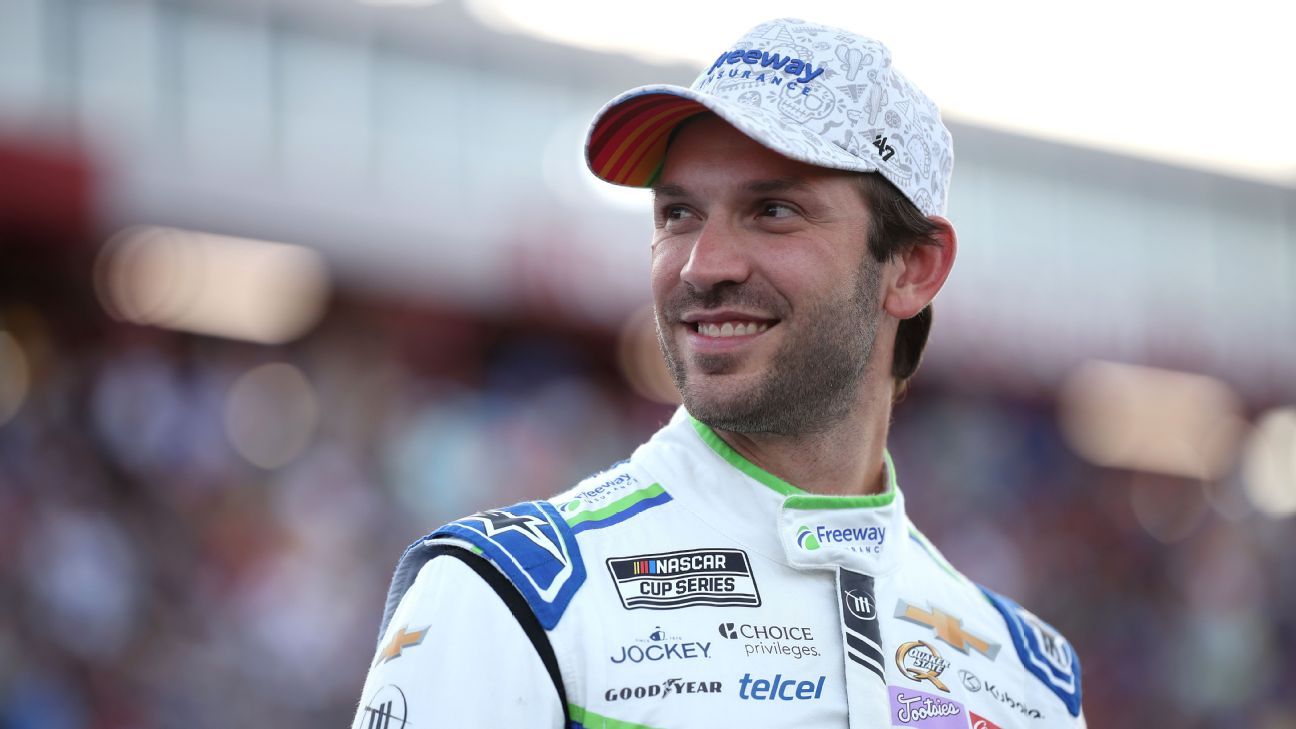
It’s been 10 years since Daniel Suárez raced in his native Mexico. He was in his early 20s, competing in the NASCAR Mexico Series while also commuting to the United States, where he would compete in what is now known as the ARCA Menards Series East — the stock-car equivalent of Single-A baseball.
He’ll do it again this weekend when he pulls double duty at Mexico City’s Autódromo Hermanos Rodríguez road course, competing in both the Xfinity Series and the Cup Series — the first time NASCAR’s headliners will race in the country.
“It’s very special,” Suárez told ESPN. “Honestly, it’s very difficult to put into perspective for people. Only those who really know me very well understand how important and special this is for me.
“After a lot of work and sacrifices, I was able to make it in NASCAR Mexico, and at one point in my life, that was my goal — that was my ultimate goal. I was able to get there at an early age, which gave me hope to be able to do something in the United States.”
Suárez’s story is a Hollywood script, the quintessential American dream. His family didn’t come from racing or money, but they did what they could to support their son. When Suárez was 17, he was ready to quit racing because his funding had run out, then along came a big-time sponsor that helped Suárez turn his dreams into reality — helping him move to the U.S. despite not speaking English.
His journey Stateside included staying on the couch of a friend in Buffalo, New York, and continuing to split time between racing in Mexico and the United States. Eventually, Suárez landed in Charlotte, North Carolina, and soon was on the radar of Joe Gibbs Racing, which gave him a shot at the Xfinity Series in 2014. He was champion two years later, and has gone on to become a two-time winner in the Cup Series.
As for the language barrier, Suárez, who now drives the No. 99 Chevrolet for Trackhouse Racing in the Cup Series, taught himself English — and in the most endearing way. When his focus wasn’t on racing, it was on watching cartoons. The children-centric shows were easy to follow and the words clearly pronounced.
“And now coming back to my home country as a NASCAR Cup Series winner and an Xfinity Series champion, all these different things, it’s very special,” Suárez said. “Not just for me, but a lot of people who have been in my corner for many, many years, for the fans, the media, for Mexico. They have known me for many years. So, it’s very special.”
Suárez never imagined when he left his home country that the Cup Series would run in Mexico. It was a dream, but nothing more than one of those “what if” dreams, a “maybe one day” dream.
There is no arguing that he is the face of the upcoming weekend as the homegrown star. Suárez has become even more popular with his fellow drivers, some of whom have picked his brain for knowledge of what to expect and other local tidbits.
“I just feel very fortunate to be in this position and be able to represent my country, my community, my people, and to bring the entire NASCAR industry into my home,” Suárez said. “I don’t want to say I’m going to be the superstar down there, but I’m going to be local, and that will be special. And like I said, there are a lot of people down there who have followed me for 15 years.
“Actually, a few weeks ago I was in Mexico City doing some events, and I saw a kid on the street waiting for a taxi, and he had one of my hats. He said, ‘Daniel, I’m going to be at the race. I’ve been supporting you since the NASCAR Mexico days.’ There are going to be thousands of people like that.”
NASCAR has a worldwide presence, with series that run in Canada, Europe, Brazil and Mexico. The NASCAR Mexico Series will join the Cup and Xfinity series this weekend, but the two national series going international is a significant moment for the industry.
The Xfinity Series raced in Mexico City from 2005 through 2008, and the Craftsman Truck Series has previously run races in Canada. However, Sunday will be the first time the Cup Series, a true-blue American sport, holds a points-paying race outside the United States since 1958. In doing so, the industry will take its premier series and do what other professional American sports like the NFL and MLB have been doing for years: serving an international audience.
Suárez has no doubt that NASCAR can provide the same type of international appeal, especially as Mexico continues to grow its car, motorsports and overall sports culture.
“The reason I have zero doubt is because maybe I have a different perspective than most people and maybe most drivers here in the United States,” Suárez said. “Obviously, I’m Mexican. I have a wife who is Brazilian. We have a lot of relationships in Brazil and South America, Mexico, and I know some people in Argentina and Colombia. I know for a fact how popular this sport is, and I know that people will get crazy in Mexico. And I know if one day we race in Brazil and Argentina, it would be a huge success.
“There are a lot of people who love motorsports in Mexico and South America. So, the way I see it, the sky’s the limit. I think that NASCAR has done a tremendous job for over 75 years in the United States, and they have done a few things here and there internationally, but I think it’s a great time to explore new boundaries.”
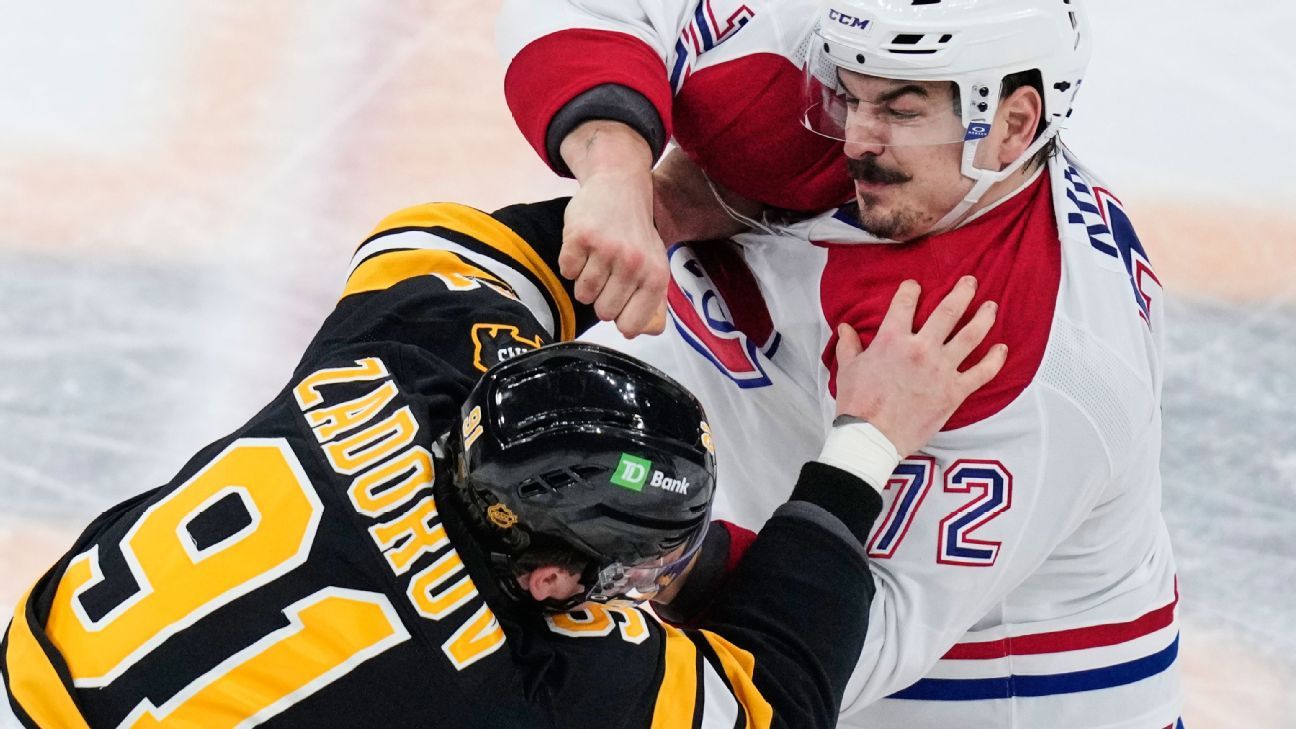
Boston’s Tanner Jeannot and Montreal’s Josh Anderson dropped the gloves at the opening faceoff of Tuesday night’s game. Another first-period fight helped set the tone for the Bruins, who had beaten Montreal in eight of the previous 10 meetings.
But after falling behind 2-1, the Canadiens scored five straight goals — four of them in a five-minute span in the third period — to win 6-2 and put some distance between the two Original Six teams who are jockeying for position in the Eastern Conference standings.
The Bruins lost the past four games on their homestand after winning five of their previous six. They have three days off before heading to a five-game road trip.
“We all recognized it was the last game before break — against the Habs, at the Garden,”Bruins forward Alex Steeves said. “We were down early, but we bounced back. Energy was good. And then it just got away from us.”
Five weeks after starting a fight from the opening faceoff in Montreal, the teams did it again. Jeannot, who has 53 goals and 435 penalty minutes in his career, and Anderson, who has 154 goals and 582 penalty minutes, fought for about a minute while teammates on both benches banged their sticks against the boards in approval.
The Bruins forward landed several blows before his Canadiens counterpart went to the ice, drawing a big roar and a chant of “U-S-A!” from the TD Garden crowd. Midway through the first period, it happened again, with Boston’s Nikita Zadorov and Montreal’s Arber Xhekaj dropping their gloves off a faceoff in the Bruins’ end.
“It had everything to me: Guys winning fights; guys laying their body on the [line],” Bruins forward David Pastrnak said. “It’s easy to get into the game when you have guys like this.”
In all, there were nine penalties for 30 minutes in the first, with Boston taking a 2-1 lead on Steeves’ power-play goal with 18 seconds left in the period.
“It gives the whole building energy — not just us players,” Steeves said. “Some guys on the bench just said it was the loudest we’ve heard the building. So it’s awesome. Those guys lay their bodies on the line every night. It’s up to us as a team to galvanize around that and really use that.”
But the penalties in the third were costly, with the Canadiens twice capitalizing on 5-on-3 advantages to pull away. Montreal ended the night with 45 points, four more than Boston and good for third in the Eastern Conference. The Bruins are currently out of playoff position.
“I still can’t believe that the game actually ended 2-6,” Bruins coach Marco Sturm said. “Even after the first period, guys came ready to play today. They were very excited.”
The Bruins had won eight of the past 10 matchups between the teams, including a 3-2 win in Montreal on Nov. 15. That game also featured several scuffles, including a fight at the opening faceoff. But the bigger problem for the Bruins had nothing to do with the fisticuffs: Star defenseman Charlie McAvoy was hit in the face by a slap shot, which could make him miss almost a month.
Members of the Professional Hockey Players’ Association are on the verge of staging a strike in the ECHL if the union and the league cannot come to an agreement on a new collective bargaining agreement.
The PHPA announced Monday that its ECHL membership has served a strike notice that would be effective Friday, when play is scheduled to resume following the holiday break. Players voted Friday to authorize their bargaining committee to call for a strike, executive director Brian Ramsay said Monday.
“Our members have made it very clear that they’ve had enough,” Ramsay said on a video call with reporters. “Unfortunately, this is a league that would rather bully us than bargain.”
The sides appeared no closer to a resolution Tuesday based on an update from Ramsay, even after he said the PHPA offered the option of reaching a settlement through mediation or arbitration.
“The ECHL responded within minutes, rejecting any interest in this solution and demanding ‘significant movement’ and concessions from the players,” Ramsay said in a released statement. “This approach continues to align with the increased threats our membership has faced over the past 18 hours.”
CBA talks began in January, with Ramsay accusing the league of unfair bargaining practices, including most recently contacting players directly with proposals, which have been reported to the National Labor Relations Board.
“This is a league that has taken almost a year to concede that we should be entitled to choose helmets that properly fit us and are safe,” Ramsay said. “This is the league that still supplies our members with used equipment. This is a league that shows no concern for players’ travels and in fact has said the nine-hour bus trip home should be considered your day off. We have had members this year spend 28 hours-plus on a bus to play back-to-back games on a Friday and Saturday night, only to be paid less than the referees who work those very same games.”
The ECHL posted details of its latest proposal on its website Monday, saying it calls to raise the salary cap 16.4% this season, with retroactive pay upon ratification, and increases in total player salaries in future years to pay players nearly 27% more than the current cap. The league said it has also offered larger per diems, mandatory day-off requirements and a 325-mile limit for travel between back-to-back games.
“Our approach will continue to balance the need to best support our players and maintain a sustainable business model that helps ensure the long-term success of our league so it remains affordable and accessible to fans,” the ECHL said, adding that the average ticket price is $21. “Negotiations have been progressing but not as quickly as we would like.
“We have reached a number of tentative agreements and remain focused on reaching a comprehensive new agreement that supports our players and the long-term health of every team in our league.”
Taking issue with the ECHL’s offer numbers, Ramsay said inflation would have players making less than the equivalent amount in 2018, prior to the pandemic. The league said a work stoppage would result in some games being postponed and players not being paid and losing housing and medical benefits that it pays for.
Ramsay called threats of players losing their housing if there’s a strike an unfair labor practice in itself.
“Consistently in the last six or eight weeks, teams trying to intimidate and bully our members, threaten our members with their jobs, with their housing, with their work visas if they’re from out of country — different tactics like that,” Ramsay said.
Jimmy Mazza, who played several seasons in the ECHL and is now on the negotiating committee, argued that owners do not know what it’s like to travel 29 hours in a bus or to be given a used helmet.
“The top level, you know that those players aren’t being treated that way, so why are they treating us that way?” Mazza said. “To us, it’s a little bit of a slap in the face with the way these negotiations have gone for a year, when only five days ago, we get a little bit of movement on a helmet issue when it should have been done a year ago.”
The ECHL, formerly known as the East Coast Hockey League and now going just by the acronym, is a North American developmental league that is two levels below the NHL, with the American Hockey League in between. There are 30 teams, 29 of which are in the U.S. and one in Canada in Trois-Rivières, Quebec.
The AHL and PHPA have been working under the terms of their most recent CBA, which expired Aug. 31. An AHL spokesperson said the sides are very close to a new agreement.
The NHL and the NHL Players’ Association earlier this year ratified a deal that ensures labor peace through 2030.
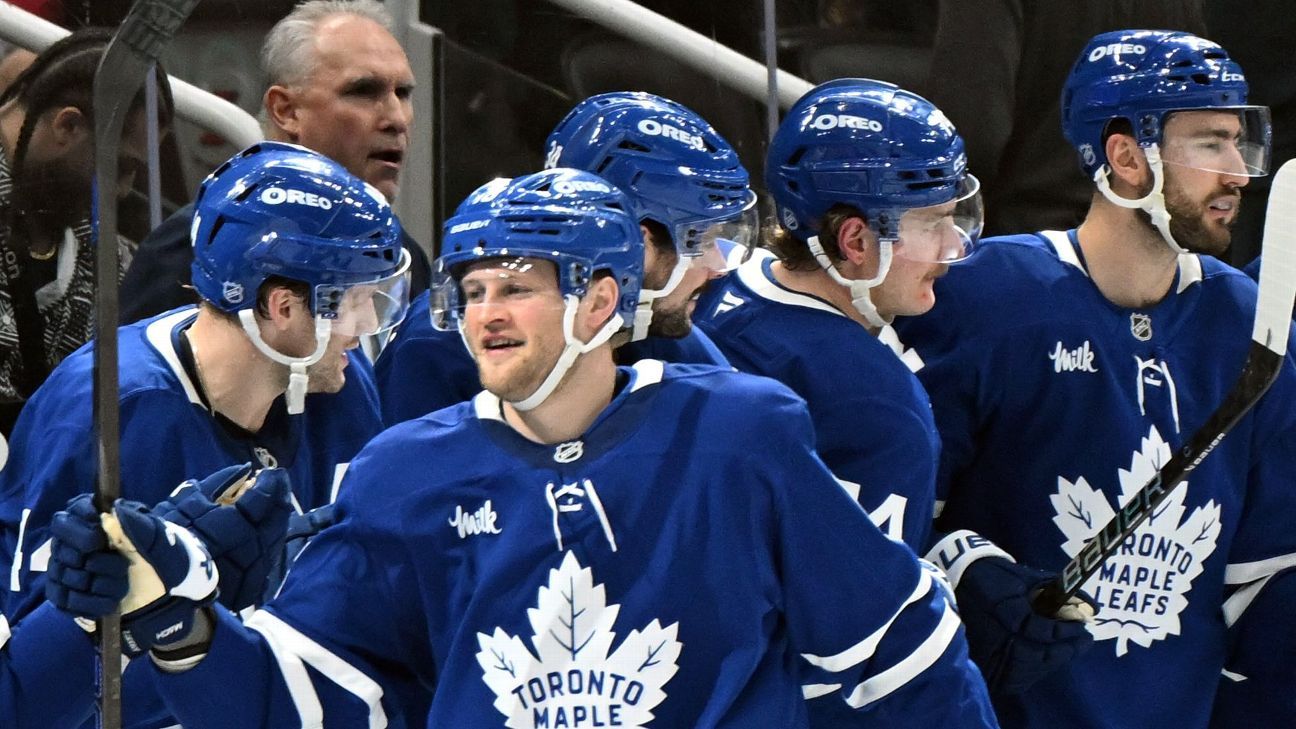
TORONTO — Max Domi scored the winner with 8:25 remaining to snap a 23-game goalless streak and added an assist to end the Toronto Maple Leafs‘ three-game slide with a 6-3 win against the Pittsburgh Penguins on Tuesday.
Domi danced around Pittsburgh newcomer Brett Kulak for the deciding goal, a few hours after Toronto general manager Brad Treliving gave coach Craig Berube a vote of confidence for the second time this season.
“I support Craig fully. When you go through rough stretches, that’s part of the business,” he said. “There isn’t a disconnect. We all need to be better, we all recognize that, but I think we got a really good coach.”
Treliving spoke a day after the club fired assistant coach Marc Savard following two losses in two days over the weekend.
“The players have responsibility and this doesn’t absolve anybody. This is not we throw somebody out and blame that person,” he said. “It’s a change that we could make to change the dynamic, change maybe a little bit of the play.”
Nylander scored the icebreaker for his first in 11 games, midway through the first period. But Rust drew the Penguins even 44 seconds later, getting behind Nicolas Roy and Chris Tanev for a successful breakaway.
Tanev returned after a 23-game absence. He was stretchered off the ice after a collision on Nov. 1 in Philadelphia.
Toronto fired 31 shots on goal while the Penguins registered 32, with Joseph Woll picking up his sixth win in 11 starts. Pittsburgh goalie Stuart Skinner has yet to win in three starts, with 12 goals against since being traded by the Edmonton Oilers on Dec. 15.
Savard steered the Maple Leafs to the NHL’s worst power play (12 for 90 with four short-handed goals against), and on Tuesday, Toronto went 0 for 2 against Pittsburgh. Assistant coach Derek Lalonde has been tasked with fixing the team’s power-play struggles.