

Labour MP Vicky Foxcroft quits as government whip over cuts to disability benefits


Labour MP Vicky Foxcroft has quit her job as a government whip in opposition to the government’s plans to cut disability benefits.
She wrote in a letter to the prime minister that she could not vote “for reforms which include cuts to disabled people’s finances”.
The former shadow minister for disabled people becomes the first MP to quit a government job over the controversial welfare reform plans that have seen over 100 Labour MPs publicly express concern over the proposals.
A government spokesperson defended the reforms as “principled” and insisted they will protect the vulnerable.
Politics latest: Defence secretary warns of ‘moment of real danger’
The MP for Lewisham North wrote that the benefits system is in “desperate need of reform”, but argued this is not the way to do it.
She said: “I absolutely understand the need to address the ever-increasing welfare bill in these difficult economic times, but I have always believed this could and should be done by supporting more disabled people into work.
“I do not believe that cuts to personal independence payment (PIP) and the health element of Universal Credit should be part of the solution.”
Labour MP Vicky Foxcroft. Pic: UK Parliament
Ms Foxcroft said she has “wrestled” with the decision over whether to resign, but said: “Sadly it now seems that we are not going to get the changes I desperately wanted to see.
“I therefore tender my resignation as I know I will not be able to do the job that is required of me and whip – or indeed vote – for reforms which include cuts to disabled people’s finances.”
She has received public support from a number of fellow Labour MPs, who praised her “principled” stand on this issue.
‘Moral case for change’
The government published its bill earlier this week to tighten the eligibility for PIP benefits, and also cuts to the sickness-related portion of Universal Credit.
Ministers say these plans will cut £5bn from the welfare budget that is ballooning.
The government’s plans to cut benefits
The cost of long-term sickness and disability benefits for working-age people has risen by £20bn since the pandemic and is forecast to hit £70bn over the next five years.
Ministers have said there is also a moral case for change, with one in eight young people not in education, training, or employment – prompting fears of a “wasted generation”.
But disability groups say they fear an increase in suicides and mental health conditions.
Read more from Sky News:
Why cancer patient is praying assisted dying bill passes major vote
Compensation scheme for Capture victims announced
The government’s own assessment forecast an extra 250,000 people could be pushed into poverty – including 50,000 children. It did not include the impact of people moving into work.
A government spokesperson said: “This Labour government was elected to deliver change. The broken welfare system we inherited is failing the sick and most vulnerable and holding too many young people back. It is fair and responsible to fix it.
“Our principled reforms will ensure those who can work should, that those who want to work are properly supported, and that those with most severe disabilities and health conditions are protected.”

The US Federal Deposit Insurance Corporation will propose a framework for implementing US stablecoin laws later this month, according to its acting chair, Travis Hill.
“The FDIC has begun work to promulgate rules to implement the GENIUS Act; we expect to issue a proposed rule to establish our application framework later this month,” Hill said in prepared testimony to be delivered on Tuesday to the House Financial Services Committee.
He added the agency will also have a “proposed rule to implement the GENIUS Act’s prudential requirements for FDIC-supervised payment stablecoin issuers early next year.”
President Donald Trump signed the GENIUS Act in July, which created oversight and licensing regimes for multiple regulators, with the FDIC to police the stablecoin-issuing subsidiaries of the institutions it oversees.
The FDIC insures deposits in thousands of banks in the event that they fail, and under the GENIUS Act, it will also be tasked with making “capital requirements, liquidity standards, and reserve asset diversification standards” for stablecoin issuers, said Hill.

Federal agencies, such as the FDIC, publish their proposed rules for public feedback, and they then review and respond to the input, if necessary, before publishing a final version of the rules, a process that can take several months.
Related: Republicans urge action on market structure bill over debanking claims
The Treasury, which will also regulate some stablecoin issuers, including non-banks, began its implementation of the GENIUS Act in August and finished a second period of public comment on its implementation proposal last month.
FDIC is working on tokenized deposit guidelines
Hill said in his remarks that the FDIC has also considered recommendations published in July by the President’s Working Group on Digital Asset Markets.
“The report recommends clarifying or expanding permissible activities in which banks may engage, including the tokenization of assets and liabilities,” Hill said.
“We are also currently developing guidance to provide additional clarity with respect to the regulatory status of tokenized deposits,” he added.
Fed helping regulators with stablecoin rules
The Federal Reserve’s vice supervision chair, Michelle Bowman, will also testify on Tuesday that the central bank is “currently working with the other banking regulators to develop capital, liquidity, and diversification regulations for stablecoin issuers as required by the GENIUS Act.”
Bowman added, according to her prepared remarks, that “we also need to provide clarity in treatment on digital assets to ensure that the banking system is well placed to support digital asset activities.”
“This includes clarity on the permissibility of activities, but also a willingness to provide regulatory feedback on proposed new use cases,” she said.
The House Finance Committee’s hearing on Tuesday will also see remarks from the heads of the Office of the Comptroller of the Currency and the National Credit Union Administration, which will both have a role in implementing stablecoin rules.
Magazine: Bitcoin vs stablecoins showdown looms as GENIUS Act nears

The Japanese government is reportedly backing plans to introduce a significant reduction in the nation’s maximum tax rate on crypto profits, with a flat rate of 20% across the board.
Japan’s financial regulator, the Financial Services Agency (FSA), first floated the proposed tax changes in mid-November, outlining plans to introduce a bill in early 2026, and now the government and ruling coalition — the political parties in control of Japan’s parliament, the National Diet — are on board.
According to a report from Japanese news outlet Nikkei Asia on Sunday, the new rules aim to align crypto taxation rules with those of other financial products, such as equities and investment funds.
Under the current laws, taxation on crypto trading is included as part of income taxes for individuals and businesses, falling under the category of “miscellaneous income.” The rate ranges from 5% on the lower end of the spectrum to 45% on the high end, with high-income earners potentially on the hook for an additional 10% inhabitant tax.
Meanwhile, assets such as equities and investment trusts are taxed separately, with a flat 20% tax on profits, regardless of the amount.
The tax changes could be a boon for the domestic cryptocurrency market, as the higher tax rates may have deterred potential investors.

According to the Nikkei report, the potential changes to crypto taxation in Japan will be introduced as part of a “solid investor-protection framework” proposed in the FSA’s bill, which aims to amend the Financial Instruments and Exchange Act.
The FSA will submit the bill during the regular Diet session in 2026, as it pushes for greater oversight of crypto trading, including a ban on dealing with non-public information and stricter investment disclosures.
Japan finally set for crypto tax change after long fight
The Japan Blockchain Association (JBA), the nation’s major crypto-focused non-governmental lobbying group, has been calling for these changes for almost three years.
Related: Bitcoin falls to $84K: Is Japan’s bond market the culprit, or is more at play?
In July 2023, the JBA published a letter to the government on its website, outlining key tax reform requests to support the industry. The letter called for a 20% tax rate that aligns with other investment vehicles.
“This letter requests a review of tax on crypto assets, which is the biggest hurdle for companies operating Web3 businesses in Japan and a disincentive for the public to actively own and use crypto assets,” the letter reads.
While it is unclear if the JBA had a direct influence on the FSA’s thinking, the financial watchdog did start warming up to the idea and pushing for reform in September 2024.
Magazine: Koreans ‘pump’ alts after Upbit hack, China BTC mining surge: Asia Express


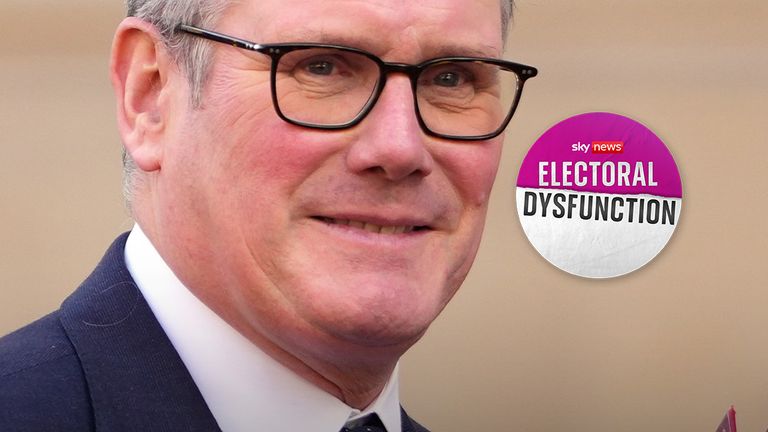
Sir Keir Starmer has warned China poses “real national security threats to the United Kingdom”.
But the prime minister also described China as a “nation of immense scale, ambition and ingenuity” and a “defining force in technology, trade and global governance”.
“The UK needs a China policy that recognises this reality,” he added in a speech at the Guildhall in London.
“Instead, for years we have blown hot and cold.
“So our response will not be driven by fear, nor softened by illusion. It will be grounded in strength, clarity and sober realism.”
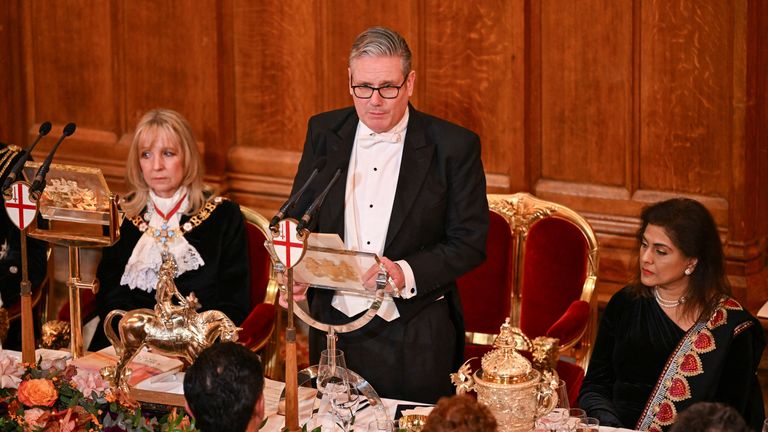
Prime Minister Keir Starmer giving his speech. Pic: Reuters
Describing the absence of engagement with China – the world’s second-biggest economy – as “staggering” and “a dereliction of duty”, Sir Keir said: “This is not a question of balancing economic and security considerations. We don’t trade off security in one area, for a bit more economic access somewhere else.
“Protecting our security is non-negotiable – our first duty. But by taking tough steps to keep us secure, we enable ourselves to cooperate in other areas.”
Sir Keir’s remarks come after MPs and parliamentarians were warned last month of new attempts to spy on them by China.
And they follow the collapse of a prosecution of two people suspected of spying on behalf of China.
That case led to controversy over how the government under Labour responded to the Crown Prosecution Service’s requests for evidence.

Speech at the annual Lady Mayor’s Banquet. Pic: Reuters
At the time, Sir Keir sought to blame the previous Conservative government for the issues, which centred on whether China could be designated an “enemy” under First World War-era legislation.
Meanwhile, Sky News understands the prime minister is set to approve plans for a controversial Chinese “super embassy” in central London.
Read more:
MI5 spying warning aims to send signal to China
‘Many options’ on table for Venezuela
A final decision on the planning application for the former Royal Mint site near the Tower of London is due on 10 December, after numerous previous delays.
Sir Keir is also understood to be preparing for a likely visit to China in the new year.
Since he was elected last year, Sir Keir has been active on the world stage, trumpeting deals with the US, India and the EU and leading the “coalition of the willing” in support of Ukraine.
PM preparing for likely China visit
But he has also faced criticism from his opponents, who accuse him of spending too much time out of the UK attending international summits rather than focusing on domestic issues.
Sir Keir offered a defence of his approach, describing it as “the biggest shift in British foreign policy since Brexit” and “a decisive move to face outward again”.
While saying he would “always respect” the Brexit vote as a “fair, democratic expression”, he said the way the UK’s departure from the EU had been “sold and delivered” was “simply wrong”.
He said: “Wild promises were made to the British people and not fulfilled. We are still dealing with the consequences today.”
In his speech on Monday, the prime minister accused opposition politicians of offering a “corrosive, inward-looking attitude” on international affairs.
Sir Keir Starmer. Pic: Reuters
Taking aim at those who advocate leaving the European Convention on Human Rights or NATO, he said they offered “grievance rather than hope” and “a declinist vision of a lesser Britain”.
Sir Keir said: “Moreover, it is a fatal misreading of the moment, ducking the fundamental challenge posed by a chaotic world – a world which is more dangerous and unstable than at any point for a generation, where international events reach directly into our lives, whether we like it or not.”
He added: “In these times, we deliver for Britain by looking outward with renewed purpose and pride, not by shrinking back. In these times, internationalism is patriotism.”
Responding to the prime minister’s speech, shadow foreign secretary Dame Priti Patel said: “From China’s continued flouting of economic rules to transnational repression of Hong Kongers in Britain, Starmer’s ‘reset’ with Beijing is a naive one-way street, which puts Britain at risk while Beijing gets everything it wants.
“Starmer continues to kowtow to China and is captivated by half-baked promises of trade.
“Coming just days after the latest Chinese plot to interfere in our democracy was exposed, his love letter to the Chinese Communist Party is a desperate ploy to generate economic growth following his budget of lies and is completely ill-judged.
“While China poses a clear threat to Britain, China continues to back Iran and Russia, and plots to undermine our institutions. Keir Starmer has become Beijing’s useful idiot in Britain.”
-
 Sports2 years ago
Story injured on diving stop, exits Red Sox game
-
 Sports3 years ago
‘Storybook stuff’: Inside the night Bryce Harper sent the Phillies to the World Series
-
 Sports2 years ago
Game 1 of WS least-watched in recorded history
-
 Sports3 years ago
Button battles heat exhaustion in NASCAR debut
-
 Sports3 years ago
MLB Rank 2023: Ranking baseball’s top 100 players
-
Sports4 years ago
Team Europe easily wins 4th straight Laver Cup
-
 Environment3 years ago
Japan and South Korea have a lot at stake in a free and open South China Sea
-
 Environment1 year ago
Here are the best electric bikes you can buy at every price level in October 2024