

Welfare concessions are on the table, PM confirms ahead of crunch vote

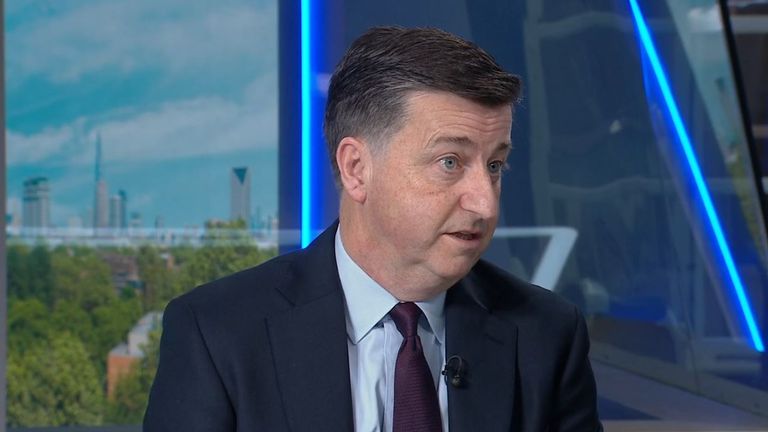
Concessions on welfare are being discussed with rebel MPs ahead of a crunch vote next week, Sir Keir Starmer has confirmed.
The prime minister opened a statement about the NATO summit he has just returned from with a nod to the troubles he is facing at home.
Politics Live: PM offers olive branch to Labour rebels ahead of pivotal vote
Speaking in the Commons he said all colleagues want to get welfare reform right and “so do I”.
He added: “We want to see reform implemented with Labour values of fairness. That conversation will continue in the coming days.”
Sir Keir faces a difficult task as several MPs have told Sky News they are “sticking to their guns” after frantic calls from cabinet ministers on Wednesday failed to bring them on side.
One MP from the 2024 intake said: “Many are sticking to their guns. It’s now become more than welfare. They were too heavy with their calls this week and pressure on back benches.”
Another MP accused Number 10 and the prime minister of showing “utter contempt” towards the rebels’ concerns and said this “is only annoying people more”.
The Universal Credit and Personal Independence Payment Bill aims to shave £5bn off the welfare budget by 2030.
Labour Party ‘agrees welfare needs reform’
This includes restricting eligibility for the personal independence payment (pip), the main disability payment in England, and limit the sickness-related element of universal credit.
The government’s own figures show 250,000 people could be pushed into poverty, including 50,000 children, because of the changes.
Ministers say this will be offset by plans to get more people into work, but while lots of MPs agree with that in principle they say it’s not clear how this will be achieved.
What are the rebels calling for?
More than 120 Labour MPs have signed a “reasoned amendment” arguing that disabled people have not been properly consulted and further scrutiny of the changes is needed.
The government initially stuck to its guns amid the growing disquiet.
But while outwardly confident, Sky News learnt that cabinet ministers were ringing MPs asking them to take their name off the amendment and warning of a potential leadership contest or general election if the government loses the vote on Tuesday.
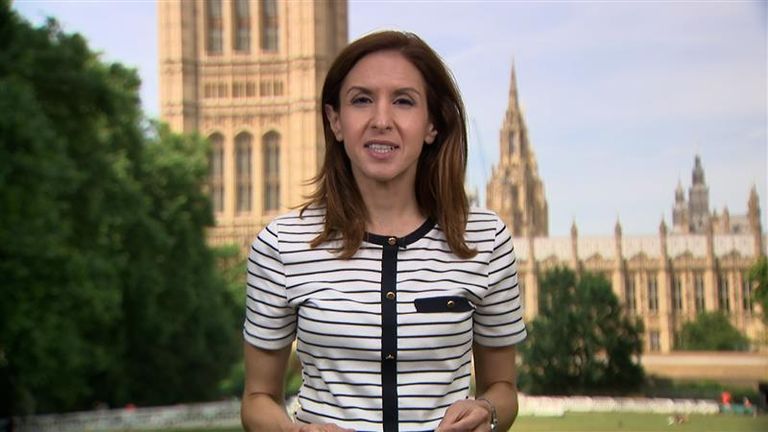
Government’s battle over welfare reforms explained
What concessions could be reached?
Ministers have since hinted at attempts to reach a compromise, but it’s not clear what sort of concessions would satisfy the bills’ critics.
Sky News understands there has been discussions about watering down the changes to pip.
Under current plans, people will need to score a minimum of four points in at least one activity to qualify for the daily living element instead of fewer points spread across a range of tasks, as is currently the case.
Ministers have discussed lowering the new criteria to three points, but one MP told Sky News this is “still unacceptable” as it would not greatly reduce the number of people set to lose out.
Read More:
Reform would win most seats in general election, poll suggests
Another MP said they had not heard anything concrete on concessions yet, but added: “Frankly, personally, this has been so badly mishandled that short of pulling the bill and bringing it back later in the year following the impact assessment and with amendments, I don’t think my position will change going in to Tuesday at this point.”
Timeline for debate ‘unbelievable’
MPs are also annoyed that if the legislation clears the first hurdle it will then face only a few hours’ examination rather than days or weeks in front of a committee tasked with looking at the bill.
Lucy Powell, the leader of the House of Commons, has said following the second reading and vote on Tuesday 1 July, the bill’s remaining stages will take place in a Commons debate on 9 July.
She said the vote next week is for the principles to be considered, with the details to be “discussed and amended” at the next stages.
This appears to suggest the government is asking MPs to back the bill on Tuesday as a show of agreement on the principle of reform, with a promise that changes could be made later.
But it’s not clear whether this strategy will work given one of the rebels’ main concerns is that the bill is being rushed through.
One MP said: “The new line appears to be we all agree on the principle of reform so back at second reading and amend at remaining stages.
“One single day [for] all other stages of the bill is unbelievable.”

Over a third of people think Rachel Reeves exaggerated economic bad news in the run-up to the budget – twice as many as thought the chancellor was being honest, a new Sky News poll has found.
Some 37% told a YouGov-Sky News poll that Ms Reeves made out things were worse than they really are. This is much higher than the 18% who said she was broadly honest, and the 13% who said things were better than she presented.
This comes in an in-depth look at the public reaction to the budget by YouGov, which suggests widespread disenchantment in the performance of the chancellor.
Just 8% think the budget will leave the country as a whole better off, while 2% think it will leave them and their family better off.
Some 52% think the country will be worse off because of the budget, and 50% think they and their family will be worse off.
This suggests the prime minister and chancellor will struggle to sell last week’s set-piece as one that helps with the cost of living.
Some 20% think the budget worried too much about help for older people and didn’t have enough for younger people, while 23% think the reverse.
The poll found 57% think the chancellor broke Labour’s election promises, while 13% think she did not and 30% are not sure. Some 54% said the budget was unfair, including 16% of Labour voters.
And it arguably gets worse…
This comes as the latest Sky News-Times-YouGov poll showed Labour and the Tories are now neck and neck among voters.
The two parties are tied on 19% each, behind Reform UK on 26%. The Greens are on 16%, while the Liberal Democrats are on 14%.
This is broadly consistent with last week, suggesting the budget has not had a dramatic impact on people’s views.
However, the verdict on Labour’s economic competence has declined further post-budget.
Asked who they would trust with the economy, Labour are now on 10% – lower than Liz Truss, who oversaw the 2022 mini-budget, and also lower than Jeremy Corbyn in the 2019 election.
The Tories come top of the list of parties trusted on the economy on 17%, with Reform UK second on 13%, Greens on 8% and Lib Dems on 5%. Nearly half, 47%, don’t know or say none of them.
Only 57% of current Labour voters say the party would do the best job at managing the economy, falling to 25% among those who voted Labour in the 2024 election.
Some 63% of voters think Ms Reeves is doing a bad job, including 20% of current Labour voters, while just 11% of all voters think she is doing a good job.
A higher proportion – 69% – think Sir Keir Starmer is doing a bad job.

Paul Atkins, chair of the US Securities and Exchange Commission, said that the agency can continue advancing digital asset regulation without legislation from Congress, signaling his expectations for the industry in 2026.
In a CNBC interview released on Tuesday, Atkins said the SEC was providing “technical assistance” as Congress considered legislation for digital asset regulation, likely referring to the market structure bill working its way through the US Senate. Atkins said that although the agency’s operations were impacted by the longest US government shutdown in the country’s history, he continued to make progress on “rules that are focused on helping [the crypto] sector.”
“We have enough authority to drive forward,” said Atkins. “I’m looking forward to having an innovation exemption that we’ve been talking about now. We’ll be able to get that out in a month or so.”

Atkins, whom the US Senate confirmed to chair the SEC in April after his nomination by US President Donald Trump, has taken steps to reduce the number of enforcement actions against crypto companies, including by issuing no-action letters for decentralized physical infrastructure networks.
His actions align with many of the policy directives from the White House under Trump, who has issued several executive orders touching on crypto and blockchain.
Related: Republicans urge action on market structure bill over debanking claims
The SEC chair rang the opening bell at the NYSE on Tuesday, outlining his plans for the agency “on the cusp of America’s 250th anniversary.”
US regulators are still awaiting progress on a market structure bill
Lawmakers on the US Senate Agriculture Committee and the Senate Banking Committee are taking steps to move forward with a digital asset market structure bill, which will outline the regulatory authority of agencies, including the SEC and Commodity Futures Trading Commission, over cryptocurrencies.
Senate Banking Chair Tim Scott said that the committee planned to have the bill ready for markup in December.
Magazine: When privacy and AML laws conflict: Crypto projects’ impossible choice

An official from the Bank of Russia suggested easing restrictions on cryptocurrencies in response to the sweeping sanctions imposed on the country.
According to a Monday report by local news outlet Kommersant, Bank of Russia First Deputy Governor Vladimir Chistyukhin said the regulator is discussing easing regulations for cryptocurrencies. He explicitly linked the rationale for this effort to the sanctions imposed on Russia by Western countries following its invasion of Ukraine in February 2022.
Chistyukhin said that easing the crypto rules is particularly relevant when Russia and Russians are subject to restrictions “on the use of normal currencies for making payments abroad.”
Russia banned the use of cryptocurrencies for payments in the summer of 2020.
Chistyukhin said he expects Russia’s central bank to reach an agreement with the Ministry of Finance on this issue by the end of this month. The central issue being discussed is the removal of the requirement to meet the “super-qualified investor” criteria for buying and selling crypto with actual delivery. The requirement was introduced in late April when Russia’s finance ministry and central bank were launching a crypto exchange.

Related: UK sanctions Kyrgyz banks, $9.3B crypto network tied to Russia
What is a super-qualified investor?
The super-qualified investor classification, created earlier this year, is defined by wealth and income thresholds of over 100 million rubles ($1.3 million) or an annual income of at least 50 million rubles.
This limits access to cryptocurrencies for transactions or investment to only the wealthiest few in Russian society. “We are discussing the feasibility of using ‘superquals’ in the new regulation of crypto assets,” Chistyukhin said, in an apparent shifting approach to the restrictive regulation.
Related: How a Russian national allegedly laundered $530M in crypto via Tether
Russia’s fight against sanctions
Russia has been hit with sweeping Western sanctions for years, and regulators in the United States and Europe have increasingly targeted crypto-based efforts to evade those measures.
In late October, the European Union adopted its 19th sanctions package against Russia, including restrictions on cryptocurrency platforms. This also included sanctions against the A7A5 ruble-backed stablecoin, which EU authorities described as “a prominent tool for financing activities supporting the war of aggression.”
Earlier in October, reports indicated that A7A5 — backed by the Russian ruble but issued in Kyrgyzstan — had become the world’s largest non-US-dollar stablecoin. In August, the US Treasury’s Office of Foreign Assets Control also redesignated cryptocurrency exchange Garantex Europe to its list of sanctioned entities for a second time.
Magazine: When privacy and AML laws conflict: Crypto projects’ impossible choice
-
 Sports2 years ago
Story injured on diving stop, exits Red Sox game
-
 Sports3 years ago
‘Storybook stuff’: Inside the night Bryce Harper sent the Phillies to the World Series
-
 Sports2 years ago
Game 1 of WS least-watched in recorded history
-
 Sports3 years ago
Button battles heat exhaustion in NASCAR debut
-
 Sports3 years ago
MLB Rank 2023: Ranking baseball’s top 100 players
-
Sports4 years ago
Team Europe easily wins 4th straight Laver Cup
-
 Environment3 years ago
Japan and South Korea have a lot at stake in a free and open South China Sea
-
 Environment1 year ago
Here are the best electric bikes you can buy at every price level in October 2024