

One year of Starmer: Nine charts that tell us whether Labour’s first year has been a success or failure

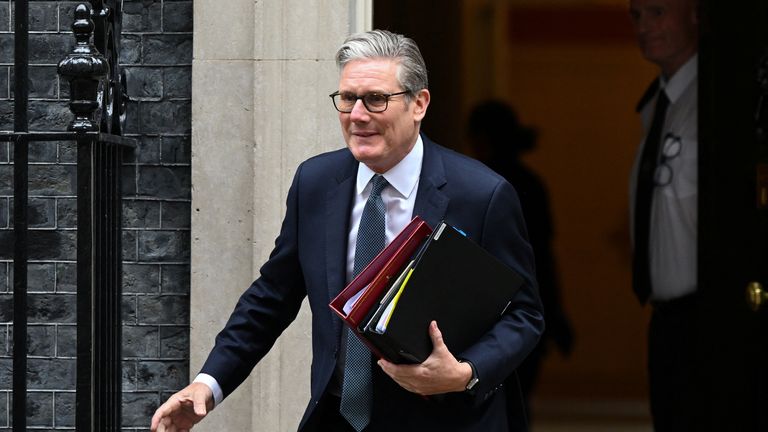
It might feel like it’s been even longer for the prime minister at the moment, but it’s been a whole year since Sir Keir Starmer’s Labour Party won a historic landslide, emphatically defeating Rishi Sunak’s Conservatives and securing a 174-seat majority.
Over that time, Sir Keir and his party have regularly reset or restated their list of milestones, missions, targets and pledges – things they say they will achieve while in power (so long as they can get all their policies past their own MPs).
We’ve had a look at the ones they have repeated most consistently, and how they are going so far.
Overall, it amounts to what appears to be some success on economic metrics, but limited progress at best towards many of their key policy objectives.
From healthcare to housebuilding, from crime to clean power, and from small boats to squeezed budgets, here are nine charts that show the country’s performance before and after Labour came to power, and how close the government are to achieving their goals.
Sir Keir Starmer has been in office for a year. Pic Reuters
Cost of living
On paper, the target that Labour have set themselves on improving living standards is by quite a distance the easiest to achieve of anything they have spoken about.
They have not set a specific number to aim for, and every previous parliament on record has overseen an increase in real terms disposable income.
The closest it got to not happening was the last parliament, though. From December 2019 to June 2024, disposable income per quarter rose by just £24, thanks in part to the energy crisis that followed Russia’s invasion of Ukraine.
By way of comparison, there was a rise of almost £600 per quarter during the five years following Thatcher’s final election victory in 1987, and over £500 between Blair’s 1997 victory and his 2001 re-election.
After the first six months of the latest government, it had risen by £144, the fastest start of any government going back to at least 1954. As of March, it had fallen to £81, but that still leaves them second at this stage, behind only Thatcher’s third term.
VERDICT: Going well, but should have been more ambitious with their target
Get inflation back to 2%
So, we have got more money to play with. But it might not always feel like that, as average prices are still rising at a historically high rate.
Inflation fell consistently during the last year and a half of Rishi Sunak’s premiership, dropping from a peak of 11.1% in October 2022 to exactly 2% – the Bank of England target – in June 2024.
It continued to fall in Labour’s first couple of months, but has steadily climbed back up since then and reached 3.4% in May.
When we include housing costs as well, prices are up by 4% in the last year. Average wages are currently rising by just over 5%, so that explains the overall improvement in living standards that we mentioned earlier.
But there are signs that the labour market is beginning to slow following the introduction of higher national insurance rates for employers in April.
If inflation remains high and wages begin to stagnate, we will see a quick reversal to the good start the government have made on disposable income.
VERDICT: Something to keep an eye on – there could be a bigger price to pay in years to come
‘Smash the gangs’
One of Starmer’s most memorable promises during the election campaign was that he would “smash the gangs”, and drastically reduce the number of people crossing the Channel to illegally enter the country.
More than 40,000 people have arrived in the UK in small boats in the 12 months since Labour came to power, a rise of over 12,000 (40%) compared with the previous year.
Labour have said that better weather in the first half of this year has contributed to more favourable conditions for smugglers, but our research shows crossings have also risen on days when the weather is not so good.
VERDICT: As it stands, it looks like “the gangs” are smashing the government
Reduce NHS waits
One of Labour’s more ambitious targets, and one in which they will be relying on big improvements in years to come to achieve.
Starmer says that no more than 8% of people will wait longer than 18 weeks for NHS treatment by the time of the next election.
When they took over, it was more than five times higher than that. And it still is now, falling very slightly from 41.1% to 40.3% over the 10 months that we have data for.
So not much movement yet. Independent modelling by the Health Foundation suggests that reaching the target is “still feasible”, though they say it will demand “focus, resource, productivity improvements and a bit of luck”.
VERDICT: Early days, but current treatment isn’t curing the ailment fast enough
Halve violent crime
It’s a similar story with policing. Labour aim to achieve their goal of halving serious violent crime within 10 years by recruiting an extra 13,000 officers, PCSOs and special constables.
Recruitment is still very much ongoing, but workforce numbers have only been published up until the end of September, so we can’t tell what progress has been made on that as yet.
We do have numbers, however, on the number of violent crimes recorded by the police in the first six months of Labour’s premiership. There were a total of 1.1m, down by 14,665 on the same period last year, a decrease of just over 1%.
That’s not nearly enough to reach a halving within the decade, but Labour will hope that the reduction will accelerate once their new officers are in place.
VERDICT: Not time for flashing lights just yet, but progress is more “foot patrol” than “high-speed chase” so far
Build 1.5m new homes
One of Labour’s most ambitious policies was the pledge that they would build a total of 1.5m new homes in England during this parliament.
There has not yet been any new official data published on new houses since Labour came to power, but we can use alternative figures to give us a sense of how it’s going so far.
A new Energy Performance Certificate is granted each time a new home is built – so tends to closely match the official house-building figures – and we have data up to March for those.
Those numbers suggest that there have actually been fewer new properties added recently than in any year since 2015-16.
Labour still have four years to deliver on this pledge, but each year they are behind means they need to up the rate more in future years.
If the 200,000 new EPCs in the year to March 2025 matches the number of new homes they have delivered in their first year, Labour will need to add an average of 325,000 per year for the rest of their time in power to achieve their goal.
VERDICT: Struggling to lay solid foundations
Clean power by 2030
Another of the more ambitious pledges, Labour’s aim is for the UK to produce 95% of its energy from renewable sources by 2030.
They started strong. The ban on new onshore wind turbines was lifted within their first few days of government, and they delivered support for 131 new renewable energy projects in the most recent funding round in September.
But – understandably – it takes time for those new wind farms, solar farms and tidal plants to be built and start contributing to the grid.
In the year leading up to Starmer’s election as leader, 54% of the energy on the UK grid had been produced by renewable sources in the UK.
That has risen very slightly in the year since then, to 55%, with a rise in solar and biomass offsetting a slight fall in wind generation.
The start of this year has been unusually lacking in wind, and this analysis does not take variations in weather into account. The government target will adjust for that, but they are yet to define exactly how.
VERDICT: Not all up in smoke, but consistent effort is required before it’s all sunshine and windmills
Fastest economic growth in the G7
Labour’s plan to pay for the improvements they want to make in all the public services we have talked about above can be summarised in one word: “growth”.
The aim is for the UK’s GDP – the financial value of all the goods and services produced in the country – to grow faster than any other in the G7 group of advanced economies.
Since Labour have been in power, the economy has grown faster than European rivals Italy, France and Germany, as well as Japan, but has lagged behind the US and Canada.
The UK did grow fastest in the most recent quarter we have data for, however, from the start of the year to the end of March.
VERDICT: Good to be ahead of other similar European economies, but still a way to go to overtake the North Americans
No tax rises
Without economic growth, it will be difficult to keep to one of Chancellor Rachel Reeves’ biggest promises – that there will be no more tax rises or borrowing for the duration of her government’s term.
Paul Johnson, director of the Institute for Fiscal Studies, said last month that she is a “gnat’s whisker” away from being forced to do that at the autumn budget, looking at the state of the economy at the moment.
That whisker will have been shaved even closer by the cost implications of the government’s failure to get its full welfare reform bill through parliament earlier this week.
And income tax thresholds are currently frozen until April 2028, meaning there is already a “stealth” hike scheduled for all of us every year.
One year of Keir: A review of Starmer’s first 12 months in office
But the news from the last financial year was slightly better than expected. Total tax receipts for the year ending March 2025 were 35% of GDP.
That’s lower than the previous four years, and what was projected after Jeremy Hunt’s final Conservative budget, but higher than any of the 50 years before that.
The Office for Budget Responsibility (OBR) still projects it to rise in future years though, to a higher level than the post-WWII peak of 37.2%.
The OBR – a non-departmental public body that provides independent analysis of the public finances – has also said in the past few days that it is re-examining its methodology, because it has been too optimistic with its forecasts in the past.
If the OBR’s review leads to a more negative view of where the economy is going, Rachel Reeves could be forced to break her promise to keep the budget deficit from spiralling out of control.
VERDICT: It’s going to be difficult for the Chancellor to keep to her promise
OVERALL VERDICT: Investment and attention towards things like violent crime, the NHS and clean energy are yet to start bearing fruit, with only minuscule shifts in the right direction for each, but the government is confident that what’s happened so far is part of its plans.
Labour always said that the house-building target would be achieved with a big surge towards the back end of their term, but they won’t be encouraged by the numbers actually dropping in their first few months.
Where they are failing most dramatically, however, appears to be in reducing the number of migrants making the dangerous Channel crossing on small boats.
The economic news, particularly that rise in disposable income, looks more healthy at the moment. But with inflation still high and growth lagging behind some of our G7 rivals, that could soon start to turn.
The Data and Forensics team is a multi-skilled unit dedicated to providing transparent journalism from Sky News. We gather, analyse and visualise data to tell data-driven stories. We combine traditional reporting skills with advanced analysis of satellite images, social media and other open source information. Through multimedia storytelling we aim to better explain the world while also showing how our journalism is done.

Did the chancellor mislead the public, and her own cabinet, before the budget?
It’s a good question, and we’ll come to it in a second, but let’s begin with an even bigger one: is the prime minister continuing to mislead the public over the budget?
The details are a bit complex but ultimately this all comes back to a rather simple question: why did the government raise taxes in last week’s budget? To judge from the prime minister’s responses at a news conference just this morning, you might have judged that the answer is: “because we had to”.
“There was an OBR productivity review,” he explained to one journalist. “The result of that was there was £16bn less than we might otherwise have had. That’s a difficult starting point for any budget.”
Politics latest: OBR boss resigns over budget leak
Beth Rigby asks Keir Starmer if he misled the public
Time and time again throughout the news conference, he repeated the same point: the Office for Budget Responsibility had revised its forecasts for the UK economy and the upshot of that was that the government had a £16bn hole in its accounts. Keep that figure in your head for a bit, because it’s not without significance.
But for the time being, let’s take a step back and recall that budgets are mostly about the difference between two numbers: revenues and expenditure; tax and spending. This government has set itself a fiscal rule – that it needs, within a few years, to ensure that, after netting out investment, the tax bar needs to be higher than the spending bar.
At the time of the last budget, taxes were indeed higher than current spending, once the economic cycle is taken account of or, to put it in economists’ language, there was a surplus in the cyclically adjusted current budget. The chancellor had met her fiscal rule, by £9.9bn.
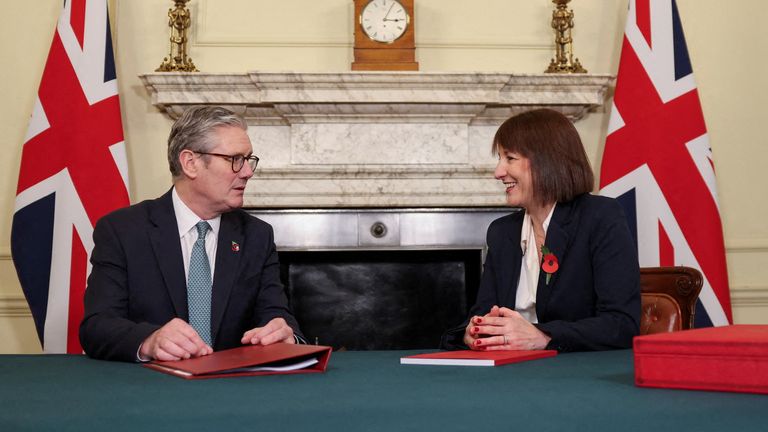
Pic: Reuters
This, it’s worth saying, is not a very large margin by which to meet your fiscal rule. A typical budget can see revisions and changes that would swamp that in one fell swoop. And part of the explanation for why there has been so much speculation about tax rises over the summer is that the chancellor left herself so little “headroom” against the rule. And since everyone could see debt interest costs were going up, it seemed quite plausible that the government would have to raise taxes.
Then, over the summer, the OBR, whose job it is to make the official government forecasts, and to mark its fiscal homework, told the government it was also doing something else: reviewing the state of Britain’s productivity. This set alarm bells ringing in Downing Street – and understandably. The weaker productivity growth is, the less income we’re all earning, and the less income we’re earning, the less tax revenues there are going into the exchequer.
The early signs were that the productivity review would knock tens of billions of pounds off the chancellor’s “headroom” – that it could, in one fell swoop, wipe off that £9.9bn and send it into the red.
Read more:
Main budget announcements – at a glance
Enter your salary to see how the budget affects you
That is why stories began to brew through the summer that the chancellor was considering raising taxes. The Treasury was preparing itself for some grisly news. But here’s the interesting thing: when the bad news (that productivity review) did eventually arrive, it was far less grisly than expected.
True: the one-off productivity “hit” to the public finances was £16bn. But – and this is crucial – that was offset by a lot of other, much better news (at least from the exchequer’s perspective). Higher wage inflation meant higher expected tax revenues, not to mention a host of other impacts. All told, when everything was totted up, the hit to the public finances wasn’t £16bn but somewhere between £5bn and £6bn.
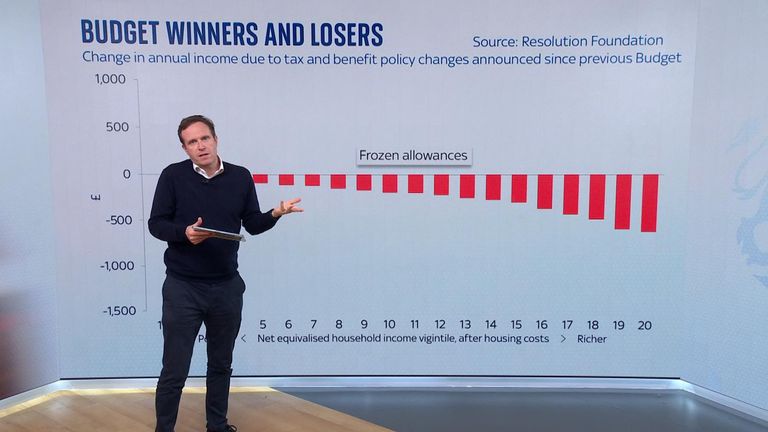
Budget winners and losers
Why is that number significant? Because it’s short of the chancellor’s existing £9.9bn headroom. Or, to put it another way, the OBR’s forecasting exercise was not enough to force her to raise taxes.
The decision to raise taxes, in other words, came down to something else. It came down to the fact that the government U-turned on a number of its welfare reforms over the summer. It came down to the fact that they wanted to axe the two-child benefits cap. And, on top of this, it came down to the fact that they wanted to raise their “headroom” against the fiscal rules from £9.9bn to over £20bn.
These are all perfectly logical reasons to raise tax – though some will disagree on their wisdom. But here’s the key thing: they are the chancellor and prime minister’s decisions. They are not knee-jerk responses to someone else’s bad news.
Yet when the prime minister explained his budget decisions, he focused mostly on that OBR report. In fact, worse, he selectively quoted the £16bn number from the productivity review without acknowledging that it was only one part of the story. That seems pretty misleading to me.


Prediction markets Polymarket and Kalshi view Kevin Hassett, US President Donald Trump’s National Economic Council director, as the favorite to replace Jerome Powell as the next Federal Reserve chair.
The odds of Hassett filling the seat have spiked to 66% on Polymarket and 74% on Kalshi at the time of writing. Hassett is widely viewed as crypto‑friendly thanks to his past role on Coinbase’s advisory council, a disclosed seven‑figure stake in the exchange and his leadership of the White House digital asset working group.
Founder and CEO of Wyoming-based Custodia Bank, and a prominent advocate for crypto-friendly regulations, Caitlin Long, commented on X:
“If this comes true & Hassett does become Fed chairman, anti-#crypto people at the Fed who still hold positions of power will finally be out (well, most of them anyway). BIG changes will be coming to the Fed.”

Related: Crypto-friendly Trump adviser Hassett top pick for Fed chair: Report
Kevin Hassett’s crypto credentials
Hassett is a long-time Republican policy economist who returned to Washington as Trump’s top economic adviser and has now emerged as the market-implied frontrunner to lead the Fed.
His financial disclosure reveals at least a seven‑figure Coinbase stake and compensation for serving on the exchange’s Academic and Regulatory Advisory Council, placing him unusually close to the crypto industry for a potential Fed chair.
Still, crypto has been burned before by reading too much into “crypto‑literate” resumes. Gary Gensler arrived at the Securities and Exchange Commission with MIT blockchain courses under his belt, but went on to preside over a wave of high‑profile enforcement actions, some of which critics branded as “Operation Chokepoint 2.0.”
A Hassett-led Fed might be more open to experimentation and less reflexively hostile to bank‑crypto activity. Still, the institution’s mandate on financial stability means markets should not assume a one‑way bet on deregulation.
Related: Caitlin Long’s crypto bank loses appeal over Fed master account
Supervision pushback inside the Fed
The Hassett odds have jumped just as the Fed’s own approach to bank supervision has received pushback from veterans like Fed Governor Michael Barr, who earned his reputation as one of Operation Chokepoint 2.0’s key architects.
According to Caitlin Long, while he Barr “was Vice Chairman of Supervision & Regulation he did Warren’s bidding,” and he “has made it clear he will oppose changes made by Trump & his appointees.”
On Nov. 18, the Fed released new Supervisory Operating Principles that shift examiners toward a “risk‑first” framework, directing staff to focus on material safety‑and‑soundness risks rather than procedural or documentation issues.
In a speech the same day, Barr warned that narrowing oversight, weakening ratings frameworks and making it harder to issue enforcement actions or matters requiring attention could leave supervisors slower to act on emerging risks, arguing that gutting those tools may repeat pre‑crisis mistakes.
Days later, in Consumer Affairs Letter 25‑1, the Fed clarified that the new Supervisory Operating Principles do not apply to its Consumer Affairs supervision program (an area under Barr’s committee as a governor).
If prediction markets are right and a crypto‑friendly Hassett inherits this landscape, his Fed would not be writing on a blank slate but stepping into an institution already mid‑pivot on how hard (and where) it leans on banks.
Magazine: EU’s privacy-killing Chat Control bill delayed — but fight isn’t over
-
 Sports2 years ago
Story injured on diving stop, exits Red Sox game
-
 Sports3 years ago
‘Storybook stuff’: Inside the night Bryce Harper sent the Phillies to the World Series
-
 Sports2 years ago
Game 1 of WS least-watched in recorded history
-
 Sports3 years ago
Button battles heat exhaustion in NASCAR debut
-
 Sports3 years ago
MLB Rank 2023: Ranking baseball’s top 100 players
-
Sports4 years ago
Team Europe easily wins 4th straight Laver Cup
-
 Environment3 years ago
Japan and South Korea have a lot at stake in a free and open South China Sea
-
 Environment1 year ago
Here are the best electric bikes you can buy at every price level in October 2024