
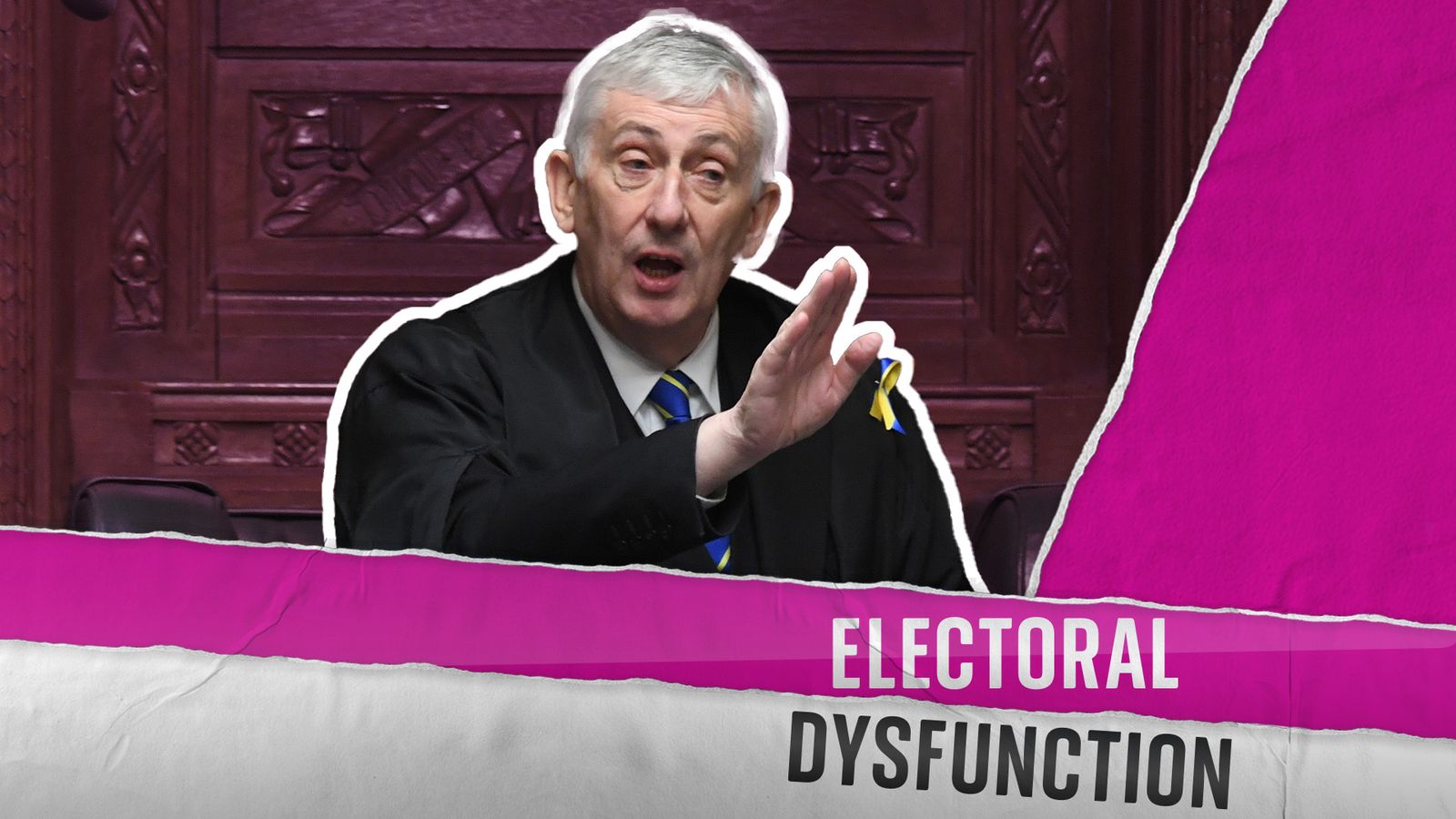
Commons Speaker Sir Lindsay Hoyle knew about Afghan data leak, claims Harriet Harman

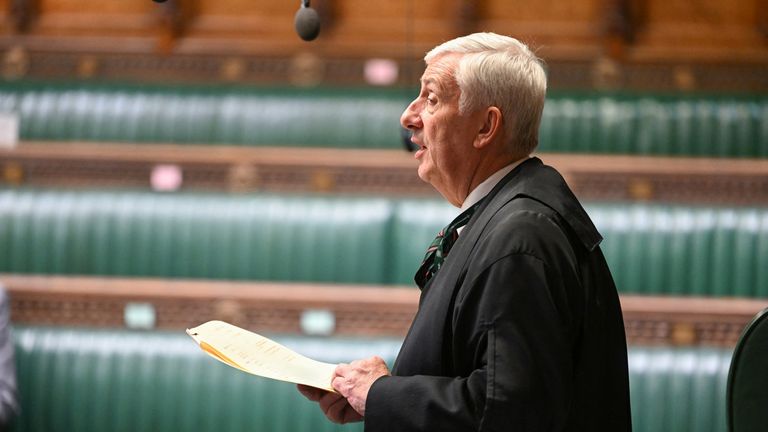
Commons Speaker Sir Lindsay Hoyle knew about Afghan data leak and should have made ministers tell MPs, Dame Harriet Harman has claimed.
Speaking to Beth Rigby on the Electoral Dysfunction podcast, the Labour peer said the Speaker – whose job she ran for in 2019 – should have asked for a key select committee to be made aware.
A spokesperson for the Speaker said he was “himself under a super-injunction” and so “would have been under severe legal restrictions”.
A massive data breach by the British military that was only made public this week exposed the personal information of close to 20,000 Afghan individuals, endangering them and their families.
Successive governments tried to keep the leak secret with a super-injunction, meaning the UK only informed everyone affected on Tuesday – three-and-a-half years after their data was compromised.
The breach occurred in February 2022, when Boris Johnson was prime minister, but was only discovered by the British military in August 2023.
A super-injunction which prevented the reporting of the mistake, was imposed in September of that year.
The previous Conservative government set up a secret scheme in 2023 – which can only now be revealed – to relocate Afghan nationals impacted by the data breach but who were not eligible for an existing programme to relocate and assist individuals who had worked for the British government in Afghanistan.
Some 6,900 Afghans – comprising 1,500 people named on the list as well as their dependents – are being relocated to the UK as part of this programme.
Dame Harriet said: “The Speaker was warned, ‘If somebody’s going to say something which breaches this injunction, will you please shut them up straight away if an MP does this’, and he agreed to do that.
“But what he should have done at the time is he should have said but parliamentary accountability is important. I’m the Speaker. I’m going to stand up for parliamentary accountability. And you must tell the Intelligence and Security Committee and allow them to hold you to account.
“What’s happened now is now that this is out in the open, the Intelligence and Security Committee is going to look at everything. So, it will be able to see all the papers from the MoD [Ministry of Defence].”
Speaker of the House Lindsay Hoyle. Pic: Reuters
Pressed on whether she meant the Speaker had failed to do his job, Dame Harriet replied: “Yes, and it’s a bit invidious for me to be saying that because, of course, at that time, Lindsay Hoyle was elected a speaker, I myself ran to be speaker, and the House chose him rather than me.
Read more:
Afghan data breach timeline: The fallout behind the scenes
Sixteen and 17-year-olds will be able to vote in next general election
“So it’s a bit bad to make this proposal to somebody who actually won an election you didn’t win. But actually, if you think about the Speaker’s role to stand up for parliament, to make sure that government is properly scrutinised, when you’ve got a committee there, which is security cleared to the highest level, appointed by the prime minister, and whose job is exactly to do this.”
A spokesperson for the Speaker said: “As has been made clear, Mr Speaker was himself under a super-injunction, and so would have been under severe legal restrictions regarding speaking about this.
“He would have had no awareness which organisations or individuals were and were not already aware of this matter.
“The injunction could not constrain proceedings in parliament and between being served with the injunction in September 2023 and the 2024 general election, Mr Speaker granted four Urgent Questions on matters relating to Afghan refugees and resettlement schemes.
“Furthermore, as set out in the Justice and Security Act 2013, the Speaker has no powers to refer matters to the Intelligence and Security Committee.”

Former US Securities and Exchange Commission Chair Gary Gensler renewed his warning to investors about the risks of cryptocurrencies, calling most of the market “highly speculative” in a new Bloomberg interview on Tuesday.
He carved out Bitcoin (BTC) as comparatively closer to a commodity while stressing that most tokens don’t offer “a dividend” or “usual returns.”
Gensler framed the current market backdrop as a reckoning consistent with warnings he made while in office that the global public’s fascination with cryptocurrencies doesn’t equate to fundamentals.
“All the thousands of other tokens, not the stablecoins that are backed by US dollars, but all the thousands of other tokens, you have to ask yourself, what are the fundamentals? What’s underlying it… The investing public just needs to be aware of those risks,” he said.
Gensler’s record and industry backlash
Gensler led the SEC from April 17, 2021, to Jan. 20, 2025, overseeing an aggressive enforcement agenda that included lawsuits against major crypto intermediaries and the view that many tokens are unregistered securities.
Related: House Republicans to probe Gary Gensler’s deleted texts
The industry winced at high‑profile actions against exchanges and staking programs, as well as the posture that most token issuers fell afoul of registration rules.

Under Gensler’s tenure, Coinbase was sued by the SEC for operating as an unregistered exchange, broker and clearing agency, and for offering an unregistered staking-as-a-service program. Kraken was also forced to shut its US staking program and pay a $30 million penalty.
The politicization of crypto
Pushed on the politicization of crypto, including references to the Trump family’s crypto involvement by the Bloomberg interviewer, the former chair rejected the framing.
“No, I don’t think so,” he said, arguing it’s more about capital markets fairness and “commonsense rules of the road,” than a “Democrat versus Republican thing.”
He added: “When you buy and sell a stock or a bond, you want to get various information,” and “the same treatment as the big investors.” That’s the fairness underpinning US capital markets.
Related: Coinbase files FOIA to see how much the SEC’s ‘war on crypto’ cost
ETFs and the drift to centralization
On ETFs, Gensler said finance “ever since antiquity… goes toward centralization,” so it’s unsurprising that an ecosystem born decentralized has become “more integrated and more centralized.”
He noted that investors can already express themselves in gold and silver through exchange‑traded funds, and that during his tenure, the first US Bitcoin futures ETFs were approved, tying parts of crypto’s plumbing more closely to traditional markets.
Gensler’s latest comments draw a familiar line: Bitcoin sits in a different bucket, while most other tokens remain, in his view, speculative and light on fundamentals.
Even out of office, his framing will echo through courts, compliance desks and allocation committees weighing BTC’s status against persistent regulatory caution of altcoins.
Magazine: Solana vs Ethereum ETFs, Facebook’s influence on Bitwise — Hunter Horsley

New figures reveal a 70% year-on-year increase in Cayman Islands foundation company registrations, with more than 1,300 on the books at the end of 2024, and over 400 new registrations already in 2025.
These structures are increasingly being used as legal wrappers for decentralized autonomous organizations (DAOs) and as ecosystem stewards for major Web3 projects.
According to a news release from Cayman Finance, many of the world’s largest Web3 projects are now registered in the Cayman Islands, including at least 17 foundation companies with treasuries over $100 million.
Why DAOs are choosing Cayman
The Cayman foundation company has emerged as a preferred tool for DAOs that need to sign contracts, hire contributors, hold IP and interact with regulators, all while shielding tokenholders from personal liability for the DAO’s obligations.
The legal wake‑up call for many communities came in 2024 with Samuels v. Lido DAO, in which a US federal judge found that an unwrapped DAO could be treated as a general partnership under California law, exposing participants to personal liability.
The Cayman foundation company is designed to plug that gap, offering a separate legal personality and the ability to own assets and sign agreements, while giving tokenholders assurance that they are not partners by default.

Add tax neutrality, a legal framework familiar to institutional allocators and an ecosystem of companies that specialize in Web3 treasuries, and it becomes clear why more projects have quietly redomiciled their foundations to Grand Cayman.
Elsewhere, policymakers have made big promises but delivered patchwork. US President Donald Trump has repeatedly pledged to turn the United States into the “crypto capital of the planet,” but at the entity level, only a handful of states explicitly recognize DAOs as legal persons.
Switzerland remains the archetypal onshore Web3 foundation center, with the Crypto Valley region now hosting over 1,700 active blockchain firms, up more than 130% since 2020, with foundations and associations representing a growing share of new structures.
Related: Switzerland’s Crypto Valley hits $593B with 17 unicorns in 2024
From light‑touch haven to compliance player
The surge in Web3 foundations coincides with a shift in Cayman’s own regulatory posture — the arrival of the Organisation for Economic Co-operation and Development’s Crypto‑Asset Reporting Framework (CARF), which the Cayman Islands has now implemented via new Tax Information Authority regulations that take effect from Jan. 1, 2026.
CARF will impose due diligence and reporting duties on Cayman “Reporting Crypto‑Asset Service Providers” (entities that exchange crypto for fiat or other crypto, operate trading platforms or provide custodial services), requiring them to collect tax‑residence data from users, track relevant transactions and file annual reports with the Tax Information Authority.
Legal professionals note that CARF reporting under the current interpretation applies to relevant crypto-asset service providers, including exchanges, brokers and dealers, which likely leaves structures that merely hold crypto assets, such as protocol treasuries, investment funds, or passive foundations, off the hook.
“The key question is whether your entity, as a business, provides a service effectuating exchange transactions for or on behalf of customers, including by acting as a counterparty or intermediary or by making available a trading platform.”
In practice, that means many pure treasury or ecosystem‑steward foundations should be able to continue benefitting from Cayman’s legal certainty and tax neutrality without being dragged into full reporting status, so long as they are not in the business of running exchange, brokerage or custody services.
Magazine: EU’s privacy-killing Chat Control bill delayed — but fight isn’t over
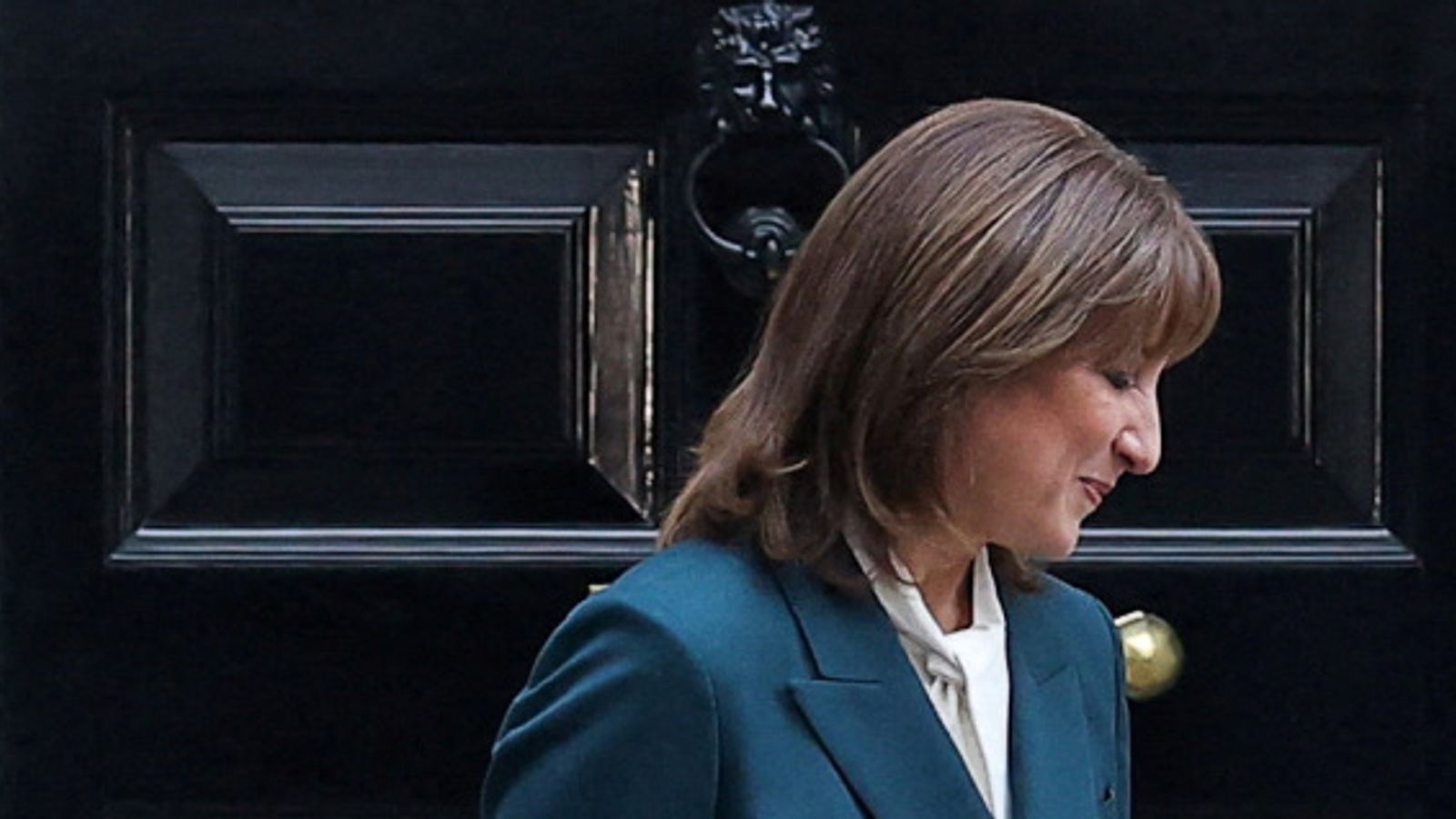
Chancellor Rachel Reeves has suffered another budget blow with a rebellion by rural Labour MPs over inheritance tax on farmers.
Speaking during the final day of the Commons debate on the budget, Labour backbenchers demanded a U-turn on the controversial proposals.
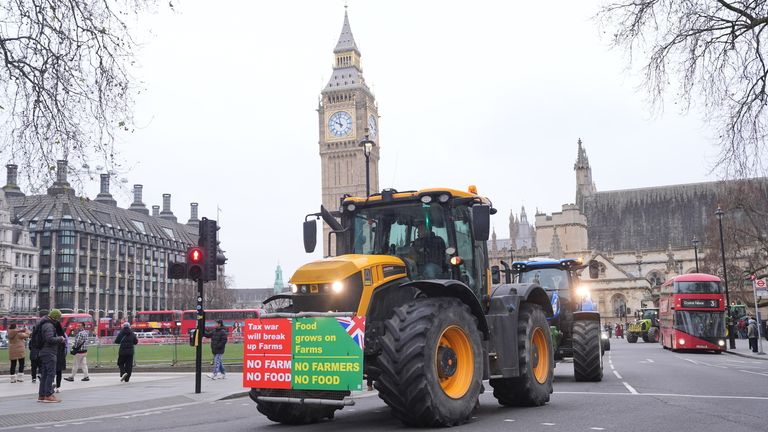
Plans to introduce a 20% tax on farm estates worth more than £1m from April have drawn protesters to London in their tens of thousands, with many fearing huge tax bills that would force small farms to sell up for good.
Farmers have staged numerous protests against the tax in Westminster. Pic: PA
MPs voted on the so-called “family farms tax” just after 8pm on Tuesday, with dozens of Labour MPs appearing to have abstained, and one backbencher – borders MP Markus Campbell-Savours – voting against, alongside Conservative members.
In the vote, the fifth out of seven at the end of the budget debate, Labour’s vote slumped from 371 in the first vote on tax changes, down by 44 votes to 327.
‘Time to stand up for farmers’
The mini-mutiny followed a plea to Labour MPs from the National Farmers Union to abstain.
“To Labour MPs: We ask you to abstain on Budget Resolution 50,” the NFU urged.
“With your help, we can show the government there is still time to get it right on the family farm tax. A policy with such cruel human costs demands change. Now is the time to stand up for the farmers you represent.”
After the vote, NFU president Tom Bradshaw said: “The MPs who have shown their support are the rural representatives of the Labour Party. They represent the working people of the countryside and have spoken up on behalf of their constituents.
“It is vital that the chancellor and prime minister listen to the clear message they have delivered this evening. The next step in the fight against the family farm tax is removing the impact of this unjust and unfair policy on the most vulnerable members of our community.”
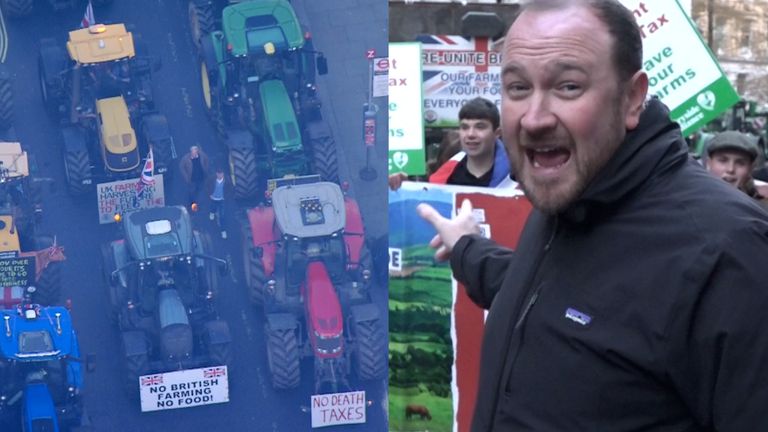
Farmers defy police ban in budget day protest in Westminster.
The government comfortably won the vote by 327-182, a majority of 145. But the mini-mutiny served notice to the chancellor and Sir Keir Starmer that newly elected Labour MPs from the shires are prepared to rebel.
Speaking in the debate earlier, Mr Campbell-Savours said: “There remain deep concerns about the proposed changes to agricultural property relief (APR).
“Changes which leave many, not least elderly farmers, yet to make arrangements to transfer assets, devastated at the impact on their family farms.”
Samantha Niblett, Labour MP for South Derbyshire abstained after telling MPs: “I do plead with the government to look again at APR inheritance tax.
“Most farmers are not wealthy land barons, they live hand to mouth on tiny, sometimes non-existent profit margins. Many were explicitly advised not to hand over their farm to children, (but) now face enormous, unexpected tax bills.
“We must acknowledge a difficult truth: we have lost the trust of our farmers, and they deserve our utmost respect, our honesty and our unwavering support.”

UK ‘criminally’ unprepared to feed itself in crisis, says farmers’ union.
Labour MPs from rural constituencies who did not vote included Tonia Antoniazzi (Gower), Julia Buckley (Shrewsbury), Jonathan Davies (Mid Derbyshire), Maya Ellis (Ribble Valley), and Anna Gelderd (South East Cornwall), Ben Goldsborough (South Norfolk), Alison Hume (Scarborough and Whitby), Terry Jermy (South West Norfolk), Jayne Kirkham (Truro and Falmouth), Noah Law (St Austell and Newquay), Perran Moon, (Camborne and Redruth), Samantha Niblett (South Derbyshire), Jenny Riddell-Carpenter (Suffolk Coastal), Henry Tufnell (Mid and South Pembrokeshire), John Whitby (Derbyshire Dales) and Steve Witherden (Montgomeryshire and Glyndwr).
-
 Sports2 years ago
Story injured on diving stop, exits Red Sox game
-
 Sports3 years ago
‘Storybook stuff’: Inside the night Bryce Harper sent the Phillies to the World Series
-
 Sports2 years ago
Game 1 of WS least-watched in recorded history
-
 Sports3 years ago
Button battles heat exhaustion in NASCAR debut
-
 Sports3 years ago
MLB Rank 2023: Ranking baseball’s top 100 players
-
Sports4 years ago
Team Europe easily wins 4th straight Laver Cup
-
 Environment3 years ago
Japan and South Korea have a lot at stake in a free and open South China Sea
-
 Environment1 year ago
Here are the best electric bikes you can buy at every price level in October 2024