
Connect with us

Published

on

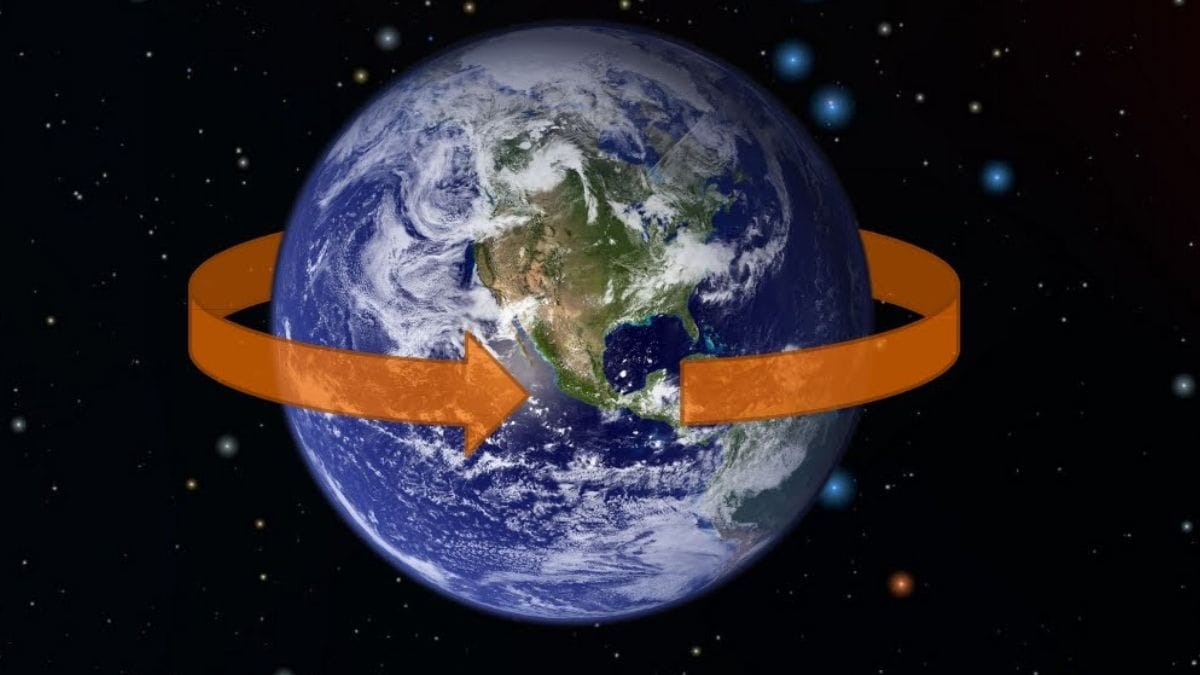
Scientists say Earth will spin slightly faster on Tuesday, July 22, 2025, making that day roughly 1.34 milliseconds shorter than the usual 24-hour period. This subtle acceleration, detected by atomic clocks and satellites, will make July 22 the second-shortest day in recorded history. (Only July 10, 2025 — 1.36 ms short — was shorter this year.) Experts note that since 2020, Earth has repeatedly set new short-day records, a trend now under close watch by global timekeeping authorities. While imperceptible in daily life, the phenomenon may ultimately require an unprecedented “negative” leap second to keep atomic time aligned with Earth’s spin.

Earth’s Unusual Acceleration

According to previous studies, Earth’s rotation is not perfectly constant. The July 22 rotation was measured at 1.34 milliseconds less than a normal day. Reports say that 2025 is witnessing some of the fastest spins on record – the quickest since continuous measurements began in 1973.

In fact, new data showed that earlier in 2025 the shortest day occurred on July 10 (about 1.36 ms shorter than 24 hours), with July 22 a “close runner-up” at 1.34 ms below normal. If current models hold, another brief day is expected on August 5 (roughly 1.25 ms short), leaving July 22 as the second-shortest of the year. Altogether, researchers describe this as a “puzzling trend” of Earth’s rotation speeding up in recent years.

Speed-Up reasons

Scientists attribute these fluctuations to a mix of celestial and geophysical factors. The Moon’s orbit is a prime factor: in early July it reached maximum declination, pulling off-center and briefly accelerating Earth’s spin. The same lunar alignment on July 22 is expected to repeat the effect. Normally, lunar tides act as a brake, gradually lengthening days, but on these shorter timescales the Moon’s position can instead speed up the rotation.

Other subtle influences also play a role. Climate-driven mass shifts – such as melting ice sheets and moving ocean water – change Earth’s moment of inertia and can tweak day length. Even large earthquakes or seasonal atmospheric changes can nudge Earth’s rotation by tiny microseconds.

Continue Reading

Science

Hubble Captures Rare Collision in Nearby Planetary System, Revealing Violent Planet Formation

Published

on

By

Astronomers using NASA’s Hubble Space Telescope have witnessed rare collisions between rocky bodies in the Fomalhaut system. The glowing debris clouds created by these impacts offer a unique glimpse into how planets form and highlight challenges in identifying true exoplanets.

Continue Reading

Science

Astronomers Observe Black Hole Twisting Spacetime for the First Time, Confirming Einstein’s Theory

Published

on

By

Astronomers have directly observed a black hole twisting spacetime for the first time, confirming Einstein’s long-standing prediction. The effect was detected during a violent stellar destruction event, where repeating X-ray and radio signals revealed a slow cosmic wobble. The discovery provides new insight into black hole spin, jets, and extreme gravity.

Continue Reading

Science

Scientists Rule Out Elusive Sterile Neutrino After 10-Year Hunt, Shaking Particle Physics

Published

on

By

After ten years of experiments, physicists found no evidence for the sterile neutrino, once thought to explain unusual neutrino behaviour. The MicroBooNE experiment at Fermilab analysed neutrinos from two beams and ruled out the particle with 95% certainty. The findings narrow the search for new physics and inform future experiments like DUNE.

Continue Reading

Trending





