
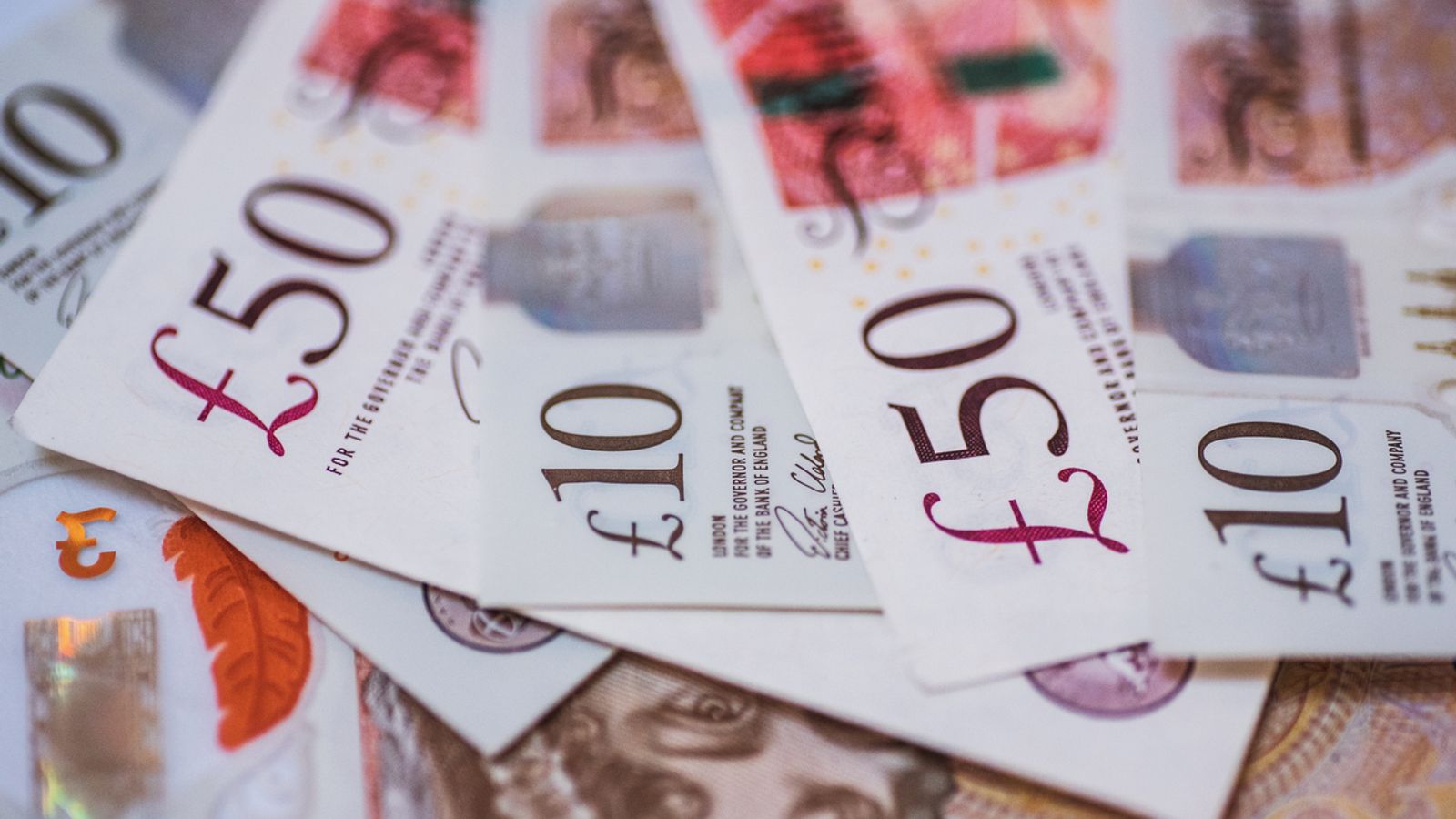
Government borrowing soars to second-highest level on record


Government borrowing rose significantly more than expected last month as debt interest payments soared.
Official figures show the cost of public services and interest payments on government debt rose faster than the increases in income tax and national insurance contributions.
It means government borrowing reached the second-highest level in June since records began in 1993, according to data from the Office for National Statistics (ONS).
Money latest: Britons are eating out earlier – here’s what’s going on
June’s borrowing figures – £20.684bn – were second only to the highs seen in the early days of the COVID-19 pandemic in 2020, when many workers were furloughed.
The figure was a surprise, nearly £4bn higher than anticipated by economists polled by Reuters.
State borrowing – the difference between income from things like taxes and expenditure on the likes of public services – was more than £6bn higher than the same month last year.
Read more:
The wealth tax options Reeves could take to ease her fiscal bind
The ‘mad’ situation blamed for slowing building projects
Pushing the borrowing figure up was the high cost of interest payments, which was the second-highest June figure since those records began in 1997. Only June 2022 saw higher spending on government debt.
But despite the latest rise, borrowing this year is in line with the March forecast from the independent forecasters at the Office for Budget Responsibility (OBR), though it’s the second month in a row borrowing was above its projections.
It’s bad news for Chancellor Rachel Reeves, who has vowed to bring down government debt and balance the budget by 2030 as part of her self-imposed fiscal rules.
She’s expected to increase taxes to meet the gap between spending and tax revenue.
The pressure is such that analysts from economic research firm Pantheon Macroeconomics said: “Autumn tax hikes are likely and will probably be backloaded.”
What’s the deal with wealth taxes?
Rob Wood, its chief UK economist, estimated the size of the gap between government expenditure and income has grown.
“All told, we estimate that the chancellor’s £9.9bn of headroom has turned into a £13bn hole, meaning that Ms Reeves would need to raise taxes or cut spending by a little over £20bn in the autumn budget to restore her slim margin of headroom,” he said.
“We expect ‘sin tax’ and duty hikes, freezing income tax thresholds for an extra year in 2029 and a pensions tax raid – reinstating the lifetime limit on pension pots and cutting relief – to fill most of the hole.”
Taxes on goods such as alcohol and tobacco are classed as sin taxes.
Darren Jones, Ms Reeves’s deputy as the chief secretary to the Treasury, said: “We are committed to tough fiscal rules, so we do not borrow for day-to-day spending and get debt down as a share of our economy.”
“This commitment to economic stability means we can get on with investing in Britain’s renewal.”

A millionaires’ playground, Poole in Dorset boasts some of the most expensive properties in the UK, and has been called Britain’s Palm Beach.
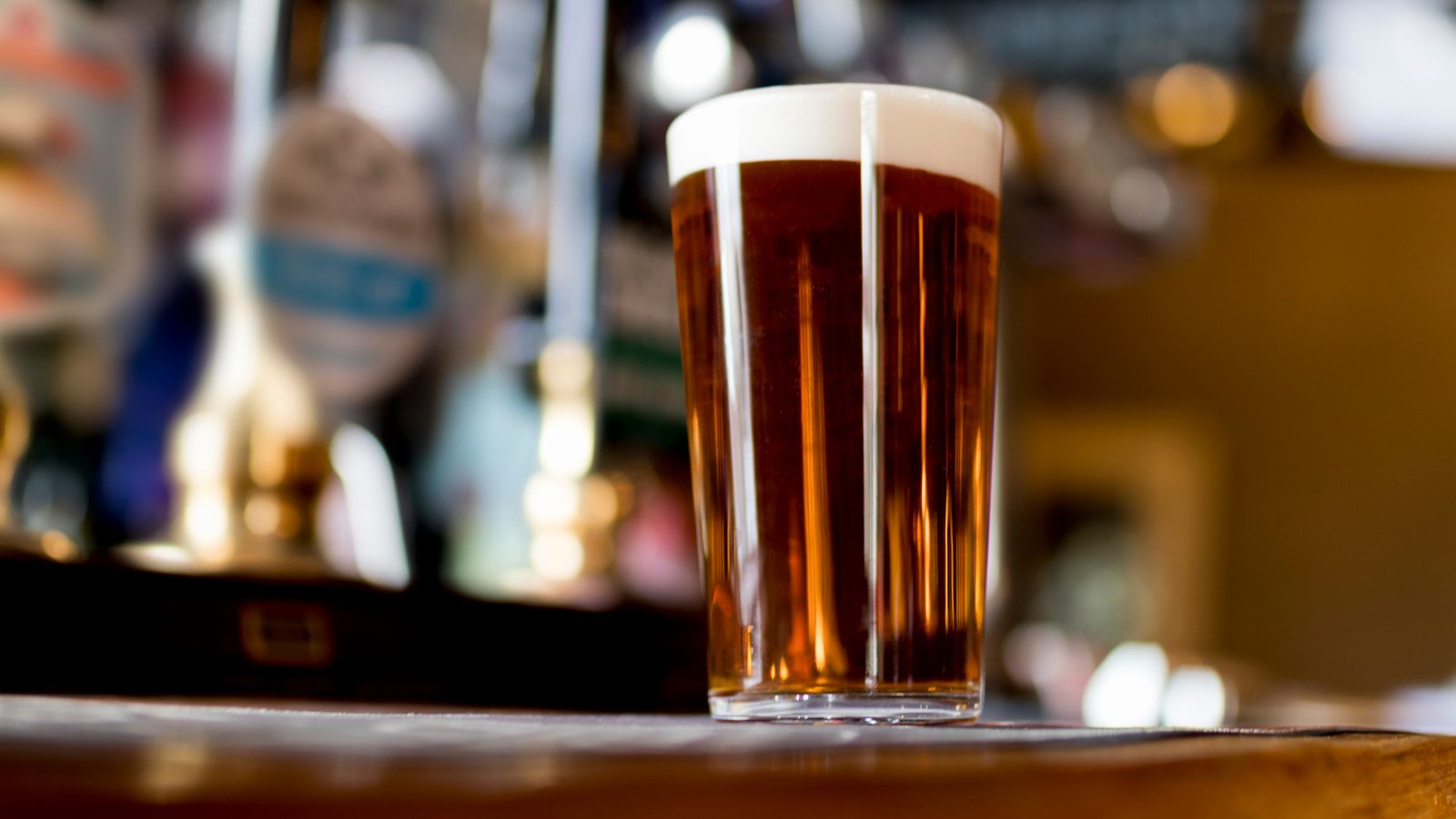
Away from the yachts and the mansions of Sandbanks, however, Poole is also a beer drinkers’ paradise, with 58 pubs in the parliamentary constituency alone.
But now many of Dorset’s pub landlords have joined a bitter backlash against rises in business rates of up to £30,000 in Rachel Reeves’s November budget.
Across the UK, it is claimed up to 1,000 publicans have even banned Labour MPs from their pubs, after the chancellor axed a 40% rates discount, introduced during COVID, from next April.
The row over the rises, brewing since the budget, came to a head in a clash between Kemi Badenoch and Sir Keir Starmer in the final Prime Minister’s Questions of 2025.
“He gave his word that he would help pubs,” said the Tory leader.
“Yet they face a 15% rise in business rates because of his budget. Will he be honest and admit that his taxes are forcing pubs to close?”
The PM replied that the temporary relief introduced during COVID – a scheme the Conservatives put in place and Labour supported, he said – had come to an end.
“But it was always a temporary scheme coming to an end,” he said.
“We have now put in place a £4bn transitional relief.”
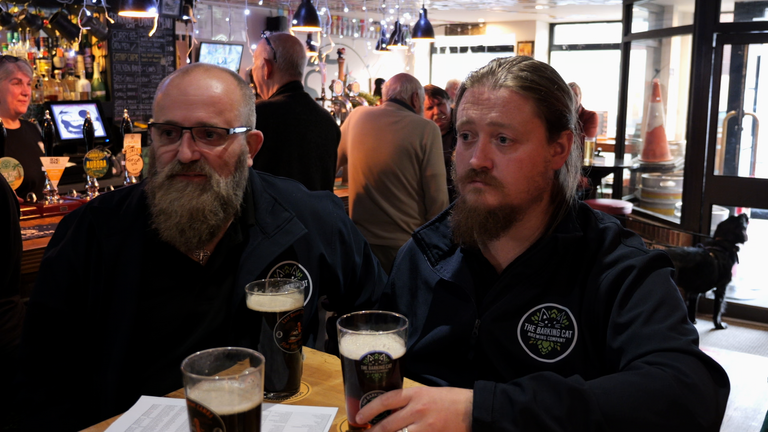
Mark and Michael Ambrose, father and son co-landlords of The Barking Cat, said the increases are a ‘pub destroyer’
But in the Barking Cat Ale House in Poole, facing an increase in business rates of nearly £9,000 a year, the father and son co-landlords fear the rises could mean last orders for many pubs.
“We’re sort of in the average area at 157%, but we’ve got a lot of local pubs that are increasing by 600%, and another one by 800%,” Ambrose senior, Mark, told Sky News.
“It’s a pub destroyer. Pubs can’t survive these kinds of increases. It’s not viable. Most pubs are just about scraping by anyway. If you add these massive increases your profit margins are wiped out.
“We struggle as it is. You can’t have that kind of increase and expect businesses to succeed.
“Fortunately, the customers understand. But they still don’t want to have to spend an extra 30 or 50 pence a pint.”
Son Michael added: “It’s all back to front. It’s really these bigger pub companies and supermarkets that need to be facing increased taxes. We can’t handle them. They can.”
Michelle Smith, landlady of the Poole Arms, the oldest pub on the town’s quay, dating back to 1635, said: “Our rates per value is due to go up £9,000 in April, so it’s quite a deal.”
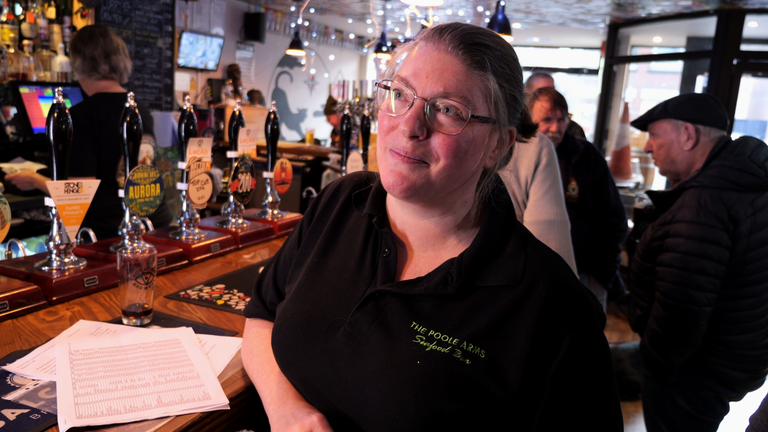
Michelle Smith, landlady of The Poole Arms, said all her prices are going up
“And we had a rates increase just gone as well,” she added. “So our rates had already increased over £1,000 a month last April. So another hit is quite considerable really.
“Prices definitely have to go up with all the different price increases that we’ve got throughout: business rates, wage increases, the beer goes up from the breweries. Everything is going up.”
Backing the publicans, Neil Duncan-Jordan, who became Poole’s first ever Labour MP last year, has written to the chancellor demanding a rethink. He said he is prepared to vote against the tax rise in the Commons.
“They’ve got to listen,” he told Sky News.
“They’ve got to listen to the high street, to publicans, people who run social clubs and listen to problems that they’re facing and the impact that these changes have made.”
Mr Duncan-Jordan said he was prepared to support an amendment to the Finance Bill, which turns the budget into law and had its second reading in the Commons last week.
Despite being suspended for four months for rebelling against welfare cuts earlier this year, he said: “I was discussing this with some MPs just this morning and I’ll be happy to support those. Sometimes you just have to say what you think is right.”
As chancellor, Ms Reeves has regularly raised a glass to pubs and promised to protect them from rising costs.
But Sir Keir has faced the wrath of a publican before, when he was thrown out of a pub in Bath during COVID by an anti-lockdown landlord.
This time, without a U-turn by the chancellor on the business rates increases, pub landlords fear the government has them over a barrel.
-
 Sports2 years ago
Story injured on diving stop, exits Red Sox game
-
 Sports3 years ago
‘Storybook stuff’: Inside the night Bryce Harper sent the Phillies to the World Series
-
 Sports2 years ago
Game 1 of WS least-watched in recorded history
-
 Sports3 years ago
Button battles heat exhaustion in NASCAR debut
-
 Sports3 years ago
MLB Rank 2023: Ranking baseball’s top 100 players
-
Sports4 years ago
Team Europe easily wins 4th straight Laver Cup
-
 Environment3 years ago
Japan and South Korea have a lot at stake in a free and open South China Sea
-
 Environment1 year ago
Here are the best electric bikes you can buy at every price level in October 2024