
Need an ace to win big? Here’s why the Mets won’t overpay for one


-
Jorge Castillo
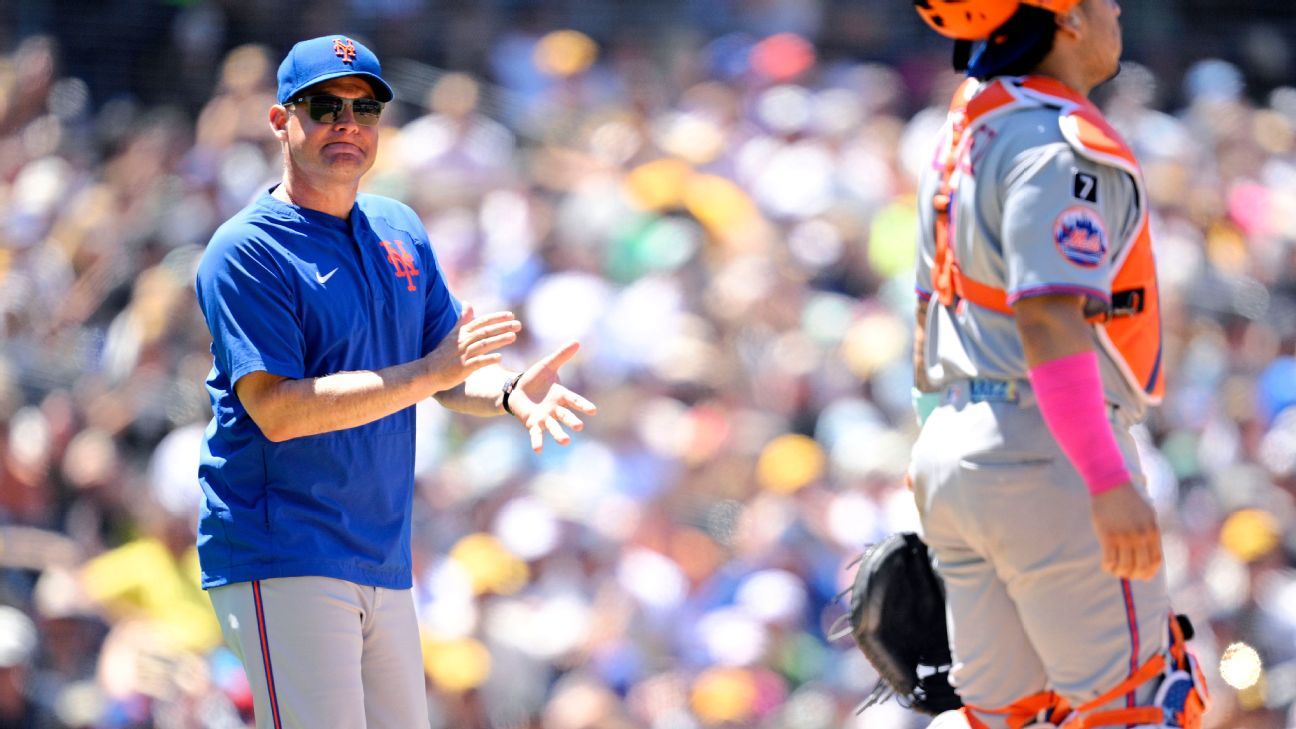
NEW YORK — David Stearns was about to disappear into the New York Mets‘ clubhouse Monday afternoon when he stopped to answer questions about the one potentially prominent flaw remaining on his roster after the trade deadline: the starting rotation.
The glaring inability of Mets starters to pitch deep into games over the past two months — David Peterson is the only one to log at least six innings in an outing during that span — prompted fans to plead for the Mets’ president of baseball operations to fortify the rotation. After he elected not to acquire a starting pitcher at the trade deadline, the talk has turned to potentially improving from within by promoting Brandon Sproat or Nolan McLean, two standout pitching prospects excelling in Triple-A.
“I think it’s always a combination of when, developmentally, those guys are ready,” Stearns said. “And also when there’s the need and how to fit it on the roster. And so we may get to the point where we decide that it’s the best thing to do to bring one or both of them here. But we’re not at that point right now.”
The Mets’ front office acted aggressively ahead of last Thursday’s deadline, acquiring three top-tier relievers (Ryan Helsley, Tyler Rogers and Gregory Soto) to strengthen a taxed bullpen, and a veteran center fielder (Cedric Mullins) to improve the lineup. But while Stearns said he “engaged” teams on starting pitchers — including Washington Nationals All-Star left-hander MacKenzie Gore, sources told ESPN — he determined the costs were too high.
The Mets were far from the only World Series contender to not bolster their starting rotation in a deadline with an exorbitant trade demand for the few available. But the difference between most of those clubs and the Mets is that refusing to pay the going rate for elite major league starting pitchers — whether in free agency or via the trade market — has been a fundamental principle in Stearns’ roster-building.
One of the mysteries surrounding Stearns’ move to New York after a hugely successful seven-year run leading the small-market Milwaukee Brewers was how he would use owner Steve Cohen’s deep pockets. The Mets have spent large sums of money — they gave Juan Soto the richest contract in North American sports history in December — but Stearns has remained disciplined and methodical in building his pitching staff, preferring starting pitchers he says he believes have untapped potential.
After an unexpected run to the National League Championship Series without a true ace last fall, the Mets head into the stretch run this season with the same missing ingredient.
“I think there are multiple ways to build a pitching staff and we focused on the back end of the pitching staff, the bullpen,” Stearns said. “We’re really happy with the arms we were able to acquire who are going to pitch out of our pen and we have confidence, not only in the stars who are here who we think are going to keep us competitive and help us win games, we are also pleased with the development of how some of the guys in Triple-A are progressing. And we understand that they could … be part of the mix going forward if needed.”
The Mets strongly pursued Yoshinobu Yamamoto before last season and offered him a contract similar to the 12-year, $325 million deal — the largest ever for a pitcher — Yamamoto signed with the Los Angeles Dodgers. But Yamamoto was an outlier — not just an already highly accomplished pitcher in Japan, but, just as importantly, only 25 years old. That rare combination of age and talent met Stearns’ criteria to offer an expensive long-term contract.
Ultimately, the Mets signed Sean Manaea to a one-year deal with an option and Luis Severino to a one-year contract for the rotation, then opted for a similar blueprint this past winter, choosing not to strongly pursue any of the top three starting pitchers (Corbin Burnes, Max Fried and Blake Snell) on the free agent market.
Stearns instead re-signed Manaea to a three-year, $75 million deal (the biggest contract Stearns has given to a starting pitcher), inked Clay Holmes to a three-year, $38 million deal (with an opt-out after 2026) to convert him from a reliever to a starter, gave Frankie Montas a two-year, $34 million contract (with an opt-out after this season), and added Griffin Canning on a one-year deal.
“I still think it’s really valuable and there have been teams that I’ve been around in my career that have had one or multiple ace-level starters on their staff and got bounced early in the playoffs and that can be tough to figure out sometimes too,” Stearns said last month. “So, you’d always like to have the horse at the front of the rotation, there’s no question. But it’s not the only way to build a rotation, it’s not the only way to win a playoff series, it’s not the only way to win a World Series.”
The moves have so far yielded mixed results.
The Mets’ rotation led the majors with a 2.84 ERA and ranked 14th in innings pitched through June 7, when they were 41-24 and led the NL East by 3½ games. Since then, Mets starters rank 24th in ERA (4.74) and 28th in innings pitched. The club has a 22-27 record during the stretch and now trails the Philadelphia Phillies by 2½ games in the division.
Injuries have played a factor in the drop-off, with four starters landing on the injured list in June. Kodai Senga, who signed a five-year, $75 million deal in 2022 — a year before Stearns’ arrival in Queens — strained his hamstring and sat out nearly a month. Canning had been a strong contributor until a ruptured left Achilles tendon ended his season, and Tylor Megill (elbow) and Paul Blackburn (shoulder) are still working their way back.
Manaea, who began the season on the IL, has made only five starts since his return last month, the most recent Monday against the Cleveland Guardians, when he dominated for five innings before surrendering five runs in the sixth. Montas, who has posted a ghastly 6.68 ERA in seven starts, is in danger of losing his rotation spot when Blackburn and Megill are activated.
Holmes, meanwhile, hasn’t logged more than 5⅓ innings in a start since June 7 against the Colorado Rockies, and has already doubled his previous career high for innings in a season. And Senga yielded four runs over four innings Saturday, marking the fourth straight start he has failed to pitch into the sixth.
“We haven’t gotten consistency out of the starting pitching,” Mets manager Carlos Mendoza said Monday. “I think that’s where it starts every night. It starts on the mound, and we haven’t been able to get some quality starts.”
One of Sproat and McLean, if not both, could soon get the call to help. McLean has a 2.81 ERA in 15 games (12 starts) for Triple-A Syracuse after posting a 1.37 ERA in five games for Double-A Binghamton to begin the season. Sproat has emerged from early-season struggles with a dominant stretch for Syracuse, holding opponents to two earned runs in 33 innings over his past six starts.
The two 24-year-old right-handers, both drafted and developed by the Mets, have seemingly checked the necessary boxes in the minors. They could give the big league rotation the push it needs for the final stretch. For now, they and the Mets’ fan base wait.
Said Stearns: “I think they’re getting close.”


-
Max Olson
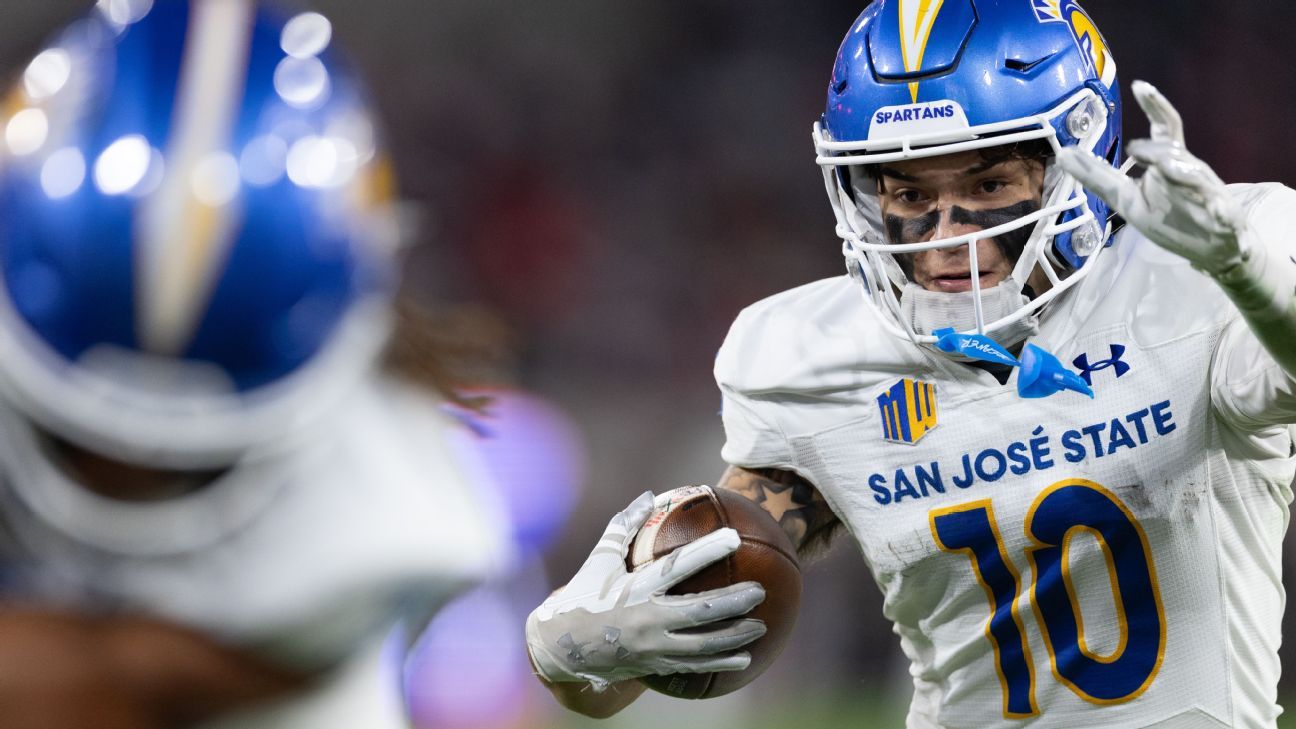
San Jose State wide receiver Danny Scudero, the leading receiver in FBS this season, will enter the NCAA transfer portal when it opens in January, he announced Friday.
The 5-foot-9, 174-pound redshirt sophomore caught 88 passes for 1,291 yards and 10 touchdowns in his first season with the Spartans, becoming a semifinal for the Biletnikoff Award and earning first-team All-Mountain West honors.
Scudero is expected to be one of the more coveted wide receivers available when the transfer portal officially opens on Jan. 2 and has two more seasons of eligibility remaining.
Scudero spent two years at Sacramento State before transferring to San Jose State after the 2024 season. He broke out with 189 receiving yards to open the season against Central Michigan and surpassed 100 yards in five more games, including a career-high 215 and two touchdowns against Hawaii.
Scudero’s 88 receptions ranked fourth-most in FBS, and he leads all receivers this season with 16 catches of 30 or more yards.
The Spartans produced the No. 14 passing offense in FBS this season but went 3-9 in their second year under coach Ken Niumatalolo.
-
 Sports2 years ago
Story injured on diving stop, exits Red Sox game
-
 Sports3 years ago
‘Storybook stuff’: Inside the night Bryce Harper sent the Phillies to the World Series
-
 Sports2 years ago
Game 1 of WS least-watched in recorded history
-
 Sports3 years ago
Button battles heat exhaustion in NASCAR debut
-
 Sports3 years ago
MLB Rank 2023: Ranking baseball’s top 100 players
-
Sports4 years ago
Team Europe easily wins 4th straight Laver Cup
-
 Environment3 years ago
Japan and South Korea have a lot at stake in a free and open South China Sea
-
 Environment1 year ago
Here are the best electric bikes you can buy at every price level in October 2024