
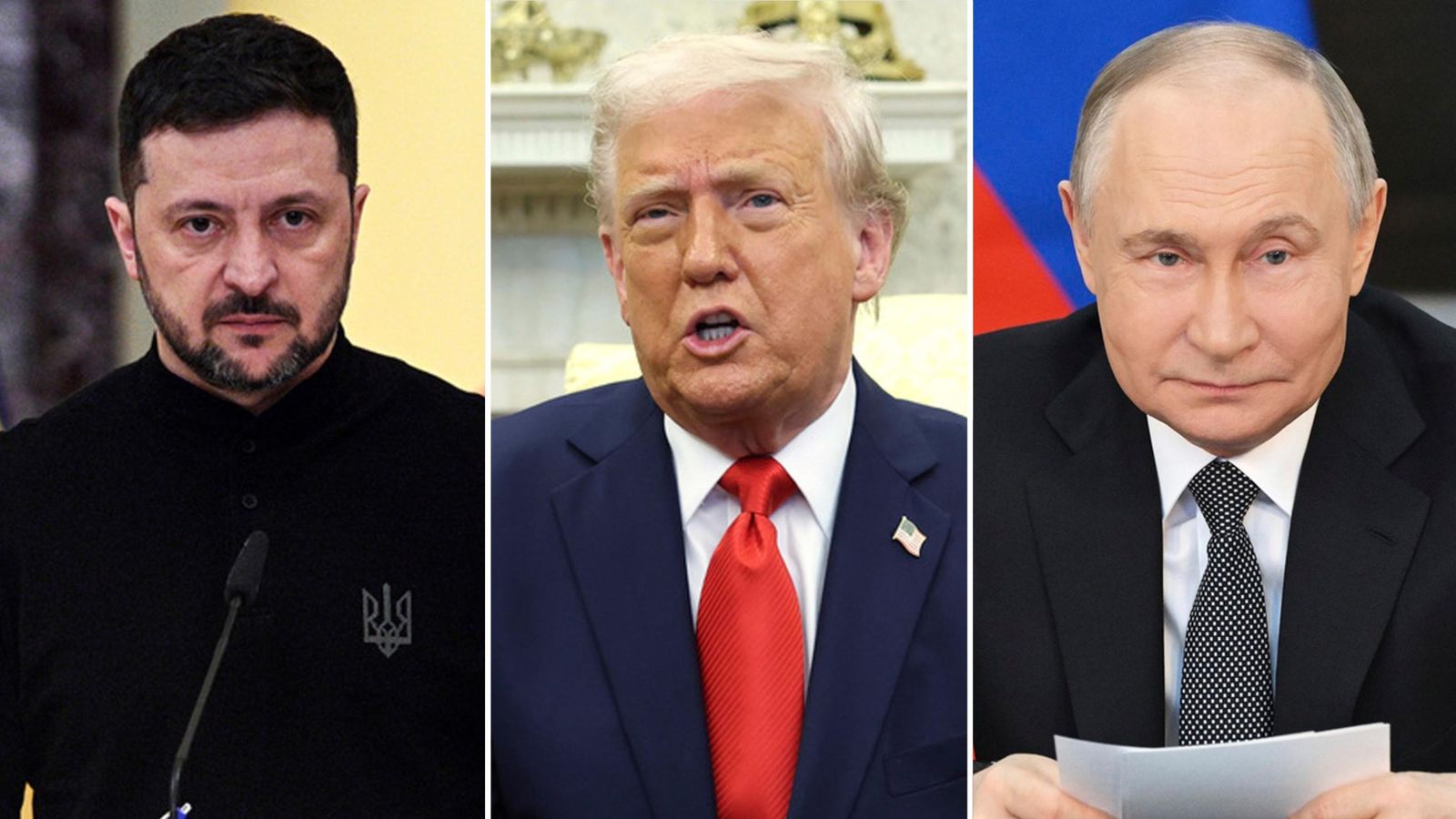
White House considering inviting Zelenskyy to Trump-Putin meeting in Alaska – reports

The White House is considering inviting Volodymyr Zelenskyy to a meeting between Donald Trump and Vladimir Putin in Alaska, according to reports in the US.
The reports come a day after Washington and Moscow confirmed the US and Russian presidents will meet on Friday to discuss bringing about an end to the war in Ukraine.
A senior US official and three people briefed on internal discussions have told Sky News’ US partner network NBC News that the Trump administration is now considering inviting the Ukrainian president to the summit.
“It’s being discussed,” one of the people briefed on the talks was quoted as saying.
The sources said a visit by Mr Zelenskyy has not been finalised – and it is unclear whether the Ukrainian leader will be in Alaska for the summit.
However, the senior administration official said it is “absolutely” possible.
“Everyone is very hopeful that would happen,” the official said.
Asked whether the US had officially invited Mr Zelenskyy to Alaska, a senior White House official said: “The President remains open to a trilateral summit with both leaders. Right now, the White House is focusing on planning the bilateral meeting requested by President Putin.”
Mr Trump told reporters at the White House on Friday before the Alaska summit was confirmed that “we’re getting very close to a deal” that would end the war.
The US president added there will be “some swapping of territories to the betterment of both sides”.
US diplomacy ‘totally amateur’
Zelenskyy suggests he’s unwilling to give up territory
However, the Ukrainian president warned on Saturday that allowing Russia to keep territory it has occupied in Ukraine will result in another invasion.
He said allowing Mr Putin to annex Crimea in 2014 didn’t prevent Russia forces from occupying more parts of Ukraine during the current conflict.
Mr Zelenskyy added: “Now, Putin wants to be forgiven for seizing the south of our Kherson region, Zaporizhzhia, the entire territory of Luhansk and Donetsk regions, and Crimea. We will not allow this second attempt to partition Ukraine.
“Knowing Russia – where there is a second, there will be a third.”
Zelenskyy: Ukraine will not give land to ‘occupier’
NATO allies say Ukraine must be involved in negotiations
The reports Mr Zelenksyy could be invited to Alaska come as Ukraine and several NATO allies have reportedly been privately concerned Mr Trump might agree to Mr Putin’s proposals for ending the war without taking their positions into account.
In a joint statement on Saturday night, UK Prime Minister Sir Keir Starmer and the leaders of France, Italy, Germany, Poland, Finland and the European Commission said Ukraine’s future cannot be decided without Kyiv.
They said: “Ukraine has the freedom of choice over its own destiny. Meaningful negotiations can only take place in the context of a ceasefire or reduction of hostilities.
“The path to peace in Ukraine cannot be decided without Ukraine.
“We remain committed to the principle that international borders must not be changed by force.
“The current line of contact should be the starting point of negotiations.”
Read analysis:
Lifting sanctions a ‘massive victory for Moscow’
Stakes high for Alaska summit as Zelenskyy faces nightmare deal
Why Trump will have a lot of ice to break at Alaska summit
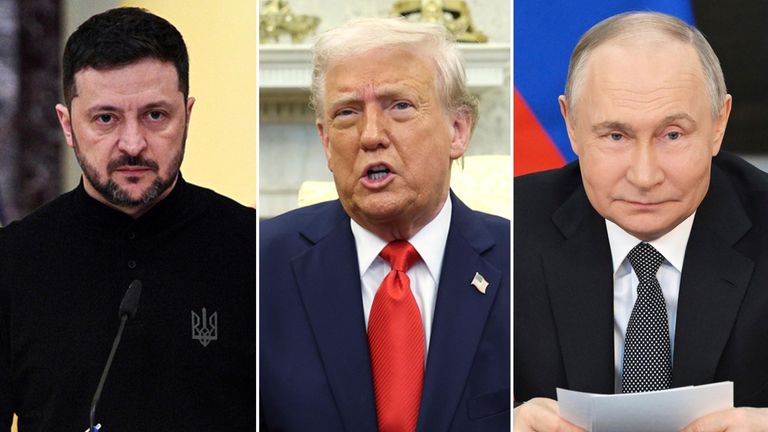
From left: Volodymr Zelenskyy, Donald Trump and Vladimir Putin. Pics: AP
UK hosts Ukrainian officials ahead of summit
British Foreign Secretary David Lammy had earlier hosted a meeting of top Ukrainian officials and European national security advisers alongside US vice-president JD Vance on Saturday ahead of the Trump-Putin meeting.
The meeting took place at the foreign secretary’s official country retreat, Chevening, in Kent, where Mr Vance is staying at the start of a UK holiday.
After the meeting, Mr Lammy said: “The UK’s support for Ukraine remains ironclad as we continue working towards a just and lasting peace.”
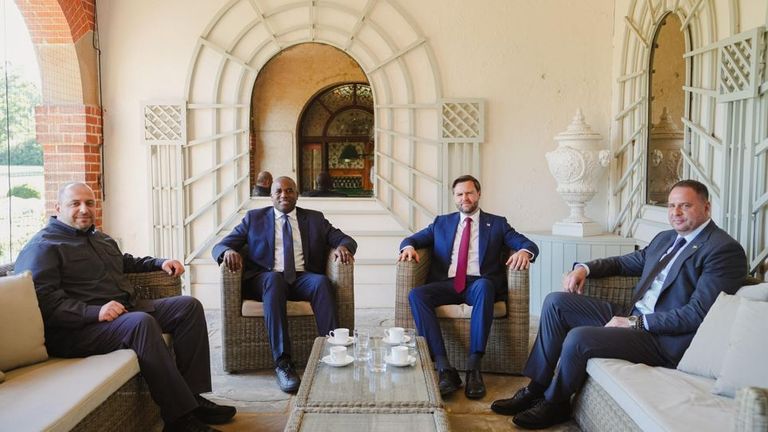
From left: Rustem Umerov, David Lammy, JD Vance and Andriy Yermak. Pic: X/David Lammy
It is understood that the meeting had been called at Washington’s request, and included representatives from the US, Ukraine, France, Germany, Italy, Finland and Poland as well as the UK.
Ukraine was represented by Rustem Umerov, secretary of the country’s national security and defence council, and the head of Mr Zelensky’s office, Andriy Yermak.
In a post on social media, Mr Yermak said the allies’ positions were “clear” that “a reliable, lasting peace is only possible with Ukraine at the negotiating table, with full respect for our sovereignty and without recognising the occupation”.
Ahead of the meeting at Chevening, Sir Keir discussed the talks in a call with Mr Zelenskyy on Saturday and also spoke to French President Emmanuel Macron.
A Downing Street spokeswoman said Sir Keir and Mr Macron “discussed the latest developments in Ukraine, reiterating their unwavering support for President Zelenskyy and to securing a just and lasting peace for the Ukrainian people”.
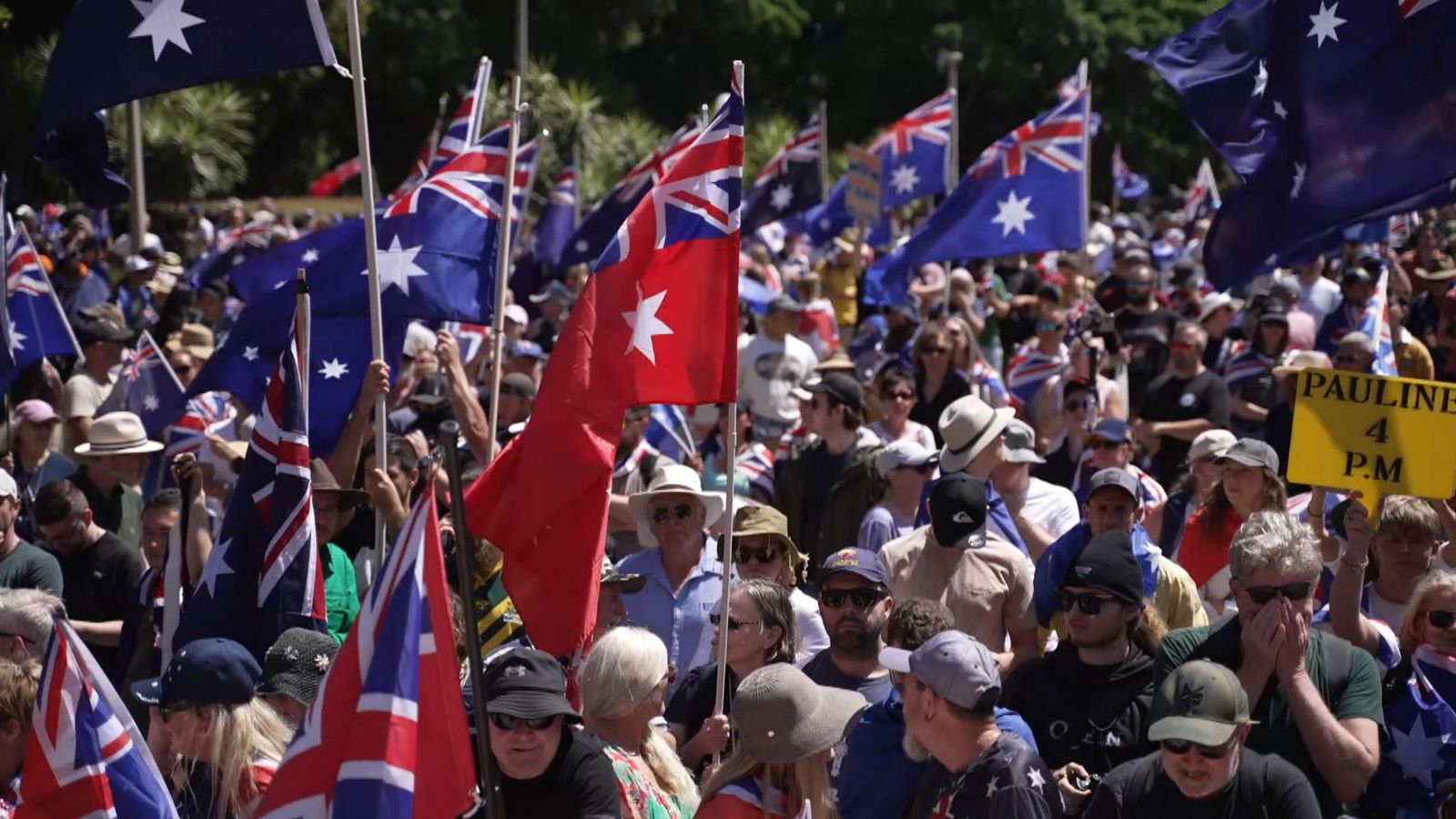

As Australia slides into its summer, it is leaving behind months marked by nationwide protests on one major issue – migration.
In August, around 50,000 people demonstrated in towns and cities across the country. There were clashes at separate rallies between far-right and far-left protesters in Melbourne.
In October, there were more protests. This time police accused the far-left of attacking officers and trying to confront right-wing protesters.
Tension on both sides is running high.
Fran Grant, right
Sydney protester Fran Grant has attended all the rallies.
“I love Australia and I’m not happy with what’s happening now,” she explained.
“It looks like the Labour government are continuing to bring in immigrants. I have no problem with that if we have the infrastructure to support it, but we don’t.”
Migration levels now falling
During the COVID crisis, Australia introduced strict border closures and migration plummeted.
Then in the years following the pandemic, there was a migration boom. A total of 1.4 million people entered Australia.
These were huge numbers. However, the Australian Bureau of Statistics shows net overseas migration has since fallen by almost 40% since its post-COVID peak.
But many Australians still believe the numbers are still too high.
‘We can’t keep going like this’
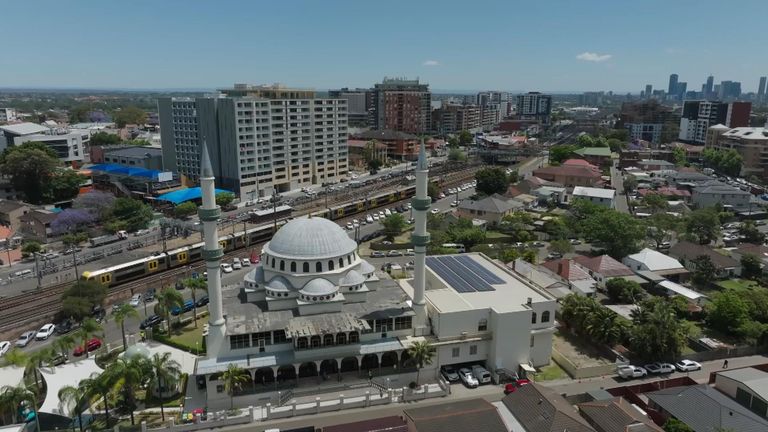
Auburn, Sydney
Australia’s multicultural heart is in suburbs like Auburn in Sydney, where almost 80% of families use a language other than English at home.
Steve Christou is a Cumberland City councillor and the son of Greek-Cypriot migrants.
“All we’re saying is put a stop to excess immigration until the country’s infrastructure can keep up,” he said. “We can’t keep going like this.”
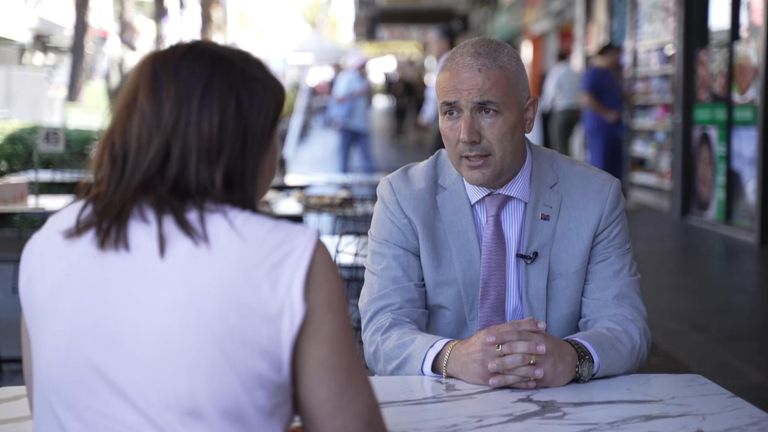
Steve Christou
He added: “We’re not blaming the migrants in the country, let’s be very clear about that. The government is being blamed for letting in 1.4 million migrants in the last three years to the point where the country can’t cope.”
Mr Christou spoke to protesters at the rally in October. There were families, students and seniors in the crowd, flying Australian flags and singing Australian songs.
Critics have called these protests racist, inflammatory and dangerous, but many people attending said they were there to show their pride for Australia and its way of life.
Others were demonstrating against the country’s housing shortage and increasing cost of living.
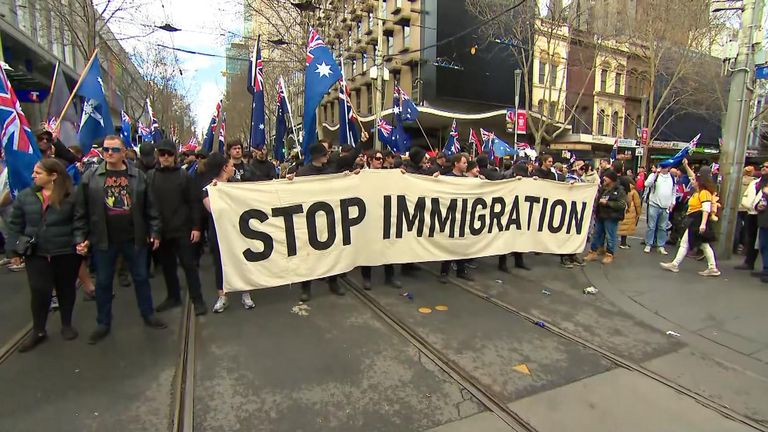
Neo-Nazi Melbourne march
Australia’s neo-Nazis emboldened
In August, dozens of Australia’s neo-Nazis also attended the Melbourne and Sydney protests and addressed the crowds.
In Melbourne, migration demonstrations and counter-protests turned violent. Neo-Nazis allegedly attacked an indigenous camp in the city.
Speaking at an anti-racism rally in Sydney, deputy leader of the Australian Greens, Mehreen Faruqi, told Sky News: “The far-right are emboldened in a way that I have never seen before.”
Senator Faruqi was born in Pakistan but has lived in Australia for more than 30 years.

Mehreen Faruqi
“They [far-right] are coming out on the streets, they have signs and slogans and chants that are white supremacists, white nationalists, and of course, this is happening across the world.”
Terrorism and far-right expert, Dr Josh Roose, from Deakin University in Melbourne, said: “We know that the Nazis see this as their time to capitalise.
“They’re not only attending these rallies, but they’re seeking to position themselves at the front, to mobilise people and shape the public conversation by normalising extreme ideas.”
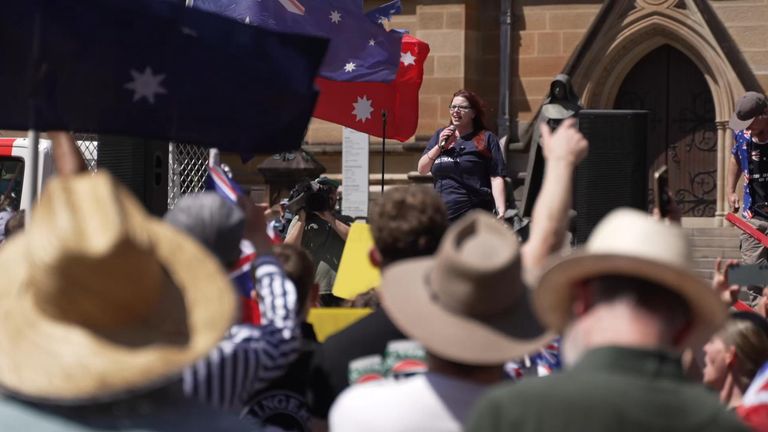
Bec ‘Freedom’
At the “March for Australia” rally in October, organiser Bec “Freedom” told Sky News that the neo-Nazis are “proud Australians .. standing up for our country against mass immigration. So long as they’re not violent, they’re welcome here.
“While they’re at my event, they’ve been told to keep it respectful. No hate speech, no violence, no Hitler talk,” she said.
Read more from Sky News:
UK sanctions paramilitary commanders in Sudan over ‘mass killings’
Belgian PM ‘sceptical’ about Ukraine loan using Russian assets
Ms Freedom said she’s “definitely not” coordinating with the neo-Nazis, that she has spoken with them and “that’s as far as it goes”.
Asked if she was worried that the presence of the neo-Nazis at the August rally would give the March for Australia movement a bad name, she replied: “The thing is we’ve been abused, and name-called by the media for so long… If you want to call me a Nazi, then fine, call me a Nazi.”
Other demonstrators said they wanted nothing to do with the neo-Nazis and had no time for the group and its messages.
On 8 November, more than 60 neo-Nazis gathered on the steps of the New South Wales state parliament, holding a banner reading “Abolish the Jewish Lobby”.
The brazen stunt shocked the public and was widely condemned by the state government.
The government is now strengthening laws against public displays of neo-Nazi ideology.
A bill to ban the burqa
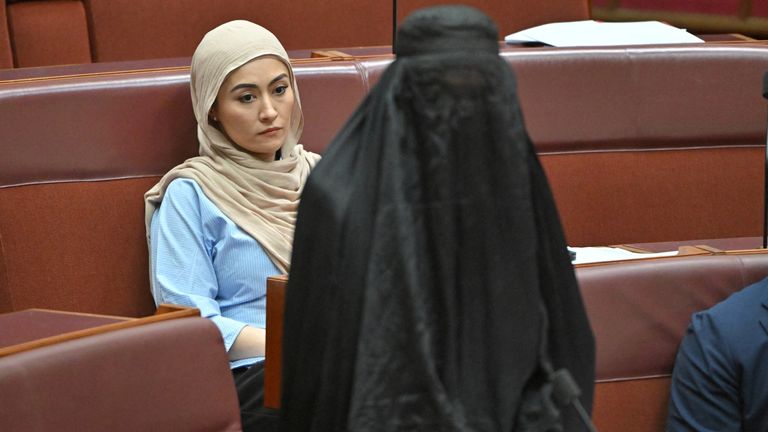
One Nation leader Pauline Hanson wears a burqa in the Senate chamber. Pic: AAP/Reuters
There’s been political controversy too.
In November, Australian senator and leader of the far-right One Nation party, Pauline Hanson, created a political storm when she wore a burqa (a full-face Islamic covering) inside federal parliament.
Ms Hanson is calling for the burqa to be banned in public places. Her party is rising in the polls and drawing disaffected Coalition (or Conservative) voters to its ranks.
At home with Fran Grant and her reptiles
Ms Grant’s home is where she can really express her pride in Australia.
She has an Australian flag flying out the front, an Australian-map-shaped coffee, and a collection of native goannas and snakes.
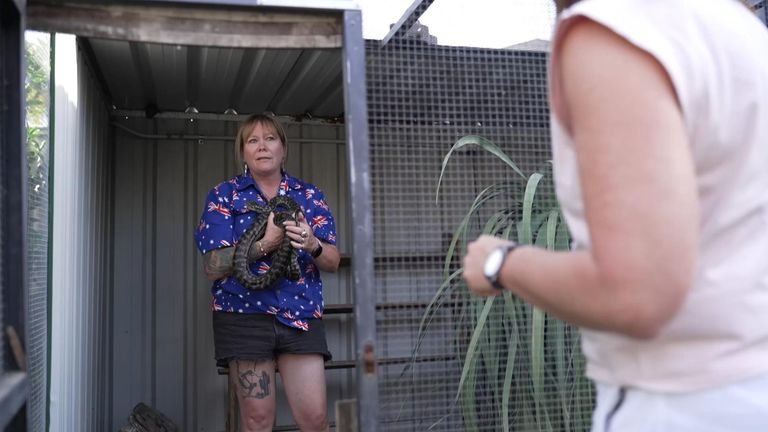
Ms Grant with snake
Ms Grant said being born in Australia, she’s won the “lottery of life” but believes there are too many “economic migrants” coming in.
“I’m very happy for people to come here. My mum was a 10-pound pom (British migrant),” she explained.
“At the moment where the cost of living and housing is so high, instead of just saying ‘racism, racism’ let’s look at what’s best for people who live here now.”
World
Belgian prime minister tells Sky News he is ‘sceptical’ about Ukraine loan using Russian assets
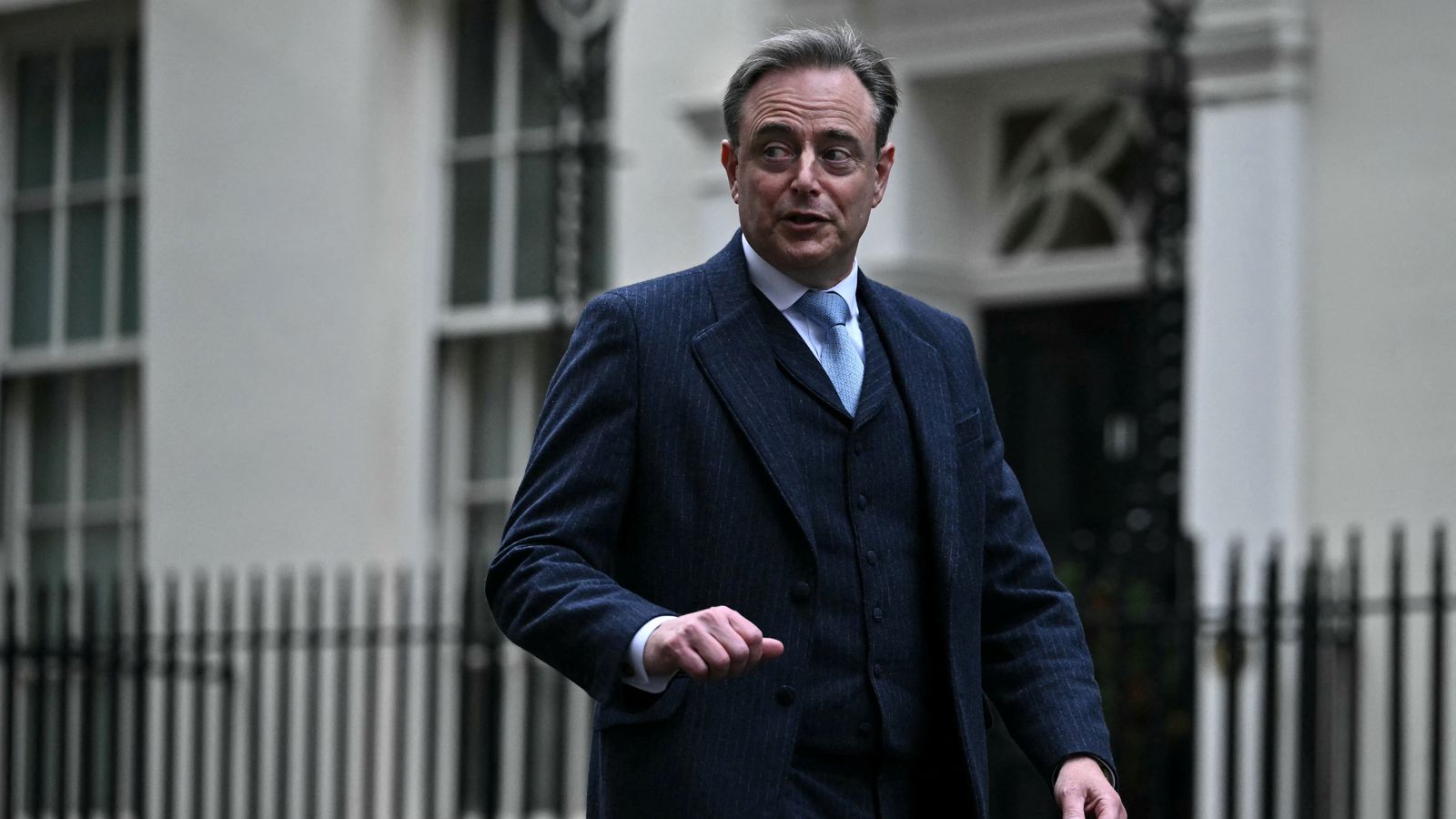
The Belgian prime minister said he is “sceptical” about giving Ukraine a loan using frozen Russian assets, and tells Sky News that it would need to be done with European partners.
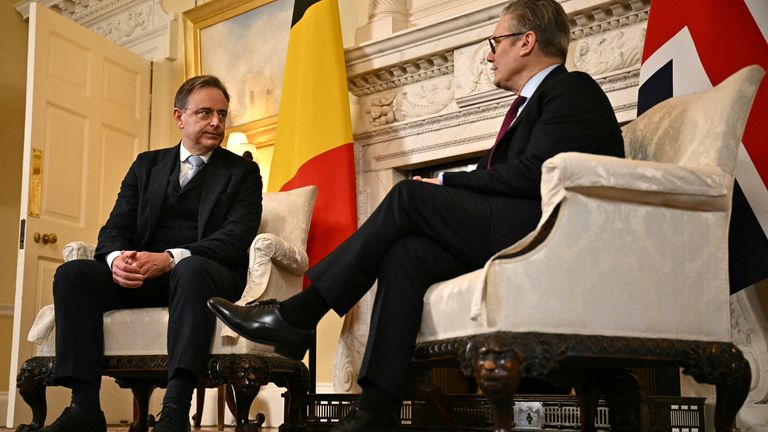
Bart De Wever met Sir Keir Starmer at Downing Street on Friday for talks on using frozen Russian assets, the majority of which are held in Belgium, to fund Ukraine.
European Council president Antonio Costa said this week that members were close to greenlighting the proposal, but the Belgian prime minister has not ruled out taking legal action against the EU if the bloc decides to confiscate the assets.
Asked by Sky News’ people and politics correspondent Nick Martin if Belgium holds the key to Ukraine’s future defence, Mr De Wever said “that’s a bit of a cynical question”.
“I don’t think we hold the key, but we do hold a lot of Russian assets,” he said. “Will we do it with a European solution or with the reparation loan? I’m sceptical about a loan. I’m not going to lie.
“That’s because I’m heavily exposed to the liabilities of such an operation. But I’m a loyal European. I’m loyally pro Ukraine.”
‘I’m not the only one who holds immobilised assets, there are other countries’. Pic: Reuters
The Belgian prime minister then said “if you want to go through with this, we could,” but said there would need to be “the mutualisation of the risk of it being a liquidity safety net”.
“The idea that we do this all together,” he said. “But I’m not the only one who holds immobilised assets, there are other countries like the UK, like France.
“If you go together, then you’re under a big umbrella and you’re not the only one that is exposed to all the risks.”
Russian assets worth €190bn are held in Belgium, De Wever said outside Number 10, compared with €8bn worth in the UK.
When asked if he received assurances on shared liability from Sir Keir, Mr De Wever added: “I’m not sure that I’m at liberty to say what the Prime Minister has told me… but it was a constructive meeting”.

Pics: Reuters
‘It’s something historic’
Mr De Wever also said that the meeting was timely and noted “I’ve even been described as a Russian asset” for his stance on the proposal.
“It worries me a lot, of course. The exposure risk is huge. €190bn plus damages, and litigation that could go on, go on for two decades.
“It’s a tall order, because until two months ago, we considered this to be an operation that we would never do… It’s not a detail. It’s something historic.
“So to get that all in the right wording, with the right reassurances, it’s quite something.”
A Downing Street spokesperson said in a statement that Mr De Wever and Sir Keir “discussed ongoing work, together with European partners, on addressing Ukraine’s financial needs, including through the use of the value of immobilised Russian Sovereign Assets”.
“They agreed to continue to work together closely to make progress on this complex issue,” they added.
Read more from Sky News:
Everyone in new Epstein photos identified
UK ‘rapidly developing’ plans to prepare for war
EU indefinitely freezes assets
It comes as Russia’s central bank said on Friday that the plan was “illegal” and that it reserved the right to take any means necessary to protect its interests.
Meanwhile, the EU has indefinitely frozen Russia’s assets in Europe using a special procedure meant for economic emergencies to prevent the billions of euros from being used to support Ukraine.
Hungarian prime minister Viktor Orban – who has friendly relations with Russian President Vladimir Putin – accused the European Commission, which prepared the decision, “of systematically raping European law.”
“It is doing this in order to continue the war in Ukraine, a war that clearly isn’t winnable,” he added on social media.
Slovakian prime minister Robert Fico has also said that he would refuse to support any move that “would include covering Ukraine’s military expenses for the coming years”.
Michael Clarke answers your Ukraine questions
Zelenskyy to visit Ukraine, Sky News learns
It comes as Sky News learnt from a source that Ukrainian President Volodymyr Zelenskyy is planning to visit Berlin on Monday.
He is set to meet German chancellor Friedrich Merz and also speak with representatives of Britain and France, it’s understood.
It also comes as Ukraine’s deputy energy minister said that Russia has launched 1,800 missiles, 50,000 drones and attacked energy facilities 4,500 times since the start of the year.
Roman Andarak told a briefing: “There are no examples in recent history of an energy system existing under such conditions – such large-scale, targeted terror.
“Unfortunately, this terror is intensifying every day.”
An oil tanker seized by the US off the Venezuelan coast on Wednesday spent years trying to sail the seas unnoticed.
Changing names, switching flags, and vanishing from tracking systems.
That all came to an end this week, when American coast guard teams descending from helicopters with guns drawn stormed the ship, named Skipper.
A US official said the helicopters that took the teams to the tanker came from the aircraft carrier USS Gerald R Ford.
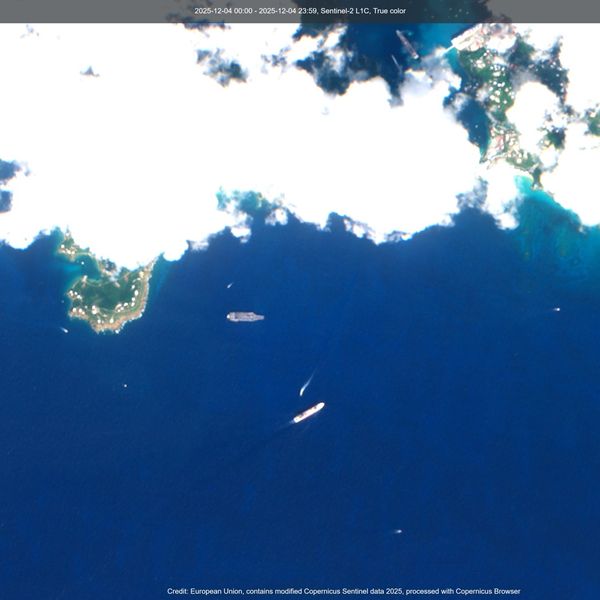
The USS Gerald R Ford (in grey) off the US Virgin Islands on 4 December. Source: Copernicus
The sanctioned tanker
Over the past two years, Skipper has been tracked to countries under US sanctions including Iran.
TankerTrackers.com, which monitors crude oil shipments, estimates Skipper has transported nearly 13 million barrels of Iranian and Venezuelan oil since 2021.
And in 2022, the US Treasury Office of Foreign Assets Control (OFAC) placed Skipper, then known as Adisa, on its sanctions list.
But that did not stop the ship’s activities.
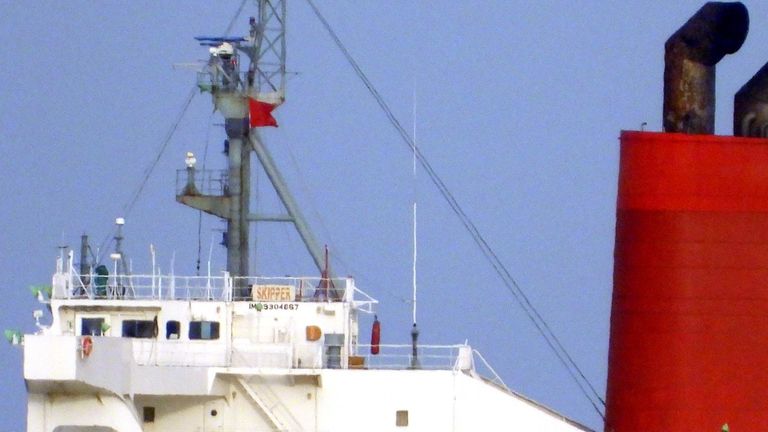
Skipper pictured from the Venezuelan shore. Source: TankerTrackers.com
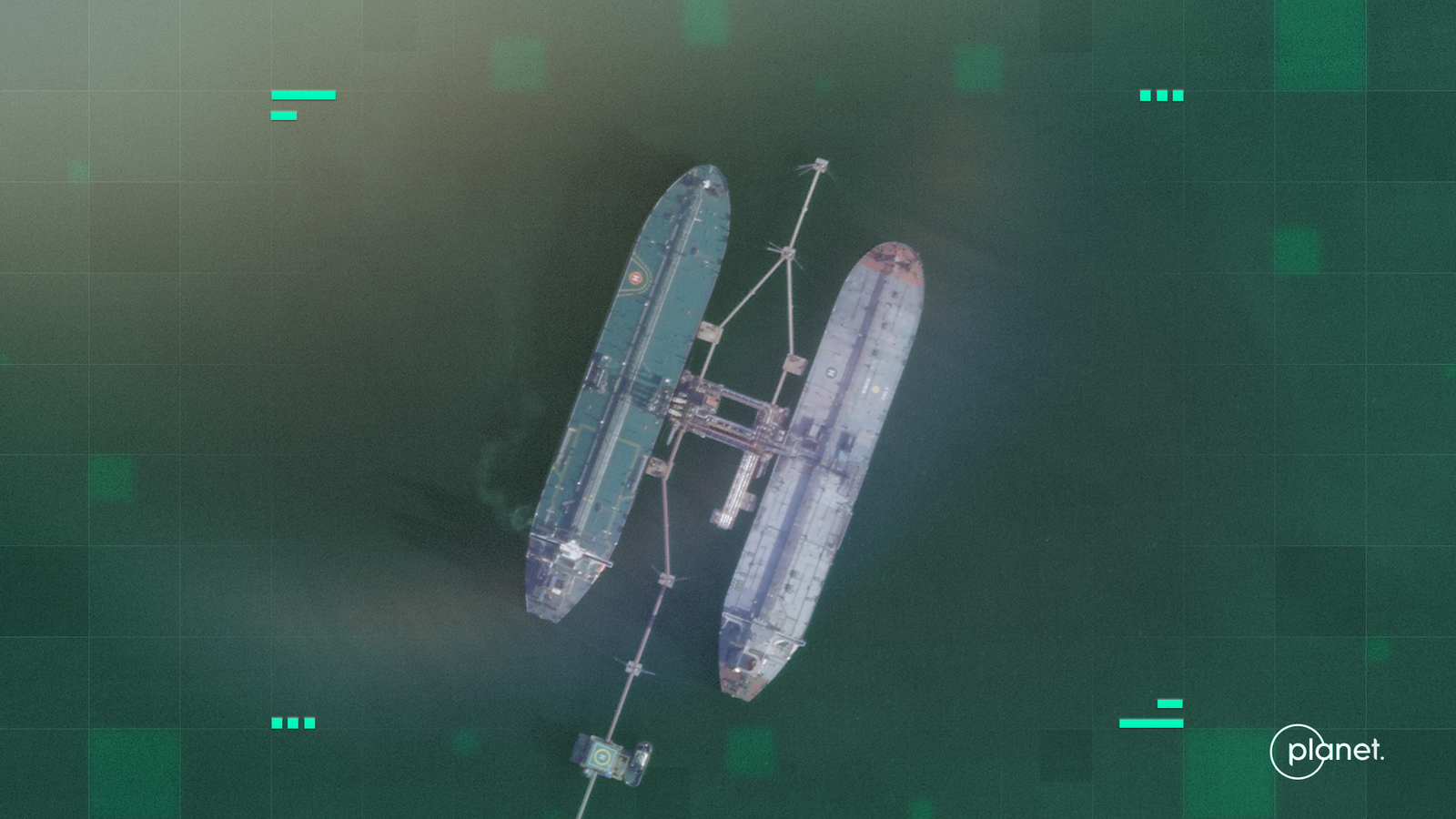
In mid-November 2025, it was pictured at the Jose Oil Export Terminal in Venezuela, where it was loaded with more than one million barrels of crude oil.

Skipper (R) loads up with crude oil at the Jose Oil Export Terminal in Venezuela. Source: Planet
It left Jose Oil Export Terminal between 4 and 5 December, according to TankerTrackers.com.
And on 6 or 7 December, Skipper did a ship-to-ship transfer with another tanker in the Caribbean, the Neptune 6.
Ship-to-ship transfers allow sanctioned vessels to obscure where oil shipments have come from.
The transfer with Neptune 6 took place while Skipper’s tracking system, known as AIS, was turned off.
Read more:
Everything we know about dramatic ship seizure
Is this what the beginning of a war looks like?
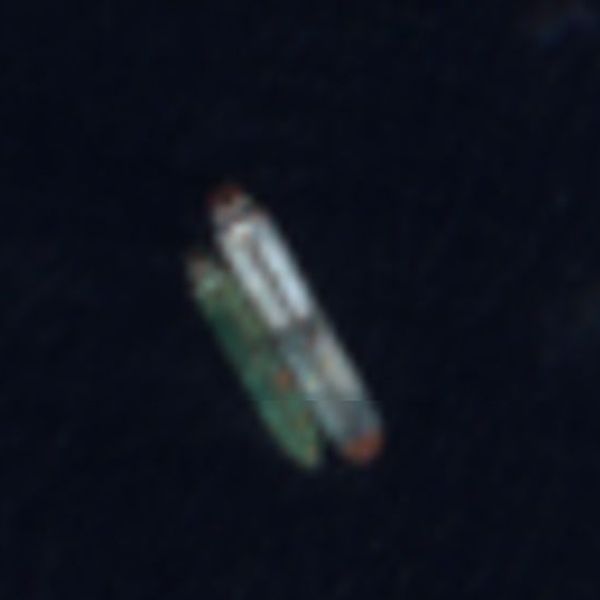
Skipper (R) and Neptune 6 in the Caribbean Sea during an AIS gap. Source: European Union Copernicus Sentinel and Kpler
Dimitris Ampatzidis, senior risk and compliance manager at Kpler, told Sky News: “Vessels, when they are trying to hide the origin of the cargo or a port call or any operation that they are taking, they can just switch off the AIS.”
Matt Smith, head analyst US at Kpler, said they believe the ship’s destination was Cuba.
Around five days after leaving the Venezuelan port, it was seized around 70 miles off the coast.
Moving in the shadows
Skipper has tried to go unnoticed by using a method called ‘spoofing’.
This is where a ship transmits a false location to hide its real movements.
“When we’re talking about spoofing, we’re talking about when the vessel manipulates the AIS data in order to present that she’s in a specific region,” Mr Ampatzidis explained.
“So you declare false AIS data and everyone else in the region, they are not aware about your real location, they are only aware of the false location that you are transmitted.”
When it was intercepted by the US, it was sharing a different location more than 400 miles away from its actual position.
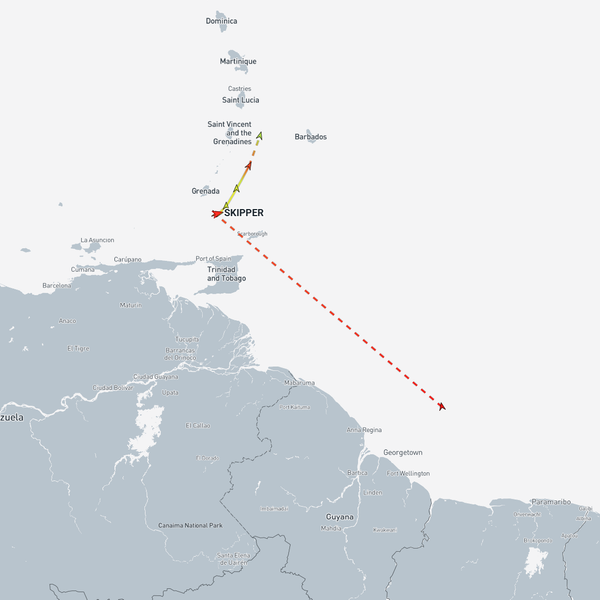
The distance between Skipper’s spoofed position on AIS (towards the bottom right hand corner) and its real position when seized by the US. Source: MarineTraffic
Skipper was manipulating its tracking signals to falsely place itself in Guyanese waters and fraudulently flying the flag of Guyana.
“We have really real concerns about the spoofing events,” Mr Ampatzidis told Sky News.
“It’s about the safety on the seas. As a shipping industry, we have inserted the AIS data, the AIS technology, this GPS tracking technology, more than a decade back, in order to ensure that vessels and crew on board on these vessels are safe when they’re travelling.”
Dozens of sanctioned tankers ‘operating off Venezuela’
Skipper is not the only sanctioned ship off the coast of Venezuela.
According to analysis by Windward, 30 sanctioned tankers were operating in Venezuelan ports and waters as of 11 December.
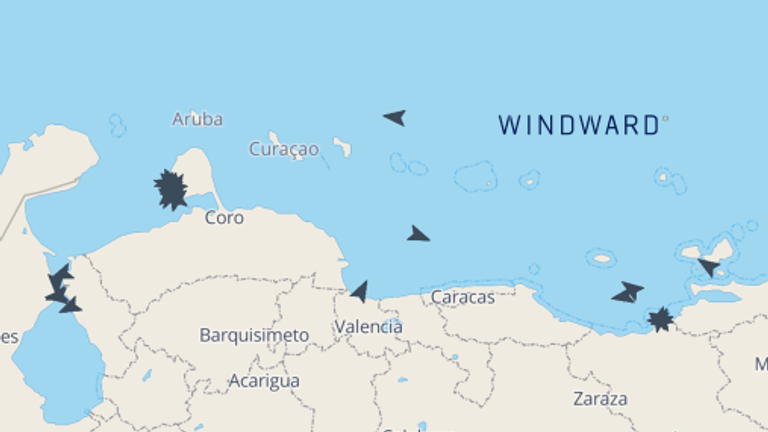
About 30 sanctioned tankers are currently operating in Venezuelan waters. Source: Windward Maritime AI Platform
The tanker seizure is a highly unusual move from the US government and is part of the Trump administration’s increasing pressure on Venezuelan President Nicolas Maduro.
In recent months, the largest US military presence in the region in decades has built up, and a series of deadly strikes has been launched on alleged drug-smuggling boats in the Caribbean Sea and eastern Pacific Ocean.
In the past, Mr Ampatzidis explained, actions like sanctions have had a limited effect on illegally operating tankers.
But the seizure of Skipper will send a signal to other dark fleet ships.
“From today, they will know that if they are doing spoofing, if they are doing dark activities in closer regions of the US, they will be in the spotlight and they will be the key targets from the US Navy.”
The Data X Forensics team is a multi-skilled unit dedicated to providing transparent journalism from Sky News. We gather, analyse and visualise data to tell data-driven stories. We combine traditional reporting skills with advanced analysis of satellite images, social media and other open source information. Through multimedia storytelling we aim to better explain the world while also showing how our journalism is done.
-
 Sports2 years ago
Story injured on diving stop, exits Red Sox game
-
 Sports3 years ago
‘Storybook stuff’: Inside the night Bryce Harper sent the Phillies to the World Series
-
 Sports2 years ago
Game 1 of WS least-watched in recorded history
-
 Sports3 years ago
Button battles heat exhaustion in NASCAR debut
-
 Sports3 years ago
MLB Rank 2023: Ranking baseball’s top 100 players
-
Sports4 years ago
Team Europe easily wins 4th straight Laver Cup
-
 Environment3 years ago
Japan and South Korea have a lot at stake in a free and open South China Sea
-
 Environment1 year ago
Here are the best electric bikes you can buy at every price level in October 2024