

Tesla influencers tried Elon Musk’s coast-to-coast self-driving, crashed before 60 miles


A duo of Tesla shareholder-influencers tried to complete Elon Musk’s coast-to-coast self-driving ride that he claimed Tesla would be able to do in 2017 and they crashed before making it about 60 miles.
In 2016, Elon Musk infamously said that Tesla would complete a fully self-driving coast-to-coast drive between Los Angeles and New York by the end of 2017.
The idea was to livestream or film a full unedited drive coast-to-coast with the vehicle driving itself at all times.
We are in 2025 and Tesla never made that drive.
Despite the many missed autonomous driving goals, many Tesla shareholders believe that the company is on the verge of delivering unsupervised self-driving following the rollout of its ‘Robotaxi’ fleet in Austin, which requires supervision from Tesla employees inside the vehicles, and improvements to its “Full Self-Driving” (FSD) systems inside consumer vehicles, which is still only a level 2 driver assist system that requires driver attention at all times as per Tesla.
Two of these Tesla shareholders and online influencers attempted to undertake a coast-to-coast drive between San Diego, CA, and Jacksonville, FL, in a Tesla Model Y equipped with the latest FSD software update.
They didn’t make it out of California without crashing into easily avoidable road debris that badly damaged the Tesla Model Y:
In the video, you can see that the driver doesn’t have his hands on the steering wheel. The passenger spots the debris way ahead of time. There was plenty of time to react, but the driver didn’t get his hands on the steering wheel until the last second.
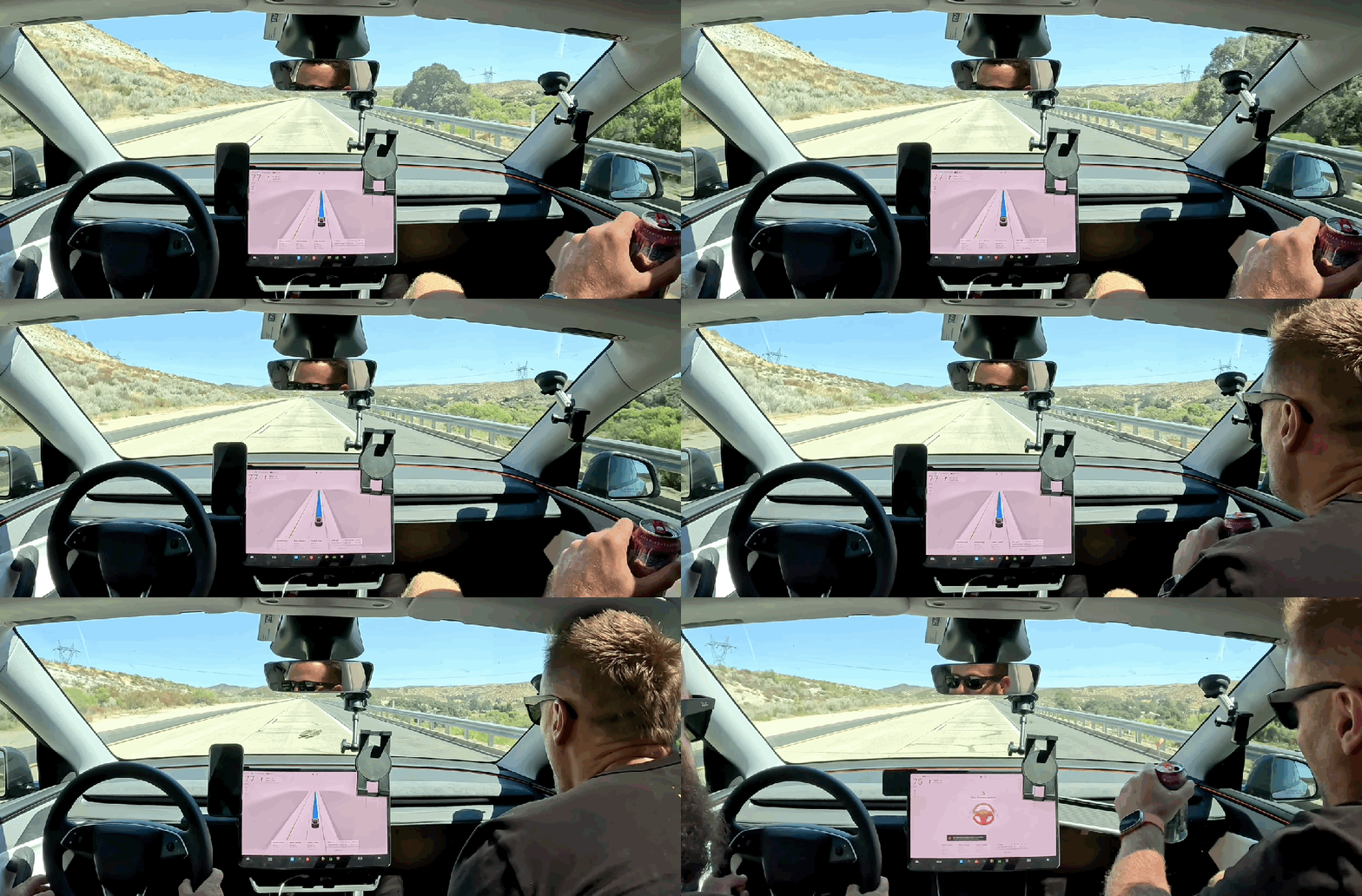
In a follow-up video, the two Tesla influencers confirmed that the Model Y had a broken sway bar bracket and damaged suspension components. The vehicle is also throwing out a lot of warnings.
They made it about 2.5% of the planned trip on Tesla FSD v13.9 before crashing the vehicle.
Electrek’s Take
Tesla shareholders used to discuss this somewhat rationally back in the day, but now that Tesla’s EV business is in decline and the stock price depends entirely on the self-driving and robot promises, they no longer do.
I recall when Musk himself used to say that when you reach 99% self-driving, it is when the “march of the 9s” begins, and you must achieve 99.999999999% autonomy to have a truly useful self-driving system. He admitted that this is the most challenging part as the real-world is unpredictable and hard to simulate – throwing a lot of challenging scenario at you, such as debris on the road.
That’s where Tesla is right now. The hard part has just started. And there’s no telling how long it will take to get there. If someone is telling you that they know, they are lying. I don’t know. My best estimate is approximately 2-3 years and a new hardware suite.
However, competition, mainly Waymo, began its own “march of the 9s” about five years ago.
Tesla is still years behind, and something like this drive by these two Tesla influencers proves it.
I was actually in a similar accident in a Tesla Model 3 back in 2020. I rented a Model 3 on Turo for a trip to Las Vegas from Los Angeles.
I ended up driving over a blown-out truck tire in the middle of the road like this. I was Autopilot, but I don’t know if the car saw it. I definitely saw it, but it was a bit late as I was following a truck that just drove over it. I had probably less than 2 seconds to react. I applied the brakes, but my choices were driving into a ditch on the right or into a car in the left lane.
I managed to reduce the force of the impact with the braking, but the vehicle jumped a bit like in this video. There wasn’t really any damage to the front, but the bottom cover was flapping down. I taped it together at the next gas station and I was able to continue the trip without much issue.
However, after returning it to the Turo owner and having the suspension damage evaluated by Tesla, the repair job was estimated to be roughly $10,000. I wouldn’t be surprised if there’s a similar situation with this accident.


FTC: We use income earning auto affiliate links. More.



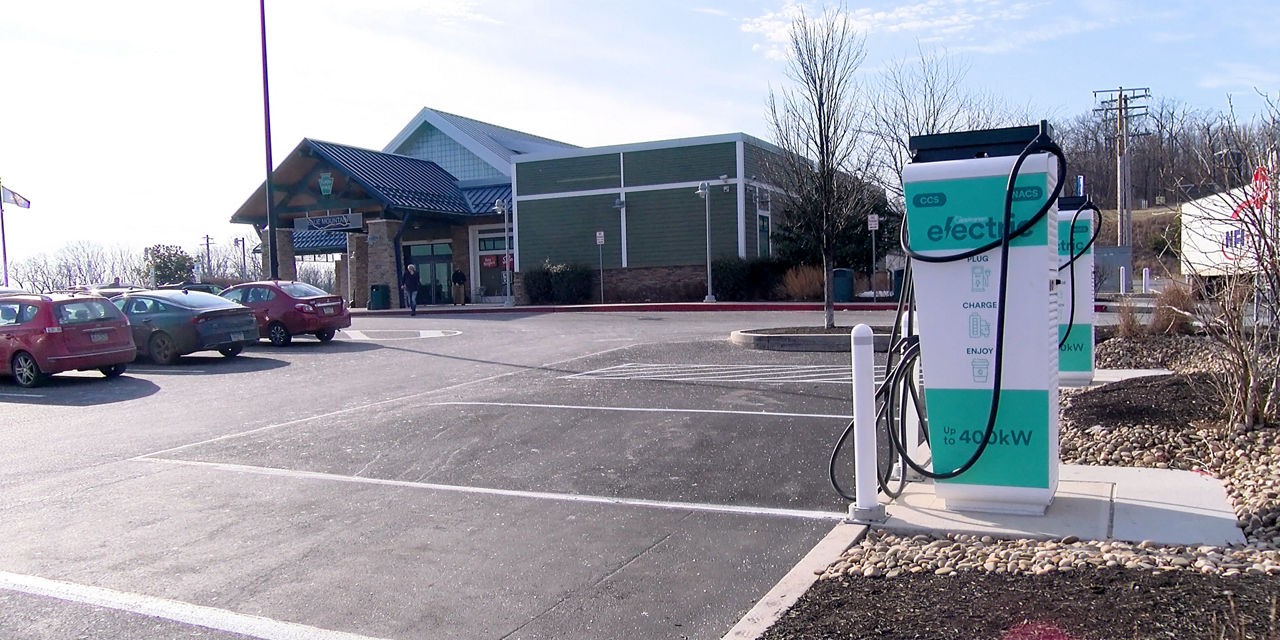
Pennsylvania just opened its first federally funded EV charging station on the Pennsylvania Turnpike — a key step toward making long-distance EV travel easier across the state.
The new station just opened at the Blue Mountain Service Plaza at Exit 202 westbound. Another NEVI-funded site at the New Stanton Service Plaza (Exit 77 westbound) is expected to open next week, according to the Pennsylvania Department of Transportation (PennDOT).
The chargers were built using funds from the federal National Electric Vehicle Infrastructure (NEVI) program, which is designed to install fast, reliable charging stations where drivers already stop — especially along busy highway corridors.
The Pennsylvania Turnpike is one of the state’s most heavily traveled roads, particularly during holiday travel, making service plazas a natural location for en-route EV charging. This first Turnpike site marks the beginning of NEVI-funded charging directly on the state’s toll road.
The Blue Mountain and New Stanton locations are part of the Turnpike’s larger, systemwide EV charging rollout. Working with Applegreen Electric, the Turnpike plans to install 80 new universal EV charging stations across all 17 service plazas by the end of 2027.
In addition to the NEVI-funded sites, the Turnpike has already brought new chargers online at the North Somerset, South Somerset, and Hickory Run service plazas using funding from Pennsylvania’s Driving PA Forward program. Each location offers high-speed charging with four ports per site, and all chargers are designed to work with all EV models without the need for adapters.
The project was awarded under the first round of PennDOT’s NEVI Alternative Fuel Corridor program. The next phase of funding, known as Corridor Connections, is focused on filling in charging gaps along major roadways that fall outside previously designated alternative fuel corridors. The goal is to make longer EV trips across Pennsylvania easier and more predictable.
The announcement also comes as Pennsylvania continues to push back against federal attempts to block EV funding. The US Department of Transportation is currently withholding congressionally approved money that would have supported EV infrastructure projects and jobs in the state. Governor Josh Shapiro (D-PA) sued the Trump administration over the move and, alongside 15 other states, successfully challenged an earlier attempt to derail the NEVI program. That legal fight helped keep projects like these Turnpike charging stations moving forward across the Commonwealth.
Electrek’s Take
This is precisely what the Biden administration’s NEVI program was meant to do: put fast, reliable charging stations where drivers already stop. Service plazas on major turnpikes are prime real estate for EV charging, particularly during holiday and long-distance travel. Pennsylvania’s rollout is still early days, but once chargers are live at all 17 plazas – assuming the federal funding spigot stays open – one of the Northeast’s busiest corridors is going to be a great place to road-trip in an EV.
Read more: PA Turnpike to add 80 new Applegreen DC fast chargers by 2027

FTC: We use income earning auto affiliate links. More.
![Kia's sporty new electric SUV spotted ahead of its big debut [Video]](https://i0.wp.com/electrek.co/wp-content/uploads/sites/3/2025/12/Kia-sporty-midsize-electric-SUV.jpeg?resize=1200,628&quality=82&strip=all&ssl=1)
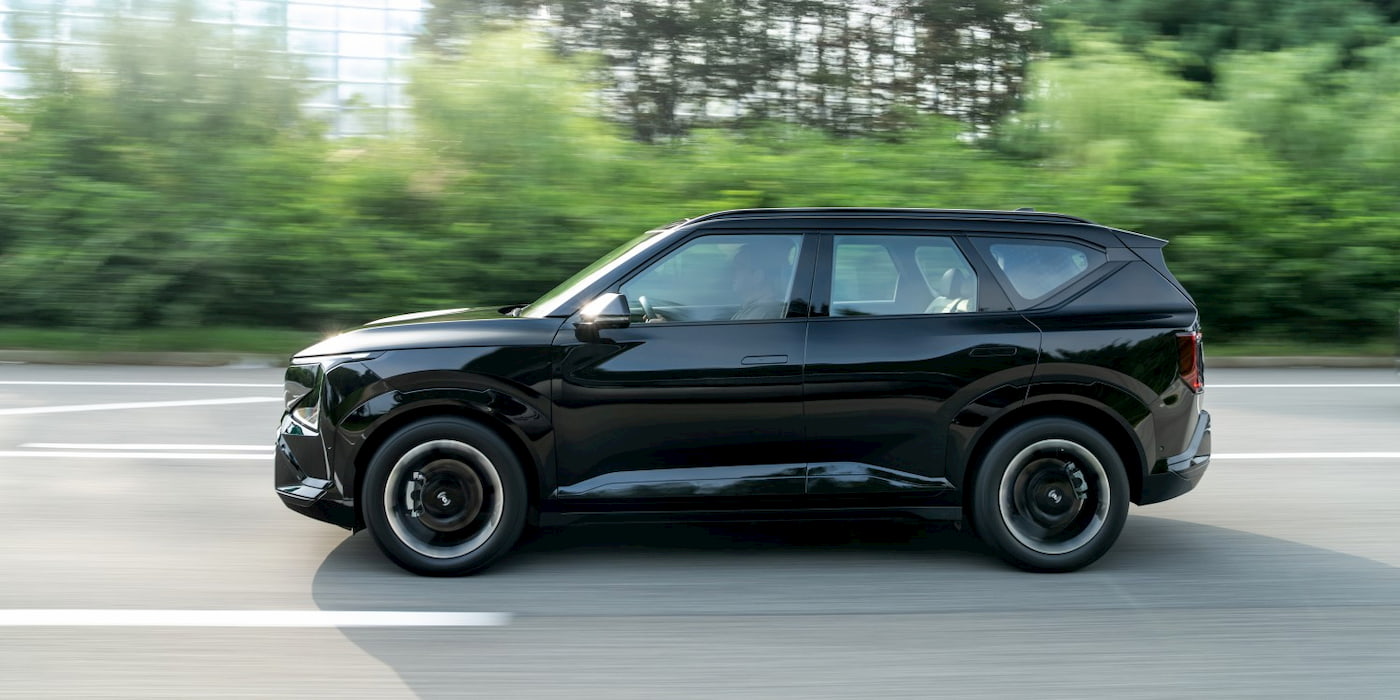
Kia is set to unveil several new electric GT models at the Brussels Motor Show, including the EV3, EV4, and EV5. With its debut less than a month away, Kia’s sporty midsize electric SUV was spotted on the road, offering our closest look at it yet.
The Kia EV5 GT will debut at the Brussels Motor Show
The EV5 is already a pretty sleek-looking SUV with a boxy, upright design like Kia’s three-row EV9, but in a smaller package.
At the Brussels Motor Show next month, Kia will unveil the EV5 GT, a sportier, more powerful version of the midsize electric SUV.
Kia has yet to say when or where it will launch, but like the standard model, the GT variant is expected to arrive in Europe, the UK, Korea, and Canada sometime in 2026. It will follow the EV6 GT and EV9 GT as Kia expands its performance EV lineup.
Although it was widely expected to share underpinnings with the new EV6 GT, that apparently won’t be the case.
According to Auto Express, the EV5 GT will instead be equipped with a separate dual-motor powertrain, packing 302 hp and 480 Nm of torque, good for a 0 to 62 mph time of 6.2 seconds.

Official range and other final specs will be revealed at the event, but the GT version will use the same 81.4 kWh battery as the standard EV5 Long Range model, which should provide a WLTP driving range of at least 300 miles.
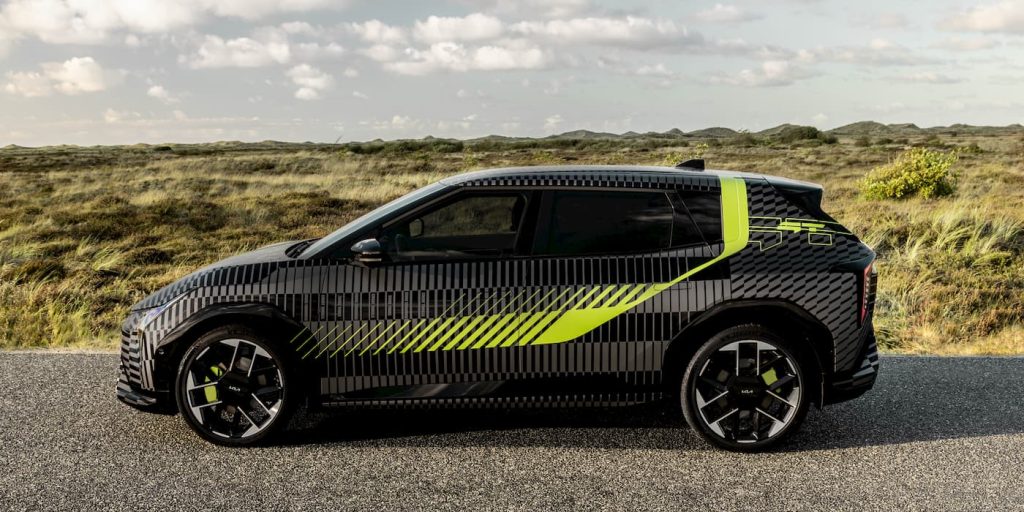
Kia said all future electric GT vehicles will wear its new “GT Wrap” featuring its signature neon green. The bold color has become a “symbol of electricity,” the company said. It will also be available in a matte Magma Red.
It’s about the size of Kia’s best-selling model, the Sportage, at 4,610 mm (181″) long, 1,875 mm (74″) wide, and 1,675 mm (66″) tall, with a wheelbase of 2,750 mm.
Thanks to its dedicated electric vehicle (E-GMP) platform, the EV5 offers noticeably more interior space with “best-in-class” interior rear legroom of 1,041 mm (41″). Kia also packed it with its latest software, features, and infotainment system.

The interior features nearly 30″ of screen space with Kia’s new connected car Navigation Cockpit (ccNC) infotainment system, including dual 12.3″ driver and navigation screens, plus a 5″ climate control display.
A video from our friends at Shortscar shows the EV5 GT driving in South Korea ahead of its upcoming debut. Although it’s still disguised, you can see the GT version has bigger wheels and updated front and rear bumpers.
The EV5 GT will debut at the Brussels Motor Show next month alongside the EV3 GT and EV4 GT. Kia will also unveil its new entry-level EV, the EV2. The event runs from January 9 through January 18, 2026. Hyundai is showcasing new EVs, including “its biggest EV” yet, which it previewed in a teaser image on Monday.
For those in the US, Kia is (sadly) not planning to launch the standard EV5 or GT version. After opening orders earlier this month, Kia said the midsize electric SUV would be exclusive to Canada in North America.
If you’re looking for a new EV, we can still help you find the right one. Kia is currently offering over $10,000 off every EV in its US lineup through its New Traditions sales event. You can use the links below to see what’s available in your area.
FTC: We use income earning auto affiliate links. More.
-
 Sports2 years ago
Story injured on diving stop, exits Red Sox game
-
 Sports3 years ago
‘Storybook stuff’: Inside the night Bryce Harper sent the Phillies to the World Series
-
 Sports2 years ago
Game 1 of WS least-watched in recorded history
-
 Sports3 years ago
Button battles heat exhaustion in NASCAR debut
-
 Sports3 years ago
MLB Rank 2023: Ranking baseball’s top 100 players
-
Sports4 years ago
Team Europe easily wins 4th straight Laver Cup
-
 Environment3 years ago
Japan and South Korea have a lot at stake in a free and open South China Sea
-
 Environment1 year ago
Here are the best electric bikes you can buy at every price level in October 2024